INTRODUCTION
This study reports variation in basic language comprehension and production as well as relations between comprehension and production in 101,250 children aged 2 ; 00 to 9 ; 11 from sixteen under-researched developing countries.
Child language comprehension and production
Child language study traditionally distinguishes between comprehension (broadly, understanding) and production (broadly, expression). Notably, relations between these two basic integral facets of language are still somewhat clouded. Comprehension and production feasibly relate to one another in two main ways. If comprehension and production are measured comparably in the same children, first, mean absolute levels of comprehension and production can be compared and, second, relative levels of individual variation between comprehension and production can be determined. It is important to understand both relations because, ultimately, comprehension and production need to be coordinated; without such coordination, “speakers would be unable to use language to communicate and to infer intentions” (Clark & Hecht, Reference Clark and Hecht1983: 326).
Two relations between comprehension and production: absolute and relative
In absolute terms, it is usually the case that comprehension precedes production developmentally and exceeds production substantively, pointing to a degree of independence in the two. Comprehension and production follow different timetables with respect to onset, milestone achievement, and trajectory and rate of development, for example (Bates, Reference Bates1993; Clark & Hecht, Reference Clark and Hecht1983; Fenson, Dale, Reznick, Bates, Thal & Pethick, Reference Fenson, Dale, Reznick, Bates, Thal and Pethick1994). Benedict (Reference Benedict1979) studied the first 50 words children comprehended and produced. Children first understood words at 0 ; 9 but first produced words at 1 ; 0, on average, and children reached a 50-word milestone in comprehension at around 1 ; 1, whereas they reached 50 words in production at around 1 ; 6. Bauer, Goldfield and Reznick (Reference Bauer, Goldfield and Reznick2002) identified distinct trajectories of expressive and receptive vocabulary from ages 0 ; 8, 0:9 or 0 ; 10 to 1 ; 2 and then to projected performance at 1 ; 9. Campbell, Macdonald and Dockrell (Reference Campbell, Macdonald, Dockrell, Lowenthal, Vandamme and Cordier1982) pointed to distinct lexical representations in the two domains in preschool-age children learning new words. In addition, children learning different languages almost invariably have larger concurrent receptive than productive vocabularies (Kern, Reference Kern2007; Zink & Lejaegere, Reference Zink and Lejaegere2002). Finally, comprehension does not always predict production (Bauer et al., Reference Bauer, Goldfield and Reznick2002). In these several respects, comprehension and production appear to be somewhat distinct aspects of language, and some authors have posited that comprehension and production are ‘dissociated’ psycholinguistic processes that draw on different skills and neurological bases (Bates, Reference Bates1993; Fenson et al., Reference Fenson, Dale, Reznick, Bates, Thal and Pethick1994; see also Dale & Goodman, Reference Dale, Goodman, Tomasello and Slobin2005).
In relative terms, however, empirical work shows that associations between comprehension and production vary from moderate to strong, depending on the ages of the children studied, evaluation procedures, and the like, and so the two are thought to be related. Thus, in different languages, young children who comprehend more words are also likely to produce more words (Bornstein & Haynes, Reference Bornstein and Haynes1998; Reznick & Goldfield, Reference Reznick and Goldfield1992). MCDI norming data for Dutch (N-CDI; Zink & Lejaegere, Reference Zink and Lejaegere2002) show correlations between (word) comprehension and (word) production based on 1,024 children 0 ; 8 to 1 ; 4 (r=0·62) and 958 children 1 ; 4 to 2 ; 6 (r=0·88). MCDI norming data for European French (Kern, Reference Kern2007), based on 548 children 0 ; 8 to 1 ; 4, show a slightly smaller, but still respectable, correlation between (word) comprehension and (word) production (r=0·45). Using the (UK version) CDI-WS, Tan and Schafer (Reference Tan and Schafer2005) asked parents of children between 1 ; 4 and 1 ; 8 to indicate which items their children produced and which items they understood but did not produce; the two were correlated (r=0·80). Predictively, Harris, Yeeles, Chasin and Oakley (Reference Harris, Yeeles, Chasin and Oakley1995) hypothesized that early comprehension should underpin later production, and contrary to studies cited earlier many reports document a predictive relation between early receptive and later expressive language in children with language skills ranging from delayed to typical (Lyytinen, Poikkeus, Laakso, Eklund & Lyytinen, Reference Lyytinen, Poikkeus, Laakso, Eklund and Lyytinen2001; Tamis-LeMonda, Bornstein, Kahana-Kalman, Baumwell & Cyphers, Reference Tamis-LeMonda, Bornstein, Kahana-Kalman, Baumwell and Cyphers1998; Zink & Lejaegere, Reference Zink and Lejaegere2002). Moreover, just as children overextend words in comprehension (Behrend, Reference Behrend1988), they overextend them in production (Clark, Reference Clark1993). In most respects, comprehension and production call on many of the same constituent skills (Harris et al., Reference Harris, Yeeles, Chasin and Oakley1995). These several kinds of associations and similarities between comprehension and production implicate their intimate connection.
The variation in comprehension–production relations could be accounted for by any of several reasons. Many studies compare comprehension and production among children who are very young (in infancy, both comprehension and production are immature and restricted in range, thereby attenuating potential correlation); other studies include older children in whom difficulties in assessing comprehension place a different kind of methodological limit on understanding putative comprehension–production relations. Small sample size (and therefore limited power to detect effects) is another factor determining significance in this literature. Much, too, depends on the ways in which comprehension and production are measured: observations, reports and testing child language can yield different measures and results (Bornstein & Haynes, Reference Bornstein and Haynes1998). In short, age of child, sampling, procedure and language index each may influence comprehension–production relations. Anyway, it is likely that dissociation is never complete and that dissociation and association positions converge and are not mutually exclusive (Reznick & Goldfield, Reference Reznick and Goldfield1992).
The present study aimed to learn more about absolute and relative relations between basic language comprehension and production by overcoming some prior limitations. For this purpose, comprehension and production data were collected from a substantial number of children over a wide age range using a common measure of child language assessment: parent report. The samples in this study differed widely, too, in terms of language (and cultural) backgrounds; therefore, results ought also to transcend local variation in norms and patterns of development. In addition, we studied comprehension and production in nations barely represented (if at all) in contemporary developmental and language research.
International developmental language science
There is a dearth of population-based multinational data on child language, especially from developing countries. Most contemporary research in child language is Western (European or North American) in origin. Less than 10% of the literature in developmental science generally emanates from regions of the world that account for more than 90% of the world's population (Arnett, Reference Arnett2008), and critics have long wisely rejected broad generalizations derived from contextually restricted findings (Bornstein, Reference Bornstein2010). As a corollary, the societies typically included in developmental research are usually sociodemographically and linguistically similar. Therefore, much less is currently known scientifically than is commonly acknowledged about child language generally or the majority of ecological contexts of child language development specifically. This sampling restriction is as limiting in terms of understanding idiosyncrasies of child language as it is generalizations and universals about it. Child language science can only benefit from an enlarged empirical representation of the world's children, and studies that use such a contextual lens promise deeper insights into how children comprehend and produce language (Bornstein, Reference Bornstein2010). This situation is especially true for developing countries, which are virtually unexplored in the extant child language literature and, if at all, usually contribute small samples from single locales.
The countries we report about here represent the majority developing world, contra the minority developed world (National Center for Children in Poverty, 1999; UNICEF, 2006), and vary widely in terms of language as well as history and ideology, social situations, and other factors. Notably, however, all are low in socioeconomic status, which is thought generally to influence (later) child language development (Hoff, Reference Hoff2006). The nature of the social interactions that expose children to language and the properties of language itself are shaped by larger social and cultural considerations. The amount of speech addressed to children, the richness of the vocabulary, the rate of question asking, and the length of utterances are positive environmental input predictors of child language development (Bauer et al., Reference Bauer, Goldfield and Reznick2002; Bornstein, Haynes & Painter, Reference Bornstein, Haynes and Painter1998; Hart & Risley, Reference Hart and Risley1995; Weizman & Snow, Reference Weizman and Snow2001). Beginning in the second year of life and continuing through the school years, children from lower socioeconomic strata tend to show slower rates of development than do children from higher socioeconomic strata (Dollaghan, Campbell, Paradise, Feldman, Janosky & Pitcairn, Reference Dollaghan, Campbell, Paradise, Feldman, Janosky and Pitcairn1999; Huttenlocher, Vasilyeva, Cymerman & Levine, Reference Huttenlocher, Vasilyeva, Cymerman and Levine2002; Rescorla & Alley, Reference Rescorla and Alley2001). Indeed, children from lower socioeconomic strata are over-represented in samples identified as having poor communication skills (Tomblin, Hardy & Hein, Reference Tomblin, Hardy and Hein1991).
This study
The complex relations between comprehension and production allow for both association and dissociation. In this study, variation and concurrent associations in comprehension and production were evaluated in more than 100,000 children aged 2 ; 00 to 9 ; 11 from sixteen under-researched developing countries learning more than a dozen languages (including, for example, Arabic, Ashante, Bengali, English, French, Macedonian, Sango, Serbian, Spanish, Thai and Uzbek) that are typologically and genetically varied (representing, for example, Indo-Aryan, Indo-European, Mongolic, Niger-Congo, Romance, Semitic, Slavic, Thai-Kadai and Turk). The wider range of nations included in this study opens inquiry into understudied contexts of child language acquisition. Multinational–linguistic developmental inquiry can contribute to identifying, distinguishing and understanding general as well as specific patterns of child language development (Bornstein, Reference Bornstein2010). Comprehension and production are normally studied in infancy and toddlerhood, yet both comprehension and production continue to develop at least until early adolescence (see, e.g., Wassenberg et al., Reference Wassenberg, Hurks, Hendriksen, Feron, Meijs, Vles and Jolles2008, for comprehension, and Berman, Reference Berman2004, for production). The wide age range included in this study opens inquiry into an understudied period of childhood as well.
METHOD
The MICS3
In collaboration with selected developing countries around the world, UNICEF (2006) developed the Multiple Indicator Cluster Survey (MICS), a household questionnaire designed to collect internationally comparable data to evaluate country-level progress in child development and family life (Bornstein, Britto, Nonoyama-Tarumi, Ota, Petrovic and Putnick, Reference Bornstein, Britto, Nonoyama-Tarumi, Ota, Petrovic and Putnick2012). The main purposes of the MICS are to support evidence-based policy formulation, assess trends, and identify and measure disparities in progress towards international goals, such as the Millennium Declaration and the Millennium Development Goals. The present report uses data from the third MICS (MICS3) conducted 2005–2007. The items used for this study came from an optional module of the Household Questionnaire in the MICS3 which asked mothers (or primary caregivers) about basic language skills in children aged 2 ; 00 to 9 ; 11. The respondent for each child answered No (=0) or Yes (=1) to the following two questions about the target child's basic language comprehension and production, respectively: “When you tell (name) to do something, does he/she seem to understand what you are saying?” and “Does (name) speak at all; can (he/she) make (him or herself) understood in words; can (name) say any recognizable words?” Other contemporarily prominent parent-questionnaire child-language measures, such as CDI: Words and Gestures, tap into associated processes by asking similar kinds of nominal questions (Fenson, Marchman, Thal, Dale, Reznick & Bates, Reference Fenson, Marchman, Thal, Dale, Reznick and Bates2007).
The Human Development Index
Child language comprehension and production data in the sixteen countries reported here are related to key country-level indicators from the Human Development Index (HDI; United Nations Development Programme, 2007). The HDI was developed by the United Nations as a measure of the social and economic status of a country as a preferred way to represent general standards of living. The HDI has three major indices: life expectancy (in years), education (adult literacy rate and the percentage of school-aged children enrolled in primary, secondary and tertiary school), and gross domestic product (GDP; in purchasing power parity [PPP] in US dollars). Each country's life expectancy, education and GDP were scaled from 0 to 1 (based on minimum and maximum values of 25–85 years for life expectancy; 0–100% for literacy and school enrollment; and $100–40,000 PPP for GDP) and then averaged to compute the country's HDI. The HDI offers a reasonable proxy for the level of support that is generally available for promoting human development in poor nations. As such, it likely connects to many aspects of the family and home environment with known relations to child development. The HDI provides a set of universally accepted standards for human development and represents a global shift in thinking about development from purely economic progress to human well-being (Mankiw, Romer & Weil, Reference Mankiw, Romer and Weil1992). The HDI is more about the population that resides in the country and less about country indicators per se. We therefore selected the HDI over other global social and economic national indices as a means of grouping countries in a meaningful way. Countries with an HDI of 0·80 or greater are considered high, 0·50 to 0·79 medium, and 0·00 to 0·49 low. MICS3 data generally draw from the high, medium and low regions of the HDI, and this tripartite division is used to organize countries. (The HDI was not available for Iraq because of missing GDP data; however, the life expectancy index and the education index were available.)
Analytic plan
First, we examined the whole sample of children aged 2 ; 0 to 9 ; 11. We computed, for the entire age range and by year, the means and standard deviations, by country, for the proportions of children reported as comprehending and producing. We then computed correlations between language comprehension and production by country. Because of the disparity in sample sizes, a mean weighted and normalized correlation coefficient was computed for the whole sample. The correlations to be combined were transformed into Fisher Z values, which are approximately normally distributed and are numbers on a ratio scale and can thus be directly compared. Z values were then weighted and subjected to a linear combination. The result is a weighted and normalized average correlation (Hedges & Olkin, Reference Hedges and Olkin1985). In describing effect sizes, we follow Cohen's (Reference Cohen1988: 223) terminology regarding coefficients: estimate of population correlation for a small effect size, r Φ≈0·10, medium effect size: r Φ≈0·30, and large effect size: r Φ≈0·50. The primary measures used in this study are dichotomous, and appropriate non-parametric analyses are used throughout. Given the wide age range it is possible that the correlations are larger than what might be expected for more age-restricted samples of younger children alone. Next, we examined linear or non-linear growth functions across age groups and, as a result, restricted the age range for a focus subsample to 2 ; 00 to 4 ; 11. Analyses of the focus sample were expanded to include potential covariates and a comparison of each country for each of the language measures to determine in which countries children performed better or worse than the overall effect of country.
WHOLE SAMPLE: 2 ; 00–9 ; 11
Participants
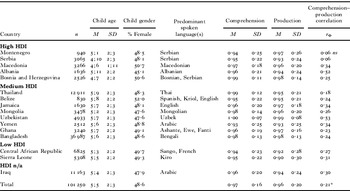
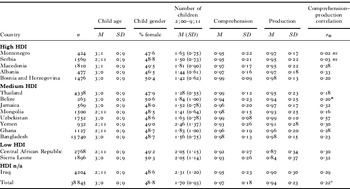
All sixteen developing nations provided data. If there was more than one child between the ages of 2 ; 00 and 9 ; 11 in a family, we randomly selected a target child in the household. Table 1 presents the countries, number of families providing data, average age of the selected child, and percentage of female children for the whole sample (ages 2 ; 00 to 9 ; 11). Also included is the predominant language(s) spoken in each country. Comprehension and production data are provided for 101,250 children of an average age of 5 ; 5 (SD=2 ; 3) with approximately equal numbers of girls and boys in each national sample. Ns vary slightly by analysis as data were not complete for all variables (less than 1% of data was missing for any measure).
Sociodemographic statistics, proportions of children comprehending and producing, and correlations between comprehension and production by country by HDI for whole sample (2 ; 00–9 ; 11)

notes: Unless otherwise noted, all phi correlations are p<0·001.
a Weighted and normalized average correlation.
Comprehension, production and their relations
Descriptive statistics and the mean proportions of children comprehending and producing language and the correlation between language comprehension and production by country are reported in Table 1. Mean proportions of children comprehending and producing were high. However, the mean levels for comprehension and production marginally differ. A MANOVA comparing mean comprehension and production showed (F(1,101189)=293·99, p<0·001, η2p=0·003), with the difference between estimated marginal means=0·008. Not unexpectedly, comprehension is reportedly higher than production. Zero-order phi (r Φ) correlations for the dichotomous measures of comprehension and production were uniformly positive, significant in all countries (except Montenegro), but varied from small to large. The weighted and normalized average correlation for the entire sample was positive, significant, and small to medium in size (r=0·21, standard error of the mean Z coefficient=0·003; 95% confidence interval=(0·202, 0·214)).
Comprehension and production by age
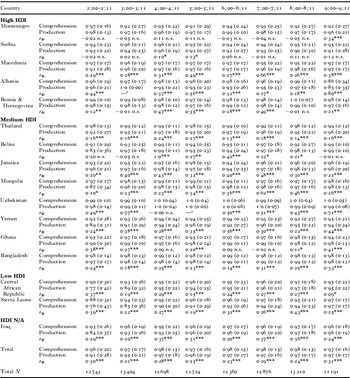
For each age for each country separately (Table 2), we computed mean proportions of children comprehending and producing and correlations between the two measures. The mean proportions of children comprehending and producing varied with age. Correlations between comprehension and production by age were uniformly positive, significant at all ages, and varied only slightly.
Proportions of children comprehending and producing and correlations between comprehension and production by age by country by HDI

notes: M (SD) Correlations reported are phi.
a No statistics are computed because at least one variable is a constant.
* p<0·05; ** p<0·01; *** p<0·001.
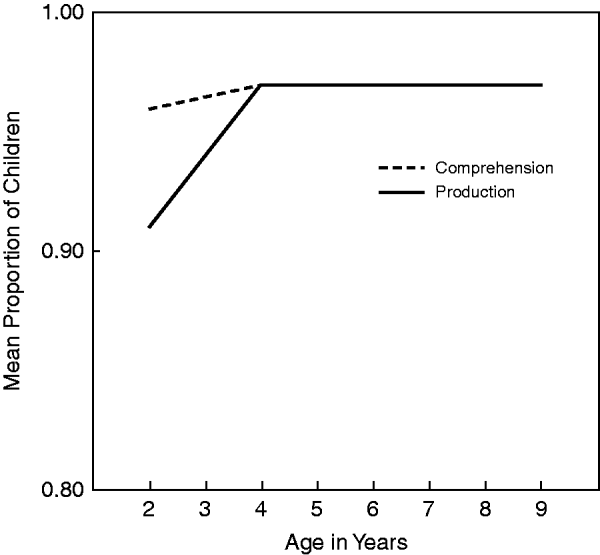
We plotted the mean proportions of children comprehending and producing by age to investigate the nature of their respective growth functions (Figure 1). Examination of the plots suggested linear relations from ages 2 ; 00 to 4 ; 11, after which trend lines appeared to reach an asymptote. We therefore performed a series of logistic spline regressions to identify non-linear relations. Spline regression is a method for fitting separate regression lines in segments of a sample (Marsh & Cormier, Reference Marsh and Cormier2001). The segments are defined by ‘knots’, the points on the independent variable (child age) where the regression line changes slope. Spline regression can be used to estimate the location of knots as well as test whether there is a significant change in slope before and after a knot. In this study, logistic spline regression was used to determine the point on the child age continuum where the slope changed (i.e. the location of a single knot in the regression line) and whether there was a significant difference in slopes when the distribution was segmented at the knot age. Start values for the intercept and slopes were set at 0, and the start value for the knot age was set at 4 ; 0 based on visual examination of the plots.
Mean proportions of children in sixteen developing countries who comprehend and produce basic language by age.
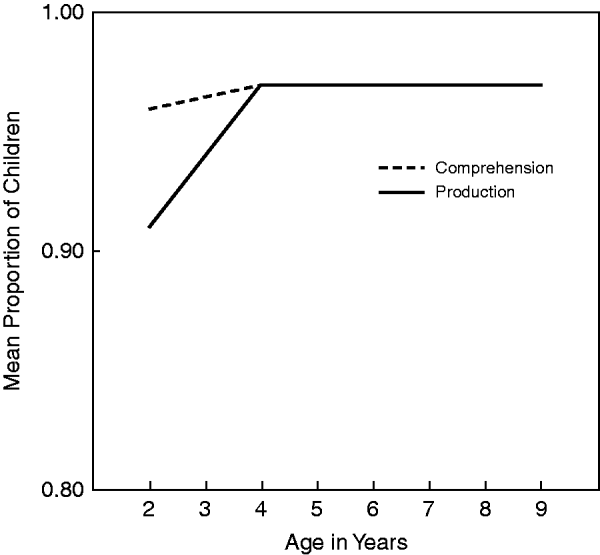
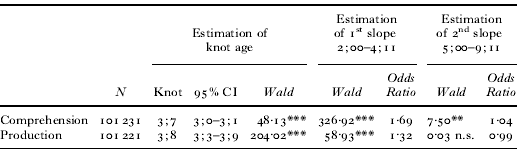
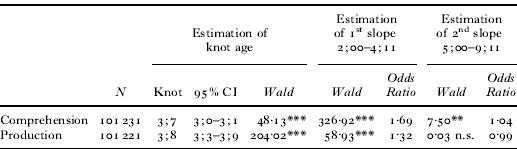
Table 3 presents the estimated knot age and 95% confidence intervals. Because child age was collected only in years, we rounded up to 4 ; 0 and tested whether the slope changed at age 4 ; 0. The results showed significant changes in the slopes of regression lines at 4 ; 0 for both comprehension and production. Furthermore, the estimation of the slopes from 2 ; 00 to 4 ; 11 was significant, with increasingly older children in that age range reporting higher mean proportions comprehending and producing language. The slope from 5 ; 00 to 9 ; 11 was not significant for production, and, although the Wald estimate was significant for comprehension, the odds ratio shows a negligible effect of child age.
Logistic spline regressions for language comprehension and production with child age
notes: ** p<0·01; *** p<0·001.
Based on these results, we restricted the range of the next analyses to a focus subsample of children aged 2 ; 00 to 4 ; 11. The analyses and tables that follow are based on this focus sample.
FOCUS SAMPLE: 2 ; 00–4 ; 11
Participants
All sixteen developing nations provided data. Table 4 presents the countries, number of families providing data, the average age of the selected child, the percentage who were female for the focus sample ages 2 ; 00 to 4 ; 11, and the average number of children aged 2 ; 00 to 9 ; 11 in the household. Also included are the mean proportions of children comprehending and producing language and the correlation between language comprehension and production by country. Comprehension and production data are provided for 38,845 children of an average age of 3 ; 0 (SD=0 ; 9) and for approximately equal numbers of girls and boys. Ns vary slightly by analysis as data were not complete for all variables (less than 1% of data was missing for any measure). We used pairwise deletion when computing the analyses.
Sociodemographic statistics, proportions of children comprehending and producing, and correlations between comprehension and production by country by HDI for the focus sample (2 ; 00–4 ; 11)

notes: Except when noted otherwise, for all correlations p<0·001.
* p<0·05.
a Weighted and normalized average correlation.
Covariates
We considered child age and gender and number of children in the family aged 2 ; 00–9 ; 11 as potential covariates. Mean child age varied across countries (F(15,38849)=5·12, p<0·001, η2p=0·002), and, as might be expected, was associated with language comprehension (r Φ=0·01, p<0·001) and production (r Φ=0·07, p<0·001), but the magnitudes (effect sizes) are small. Given this pattern and the restricted age range of 2 ; 00 to 4 ; 11, we rejected child age as a covariate. Child gender was not used as a covariate either because similar percentages of girls and boys were selected in each country and across countries (χ2(15, N=38865)=6·84, n.s.), and child gender in this age range for these samples for these variables was unrelated to either measure of language comprehension or production (r Φs=0·01 and 0·01). We also compared language comprehension and production by gender by country, and only Iraq showed a gender difference in language production (χ2(1, N=4204)=13·41, p<0·001), with boys greater than girls. Number of children 2 ; 00–9 ; 11 in the family varied across country (F(15,38849)=329·47, p<0·001, η2p=0·11); the point-biserial correlations with language comprehension and production were (r pb=−0·05, p<0·001, r pb=−0·04, p<0·001), respectively, and therefore we retained number of children 2 ; 00–9 ; 11 in the family as a covariate.
Language measures were explored using logistic regression, with country as the predictor, controlling for number of children aged 2 ; 00 to 9 ; 11. We used a deviation contrast to compare each country to the overall effect to investigate the general ordering of these sixteen countries on a continuum. We report Cox and Snell's and Nagelkerke's pseudo-R 2 values as estimates of the percentages of variance accounted for by country; Wald estimates for significance of the logistic regression coefficients (which correspond to significance testing of b coefficients in OLS regression); and odds ratios for effect size.
Comprehension versus production
Table 4 shows the mean proportions of children reported as comprehending and producing language. As can be seen, both were high (uniformly in the 0·90s). However, the means for comprehension and production differ (χ2(1, N=38845)=2787·27, p<0·001). Overall, as expected, reported comprehension was higher than reported production.
Comprehension–production correlations
Correlations between comprehension and production were uniformly positive, significant in all countries (except Montenegro and Serbia), and varied from small to large. The weighted and normalized average correlation for the focus sample was positive, significant, and small to medium in size (r=0·22; standard error of the mean Z coefficient=0·005; 95% confidence interval=(0·206, 0·225)).
Child language: deviations from the overall effect
Comprehension
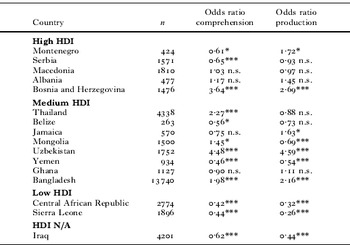
Controlling for number of children aged 2 ; 00 to 9 ; 11 in the family, the majority of countries (12 of 16) differed significantly from the overall effect of country. Country explained between 1·5% (Cox & Snell R 2) and 6·3% (Nagelkerke R 2) of the variance. Results for high- and medium-HDI countries varied in whether young children were more or less likely to understand when their mother (or caregiver) asked them to do something (ORs=0·46–4·48). Young children in both countries with low HDI and in Iraq were less likely to understand when their mother (or caregiver) asked them to do something (ORs=0·42–0·62) (see Table 5).
Odds ratios (ORs) for country deviation from overall effect for language comprehension and production by country by HDI for focus sample (2 ; 00–4 ; 11)

notes: * p<0·05; *** p<0·001.
Production
Controlling for number of children aged 2 ; 00 to 9 ; 11 in the family, the majority of countries (10 of 16) differed significantly from the overall effect of country. Country explained between 3·1% (Cox & Snell R 2) and 8·8% (Nagelkerke R 2) of the variance. Results for high- and medium-HDI countries varied in whether young children were more or less likely to speak and say recognizable words (ORs=0·54–4·59). Children in both countries with low HDI and in Iraq were less likely to speak and say recognizable words (ORs=0·26–0·44) (see Table 5).
DISCUSSION
Language is a requisite for successful functioning in society, and, although complex and dynamic in its ontogeny, it is a fundamental skill and a cornerstone of human development. Children's language has been linked to a variety of other important areas of growth from emotional maturity and social interaction to reading and academic outcomes.
Language comprehension and production are usually studied in infants or very young children, but this age range imposes limitations and both aspects of language continue to develop beyond this early stage of the life course (Berman, Reference Berman2004; Wassenberg et al., Reference Wassenberg, Hurks, Hendriksen, Feron, Meijs, Vles and Jolles2008). Our study compared comprehension and production to examine their mean absolute and relative associations. We approached the assessment of child comprehension and production of language using a common parental report measure, following Bates's (Reference Bates1993) admonition that different measures of comprehension and production can yield different results (in mean level, though perhaps not rank order; see Bornstein & Haynes, Reference Bornstein and Haynes1998). We also used the Multiple Indicator Cluster Survey, one of the main tools applied in developing nations in the world today to measure progress in child development (see Bornstein et al., Reference Bornstein, Britto, Nonoyama-Tarumi, Ota, Petrovic and Putnick2012). The MICS plays a role in planning and reporting on children and families, being a reliable source of data for many indicators which for developing nations are difficult to find otherwise. It thus affords unique and useful insights on child language from usually wholly neglected sources. The MICS3 is admittedly a blunt instrument not designed to assess language development in children in depth, as it trades depth for extensive breadth.
Based on the MICS3 we report about language comprehension and production in a sample of 101,250 children age 2 ; 00 to 9 ; 11 and a focus subsample of 38,845 children age 2 ; 00 to 4 ; 11 from sixteen under-researched developing nations. In the whole sample of children in these developing nations, average comprehension and production were reportedly high, but still not perfect, even by 9 ; 11.
In both samples, many of the central findings paralleled those previously reported for English and other more commonly studied languages (Dale & Goodman, Reference Dale, Goodman, Tomasello and Slobin2005). Comprehension slightly exceeded production. The correlations between comprehension and production by country were positive and significant, but varied in size, and the weighted and normalized average correlation was positive, significant, and small to medium in size. Thus, MICS3 data show that basic language comprehension and production are moderately related at each age from 2 ; 00 to 9 ; 11, but share less than 10% of common variance. At the same time, language and culture moderated comprehension–production relations as the relatively wide range in their shared variances (00–28%) amply attests. (Of marginal note, in different countries that speak the same dominant language, comprehension–production correlations are comparable; see English in Belize and Jamaica and Serbian in Montenegro and Serbia.) These small but significant correlational results are in line with the extant literature on comprehension–production relations reviewed at the outset. Of course, the finding that comprehension and production are minimally associated with one another suggests, but does not prove, that these two basic language faculties spring from the same source(s).
Comprehension and production varied with child age, and each grew from 2 ; 00 to 5 ; 00 after which each reached an asymptote. In addition, analyses comparing countries to the overall effect of country showed a general relation between language in the 2 ; 00 to 4 ; 11 age range and national standard of living as measured by the Human Development Index: young children in countries with lower standards of living were less likely to demonstrate basic language comprehension or production to mother (or caregiver). In representative samples in developed nations, children from lower socioeconomic strata tend to show slower rates of development than do children from higher socioeconomic strata, as here beginning within the second year of life and continuing through the school years (Dollaghan et al., Reference Dollaghan, Campbell, Paradise, Feldman, Janosky and Pitcairn1999; Huttenlocher et al., Reference Huttenlocher, Vasilyeva, Cymerman and Levine2002; Rescorla & Alley, Reference Rescorla and Alley2001). A variety of input factors (amount of speech addressed to children, richness of the vocabulary used, rate of question asking, and length of utterances) has been identified as positive predictors of language development (Bornstein et al., Reference Bornstein, Haynes and Painter1998; Weizman & Snow, Reference Weizman and Snow2001). Hart and Risley (Reference Hart and Risley1995) reported significant associations between family socioeconomic status on the one hand and both vocabulary exposure and vocabulary growth on the other. Children from low-income families in the United States were exposed to significantly fewer words than children from high-income families and subsequently followed slower rates of vocabulary development.
Comprehension and production may be culturally common patterns in language development, but their acquisition and the degree of their association appear to be community specific and express flexible adaptations to the language setting in which the child develops. Evolutionary psychology seeks evidence for human universals, and cultural psychology seeks evidence for human diversity. These complementary approaches converge to define conditions under which culturally universal mechanisms are expressed in community-specific ways. In essence, language development is common and specific. An evolutionary model posits a language instinct from the perspective of an inborn and universal acquisition device, but specificity of environmental input plays a demonstrable role in the acquisition of each specific language (Pinker, Reference Pinker2007). In these terms, language comprehension and production might be best described by the interplay of evolutionarily based, inborn biases that are culture-common with environmental input that stimulates community-specific patterns of relations and development. Cross-national linguistic research, such as the study presented here, exposes the ways by which ecological context may moderate universal tendencies in child language. More generally, it is imperative to learn more about children in widely diverse language communities so that linguists and developmental scientists as well as educators, practitioners and policy-makers can better understand human development and advantageously promote children's language and cognitive functioning and their well-being.