For lack of ink, the candle coal,
For pen a pin I use,
The which also I may allege
In part of my excuse:
For said it is of many men,
And such as are no fools,
A workman is but little worth
If he do want his tools ...Footnote 2
These words, taken from a verse-letter composed by the recusant prisoner Francis Tregian, epitomise the metaphorical link between improvised resources and prisoners’ heroic battles against privation. We do not know whether Tregian actually did make a pen out of a pin and collect soot from candles to use for his ink.Footnote 3 But he certainly exploits the idea that this is correct behaviour for a prison writer - and since he represents himself as having paper, he appears better resourced than some who could only write on the walls that held them captive. The strong association between prison-writing and writing on walls, whether by graffiti or carving, is as true of Tudor and Stuart England as of other times and places. Yet just because prison-writers were associated with the idea of writing on a wall, they need not necessarily have done so. This article considers the topos in the writings and afterlife of Tregian’s contemporary, the Catholic priest, poet and martyr, John Ingram, and asks whether it is to be taken at face value.
Ingram was born in 1565, possibly in Herefordshire – a remote area of England where Catholicism remained strong throughout the 1560s and beyond – and educated first in Worcestershire, then at the English College in Rheims, the Jesuit College at Pont-à-Mousson, and the English College in Rome. He was ordained in 1589 and went to Scotland around 1592, where he consorted with Catholic nobles. Following an outcry against Catholics in Scotland, he was obliged to flee across the border. He was captured in the North of England in November 1593 and imprisoned successively at Berwick, Durham, York and the Tower of London, where he appears to have written his verses. Subsequently he was sent north again to York, Newcastle and Durham, where he stood trial. Even though there was no evidence that he had exercised any priestly function in England, he was convicted under the statute that made the mere presence of a Catholic priest in England high treason. He was hanged, drawn and quartered in Gateshead on 26 July 1594, and his quarters were sent across the river to Newcastle. In 1929 he was beatified, and to this day a commemorative walk in his honour from Newcastle to Gateshead takes place every year around his execution date.Footnote 4 His verse, composed in Latin and mostly epigrammatic, survives in two contemporary manuscripts. One, traditionally held to be autograph, forms part of the 17th-century Catholic antiquary Christopher Grene’s collections, and a contemporary copy was also circulated by the priest Richard Holtby.Footnote 5
Tudor and Stuart prison writing has attracted much attention recently.Footnote 6 Its scholars emphasise the notion that the early modern prison should not be seen as an existential experience where the isolated prisoner communed primarily with himself and God, but as a place where like-minded people had considerable opportunity for interchange. Moreover, despite the imperative of confinement, the boundaries between inside and outside were permeable and often permeated. Robyn Adams, for instance, has commented that ‘the prison wall ... is ... a site of enclosure and a visible barrier, but one that can be penetrated and through which subversive material can be exchanged.’Footnote 7 Taking her bearings from network analysis, Ruth Ahnert confirms that ‘prison communities were not bound by prison walls’.Footnote 8 Writing was an especially important way for prisoners to form bonds with each other and maintain contact with the outside world, and Molly Murray has described the early modern prison as ‘a site of culture, one that ought to be considered alongside the court and the university as a place of significant textual, and literary, production’.Footnote 9
The recent surge of interest in prison writing has complicated our view of how that writing took place. While orders controlling writing and reading may suggest that these were relatively common under normal circumstances, there was also enormous variation in whether prisoners were allowed the wherewithal to write; in some cases it was hardly regulated at all, in other cases it could be cracked down upon severely.Footnote 10 Catholic prisoners were, of course, not the only ones to be deprived of writing materials, but they had a more systematised response than many to this hardship. Having pen, ink and paper confiscated, or - worse - being tortured to the extent that it was difficult or impossible to write, were privations that would have enabled co-religionists to build up a case for one’s exemplary suffering and confessorship, via such means as letters and biographical narratives. One example is the anecdote circulated by Henry Garnet about Robert Southwell’s time in prison; Southwell, he claimed, scratched words with a pin in his breviary because he had no access to writing materials. Garnet writes, ‘I have turned over each leaf of the breviary curiously, and have not found one single sign made with ink, from which it follows, that he was never granted the commodity of writing to his friends outside.’Footnote 11 Garnet’s logic is shaky, but the idea would certainly have helped to shape the Southwell cult.
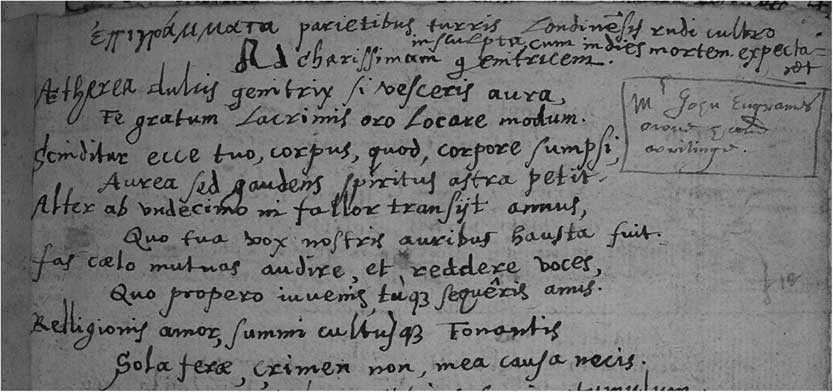
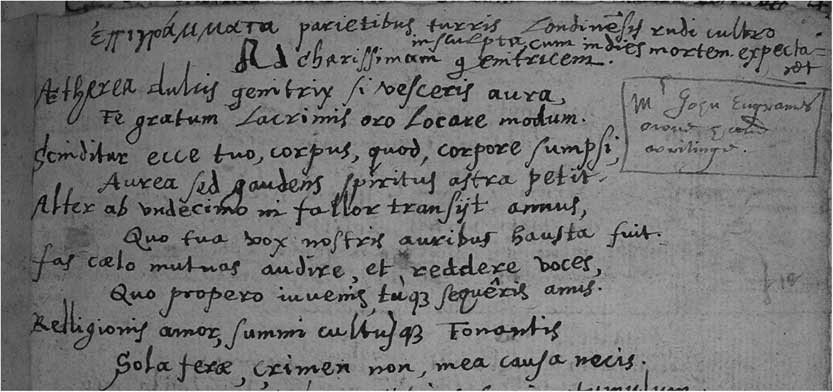
All this is important when considering Ingram’s writing: both how he himself presented it, and how it was preserved by the custodians of his memory. The manuscript of his verse traditionally held to be autograph has a brief prefatory remark, which appears to be in the same hand, telling the reader that he carved his epigrams ‘with a blunt knife on the walls of the Tower of London while he daily awaited death’.Footnote 12
MS Anglia A.VII.8, heading to the manuscript of Ingram’s verse traditionally held to be autograph. Reproduced by kind permission of the Archivum Britannicum Societatis Jesu.
As observed above, there is certainly a strong correspondence, at this or any date, between carving and writing on walls and prison writing: no doubt because, in many cases, a wall is the only writing-surface available to a prisoner, and because they are obvious hobbies for anyone with too much spare time.Footnote 13 The Catholic priest Henry Morse wrote of one prison he visited: ‘The ... chamber walls, made entirely of stone, were bedaubed with texts of Scripture, scribbled in charcoal, and with scraps of verses composed according to the disposition and circumstances of the several tenants thereof.’Footnote 14 Given this context, it is not surprising that the idea of writing on walls, turning a means of enclosure into a means of expression, came to emblematise resistance.
But what were the practicalities of writing on a wall? As Morse’s description suggests, one could write with chalk or with charcoal. More permanently, a prisoner could carve the stone walls with the knife he was given for meals, which is what the introduction to the autograph manuscript could be referring to, and which has been taken at face value by the handful of people who have studied Ingram.Footnote 15 The relative permanency of a carved inscription would certainly have made it appealing to Catholic prisoners as a means of witnessing to one’s faith, and leaving inspiring messages for successors.Footnote 16 However, there are also reasons to be sceptical. Ingram wrote a lot of verse - 20 poems totalling 188 lines in all - and it would have taken an immense amount of time even to scratch this on a wall. The recent catalogue of Tower of London inscriptions not only records none of Ingram’s verses, but gives little of remotely comparable length or sophistication.Footnote 17 Much more typical, both in content and length, are the three inscriptions by Ingram’s co-inmate and fellow priest, Henry Walpole: two giving his name and titles, the third listing himself alongside the four Western Doctors of the church, Saints Jerome, Ambrose, Augustine and Gregory.Footnote 18 Ingram is never recorded as out of his captors’ hands from the time he was brought into the Tower of London until the time when he was brought up to Gateshead and executed; as commented above, the provenance and penmanship of the earliest manuscript suggests that it is in Ingram’s hand; and this in turn would show that, at some point during his period of imprisonment, he did have access to pen and paper. It seems, therefore, much more likely that they were written in the usual way, rather than carved on the wall of Ingram’s cell.
So is Ingram’s claim that he scratched his verse with a blunt knife no more than a metaphor for incarcerated creativity that his audience would not necessarily have taken at face value? That is certainly one possibility, but another and more complex one is suggested by Epigram X, ‘Of the Knife He Had in the Tower’:
Why has Fanner, the keeper of the keys, given me a knife blackened with all
manner of rust, and without a point?
An Irishman, who had followed the dread career of bloody Mars,
Wished to lay violent hands upon himself.Footnote 19
Thou also hadst once been girt with Pallas’ gleaming sword;
And in thy life hast followed her banner.
Yet thou wouldst never be willing to destroy thy wretched life with the steel,
On that account was the sharp knife refused thee.
Men of kindred professions he has treated us in the same way,
Lest thy fate should harm thy keeper.
Lo, I confess that I have ever been a friend of the nine muses,
But Minerva the wise differs far from Mars the ferocious.
In presence of all I desire to seal my faith with my blood,
That my death may be to them a cause of a holy life.Footnote 20
To summarise the argument of this dense epigram: Ingram is comparing an Irish soldier, his co-prisoner and the follower of Mars, god of war, to himself as scholar and friend of Pallas Athena, goddess of learning. The difference between them is that the soldier is suicidally inclined, while Ingram is in jail precisely because he is not willing to risk spiritual destruction by renouncing the Catholic faith. By the same token, he would never commit the sinful act of suicide; yet despite the fact that he poses no threat, he has been given a blunt knife by the jailer so that he cannot stab himself. Since blunt knives were sometimes given to prisoners during periods of torture in case they killed themselves, and since there is external evidence that Ingram underwent torture at various points, we may be intended to read the knife itself as an oblique reference to being tortured.Footnote 21 But even without this potential additional meaning, Ingram’s was a situation in which anyone might be inclined to compare the act of writing to carving with a blunt knife.
In fact, the knife undergoes an ontological reversal, becoming an instrument not of damage, but of perpetuation. Following the hint in the poem’s title, we are meant to think of it as an extempore chisel for lapidary verses, metaphorically if not literally: inscribing Ingram’s own defiance and signifying the impotence of the persecutor. The disparate professions of soldier and scholar become paradoxically united through the idea of knives, which are compared to the sword of the former and the pen, or intellectual acuity, of the latter. This also makes the bluntness of Ingram’s knife a reference to the fact that he is deprived of scholarly resources. Complaints at privation and the expression of a desire to publish against the odds are - understandably enough - constant themes in prison verse, as shown in the poem of Francis Tregian’s with which this article began. This variant of the modesty topos so familiar in early modern writing can also act as a way of pre-empting criticism: the writer who cannot lay his hands on pen, ink and paper is likely to be away from his books, at best, and suffering extreme mental and physical hardship at worst. Ingram’s verses do end with his apology for any faults that the lack of reference material might have occasioned: ‘Seeing that the time was one ill-suited for writing poetry, and that there was a total dearth of books needful for such a task, it will not be strange that some faults should have crept in which a generous reader will either courteously condone, or, what is better, correct.’Footnote 22
There is something a little disingenous in this; only a Momus would react harshly to poetry written in the circumstances Ingram was experiencing. But Ingram was, it is true, composing in an ambitious genre. The epigram was a learned poet’s pastime, drawing on classical models like Martial, Catullus and the poets of the Greek Anthology, and Renaissance humanist poets such as Clément Marot, Theodore de Bèze, and England’s own Ben Jonson.Footnote 23 Ingram is likely to have been well aware of this heritage, since - despite his protestations - his verse is highly sophisticated and allusive, operating on a different level from many English Catholic poets of his time.Footnote 24 A recusant’s life or a martyr’s death may or may not accompany literary expertise, and Ingram’s verse takes us into a different world from Tregian’s good-humoured doggerel; indeed, it implies a very different type of audience, which one can glimpse in his ‘Ode showing the gratitude of his soul to those places in which he had learned the gentle arts’:Footnote 25
I long to pay due thanks to those cities
Which once on a time taught me their arts.
Flanders, thou that flashest with war, and which for the fruit of the soil,
Ownest no two equals in all Europe,
Thou didst teach me the sweet words of the Roman tongue,
And did make me bind all well unto the wheel.
France, thou of old second to none in holiness,
And skilled often to nourish learned men within thy bosom,
Thou dost make me know Cicero the father of Latin oratory,
Thou dost make me know how to sound the measures of the gladsome lyre.
Rome, thou of old sprinkled with the blood of thy founder,
Rome, now the fount of faith, the pinnacle of holiness,
Under thy tuition I learnt wisdom and Christ in the sacred text,
And to raise anointed hands unto heaven.
Flanders, Realm of France, and Latium, hail:
Your honour grows in the heart of Ingram.Footnote 26
Ingram addresses men like himself in this ode -- fervent Catholics, but also urbane and classically educated -- and the references to fighting invite one to glance back to his epigram on the blunt knife, where scholarship is compared to combat. Neo-Latin, the ordinary international means of communication, could be seen as a potent weapon for the Catholic cause; Ingram’s poems are potentially pan-European in their language and referential range, deriving from and contributing to the robust tradition of neo-Latin martyrological writing fostered within the English Catholic colleges overseas.Footnote 27
At first glance the ‘Ode’ may seem less concerned than others with the circumstances of Ingram’s imprisonment, but pondering its most difficult passage suggests another conclusion. Part of Ingram’s address to the personified city of Flanders, ‘Thou didst teach me the sweet words of the Roman tongue, / And didst make me bind all well unto the wheel,’ provoked John Hungerford Pollen to write: ‘I am unable to ascertain the meaning of this line’.Footnote 28 However, it makes sense if read as referring to St Catherine of Alexandria, who was tortured on a spiked wheel; Ingram’s glancing reference to torture here is very reminiscent of the reference to his blunt knife, discussed above. Ingram had a particular devotion to St Catherine, since he was ordained on 25 November, her feast-day, and captured in England on the same day several years later. In another epigram, he writes, ‘What chance was it, what cause, or what mistake that I should have been taken / On the day dedicated to thee, holy Catherine?’, then, addressing himself, ‘After the lapse of years it has fallen out that thou shouldst confess thyself a priest / On the day on which thou wast happily made one.’Footnote 29 This epigram comes directly before the ‘Ode’: a clue that the sequence of verses is important, and that the reader should glance back to the earlier poem to pick up on Ingram’s identification of himself with St Catherine.Footnote 30
Ingram’s characterisation of himself as actively embracing torture and death follows on from the way he compares his own arraignment to Catherine’s, translated by Pollen as follows: ‘The maiden filled with the most high God forfeited / Her chaste life beneath the savage sword of a heartless tyrant. / Thou standing bound in the midst of so many armed foes / Wilt give thyself piece by piece a sacrifice to the Immense God.’Footnote 31 Pollen is paraphrasing here, and if the line were translated more literally, a possible reading would be: ‘You will give [yourself] to the immense God through small pious pieces.’ The word frusta is the plural of frustillum, a rare word meaning ‘a small piece’ or ‘little bit’, and Ingram’s use of the diminutive, frusta, suggests particularly small pieces.Footnote 32 The epigram, the shortest of all classical poetic genres, is here being used to play with the idea of littleness. Being chopped into small pieces also recalls the Elizabethan Catholic priest’s all-too-common fate of hanging, drawing and quartering, which Ingram correctly anticipated for himself in ‘A Merry Epigram on his Tomb’:
Rocks are quarried, the entrails of the earth,
That Dives may have living rock for his tomb.
No tomb seek I; and yet shall there be a living tomb
For my lifeless body — the carrion-crow.Footnote 33
Showing its author at his most blackly humorous, this points to the fact that it was common for the bodies of Catholic priests to remain unburied; sometimes quartered, they were put in a public place or places as an admonition, high up to discourage the relic-hunters, for as long as they remained undecayed or uneaten as carrion. As Ingram’s title suggests, he is making a bid for an alternative memorial in verse - if he is unable to have an inscription physically on his tomb, it can at least be about his tomb - and through onomastic punning, he associates his own name not only with that title, but with the very genre of verse he uses here and elsewhere. The word ‘epigram’ is Greek in derivation, and one of the main meanings of the word ἐπι is ‘in’. Despite the fact that ‘epigram’ is a commonly naturalised word in classical Latin, the autograph manuscript of Ingram’s verse displays it in Greek characters no fewer than four times, drawing attention to the pun on ‘Ingram’ and ‘epigram’.Footnote 34
Writing in stone has, at least potentially, a physical longevity that most other forms of writing do not, and tombs are closely associated with lapidary inscription.Footnote 35 Ingram’s graveyard humour, compensating for the lack of a gravestone, brings us back to the question with which this article began: whether his verses were actually carved, or whether he simply wanted to associate them with the act of carving. Looking again at the prefatory remark in the autograph manuscript of his verses, ‘Επιγράμματα parietibus turris Londinie[n]sis rudi cultro insculpta cum indies mortem expectaret, the close association it reveals between blunt knives and suffering for the faith may help to resolve a question posed earlier. We shall never know whether Ingram actually did scratch away painstakingly with his blunt knife to write his verses, making it blunter still; this article has argued that it is an unlikely scenario, and queried previous commentators’ unquestioning acceptance of the story. But they would not have gone in that direction if Ingram had not pointed the way in the prefatory remark to his verses: Pollen translated this as ‘Epigrams cut with a blunt knife on the walls of the Tower of London while he daily awaited death’, but this is not the only possible rendition. Thanks to the wide remit of the Latin ablative, one can translate parietibus both as ‘on the walls of the Tower of London’ and as ‘in the walls of the Tower of London’. If one assumes that this ambiguity is deliberate -- and Ingram had easily enough Latinity and playfulness to make this plausible -- it suggests that, while Ingram wrote his verses in the conventional manner with paper, ink and pen, he may have wished to imply that writing after torture was comparable to carving with a blunt knife, and certainly desired to associate himself with the tradition of prisoners who did carve their names and thoughts on the walls of their jail. As he himself recognised, he needed a memorial.
Appendix
In an edition of Robert Southwell’s verse printed in Edinburgh around 1600, a holy sonnet following his long poem ‘St Peter’s Complaint’ is signed ‘I.I.’, and runs as follows:
A sinfull soule to Christ.
I Lurke, I lowre, in dungeon deepe of mynd,
In mourning moode, I run a restles race,
With wounding pangs, my Soule is sorelie pyn’d,
My griefe it growes, and death drawes on a pace:
What life can last except there come releace?
Feare threats, dispaire; my sinne infernall wage.
I faint, I fall: most wofull is my cace,
Who can me helpe, who may this storme assuage?
O Lord of life, our peace, our only pleage,
O blesfull light, who life of death hast wrought
Of heau’nlie loue the brightsome beame, and bage,Footnote 36
Who by thy death from death and hell us bought,
Reviue (sic) my Soule, my sinnes, my sores redresse,
That liue I may with thee in lasting blesse.Footnote 37
The initials are the same as Ingram’s, and Southwell and he were imprisoned in the Tower of London at the same time.Footnote 38 While I.I. is not an uncommon set of initials, and the sonnet could have been added to a manuscript or printed copy of Southwell’s verse at many junctures, it is certainly possible to envisage a scenario where Ingram, within the Tower of London or outside, was shown ‘St Peter’s Complaint’ and composed a response to it.Footnote 39
The printer of the volume in question, Robert Waldegrave, is known for subversive publishing of many kinds: most notoriously, the puritan Martin Marprelate tracts, and pirated copies of Sidney’s Arcadia.Footnote 40 The publication of Catholic matter is a departure from both these ventures, and seems on first consideration an unlikely departure for someone so strongly associated with the puritan cause. Developing a spread of interests in subversive publishing might, perhaps, have appealed to a printer who considered moral and ideological considerations less important than financial ones, and while there is nothing religiously provocative in I.I.‘s poem, the fact that the poem is presented as a comment on ‘St Peter’s Complaint’ does set up the question of whether its author was of Southwell’s persuasion. To Catholic-minded readers, the inclusion of such a poem could have suggested that the printer had underground contacts among their co-religionists. On the other hand, given that the majority of Southwell’s poems had been published in the mainstream before Waldegrave issued his edition, it seems more likely that he was simply capitalising on the volume’s English success. I.I.‘s poem could have been grafted in for many reasons and at many stages, but one possibility is that it was a manuscript addition to the copy-text.
While the circumstances of this poem’s preservation are unusual, its writer’s response to Southwell’s verse is very much in keeping with those penned by others. Southwell is almost unique among Elizabethan poets in the level of active response he elicits from readers, and this accomplished sonnet, very much in the Southwellian manner, clearly responds to the theme of betrayal in ‘St Peter’s Complaint’.Footnote 41 Southwell’s poem is an unsparing exploration of religious abjection, designed to call its readers to repentance, and sometimes read as reflecting on the persecution which Southwell and other Catholics underwent. But St Peter’s sin, that of denying acquaintanceship with Christ, maps him more onto the negative stereotype of the church-papist than onto the fortitude of Southwell himself, and of other Catholics who made no attempt to conceal their allegiance. The betrayal that such Catholics were tempted towards by their captors was typically of a different kind, to disclose information about their associates, and Ingram was concerned to present himself as not having revealed any damaging facts. In letters to his fellow prisoners, he wrote that ‘he had ‘neither named person nor disclosed anything as house or harbour, to any man, woman or child his damage in any climate whatsoever’ and claimed that the torturer Richard Topcliffe had called him a monster of taciturnity for not giving way.Footnote 42 So, supposing the sonnet was Ingram’s work, he blamed himself for sin, but not Peter’s sin of betrayal.