INTRODUCTION
An accurate account of the evolutionary history of parasite species is essential to understand the acquisition of novel parasite life-history traits and the emergence of new human diseases (Lefevre et al. 2007; Wolfe et al. Reference Wolfe, Dunavan and Diamond2007). Despite the fact that malaria is one of the most devastating infectious diseases currently affecting the human species (Hotez et al. Reference Hotez, Molyneux, Fenwick, Ottesen, Ehrlich Sachs and Sachs2006), key aspects in the phylogeny of the Plasmodium genus remain elusive (Waters et al. Reference Waters, Higgins and McCutchan1991; Escalante and Ayala, Reference Escalante and Ayala1994; McCutchan et al. Reference McCutchan, Kissinger, Touray, Rogers, Li, Sullivan, Braga, Krettli and Miller1996; Qari et al. Reference Qari, Shi, Pieniazek, Collins and Lal1996; Escalante et al. Reference Escalante, Freeland, Collins and Lal1998, Reference Escalante, Cornejo, Freeland, Poe, Durrego, Collins and Lal2005; Perkins and Schall, Reference Perkins and Schall2002; Martinsen et al. Reference Martinsen, Perkins and Schall2008; Garamszegi, Reference Garamszegi2009), and a comprehensive assessment of the age of the major Plasmodium lineages infecting mammals has never been attempted.
P. falciparum and P. vivax are the two most important malaria parasites of humans, together accounting for several hundred million cases per year (Kappe et al. Reference Kappe, Vaughn, Boddey and Cowman2010). Human infections with P. knowlesi, a simian parasite previously reported to infect humans occasionally, may be increasing as a result of forest clearing in Southeast Asia (Cox-Singh et al. Reference Cox-Singh, Davis, Lee, Shamsul, Matusop, Ratnam, Rahman, Conway and Singh2008). Although P. vivax is known to be more closely related to P. knowlesi than to P. falciparum, the apparent absence of a correlation with host divergence has hampered attempts to estimate the P. vivax–P. knowlesi divergence time. Estimates based on the mitochondrial genome (which, in Plasmodium, contains only three protein-coding genes) and on small numbers of nuclear genes placed the P. vivax–P. knowlesi divergence time within the past 7 million years (My) (Escalante et al. Reference Escalante, Cornejo, Freeland, Poe, Durrego, Collins and Lal2005; Jongwutiwes et al. Reference Jongwutiwes, Putaporntip, Iwasaki, Ferreira, Kanbara and Hughes2005), leading to the hypothesis that P. vivax has arisen from a macaque monkey parasite through a host switch event in Southeast Asia.
P. falciparum, by contrast, shows evidence of a close relationship to P. reichenowi, a parasite of the common chimpanzee, supporting an African origin for the former species (Escalante and Ayala, Reference Escalante and Ayala1994; Hughes and Hughes, Reference Hughes and Hughes1995; McCutchan et al. Reference McCutchan, Kissinger, Touray, Rogers, Li, Sullivan, Braga, Krettli and Miller1996; Qari et al. Reference Qari, Shi, Pieniazek, Collins and Lal1996; Escalante et al. Reference Escalante, Freeland, Collins and Lal1998; Perkins and Schall, Reference Perkins and Schall2002; Martinsen et al. Reference Martinsen, Perkins and Schall2008). Thus, it has frequently been assumed that these two Plasmodium species co-speciated with their mammalian hosts and thus diverged 5–7 million years ago (Mya) (Escalante and Ayala, Reference Escalante and Ayala1994), the divergence time of human and chimpanzee lineages (Glazko and Nei, Reference Glazko and Nei2003). Recent sequencing of mitochondrial genes from wild populations of African apes has complicated this picture by showing that African apes are infected by a number of Plasmodium taxa related to P. falciparum and P. reichenowi (Ollomo et al. Reference Ollomo, Durand, Prugnolle, Douzery, Arnathau, Nkoge, Leroy and Renaud2009; Rich et al. Reference Rich, Leendertz, Xu, LeBreton, Djoko, Aminake, Takang, Diffo, Pike, Rosenthal, Formenty, Boesch, Ayala and Wolfe2009; Krief et al. Reference Krief, Escalante, Pacheco, Mugisha, Andre, Halbwax, Fischer, Krief, Kasenene, Crandfield, Cornejo, Chavatte, Lin, Letourneur, Gruner, McCutchan, Renia and Snounou2010; Prugnolle et al. Reference Prugnolle, Durand, Neel, Ollomo, Ayala, Arnathau, Etienne, Mpoudi-Ngole, Nkoghe, Leroy, Delaporte, Peeters and Renaud2010). Rich et al. (Reference Rich, Leendertz, Xu, LeBreton, Djoko, Aminake, Takang, Diffo, Pike, Rosenthal, Formenty, Boesch, Ayala and Wolfe2009) proposed that P. falciparum and P. reichenowi diverged very recently, possibly as recently as 10,000 years ago. However, it has been argued that the degree of sequence divergence at mitochondrial and apicoplast loci between P. falciparum and P. reichenowi is too great to be consistent with a very recent date for the divergence of these two species (Hughes and Verra, Reference Hughes and Verra2010; Ricklefs and Outlaw, Reference Ricklefs and Outlaw2010), but the latter conclusion was based on a small number of sequences.
Krief et al. (Reference Krief, Escalante, Pacheco, Mugisha, Andre, Halbwax, Fischer, Krief, Kasenene, Crandfield, Cornejo, Chavatte, Lin, Letourneur, Gruner, McCutchan, Renia and Snounou2010) reported mitochondrial genomic sequences from the bonobo (Pan paniscus) that appear to belong to P. falciparum. On this basis, they proposed that P. falciparum arose in bonobos and subsequently colonized humans by a host switch. On this scenario, it might be supposed that the divergence of P. falciparum from P. reichenowi occurred at the time of the divergence of the bonobo from the common chimpanzee (about 1·3 Mya; Caswell et al. 2008). An alternative hypothesis remains that P. falciparum infecting bonobos originated from humans, rather than the other way around (Hughes and Verra, Reference Hughes and Verra2010). Similarly, Liu et al. (Reference Liu, Li, Learn, Rudicell, Robertson, Keele, Ndjango, Sanz, Morgan, Locatelli, Gonder, Kranzusch, Walsh, Delaporte, Mpoudi-Ngole, Georgiev, Müller, Shaw, Peeters, Sharp, Rayner and Hahn2010) argued that P. falciparum was recently transferred from gorillas (Gorilla gorilla) to humans; but these authors did not attempt to rule out the alternative hypothesis that gorilla infections with P. falciparum originated from humans.
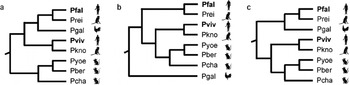
The three most studied rodent-infecting malaria parasite species form a monophyletic clade in phylogenetic analyses, but the phylogenetic position of this group in the Plasmodium tree is not consistent across analyses (Fig. 1; Waters et al. Reference Waters, Higgins and McCutchan1991; McCutchan et al. Reference McCutchan, Kissinger, Touray, Rogers, Li, Sullivan, Braga, Krettli and Miller1996; Perkins and Schall, Reference Perkins and Schall2002). Finally, the relationship of the bird malaria parasite P. gallinaceum to Plasmodium species infecting mammals, has been the source of repeated revision and controversy (Fig. 1; Waters et al. Reference Waters, Higgins and McCutchan1991; Siddall and Barta, Reference Siddall and Barta1992; McCutchan et al. Reference McCutchan, Kissinger, Touray, Rogers, Li, Sullivan, Braga, Krettli and Miller1996; Qari et al. Reference Qari, Shi, Pieniazek, Collins and Lal1996; Perkins and Schall, Reference Perkins and Schall2002; Roy and Irimia, Reference Roy and Irimia2008). The ability to address these phylogenetic questions has been hampered by the small number of loci sampled and the lack of a suitable outgroup. Further increasing the difficulty of phylogenetic reconstruction are the large evolutionary distances involved and the strong bias in nucleotide composition of some Plasmodium nuclear genomes, which are conducive to homoplasy (Dávalos and Perkins, Reference Dávalos and Perkins2008). On the other hand, recent analyses of rare changes in mitochondrial genomes strongly support the monophyly of Plasmodium species infecting mammals (Roy and Irimia, Reference Roy and Irimia2008).
Alternative hypotheses for the phylogenetic relationships among Plasmodium species. Pfal=P. falciparum; Prei=P. reichenowi; Pgal=P. gallinaceum; Pviv=P. vivax; Pkno=P. knowlesi; Pyoe=P. yoelii; Pber=P. berghei; Pcha=P. chabaudi (See text for further discussion of each hypothesis).

Based on the genomic sequence data now available for eight Plasmodium species, we generated a set of 45 highly conserved, single-copy orthologous nuclear genes containing sequences from all species, for a total of ∼15,400 aligned amino acid residues. Here we use this data-set to estimate divergence times in the genus Plasmodium and a subset to infer a phylogeny. We also use data on polymorphism at these loci within P. falciparum to estimate the timing of the most recent common ancestor (MRCA) of P. falciparum relative to the divergence of P. falciparum and P. reichenowi. These analyses thus provide a further test of the hypothesis that P. falciparum and P. reichenowi co-speciated with their hosts, which in turn provides a calibration for estimates of the divergence times of other Plasmodium taxa. In addition, we analyze sequences of complete mitochondrial genomes in order to test the hypothesis that P. falciparum originated from a parasite of bonobos (Krief et al. Reference Krief, Escalante, Pacheco, Mugisha, Andre, Halbwax, Fischer, Krief, Kasenene, Crandfield, Cornejo, Chavatte, Lin, Letourneur, Gruner, McCutchan, Renia and Snounou2010).
MATERIALS AND METHODS
Genomic sequence data
We obtained from PlasmoDB5.4 the genomic sequence data for six Plasmodium species: P. gallinaceum, P. falciparum, P. reichenowi, P. vivax, P. knowlesi, P. berghei, P. chabaudi and P. yoelii. We also downloaded the accompanying GFF files describing gene, protein coding and exon features. In addition we obtained the draft genome sequences for P. gallinaceum and P. reichenowi, with permission, from the WT Sanger Institute (http://www.sanger.cak.uk/resources/downloads/protozoa). A set of 1285 high-quality orthologous clusters was determined for P. vivax, P. knowlesi, P. falciparum and P. yoelii, which included exactly one copy in each of the species (i.e. no paralogs were detected at a Jacquard filter cut-off of 0·6). For each of these genes, the P. falciparum and P. yoelii sequence lengths were within 10% of each other; and the same was true for P. vivax and P. yoelii. Orthologs from P. gallinaceum and P. reichenowi were obtained by BLAST homology search of their respective partial genome shotgun sequence using the P. falciparum amino acid or nucleotide sequences as queries, respectively. A similar procedure was used to find orthologs from P. berghei and P. chabaudi, using P. yoelii sequences as queries. A total of 45 genes were obtained from all species that satisfied the following criteria: (1) each gene was a complete single-exon gene; (2) the BLAST alignment encompassed >97% of the P. falciparum or P. yoelii sequence with an E value <1×10⁻³⁰); and (3) no paralogs of these genes were found in any of the species. By homology search we identified full-length orthologs of 29 of the 45 genes in the genomes of Theileria parva and T. annulata; the subset of 29 genes (Supplementary Table S1; Supplementary Fig. S1, available at http://journals.cambridge.org/PAR) was used in phylogenetic analyses, so that the Theileria species could be used to root the Plasmodium in-group.
Phylogenetic analyses
The sequences for each locus were aligned with ClustalW (Thompson et al. Reference Thompson, Higgins and Gibson1994), using default parameters, followed by manual inspection. Alignments were usually straightforward as a consequence of our method of choosing of orthologs (see above), which selected for genes that were highly conserved in both sequence and length. The draft nature of several of the assemblies led to the presence of certain problematic sequences, such as those in which indels interrupted the open reading frame (ORF). Loci with such problematic sequences were generally discarded, except in cases where the source of error could be easily identified and corrected. For example, in some cases polynucleotide runs disrupted the ORF in draft genome assembles, but these were assumed to be sequencing or assembly errors and were trimmed to preserve the ORF.
The concatenated amino acid sequence alignments of the 29 genes (Supplementary Fig. S1) were used to reconstruct the species phylogeny using the following methods: (1) Neighbor-joining (NJ) implemented in MEGA V4.1 (Tamura et al. Reference Tamura, Dudley, Nei and Kumar2007) using the JTT distance matrix and gamma-distributed rates with the shape parameter α=0·6, as estimated by ProTest V10.2 (Abascal et al. Reference Abascal, Zardoya and Posada2005); (2) Bayesian, using both the MrBayes V3.12 (Ronquist and Huelsenbeck, Reference Ronquist and Huelsenbeck2003) and Beast V1.5.4 (Drummond and Rambaut, 2007) programs; and (3) maximum likelihood (ML), using RAxML V7.2.6 (Stamatakis, Reference Stamatakis2006). In the NJ and ML analyses, bootstrapping (Felsenstein, 1985) was used to test support for branching patterns; 5,000 and 1,000 bootstrap samples were used, respectively. The ML and Bayesian analyses allowed for partitioning of the 29 genes, while the NJ data-set was unpartitioned.
We conducted multiple preliminary runs of MrBayes via the CIPRES Portal V2.2 (Miller et al. Reference Miller, Holder, Vos, Midford, Liebowitz, Chan, Hoover and Warnow2010) and the Computational Biology Service Unit from Cornell University, to optimize the temperature (0·05) and mixing of chains (86 to 87%). Three analyses consisting of 4 runs, each with 6 chains, were executed for 10, 12·5, and 15 million generations on the Texas A&M University Brazos HPC cluster. All parameters for the 29 gene partitions were unlinked, and MrBayes was allowed to estimate all parameters. Burn-in was set to 25% of the trees sampled, and convergence was assessed by evaluating (1) average standard deviation of split frequencies (0·006583, 0·008690 and 0·00601, respectively); (2) the –Ln cold-chain score of the four runs; (3) the Potential Scale Reduction Factor for the branch lengths (∼1·0); and (4) the slide and compare commands of AWTY (Wilgenbusch et al. Reference Wilgenbusch, Warren and Swofford2004). In all three analyses, posterior probability of amino acid models was 1·00 (sd=0·000) for the JTT model and 0·00 (sd=0·000) for all other models.
Seven runs of BEAST were launched, one of which ran for 15 million generations, and another three each for 20 and 30 million generations. The runs were based on the concatenated amino acid alignment, with the following parameters: JTT substitution matrix, with gamma-distributed rates (modeled by 6 classes) with alpha and the proportion of invariant sites estimated from the data. We used an uncorrelated relaxed lognormal clock, with the mean amino acid substitution rate estimated from the data, uniformly sampled between 0–2%/MY. Tree priors used include a Yule process, the monophyly of P. falciparum and P. reichenowi with divergence time uniformly distributed between 5–7 MY, and the divergence time between Plasmodium and Theileria uniformly sampled from the interval 50–500 MY. Appropriate mixing values for operators were determined based on several preliminary runs. Convergence was monitored with Tracer v1.5 (http://tree.bio.ed.ac.uk/software/tracer/). When appropriate, log and tree files were combined using LogCombiner v1.5.4 (distributed with BEAST), after removal of 2000 samples (2 million steps) from each run. Convergence was measured by the value of the effective sample size (ESS).
An initial test analysis using the frequency-based criterion to allow RaxML to halt automatically the number of boostraps (BS) showed that 550 BS were adequate. An analysis of 1000 BS, followed by ML optimization to find the best-scoring tree was conducted for the partitioned data-set, which applied the LG model (the best-fit model for the majority of genes suggested by ProtTest (Abascal et al. Reference Abascal, Zardoya and Posada2005), estimated all free model parameters with the gamma model of rate heterogeneity (alpha=0·9065), and applied empirical base frequencies to all 29 partitions.
P. falciparum–P. reichenowi calibration
In order to test the hypothesis that P. falciparum and P. reichenowi co-speciated with their hosts, we compared polymorphism within P. falciparum at the 45 loci with divergence between P. falciparum and P. reichenowi. Polymorphism data for the 45 loci in P. falciparum was obtained with permission from the Plasmodium falciparum Database at the Broad Institute (http://www.broadinstitute.org/annotation/genome/plasmodium_falciparum_spp/GenomesIndex.html). In order to obtain a high quality sequence data set, we excluded isolates from which the available orthologous sequence was substantially less than full-length or included one or more frameshifts. For the 45 genes, the mean number of isolates present in our data set was 6·0 (±0·2 s.e; median=6·0; range=3–12).
We computed the number of synonymous substitutions per synonymous site (d S) and the number of non-synonymous substitutions per non-synonymous site (d N) by Nei and Gojobori's (Reference Nei and Gojobori1986) method. We used this simple method to analyze the data from P. falciparum and P. reichenowi because the numbers of substitutions per site were few. When the numbers of substitutions per site are few, this method and more complicated methods yield essentially identical results (Hughes and French, Reference Hughes and French2007); yet the variance of the simpler method is lower (Nei and Kumar, Reference Nei and Kumar2000). Within P. falciparum, we estimated the synonymous nucleotide diversity (mean of all pairwise d S values, designated π S) and the non-synonymous nucleotide diversity (mean of all pairwise d N values, designated π N). In order to estimate the age of the most recent common ancestor (MRCA) of P. falciparum, we used the maximum d S value for each gene. In order to compute the rate of synonymous substitution under different assumptions for the divergence time of P. falciparum from P. reichenowi, we computed mean d S between P. reichenowi and P. falciparum sequences for each gene.
As a further test of this calibration, we conducted a phylogenetic analysis of complete or nearly complete mitochondrial genomes (4695 aligned nucleotide sites) from P. falciparum isolated from bonobos (Krief et al. Reference Krief, Escalante, Pacheco, Mugisha, Andre, Halbwax, Fischer, Krief, Kasenene, Crandfield, Cornejo, Chavatte, Lin, Letourneur, Gruner, McCutchan, Renia and Snounou2010) along with P. falciparum sequences isolated from humans. The phylogenetic tree was reconstructed by the NJ method based on the maximum composite likelihood (MCL) distance (Tamura et al. Reference Tamura, Dudley, Nei and Kumar2007). The data-set included 4 isolates of P. falciparum from bonobos, 104 isolates of P. falcparum from humans, two isolates of P. reichenowi, 3 isolates assigned to P. billbrayi, and 3 isolates assigned to P. billcollinsi (Supplementary Table S2, available at http://journals.cambridge.org/PAR). 99 of the human isolates were mostly from Joy et al. (Reference Joy, Feng, Mu, Furuya, Chotivanich, Krettli, Ho, Wang, White, Suh, Beerli and Su2003) and others were from additional Genbank accessions. 30 isolates were of African origin, 31 from Southeast Asia, 11 from Papua New Guinea, 30 from Central and South America, and 2 of unknown origin.
Other divergence times
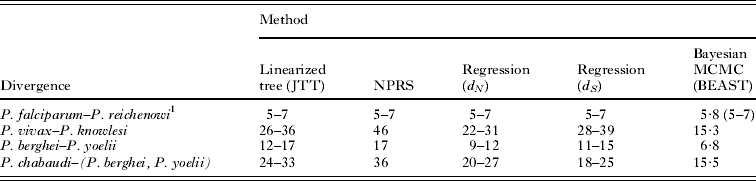
Other divergence times were estimated by a number of methods; in each case, a time of 5–7 Mya for the P. falciparum–P. reichenowi divergence was used as a calibration. The following methods were used: (1) The linearized tree method (Takezaki et al. Reference Takezaki, Rzhetsky and Nei1995) as implemented in the MEGA 4.1 program (Tamura et al. Reference Tamura, Dudley, Nei and Kumar2007); (2) the non-parametric rate smoothing method of Sanderson (Reference Sanderson1997), as implemented in the r8s program, version 1.71; (3) a linear regression method (Hughes and Nei, Reference Hughes and Nei1990) applied to d S and d N values; (4) a Bayesian method, with the posterior distribution of node ages approximated by MCMC simulations, as implemented in BEAST V1.5.4 (Drummond and Rambaut, Reference Drummond and Rambaut2007). In the regression method, the divergence time between species A and B was estimated by regressing d S or d N between the two species against the corresponding value for the orthologous comparison between P. falciparum and P. reichenowi. The regression line was forced through the origin, and the slope of the line used to estimate the ratio of the species A-species B divergence time to the P. falciparum–P. reichenowi divergence time. Estimations based on d S were only done for close relatives because synonymous sites are saturated for all other branches. In these analyses, because more distantly related sequences were involved, d S and d N were estimated by the method of Yang and Nielsen (Reference Yang and Nielsen2000) implemented in PAML (Yang, Reference Yang2007), which takes into account nucleotide composition and mutational biases. PAML analyses were launched, monitored and results visualized, using IDEA (Egan et al. Reference Egan, Mahurkar, Crabtree, Badger, Carlton and Silva2008). These biases can have a substantial effect on estimates of d S and d N when the latter are large (Nei and Kumar, Reference Nei and Kumar2000).
RESULTS
Phylogenetic analyses
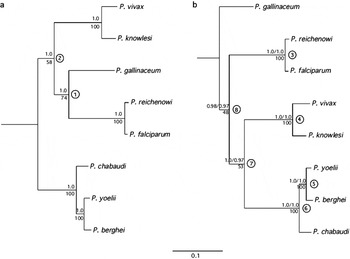
The NJ method with JTT distance recovered the topology illustrated in Fig. 1a; that is a tree in which the bird parasite P. gallinaceum clustered with the primate parasites P. falciparum and P. reichenowi. NJ analyses using other distance methods and joining algorithms yielded the same result (not shown). The same tree was also obtained as the majority rule consensus of a bootstrap analysis, using JTT distances and 5000 replicates. However, the node establishing this topology (node 1 in Fig. 2a) received only 74% bootstrap support. The node clustering P. falciparum, P. reichenowi, and P. gallinaceum with P. vivax and P. knowlesi (node 2 in Fig. 2a) received only 58% bootstrap support. On the other hand, bootstrap support for all other nodes in the tree was 100%.
Bayesian analyses using MrBayes and BEAST, as well as the RAxML analyses, recovered the topology in Fig. 2b. With MrBayes, the posterior probability for all tree nodes was 1·00 (sd=0·000; PSRF of branch lengths=1·0), except for nodes 7 and 8, each of which had posterior probability=0·97 (sd=0·023, 0·030, and 0·021, respectively; PSRF of branch length=1·00). Similarly, bootstrap node support was 100% for all nodes save 7 and 8, which were 53% and 48%, respectively. Likewise, in the BEAST analyses the tree topology represented in the posterior sample is that shown in Fig. 2b. Five of the seven runs converged to this tree (ESS value for each individual run>2000), with log likelihood score of −86,630. The posterior, prior and parameter values were all identical for these five runs, which were then combined (posterior ESS>500). The divergence between the Plasmodium clade and the Theileria outgroup was estimated at 294 My (ESS∼295). However, two runs of BEAST (with 15 million and 20 million generations, respectively), stabilized in a different region of tree and parameter space, with a topology corresponding to that of Fig. 2a. Posterior, prior and parameter values in these two runs were also identical to each other, and the two runs were combined. This tree had a slightly lower posterior log likelihood score (−86,636; ESS>2000) than that found in the other five runs. This topology places the divergence between Plasmodium and Theileria at an earlier date of 314 Mya (ESS∼111).
These results exemplify the mixed signal in Plasmodium data that has led to much of the discussion regarding the position of bird and reptile malaria parasites relative to that of mammalian parasites (Dávalos and Perkins, Reference Dávalos and Perkins2008). Amino acid sequence convergence has taken place among the Plasmodium species with the highest AT nucleotide content in a degree sufficient to confound distance methods such as NJ, and to create a sub-optimal peak in the likelihood surface that is captured by a small number of runs of BEAST. In addition, our method of identifying orthologs may have preferentially selected genes from P. gallinaceum with high sequence similarity to P. falciparum, thus magnifying the problem. Nonetheless, both ML and Bayesian methods, those that are probably most impervious to the effects of sequence convergence, mostly capture the topology supported by rare mutational events, such as indels (Roy and Irimia, Reference Roy and Irimia2008).
P. falciparum–P. reichenowi calibration
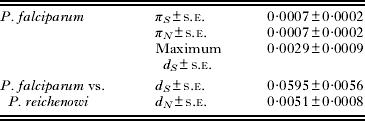
Mean π S in P. falciparum for the 45 loci analyzed here was 0·0007±0·0002 (Table 1); this value is comparable to estimates of synonymous nucleotide diversity in humans (Aquadro et al. Reference Aquadro, Dumont and Reed2001; Li and Sadler, Reference Li and Sadler1991; The International SNP Map Working Group, 2001). Though somewhat lower than some early estimates of nucleotide diversity in P. falciparum (Hughes and Verra, Reference Hughes and Verra2001, Reference Hughes and Verra2002), this value is very similar to recent estimates based on genome-wide SNPs (Volkman et al. Reference Volkman, Sabeti, DeCaprio, Neafsey, Schaffner, Milner, Daily, Sarr, Ndiaye, Ndir, Mboup, Duraisingh, Lukens, Derr, Stange-Thomann, Waggoner, Onofrio, Ziaugra, Mauceli, Gnerre, Jaffe, Zainoun, Wiegand, Birren, Hartl, Galagan, Lander and Wirth2007).
Mean synonymous and non-synonymous nucleotide diversity (π S and π N) within P. falciparum and synonymous divergence (d S and d N) between P. falciparum and P. reichenowi at 45 protein-coding loci

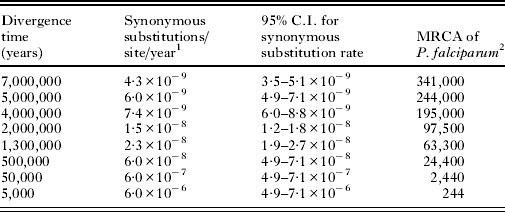
The ratio of the maximum d S value within P. falciparum (0·0029±0·0009; Table 1) to mean d S between P. falciparum and P. reichenowi (0·0595±0·0056; Table 1) was 0·0487. Using this ratio, we estimated the MRCA of P. falciparum based on different hypotheses for the time of the P. falciparum–P. reichenowi divergence (Table 2). If the latter divergence is placed at 4–7 Mya, the MRCA of P. falciparum is around 200,000–300,000 years. This is consistent with previous estimates of the MRCA of P. falciparum (Hughes and Verra, Reference Hughes and Verra2001, Reference Hughes and Verra2002), and it would place the MRCA of P. falciparum around the time of the origin of modern humans (Tamura and Nei, Reference Tamura and Nei1993). A very recent divergence of P. falciparum and P. reichenowi (5,000–50,000 years ago) yielded estimates of the MRCA of P. falciparum that seem implausible (Table 2).
Synonymous substitution rates of Plasmodium falciparum and P. reichenowi nuclear genes and estimated most recent common ancestor (MRCA) of P. falciparum based on hypothetical P. falciparum–P. reichenowi divergence times

When the synonymous substitution rate was estimated on the basis of different divergence times for P. falciparum and P. reichenowi, recent times (2 Mya or less) yielded very high estimates of the synonymous substitution rate, which were more comparable to those of DNA viruses (10−6 to 10−8 substitutions/site/year; Table 2) than to those known from eukaryotes (Li, Reference Li1997). On the other hand, a divergence time between 5 and 7 Mya, which is consistent with the co-speciation hypothesis, yielded rate estimates (4 to 6×10⁻⁹ substitutions/site/year; Table 2), which are consistent with estimates from eukaryotic groups having good fossil records, including vertebrates (Li, Reference Li1997) and diatoms (Sorhannus and Fox, Reference Sorhannus and Fox1999), the latter being the only protists with a substantial fossil record. We therefore used the calibration of 5–7 Mya between P. falciparum and P. reichenowi for estimation of divergence times of other Plasmodium taxa.
Mitochondrial genomes
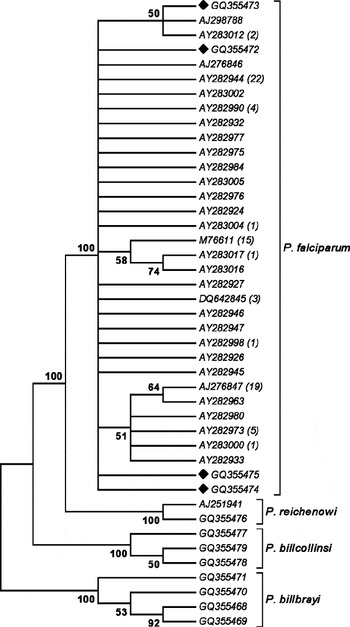
A neighbor-joining tree (Fig. 3) was constructed from mitochondrial genome sequences of P. falciparum from humans and bonobos, along with sequences of P. reichenowi and others attributed to P. billcollinsi and P. billbrayi by Krief et al. (Reference Krief, Escalante, Pacheco, Mugisha, Andre, Halbwax, Fischer, Krief, Kasenene, Crandfield, Cornejo, Chavatte, Lin, Letourneur, Gruner, McCutchan, Renia and Snounou2010). The four bonobo-derived sequences all fell within the cluster of human-derived P. falciparum sequences. This topology did not support the hypothesis that human infection with P. falciparum results from an ancient host transfer event from bonobos (Krief et al. Reference Krief, Escalante, Pacheco, Mugisha, Andre, Halbwax, Fischer, Krief, Kasenene, Crandfield, Cornejo, Chavatte, Lin, Letourneur, Gruner, McCutchan, Renia and Snounou2010). Rather, the topology is most consistent with the hypothesis that bonobo infections by P. falciparum are derived from the P. falciparum population infecting humans.
Phylogenetic relationships among Plasmodium species. a: Tree topology recovered in NJ, and in two out of seven BEAST runs (posterior log likelihood score=−86,636, ESS >2000). b: Tree topology recovered in RAxML, MrBayes and five out of seven BEAST analyses (posterior log likelihood score=−86,630, ESS>2000). Branch lengths as per BEAST analyses. Nodes referenced in the text are circled. Posterior probability for each node is shown above the branches (BEAST/MrBayes; the latter only available for b). Percent bootstrap support in NJ or ML analyses is shown below branches in trees a and b, respectively. Out-group (T. parva and T. annulata) not shown.

This interpretation is further supported by analysis of the pattern of nucleotide sequence difference among these mitochondrial genomes (Supplementary Table S2, available at http://journals.cambridge.org/PAR). Although none of the sequences originating from bonobos was identical to any sequence yet recorded from humans, each was less than 1% different at the nucleotide level from every P. falciparum sequence so far found in humans; and none of the bonobo-derived sequences was more than 0·34% different from the closest human sequence. Moreover, each bonobo-derived P. falciparum sequence showed greater sequence identity to certain human-derived sequences than it did to any other bonobo-derived sequence. For example, GQ355475 from bonobo was only 0·19% different from 6 human-derived sequences, but the closest other bonobo-derived sequence (GQ355472) was 0·38% different. The latter bonobo-derived sequence was only 0·17% different from a total of 23 different human-derived sequences, while it was no closer to any other bonobo-derived sequence than to GQ355475 (0·38% different). Likewise, the bonobo-derived sequence GQ355474 was 0·34% different from 23 human-derived sequences, but 0·51% different from the closest other bonobo-derived sequence; and the bonobo-derived sequence GQ355473 was 0·23% different from 27 human-derived sequences, but 0·40% different from the closest other bonobo-derived sequence. The nucleotide diversity of the four bonobo-derived sequences (0·00474±0·00075) was significantly greater than that of the 104 human derived sequences (0·00049±0·00015; Z-test; P<0·001). However, only 30 of the 104 available human sequences (28·8%) were from Africa.
Other divergence time estimates
We applied a variety of methods to estimate the age of strongly supported nodes on the phylogeny using the 5–7 My divergence between P. falciparum and P. reichenowi as a calibration point (Table 3; node 3 in Fig. 2b). Although divergence time estimates varied among methods (Table 3), there was broad agreement on several main points. All methods placed the time of the P. vivax–P. knowlesi divergence between 15 and 46 Mya (Table 3; node 4 in Fig. 2b), a period corresponding to the early radiation of the Old World primate lineage. Estimates of the divergence of New World primates (Platyrrhini) and Old World primates (Catarrhini) range between 37 and 54 Mya, while those for the divergence of the Old World monkeys (Cercopithecoidea) from the great ape/human lineage (Hominoidea) range between 26 and 30 Mya (Steiper and Young, Reference Steiper, Young, Hedges and Kumar2009).
Summary of divergence time estimates, in millions of years

1 Calibration.
Because estimates based on mitochondrial genomes yielded a much earlier estimate of the divergence time between P. vivax and P. knowlesi (Jongwutiwes et al. Reference Jongwutiwes, Putaporntip, Iwasaki, Ferreira, Kanbara and Hughes2005), we examined potential alternative explanations for our results. One hypothesis might be that P. vivax and P. knowlesi diverged from each other recently and that the differences between the two species at nuclear loci have increased due to an unusually high mutation rate. If this was the case, and since the effects of a high mutation rate should be seen more strongly at synonymous than at non-synonymous sites (because of purifying selection on the latter), one would expect the mean value of d N/d S between P. falciparum and P. reichenowi to be significantly higher than that between P. vivax and P. knowlesi. Nevertheless, the two ratios are quite similar, with the former ratio being 0·0612 and the latter 0·0616 (Supplementary Table S3, available at http://journals.cambridge.org/PAR).
All methods of divergence time estimation supported the conclusion that the diversification of the three rodent malaria parasites (node 6 in Fig. 1b) has taken place within the last 36 My at most, and the regression and MCMC methods placed the divergences of these species within the past 25 My (Table 3). The known natural hosts of these rodent malaria parasites are primarily members of the genus Thamnomys in the rodent family Muridae (Killick-Kendrick, Reference Killick-Kendrick1968; Yoeli and Most, Reference Yoeli and Most1964), and the origin of the Muridae has been estimated at about 24 Mya (Honeycutt, Reference Honeycutt, Hedges and Kumar2009).
DISCUSSION
The origin and evolutionary relationships of malaria parasites have been controversial for decades. The present analyses suggest that, although many questions remain unresolved, the overall pattern within Plasmodium parasites of mammals has been one where parasites and hosts lineages have co-evolved, with no evidence of frequent transfer between hosts across wide taxonomic distances (such as between different mammalian orders). However, within groups of closely related host species, transfers across species boundaries may be fairly common, as is seen in field infections of Southeast Asia primates (Putaporntip et al. Reference Putaporntip, Jongwutiwes, Thongaree, Seethamchai, Grynberg and Hughes2010) and as inferred to have occurred over evolutionary time in Southeast Asia (Garamszegi, Reference Garamszegi2009).
Recently, some authors have revived the old idea that P. falciparum is a new human parasite on an evolutionary time scale (Rich et al. Reference Rich, Leendertz, Xu, LeBreton, Djoko, Aminake, Takang, Diffo, Pike, Rosenthal, Formenty, Boesch, Ayala and Wolfe2009). This hypothesis was originally based on the estimations that the sickle-cell gene arose in the human population of West Africa about 5,000 years ago, around the time that agriculture appeared in that region; and it was presumed that P. falciparum malaria must have first infected humans around that time (Livingstone, Reference Livingstone1958). The inference was thus based on a misunderstanding of the evolutionary process, since it was assumed that an adaptive mutation (the sickle-cell gene) must have occurred in response to the selection imposed by the parasite. Mutation is a random event, and an adaptive mutation need not coincide in time with the selective pressure to which it represents an adaptive response. However, if agriculture enabled an increase in the human population in West Africa, it would have increased the probability that an adaptive mutation would occur on at least one chromosome in the population, as well as the probability that it would be able to increase in response to selection rather than being lost to drift (Hughes and Verra, Reference Hughes and Verra2010).
The present results from 45 nuclear genes showed that the assumption of a recent divergence of P. falciparum and P. reichenowi requires the assumption of both (1) an implausibly high synonymous substitution rate, and (2) an implausibly recent MRCA of worldwide P. falciparum. Likewise, the divergence of P. falciparum from P. reichenowi around the time of the divergence of the bonobo from the common chimpanzee (about 1·3 Mya) would require a nuclear synonymous substitution rate (Table 2) over 4 times that of mammals (4–5×10⁻⁹; Li, Reference Li1997), which seems unlikely. These results are thus consistent with earlier analyses of mitochondrial and apicoplast sequences (Hughes and Verra, Reference Hughes and Verra2010) and are consistent with the hypothesis of co-speciation of P. falciparum and P. reichenowi with their respective human and chimpanzee hosts. These results are also consistent with earlier results showing that P. falciparum has substantial genetic diversity and thus an ancient MRCA, probably around the time of the origin of modern Homo sapiens 100,000–300,000 years ago (Hughes and Verra, Reference Hughes and Verra2001, Reference Hughes and Verra2002; Mu et al. Reference Mu, Duan, Markova, Joy, Huynh, Branch, Li and Su2002; Volkman et al. Reference Volkman, Sabeti, DeCaprio, Neafsey, Schaffner, Milner, Daily, Sarr, Ndiaye, Ndir, Mboup, Duraisingh, Lukens, Derr, Stange-Thomann, Waggoner, Onofrio, Ziaugra, Mauceli, Gnerre, Jaffe, Zainoun, Wiegand, Birren, Hartl, Galagan, Lander and Wirth2007). The estimation of the MRCA of P. falciparum in humans at 100,000 years ago or earlier is in turn consistent with evidence that this parasite accompanied modern humans in their first emergence from Africa to Asia (Tanabe et al. Reference Tanabe, Mita, Jombart, Eriksson, Horibe, Placpac, Ranford-Cartwright, Sawai, Sakihama, Ohmae, Nakamura, Ferreira, Escalante, Prugnolle, Björkman, Färnet, Kaneko, Horii, Manica, Kishino and Balloux2010).
Recent PCR-based studies of malaria parasites from natural populations of non-human primates have revealed surprising diversity, suggesting that there may be numerous undescribed species infecting primates in both Southeast Asia (Putaporntip et al. Reference Putaporntip, Jongwutiwes, Thongaree, Seethamchai, Grynberg and Hughes2010) and Africa (Duval et al. Reference Duval, Fourment, Nerrienet, Rousset, Sadeuh, Goodman, Andriaholinirina, Randrianarivelojosia, Paul, Robert, Ayala and Ariey2010; Prugnolle et al. Reference Prugnolle, Durand, Neel, Ollomo, Ayala, Arnathau, Etienne, Mpoudi-Ngole, Nkoghe, Leroy, Delaporte, Peeters and Renaud2010). The relationships and divergence times of these complex assemblages are far from being resolved. Because P. falciparum sequences have been found in African apes, Duval et al. (Reference Duval, Fourment, Nerrienet, Rousset, Sadeuh, Goodman, Andriaholinirina, Randrianarivelojosia, Paul, Robert, Ayala and Ariey2010) suggested that chimpanzee and gorillas constitute ‘reservoirs’ of malaria that might continue to maintain the parasite even if it were exterminated in humans. Similarly, Krief et al. (Reference Krief, Escalante, Pacheco, Mugisha, Andre, Halbwax, Fischer, Krief, Kasenene, Crandfield, Cornejo, Chavatte, Lin, Letourneur, Gruner, McCutchan, Renia and Snounou2010) suggested that P. falciparum in humans arose as a result of a host transfer from bonobo. Analyses reported here show that all available bonobo-derived complete mitochondrial genomes are more similar to human-derived P. falciparum sequences than they are to other bonobo-derived sequences. It is true that nucleotide diversity of bonobo-derived P. falciparum mitochondrial genomes was greater than that of available human-derived mitochondrial genomes. However, the vast majority (69·2%) of available human-derived complete mitochondrial genome sequences originated in Asia, New Guinea or the Americas. Since there is no doubt that P. falciparum originated in Africa, it is expected that the most diverse P. falciparum populations infecting humans would be seen in Africa and that P. falciparum underwent a severe population bottleneck as it accompanied its human host out of Africa. Tanabe et al. (Reference Tanabe, Mita, Jombart, Eriksson, Horibe, Placpac, Ranford-Cartwright, Sawai, Sakihama, Ohmae, Nakamura, Ferreira, Escalante, Prugnolle, Björkman, Färnet, Kaneko, Horii, Manica, Kishino and Balloux2010) have reported evidence from nuclear DNA sequences in support of the hypothesis that P. falciparum accompanied humans out of Africa and underwent substantial reduction in genetic diversity. An even more severe bottleneck is likely to have occurred when P. falciparum was introduced to the Americas as a result of the African slave trade (Anderson et al. Reference Anderson, Haubold, Williams, Estrada-Franco, Richardson, Mollinedo, Bockarie, Mokili, Mharakurwa, French, Whitworth, Velez, Brockman, Nosten, Ferreira and Day2000).
On the other hand, it is also possible that there has been a recent worldwide reduction in diversity of the mitochondrial genome of P. falciparum infecting humans as the result of a selective sweep, perhaps in response to treatment with anti-mitochondrial drugs such as atovaquone (Warhurst, Reference Warhurst1999). Point mutations in the cytochrome b gene are known to be associated with resistance to the latter drug (Warhurst, Reference Warhurst1999). In any event, a complete understanding of the population history of the mitochondrial genome of P. falciparum will require a much more extensive sequencing of human-derived isolates from Africa than has so far been undertaken. Moreover, understanding the origin of P. falciparum in different primate hosts in Africa will require extensive sequencing of nuclear as well as mitochondrial genes, since the pattern of sequence polymorphism at nuclear loci will provide independent information regarding the species’ history.
Liu et al. (Reference Liu, Li, Learn, Rudicell, Robertson, Keele, Ndjango, Sanz, Morgan, Locatelli, Gonder, Kranzusch, Walsh, Delaporte, Mpoudi-Ngole, Georgiev, Müller, Shaw, Peeters, Sharp, Rayner and Hahn2010) argued that P. falciparum was transferred from gorilla to human, on the basis of an analysis of mitochondrial cytochrome b genes in which P. falciparum-like sequences from gorilla clustered with human-derived P. falciparum. Like the phylogeny of bonobo-derived mitochondrial genomes (Fig. 3), this phylogeny is also consistent with the hypothesis of a very recent transfer from human to gorilla. In Fig. 4, we represent schematically the portion of Liu et al.’s (2010, p. 422) cytochrome b phylogeny that concerns the subgenus Laverania, to which P. falciparum and P. reichenowi belong. In this rooted phylogenetic tree, P. falciparum and P. reichenowi form part of a clade within Laverania, most members of which are found in Pan (the genus including the two extant chimpanzee species; Fig. 4). This topology can be explained by the following hypotheses: (1) that the clade including P. falciparum and P. reichenowi was present in the common ancestor of Pan and Homo; (2) that P. falciparum and P. reichenowi diverged when their host species diverged; and (3) that P. falcipartum sequences found in present-day gorilla, bonobo, and chimpanzee represent recent host transfers from human.
Condensed NJ tree of Plasmodium mitochondrial genomes based on MCL distance. Diamonds indicate P. falciparum sequences derived from bonobo; other P. falciparum sequences are from human. Only unique sequences are shown; when the data-set included more sequences from human identical to a given sequence, the number of those additional sequences is indicated in parentheses. Numbers on the branches are percentages of 1000 boostrap samples supporting the branch; only branches with 50% support or more are shown.

Alternatively, if P. falciparum was originally a parasite of gorilla, one might hypothesize that P. falciparum and P. reichenowi diverged when Pan and Gorilla diverged (6–8 Mya; Glazko and Nei, Reference Glazko and Nei2003). Note that, because this divergence time is just slightly earlier than that of Pan and Homo, the earlier divergence time as a calibration would have little effect on our other divergence time estimates (Table 3). However, if P. falciparum was originally a parasite of gorillas, one would also have to assume that Homo had no Laverania parasites until its acquisition of P. falciparum from gorilla. This seems unlikely given that Homo inhabited Africa and diverged 5–7 Mya from Pan, which is parasitized by several Laverania species.
Thus, although further sequencing of P. falciparum from human hosts in Africa is needed, currently available results favour the hypothesis that humans are reservoirs for the apes, not vice-versa. Indeed ape infections with P. falciparum may be very recent phenomena, occurring only as a result of forest destruction that has brought human and ape populations into greater proximity (Harcourt, Reference Harcourt1981; Struhsaker, Reference Struhsaker1981; Morgan et al. Reference Morgan, Sanz, Onononga and Strindberg2006). The claim that ape-derived malaria infections may be common in humans (Duval et al. Reference Duval, Fourment, Nerrienet, Rousset, Sadeuh, Goodman, Andriaholinirina, Randrianarivelojosia, Paul, Robert, Ayala and Ariey2010; Liu et al. Reference Liu, Li, Learn, Rudicell, Robertson, Keele, Ndjango, Sanz, Morgan, Locatelli, Gonder, Kranzusch, Walsh, Delaporte, Mpoudi-Ngole, Georgiev, Müller, Shaw, Peeters, Sharp, Rayner and Hahn2010) is premature and may have unfortunate consequences for great ape survival. The African great apes are subject to numerous threats (Caldecott and Miles, Reference Caldecott and Miles2005), and the Western gorilla (Gorilla gorilla) is listed as critically endangered (Hopkin, Reference Hopkin2007). Unsubstantiated assertions that these primates are a source of human malaria infections can only worsen the situation by providing a convenient excuse to those in Africa who see no value in great ape conservation. On the other hand, if P. falciparum infections in great apes are derived from humans, that fact also may be of considerable importance for conservation, further emphasizing the need to establish refuges for the great apes that are safe from human intrusion.
As regards the most widespread human malaria parasite, Plasmodium vivax, numerous studies have suggested that it originated in Southeast Asia, since it shows close affinities to malaria parasites of Southeast Asian primates (Escalante et al. Reference Escalante, Cornejo, Freeland, Poe, Durrego, Collins and Lal2005; Garamszegi, Reference Garamszegi2009). A previous comparison of complete mitochondrial genomes placed the divergence of P. vivax from P. knowlesi as recently as 1·5 Mya (Escalante et al. Reference Escalante, Cornejo, Freeland, Poe, Durrego, Collins and Lal2005), whereas the present analysis of nuclear genes placed it at 15–40 Mya. The most likely explanation for this discrepancy is that synonymous sites in the mitochondrial genome saturate rapidly with changes, but extremely biased codon usage (McIntosh et al. Reference McIntosh, Srivasta and Vaidya1998) leads to a high degree of homoplasy that in turn masks the effects of saturation. Hughes and Verra (Reference Hughes and Verra2010) estimated the synonymous substitution rate in the mitochondrial cytb gene between P. falciparum and P. reichenowi to be about 1–2×10⁻⁸ substitutions/site/year. The present estimates of the synonymous substitution rate in nuclear genes of the same taxa are at least 20 lower (6×10⁻⁹ substitutions/site/year, assuming a divergence time of 5 My; Table 2). If the rates are similar in P. vivax and P. knowlesi, saturation of synonymous sites in mitochondrial genes after 20 million years would be expected.
The recent analyses of Ricklefs and Outlaw (Reference Ricklefs and Outlaw2010) provide additional support for the hypothesis of rapid saturation in Plasmodium mitochondrial genes. Using a rate estimation based on closely related pairs of bird species, those authors used mitochondrial cytochrome b sequences to obtain estimates of the deep divergence times within the Haemosporidia that were far more recent than those we obtained using nuclear sequences (Table 3). For instance, Ricklefs and Outlaw (Reference Ricklefs and Outlaw2010) provided an estimate of only 8·7 Mya for the basal split within mammalian Plasmodium, which by our estimates must have occurred substantially before 15–46 Mya, the estimated age of the P. vivax–P. knowlesi and rodent malaria clades (Table 3). The phenomenon of saturation was particularly likely to be a factor in this case because Ricklefs and Outlaw (Reference Ricklefs and Outlaw2010) based their estimates on both synonymous and non-synonymous sites in the cytochrome b gene, although non-synonymous sites are known to be subject to strong purifying selection (Hughes and Verra, Reference Hughes and Verra2010).
A much earlier date for the divergence of P. vivax and P. knowlesi places that divergence long before the origin of the genus Macaca, around the time of the early radiation of the Old World primates. This does not necessarily imply that P. vivax has been a parasite of hominoids from such an early date. Rather, most phylogenetic analyses show that P. vivax forms part of a well-supported clade along with malaria parasites from Asian monkeys (Duval et al. Reference Duval, Fourment, Nerrienet, Rousset, Sadeuh, Goodman, Andriaholinirina, Randrianarivelojosia, Paul, Robert, Ayala and Ariey2010; Escalante et al. Reference Escalante, Freeland, Collins and Lal1998, Reference Escalante, Cornejo, Freeland, Poe, Durrego, Collins and Lal2005; Hayakawa et al. Reference Hayakawa, Culleton, Otani, Horii and Tanabe2008; Jongwutiwes et al. Reference Jongwutiwes, Putaporntip, Iwasaki, Ferreira, Kanbara and Hughes2005; Mitsui et al. Reference Mitsui, Arisue, Sakihama, Inagaki, Horii, Hasegawa, Tanabe and Hashimoto2010; Mu et al. Reference Mu, Joy, Duan, Huang, Carlton, Walker, Barnwell, Beerli, Charleston, Pybus and Su2005; Roy and Irimia, Reference Roy and Irimia2008). So far, no member of that clade has been found in Africa, other than P. vivax in humans, although interestingly cytb and cox1 sequences from a Plasmodium isolate apparently closely related to that clade has been isolated from a Prosimian in Madagascar (Duval et al. Reference Duval, Fourment, Nerrienet, Rousset, Sadeuh, Goodman, Andriaholinirina, Randrianarivelojosia, Paul, Robert, Ayala and Ariey2010). Thus, at the present time, it still seems most likely that P. vivax became a hominid parasite when hominids first reached Southeast Asia, although this host transfer may have occurred at the Homo erectus stage (Jongwutiwes et al. Reference Jongwutiwes, Putaporntip, Iwasaki, Ferreira, Kanbara and Hughes2005).
The present analyses suggest that the radiation of P. berghei, P. chabaudi and P. yoelii, the three rodent malaria parasite species with completely sequenced genomes, coincided with the radiation of the rodent family Muridae. The observation that non-human primates are infected by complex communities of malaria parasites (Duval et al. Reference Duval, Fourment, Nerrienet, Rousset, Sadeuh, Goodman, Andriaholinirina, Randrianarivelojosia, Paul, Robert, Ayala and Ariey2010; Prugnolle et al. Reference Prugnolle, Durand, Neel, Ollomo, Ayala, Arnathau, Etienne, Mpoudi-Ngole, Nkoghe, Leroy, Delaporte, Peeters and Renaud2010; Putaporntip et al. Reference Putaporntip, Jongwutiwes, Thongaree, Seethamchai, Grynberg and Hughes2010) suggests that the same is likely to be true of rodents as well. Further examination of Thamnomys and related African rodents can be expected to yield new information that will be critical for understanding the evolutionary and ecological relationships of rodent malaria parasites; such an understanding may in turn enhance the usefulness of the rodent malaria parasites as laboratory models for understanding basic malarial biology.
Schematic representation of the phylogeny of the subgenus Laverania from the phylogenetic analyses of Liu et al. (Reference Liu, Li, Learn, Rudicell, Robertson, Keele, Ndjango, Sanz, Morgan, Locatelli, Gonder, Kranzusch, Walsh, Delaporte, Mpoudi-Ngole, Georgiev, Müller, Shaw, Peeters, Sharp, Rayner and Hahn2010).

ACKNOWLEDGEMENTS
We thank D. Harris and J. Gillespie for methodological discussions and comments on the manuscript.
FINANCIAL SUPPORT
This work was supported by grant GM43940 from the National Institutes of Health to A.L.H., and 5R01 GM070793-03 to J.M.C. We thank the Wellcome Trust Sanger Institute for access to the draft genome assemblies of P. gallinaceum and P. reichenowi, and the Texas A&M University Brazos HPC cluster and the Computational Biology Service Unit from Cornell University for providing computational resources.