The acquisition of referring expressions has been investigated extensively in a great number of studies (e.g., Allen, Reference Allen2000; Gavarró, Torrens, & Wexler, Reference Gavarró, Torrens and Wexler2010; Grüter, Reference Grüter2006; Jakubowicz, Müller, Riemer, & Rigaut, Reference Jakubowicz, Müller, Riemer, Rigaut, Hughes, Hughes and Greenhill1997; Pérez-Leroux, Pirvulescu, & Roberge, Reference Pérez-Leroux, Pirvulescu and Roberge2008; Schmitz & Müller, Reference Schmitz and Müller2008; Serratrice, Reference Serratrice2008). However, most of these studies focus exclusively on either subject referents or erroneous object omissions (also known as “nulls”). The present paper presents new research that offers a different perspective on the relatively well-known issue of reference-expression choice in child speech; specifically, we investigate the use of overt direct object (DO) types in two languages that allow null elements as a legitimate alternative.
Slavic languages, in this case Polish and Ukrainian, allow a range of alternative structures. Opportunities for ellipsis are dependent on discourse accessibility. For instance, the question What did Peter do with the cake? , assuming that he has eaten the cake, can be answered in at least two ways: with the full sentence structure in (1a) or (2a) and with the omitted subject structure in (1b) or (2b). In addition, native speakers of both Polish and Ukrainian might produce sentences with both arguments omitted, as in (1c) or (2c) (but, for a different observation, see Tryzna, Reference Tryzna2009).Footnote 1
-
(1)

-
(2)
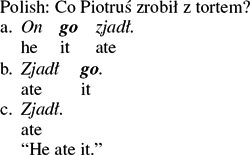
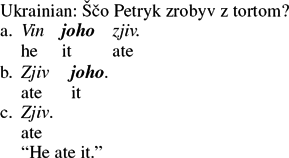
Polish and Ukrainian pattern together in permitting subject ((1b) or (1c)) and object ((2b) or (3c)) omissions in the same discourse setting, that is, when the referent in question has already been mentioned in a previous context. However, the two languages contrast morphologically: while standard Ukrainian employs full object pronouns, for example, його (joho) “him,” Polish makes use of “reduced” versions of similar elements, defined as clitics, for example, go “him” (Franks & Holloway King, Reference Franks and Holloway King2000).
These facts are interesting in a number of ways. On the level of end-state or target grammar, little is known about semantic or pragmatic constraints on the use of various types of referring expressions, such as nouns, pronouns, and omissions, in adult speech. On the level of developing (child) grammar, the role of clitics is often overstated. The frequently made claim that object clitic constructions are particularly difficult to master (see, e.g., Grüter & Crago, Reference Grüter and Crago2012, p. 531; Schmitz & Müller, Reference Schmitz and Müller2008) might hold for some languages, but the universal empirical validity of this generalization has yet to be proven through comparison with other types of pronominal elements in the same semantic/discourse contexts. Unfortunately, such a comparison is generally unachievable in a within-language setting: in Polish (or French), for instance, full pronouns and clitics usually appear in complementary distribution, with the result that confounding discourse-pragmatic factors might affect the relative pace of their acquisition. In contrast, the Polish–Ukrainian cross-linguistic contrast pursued in this paper provides a rich source of evidence on the question of clitic/pronoun development.
Our study addresses two main research questions: (a) what are the preferred DO types in children's Polish and Ukrainian speech, and (b) are Polish clitics more difficult to acquire than Ukrainian full pronouns in the same anaphoric contexts? These questions will be addressed using data obtained in an elicited production study conducted with Polish and Ukrainian children and adults. We focus on the role of the individual language, the children's age, and the referent's animacy in the choice of DO type. The results show that null objects are a licit option in the grammars of Polish and Ukrainian adult native speakers and monolingual children (vs. Tryzna, Reference Tryzna2009). However, children tend to overuse this option in some contexts as late as the age of 5 (cf. Gordishevsky & Avrutin, Reference Gordishevsky, Avrutin, Van Kampen and Baauw2004, on Russian; but see Pérez-Leroux et al., Reference Pérez-Leroux, Pirvulescu and Roberge2008, on French).
We provide an overview of the key results of several previous studies united under the broad topic of “acquisition of referring expressions.” Then we present some relevant language facts from Polish and Ukrainian. The remainder of the paper presents our experimental study and provides an assessment and summarization of our findings.
PREVIOUS RESEARCH
Previous findings on object omissions in child Polish and Ukrainian
The acquisition of monolingual (first language [L1]) Polish has been documented in several studies (e.g., Łuczyński, Reference Łuczyński2004; Smoczyńska, Reference Smoczyńska and Slobin1985; Smoczyński, Reference Smoczyński1955; Szuman, Reference Szuman1968). According to Smoczyński (Reference Smoczyński1955, p. 117), children acquiring Polish display mastery of the language's inflection system at the turn of the second and third year. Smoczyńska (Reference Smoczyńska and Slobin1985) also reports early acquisition of argument structure and case-marking systems. Moreover, Łuczyński (Reference Łuczyński2004) proves that the subject–DO opposition is one of the earliest acquired phenomena in case marking.
A short stage is observed in child Polish in which infinite/root verbal forms may stand for finite verbs, and these “optional infinitives” might influence omissions of verbal arguments (Bar Shalom & Snyder, Reference Bar Shalom, Snyder, Shillcock, Sorace and Heycock1998; Tryzna, Reference Tryzna, Caunt-Nulton, Kulatilake and Woo2007). Nonetheless, acquisition of verb inflection is standardly completed within 5 or 6 months from the first occurrences of verbal utterances in L1 Polish (Sopata, Reference Sopata2008, Reference Sopata2010); this finding suggests that optional infinitives are likely not the cause of missed arguments after the age of 2.
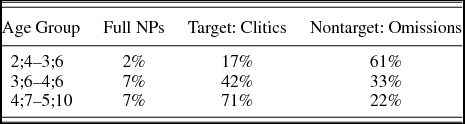
Omission of DOs in Polish has only been examined in one previous study, that of Tryzna (Reference Tryzna2009). This study provides naturalistic and experimental data from young L1 Polish children. Naturalistic data based on language production by a monolingual Polish child (aged 2 years, 1 month [2;1]–2;9) establishes that clitic production begins at an average age of 2;9. According to Tryzna (Reference Tryzna2009, p. 48), “it appears that children who produce clitics in [an] adultlike manner consistently use correct person and gender and place the clitic post-verbally.” The results of Tryzna's data elicitation experiment, conducted with 53 children aged 2;9–5;10, show that clitic substitution with a noun phrase (NP) is low (2%–7%) across all age groups. Conversely, clitic omission rates are initially high (60%), but decrease to 22% in the responses of the oldest group, as shown in Table 1.
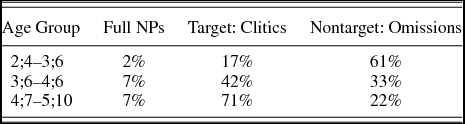
In Tryzna (Reference Tryzna2009), object omissions are attributed to a discourse-linking mechanism. Tryzna postulates that children default to this mechanism whenever they experience uncertainty as to the morphophonological material needed to realize a functional element such as an object clitic. The author assumes that Polish is an overt-object language, and therefore treats all instances of clitic omission in child Polish as nontargetlike; however, adult data are not provided for comparison.
Acquisition of Ukrainian has received very limited attention thus far. To the best of our knowledge, only two recent studies focus on word order issues in the development of the Ukrainian syntactic system (Mykhaylyk, Reference Mykhaylyk2012a; Mykhaylyk, Rodina, & Anderssen, Reference Mykhaylyk, Rodina and Anderssen2013). These studies show that children are able to correctly place DOs in various positions (i.e., postverbal and preverbal) according to semantic–pragmatic context from the age of 3, and they become mostly adultlike by the age of 6. Mykhaylyk et al. (Reference Mykhaylyk, Rodina and Anderssen2013) provide some data on omissions of DOs and indirect objects in ditransitive constructions. It appeared that, while adults omit a minority of arguments in an experimental setting (17%), children use this option much more regularly, even at the age of 5 or 6 (~60% of the time). Nonetheless, similarly to the adults, children produce one-object responses in a pragmatically felicitous way in the majority of cases: 80%–87% of arguments omitted by children in Mykhaylyk et al.’s (Reference Mykhaylyk, Rodina and Anderssen2013) study were given or previously mentioned. The authors thus suggest that children opt to produce short utterances with only as much information as needed, mirroring a syntactic option that is allowed in the adult grammar.
Theoretical approaches to argument/object omissions
In previous acquisition studies on referring choices (as well as in theoretical linguistics), much attention has been paid to object clitics and the developmental errors associated with their use, primarily involving omissions (e.g., Clark, Reference Clark and Slobin1985; Costa, Lobo, & Silva, Reference Costa, Lobo, Silva, Larranaga and Guijarro-Fuentes2012; Jakubowicz, Müller, Kang, Riemer, & Rigaut, Reference Jakubowicz, Müller, Kang, Riemer, Rigaut, Springfellow, Cahana-Amitay, Hughes and Zukowski1996; Jakubowicz et al., Reference Jakubowicz, Müller, Riemer, Rigaut, Hughes, Hughes and Greenhill1997; Müller & Hulk, Reference Müller and Hulk2001; Pérez-Leroux et al., Reference Pérez-Leroux, Pirvulescu and Roberge2008; Thrift, Reference Thrift2003; Wexler, Gavarro, & Torrens, Reference Wexler, Gavarro, Torrens, Bok-Bennema, Hollebrandse, Kampers-Mahne and Sleeman2004). Various accounts of “optional objects” have been offered, and comprehensive overviews of these competing analyses are available in many recent papers; for example, see Castilla and Pérez-Leroux (Reference Castilla and Pérez-Leroux2010) or Gavarró et al. (Reference Gavarró, Torrens and Wexler2010). The main previous approaches to argument omissions can be divided into grammatical and discourse-pragmatic accounts. Accounts based on the grammatical properties of object constructions usually relate object omission to the putative computational complexity of structures with clitics (e.g., Hamann, Rizzi, & Frauenfelder, Reference Hamann, Rizzi, Frauenfelder and Clahsen1996; Jakubowicz et al., Reference Jakubowicz, Müller, Riemer, Rigaut, Hughes, Hughes and Greenhill1997; Zesiger et. al., Reference Zesiger, Zesiger, Arabatzi, Baranzini, Cronel-Ohayon and Franck2010). Discourse-pragmatic accounts conversely identify various discourse features as possible predictors of overt argument realization (Allen, Reference Allen2000; Skarabela, Allen, & Scott-Phillips, Reference Skarabela, Allen and Scott-Phillips2013), which are applicable to various types of subjects and objects.
It is crucial for our purposes that a number of prominent grammatical hypotheses attribute DO omission during L1 acquisition to a syntactic or morphophonological property of clitics; several of these proposals are reviewed below. We consider the unique checking constraint proposed by Wexler and colleagues as an explanation for object clitic omissions in some Romance languages (Gavarró et al., Reference Gavarró, Torrens and Wexler2010; Tsakali & Wexler, Reference Tsakali, Wexler, van Kampen and Baauw2004; Wexler et al., Reference Wexler, Gavarro, Torrens, Bok-Bennema, Hollebrandse, Kampers-Mahne and Sleeman2004). These authors view the optionality of object clitics as a general outcome of a syntactic derivation that requires multiple checking operations. According to this hypothesis, there are two groups of languages: languages with past-participle agreement, in which object clitics are particularly difficult to acquire (e.g., Catalan, French, and Italian), and languages where object clitic omission occurs infrequently even at early stages (e.g., Spanish and Romanian). However, the correlation described by Wexler et al. does not always hold (for an overview, see Tryzna, Reference Tryzna2009).
Jakubowicz, Nash, Rigaut, and Christophe-Loic (Reference Jakubowicz, Nash, Rigaut and Christophe-Loic1998) and Jakubowicz and Nash (Reference Jakubowicz, Nash, Jakubowicz, Nash and Wexler2003) present a computational approach to object omission in French that relies on a categorical and featural deficiency in third-person clitics. The authors propose that these clitics differ from lexical nouns or strong pronouns in lacking the categorical feature [+N] and the feature ANIMACY. In addition, they are morphologically richer than first- and second-person clitics, containing a gender feature. The authors postulate that these deficiencies pose a special difficulty for young children attempting to merge third-person clitics into an argument position.
Phonological approaches to the clitic properties of omitted objects have also been pursued, based on the general hypothesis that children's early output is prosodically constrained (Demuth, Reference Demuth, Lust, Suñer and Whitman1994, Reference Demuth, Belikova, Meroni and Umeda2007; Gerken, Reference Gerken1994, Reference Gerken1996; Lleó & Demuth, Reference Lleó, Demuth, Greenhill, Littlefield and Tano1999). According to the “phonological hypothesis,” children's tendency to omit syllables in certain prosodic contexts affects clitics, which are phonologically weak monosyllabic elements. Tedeschi (Reference Tedeschi2009) provides empirical evidence in favor of this hypothesis and suggests several prosodic factors (e.g., a trochaic bias) that affect early speakers of Italian (up to age 3) and could account for omission phenomena.
Research on object omissions in null-object languages such as European Portuguese (see, e.g., Costa et al., Reference Costa, Lobo, Silva, Larranaga and Guijarro-Fuentes2012) is particularly relevant to the issues raised in this paper; this work shows that, if the target language allows a null argument option, children preferentially make use of this option for a long period of time. For instance, in production experiments reported in Silva (Reference Silva, Escobar, Torrens, Gavarro and Gutierrez2010) and Costa et al. (Reference Costa, Lobo, Silva, Larranaga and Guijarro-Fuentes2012), children acquiring European Portuguese omit third-person clitics at a rate of 52.5% until the age of 6. The author concludes that clitic omission in child Portuguese constitutes an overuse of the null-object option independently available in the target grammar.
DO pronouns in most of the studies mentioned above correspond to object clitics. However, as Pirvulescu and Roberge (2005) pointed out, missing DOs cannot always be treated as cases of clitic-drop. A range of null-object types appear in child speech. Beside clitic-drop, there are cases of deictic null objects, where the referent is physically present in the communicative situation, and nonreferential null objects, where there is no specific element identified as a potential referent in the linguistic or extralinguistic context. An attempt at a general account of object omission has been put forward by Pérez-Leroux et al. (Reference Pérez-Leroux, Pirvulescu and Roberge2008) for child French and by Castilla and Pérez-Leroux (Reference Castilla and Pérez-Leroux2010) for child Spanish. Castilla and Pérez-Leroux claim that children overgeneralize a null cognate object from generic contexts in pronominal and nonpronominal situations. This null object is assumed to be a null bare noun. The null cognate object competes with both lexical DPs and pronouns in child grammar. According to the authors, the learning problem here is semantic rather than syntactic.
Studies based on discourse-pragmatics approaches to argument realization focus on the different properties of referents and the contexts in which they appear. Therefore, these accounts of object omission tend to focus on knowledge of the informational structure and pragmatic features of discourse. For instance, Allen (Reference Allen2000) considers several discourse features as possible predictors of overt argument realization in Inuktitut, and presents a logistic regression analysis confirming that five of these features have a significant effect: absence, contrast, differentiation in context, newness, and person. This list has subsequently been extended to include other factors, including joint attention (Skarabela et al., Reference Skarabela, Allen and Scott-Phillips2013), number of subject referents (Serratrice, Reference Serratrice2008), and animacy of a referent or competitor (Serratrice, Reference Serratrice2013; but see Skarabela, Reference Skarabela2007), where the same author excludes this factor on the argument that animacy is, in most cases, an inherent property of the referent and hence a semantic rather than a discourse-pragmatic factor.
Although a number of studies consider the acquisition of argument realization in various languages, some language types, including the Slavic languages, which permit discourse-related omissions, remain underrepresented. Therefore, it is not obvious at the moment whether the proposed accounts (whether grammatical or discourse pragmatic) are applicable to languages in which omissions in child speech may simply be adultlike reflections of the language-specific grammar system.
DO TYPES IN POLISH AND UKRAINIAN
General language facts
Both Polish and Ukrainian are syntactically “flexible” languages; although they exhibit basic subject–verb–object (SVO) word order, both languages allow various word order permutations depending on the information status of sentence elements. Each language has a complex case marking system, consisting of seven cases. NPs usually contain a noun plus a facultative determiner (e.g., demonstrative/possessive pronoun) or adjective. Case marking depends on declension type, gender, and number of the noun.
This study focuses on the use of DOs in linguistically specified contexts, which share a similar mode of expression across the two languages (see Examples (1) and (2)). By linguistically specified contexts, we mean those environments in which a DO referent has been previously mentioned in a question or a statement, and thus could be defined as given, specific, definite, or known (see more in the Method section). Because the structural contrast between the two languages, and the internal grammatical structure of Polish in particular, is central to the purpose and design of this study and to the argumentation brought forward based on the results, this contrast is addressed in detail in the following three subsections.
Polish pronominal DOs
The pronominal system of Polish deserves a more detailed description than was provided in the overview above. Polish exhibits strong or full pronominals and clitic DOs, which developed historically from reduced forms of the full pronouns (for a comprehensive analysis of the synchronic situation, see Franks & Halloway King, Reference Franks and Holloway King2000; Witkoś, Reference Witkoś1998; for a historical account, see Długosz-Kurczabowa & Dubisz, Reference Długosz-Kurczabowa and Dubisz2001; Włodarczyk, Reference Włodarczyk2012). However, note that Polish clitics, and Slavic clitics in general, do not share the complete cluster of typical properties exhibited by well-known clitic constructions in Romance languages. For instance, in the preverbal position, Polish clitics do not need to be strictly adjacent to the verb, and their placement is not blocked by the presence of a negation marker, as in Italian (Witkoś, Reference Witkoś1998, p. 193).
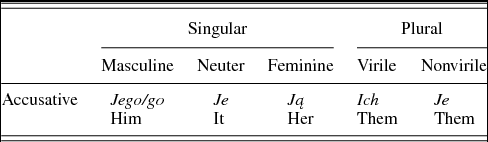
In the accusative case, the main morphological distinction between strong forms and clitics is seen in two masculine forms –jego and go–, shown in Table 2. Other full or clitic pairs, such as the third-person singular for feminine, neuter, and plural, do not differ at first glance. However, distributional, semantic, and syntactic evidence demonstrates amply that full pronouns and clitics are distinct for all Polish person/number/gender combinations (see Grzegorczykowa, Laskowski, & Wróbel, Reference Grzegorczykowa, Laskowski and Wróbel1998, p. 339; Saloni & Świdziński, Reference Saloni and Świdziński1985; Witkoś, Reference Witkoś1998, p. 150).
Third person pronouns and clitics in Polish accusative
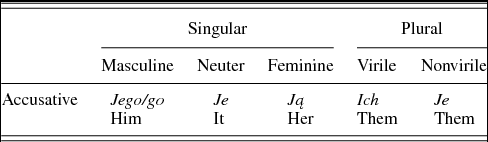
One important difference between the strong pronouns (e.g., jego in accusative, jemu in dative) and the corresponding clitics (e.g., go, mu) is found in the area of semantics: strong pronouns can only be used with animate/human referents, whereas clitics can refer to both animate and inanimate objects. Other clitic/pronoun distinctions are morpho/phono/syntactic in nature, and correspond to the criteria for clitic identification extensively discussed in the literature (see, e.g., Cardinaletti & Starke, Reference Cardinaletti, Starke and van Riemsdijk1999; Franks & Halloway King, Reference Franks and Holloway King2000; Kayne, Reference Kayne1975). In particular, Polish object clitics are monosyllabic elements that lack lexical stress, and thus usually appear in unfocussed pre- and postverbal positions as in (3a) and (3b):
-
(3)
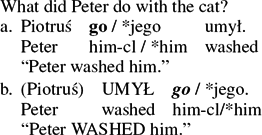
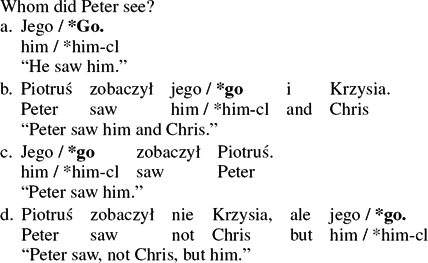
In contrast, strong pronouns can carry stress. These pronouns are used in initial or sentence-final position to indicate some contrast between two different constituents in the immediate context. The typical syntactic tests for pronoun/clitic distinction are illustrated below: clitics cannot appear in isolation (4a) or in a coordinated construction (4b), and they cannot be topicalized in sentence-initial position (4c) or extraposed (4d). Only full pronouns occur in these positions.
-
(4)
In sum, Polish full pronouns differ considerably from their clitic counterparts in form, function, and placement. As summarized in Franks and Halloway King (Reference Franks and Holloway King2000, p. 162), Polish “pronominal clitics appear immediately after the verb plus verbal clitics or in any position a scrambled NP can otherwise appear (other than initial).” For a more elaborate analysis of the full and clitic pronouns in Polish, see Nagórko (Reference Nagórko1996) and Witkoś (Reference Witkoś1998).
Ukrainian pronouns
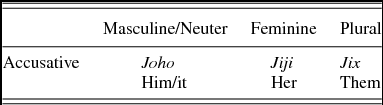
The Ukrainian pronominal elements tend to differ from their Polish counterparts morphologically. It has been widely accepted since at least Jakobson's (1935/Reference Jakobson1971) generalization that all the original Slavic inflecting clitics were lost in East Slavic, which includes Russian, Belarusian, and Standard Ukrainian (see also Franks & Halloway King, Reference Franks and Holloway King2000; Shevelov, Reference Shevelov, Comrie and Corbett1993). Thus, with the exception of some decadent forms in the southwestern dialects, Ukrainian pronouns are always used in their full form: for example, see the third-person singular accusative pronouns illustrated in Table 3.
Third person pronouns in Ukrainian accusative
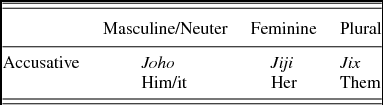
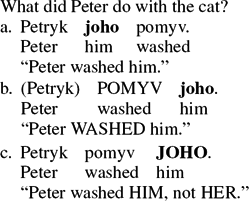
These full forms exhibit only a few of the syntactic properties associated with Polish clitics; the above statement from Franks and Halloway King (Reference Franks and Holloway King2000, p. 62) can readily apply to both languages. Specifically, pronominal DOs in Ukrainian usually appear in preverbal position if there is another sentence-initial element, as in (5a), but they can also remain postverbally in special prosodic circumstances (e.g., when the verb receives the strongest falling pitch accent, as in (5b), or when the object is stressed, as in (5c)):
-
(5)
There is no consensus on the categorial status or theoretical analysis of pronouns in general for languages that lack clitics but allow flexible word order, and in particular, little is known about Ukrainian pronouns. However, it is obvious that these forms do not satisfy most of the criteria for clitics, as exemplified by the Polish examples in (4) and the Ukrainian examples in (6).
-
(6)
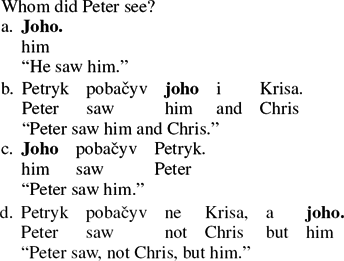
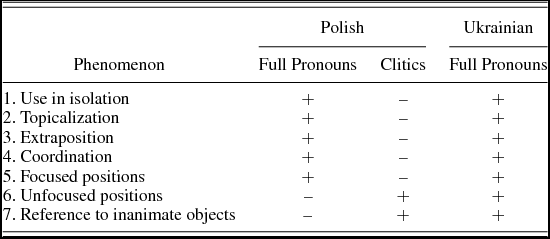
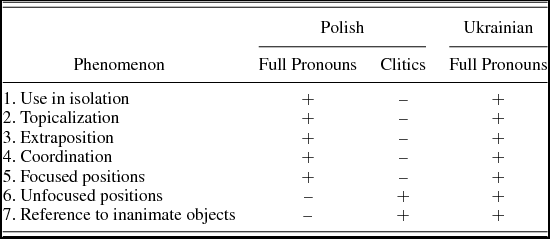
It is crucial for our study that Ukrainian pronouns mostly align with Polish full pronouns in showing many characteristics typical of full lexical NPs, whereas Polish clitics exhibit different prosodic, syntactic, and semantic properties, which are summarized in Table 4.
Characteristics of Polish and Ukrainian pronouns
Null DOs
Both Polish and Ukrainian allow various elliptical constructions that must be interpreted based on information provided by the linguistic (discourse) or extralinguistic (environmental) contexts. In natural speech, even the DOs of obligatorily transitive verbs can be omitted (Kowaluk, Reference Kowaluk1999; but, for a different view on Polish, see Tryzna, Reference Tryzna2009). Null DOs can occur when the antecedent appears in a preceding statement (see (7a) for Polish; (7b) for Ukrainian) or in a question ((8a) for Polish; (8b) for Ukrainian). In this study, we will investigate only question–answer contexts; we leave the anaphoric contexts exemplified in (7) for further research.
-
(7)
-
(8)
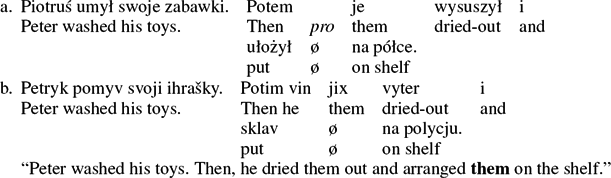
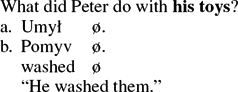
As noted above, the use of null versus overt objects varies according to intralinguistic factors (such as prior discourse) as well as extralinguistic factors (sociodemographic origin of the speakers, communicative situation, language register, etc.). Elliptical constructions are common in colloquial speech, but less frequent in written language variants. In our study, we consider only those contexts where pronouns alternate with null objects freely and without obvious semantic/pragmatic restrictions (as shown by the adult native speakers’ data). However, the use of null objects is constrained even in these contexts by a rule of subject–object symmetry: an object can be omitted together with the subject, but cannot be omitted on its own: SVO ➔ ØVØ (as in (10a) and (10b)), but SVO ➔ *SVØ (as in (9a) for Polish and (9b) for Ukrainian).
-
(9)
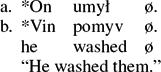
Empirical support for this generalization comes from a recent experimental study on Ukrainian presented in Mykhaylyk (Reference Mykhaylyk2012b). Preliminary results of an acceptability judgment task with 20 adult native speakers of Ukrainian show that the average score for the SV structure was much lower than the average score for the V structure: 1.8 versus 4.9 (out of 6). These findings suggest that DO omissions in sentences with transitive verbs are allowed in the adult grammar, but they are constrained contextually (to discourse-specified elements) and syntactically (to subjectless structures). However, there is no similar experimental data from Polish, and the previous theoretical generalizations conflict to some extent. Although null objects are acceptable in many structures in both languages, dropping an object is never obligatory. The input that Polish and Ukrainian L1 learners are exposed to is therefore ambiguous.
PRESENT STUDY: APPROACHES AND PREDICTIONS
In our study, we address two main issues largely disregarded in previous research: (a) children's choice of DO type in those languages that allow null arguments (such as the Slavic languages), and (b) the difference between acquisition of clitics and full pronouns in the same contexts. While it is broadly accepted that “clitic pronouns have particular characteristics that differentiate them from other types of pronouns” (Tedeschi, Reference Tedeschi2009, p. 2, based on a number of theoretical studies), there is no experimental evidence that verifies directly how these “particular characteristics” influence acquisition of pronominal or anaphoric expressions. We present just such a study here, by investigating a pair of discourse-oriented languages for which discourse-pragmatic approaches predict a minimal clitic–full pronoun difference with regard to omission of referring expressions. Even proponents of grammatical approaches to optional objects suggest that “for languages with a null object option, the lack of a clitic pronoun obviously cannot be evaluated as a departure from adult grammar. Rather, it should be considered . . . taking pragmatic aspects into account” (Gavarró et al., Reference Gavarró, Torrens and Wexler2010, p. 208). In our study, we support this statement in general, but suggest that the word “clitic” is avoidable in the citation above.
The main predictions of our experimental study depend on the theoretical analysis in which it is couched. The clitic deficit hypothesis (based on Jakubowicz et al., Reference Jakubowicz, Müller, Riemer, Rigaut, Hughes, Hughes and Greenhill1997) predicts that children will have particular difficulties with third-person clitic object pronouns, leading to more omissions in Polish than in Ukrainian. In addition, grammatical approaches that emphasize the role of morphophonological characteristics in reduced or weak pronominal elements (e.g., Tedeschi, Reference Tedeschi2009) might also predict that some elements are “easier” to acquire than others. For instance, Polish clitics (e.g., go “him”) might be omitted more often than Ukrainian full pronouns (e.g., joho “him”), whereas there should be no difference between Polish ich [ix] “them” and Ukrainian jix “them”; conversely, Ukrainian monosyllabic pronouns (e.g., jix) should be omitted more often than disyllabic full pronouns (e.g., joho).
In contrast, discourse-pragmatic approaches do not distinguish arguments according to their grammatical/syntactic properties (or at least, such approaches do not emphasize these distinctions). Nonetheless, these accounts do consider certain syntactic phenomena; for instance, it is never argued that just any sentence element can be omitted given the right pragmatic context; subject/object arguments are vulnerable because of their centrality in syntactic derivation. Thus, the discourse-pragmatic hypothesis (in our own terms) predicts that (a) a referring DO argument (either clitic or full pronoun) may be omitted if it is linguistically specified (i.e., mentioned in previous discourse), in both adult and child speech (based on Allen, Reference Allen2000); and (2) if the specified DO is animate/human, it is more likely to be realized as a pronoun than an NP (based on Fukumura & Van Gompel, Reference Fukumura and Van Gompel2011; Serratrice, Reference Serratrice2013; and properties of the Polish grammar described above).
METHOD
Participants
The present study was conducted separately with Polish- and Ukrainian-speaking participants. Each of the language groups was divided into five age groups: 3-, 4-, 5-, and 6-year-old children, and a group of adult controls.
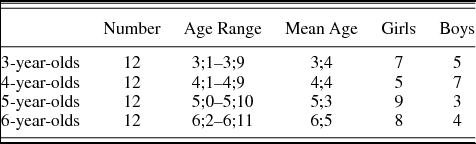
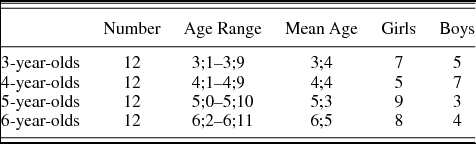
Among the Polish-speaking participants, 48 were monolingual children acquiring Polish as their first language and 33 were adult native speakers of Polish. The children's ages ranged from 3;1 to 6;9; there were 29 girls and 19 boys (see Table 5 for more details). All the children came from middle-class families. The adults were native speakers of Polish with some knowledge of other languages (German or English) acquired in a school setting. The adult participants consisted of 25 females and 8 males, ranging in age from 19 to 70 years (mean = 27). All adult speakers were middle class with an educational level of secondary school or higher. The children and adults were recorded in Poznań in western Poland.
Polish child age groups
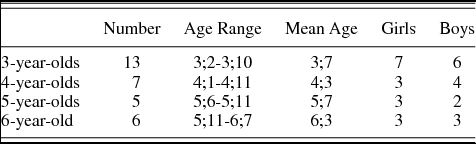
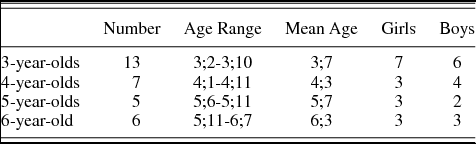
The Ukrainian group included 31 children acquiring Ukrainian as their first language and 22 adult native speakers of Ukrainian (the children's caregivers). The children ranged in age from 3;2 to 6;7, and were split into four age groups as shown in Table 6. All the children were primarily Ukrainian speakers with some passive knowledge of Russian, which they often heard in everyday life. The adults ranged in age from 17 to 65 (mean = 32), with a minimum of secondary school education. All were active speakers of both Ukrainian and Russian, but identified Ukrainian as their native language. Ukrainian–Russian bilingualism is common in Ukraine; but because Russian has syntactic properties similar to Ukrainian, no cross-linguistic influence is expected with regard to the object types investigated. The Ukrainian children and most of the adults were tested in Ternopil in western Ukraine in the spring of 2012.
Ukrainian child age groups
Materials and stimuli
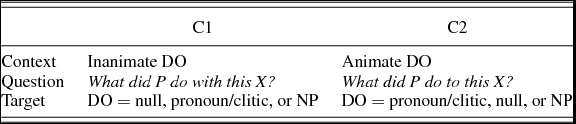
The experiment was designed as an elicited-production picture description task, based on similar tasks used in Castilla and Pérez-Leroux (Reference Castilla and Pérez-Leroux2010), Tedeschi (Reference Tedeschi2009), and Tryzna (Reference Tryzna2009). During the experiment, the participants were shown a series of pictures on a computer screen representing two experimental conditions depending on the question type: Condition 1, with a specified inanimate DO, and Condition 2, with a specified animate DO. The experimental design is summarized in Table 7.Footnote 2
Experimental conditions
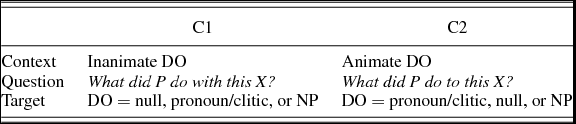
Note: Both conditions contained eight items. C1, Condition 1; C2, Condition 2; DO, direct object; NP, noun phrase.
The words used in the linguistic materials were selected according to certain morphological and syntactic properties. The verb forms were the same in each trial: past tense, masculine, perfective, and (mono)transitive. The same subject (a boy called Peter) was used in all items. All objects were introduced in the question text in either the instrumental (inanimate) or dative (animate) case. There were eight animate (three human and five animal) NPs and eight inanimate NPs, and their gender/number properties were distributed between masculine, neuter, feminine, and plural. Note that all contexts could trigger varying replies, which might include overt pronouns, null pronouns, or NPs, as explained in more detail below.
Procedure
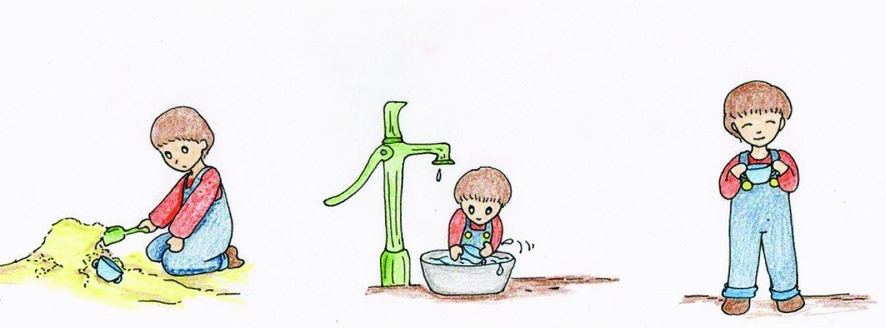
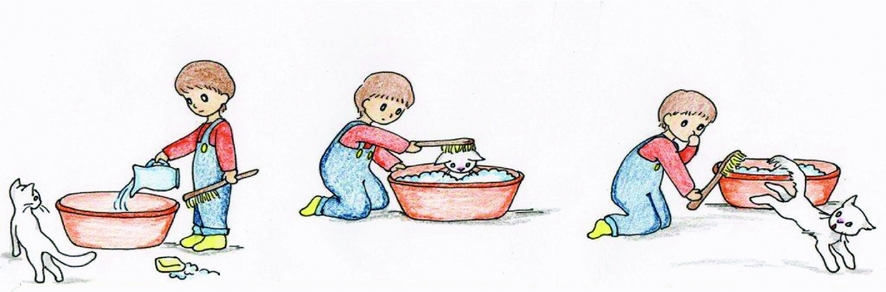
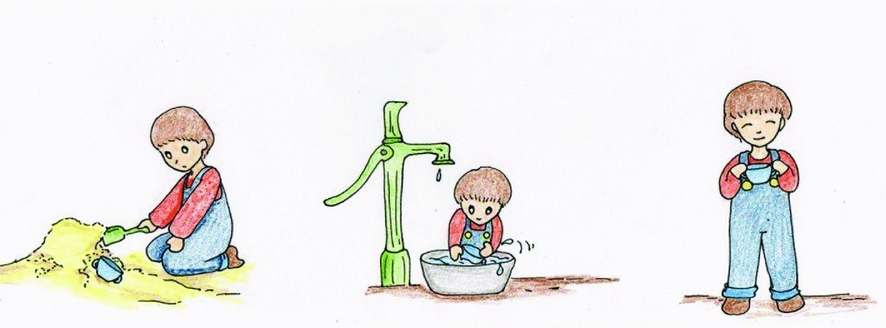
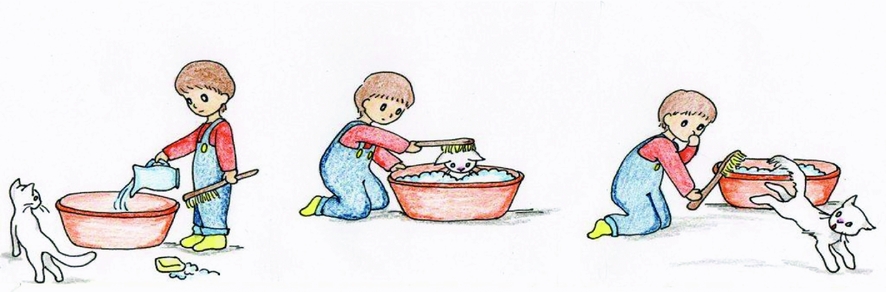
The experiment proceeded as follows. The experimenter set up the computer in front of the participant and introduced the main character, Peter, and the puppet, Dragon. Next, the participant was shown a few training items: Peter performed an action on an object or another person, and the puppet listened to the experimenter's story about it. The puppet did not pay attention, and would ask either “What did Peter do with the object?” or “What did Peter do to the person?” The participants were asked to respond with a short statement. The same procedure was then used with the testing items, which included 16 pictures presented in a pseudorandomized order. However, for most participants, the storytelling component appeared to be unnecessary, because they were eager to describe the picture themselves. Each picture showed Peter performing an action in three parts, while the question usually concerned the final part of the story (Peter with the object, person, or animal). The stimuli are exemplified in Examples (10) and (11), in Figures 1 and 2, and in Appendix A.
Visual stimuli for Condition 1.
Visual stimuli for Condition 2.
-
(10)
-
(11)
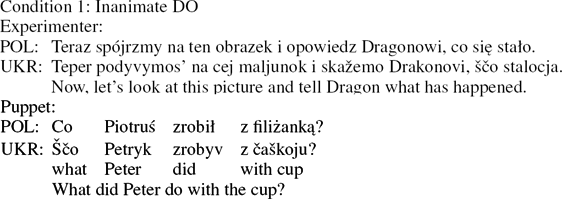
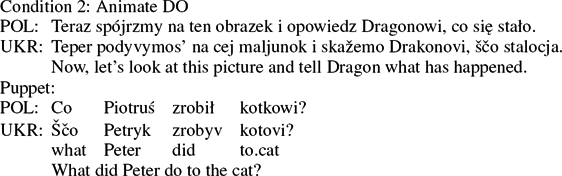
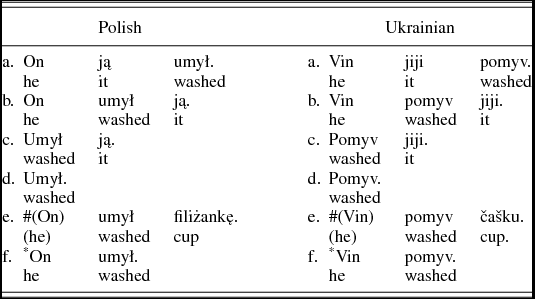
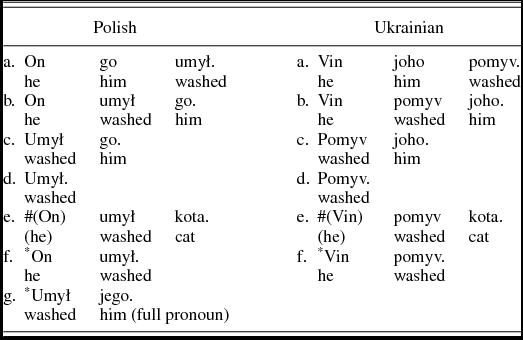
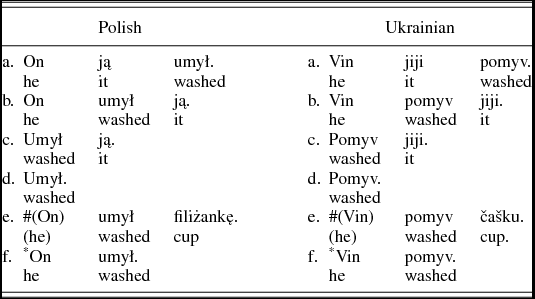
The target or expected responses could vary, because there were several possible answers to each question. However, some possible response configurations, for example, SVø (Table 8, entry f and Table 9, entry f), were not well formed in any of the given contexts, and thus were considered “erroneous.” In addition, sentences with full NP objects (Table 8, entry e and Table 9, entry e) were considered to be grammatical, but pragmatically less appropriate than sentences with pronominal or null DOs, due to the lexical redundancy of including in the response the same NP already mentioned in the question. The same subject, Peter, was used across all items; however, the subject was often omitted in the responses, and its realization has not been considered in this study.
Possible responses in Condition 1
Possible responses in Condition 2
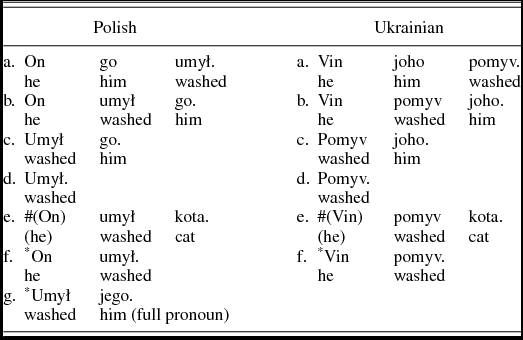
The participants’ responses were audiorecorded and later transcribed by research assistants. Only relevant utterances (i.e., those that included obligatorily transitive verbs) were coded for the purpose of this study. The coding categories were as follows: full NP DO (as in Table 8, entry e and Table 9, entry e), DO pronoun/clitic (as in Table 8, entries a, b, and c and Table 9, entries a, b, and c), or null DO (as in Table 8, entries d and f and Table 9, entries d and f). Detailed statistical analyses were conducted with the two most appropriate target responses: pronominal DOs and null DOs.
RESULTS
Adult data
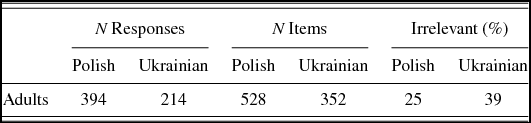
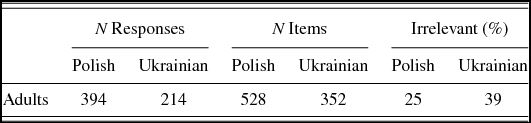
Seventy-five percent (394 out of 528) of Polish adult responses were included in the analysis, with the remaining 25% omitted due to irrelevance (e.g., responses formulated as complex constructions without a transitive verb; Table 10). Sixty-one percent (214 out of 352) of Ukrainian adult responses were included in the analysis, with 39% omitted.
Adult's responses by language group
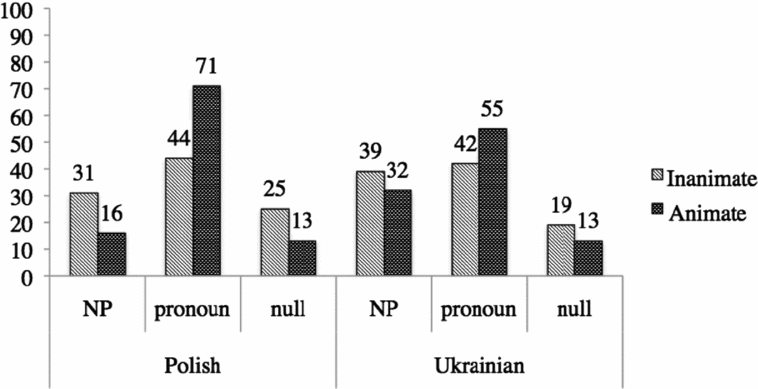
The results show that the adult grammars of both languages allow three types of DOs: pronouns, null DOs, and NPs (Figure 3). The most frequent use of object pronouns was found in animate contexts for both Polish and Ukrainian (71% and 55%, respectively). It is crucial that the data show that null DOs are acceptable in adult speech, especially as a realization of an inanimate referent; null DOs appeared in this context at a rate of 25% for Polish and 19% for Ukrainian. The majority of null DOs appeared in context-appropriate øVø structures, while erroneous *SVø responses were used in only three cases in complex utterances in Ukrainian. It is interesting that the adults also often used full NP DOs (at a rate of 16% to 39%), although such a choice incorporated an element of redundancy into their responses. Because use of pronouns was the most pragmatically appropriate option in all the contexts presented, we set aside the NP DOs and considered only pronouns and null DOs in our detailed analysis.
Percentages of direct objects used in two contexts for adults. NP, Noun phrase.
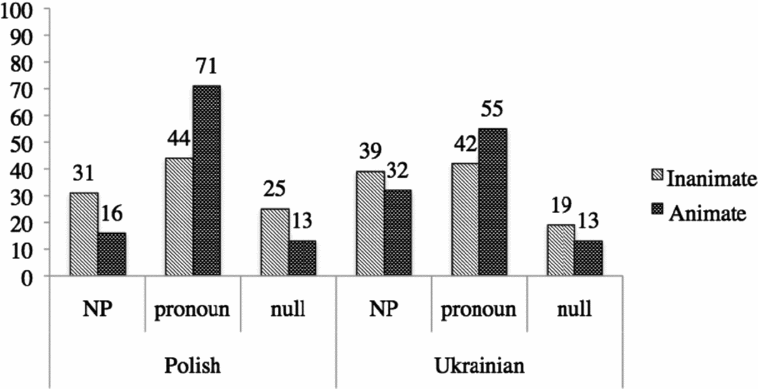
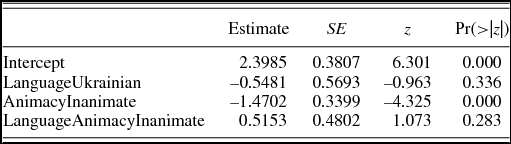
Generalized linear mixed model analyses were conducted with the statistical program R, using library “lme4” functions. Numbers of null versus pronominal DOs were coded as a binomial response in our model, with “condition” (animate or inanimate) entered as an independent variable in addition to the dichotomous variable “language” (Ukrainian or Polish). “Participant” and “item” were included as random effects, and did not differ statistically. Model.condition.adults, the subset of the adult data, showed no effect of language (p = .336) or interaction of language and condition (p = .283) on realization of DO as pronominal or null. However, a highly significant effect of condition was found in the whole adult data set (p < .001), as summarized in Table 11. These results suggest that the animacy of the referent affected the choice of DO type in both languages.
Fixed effects for the effects of language and animacy on the direct object type for adults (608 responses)
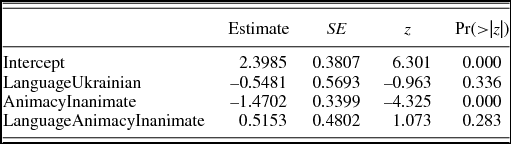
To verify these effects further, we computed a second model with the independent variable “semantics” (human, animal, and inanimate) considered as a possible predictor of DO type. However, the model.semantics.adults fared no better than model.condition.adults: no significant difference was found between the two languages, and no significant interaction between the variables. There was a highly significant difference in realization of inanimate objects compared to humans and animals (p < .001); however, there was no difference between the realization of human and animal referents. Thus, for adult speakers of Polish and Ukrainian, any animate referent (regardless of its “human” semantics) is more likely to be realized as a pronoun, while inanimate referents are more often realized as null elements.
Child data
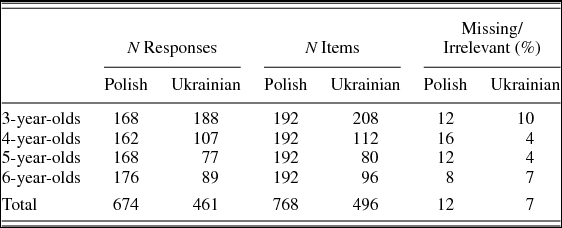
The child data set we analyzed included 674 (out of 768) relevant items for Polish and 461 (out of 496) relevant items for Ukrainian. The relevant items in Polish include only clitics: full pronouns (marked by stress and syntactic position) were inappropriate in the tested contexts, and the Polish children clearly avoided them. No child placed a pronominal DO in the sentence-final position if the utterance contained more than two elements. Only 4 out of 46 children used pronominal elements in the sentence-initial position, and even for these children, the degree of use of this nonadultlike placement was well under 50% in each case (11%, 17%, 19%, and 30%). The distribution of relevant child responses with Polish clitics and Ukrainian pronouns is given in Table 12.
Children responses by age and language group
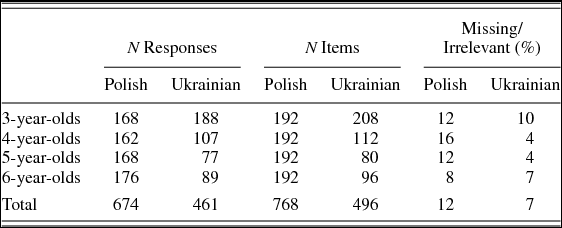
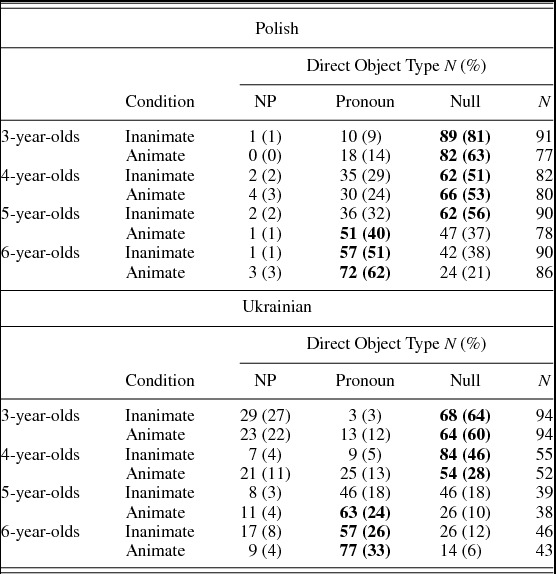
Because the child group has a rather wide age range (from 3 to 6), we analyzed the data separately for each age subgroup. Table 13 presents the child results by age and condition, with the highest rates of DO types shown in bold for each age group for each language.
Child results per age group and condition
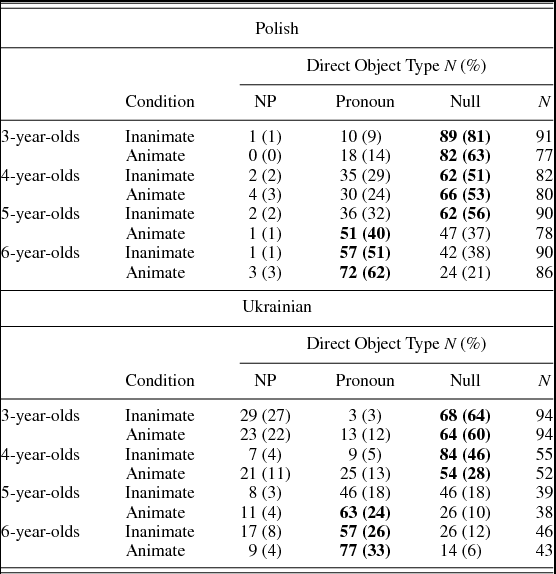
Note: The highest rates of direct object types for each age group for each language are in bold type. NP, Noun phrase.
We can see that 3- to 4-year-old children prefer null objects at higher rates than do adults (from 54% to 89%) in both conditions. Five- to 6-year-olds start using DO pronouns more often than null DOs, especially in the animate condition. Crucially, however, there are almost no errors in the use of mandatory transitive constructions. Null DOs could appear in øVø or *SVø structures; however, the numbers of ungrammatical structures was very low in the Ukrainian child data (only three cases out of 461) and nonexistent in the Polish data.
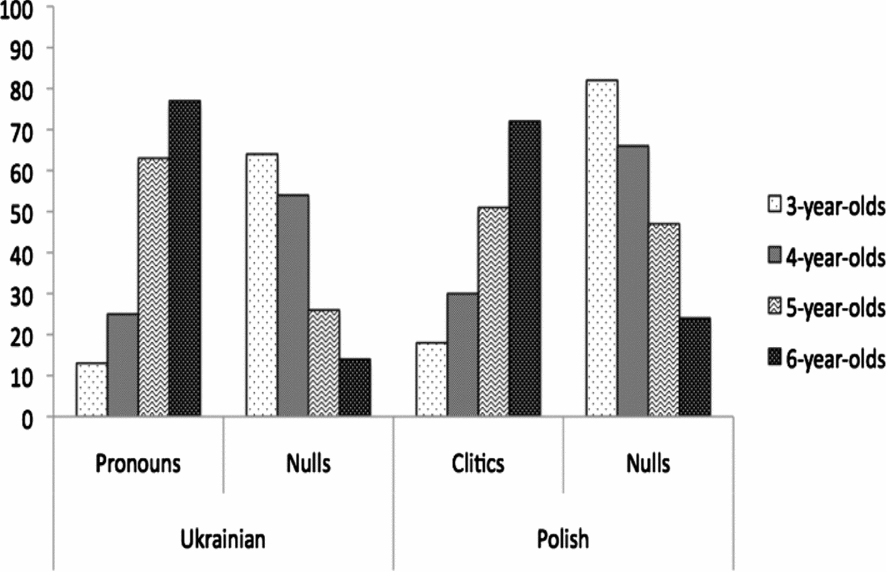
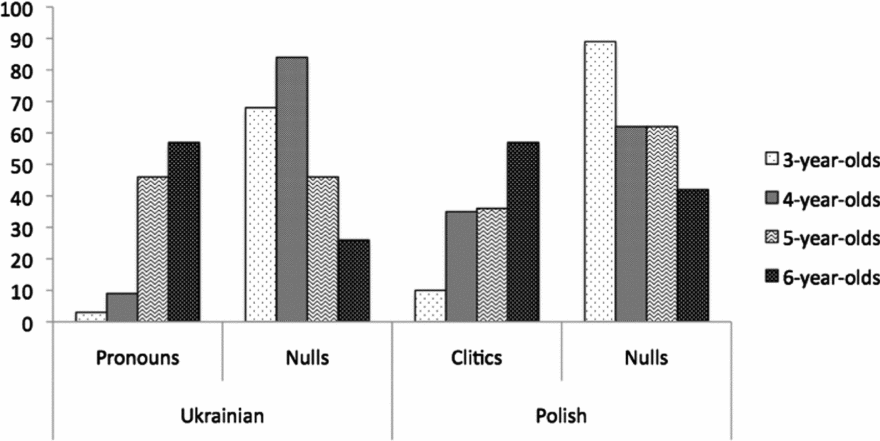
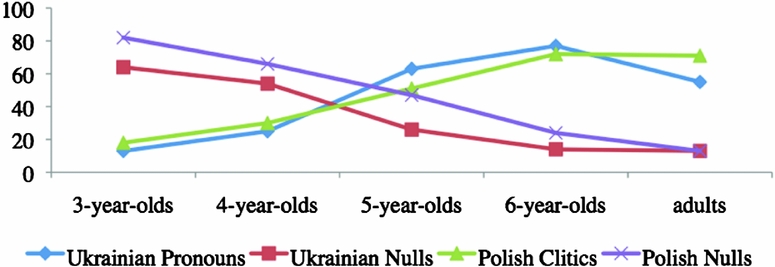
Figures 4 and 5 illustrate developmental tendencies in the use of null DOs and pronouns in the two conditions (animate and inanimate) for the two groups. These graphs show similar behavior across both groups of participants: the use of Ukrainian pronouns and Polish clitics increases with each year, starting below 20% at the age of 3 and reaching adult level by the age of 5 or 6.
Use of direct objects for animate referents for children.
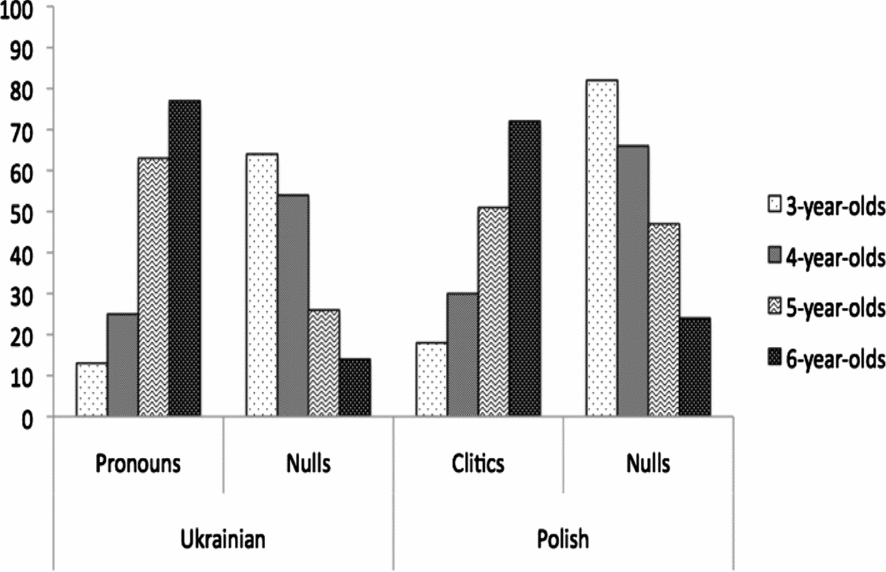
Use of direct objects for inanimate referents for children.
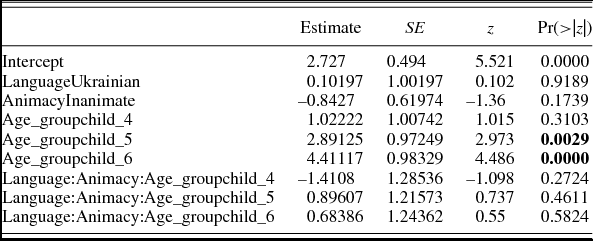
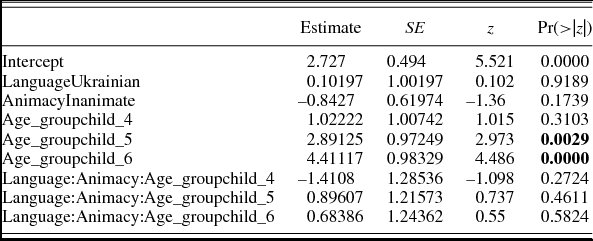
Statistical analyses of the child results was conducted using the same linear mixed models as for the adult data, but with the addition of another variable, “age group,” in order to account for different developmental stages of acquisition of null DOs and pronouns. Similar to the adult results, the general analysis of the total child data (summarized in Table 14) did not show any effect of language (p = .919). Unlike the adults groups, there was also no effect of condition (p = .174). However, there was a highly significant difference between the older (5- and 6-year-old) children and the other age groups (p = .003 and p < .001, respectively). None of the interactions between these three factors was significant.
Fixed effects for children (N =79) for 1039 observations with pronouns and null direct objects
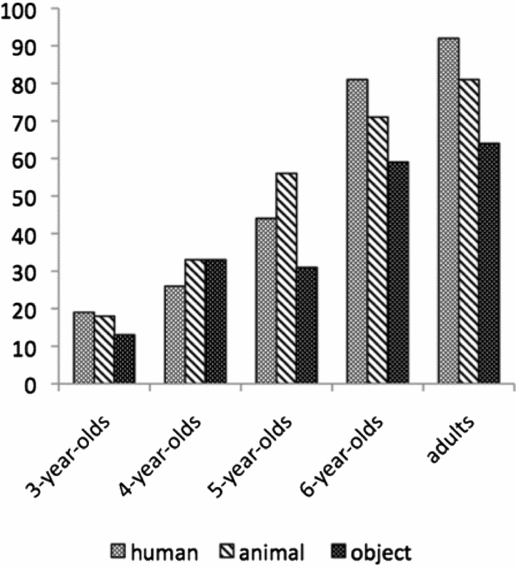
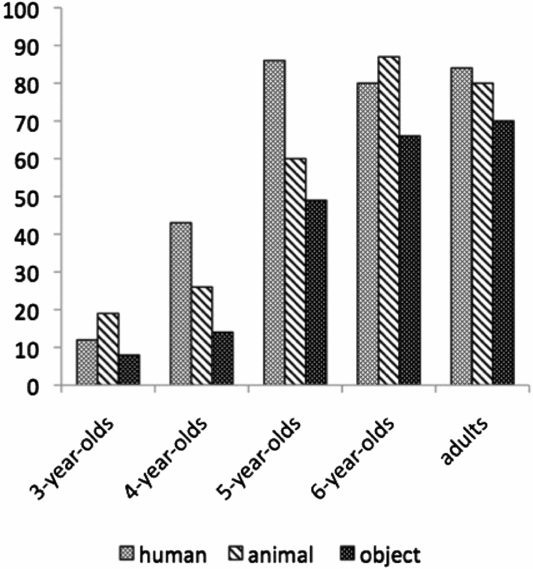
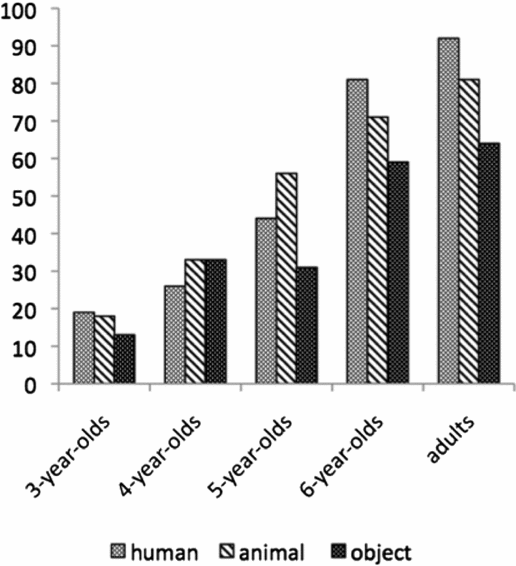
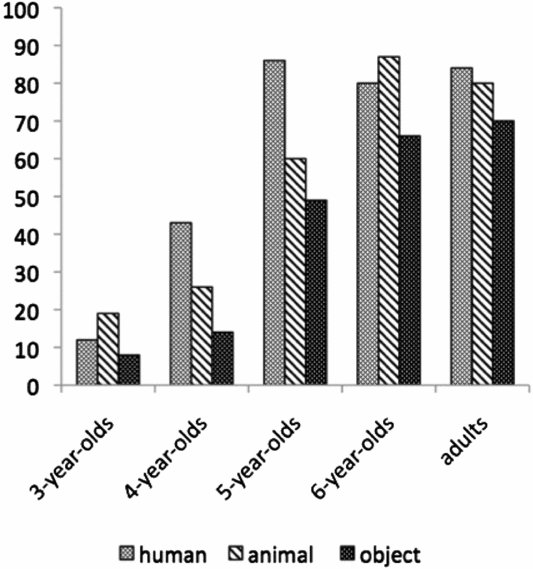
More detailed analysis of the separate age groups show only marginal effects of animacy for older children; however, due to the low numbers of relevant examples, the validity of these results must be verified further. Although it seems that children begin to use more pronouns for human and animal referents than for inanimate objects from the age of 4, as illustrated in Figures 6 and 7, the role of the referent's semantics is not supported by the statistical analysis in this data set.
Use of clitics in Polish.
Use of pronouns in Ukrainian.
To summarize thus far, Polish and Ukrainian children behave similarly in their use of different types of DOs: they start by using mostly null DOs and reach adult levels of pronouns/clitic use only around the age of 6. Both language groups show the same child–adult distinctions: 3- to 4-year-old children differ significantly from the other age groups, and the effects of animacy start to show up only at the older stages.
Third-person pronouns: “him” and “them”
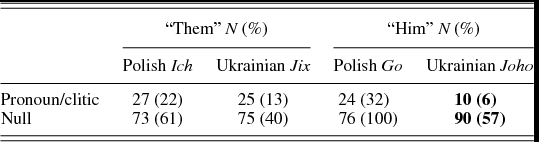
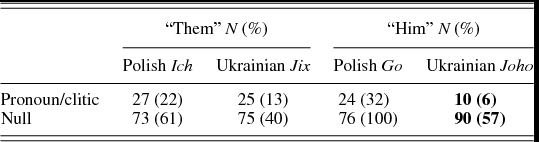
We now verify whether the morphophonological properties of clitics versus full pronouns affect children's choice of DO type. Recall that we predicted that monosyllabic unstressed elements (i.e., clitics) might be easier to omit than full disyllabic pronouns. Our data allow us to compare these two types of elements. The Polish clitic go “him” has a counterpart full pronoun jego, which is used only in some contexts (not tested in this study), but in Standard Ukrainian, the only possible form for a third-person singular masculine pronoun is the full form joho. In contrast, the plural form of the third-person pronoun “them” is monosyllabic in both languages: ich [ix] in Polish (for masculine) and jix in Ukrainian. Below we present the results for the most vulnerable age group, the 3- to 4-year-olds, who showed a very high rate of DO omissions. Note that we did not split the data along the “condition” variable, because, as shown above, we observed no effect of animacy for this age group.
As shown in Table 15, the monosyllabic elements ich, jix, and go are realized at similar rates in both languages (27%, 25%, and 24%, respectively). It is intriguing that the disyllabic pronoun joho is not used at a higher rate than the other forms, despite the prediction above. The results show the opposite effect: the full pronoun is omitted more often than clitics (90% omission rate vs. 73%–76% for other elements in Table 15). Although the low number of items in this data subset does not allow us to conduct reliable statistics, the contrasts between the two morphological forms clearly contradict the “clitic difficulty” hypothesis.
Use of direct objects for a third-person plural masculine referent (them) and a third-person singular masculine referent (him), 3- to 4-year-old children
DISCUSSION
Adult grammar
The results presented above allow us to draw some important conclusions about the state of the target grammar in Polish and Ukrainian: the acceptability of DO omissions in both languages, the effects of animacy on the DO choice, and NP substitutions of pronouns.
Our data show that adult speakers of Polish and Ukrainian use three types of DOs: pronominals, null elements, and NPs. Although the most pragmatically appropriate grammatical structure with a mandatorily transitive verb is an overt DO (i.e., SVO or øVO), in some contexts the structure øVø is also used. If both the subject and the object are recoverable from the previous context, as in the experimental stimuli exemplified in (10) and (11), the verbal arguments can be dropped. The results of our experiment show that omitted DOs are acceptable in adult speech, especially when the object to be omitted is inanimate. It is important that there is no statistical difference between the data obtained from the two language groups, confirming that both Polish and Ukrainian are object-drop languages (contrast to Tryzna, Reference Tryzna2009).
Another finding concerns the semantic properties of the referent, which might affect the choice of DO type. It is clear that givenness/specificity of a DO referent allows it to surface as null (see, e.g., Mykhaylyk et al., Reference Mykhaylyk, Rodina and Anderssen2013); however, other language-specific properties may also influence the choice of DO. We tested the role of animacy in our experiment, and found that, when the DO referent was human or animal, it was more often realized as a pronoun than as a null object or NP. These results suggest that the referent's animacy is an important factor in DO realization.
In addition, it appeared that adults are not always pragmatically efficient: our adult participants overused NPs (from 16% to 39%) instead of avoiding repetition by using more context-appropriate pronouns. It is possible, however, that this finding is an outcome of the “unnatural” experimental setting, where the adult speakers tried to be as “correct” and informative as possible (see similar results and discussion in Mykhaylyk, Reference Mykhaylyk2012a; Mykhaylyk et al., Reference Mykhaylyk, Rodina and Anderssen2013). We set these findings aside for now, because they are not directly relevant to our main research question concerning clitic/pronoun acquisition. We hope to return to these data when spontaneous speech samples become available for comparison with the experimental findings.
Child grammar: Predictions evaluated
Our research goal concerning child grammar can be divided into two subissues, which we will discuss in turn: (a) children's preferences for DO realization at different ages; and (b) the role of the referent's semantics and morphosyntax in the pattern of omissions. Based on our experimental findings, in this section, we will reevaluate the two overarching hypotheses described earlier in Predictions (the clitic deficit hypothesis and the discourse-pragmatic hypothesis), and indicate new directions for further investigation.
Our experimental data reveal that the use of third-person DO pronouns takes time to develop: Polish and Ukrainian children have knowledge of the semantic and syntactic properties of pronouns, but they use them differently from adults. The most prominent difference between the children and adult participants lay in the production of null and pronominal DOs. Both Polish and Ukrainian children employed omissions at high rates till the age of 5. As shown in Figures 4 and 5, the children use very few full pronouns/clitics at early stages, which correlates with the high numbers of null DOs at the 3–4 age range. Around the age of 5, the children start using more pronouns for animate referents, and around the age of 6, they begin to use them for inanimate objects. The general developmental trajectory is similar for both languages. Statistical analyses of DO types in the children's responses reveal no significant difference between the two languages, as in the adult data. The postulated “clitic effect” in object omissions was not found, and thus the predictions based on the “clitic deficit hypothesis” have not been supported.
Moreover, the data clearly show that the majority of Polish children treat pronominal elements (e.g., ich “them”) as clitics, and not as full pronouns. These elements do not receive stress in child language. Only four children showed some confusion regarding the placement of these pronominal forms and used them in the infelicitous sentence-initial position. None of the children placed a pronoun in sentence-final position if the utterance contained more than two elements. These results suggest that children are able to differentiate between the third-person clitics and strong pronouns in linguistically specified contexts.
Many existing grammatical approaches to the acquisition of pronominal elements hold that clitics require some special computational effort due to their syntactic or morphophonological properties (Jakubowicz et al., Reference Jakubowicz, Müller, Riemer, Rigaut, Hughes, Hughes and Greenhill1997; Tedeschi, Reference Tedeschi2009). We hypothesized above that, if this approach were on the right track, we should observe Polish children producing more omissions than Ukrainian children, who acquire full pronouns. This hypothesis predicted specifically that the Polish clitic go “him” might be omitted more often than the Ukrainian full pronoun joho “him.” However, our data from 3- to 4-year-olds reveal the opposite result: full pronouns like joho are omitted more often than clitics like go.
In general, the developmental path of both languages looks very similar, suggesting that, if a null argument is available in the grammar, the grammatical properties of DOs become irrelevant, allowing the discourse-pragmatic or semantic features of the DO referent to play a more important role in argument realization. Based on these results, we can reformulate the statement by Gavarró et al. (Reference Gavarró, Torrens and Wexler2010) mentioned in the section on Predictions, removing the “clitic” modifier from “clitic pronoun”: “for languages with a null object option, the lack of a pronoun obviously cannot be evaluated as a departure from adult grammar. Rather, it should be considered . . . taking pragmatic aspects into account.” In the context of previous results on overt-object languages (e.g., Pérez-Leroux et al., Reference Pérez-Leroux, Pirvulescu and Roberge2008), this quote could be modified further to remove the restriction to languages with a null-object option. However, because we cannot support this statement with our own experimental results, we prefer to limit our argumentation to null-object languages, such as Polish or Ukrainian, and leave other suggestions for further research.
Our data show that 2- to 6-year-old children have acquired the syntactic properties of DOs. Recall that we observed almost no grammatical errors in the children's choices of syntactic structure; *SVø was used in only three cases, with the same error rate as was found in the adult data. These results are clearly insignificant. The only question that remains is why the children preferred øVø structures with null DOs at early stages and only later became more adultlike in using øVO with pronominal objects. There may be some previously unconsidered grammatical/syntactic reasons for this effect, and we will mention some directions for further research later; but here, we discuss some possible predictions based on the discourse-pragmatic account.
Previous studies have already shown that children exhibit early sensitivity to pragmatic principles, and particularly to the givenness (or specificity) of arguments. For instance, recent studies on Russian and Ukrainian reveal that even 3-year-olds usually omit only previously mentioned arguments, while overtly producing those that are considered to be “new”/”unspecified” by the speaker and the hearer (Gordishevsky & Avrutin, Reference Gordishevsky, Avrutin, Van Kampen and Baauw2004; Mykhaylyk et. al., Reference Mykhaylyk, Rodina and Anderssen2013). In the present experiment, we did not test the given–new contrast per se, but instead investigated another property of the NP that has been shown to play a role in Polish clitic licensing: animacy (including both “human” and “animal” features). We have seen that the children in our experiment differed from the adults in their (in)sensitivity to the referent's semantic status: there was no strong statistical effect of animacy on the use of null DOs/pronouns in the overall child data, and no significant difference between the rates of omissions in Polish and Ukrainian data based on the conditions animate/inanimate.
These findings support one of the predictions of the “discourse-pragmatic hypothesis”: a referring DO element (either clitic or full pronoun) can be omitted if it is linguistically specified (i.e., mentioned in previous discourse) both in adult and child speech. Because we find the same rates of omissions throughout various age groups in the two languages, this statement about the lack of language effect is supported by our data. However, we also expected to find comparable effects of animacy in the child and adult data: if the specified DO is animate/human, it is more likely to be realized as a pronoun. Instead, we found that, although children produce more pronominal DOs for animate referents than for inanimate referents, this tendency becomes stronger only around age 5 or 6. Note that this is also the age at which the children became more adultlike with regard to referent choices in general. This observation suggests the possibility that the acquisition of pronominal DOs (and concomitant decrease in the use of null DOs) depends to some extent on the acquisition of semantic–grammatical mapping in referent realization. As soon as children understand that animate referents receive a different treatment in the adult grammar (around the age of 5), they start omitting them less, and only later, at the age of 6, do their omission rates for inanimate DOs also conform to adult levels (cf. Figures 3 and 5).
The results obtained in our study that we report here contradict at least two previous proposals: early discourse-pragmatic mastery and so-called accessibility theory (Ariel, Reference Ariel1990; adapted in Kayama, Reference Kayama, Burelle and Somesfalean2003). We address these issues as follows. First, we consider animacy to be a semantic property of NPs, rather than a discourse-pragmatic property (as has been assumed in some studies); if this is the case, the acquisition of animacy, and especially the ability to map this feature to certain pronominal elements, might take longer than the acquisition of discourse features. Second, we caution that accessibility theory might be language specific. According to this theory, more salient referents, for example, discourse topics or physically present objects, are likely to be represented with high accessibility markers, such as pronouns (English) or null elements (Japanese). Assuming that animate referents are more salient than inanimate referents and that null DOs take a higher position on the accessibility markers scale, we would expect to see more omissions in the animate condition than in the inanimate condition. However, this appears not to be the case for any of the tested age groups; among our adult participants, the results were in robust opposition to this prediction. The reasons for this are unclear and require more cross-linguistic research. Nonetheless, the data from our study suggest that the animacy of a DO referent is likely to affect the choice of object type in Polish and Ukrainian, so we plan to investigate this further.
Cross-linguistic perspective
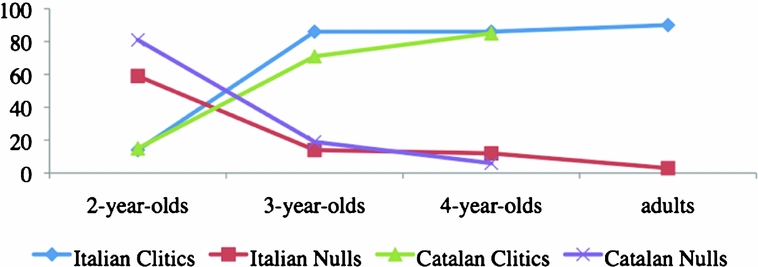
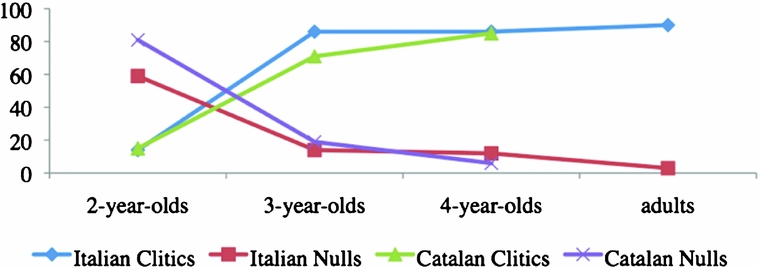
It has been suggested in the previous literature that optionality of DOs is a characteristic feature of child grammar in many languages, and that it is likely to have a universal nature. However, previous studies have focused mainly on Romance and Germanic langauges. For instance, the optional DO stage has been shown to be very short in English, a bit more extended in Spanish and Romanian, and even longer in Portuguese, Catalan, French, and Italian (see, e.g., Costa et al., Reference Costa, Lobo, Silva, Larranaga and Guijarro-Fuentes2012; Gavarro et al., Reference Gavarró, Torrens and Wexler2010; Pérez-Leroux et al., Reference Pérez-Leroux, Pirvulescu and Roberge2008; Wang, Lillo-Martin, Best, & Levitt, Reference Wang, Lillo-Martin, Best and Levitt1992). It has been suggested that these differences are due to the grammatical properties of these languages: while English has full pronouns, all the Romance languages employ clitics, and in addition, Catalan, French, and Italian have clitic–participle agreement. The latter property has been claimed to be particularly difficult to acquire, and thus the target use of clitics in these languages takes more time to develop. As shown in Figure 8, constructed from two available experimental studies on these languages (with a design similar to ours), 3-year-olds are mostly adultlike in the use of clitics, but still drop objects more often than do adults, who typically have overt DOs.
Use of direct objects in Catalan (Gavarro et al., Reference Gavarró, Torrens and Wexler2010) and Italian (Tedeschi, Reference Tedeschi2009).
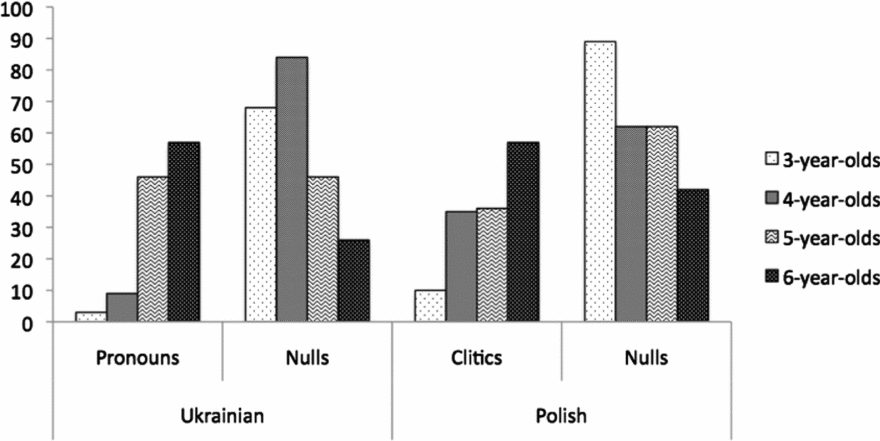
Our study considered two languages of the Slavic family. The Slavic language type allows discourse-related argument omissions in the adult grammar, with the result that both overt and null DOs are available in the input for the same transitive structures. For children, therefore, the input is ambiguous. We tested the role of pronominal DO types (clitics vs. full pronouns) in an experimental task, and concluded that the clitic/full pronoun difference is likely to be irrelevant in the acquisition of DOs in such languages. However, considerable child–adult differences do exist in the use of omissions and pronouns. As shown in Figure 9, modified from Figure 4, 3- to 4-year-old children differ from other age groups in employing excessive object-drop.
Use of direct objects in animate contexts (modified from Figure 4).
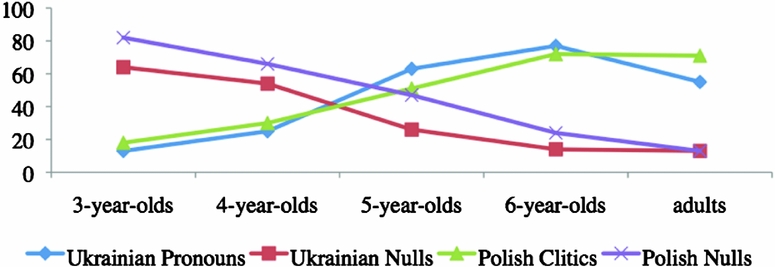
We find it remarkable that the developmental path of DO acquisition is similar not only for the two Slavic languages (i.e., Polish, with clitics, and Ukrainian, with full pronouns) but also across other Slavic and Romance languages. Compare Figure 9 and Figure 8: children in both language families start by using pronominal elements at very low rates (below 20%) and prefer null DOs at a rate of 60%–80% (Stage 1); then, at a certain point (Stage 2), a switch occurs, and their use of pronouns approaches adult levels. Nevertheless, the children's rates of null-object use still continue to exceed adult rates for some time (Stage 3) before becoming fully targetlike (Stage 4). The major difference between the trajectories of Romance and Slavic languages is in the chronological age at which the main shift to Stage 2 occurs: L1 learners of Romance languages make the switch at age 2 or 3, while L1 learners of Slavic languages do not switch until age 4/5. Note, however, that typological distinctions do not play a primary role here; European Portuguese is likely to pattern with Polish and Ukrainian, based on Costa et al. (Reference Costa, Lobo, Silva, Larranaga and Guijarro-Fuentes2012) and Silva (Reference Silva, Escobar, Torrens, Gavarro and Gutierrez2010). Our experimental finding that clitics are no more difficult to acquire than full pronouns suggests that any object can be omitted, while the cross-linguistic comparison points to a “universal” null-object stage in L1 development (see, e.g., Frolova Reference Frolova2014). We will not attempt to generalize further in this paper and will leave this striking observation for further research, but note that there are many more language properties, besides clitics and participles, that could be fruitfully considered in future investigations into the acquisition of referring expressions.
Conclusion
In both Polish and Ukrainian, child grammar options stay within the range allowed by adult grammar, but some variants (e.g., øVø structures) are more strongly preferred at early developmental stages (before the age of 5). It is crucial that the slower acquisition of clitics as opposed to full pronouns in DO patterns has not been confirmed, suggesting that the morphophonological properties of DOs are not primary predictors of object realization in languages that allow discourse-related omissions. Both grammatical and discourse-pragmatic accounts that consider such factors as word order patterns, referent semantics, and visual specificity remain to be explored.
APPENDIX A
The following are questions used in the experiment (given in Polish or Ukrainian).
Condition 1: Specified inanimate DO
-
1. What did Peter do with this nut?
-
2. What did Peter do with the sun?
-
3. What did Peter do with the flower?
-
4. What did Peter do with the keys?
-
5. What did Peter do with the letter?
-
6. What did Peter do with the bucket?
-
7. What did Peter do with the cup?
-
8. What did Peter do with the doors?
Condition 2: Specified animate DO
-
1. What did Peter do to his brother?
-
2. What did Peter do to the chicken?
-
3. What did Peter do to his sister?
-
4. What did Peter do to the dogs?
-
5. What did Peter do to the cat?
-
6. What did Peter do to the calf?
-
7. What did Peter do to the bird?
-
8. What did Peter do to the boys?
ACKNOWLEDGMENTS
We are grateful to two anonymous reviewers and the editor of Applied Psycholinguistics for useful comments and suggestions. We also thank the audiences at the LAGB 2013 (London), GALA 2013 (Oldenburg, Germany), and AERef 2013 (Paris) for helpful feedback and discussions. Special words of gratitude are due to our collaborators in Ukraine (Dr. Halyna Bachynska and Roksolana Bachynska), to the adult and child participants in Poznan and Ternopil’, and to the parents and teachers who made this study possible.