- ADLA
Archives Départementales de la Loire-Atlantique
- AMN
Archives Municipales de Nantes
- RHEF
Revue d'histoire de l'église de France
In 1721 Mathieu Gaultron de la Bâle, vicar-general of the diocese of Nantes, received a petition from the rector and priests of the city parish of Saint-Nicolas. They requested that the number of perpetual mortuary foundations maintained by their church be reduced. They were responsible for foundations of 649 high and 646 low masses annually, along with further daily matins, salutations of the Holy Sacrament, vespers of the dead and other prayers. All of these services had to be performed by just ten priests; the funds were worth only 1,300 livres per year, which scarcely made ten livings. Instead, the parish offered to celebrate seven of the larger chantries annually rather than weekly, and to keep sixteen solemn anniversaries throughout the year for the other founders. After some negotiation, this greatly reduced intercessory obligation was approved. Thus 1721 marked the beginning of the end of a long tradition in Nantes of founding perpetual masses: Saint-Nicolas was one of several of the city's twelve parish churches to restructure its provision of mortuary intercession at this time.Footnote 1
The dead, who were the subject of such commemoration, have received much attention in French historiography. The works of Philippe Ariès, Michel Vovelle, Pierre Chaunu, François Lebrun and, recently, Vanessa Harding among many others, have revealed much about dying, death and disposal in the early modern period.Footnote 2 The dead are particularly important in the historiography of Brittany. Alain Croix's magisterial thesis and the work of the anthropologist Ellen Badone, have charted the demography and rites of passage of dying.Footnote 3 They argue that the macabre played a special role in popular Breton culture, rich in traditions of the collectivity of the dead known as the Anaon, and in the skeletal personification of death, Ankou. The cult of the dead is seen as especially important in the dissemination of Counter-Reformation ideas after 1600, called the ‘reChristianisation’ of the province, in a model borrowed from Jean Delumeau. Croix argues that Brittany was ‘an ideal terrain for a pastorate based on death’, a marked feature of church teaching after 1640.Footnote 4 To enhance spirituality, increase participation in the sacraments, eliminate superstition and promote morality, clergy preached on themes of death, judgement and repentance. As evidence of their success, Croix cites the construction of monumental parish closes with ossuaries and high cemetery walls, greater ritualisation of the use of sacred space and an increase in church burial in this period.Footnote 5
While Croix draws examples from the city of Nantes, the focus of his study of the religious culture of the ‘macabre’ is the countryside, above all the western, Breton-speaking, regions of Brittany. Nantes, the largest city in the historic duchy, with around 24,000 inhabitants in 1600, did not always follow the same patterns of development as the rest of the province. Nantes was Brittany's economic ‘capital’, situated at the confluence of the Erdre and Loire rivers, an important river and maritime port. It was a French-speaking city, with easy communications with the rest of the kingdom as well as with Iberia and northern Europe, and there were communities of Spanish, Portuguese and later Dutch merchants here. In a recent study of the city during the French wars of religion, evidence emerged which suggests that Catholic reform in Nantes was earlier, more indigenous and polymorphous than Croix's model for the wider province suggests. Rather than a movement of the seventeenth century, changes in religious practice clearly occurred in the mid-sixteenth century, associated with sectarian conflict and war. Also, these changes did not always coincide with ‘classic’ Tridentine concerns, for there was particular emphasis on public, collective ritual, in which the role of the laity was crucial.Footnote 6 There were further changes in religious practice from the last decades of the sixteenth century, with increased influence of Roman reforms and dévôt spirituality, although little work has been carried out to date on these practices in the city.
The aim of this article therefore, is to examine changes in pious practices in Nantes through an examination of a specific devotion, the foundation of perpetual mortuary intercession, chantries and obits. Of central interest are the continuities and changes in post-mortuary intercessory practice across the long period of the Protestant and Catholic reformations, from 1480 to 1720. Post-mortuary intercessory institutions, which perpetuated relationships between the living and the dead, offer a useful lens through which to examine changes in belief and practice across the Counter-Reform centuries. As Peter Marshall has observed for England, throughout the early modern period, the dead continued to be ‘an elaborate cultural construction and a complex social presence’ and ‘the fate of the dead in the afterlife was the hub around which the theology of the Church revolved’.Footnote 7 While a great deal is known about funerary practice, much less is known about intercessory institutions and practices in this period, particularly attitudes to the fate of the soul as opposed to the body. The study thus begins in 1480, in order to examine the ‘traditional’ chantry practice of the later medieval, or pre-Reform, period. It then traces the impact of Protestantism and, above all, that of Catholic revival during the wars of religion and the Tridentine reforms of the seventeenth century, on devotions linked with the dead. The practice of founding chantries and obits declined rapidly in Nantes after 1720, although some continued to occur. In 1721–2, the kingdom-wide fiscal collapse associated with Law's System led to a serious crisis in Nantes's ecclesiastical finances. As a result, churches were forced greatly to reduce their provision of post-mortuary intercession. This date, therefore, marks the end of much traditional practice in the city.
The periodisation of the study is also linked to the availablity of documentary sources. Few of the parish, collegiate or conventual church buildings of early modern Nantes survive. Of the twelve medieval parish churches, only four, along with the cathedral of St Pierre, remain, all heavily modified or rebuilt in the nineteenth century. None of Nantes's former religious houses are extant. This limits the iconographic evidence for mortuary practices and behaviour. The archives of Nantes's churches and religious communities are also limited in scope, damaged or destroyed in the post-revolutionary period and by World War II bombing. However, two rich sources remain: parish registers, and the land transfers of chantry and obit foundation documents, upon which this study is based. To date, records of 550 perpetual mortuary foundations have been found for the long period 1400–1720, but it is only after 1480 that they survive in sufficient quantity for meaningful evaluation of their content to be made. The majority of these foundation documents – almost 80 per cent – were notarised acts of creation by living donors. The rest survive as extracts from wills, copied from the original documents for the churches' archival records.
The methodology used combines quantitative and qualitative analysis of the foundation documents. First, serial data has been extracted and evaluated in the manner pioneered by French historians such as Michel Vovelle, to examine changes in rates, location and type of foundations over time.Footnote 8 Numerical analysis has its limitations; it is heavily influenced by arbitrary documentary survival rates and by chosen categories of analysis and it is an ineffective guide to mentalities. But the advantage of quantitative analysis is that it does give indications of broad trends over time, which can be further investigated in other ways. Second, close analysis has been undertaken of the qualitative content of each foundation, its rationale, dedication and devotional emphasis. Where it survives, further evidence, such as a handful of sermons and pamphlets, and antiquarians' recording of monuments and funerary practice, has also been added to the study. The following results are an initial interpretation of this material.
Chantry and obit foundations were the preserve of the relatively wealthy throughout the period under study. Up until the early sixteenth century most founders were men. During the sixteenth century and into the seventeenth century, the proportion of male donors fell, so that 50 per cent of foundations came to be made by women and couples, and after 1650 women became the most important patrons. Linked to this change was the proportion of clerical to lay donors. Into the first third of the sixteenth century, clerics constituted at least 25 per cent of donors. Thereafter, their proportion declined, to around 20 per cent. The laity therefore increased in importance as founders of intercession. While attention to the beliefs and practices of a small elite group is perhaps unrepresentative of the wider population, their evolution over time allows insight into changing religious concerns and is therefore the central focus of this article.
The perpetual chantry was an institution which received its rationale from the doctrine of purgatory, the medieval origins and development of which have received detailed attention in the work of Jacques Le Goff.Footnote 9 In the Middle Ages, western Christians came to believe that, despite his boundless mercy, sinners were unprepared and unworthy to meet Christ when they died. God would forgive sin, if offered contrition, permitting entry to heaven, but first of all a soul needed to be cleansed of sin's stains.Footnote 10 This was achieved through chastisement in purgatory. Official teaching on purgatory was defined at the Council of Lyon in 1274 and formally promulgated as an article of faith at Florence in 1439.Footnote 11 The closely interwoven relationship between the living and the dead of the late medieval Church, and the mutual aid and charity which existed between its members, alive and departed, meant that souls in purgatory could rely on fraternal relief from the living, for their sufferings. Of course the best place for reducing the time spent in atonement was not in purgatory but here on earth; ‘mortified lives of penance would make Purgatory superfluous, almsgiving and good works in times of prosperity would be better than last-minute deathbed gifts’.Footnote 12 But most individuals were certain that lifetime efforts alone were insufficient. To secure the intercession of the living and of spiritual helpers such as saints, people exploited moral ties such as kinship and material obligations created by bequests, to ensure that the living took intercessory responsibility for departed souls.
While Eamon Duffy argues that purgatory was the single most influential factor in shaping both the organisation of the Church and the physical layout and appearance of its buildings, paradoxically it was the least defined and articulated of the doctrines of late medieval Catholicism.Footnote 13 Larissa Taylor has shown in her study of sermons that preachers mentioned purgatory infrequently compared with other penitential themes and she argues that dissemination of the doctrine was probably by other media, mystery plays, artistic representations in churches and indulgence preachers.Footnote 14 Local studies reveal that fears of purgatory did shape religious practice at all social levels. Wills show that the need for intercession had been widely internalised.Footnote 15 Altars and chapels were created for the souls in purgatory. In many parishes of southern France, churches had ‘bassins du purgatoire’ for donations for the daily mass said for souls.Footnote 16 There were regional nuances throughout Catholic Europe, however. While Duffy shows the importance of purgatory for England, in Spain, the work of Sarah Nalle on Cuenca and more recently, Maria Tausiet's on Zaragoza, have revealed that conceptions of purgatory were less evident in the later Middle Ages but developed more fully across the sixteenth century, a result of Counter-Reformation teaching and preaching.Footnote 17 Across the period, there were three main ways in which suffering souls in purgatory could be relieved: through prayers, good works and above all by the sacrament of the mass. The importance of the mass in Catholic belief and practice grew in the fifteenth and early sixteenth centuries. By 1500 it was the central form of both lifetime practice and mortuary intercession. The Spanish author Alonso de Orozco explained the superiority of the mass over other forms of suffrage by saying that it counted twice, as Christ's sacrifice and as almsgiving, for the money paid to have masses said for the dead was a contribution towards the upkeep of the clergy.Footnote 18 The funeral liturgy was centred upon the requiem mass, which could be repeated at intervals after burial up to the first anniversary of death. The living could ensure the continued benefit of the sacrament for their souls by founding masses to be said in perpetuity. Parishioners of modest means might join a gild and share in the masses of the brethren. For the wealthy, perpetual foundations would ensure that a dedicated chaplain would intercede for the founder until doomsday.Footnote 19 Some historians have argued that the concern of the wealthy with private masses is evidence of an increased privatisation and individualisation of religious life in the later Middle Ages. Just as notables read, sat in private pews or chapels, separated from their neighbours, so they used their wealth to ensure individual representation before God through the personal mass. Beat Kümin and others argue conversely that chantries were a communal resource, to augment divine service, to provide assistance for parish priests or to educate children, conceived to draw in as many people and their intercessory prayers as possible.Footnote 20 But individual and group concerns were not mutually exclusive categories, and foundations of masses for both purposes were made widely, across Europe.
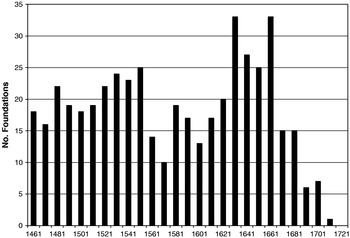
In Nantes, as elsewhere in France in the late fifteenth and early sixteenth centuries, there was a constant obligation to remember the dead, to include them in one's prayers. Purgatory clearly influenced the religious practices of individuals and communities. In 1495 the bishop of Nantes ordered the creation of a night crier in each parish, ‘to alert the faithful at midnight, by means of a bell and a loud and intelligible voice, to pray for the dead’.Footnote 21 There is limited sermon and devotional literature for Nantes before 1560, and few surviving wills, but foundation documents suggests that purgatory and its amelioration were important in the city, at least among elites, right up until the religious wars. The endowment of perpetual foundations in Nantes began before 1400, but evidence is limited before the second half of the fifteenth century. From 1480 the rate of foundation – or at least the survival of documents – greatly increased. Despite fluctuations over the next century there was a steady rise, with the years 1520–60 witnessing decadal totals of around twenty-three foundations. With the advent of the wars of religion after 1560, however, foundations underwent a rapid and serious decline. They picked up again in the 1590s, a development associated with the Catholic League, to a level which was sustained into the 1620s, the years of early Counter-Reform in the Nantes diocese. After 1630 there was a great increase in the numbers of foundations, sustained for four decades, surpassing the rate of the early sixteenth century. After 1680, however, foundations fell off rapidly, to almost nothing by 1720.
Nantes: foundations, 1461–1721.

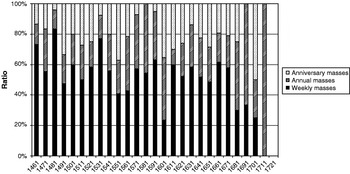
The evolution of permanent foundations contains within it changes in the type favoured by donors. There were three forms of perpetual foundation. The weekly or daily mass – the chantry – was served by a permanent chaplain, funded by an endowed benefice. The anniversary or obit was a requiem mass, often with subsidiary services of matins and vespers, held annually, on the day of the death of the founder. The annual or special service was a specific devotion or mass, which took place during special feasts or liturgical seasons, when prayers for the founder would be said. The most popular form in the period 1450 to 1550 was the weekly mass, most commonly on Fridays (the day of Christ's Passion) or Saturdays (associated with the Virgin). The foundation in Saint-Nicolas's church by Jean Seron, merchant and bourgeois, in 1502, was typical: a weekly low mass, on Mondays, at the altar of the confraternity of Notre Dame de Chandeleur, followed by the recitation of the De profundis at his tomb.Footnote 22 From 1500 the popularity of annual and anniversary masses grew, constituting around 50 per cent of foundations over the following two centuries. Again, the foundation of Françoise Bouschier in Sainte-Croix in 1544 is typical: a sung mass, preceded by a vigile des morts, was to be celebrated each year on 27 February.Footnote 23 In periods of declining foundations, between 1560 and 1590 and again after 1680, annuals and anniversaries formed the greater proportion of endowments. These shifts cannot be accounted for on economic grounds alone. The foundation of annuals and anniversaries were almost always for sung services and indeed all types of yearly commemoration became very elaborate in the seventeenth century. For example, in 1643, Jean Avril, choir priest of Sainte-Croix, founded an annual service of remembrance on the feast of St John the Baptist, at the altar of St John in the parish church. There was to be vigil, matins, mass, second vespers and requiem mass, followed by a Libera at his tomb, performed by all the priests and choir of Sainte-Croix.Footnote 24 The cost of endowing an elaborate annual mass and a year's worth of weekly low masses was similar.
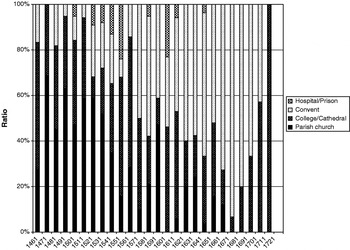
The location of foundations also underwent change over time. Before 1480 evidence points to the overwhelming popularity of the religious houses and collegiate churches, Notre Dame and the cathedral, as sites of foundations, with parish churches receiving around one-third of endowments. After 1480, and until about 1550, parish churches became the preferred sites for donors: up to 60 per cent of masses were founded here. After 1560 the parish declined in importance and the collegiate churches and religious houses again dominated. The conventual churches of the Carmelites and Franciscans became the most important sites of foundation: in the mid seventeenth-century boom, more than three-quarters of founders favoured the mendicant orders. Towards the end of the century, when foundations declined markedly, the collegiate institutions benefited most, although even they received very small numbers of endowments.Footnote 25 Further, the colleges and convents of Nantes increasingly separated themselves off from popular funerary rites. The presence of mendicants at funerals was widespread at the end of the sixteenth century, but by the middle of the seventeenth century it had become rare, linked only to burial in the orders' churches. In 1591 the cathedral chapter decided only to attend the funerals of ‘persons of quality’, and in 1632 the Carmelites refused to participate in funeral convoys of people other than those buried in their own church.Footnote 26
Nantes: foundations, 1461–1721.

How are these trends in endowment rates in Nantes to be explained? Historians such as Alan Galpern have seen the 1530s as a watershed, marking the beginning of falling confidence in traditional Catholic practices, particularly mortuary intercession, for chantry foundations and bequests for funerary masses declined after this date in many communities of north-eastern France. In support of this argument, J. M. Matz's study of chantries in the diocese of Angers shows that foundations increased greatly between 1470 and 1530–40 but thereafter, numbers fell.Footnote 27 Philip Hoffman's study of the Lyonnais also showed a decline in the popularity of post-mortuary intercession after 1530 and he argues that evidence ‘points to a stunning shift in religious attitudes, beginning in the late 1530s and reaching crisis proportions by 1555. The conclusion seems inescapable that a number of men and women from all social classes had come to question the efficacy of Catholic ritual’.Footnote 28 By the second quarter of the sixteenth century, purgatory and its attendant framework of intercessory actions and institutions was coming under severe criticism from Protestant reformers. Martin Luther rejected purgatory at the diet of Augsburg in 1530, while John Calvin vigorously condemned it in the first edition of his Institutes of the Christian religion in 1536.Footnote 29 Justification by faith eliminated the reason for purgation of sin; an individual relationship with God negated the need for third-party intercession, while the centrality of Scripture as the sole source of truth cast doubt on this non-biblical doctrine. Purgatory was ridiculed as a make-believe place, invented by greedy clerics to fill the innocent with fear and to line the pockets of the Church. Galpern suggests that even in parts of Catholic Europe where Protestantism gained limited converts, these criticisms may have undermined confidence in post-mortem intercession.Footnote 30 Yet in Nantes, this was not the case. The 1550s did see a slight fall in lay benefactions, although offset by a rise in clerical endowments. The real decline in foundations did not come until after 1560.Footnote 31
Nantes: location of foundations, 1461–1721.

The reasons for this pattern in Nantes are complex. Declining economic fortunes began in the 1550s, as war with Spain affected overseas trade. Prosperity was further affected during the religious wars, for plague, military conflict and piracy disrupted agricultural production, textile manufacture and commerce in western France, although serious economic problems did not set in until the 1580s.Footnote 32 A second factor explaining falling confidence has traditionally been anticlericalism. Complaints about the clergy were common in these decades. The cahiers of the third estate at the Estates-General of Orléans and Pontoise of 1560 and 1561 show a widespread desire among lay elites for reform of the French Church, the wealth, privileges and immunities of which were resented.Footnote 33 In Nantes, there was some dissatisfaction centred on priestly inattention to duty through neglect and absence. For example, in 1562, the parishioners of Saint-Nicolas obtained a sentence against their rector, Gilles Hamon, ordering him to preach sermons, which he failed to do. The following year the parish seized the revenues of the benefice on account of his non-residence, appointing a former curate in his place.Footnote 34 But such examples are few. There is little evidence for complaints about the standards of the urban clergy in the city. Parishioners and clergy worked closely together to ensure conscientious performance of services. A number of foundations were made to augment the incomes of the poorly paid parish choir priests. In 1549, for example, in Sainte-Croix, a donor founded two weekly masses; the chaplaincy was to rotate between the choir priests and the rights of presentation were to be held by the churchwardens.Footnote 35
A third possible cause was the influence of Protestantism. From the 1550s Nantes had a Protestant population, and a church with a pastor and elders was founded in 1560. However, the Reformed community was relatively small and its religious influence limited. Devotional practice in the city was more likely affected by Catholic humanism. In common with other towns in France, in the 1550s the Conseil des bourgeois founded a college for boys whose first master was a renowned humanist brought in from Lisieux, Pierre Bintin. Humanism had a religious programme of enhanced piety and reform of church life, stripped of superstitious accoutrements, centred directly on Christ and his holy sacrament, purified of cults and elaborate ritual including veneration of saints, images and relics.Footnote 36 Religious simplicity and austere piety had been the hallmark of the ultra-devout since the fifteenth century, inspired by the life of Christ and the teachings of the mendicant orders. These mentalities may have contributed to reduced lay investment in elaborate mortuary intercession. However, throughout Europe in the mid-century, devout Catholics leapt to the defence of purgatory in polemical debates. The Council of Trent reaffirmed purgatory in its decree on justification and went on to define it as doctrine in its twenty-fifth session in 1563.Footnote 37 There has been no detailed history of early modern purgatory to match Le Goff's study of the Middle Ages, but many regionally-based studies in France, Spain and Italy have shown the impact of a reinvigorated belief on printed devotional works, art, sculpture and testamentary behaviour, across the period 1560–1660. In Nantes, the mid-century decline in foundations relates much more to local conditions affected by civil war after 1560, than to the influence of reformed ideas.
Although Nantes was relatively peaceful during the early religious wars, the religious culture of the city underwent a profound radicalisation and there were important changes in practice after 1560. Throughout France, from the 1560s, Protestant attacks on Catholic sacred places and objects, and the experience of war after 1562, stimulated popular Catholic responses of outrage and reaffirmation of faith.Footnote 38 In Nantes, in February 1561, Protestants returning from a sermon threw stones at the windows of one of the city's churches, where mass was being said. This provoked a riot during which Protestants were stoned.Footnote 39 In April the exhumation and burning of a man's corpse led to another disturbance.Footnote 40 By the summer Protestants were meeting publicly in the churches and cemeteries of nearby bourgs such as Saint-Herblain and Sucé-sur-Erdre, and in houses in the suburbs of Nantes. On 18 July the reformed congregation held a demonstration of faith when an armed company marched in ranks through the Saint-Pierre gate, through the city.Footnote 41 There followed the worst outburst of sectarianism, lasting for two weeks as the Catholic population of Nantes reacted violently to Protestant ‘provocation’.
Perceived threats to religious culture in the city and in the kingdom at large had clearly observable results for Catholic religious practice. Greater efforts were made to teach correct doctrine, through preaching and printed works, which expanded throughout France in these years.Footnote 42 Preachers invited to Nantes for the annual advent and Lenten sermon cycles were men from Paris with firmly orthodox views and credentials. Jacques du Pré preached at the baptism of Marie de Luxembourg in July 1562; the Parisian preacher René Benoist was present in Nantes in the same month and returned as Lenten preacher in 1565. In 1566 the position of reader in theology (théologal) was created at the cathedral. The holder was to preach at the cathedral on Sundays and major feasts, at Saint-Nicolas parish church, and to teach two or three classes of theology at the university during the week.Footnote 43 The first incumbent was Jacques du Pré, followed in the 1570s by Jean Christi, student of the famous Parisian preacher, Simon Vigor. Linked with sermons, Catholic vernacular literature expanded in the 1560s. Andrew Pettegree, Luc Racaut and others have shown the important role played by Catholic vernacular printing in ‘shaping the successful defence of French Catholic identity in the face of the Huguenot onslaught’.Footnote 44 Many works came from the lower clergy, a largely unofficial campaign of renewal that preceded and was independent of the reforms of Trent. While the parish clergy of Nantes do not seem to have contributed to this literature, the théologal du Pré, Bishop Philippe du Bec and, in the 1590s, the Benedictine Jacques Le Bossu, published sermons and pamphlets, while Jean Christi edited and published the sermons of Simon Vigor.Footnote 45 There was an active book trade in Nantes in authors from outside of the province, with exports sent to Spain, to the fair of Medina del Campo and towns such as Salamanca. The registers of the merchant André Ruiz show that between 1557 and 1564 he sent 1,072 cartons of books, printed in Lyons, Paris, Tours and Antwerp, through the port of Nantes.Footnote 46 Most of these books were works of theology, liturgy and canon law. Some of them stayed in the city where, in the early 1560s, there were about five booksellers.Footnote 47 Christi himself and the archdeacon of Nantes, Pierre Le Gallo, amassed large libraries.Footnote 48 Nantes was therefore well-informed by the literature and ideas circulating throughout France. The result was an informed, recharged and militant Catholicism, amongst all social groups.
One of the clearly observable features of the early religious wars was greater emphasis on individual participation in public ritual activity, processions and pilgrimages.Footnote 49 External actions became important as ‘a defence and illustration of both institutional resilience and enduring truth’.Footnote 50 Barbara Diefendorf argues that ‘religious unity personally felt and publicly displayed was … a vital condition for individual and collective salvation. Society was perceived as an organic whole, “one bread and one body”’.Footnote 51 In particular, she argues, there was a drive to strengthen the parish as the focus for religious life and emphasis on parochial worship, intended to keep individuals under the eye of their pastor/confessor, part of a larger ‘campaign’ for greater public order and more austere morality.Footnote 52 Kathryn Jackson-Lualdi observes a similar process in the southern French diocese of Grasse: parish worship assumed a greater significance, both as an external manifestation of orthodoxy and as a place where the beliefs of individuals were formed. Good Catholics were judged in terms of their attendance at and conformity with public, parish rites and ceremonies.Footnote 53 What stands out above all during the years of religious war is the increasing degree to which the laity took the initiative in religious affairs.Footnote 54 A.E. Barnes observes that
in no other era was the clergy so dependent upon lay support and the laity so free to take the initiative in shaping its own religious life. Popular preachers abounded during this period, but lay participation in the devotions they propagated was based on the appeal of these devotions to laymen [who] were free to create or to support devotions which expressed their spiritual needs with comparatively little clerical interference.Footnote 55
In Nantes, lay control over religious life is a marked feature of the middle decades of the sixteenth century. One of the important trends in parish life was the readiness of the laity, supported by the Conseil de bourgeois, to take clerical matters into their own hands if their expectations were not met: the case of the action of the parishioners of Saint-Nicolas against their rector, Gilles Hamon, is a good example. The laity intervened to ensure conscientious performance of services but they also paid supplements to vicars, hired curates and provided extra masses in churches. In the parish of Sainte-Croix, five foundations were made between 1557 and 1589 in favour of one (for low masses) or all (for sung high masses) of the choir priests of the church. Patronage ensured conscientious and continuous performance of foundations, when private patronage might fail or be disputed, and also added to the resources underpinning the pastoral provision and liturgical richness of the parish, that is, its ten choir priests.Footnote 56
Emphasis on the parish had an impact on individual mortuary foundations, which declined, and on traditional confraternity membership, which was reduced. In 1577 the fraternity of Saint-Jean-de-l'Hôpital was suppressed.Footnote 57 Parish and community received pre-eminent spiritual and financial attention, while traditional devotions declined. The same was occurring in other French towns as well. In Aix-en-Provence, the low point for foundations occurred in 1570–95.Footnote 58 Similarly, in Lyons, pious bequests made by members of the city's upper classes had been dropping at mid-century; thereafter they levelled off and showed signs of rising. At the same time the old funeral ceremonies, from Psalms and processions to tolling bells, continued to fade away.Footnote 59
However the 1590s saw a resurgence in Nantes of traditional practices such as mortuary foundations. This was fuelled partly by an austere yet ostentatious piety associated with the Catholic League, and partly by a desire on the part of the political elites of the League rebellion to demonstrate their religion in public, to promote and sanctify their revolt against the king. The rebellious governor of Brittany, the duke of Mercoeur, together with his family, led the way. The duke founded a mass in the Dominican church and the ducal couple augmented the foundation of the confraternity of the rosary of the Franciscans.Footnote 60 In 1592 the duke founded a mass of Notre Dame de la Victoire in the parish church of Saint-Vincent, to give perpetual thanks for his victory at Craon, along with a little office of the Virgin in Notre Dame church.Footnote 61 In 1594 his mother-in-law, Madame de Martigues, also founded two weekly masses in Saint-Vincent.Footnote 62 These enabled the Mercoeurs to emphasise the religious basis of their political cause in overt acts of piety, seen by all sections of the city's population.
After 1600 elite Catholic piety in Nantes moved away from the public, parish-based devotions that had been important in the League years. There was further growth in traditional, rather old-fashioned devotions, such as mortuary foundations and confraternity membership. The restitution of traditional institutions can be linked in part with resurgent clericalism in the Tridentine-influenced reform of the early seventeenth century. In Nantes, after the relative freedom of the laity to set the religious agenda during the religious wars, bishops and their clergy sought to reassert their authority and bring religious life more closely under clerical supervision, through its institutionalisation, closer regulation and enhanced clergy involvement therein. Already in the later sixteenth century, Bishop du Bec, after his attendance at the Council of Trent in 1562–3, resided and preached in the diocese, held synods and issued regulations more frequently than his predecessors. After the end of the religious wars, Bishop Charles de Bourgneuf (1598–1617) introduced the Roman liturgy into the diocese and Gabriel de Beauvau (1635–68) was active as a pastor, director and reformer.
The episcopal resurgence in Nantes coincided with a wider growth in clerical and lay piety throughout France and within Brittany. In Breton historiography as elsewhere in the kingdom, the seventeenth century was ‘the century of saints’. An important movement of mysticism and piety developed in the west of Brittany. This was closely associated with the foundation and direction of the Jesuit colleges of Quimper and Vannes, under Jean Rigoleuc and Père Seurin, disciples of Hierosme Lallement, and their associate, Vincent Huby. The movement was active as well as spiritual; its initial aims were the setting up of retreats and the training of priests. Its adherents preached, taught and published works on the purity of the heart, abjection, prayer and contemplation. They also became involved in missions to rural parishes and they supported the Jesuit missionary Julien Maunoir.Footnote 63 The influence of this group on Nantes remains to be investigated, but a pious, dévôt movement, involving clerics and laity, was certainly evident in the city. For example, Etienne Louytre, dean of the cathedral, who knew Bérulle in his youth, was notable for dévot piety, sponsoring the introduction of the Carmelites into the city, supporting the Oratorians and creating a confraternity of the holy sacrament in his parish.Footnote 64 There was also a wave of vocations and foundations of religious orders, along with initiatives and institutions for the treatment of the poor. A house of Recollets was founded in 1617, of Carmelites in 1619, of Ursulines in 1626–9 and a hôpital général in 1640.Footnote 65 The impact of Jansenism on Nantes is harder to assess. Some Breton nobles at the royal court were sympathisers, for example the prince de Guéméné, who had the abbé de Saint-Cyran as his spiritual director, but their direct links to Nantes are unknown.Footnote 66 The Jesuits were absent from the city for much of the century, because of the hostility of the city council, which preferred to give the direction of their municipal college to the Oratorians in the 1620s.Footnote 67 Later, this order was linked to Jansenism, which was certainly important in Nantes in the eighteenth century, but there is little direct evidence for it before 1700. The great rise in post-mortuary intercession between 1630 and 1660 therefore occurred in a milieu of enhanced elite spirituality, influenced by both local and wider spiritual movements and practices.
A further influence was new conceptions of the afterlife and an almost paradoxical renewed emphasis on purgatory. After 1600, in France at least, shifts in conceptions of the afterlife appear. There was an upgrading of the importance of hell together with a downplaying of its physical punishments: the Jansenist Nicole was one of many authors who represented the real punishment of hell as being deprived of the sight and presence of God.Footnote 68 Secondly, according to Daniel Roche's study of Ars moriendi literature, emphasis on living a good life and spending a lifetime in preparation for meeting God, overtook the importance of dying a good death. Vovelle argues that between 1580 and 1700 the ideology was promoted that one's whole life should be constructed in the thought of death. There was less stress on the deathbed, more on the whole of life, as preparation for death became a daily necessity.Footnote 69 This was linked to a belief that Christ's judgement of the individual occurred immediately after death: it was therefore necessary to prepare well in advance rather than leave everything to the last moment. Numerous studies have revealed the impact of this on funerary practice. In Cuenca, for example, in the late sixteenth and early seventeenth centuries, the funeral process was shortened and the popularity of perpetual masses fell; instead testators put their money into masses that were to be said as soon as possible. There was an obsession with a quick and favourable judgement so as many suffrages as possible had to be crammed into a three-day burial period.Footnote 70 Vanessa Harding has shown that, in Paris, the proportion of wills asking for more than sixty funerary masses, small in the sixteenth century, increased after 1600.Footnote 71 Croix's data for Brittany, including Nantes, supports this view, for funerary masses seem to increase everywhere in the province in the first half of the seventeenth century. At Saint-Nicolas de Nantes, 12 per cent of wills examined contained requests for octave masses around 1600; this figure had risen to 25 per cent by 1630–60.Footnote 72
Yet Croix has also revealed numerous examples in Brittany of popular practices shaped by purgatory after 1600. For example, there sprang up all over the countryside rosary confraternities that stipulated in their statutes prayers and masses for dead members. There were also confraternities devoted to intercession for departed souls, for example in the parish of St Nicolas in Vannes, and parish devotions included the ‘bourse des defunts’ in Rannée and a ‘boîte des trépassés’ in Saffré and Châteaubriant, to assure a minimum number of regular prayers in memory of those who were too poor to pay for their own masses or who lacked family members to pray for them.Footnote 73 In Nantes, similarly, confraternities continued to support at least one annual requiem feast for deceased members. What is clear is that a range of beliefs about the soul continued side by side. In a spiritual climate of individual responsibility for the soul before God, immediate and longer-term forms of intercession had a role to play. In 1649 Claude Gabory, buried in the Carmelite church, requested a funerary mass and masses at all the altars of the church on the day of his burial, an octave service, a trental and an annual, but there is no evidence of a chantry or obit foundation; a decade later, in 1659, Claude Leborge, avocat in the Chambre des Comptes, requested in his will a minimum of funerary pomp, but an octave mass, a trental of masses thereafter and a perpetual foundation of two weekly masses and an anniversary requiem, in the Carmelite church.Footnote 74 The elites of Nantes favoured more funerary masses and more intercession, according to their own beliefs and preferences, until the 1680s, when intercessory masses of all sorts declined.
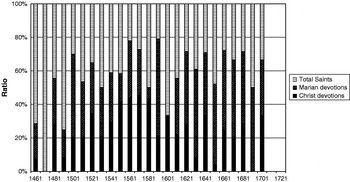
Across the period 1480–1720 a persistent minority of donors tied their foundations to the celebration of a particular cult. In the early sixteenth century, where special devotions are described in foundation documents, one third were for Christological cults of the passion and particularly the holy sacrament. In 1549, for example, Guillaume Symon, royal notary, founded an annual mass to be sung on Corpus Christi by the choir of Sainte-Croix and in the same year, at Saint-Saturnin, Thomine Gille, Dame de Launay, founded an annual mass on the octave of Corpus Christi, for the benefit of the confraternity of the Holy Sacrament.Footnote 75 Devotion to Christ rose to over 40 per cent of special devotion between 1550 and 1600, coinciding with the struggles against Protestantism in France. Thereafter, Christological cults fell to around 30 per cent of special devotions and, despite fluctuations, remained roughly at this level across the seventeenth century.
Nantes: special devotions.

In Nantes there was a direct correlation between decreasing foundations of mortuary institutions and a huge upswell in individual and public devotions to the body of Christ during the religious wars after 1560. Catholic reformers of the early sixteenth century criticised the appropriation of the mass by individuals, no matter what their foundations contributed to communal liturgy, arguing that this universal sacrifice could not be appropriated for the benefit of a single soul. But in mid sixteenth-century France, polemical then physical conflict between Catholic and Protestant refocused attention on the eucharist and there arose within Catholic communities a heightened sense of the mass's value and purpose in salvation for the whole community. The religious wars witnessed an expansion of devotions linked to the holy sacrament, with processions carrying the host and its public adoration in devotions such as the ‘forty hours’. This was underpinned by the rulings of Trent, which in 1562 upheld the doctrine of the mass and confirmed its place as the central intercessory institution for the living and for souls in purgatory. Christopher Elwood argues that in this time of crisis, communities ‘turned to the eucharist to display it and deploy it in the public realm … to recreate communal solidarity and sanctity by turning the attentions and energies of the members of society to the potent centre of the community … Through the public display of this symbol of social cohesion, the social body itself might be reconstituted and restored to health’.Footnote 76 All over France confraternities of the holy sacrament were established, a ‘sort of urban mission, symbolically defending Catholic doctrine’.Footnote 77 Nantes shared in the eucharistic impulses which characterised the religious wars in the wider kingdom. In December 1562, for the first time, the host was carried in a general procession from the cathedral, then displayed for adoration for a week thereafter.Footnote 78 During the second war of 1567–8 the host was paraded around the city on several occasions and, in April 1568, Bishop du Bec preached an important sermon on the eucharist and transubstantiation.Footnote 79
Devotion to the eucharist was not new in the 1560s. A confraternity of the holy sacrament was founded in Sainte-Croix in 1462 and by 1554 it had two hundred members, with a feast day on the octave of Corpus Christi. In the 1560s new enthusiasm saw the confraternity expand. The master and provosts were typically lower clergy, priests and chaplains from parishes in and around the city; by the 1570s Guillaume Tual, master chaplain of the cathedral, was in charge. New bequests were founded in its favour. In 1566 Guillaume Garnier, priest, founded a weekly mass in the suburban chapel of Champ-Fleuri, to be said by one of the priestly members of the fraternity. He also founded an annual memorial in the parish church of Sainte-Croix, Psalms and prayers to be said by the fraternity during their annual feast day procession around the city's churches.Footnote 80 For this reason the feast of Corpus Christi came to have a special significance for the public expression of confessional allegiance. In 1564, on Corpus Christi, several Protestants were arrested in Nantes for failing to hang tapestries on their houses. The seneschal claimed that street decoration was required of all citizens, to honour God and to prevent disorder between confessions. The dispute continued into the Corpus season of 1565.Footnote 81 Religious conflict made necessary the symbolic display of confessional allegiance. Participation in public rituals was a statement of belonging to the Catholic community, a form of works signifying faith.
After 1580 eucharistic devotion intensified. When foundations were created, they too were often eucharistic in content. Antoine de Gravoil founded a weekly mass in Sainte-Croix in 1589 ‘to induce faithful Christians to adore with honour and remembrance His precious body which he left on this [earth] in the holy sacrament of the eucharist, so that we might remember his painful passion, for our consolation and the nourishment of our souls, until the last day’.Footnote 82 New devotions appeared, a result of Tridentine influences, such as the oratoire, the display of the holy sacrament and relics on the altars of each of the city's churches for a week at a time, with special processions to carry the host to the next church.Footnote 83 Where new confraternities were founded, they were notably more austere and devout. In 1588 the silk and woollen cloth merchants founded a confraternity to SS James and Christopher in the Carmelite church. Instead of an annual feast, they celebrated high mass, vespers and matins, a vigil for the dead and requiem services. Also, on the Sunday after Corpus Christi, the brothers took part in a solemn procession around the convent.Footnote 84
An increasingly important feature of the Christological piety which characterised the religious wars throughout France, continuing a traditional theme but with greater intensity, was a desire to emulate the life of Christ, through good works and activism within the community. This seems to have worked against chantry foundations. According to the catechism of the Council of Trent, almsgiving was an act that ‘redeemed our offences against man’ and that served as ‘a medicine suited to heal the wounds of the soul’.Footnote 85 However, the work of historians of sixteenth-century Catholicism has demonstrated a decline in pious bequests. In Lyon, for example, while 84 per cent of testators left money for pious bequests between 1521 and 1555, only 66 per cent did so in the following half-century.Footnote 86 But charity was to be a lifetime activity, not just a last reflex. Barnes's study of penitential confraternities of the later sixteenth century in southern France found a new emphasis in their statutes on charitable activity, representing for the first time a fusion of penitential piety with the idea of social service.Footnote 87 In Nantes charity was a constant theme of Bishop du Bec's preaching; when, in October 1568 a municipal bureau des pauvres was created to co-ordinate the city's poor relief, he publicised the new regime from the pulpit and urged Nantais to ‘sell what you have and give alms and you will store up treasure in heaven that will never … fail … Invest alms in the pauper and he will pray for you … as water extinguishes fire so almsgiving extinguishes sin’.Footnote 88 Alms placed the recipient in debt to the giver, so testators could ask for spiritual favours in return, particularly prayer.Footnote 89 In the context of dire economic problems in the 1580s, charity was important in preserving the social as well as the religious fabric of Nantes, for Christ's poor were visible on every street. Good works in this life rather than an emphasis on purgatory was a theme of preaching, and this helps to explain the decline of foundations after 1560.
A vital part of the ‘good life’ as opposed to the ‘good death’ was a continued and growing devotion to works in emulation of Christ. Attachment to the eucharist continued to be a pre-eminent form of this, as the best of all works, and the holy sacrament gained a renewed centrality in the years of spiritual reinvigoration associated with Tridentine reform. There were also changing attitudes to the eucharist. John Bossy has described a move away from a community-based sense of the mass as the binding ritual of human charity to a more individual experience of the sacrament. Catholic reformers urged greater reverence towards the eucharist, more frequent confession and reception of the sacrament, linked to meditation and examination of conscience.Footnote 90 In the diocese of Grenoble, for example, all parishioners were to attend the priest's celebration of the mass at the main altar rather than hear it in their confraternal or domestic chapels. Visiting bishops insisted that the host be properly housed – gold and silver tabernacles, ornate ciboria exalted the eucharist; new retables attracted attention to it and framed it with representations of adoring sacred figures.Footnote 91 In Parisian wills of the mid-seventeenth century also, investment in the sacraments, especially the eucharist, also grew.Footnote 92 New eucharistic practices touched all groups. Confraternities of the holy sacrament expanded enormously in town and country; the ceremony of first communion, made between the ages of eleven and eighteen, spread and there was an upsurge in the construction of reredos to emphasise the altar and the displayed host.Footnote 93 In Nantes there were many examples of foundations dedicated to the holy sacrament. Two practices stand out. Between the 1620s and 1640s several donors founded saluts of the holy sacrament rather than chantry masses: for example in 1628 Françoise Bruny in the parish church of Saint-Vincent, and in 1639 Isabel Le Moyne in the church of the Minimes, founded weekly saluts, comprising the three anthems ‘Pange lingua’, ‘Sacris solemnis’ and ‘Verbum supernum’ which were to be sung after vespers on Sunday.Footnote 94 More popular still was the endowment of monthly processions, carrying the host, around churches. There were at least seven such between 1640 and 1669. In the Carmelite church, for example, foundations of 1642 for the second Sunday of every month by Claude Toublanc, and of 1666 for the fourth Sunday of every month by Barbe Erault, requested that the host be carried around the convent church then displayed on the high altar during the requiem mass.Footnote 95
Above all, charity was a vital part of piety, linked to prayer. Prayer, for one's self and for others, always central to the fate of the soul, seems to have risen further in esteem, to the detriment of permanent masses. Croix shows that in Brittany as a whole, the devout committed themselves to work in the world to salvage other people's souls and to receive prayers for their own. The nature of charitable giving changed, however. The practice of giving alms on the day of burial and of the octave service declined, from about 50 per cent of testators in 1590–1650 to fewer than 25 per cent after 1650. This corresponded with a decline in the personal giving of charity to the poor. Instead, there was a great rise in giving to the ‘deserving poor’ in the first half of the century, then to institutions, particularly the hospitals of the ‘pauvres renfermés’.Footnote 96 Even in the small Breton town of Montfort, the service of the poor took over spiritual life during the seventeenth century, with particular concern for sick and destitute pilgrims passing through the town.Footnote 97 This trend was also evident in Nantes: there was a decline in the attendance at funerals of mendicant friars, who were replaced after 1630 by paupers, especially the ‘enclosed’ poor and children. Croix argues for ‘a transfer of the weight of ostentation towards the poor’.Footnote 98 The rise in charitable giving was a widespread feature of testamentary behaviour. In the Lyonnais, charitable bequests in wills rose, from 54 per cent of testators in 1625–49, to more than 90 per cent by 1700, with the relative size of donations also increasing.Footnote 99 Almsgiving was still a mutual service; the request for prayers still paramount, even when the donor was anonymous. Indeed, anonymity enhanced the humility of the charitable act and made it more virtuous. Seventeenth-century Catholicism was still a corporate endeavour. One could not obtain salvation alone; it was necessary to count on the solidarity of others.Footnote 100
As part of the rise in Christocentricity and the move towards prayer, the most important observable feature of special devotions throughout France, and indeed in Catholic Europe as a whole, in the seventeenth century was the rise in importance of Marian cults, at the expense of all other saints. This can be seen all over Europe. In southern Germany, Spain and Italy Marian shrines eclipsed those of older intercessors and protectors. Vovelle's work on the iconography of retables in Provençal churches led him to the conclusion that the seventeenth century was dominated by ‘Mariolatry … for her maternal presence came to have a more prominent place than reminders of the Passion’.Footnote 101 Devotion to the mother of Christ transcended social groups; elites and popular groups joined in her veneration, which was particularly promoted through the use of the rosary, for which numerous confraternities were created. Mary became ‘a highly condensed symbol of Catholic success, doctrinal purity and proper spirituality. For the faithful, she … retained the alternative meaning of a powerful protector … For reformers, the meditative recitation of the prayers counted out on the rosary promoted an individualised, sober, contemplative and therefore sincere mode of piety’.Footnote 102 Mary was always the most important saintly intercessor in Nantes, in the sixteenth century receiving around 40–50 per cent of special bequests. In the seventeenth century this rose to 50–60 per cent. To this can be added the increased importance of the holy family, Joseph and especially Anne, whose cult became very important in Brittany from the 1630s, with the foundation of a major shrine near to Auray. The Virgin even overtook the holy sacrament as the most important object of foundations. In 1637, for example, the brothers Pierre and Jean Coupperie, priest and royal judge respectively, founded seven annual masses to celebrate the seven feasts of the Virgin, to be said at the altar of Notre Dame de la Consolation in Sainte-Croix, for their late father and Jean's late wife. Marian bequests were often associated with a particular altar or confraternity, Notre Dame de Pitié, Notre Dame de la Cité in Saint-Saturnin and Notre Dame de Chandeleur in Saint-Nicolas. The Carmelites and Franciscans also had their Marian altars.
Growing individualisation of the spiritual life was a notable hallmark of Counter-Reformation devotions, particularly among elites, as the devout adopted the practice of mental prayer and interior scrutiny.Footnote 103 John Bossy argues that the effect of the Counter-Reformation was to shift emphasis away from groups and social relations to interiorised discipline for the individual, the object of devotion becoming reconciliation to God rather than obligation to the community.Footnote 104 In Nantes, the rising cost of perpetual intercession from the late sixteenth century certainly made founding them the preserve of elites in the seventeenth century. In the early sixteenth century middling-sort people could afford at least an annual obit. A rente of 5–7 livres per year, usually on a property, would pay for an annual service in the 1530s; in the mid-seventeenth century, however, an obit would cost around 30 livres annually.Footnote 105 It had thus increased six-fold, whereas the wages, for example of a mason in the city, doubled at best across the same period, from 8 to 15 sous per week.Footnote 106 Shifts in the location of perpetual intercession may be also be evidence for the increasing separation of elites from popular groups in religious life. Vanessa Harding has shown that in early modern Paris a feature of burial practice was the proliferation of private chapels within some of the capital's parish churches, used as private burial spaces. For example, by the mid-eighteenth century the parish church of St André des Arts had eighteen or nineteen chapels in rows along its north and south aisles. Most of these had been assigned to families for private burial and the performance of commemorative services. Harding argues that this emphasised and perhaps even furthered the stratification of Parisian society by class and lineage, evidence that the elite showed a greater withdrawal from an integrated parish life.Footnote 107 Alain Croix has shown that in rural Brittany it became increasingly common, when individuals were buried within church buildings for the graves to be purchased as private property.Footnote 108 There are similar, although not always identical trends in Nantes. In the later sixteenth century, a number of private chapels and burial places were purchased, but in collegiate and mendicant churches with limited or no parochial functions, thus private or semi-private places. Between 1586 and 1590 the Rouxeau, Francheville and Loriot families took over chapels in the Carmelite church to use as family tombs, founded weekly masses there and gained the right to put their coats of arms on the altars and in the windows.Footnote 109 In the first decades of the seventeenth century this practice increased. In the collegiate church of Notre Dame, in 1608, the Roussillon family paid 500 livres to the chapter for sole use of the chapel of St Marguerite, and in 1615 Jean Fourché and Marie Toulain paid 640 livres for use of the chapel of St Maurice as a mausoleum: their two sons and their wives would also found masses and be buried there over the next thirty years. But in the parish churches there was some opposition to such appropriation of space.Footnote 110 In Saint-Vincent, in 1628, Françoise Bruny was refused a private burial place when she founded a chantry there.Footnote 111
There was thus no simple trend towards individualisation, and separation of elites should not be overstated. Evidence such as charitable works and devotion to Mary indicates the continued engagement of elites with their communities. The increasing number of foundations of anniversary and annual masses to be celebrated at the high altar rather than at side altars suggests a concern for ritual focused on the central point of the church, in which all the congregation could participate and offer prayers. Moreover, most of the foundations were made, not for private chapels, but for very popular altars while burial sites were requested in places that were sought-after or associated with a confraternity. In Nantes, twelve foundations were made for services at the altar of Notre Dame de la Consolation in Sainte-Croix between 1488 and 1638, and the popularity of Notre Dame de la Pitié in Notre-Dame is shown by four foundations there between 1647 and 1660 alone.Footnote 112 The foundation of masses into the seventeenth century thus remained a good work useful for at least a wider group of people, if not the whole parish. Indeed, the most lavish foundation of this period was for the chapel of the royal prison at Bouffay. In four gifts made between 1607 and 1613, Michel Touzelin and his wife, Françoise Fradine, endowed low masses for every Sunday, Monday, Wednesday and Friday, all major feasts and saints' days, and the chaplain was to confess and give communion to the prisoners as well.Footnote 113 Here, works of mercy were paramount.
An examination of perpetual mortuary foundations in Nantes demonstrates the continuing importance of purgatory across the period of the Counter- and Catholic Reform periods, confirming the evidence of other studies. However, this seemingly long-lived institution shows important changes in spirituality over time. The period of the religious wars was a crucial era of religious change in Nantes; the origins of some concerns and practices which later came to be called ‘Tridentine’ can be seen here, as can new developments. In strong reaction to Protestantism and the uncertainties of civil war, public, collective ritual, especially devotion to the holy sacrament and charitable work, were strongly emphasised, while traditional mortuary intercession declined. Outward demonstrations of piety, in the parish and on the streets, were vital to proclaim and uphold a Catholicism perceived to be under threat. After 1600 traditional practices reasserted themselves, encouraged by Tridentine-inspired devotions, renewed clericalism and a dévôt piety in which adherence to institutions such as chantries and obits, in the semi-private convents and collegiate churches, became the hallmark of the wealthy devout, keen to emphasise their interior, individual relationship with God. However, both elite and popular groups also turned to a greater engagement with the world through good works, and dependence upon Mary, Mother of God, for intercession and aid. Both were linked to prayer. Ultimately, such devotions gained ground over institutions of mortuary intercession. While interiority was a vital part of the new spirituality, exterior, public and collective religious acts remained vital to salvation. The study of chantries and obits has therefore raised a series of issues and questions that now need to be tested among different social groups and across a wider cultural context.