

In the reception of classical Chinese literature, no texts loom larger than the verse anthologies of the Shi jing 詩經 (Classic of Odes) and Chu ci 楚辭 (Verses of Chu). Amid the diversity of opinions regarding the origin and interpretation of these classics, most in the modern era have imagined Shi- and Chu ci-style verse as the products of two distinct cultures, one northern and one southern.Footnote 1 Needless to say, this view is entirely reasonable given the ways in which these anthologies advertise their regional character. The Shi jing assigns the “Guo feng” 國風 (Airs of the States) to fifteen different regions within the Western Zhou 周 domain, while the Chu ci is named after the southern state of Chu 楚, which is outside of the Shi jing’s northern purview. Add to this their different themes, imagery, language, and meters, and the anthologies appear as artifacts of two different literary milieus, albeit with some intermingling. Thus, Yuan Xingpei 袁行霈 in An Outline of Chinese Literature follows Wang Guowei 王國維 (1877–1927) in noting the “very pronounced regional characteristics” of the two anthologies, his foremost examples of the “regional nature of Chinese literature,” while acknowledging that the Chu ci “absorbed some northern literary nourishment.”Footnote 2 David Hawkes described the Shi jing and Chu ci as the “dual ancest[ors]” of Chinese poetry:
The Southern ancestor is less ancient than the Northern one and can, in a very roundabout sort of way, be derived from it; but the differences between them are so great that it is more convenient to think of them as two separate sources … The Chu ci poems, however popular, belonged to no canon, dealt in matters that were outlandish and unorthodox, and originated outside the area of sanctified Western Zhou tradition.Footnote 3
Such is the prevailing view: the differences between the Shi jing and Chu ci are fundamental and regional in nature, their similarities superficial.Footnote 4
This was not the consensus among ancient authorities on the Chu ci—or, more precisely, on the “Li sao” 離騷 (Parting's Sorrow) as its flagship text.Footnote 5 Liu An 劉安 (ca. 179–122 b.c.e.), the king of Huainan 淮南 and the earliest known commentator on the “Li sao,” asserted that it combined the edifying qualities of the “Guo feng” and “Xiao ya” 小雅 (Lesser Court Odes) divisions of the Shi.Footnote 6 Sima Qian 司馬遷 (d. c. 87 b.c.e.) implicitly endorsed this view when he listed the “Li sao” alongside the Shi in his list of tragically authored texts.Footnote 7 Yang Xiong 揚雄 (53 b.c.e.–18 c.e.) read the “Li sao” as a text that endorsed suicide in response to political alienation and thus deviated from canonical norms.Footnote 8 Ban Gu 班固 (32–92) acknowledged the text's literary merit but criticized Liu An's commentary on similar grounds, arguing that the “Li sao” author was more interested in showing off and criticizing his king than in promoting good government.Footnote 9 The compiler of the received Chu ci, Wang Yi 王逸 (89–158) defended the “Li sao” by arguing that it “relied on the Shi for its evocative imagery” (依詩取興) and was “composed in accordance with the principles of the Shi poets” (依詩人之義而作), which he then demonstrated by juxtaposing various “Li sao” lines with their Shi jing counterparts.Footnote 10 Crucially, however, the question of regional identity was not a focus of these early debates.Footnote 11 All parties seem to have assumed that the Shi jing and “Li sao” were part of the same tradition even if they associated the “Li sao” with the Chu region.
The argument of this article is that Wang Yi more or less got it right: the influence of the Shi jing on the “Li sao” is much more profound, and much less “roundabout” (Hawkes), than the modern consensus has recognized. Intertextual analysis reveals Chu ci poetics to have developed in direct, even self-conscious, opposition to Shi poetics.
The hallmark of both anthologies is a preoccupation with the dynamics of social, political, and spiritual union. The Shi are a poetry of belonging that present idealized images of fully integrated communities on the one hand, and alienated personas who yearn to gui 歸 (return) to those communities on the other. Individuation in the Shi is a by-product of alienation; every persona who speaks in the first person would prefer to trade the melancholy “I” for the happy “we.” In contrast, Chu ci verse is premised on alienation and the impossibility of reintegration. The protagonists of the “Li sao” and other pieces are heroic precisely because, unlike Shi personas, they are able to “forget about returning” (wang gui 忘歸), to borrow a phrase repeated throughout the anthology.Footnote 12 Crucially, the “Li sao” uses allusion to highlight the generic limits of the Shi even as it steps beyond them. By the end of the poem, the hero also transcends the Shi as he leaves the mundane world behind.
In short, Chu ci verse is distinct from Shi verse but not in the way most have imagined. On the literary map of early China, the Shi jing and Chu ci are not disconnected territories but contiguous domains whose boundaries are mutually constitutive—think Virginia and West Virginia more than New York and Alabama. Like Attic tragedy and comedy, the Shi jing and Chu ci are two sides of the same cultural coin, not different currencies.
In parallel with Galal Walker's analysis of the use of Shi jing rhymes in the earliest strata of the Chu ci,Footnote 13 this conclusion challenges the view of the Chu ci as an artifact of a distinctly southern culture, thus making a literary contribution to debates among archaeologists and historians regarding Chu cultural identity.Footnote 14 To quote Lothar von Falkenhausen, the most forceful critic of the southern culture hypothesis:
Chu during the Spring and Autumn period [was] a polity very much in the Zhou mold. As in the case of Qin, the choice of Zhou royal rhetoric to assert for Chu rulers the privileges of kingship presupposes the universal recognition of the Zhou system. This would tend to negate strongly the currently fashionable image of a “Chu civilization” that was radically different from that of the Zhou; such a distinction was certainly not operative at the ritual and the political level during the middle to late Spring and Autumn period. Of course, the possibility remains that the folk culture of the Chu region different from that of northern areas, but this is impossible to verify at present through textual or archaeological materials. The situation may have changed somewhat during Warring States times, when Chu, like other polities, tried its utmost to distinguish itself from rival contenders for supreme power; but even then, its deliberate emphasis on regionally specific trappings of rulership was pursued with the Zhou system as an implicit point of reference.Footnote 15
In the realm of literature no less than in ritual or politics or material culture, the Zhou system was the framework within and against which Chu identity was articulated. As the literary linchpin of that system, the Shi are what made the Chu ci possible.
Of Homesick Drivers and Road-Weary Horses
The first piece within the Chu ci anthology, the “Li sao” opens with the dramatic “descent” (jiang 降) of an aristocratic hero who ostentatiously proclaims his quasi-divine ancestry (from the god-king Gaoyang 高陽), auspicious names, and “inner beauty” (nei mei 內美). Festooning himself with aromatic plants, he sets out to woo/persuade a “Fair One” (meiren 美人) only to be rebuffed when s/he—the gender is unclear—heeds slanderers instead. Resolving to maintain his purity, the hero “withdraws” (tui 退; l. 112) from society and embarks on a cosmic quest for a true mate. Along the way, he makes a series of failed love connections and encounters various interlocutors who criticize or applaud his high-mindedness. Ultimately encouraged by the last of these authorities, a Shaman Xian 巫咸, he travels into increasingly mythological territory and ascends higher and higher into the heavens with an expanding retinue of chariots and spirits. The entire poem is composed of 368 lines or 92 quatrains (plus a coda) in the sao style, consisting of rhymed couplets of five- or six-syllable lines separated by strong xi 兮 caesurae.Footnote 16
Thus far I have omitted certain key details that, from the Han 漢 period onward, were the most important things to know about the “Li sao”: its author and backstory. According to his Shi ji 史記 biography, Qu Yuan 屈原 (aka Qu Ping 屈平) was a member of the Chu royal family and a loyal minister to King Huai of Chu 楚懷王 (r. 328–299 b.c.e.) who fell victim to slanderers and was banished, after which he drowned himself in the Miluo 汨羅 River.Footnote 17 Qu Yuan was said to have composed “Li sao” after falling out of favor with his king, whom he sought to advise on various occasions. Frequent references to Qu Yuan and various elements of the legend in later layers of the Chu ci indicate that this origin story eventually became integral to Chu ci poetics. However, as the “Li sao” itself makes no mention of Qu Yuan or Qu Ping, King Huai, the Miluo River, or even the state of Chu, the legend's relevance to the poem is doubtful.Footnote 18 Regardless, the Qu Yuan question does not figure into my discussion as it has no bearing on the analysis of Shi–Chu ci intertextuality.Footnote 19
A second topic that features more prominently in Chu ci scholarship than in this article is shamanism. Defended most vigorously in recent years by Gopal Sukhu, the shamanistic interpretation of the “Li sao” grows out of a reading of the (earlier)Footnote 20 “Jiu ge” as ritual hymns narrating “the descent and ascent of a spirit who has some sort of love affair with someone on earth,” i.e., the shaman or spirit medium (wu 巫).Footnote 21 Numerous resonances with the “Jiu ge” have led Sukhu and others to argue that the logic of the “Li sao” is primarily shamanistic, and secondarily lyrical or allegorical. The fundamental weakness of this interpretation was pointed out by Geoffrey Waters some three decades ago: to identify the “Jiu ge” as primary sources of (Chu) shamanistic practice requires reliable sources of shamanistic practice to identify them against. In the absence of such sources, Waters argued, it is better to read “the shamans in the Chu ci [as] literary devices, and the Chu ci [as] only tangentially ethnographic.”Footnote 22 This is the approach adopted here.
The point of departure for this essay is the final quatrain (ll. 365–68) and coda of the “Li sao,” when the hero begins his final ascent into the heavens. From his encounter with Shaman Xian up until the very end of the poem, the hero's flight is described in increasingly fantastic terms. Flying dragons pull him, phoenixes bear his banners, spirits act as his escorts, and a thousand chariots join his retinue. But then the crescendo hits a snag:

With this, the hero declares his intent to cross over into the heavenly realm from which Shaman Xian and his retinue of spirits “descended” (jiang 降; l. 279) earlier in the poem, thus capping his own descent from the opening quatrain.Footnote 24
In the aristocratic and supernatural milieu of the “Li sao,” a world peopled with spirits, shamans, sages, and “Fair Ones,” the appearance of a lowly “driver” or “servant” (pufu 僕夫) in the final quatrain is surprising. Even more surprising is the text's willingness to cede emotion and agency to such a figure. Throughout the poem we are told that the hero is a “singular” or “solitary” (du 獨) individual, the raptor that “does not flock” (不群; l. 97) with lesser birds.Footnote 25 Yet here he is a corporate entity who, like the ideal rulers of early didactic literature, must depend on others. Echoes elsewhere in the Chu ci indicate that this moment was by no means anomalous within the tradition, as when the hero of “Yuan you” 遠遊 (Distant Roaming) pauses before his final ascent: “My driver longs for home, my heart grieves; the outside horses look back and go no further” (僕夫懷余心悲兮,邊馬顧而不行).Footnote 26
Even if this moment was somewhat incongruous within the “Li sao,” I suspect that the homesick driver and road-weary horses would have been familiar to early audiences as stock figures from the Shi. One of the most common scenarios in the received Shi jing, the zheng fu 征夫 or “man on the march” theme accounts for more than thirty odes across all four divisions and roughly 10 percent of all stanzas.Footnote 27 Most of these pieces focus on a single stage (the departure, the march, or the return) of the campaign from a particular point of view (a general, his men, their loved ones at home) in a single mood (the homesickness of the men, the longing of the women, or the celebration of martial prowess); a handful narrate a complete campaign from beginning to end. The parallels between some of these odes and the “Li sao” conclusion are striking.Footnote 28 Consider the female persona of “Juan er” 卷耳 (Cocklebur, 3/1, 3–4) and the campaigners of “Chu ju” 出車 (Bring out the Carts, 168/1–2, 4):
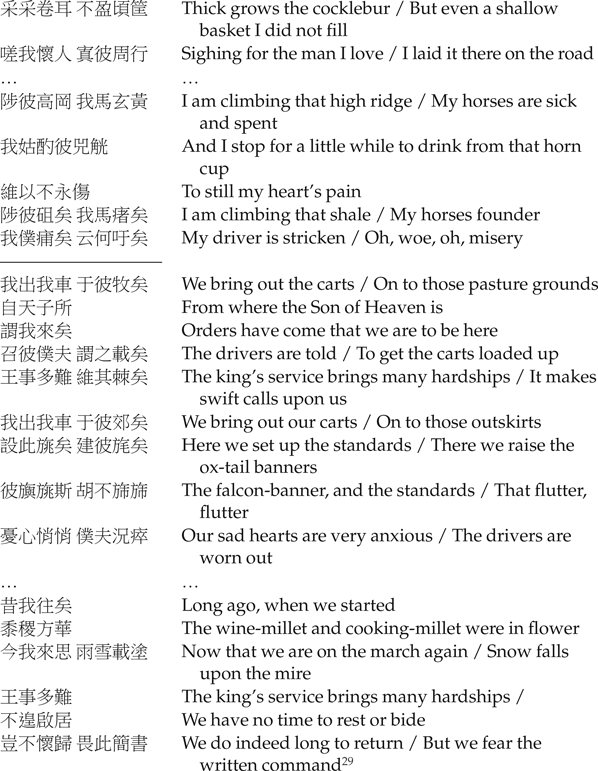
Like the “Li sao” protagonist, the persona of “Juan er” attempts to “ascend” or “climb” (chi 陟) up high with a “driver” (pu 僕) and “horses” (ma 馬) who are not up to the task.Footnote 30 In all three pieces, the dominant theme is huai gui 懷歸, the unfulfilled “longing for return,” with the associated feelings of bei 悲 (grief) in “Li sao” and you 憂 (anxiety) and qiaoqiao 悄悄 (unsettledness) in “Chu ju.”
Other Chu ci pieces amplify these connections. In the “Jiu ge” 九歌 (Nine Songs), the concluding couplet of “Yunzhong jun” 雲中君 (Lord of Yunzhong) echoes the oft-repeated phrase “our anxious hearts are so vexed” (憂心忡忡) from “Chu ju” and elsewhere: “I think of that lord and deeply sigh; it pains my heart so grievously” (思夫君兮太息,極勞心兮忡忡).Footnote 31 In the “Jiu zhang” 九章 (Nine Pieces), the hero's “chariot overturns and the horses founder” 車既覆而馬顛兮; in “Ai shi ming” 哀時命 (Lamenting My Lot), his “chariot breaks down and the horses are worn out” 車既弊而馬罷兮.Footnote 32 Twice in Liu Xiang's 劉向 (77–6 b.c.e.) “Jiu tan,” the driver is described as cui 悴 (wan), a loan character for the cui 瘁 of “Chu ju.”Footnote 33 Also in “Jiu tan,” three pieces lament the plight of “men on the march” (zheng fu 征夫), a term that appears very rarely in early sources outside of Shi quotations.Footnote 34
Writing in 1974, David Hawkes famously suggested that Chu ci poems could be analyzed into two parts: the “tristia” in which the protagonist vents his sorrows and the “itineraria” in which he embarks on a quest.Footnote 35 Given his interest in the shamanistic origins of the Chu ci, Hawkes devoted more space to the latter than the former without offering a convincing account of why the two parts were combined in the first place. His tentative suggestion was that the tristia “derives from the characteristic note of melancholy and frustration which shamanistic tradition prescribed for the hymns which they addressed to their fickle and elusive deities.”Footnote 36 The present analysis suggests another explanation. Hawkes looked to Latin to label the hero's movement through the “Li sao” despite the poem's own nomenclature: zheng 征 (ll. 143, 184).Footnote 37 At the conclusion of the “Li sao,” the itineraria that mattered was not a shamanistic spirit journey but the paradigmatic “campaign” of the Shi. And in Shi poetics, campaigns occasioned tristia.
A Meta-Journey Through the Shi
Zooming out from the “Li sao” conclusion, the zheng theme appears first in the sixth quatrain and in almost half of all quatrains thereafter. As with so much of the “Li sao,” tracing the hero's movement through the poem is complicated by the many abrupt shifts in theme, mood, and voice. Unlike “Chu ju,” the “Li sao” does not follow a literal zheng from departure to homecoming.Footnote 38 Instead, its zheng is a metadiscursive movement through various roles associated with the “men on the march” odes of the Shi. As he struggles to rationalize his plight over the course of the poem, the hero assumes the roles of the pufu, the zhengfu, the woman left behind, and the victorious king on the march only to abandon each in turn.
In other words, the “Li sao” has a structure akin to that of Mei Cheng's 枚乘 “Qi fa” 七發 (Seven Stimuli), in which a performer dramatically recreates a series of superlative experiences for a sheltered and ailing prince.Footnote 39 (Looking farther afield, this sort of episodic structure can be found in the Book of Job, which considers and rejects various rationalizations for Job's suffering, and in Plato's Symposium, which offers a series of monologues on love.) Both texts are framed as solutions to a problem: in “Qi fa,” how to cure the prince's physical malaise; in “Li sao,” how to cure the hero's “alienated heart” (li xin 離心, l. 339). The protagonists of both texts performatively embody culturally significant domains of experience: in “Qi fa,” the pleasures appropriate to a ruler; in “Li sao,” various Shi archetypes. And in both texts, each successive performance fails until the very end, when the sufferer arises and leaves the source of his suffering behind: in “Qi fa,” the prince “rises up” (qi 起) to follow the guest out of the inner palace; in “Li sao,” the hero turns his back on the world.
When dealing with a text as difficult as the “Li sao” that is most likely the product of multiple authors and editors over time, one cannot expect a single interpretation to solve every problem. That is especially true of the reading presented here, which does not explain how every line in the “Li sao” fits together. Nevertheless, the advantage of this reading is that it offers a meta-structure that (1) make sense of the poem's modularity, and (2) shows how each module or stage in the poem contributes to a larger poetic vision. Moreover, it is a structure that admits a degree of flexibility or adaptability. Like “Qi fa” and other Western Han fu 賦 (rhapsodies), it is not a narrative or itinerary so much as a serialized exposition or catalogue of roles, which helps to explain the bewilderingly abrupt transitions from one section to the next. With such a structure, it is easy to imagine different authors or editors adding or subtracting elements as they saw fit.
ROLE #1: THE DRIVER
The “Li sao” introduces the zheng theme in lines 23–24, where the hero first woos the “Fair One” (a term also found in the Shi)Footnote 40:

Although not labeled as such, here the hero plays the role of the Fair One's pufu.Footnote 42 As the driver of the “forward chariot,”Footnote 43 he avoids “careening down twisted trails” (捷徑, l. 32), he “rushes ahead and behind” (奔走以先後, l. 37), and he plots a course in “the footsteps of former kings” (前王之踵武, l. 38).Footnote 44 The exhortation to the Fair One to mount up and ride also suggests that he is responsible for harnessing the horses. When expressing his “fear that the royal carriage might topple” (恐皇輿之敗績; l. 36) should the Fair One follow “a road dark and gloomy through dangerous passes” (路幽昧以險隘; l. 34), the hero echoes an admonishment from “Zheng yue” 正月 (The First Month, 192/10):

Here we might also note the connection between the use of xiu 脩/修 (prepare, arrange; cultivate; fine; long) in the two anthologies. A key term appearing eighteen times in the “Li sao” and nearly fifty times in the Chu ci, xiu is often taken to refer to the “fine” or the “cultivation” of fine things. Of the ten appearances of xiu in the Shi jing, all but three refer to the length of horses in campaigns or to the “preparation” of equipment prior to a campaign, as in “Wu yi” 無衣 (No Wraps, 133/1.3–5): “The king is raising an army / I have made ready both spear and axe / You shall share them with me as my comrade” (王于興師,脩我戈矛,與子同仇). Given the wealth of campaign imagery in the “Li sao,” the militaristic connotations of xiu would seem to be active in that poem as well.
As it happens, the transitions of the first six quatrains—the listing of auspicious omens, the descent, the botanical imagery, the introduction of the pufu, and the theme of moral rectitude—closely mirror the structure of “Ding zhi fangzhong” 定之方中 (The Ding-Star in the Middle of the Sky, 50), one of only two odes in the received Shi jing to refer to a locale named “Chu” 楚:Footnote 45

The astronomical omens of the first stanza recall the omens of “Li sao” lines 1–4, just as “the house of Chu” recalls the hero's claim that he is descended from Gaoyang, the Chu progenitor. Both poems feature the “inspection” (kui 揆; l. 5) of these omens together with additional verbs of “surveying”: guan 觀 and wang 望 in the ode and lan 覽 (l. 5) in the “Li sao.” Both poems feature a “descent” (jiang 降; l. 4) and a “falling” (ling 零; l. 19). Both include the word ling 靈 (divine, numinous): the “magical” rain that falls in the ode and the name “Divine Balance” (ling jun 靈均; l. 8) that is bestowed on the descended hero. “Building” (zuo 作) gives way to “planting” (shu 樹) in the first stanza of the ode just as the arising (zuo 作) of the “Li sao” hero in §1–2 gives way to the botanical imagery of lines 11–12. The final stanza of the ode introduces the faithful “grooms” or “drivers” (guanren 倌人)—a synonym for pufu—just as the “Li sao” transitions to the pufu theme in line 23. There is also some evidence of aural overlap. The “auspicious names” (jia ming 嘉名; *krâi-meŋ) bestowed on the hero by his father in line six echo the “command” (ming 命; *mreŋ) to “yoke” (jia 駕; *krâih) the horses.Footnote 46 Finally, both pieces open with rhymes on *-ung/-ong.
ROLE #2: THE MAN ON THE MARCH
After the Fair One “puts his faith in slanderers” (xin chan 信讒, l. 40), another phrase from the Shi,Footnote 47 the pufu fantasy bursts and the hero enters his first triste. Describing himself as a man of singular virtue, he becomes his own driver when he “turns his chariot around and retraces [his] path” (回朕車以復路兮, l. 107) away from the Fair One. In this section, the hero adopts the persona of a toiling “campaigner” or “man on the march” (zhengfu 征夫) who sheds the “tears” (ti 涕. l. 77) and experiences the “loneliness” (du 獨, ll. 94, 126), “sorrow” (ai 哀, l. 78), “fear” (kong 恐 or wei 畏, l. 64), and “many hardships” (duo jian/duo nan 多艱/多難, l. 78) described in odes like “Xiao ming” 小明 (Minor Bright, 207/2) and “Jie nan shan” 節南山 (High-Crested Southern Hills, 191/7):Footnote 48

Note the “looking back” (gu 顧) in “Xiao ming” and the “looking out” (zhan 瞻) in “Jie nan shan.” In the Shi, such gestures are among the few outward signs of soldiers’ distress (along with sighs and tears). The king's service does not permit them to return or rest, but nothing stops them from gazing in the direction of their loved ones. “Li sao” lines 121–22 deploy both types of looking:Footnote 49

But there is also a crucial difference between the Shi and “Li sao” on this point. In the Shi, the soldiers experience homesickness as a result of the campaign. In the “Li sao,” it is the “estrangement” (li bie 離別, l. 47) with the Fair One and the resulting melancholy that prompt the hero's solo journey.Footnote 50
ROLE #3: THE WOMAN LEFT BEHIND?
In the next section, the “Li sao” hero's aloofness earns him a scolding from Nüxu 女嬃 (the Sister), who introduces the next zheng-based role from the Shi: “Men of this era stand together and love their fellows / so why [act] widowed and childless? Why not hearken to me?” (世並舉而好朋兮,夫何煢獨而不予聽, ll. 139–40).Footnote 51 As noted by Wang Yi, the phrase qiong du 煢獨 (widowed and childless; *gweŋ–dôk) appears in the thirteenth stanza of “Zheng yue” 正月 (The First Month, 192/13.5–6): “The rich are doing well indeed / but pity the widowed [qiong 惸; *gweŋ] and childless” (哿矣富人,哀此惸獨). “Hong yan” 鴻鴈 (Wild geese, 181/1.2–5), another ode about long-suffering men on the march, includes a close parallel of the same line:

Nüxu's question is thus a devastating criticism. Despite the hero's efforts to portray himself as a noble man who chooses to walk a lonely path, ultimately he is no better than a widowed wife or childless parent, the most vulnerable and pathetic victims of a king's campaigns. (Other early sources likewise identify the widowed and childless as the weakest members of society and thus the most requiring of a ruler's mercy.Footnote 52) The message is something like: you are a wretched victim of circumstance, not a master of your own fate. This reading may also explain the choice of interlocutor. Who better to call the hero a forsaken wife than a woman whose name can be read as “Woman Waiting” (removing the radical from 嬃 to yield xu 須)?Footnote 53
ROLE #4: THE KING ON THE MARCH
In rebuttal, the hero puffs himself up into a figure of royal proportions. Professing to “rely on the former sage-kings for restraint and balance” (依前聖以節中兮, l. 141), he journeys southward to the sage-king Shun 舜 to “state his case” (chen ci 敶詞/陳辭, ll. 144, 181), which is essentially a list of rulers who did and did not “follow the plumb line without swerving” (循繩墨而不頗, l. 164).Footnote 54 Prompted by the examples of ancient sage-kings, the hero proceeds to adopt the trappings of a triumphant king or general on the march. He creates a fabulous royal equipage (“I team jade dragons and mount phoenixes” 駟玉虬以椉鷖兮, ll. 183–84) and acquires an increasingly fantastic entourage of gods and, eventually, an army of a thousand chariots (ll. 357–60):

This shift is accompanied by the first appearance of verbs of command: wu ling 吾令 (I order, ll. 189, 201, 207, 221, 224, 237), shi 使 (make, ll. 197–98, 300, 351–52, 354), ming 命 (command, l. 258), and zhao 詔 (decree, l. 352).
The correspondence with the kingly zheng of the Shi is far from perfect. The entourages of the Shi do not include spirits or gods, nor do they travel to mythical locales. But the points of overlap are many: “dragon” (long 龍) and fantastic bird (luan 鸞) imagery;Footnote 56 opulent ornaments and fittings;Footnote 57 flags and banners (qi 旂 [*gəi], qi 旗 [*gə);Footnote 58 “flying” (fei 飛, ll. 201, 337), “flowing” (liu 流, ll. 332, 342), “galloping” (chi 馳, ll. 358, 362), and “rushing” (qu 驅, l. 197) movements;Footnote 59 “cloud” (yun 雲, ll. 221, 343, 360) imagery;Footnote 60 and orderly hosts numbered in the thousands. Consider “Cai qi” 采芑 (Plucking White Millet, 178/2) and “Chang wu” 常武 (Always Mighty in War, 263/5):

There is no hint in these stanzas of the longing or hardship experienced by common soldiers. Kings on the march were to be celebrated, not lamented. So, too, in the “Li sao,” the adoption of the royal persona precludes a triste. Ultimately, however, the hero is no more successful as a king than as a pufu or zhengfu. The first royal zheng (ll. 181–206) ends when he approaches the gates of Heaven and finds the way barred:

Clearly, the royal persona is not as empowering as the hero had hoped.
ROLE #5: THE SUITOR
In classical Chinese thinking, a virtuous ruler requires a virtuous adviser. Perhaps that is why the adoption of the kingly persona transitions in ll. 213–16 into a search for a mate:

As the kings of the Shi did not go on campaigns looking for love, the Shi allusions in this section shift away from campaign odes to odes of “seeking” (qiu 求) or wooing. The transformation from victorious king into hopeful lover also reopens a space for tristia, hence the “looking back,” “tears,” “sadness,” and hill-climbing of ll. 213–16.
The poem's debt to the wooing theme of the Shi is apparent in the very next stanza:Footnote 62

Whereas earlier in the poem (ll. 1112) the hero adorns himself with aromatic plants, here the ornament changes to garnet. “Gifting” (yi 詒 ll. 220, 243; yi 貽 in the Shi)Footnote 63 a friend or beloved with a (garnet) pendant is a stock gesture in the Shi, seen here in “Mu gua” 木瓜 (A Quince, 64/1):

Also note the mixing of botanical and mineral imagery in both poems.
Perhaps the most obvious point of overlap in this section is the figure of the “matchmaker” (mei 媒; ll. 237, 240, 290), a role filled by multiple characters beginning in lines 224–49: Jianxiu 蹇脩, a minister to Fuxi to who approaches Lady Fu 宓妃, the consort of Fuxi 宓羲; the toxic bird (zhen 鴆) who approaches Jiandi 簡狄 of the Yousong 有娀 clan, the mother of the Shang 商 progenitor and a figure referenced in the Shi (304/1.7); and the unnamed figure who approaches the two wives of Shaokang 少康, a king of the Xia 夏 dynasty.Footnote 65 All fail in one way or another: Lady Fu is proud and wanton; the toxic bird reports back (dishonestly?) that Jiandi does not care for the hero, and the third matchmaker is “weak” (ruo 弱) and “inept” (zhuo 拙). The second failure prompts a mini-triste in which the hero expresses his “doubts” (yi 疑) and laments the need for a matchmaker: “I wished to go myself but was not allowed” (欲自適而不可; l. 241).Footnote 66 In a poem that gives its hero the power to command the gods, who or what prevents him from acting as his own matchmaker? The answer lies in the Shi jing—specifically, in the fourth stanza of the “Nan shan” 南山 (Southern Hill, 101) ode:

Several early sources caution against seeking a mate without a matchmaker.Footnote 68 The Shi jing version is both the most canonical and the most unequivocal. Given this connection, it is probably not a coincidence that the phrase wu liang mei 無良媒 (without a fine matchmaker) from “Meng” 氓 (A Simple Peasant, 58/1.8) appears verbatim in the “Jiu zhang” (ll. 49–50) section of the Chu ci: “widowed, childless, alone / and without a fine matchmaker by my side” (既惸獨而不群兮,又無良媒在其側).Footnote 69
The hero's failure to find a mate leads him to seek the advice of Divine Fen 靈氛 (ll. 258–66) and Shaman Xian 巫咸 (ll. 279–300) in the next section of the poem. The first encourages him to continue his search while the second authorizes him to forgo a matchmaker altogether:

To justify this break with tradition, Shaman Xian recites the examples of four rulers (Yu 禹, Wuding 武丁, King Wen 文王, Lord Huan of Qi 齊桓公) who found their own advisers. If these rulers did not require matchmakers, Shaman Xian argues, then neither do you—the petty morality of the Shi be damned.Footnote 70
ROLE #4 REVISITED: THE KING ON THE MARCH
Like the first list of ancient exemplars (ll. 145–62), the second list of sage-kings prompts a return to the kingly zheng in ll. 337–40:

From here the hero proceeds to the end of the poem, where the zheng once again sputters to a halt. Whereas earlier his progress was thwarted by his own limitations in relation to Heaven's gatekeeper, in the final lines he is thwarted by the limitations of his driver and horses in relation to himself. To continue on, he must abandon his entourage and shed the trappings of a king on the march.
I opened this section with the suggestion that the hero's progress through the “Li sao” is not a literal zheng but a movement through different roles associated with the zheng (and qiu) theme of the Shi. After the descent of the opening quatrain, the hero offers to serve as the Fair One's pufu only to be slandered and rebuffed. Resolving to maintain his purity, he sets off as a wandering zhengfu only for the Sister to flip the script and treat him as the abandoned wife of a zhengfu. He responds to the accusation that he is among the weakest and most pathetic members of society by adopting the role of a super-empowered king—only to find himself barred and mocked by Heaven's gatekeeper. Transitioning out of a zheng into a qiu, he seeks a mate but fails because of his reliance on flawed matchmakers, whom he is encouraged to abandon. He resumes the kingly zheng only to be thwarted by pufu and horses mired in a Shi triste. The poem concludes with the hero turning away from his homeland once and for all.
Where does he go at the end of the poem? Much ink has been spilled on the identity of Peng and Xian (or Pengxian) and whether Qu Yuan commits suicide.Footnote 71 But the poem itself is mostly uninterested in such questions. What matters is not where the hero ends up but what he leaves behind. Beginning with the bursting of the pufu fantasy in line 39 and ending with the abandonment of the homesick pufu at the very end, the poem takes up these Shi archetypes in order to move beyond them. Those people in the Shi are always yearning for home and companionship, the “Li sao” hero seems to say, but I am not like those people. I do not need a Fair One, a ruler, a mate, a matchmaker, a pufu, or anyone else. Here in this poem, I can say goodbye and leave the world (of the Shi) behind forever.
A Poetry of Belonging
If the “Li sao” is the product of an oppositional poetics, then what exactly is it opposed to? To answer this question, below I offer a provisional theory of Shi poetics, albeit with a major caveat. Thus far I have spoken of “the Shi” and quoted the Shi jing as if the latter were an unproblematic record of the former, which it most certainly is not.Footnote 72 Not only was the received Shi jing, the Mao Shi 毛詩, one of four versions of the classic circulating in the Han period, it was the only one not to have received imperial recognition during the period when the Chu ci was first anthologized.Footnote 73 Even in Wang Yi's Eastern Han commentary, Shi citations do not always follow the received Shi jing.Footnote 74 The situation is even worse when dealing with earlier manuscript finds, whose Shi quotations exhibit significant variations on the level of individual characters, lines, stanzas, and entire odes. Especially when considering a possible pre-Han context for the earliest strata of the Chu ci, one cannot assume that the received Shi jing provides direct access to the pre-imperial Shi repertoire. But we may be on slightly firmer ground if we set the pre-imperial period aside and read the received Shi jing as a guide to Shi–Chu ci intertextuality in a Han context.
The Shi are a poetry of belonging that explore the dynamics of social, political, and spiritual integration. In the aggregate, they present a vision of society seamlessly integrated from top to bottom, from periphery to center, from outside the court to inside the court, and from living to dead. “Belonging” is my translation for gui 歸 (to return, to go home, to pay allegiance to), which I situate at the core of Shi poetics. Not only do gui and its synonyms (huan 還, fu 復, etc.) appear throughout the received Shi jing, as a heuristic it unites various themes and situations throughout the corpus
Gui in a political context is the foundational conceit of the Chinese intellectual tradition—that virtue is power (de 德). A true ruler need only cultivate his virtue because virtue has gravity; people within the orbit of a virtuous ruler inexorably gui (return, pay allegiance) to him: “All happiness to our prince, to whom the people return” (豈弟君子,民之攸歸).Footnote 75 As described in the eulogies of the “Da ya” 大雅 (Greater Court Odes), his people naturally follow his example (243/4, 244/6.2–4, 256/2), they build him towers unbidden (242/1.5–6), and even his enemies pay him homage (263/6).
Gui in a social context is the promise of social belonging, of “going home” and being fully integrated within one's family and community. The hallmark of such odes is that they are uttered in the voice of the collective, as in this agricultural scene from “Fu yi” 芣苢 (Plantain, 8/1):

The formal features of the Shi enhance this communal spirit: rhyme “bind[s] together and identif[ies] things that under other circumstances tend to fly apart—nature and social life; gift and unequal counter-gift; peasantry and aristocracy”;Footnote 77 repetition reinforces a community's sense of “identity through time.”Footnote 78
Of course, the Shi do not just present images of fully integrated communities. Many pieces depict first-person personas who yearn to gui but cannot. Individuation, the movement from the communal “we” to the singular “I,” is a symptom of one's alienation from the collective. Crucially, the tragic character of these odes is not simply a matter of disaffection or physical separation. At the heart of Shi poetics is a fascination with personas who, through no fault of their own, are caught between conflicting modes of gui. If the Shi in the aggregate present an idealized vision of Zhou society, odes of alienation explore glitches or breakdowns in the system of belonging.
Men on the march are one such glitch. As in “Chu ju,” campaigning soldiers experience a conflict between their allegiance to the king and their desire to return home to their loved ones. They perform “the king's service” but at a high cost to themselves and their community. Another set of alienated voices are the elite men of the “Xiao ya” who suffer as a result of misrule. These personas experience alienation but obey the dictates of political gui to offer loyal advice to their superiors, as in “Jie nan shan” (#191/8):

Married women are another glitch in the system. When a woman is newly married, she technically “goes home” (gui) for the first time to her husband's family. As this entails leaving the family of her birth, neither the bride nor her maiden family necessarily experience gui as a happy homecoming. As in “Yan yan” 燕燕 (Swallow, Swallow, 28/1.3–6), it is also an occasion for tears:

Some of the most tragic and poignant voices in the Shi belong to women who suffer at the hands of their new families, as in “Meng” (58/5):

Such women are trapped by the dictates of gui, as the persona of “Bai zhou” 柏舟 (Cypress Boat, 26/5.5–6) laments: “Silently I ponder [my lot]; I cannot rise up and fly away” (靜言思之,不能奮飛).
Romantic longing in general is a dis-integrating force in the Shi. So long as one is longing for a mate, a sense of wholeness or belonging is impossible. However, as the proto-almanac “Qi yue” 七月 (The Seventh Month, 154/2.10–11) makes clear, the separations occasioned by courtship are normal and necessary features of community life: “A girl's heart is sick and sad / Till with her lord she can go home” (女心傷悲,殆及公子同歸). Heartache anticipates and reinforces the marriage bonds through which communities reproduce themselves.
Spiritual communion is a special case. In odes like “Chu ci” 楚茨 (Thorny Caltrop, 209/2.9–12), interactions with the spirits are restricted to the ancestral sacrifice, in which the living propitiate their ancestors and the ancestors reward their descendants with blessings:

During the sacrifice, the dividing line between living and dead is blurred as the spirits inhabit the body of the “Dead One” or “Impersonator” (shi 尸), the living descendant who physically imbibes the offerings. But the dead cannot reside permanently with the living and so the communion is necessarily temporary: “Bells and drums see the Dead One off / The Spirits and Protectors have gone home” (鼓鍾送尸,神保聿歸; 209/5.8–9). To quote the Zuozhuan 左傳 (Zuo Traditions), “When a ghost [*kwəiʔ] has a place to return [*kwəi] to, it does not become vengeful” (鬼有所歸,乃不為厲).Footnote 79 The spirits gui but are still bound to the living by blood and the logic of “reward” or “reciprocity” (bao 報).
The one thing a person cannot do in the Shi is say goodbye forever.Footnote 80 Sundered personas do not abandon the hope for reunion as they (literally or metaphorically) gaze back toward “the one(s) they long for” (huai ren 懷人; “Juan er”). The disaffected elites of the “Xiao ya” bitterly complain about their lords’ conduct but do not turn their backs on them; like mistreated wives, they “cannot fly away.”Footnote 81 This is the ideology of the Shi in its most distilled form, a worldview premised on the impossibility of not belonging, and in which separation only emphasizes an individual's ties to his or her community.
Framed in this way, the poetics of the Shi went hand in hand with its social function in the early context. It is no accident that a corpus of verse predicated on an imperative to belong was, to quote Michael Nylan, “one of few available sources upon which elites could build a shared lingua franca accepted across the entire Central States cultural horizon.”Footnote 82 As attested by a wealth of quotations, references, and allusions in transmitted and excavated texts from the Warring States period, knowledge of the Shi more than any other (proto-)canonical tradition marked a person's membership in a class of cosmopolitan elites and licensed his participation in a shared Panhuaxia culture rooted to the Zhou ritual order.Footnote 83 In the words of Martin Kern, the Shi jing “was not merely a particular text used by the classicist tradition; it was the text around which this tradition arranged itself.”Footnote 84
Thus, to suggest that the “Li sao” hero transcends the world of the Shi at the end of the poem is not so far-fetched. In a very real sense, the Shi defined the literary ecumene for early authors and their audiences. In a roundabout way, the “Li sao” reaffirms the cultural significance of the Shi in the lengths it goes to authorize its hero's departure. After the homesick pufu halts the ascent of the final quatrain, the coda begins and the hero exclaims, “Enough!” 已矣哉. A threshold is crossed, and it feels momentous. The entirety of the “Li sao” up until this moment is an accumulation of rationales for escaping the gravitational pull of Shi poetics. Despite his inherent nobility, the hero must earn the right to say goodbye.
The Partings of Chu?
Insofar as the “Li sao” established a template for other poems and drove interest in the anthology as a whole, how did its oppositional poetics play out in the Chu ci anthology? The answer is complicated. On the one hand, there is an obvious and superficial sense in which the Chu ci presents a contrast with the Shi. Where the Shi are premised on the imperative to gui, Chu ci pieces are premised on “separation” (li 離; 77 times in 35 pieces), “parting” (bie 別; 7/7), “leaving” (qu 去; 28/21), “departing” (shi 逝; 24/19), “being sent away” (fang 放; 19/12), “seeing off” (song 送; 5/5), and “going off” (wang 往; 32/21) and “not turning back” (bu fan 不反; 9/5). The Chu ci are not just the “Verses” or “Lyrics” of Chu; thematically, they are also the “Partings” (ci 辭) of Chu.Footnote 85
The theme of separation may account for the inclusion of the most un-”Li sao” texts in the anthology: “Tian wen” 天問 (Heavenly Questions), the three “Summons” (zhao 招), and the anecdotal “Bu ju” 卜居 (Divining Whether to Stay) and “Yu fu” 漁父 (Fisherman). “Tian wen” poses a series of questions whose answers are unknowable: “At the beginning of things in ancient times, who was there to pass down the story?” (遂古之初,誰傳道之).Footnote 86 Whatever its original context, within the Chu ci it reads as an epistemological version of the disconnect between the seeker and the sought.
“Zhao hun” 招魂 (Summoning a Soul), “Da zhao” 大招 (Great Summons), and “Zhao yinshi” 招隱士 (Summoning a Hidden Man), adopt the perspective of those whom the departed have left behind. Especially when repeating the refrain of “Zhao hun” and “Da zhao” (“Soul! Come back!” 魂兮歸來/徠), these voices resemble the bereft personas of the Shi who long for reunion with their loved ones, as in “Yin qi lei” 殷其雷 (Deep Rolls the Thunder, 19/1–3.5–6): “O my true lord / Come back to me, come back” (振振君子,歸哉歸哉). Of course, the key difference in the Chu ci is that the summoned do not return; they are either dead or hidden away. No one in the Shi needs to be summoned to know to come home.
The anecdotal “Bu ju” and “Yu fu” feature Qu Yuan asking a sagely figure for guidance. “Yu fu” ends with the fisherman laughing at Qu Yuan's question as he “leaves and never speaks with him again” (去不復與言).Footnote 87 Similar to the aporia of “Tian wen,” “Bu ju” concludes with the diviner “putting aside the [milfoil] stalks and taking his leave” (釋策而謝), telling Qu Yuan that “the tortoise and milfoil truly cannot know what will happen” (龜策誠不能知事).Footnote 88
The dilemma of “Bu ju”—to stay or not to stay—suggests a more meaningful answer to the question that opened this section. The poems and anecdotes of the Chu ci are much too disparate to constitute a single genre or follow a single organizing principle. But insofar as the anthology has an internal logic, we might look for it not in any theme or formal feature but in a particular moral quandary. Like the “Li sao,” the Chu ci ups the ante on the Shi: what if a truly noble figure suffered the most profound “alienation” (li 離), what then? Would such a person be justified in turning his back on the collective? Or does the imperative to gui apply to him as well?
Beginning with the “Jiu zhang” and continuing with “Yuan you,” “Xi shi” 惜誓 (Lament for [a Broken] Oath), the “Qi jian” 七諫 (Seven Remonstrations), “Ai shi ming,” “Jiu huai” 九懷 (Nine Longings), “Jiu tan” 九歎 (Nine Laments), and “Jiu si” 九思 (Nine Pinings), most Chu ci pieces take up this dilemma and follow the “Li sao” template in one form or another. They present personas who fail to woo the object of their affections, experience alienation, mourn their predicament, and/or go on a zheng. But adopting the “Li sao” template does not entail an endorsement of the “Li sao” solution. Throughout these pieces, there is a profound ambivalence about the possibility and propriety of saying goodbye.
Like the “Li sao,” a number of poems build to a final departure:

These personas are heroic insofar as they maintain their agency and succeed in transcending the source of their suffering. (In “Yuan you,” there is also the idea that one can enter a higher, non-human communion with Heaven.) At the other end of the spectrum are pieces that leave their personas mired in tristia with no hope of escape:

Such figures are not so different from the trapped personas of the Shi who gaze back with longing in the direction of their loved ones. Insofar as they reaffirm the impossibility of not belonging, these pieces are Shi in “Li sao” clothing. At least one Chu ci author even went so far as to deny the premise of the “Li sao” quandary. After expressing his desire to “depart” (bieli 別離) on a heavenly journey, the “Jiu bian” persona promises a final return: “Relying on august Heaven's great power, I will return to my lord in good health” (賴皇天之厚德兮,還及君之無恙).Footnote 89 As in the Shi, alienation in the “Jiu bian” turns out not to be an existential threat after all.
Still other pieces take their cue from the Qu Yuan legend to end in (implied) suicide:

These personas stand somewhere between the heroic and the pathetic. An option not countenanced in the Shi, suicide grants the persona a degree of agency while sidestepping the ethical and political implications of turning one's back on a ruler (Yang Xiong's critique, mentioned above, notwithstanding). As a classic response to intractable moral conundrums, suicide highlights the tragic nature of the Qu Yuan narrative.
The “Jiu ge” 九歌 (Nine Songs) are a special case both because of their heterogeneity and the possibility that they pre-date the “Li sao.”Footnote 90 Perhaps the simplest explanation for why the “Jiu ge” were included in the Chu ci is that they have so many obvious points of overlap with the “Li sao.”Footnote 91 Thematically, too, it is possible to read the “Jiu ge” as texts premised on a certain kind of alienation, one that is explicitly spiritual and implicitly social.
A fundamental difference between the “Jiu ge” and the ritual liturgies of the Shi is that the Shi are concerned with ancestor spirits, the “Jiu ge” nature spirits (and the non-ancestral dead of “Guo shang” 國殤 [The Realm's Dead] and “Li hun” 禮魂 [Honoring Souls]). This difference tracks a distinction drawn by von Falkenhausen in his survey of the role of wu 巫 (spirit mediums) in the Zhouli 周禮 (Rites of Zhou), wherein “ritual activities were divided into nature worship and ancestral ritual, each requiring a different sort of mediating agent … [T]he part of the spirits was represented in different ways: by the non-specialist shi 尸 (aided by specialist diviners) in ancestral rituals, and by the specialist wu at other occasions.”Footnote 92 Von Falkenhausen further observes that the “conservative ritualists” who produced texts like the Zhouli were “deeply suspicious of, and hostile toward, mediumistic forms of worship,” in part due to the non-aristocratic status of spirit mediums.Footnote 93 Against the dominant ritual poetics of ancestor worship and its disdain for spirit mediums, perhaps the proper rubric for understanding the place of the “Jiu ge” in the Chu ci is not shamanism per se but interactions with non-ancestor spirits, including southern (e.g., the “Lady of the Xiang” 湘夫人) and non-southern deities (e.g., the solar “Lord of the East” 東君 and the “[Yellow] River Earl” 河伯). Ancestor spirits are bound to the living by blood and the dictates of sacrificial reciprocity. Take away blood and one's connection with the spirits becomes much more tenuous. This tenuousness, I submit, is thematically consistent with the alienation of the “Li sao.”
A few “Jiu ge” pieces (“Donghuang taiyi, “He bo,” “Li hun”) resemble Shi liturgies insofar as they describe orderly and successful ritual performances.Footnote 94 But the human personas of other pieces are beset by anxiety, uncertainty, and longing. The comings and goings of the gods are entirely unpredictable: the “Yunzhong jun” 雲中君 (Lord of the Clouds) “descends” (jiang 降) like an ancestor spirit but then “rushes up and away into the clouds” (猋遠舉兮雲中) in the very next line; similarly, the “Shao siming” 少司命 (Lesser Master of Fate) “arrives abruptly and goes off suddenly” (儵而來兮忽而逝).Footnote 95 Sometimes the spirits do not come at all: in “Xiang jun” 湘君 (Lord of the Xiang) the deity “does not come” (bu xing 不行); in “Xiang furen” 湘夫人 (Lady of the Xiang) she is the “distant one” (yuanzhe 遠者).Footnote 96 The fallen soldiers of “Guo shang” 國殤 (The Realm's Fallen) “went out but did not come back in, left but never returned” (出不入兮往不反).Footnote 97 Humans offer enticements and gifts but generally receive no confirmation that the spirits “enjoyed” (xiang 饗) the offerings or will “reward” (bao 報) the supplicants, as in the “Chu ci” ode above, not even when the persona of “Xiang furen” goes so far as to “build [the goddess] a house in the waters” (築室兮水中).Footnote 98 A few poems take this sense of precariousness to an extreme, as when the persona of “Guo shang” complains that “Heaven's luck has fallen away, the awesome spirits are angry” (天時墜兮威靈怒).Footnote 99 The major exception is the final line of “Donghuang taiyi,” where the god “merrily enjoys himself” (欣欣兮樂康) like a sated ancestor spirit.Footnote 100
Von Falkenhausen's observation that “Spirit Mediums’ principal functions are tied up with averting evil and pollution”—in a word, exorcism—suggests another way of understanding the relevance of the “Jiu ge” to the Chu ci.Footnote 101 Building on this observation, Gilles Boileau points to passages in the Liji 禮記 (Ritual Records), Yili 儀禮 (Etiquette and Ritual), and Zuozhuan to suggest that the wu exorcist “was not welcome in human dwellings,” particularly the funeral chamber, because contact with evil spirits rendered him/her “too dangerous to be permitted entry.”Footnote 102 Boileau concludes,
In the received texts of the Zhou era, even if the ritual order still could use the wu when times required, they were considered to belong more to nature (in its negative aspects) than to culture. A civilization determines itself by its limits. It seems that in late Zhou times, the boundaries of humanity excluded the wu, but at the same time one cannot say that the wu were not part of civilization: they were so to speak among the “official” outcasts and were put in charge of dealing with chaos … I think that the wu were one of the tools the Zhou period used to deal with such matters.Footnote 103
“Official outcasts” is a perfect label for the type of alienation that most fascinated Chu ci authors. In the Shi, no persona exists outside of Zhou society. But the exorcist wu who may have inspired the “Jiu ge” performed a service that necessitated their removal from regular society. Like the “Li sao” hero, their very nature precluded belonging.
Despite their obvious differences, linguistically the “Jiu ge” also have a great deal in common with the Shi.Footnote 104 As demonstrated by Walker, “Jiu ge” phonology conforms more strictly to Shi jing rhyme categories than any other section of the Chu ci, including the “Li sao.”Footnote 105 Moreover, of the thirty or so onomatopoetic binomes in the “Jiu ge,” at least two-thirds have direct parallels in the Shi. One of these is xinxin 欣欣 from “Donghuang taiyi” (see above);Footnote 106 another is the final line of “Xiang jun” (“[Let us] drift about free and easy” 聊逍遙兮容與), which echoes the first stanza of “Gao qiu” 羔裘 (Lamb's Wool, 146/1):

A more interesting case is the phrase dan wang gui 憺 … 忘歸, which appears first in “Dong jun”: “The sights and sounds delight a person / The spectator, transfixed, forgets to go home” (羌聲色兮娛人,觀者憺兮忘歸).Footnote 107 As it happens, dan wang 憺忘 (*dâmʔ–maŋ) is homophonous with zhan wang 瞻望 (look out and gaze; *tam–maŋA) from “Yan yan” (see above) and “Zhi hu” 陟岵 (Climb the Wooded Hill, 110/1), yet another ode on the “man on the march” theme:

As we have seen, gazing in the Shi is a manifestation of longing, with the direction of the gaze indicating the path of return. The “Jiu ge” take this trope and turn it on its head: the pleasure of the encounter is so intense as to overwhelm any sense of belonging, at least temporarily. This is another respect in which interactions with non-ancestor spirits challenge Shi ideology.Footnote 108
Conclusion and Postscript
In summary, this analysis of Shi–Chu ci intertextuality suggests a new way of framing the Chu ci’s place in Chinese literary history—new from a modern but not an ancient perspective. For all its differences, the “Li sao” is a text steeped in the Shi tradition. From the opening quatrains to the failed ascent of the homesick pufu at the very end, the “Li sao” unfolds as a series of confrontations with various Shi archetypes. Can a noble man alienated from his ruler and society find solace in the conventional roles of the Shi? Can he be a pufu? A zhengfu? An abandoned wife? A suitor? A king? Again and again, the answer is no. Having exhausted the menu of Shi-based social options, in the end the “Li sao” hero does what no one in the Shi ever could: he says goodbye. Not all poems in the Chu ci pieces endorse the “Li sao” solution, but they do explore the dynamics of non-belonging in one way or another.
There are still many unresolved questions regarding the origins and early history of the Chu ci. What is clear is that the southern culture hypothesis cannot account for the complex relationship between Chu ci and Shi jing poetics. Even if composed in the Chu region—say, at the court of Liu An in Huainan—by those eager to forge a distinctively Chu identity, the “Li sao” neither reveals a distinctively Chu culture nor suggests a conflict with a northern culture. In keeping with von Falkenhausen's observation that “deliberate emphasis on regionally specific trappings of rulership was pursued with the Zhou system as an implicit point of reference,” the “Li sao” author(s) broadcast their own membership in the elite Panhuaxia culture of the Shi even as they crafted a literary persona who could move beyond it. The connection between the opening quatrains of the “Li sao” and the “Ding zhi fangzhong” ode are suggestive in this context, as if the “Li sao” author(s) sought to anchor their text to one of the very few odes to mention Chu. They may have even intended to create a new “Airs of Chu” (*Chu feng 楚風) to fill the Chu-sized gap within the “Airs of the States” of the Shi jing. Speculation aside, I submit that the Chu ci does not provide evidence of the “dual ancestry” (Hawkes) of Chinese poetry. If we must speak of ancestors in this context, then Chinese poetry has a single ancestor—the Shi jing—with a profoundly influential descendant—the Chu ci—that dramatically expanded the range of literary possibilities from the Han period onward.
As a postscript, I would like to conclude with a poem. “Jie li” 介立 (Standing Alone), section 12/3 of the Lüshi chunqiu 呂氏春秋 (Annals of Lü Buwei), recounts the tragedy of Jie Zhitui 介之推 (aka Jie Zitui 介子推), one of a handful of men who followed Prince Chong'er 重耳 into exile and helped him win back the throne as Duke Wen of Jin 晉文公. When the time came for Chong'er to reward his followers in the Zuozhuan version of the story, Jie Zhitui alone “did not speak of remuneration and remuneration did not come to him” (不言祿,祿亦弗及).Footnote 109 Angered, he chose to die in self-imposed exile rather than “eat [the lord's] food” (不食其食). In the Lüshi chunqiu version, he is said to have “recited an ode” (fu shi 賦詩) and “hung a written version from [Chong'er's] gates” (懸書公門) prior to hiding away (yin 隱) in the mountains:

The poem is a curious blend. Not only is the meter that of a standard Shi poem, the opening line (XX yu fei 于飛) echoes the opening lines of “Yan yan” and several other odes: “Swallow, swallow on your flight / Wing high, wing low” (燕燕于飛,差池其羽, 28/1.1–2).Footnote 111 On the other hand, the flying dragon, the drinking of “dew” (lu 露, see “Li sao” l. 65),Footnote 112 “parched” or “withered” (qiao 橋, a loan for gao 槁) as a description of lifelessness or sadness,Footnote 113 the obvious allegory, and—most strikingly—the righteous adviser who turns away from his lord and dies alone, all smack of the Chu ci.Footnote 114 Like Qu Yuan, Jie Zhitui also became the focus of a local cult into the medieval period and beyond.Footnote 115 Also common to both anthologies are the figure of the fu 輔, a removable wheel-guard and a metaphor for “adviser,” and the verb of “return” (fan 反).Footnote 116
Is Jie Zhitui's lament more akin to the Shi or the Chu ci? Although the Lüshi chunqiu labels it a shi 詩, it violates the Shi’s quotidian sensibilities too flamboyantly to qualify as a capital-S Shi.Footnote 117 If it is possible to read certain Chu ci pieces as Shi in Chu ci clothing, then Jie Zhitui's poem might qualify as a Chu ci poem in Shi clothing: like the “Li sao,” it authorizes its persona to turn his back on his lord and homeland. Of course, one problem with this interpretation is that the poem has no connection to Chu.Footnote 118 Jie Zhitui was a man of Jin 晉, so Jinci 晉辭 (Verses of Jin) might be a better label than Chu ci. Then again, Jie Zhitui also spent years away from Jin accompanying his lord on his travels around the Central States, and his story appears in one text ostensibly composed in Lu 魯 (the Zuozhuan) and another that is a proto-imperial compilation from Qin 秦 (the Lüshi chunqiu). In both of these works, the Jin-ness of the story seems entirely irrelevant. Another problem is that we lack corroborating evidence for the existence of any Chu ci text prior to the Han period. The Jie Zhitui story might just as well have influenced the development of the Chu ci tradition as vice versa.Footnote 119
However we situate it on the literary map of early China, Jie Zhitui's lament further exposes the tenuousness of the southern culture hypothesis—or, in this case, a possible Jin culture hypothesis. Instead, I propose that we read this poem and the Chu ci as parallel responses to the dominant poetics of the Shi. As we have seen, Shi poetics complemented the elite cosmopolitan culture of the Warring States period and, eventually, the imperial culture of the Qin and Han. But as the Jie Zhitui story and the Chu ci attest, the imperative to belong was subject to various forms of negotiation and resistance, perhaps all the more so under a Han legal system that punished “abscondence” (wang 亡) from imperial authority.Footnote 120 As important as the north–south model has been for scholars of Chinese literature, reorienting the history of early Chinese poetry around the centripetal and centrifugal tensions inherent in the Shi-based literary regime is likely to open more fruitful lines of inquiry.


