Introduction
Autism spectrum disorder (ASD) is a group of neurodevelopmental disorders characterized by deficits in social communication and restricted, repetitive patterns of behavior, interests or activities (American Psychiatric Association, 2013). Beyond the core symptoms, children with ASD have been shown to have deficits in visual short-term memory, an ability to maintain and retrieve visual information (Cowan, Reference Cowan2001). An early study conducted by Boucher & Warrington (Reference Boucher and Warrington1976) demonstrated an impairment in forced-choice recognition of pictures compared with ability- or age-matched controls but normal cued recall and paired-associate learning in individuals with autism. However, using the delayed-response visual discrimination task, Prior & Chen (Reference Palmer1976) found no difference when learning and acquisition were equated. Then, Boucher & Lewis (Reference Boucher and Lewis1992) reported that unfamiliar face recognition was impaired in children with autism, but their ability to recognize buildings was normal, suggesting that impaired face recognition does not result from impaired attention or discrimination. Later on, Minshew & Goldstein (Reference Minshew and Goldstein2001) reported worse performance on a list of learning tasks, immediate and delayed recall of a story and of a complex geometric figure and maze learning task by youths with high-functioning autism (HFA), implying that youths with HFA failed to initiate organizing strategies and utilize contextual information. Based on the hypothesis of a fractionably developed visual memory system, Blair et al. (Reference Blair, Frith, Smith, Abell and Cipolotti2002) reported that adults with autism had selective memory impairments in the recognition of faces and potential agents, but a superior ability in recognizing buildings or leaves, suggesting a reduced sensitivity to agency cues. A recent study also reported that children with ASD were unable to make use of semantic affordance of the matrix patterns on the Visual Pattern Test in order to construct a global representation for memory (Mammarella et al. Reference Mammarella, Giofre, Caviola, Cornoldi and Hamilton2014).
In summary, there are controversial findings on visual memory in ASD. Some studies revealed no impairment of visual discrimination (Prior & Chen, Reference Palmer1976) and equal performance in recognition of buildings but not unfamiliar faces (Boucher & Lewis, Reference Boucher and Lewis1992). Some showed deficits in the forced-choice recognition of pictures (Boucher & Warrington, Reference Boucher and Warrington1976), and in the immediate and delayed recall of complex geometric figures (Minshew & Goldstein, Reference Minshew and Goldstein2001) compared with typically developing (TD) youths, and a possible effect of impaired semantic global organization (Mammarella et al. Reference Mammarella, Giofre, Caviola, Cornoldi and Hamilton2014). Some even found superior recognition memory of non-agency objects such as leaves and buildings (Blair et al. Reference Blair, Frith, Smith, Abell and Cipolotti2002).
The inconsistent findings can be explained by the use of tasks of various targets (e.g. words, faces or pictures) and demands (e.g. forced-choice or free recall, immediate or delayed recall), the degree of depending on verbal ability, and the potential effects of age and intelligence on visual memory. A visual memory task of meaningless shapes that are difficult to label and are independent of language ability can eliminate influences from cognitive functions other than visual memory, such as semantic memory (Salmanian et al. Reference Salmanian, Tehrani-Doost, Ghanbari-Motlagh and Shahrivar2012). Yet, the evidence for visual memory of meaningless shapes in ASD is too little to draw a conclusion. Ameli et al. (Reference Ameli, Courchesne, Lincoln, Kaufman and Grillon1988) found poor memory with meaningless patterns, but normal with meaningful pictures; however, Salmanian et al. (Reference Salmanian, Tehrani-Doost, Ghanbari-Motlagh and Shahrivar2012) reported that the differences between ASD and controls disappeared after adjusting for intelligence quotient (IQ), implying that visual memory of meaningless shapes in ASD could be moderated by general intellectual abilities. Intelligence has been shown also to correlate with visuospatial memory (Miyake et al. Reference Miyake, Friedman, Rettinger, Shah and Hegarty2001; Cowan et al. Reference Cowan, Elliott, Scott Saults, Morey, Mattox, Hismjatullina and Conway2005) through its effect on strategic choices for memory (Cusack et al. Reference Cusack, Lehmann, Veldsman and Mitchell2009). Whether ASD youths with superior IQ benefit from memorizing meaningless patterns is of particular interest. Regarding the age effect, only a few studies have shown a lack of typical adolescent development in visual tasks of rapid enumeration of the elements and global shape recognition (Scherf et al. Reference Scherf, Luna, Kimchi, Minshew and Behrmann2008), suggesting that recognition and memory deficits increased from adolescence to adulthood (O'Hearn et al. Reference O'Hearn, Tanaka, Lynn, Fedor, Minshew and Luna2014). Whether there existed an age effect on visual memory of meaningless shapes is as yet unclear.
Previous studies have established the link between spatial attention and spatial working memory (Smyth & Scholey, Reference Smyth and Scholey1994; Awh et al. Reference Awh, Jonides and Reuter-Lorenz1998; Awh & Jonides, Reference Awh and Jonides2001). Visual short-term memory is thought to be the active maintenance of attention to visual stimuli important for ongoing reactions (Chun, Reference Chun2011), and that it depends not only on actively sustained maintenance of relevant sensory representations of a limited number of visual objects, but also inhibition of distraction (Cowan, Reference Cowan2001; Awh et al. Reference Awh, Vogel and Oh2006). Our previous study demonstrated attention deficits in autism and Asperger's disorder (AS) with different patterns between the two (Chien et al. Reference Chien, Gau, Chiu, Tsai, Shang and Wu2014). With regard to the intimate relatedness between visual working memory and visual attention, whether the prior findings of visual memory deficits reflect true deficits as such, or instead, sustained attention deficits remains unclear. In addition, visuospatial abilities were shown to differ between autism and AS in some studies (e.g. Sahyoun et al. Reference Sahakian, Morris, Evenden, Heald, Levy, Philpot and Robbins2009) but not in others (e.g. Miller & Ozonoff, Reference Miller and Ozonoff2000). Also, whether diagnosis subgrouping within autism spectrum differed in terms of memory of meaningless shapes has not been investigated, either.
This study aimed to investigate visual memory and sustained attention in youths with ASD using tasks with meaningless shapes as compared with TD youths. We examined the moderating effects of age and IQ on visual memory performance and sustained attention, by stratification and by testing of the interaction. We also compared visual memory performance after adjusting for sustained attention. Our hypotheses are that youths with ASD may show visual memory deficits on meaningless shapes and impaired visual sustained attention, and that ASD youths with higher IQ or those older may not show the deficits. Besides, the visual memory impairment remained in ASD youths while sustained attention was controlled.
Method
Participants
The sample consisted of 143 youths with ASD (male 93.7%, aged 13.1, s.d. 3.5 years), and 143 age- and sex-matched TD controls (aged 13.1, s.d. 3.8 years). The diagnoses of autistic disorder (autism) (n = 67) and AS (n = 76) were made by board-certificated child psychiatrists based on the Diagnostic and Statistical Manual of Mental Disorders, fourth edition (DSM-IV) criteria, and validated by the Autism Diagnostic Interview-Revised (ADI-R) interview. Youths with ASD were recruited from out-patient clinics of the National Taiwan University Hospital and Chang Gung Memorial Hospital, and TD controls were recruited from similar school districts of youths with ASD by the assistance of school principals and teachers rather than by advertisement. Subjects with full-scale IQ (FIQ) scores lower than 80, or with current or lifetime major psychiatric diagnoses according to the Chinese-language Kiddie Schedule for Affective Disorders and Schizophrenia – epidemiological version (K-SADS-E) were excluded from the study.
Diagnostic interview for ASD and other diagnoses
The ADI-R (Lord et al. Reference Lord, Rutter and Le Couteur1994; Gau et al. Reference Gau, Lee, Lai, Chiu, Huang, Kao and Wu2011) is a standardized, semi-structured interview with the caregivers of children aged from 18 months to adulthood. It covers most developmental and behavioral aspects of ASD, including reciprocal social interaction, communication, and repetitive behaviors and stereotyped patterns. The ratings were based on an assessment under current conditions and under the most severe state at 4–5 years, as recalled by the caregivers. The Chinese ADI-R was approved by the World Psychological Association in 2007 (Gau et al. Reference Gau, Liu, Wu, Chiu and Tsai2013; Chien et al. Reference Chien, Gau, Chiu, Tsai, Shang and Wu2014).
The K-SADS-E is a standard, semi-structured interview scale for the systemic assessment of both past and current mental disorders in children and adolescents. The Chinese K-SADS-E (Gau & Soong, Reference Gau and Soong1999; Gau et al. Reference Gau, Chong, Chen and Cheng2005) has been widely used in clinical research to assess DSM-IV psychiatric disorders (e.g. Lin et al. Reference Lin, Chen and Gau2013; Gau & Huang, Reference Gau and Huang2014).
Neuropsychological tests for assessing visual memory
For fair comparison between age and IQ subgroupings, the neuropsychological tests were administered to all participants in a fixed order, by well-trained psychologists according to the standard protocols at a laboratory specializing in neurocognitive assessments. The following four tasks selected from the Cambridge Neuropsychological Test Automated Battery (CANTAB) (CANTABeclipse; UK) were used to test visual memory and sustained attention.
Spatial recognition memory (SRM)
This task assessed recognition memory for spatial locations in a two-choice forced discrimination paradigm (Sahakian et al. Reference Rojas, Peterson, Winterrowd, Reite, Rogers and Tregellas1988). In the presentation phase, empty boxes were shown at different locations on the screen, and the participant was required to remember the places where the boxes were presented. The participant then saw five stimuli in succession at different locations each for 3 s. Following a 5-s pause, the participant then viewed two boxes and was required to touch the box located in a place that was previously targeted. The subtest was repeated three more times, each time with five new locations. Two indices are presented: (1) the percentage of correct responses; and (2) the mean response latency for correct responses.
Delayed matching to sample (DMS)
This task assessed the ability to remember the features of a complex and abstract pattern in a four-choice delayed recognition memory paradigm (Egerhazi et al. Reference Egerhazi, Berecz, Bartok and Degrell2007). In the simultaneous matching condition, the sample pattern remained on screen when four choice patterns appeared. In the delayed condition, a delay of 0, 4 or 12 s was introduced between the appearance of the sample pattern and later the choice patterns. The participant was instructed to touch the pattern that matched the sample, and to repeat the trial until a correct choice was made. After three practice trials, there were 20 counterbalanced test trials in a pseudo-random order, including five simultaneous trials and five trials for each of the three delay intervals. The following indices are reported: (1) the mean latency, that is, the mean time taken to respond with correct responses; (2) the number of correct responses in the simultaneous, three delay conditions, and in total; and (3) the probability of an error after a correct and an error response.
Paired associates learning (PAL)
The PAL test assessed visuo-spatial associative learning, and contained both a delayed response procedure and a conditional learning task (Egerhazi et al. Reference Egerhazi, Berecz, Bartok and Degrell2007). Participants would complete the eight stages in order. For each stage, boxes were displayed and opened in random order. The patterns shown in the boxes were then displayed in the screen center one by one. The participants were told to touch the box where the pattern was originally located with up to 10 trials at each stage. When they got all the correct locations, they would proceed to the next stage. If they could not complete a stage correctly, the test was terminated. Three indices were analysed: (1) total errors; (2) total trials required to locate all the patterns correctly in all stages; (3) first trial memory scores; (4) mean errors and mean trials to success; (5) stages completed on the first trial.
Rapid visual information processing (RVP)
The RVP task, a 4-min visual continuous performance task modified from Wesnes and Warburton's task (Reference Wesnes and Warburton1984), is designed to assess sustained attention capacity (Sahakian et al. Reference Sahakian, Jones, Levy, Gray and Warburton1989). Digits (ranging from 2 to 9) appeared one at a time (100 digits/min) in the screen center in a random order. Participants were asked to press a response pad when they detected any one of three number sequences (3–5–7, 2–4–6 or 4–6–8). The following indices are presented: (1) total misses (occasions the participant failed to respond); (2) probability of hits (correct response, h), i.e. total hits divided by the sum of total hits and total misses; (3) total correct rejections (stimuli that were correctly rejected); (4) probability of false alarms (the participant responding incorrectly, f), i.e. total false alarms divided by the sum of total false alarms and total correct rejections (Tanner & Swets, Reference Tanner and Swets1954; CANTABeclipse™: Test Administration Guide version 3); (5) A’ (calculated as 0.5 + [(h − f) + (h − f)2]/[4 × h × (1 − f)]), a signal detection measure of sensitivity to the target, regardless of response tendency (Sahgal, Reference Sahgal1987); and (6) mean latency (mean time taken to respond in correct responses). Sensitivity (A’) refers to how hard or easy it is to detect from background events that a target stimulus is present. This index of target sensitivity is considered to represent attentiveness (Stanislaw & Todorov, Reference Stanislaw and Todorov1999).
Procedure
The research ethics committee of the university hospital approved this study prior to its implementation (200903062R; ClinicalTrials.gov number, NCT00916851). Written informed consent was obtained from both the participants and their parents after the procedures were fully explained. All of the participants and their parents were interviewed using the Chinese-language K-SADS-E for the child's DSM-IV psychiatric diagnoses. A total of 20 of the ASD youths (14.0%) were currently being treated with methylphenidate under the co-morbid diagnosis of attention-deficit/hyperactivity disorder (ADHD). The participants then performed the CANTAB tasks in the hospitals. The medications, if any, were discontinued at least 24 h before the task.
Statistical analysis
The data analysis was carried out using SAS 9.2 software (USA). The PROC MIXED procedure (Demidenko, Reference Demidenko2004; Littell et al. Reference Littell, Milliken, Stroup, Wolfinger and Schabenberger2006) was used to conduct the linear multi-level model with random and fixed effects to compare the CANTAB performance while controlling for sex, age and FIQ. The comparison groups were treated as fixed effects, since the pairing samples were matched by sex and age; individual differences were treated as random effects. Cohen's d was calculated to estimate the effect size: small (0.2–0.3), medium (0.5–0.8) and large (>0.8). Analysis of covariance was used to compare the autism, AS and TD groups adjusting for sex, age, FIQ and/or sensitivity index RVP A’. We used the Bonferroni correction method to adjust p values in a post-hoc analysis for multiple comparisons. To examine the performance in individuals with superior IQ, we compared 42 youths with ASD and 60 TD youths who had a FIQ higher than one standard deviation (FIQ > 115).
To test the age effect, we performed linear regression analysis first to treat age as a continuous variable. Next, we divided the sample into three age groups, i.e. <12, 12–14 and >14 years at the time of testing, roughly corresponding to childhood, early adolescence and late adolescence, based on the evidence that cortical thinning during the 12–14 years period predicted visuospatial functioning (Squeglia et al. Reference Squeglia, Jacobus, Sorg, Jernigan and Tapert2013) and that processing speed begins to level off at age 15 years (Kail & Ferrer, Reference Kail and Ferrer2007). We then investigated the main effects of age and diagnosis (ASD and TD) groups, as well as their interaction (age × diagnosis). Significance was set at a p < 0.05 level.
Ethical Standards
All procedures contributing to this work comply with the ethical standards of the relevant national and institutional committees on human experimentation and with the Helsinki Declaration of 1975, as revised in 2008.
Results
Sample characteristics
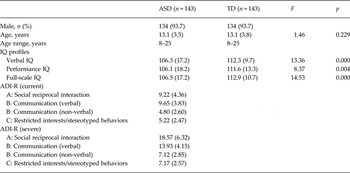
The demographics and IQ profiles for the whole sample, the ADI-R subscores of the most severe condition at around 4–5 years old, and the current conditions are presented in Table 1. Youths with ASD had lower verbal IQ, performance IQ and FIQ than the TD youths. There were no significant differences in the distribution of sex, age and IQ profiles between autism and AS (see online Supplementary Table S1).
Demographic data of youths with ASD and TD youths

Data are given as mean (standard deviation) unless otherwise indicated.
ASD, Autism spectrum disorder; TD, typically developing; IQ, intelligence quotient; ADI-R, Autism Diagnostic Interview-Revised.
Group comparison between ASD and TD
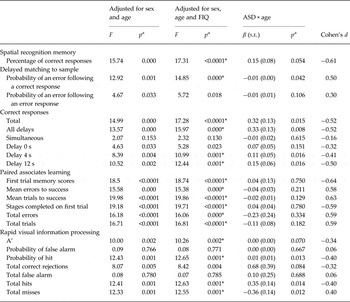
The ASD group had significantly fewer correct responses on SRM and DMS (all delay conditions), fewer hits and correct rejections but more misses on RVP, and more errors on DMS and PAL, with medium effect sizes (Cohen's d = −0.32 to −0.61, 0.30 to 0.63) (see online Supplementary Table S3). There was no significant group difference regarding correct responses on DMS (simultaneous), stages completed on PAL and false alarm on RVP. In general, there was no group difference in the mean latency of responses on SRM, DMS (delay) and RVP, except for a shorter reaction time on DMS (simultaneous). The two groups were not different in the control task Big/Little Circle (see online Supplementary Table S2).
The significance of group comparison remained after adjusting for sex and age (Table 2) as well as further adjusting for FIQ (Table 2) except for the mean latency of correct response on DMS (simultaneous). When sustained attention deficit (RVP A’) was further controlled, visual memory impairment on SRM (correct response), DMS (number of total correct, probability of an error following a correct response) and PAL (all indices) remained significant (see online Supplementary Table S4). The effect sizes were medium to large on SRM, DMS (delay) and PAL (Cohen's d = 0.5–0.64), with the highest one on PAL [first trial memory scores (Cohen's d = −0.64) and mean trial to success (Cohen's d = 0.63)].
Comparison of performance on visual memory tasks between youths with ASD and TD youths, adjusting for sex, age and/or FIQ

ASD, Autism spectrum disorder; TD, typically developing; FIQ, full-scale intelligence quotient; β, regression coefficient estimate; s.e., standard error.
a Uncorrected p values.
* Significant after Bonferroni correction (p = 0.0023).
When comparing the autism, AS and TD groups (see online Supplementary Table S5), we found there was no significant group difference between autism and AS (Bonferroni adjusted p > 0.05, Cohen's d = −0.19 to 0.28). Both two ASD groups performed worse than the TD group on all tasks except similar correct rejection and target sensitivity (A’) on RVP (Bonferroni adjusted p > 0.05).
Task difficulty effect in DMS
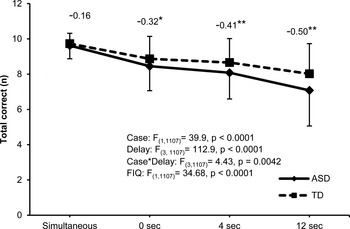
The data showed a task difficulty effect in different intervals of delay DMS (0, 4 and 12 s) relative to simultaneous DMS (F 3,1107 = 112.9, p < 0.0001) (Fig. 1). A significant diagnosis × interval interaction showed that the ASD–TD difference enlarged as the interval of delay DMS tasks increased from 0, 4 to 12 s.
Total correct numbers in delayed matching to sample simultaneous and delay conditions: diagnosis group effect (case), delay conditions (simultaneous, 0 s, 4 s and 12 s) and their interaction after controlling for full-scale intelligence quotient (FIQ). Values are effect sizes (Cohen's d). Standard deviations are represented by vertical bars. ASD, Autism spectrum disorder; TD, typically developing.

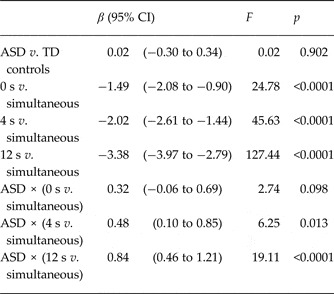
The interactions between diagnosis and each delay interval (0 s v. simultaneous, 4 s v. simultaneous, 12 s v. simultaneous), after controlling for sex, age and FIQ, showed significant diagnosis × delay intervals in 4 s delay DMS (F 1.825 = 6.25, p = 0.013) and 12 s delay DMS (F 1.825 = 19.11, p < 0.0001) relative to simultaneous DMS (Table 3).
Final model integrating the main effects of diagnostic group and different levels of task demand on the number of correct responses, controlling for confounding variables a

β, Regression coefficient estimate; CI, confidence interval; ASD, autism spectrum disorders; TD, typically developing
a Variables included sex, age and full-scale intelligence quotient.
Comparison in the subsample with superior FIQ
In the subsample with FIQ higher than 115 (42 ASD and 60 TD youths), there was no significant difference between ASD and TD youths in the correct responses, total trials or total errors on DMS, PAL and RVP, but there were fewer correct responses on SRM with a marginal significance (see online Supplementary Table S2).
Age effects on visual memory performance
When age was treated as a continuous variable, performance on the DMS and RVP significantly improved with age from childhood to adolescence in both groups. However, improvement in SRM and PAL performance was noted in the TD group only, but not in the ASD group.
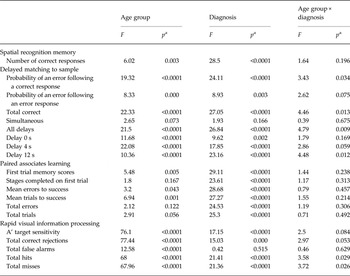
We further divided our sample into childhood, early adolescence and late adolescence subgroups and found that age subgroups had significant main effects on SRM, RVP and DMS (except for A’ and total correct responses in simultaneous matching), showing the older the youths, the better the performance (Table 4). In PAL, the late adolescence subgroup had higher memory scores and more stages completed in the first trial, and required fewer trials to succeed. Furthermore, an age × diagnosis interaction was significant in DMS and RVP, but not in SRM, and PAL. Significant age × diagnosis interactions were found in the correct responses to delay matching, and the probability of an error following a correct response of DMS, and in the probability of hit, total hits and total misses of RVP (Table 2).
Effects of age groups on visual memory performance (age as a categorical variable by the general linear model)

a Uncorrected p values.
Discussion
As one of few studies investigating visual memory in youths with ASD, and with probably the largest sample, we found that youths with ASD performed worse than TD youths on all the visual memory tasks, i.e. SRM, DMS, PAL and the visual attention task, RVP, without significant difference between autism and AS. Besides, the significant ASD–TD difference disappeared in the subsample with superior IQ. We also found that both ASD and TD youths had improved performance with age in DMS and RVP while only TD youths improved in SRM and PAL. Further interaction analyses showed that the slope of improving visual memory with regard to DMS and RVP tasks was greater in TD youths than in ASD youths. In DMS, the longer the delay was, the greater the group difference, with the gap wider among older youths with ASD.
Consistent with previous studies testing memory of meaningless shapes (Ameli et al. Reference Ameli, Courchesne, Lincoln, Kaufman and Grillon1988; Steele et al. Reference Steele, Minshew, Luna and Sweeney2007; Salmanian et al. Reference Salmanian, Tehrani-Doost, Ghanbari-Motlagh and Shahrivar2012), we found a significant visual memory impairment in youths with ASD. These findings were in accordance with some earlier studies that demonstrated visual memory impairment in tasks such as recognition of pictures (Boucher & Warrington, Reference Boucher and Warrington1976), delayed recall of complex geometric figures (Minshew & Goldstein, Reference Minshew and Goldstein2001), or semantic global organization of visual matrix patterns (Mammarella et al. Reference Mammarella, Giofre, Caviola, Cornoldi and Hamilton2014), but not others (Prior & Chen, Reference Prior and Chen1976). Hence, our findings provide strong evidence to extend our knowledge that individuals with ASD demonstrate visual memory impairment across different tasks, with more consistent memory deficits relative to meaningless shapes than other tasks.
Compared with the finding of Salmanian et al. (Reference Salmanian, Tehrani-Doost, Ghanbari-Motlagh and Shahrivar2012) that visual memory deficits in youths with ASD lost statistical significance after controlling for IQ, our data showed that the significance did not change after controlling for IQ. However, in the subsample of superior IQ, the performance of ASD youths did not differ from that of TD youths, indicating that IQ is an important moderating factor but not a confounding factor for the association between ASD and visual memory impairment. Although individuals with ASD had preserved visuospatial function and non-agency objects recognition (Blair et al. Reference Blair, Frith, Smith, Abell and Cipolotti2002), they, except for those with superior IQ showing no difference, still had deficits in recalling abstract geometric figures or locations, reflecting a core deficit in visual memory. On the other hand, youths with ASD, as expected, showed significant sustained attention deficits compared with TD youths (Chien et al. Reference Chien, Gau, Chiu, Tsai, Shang and Wu2014). The novel finding that visual memory deficits of meaningless shapes mostly remained when the effect of sustained attention impairment was regressed out warrants further investigation. This echoes the argument that impaired face recognition itself does not result from impaired attention (Boucher & Lewis, Reference Boucher and Lewis1992). Although there is a close link between visual memory and attention (e.g. Awh et al. Reference Awh, Vogel and Oh2006), attention deficits may moderate, rather than mediate, visual memory performance in ASD.
Our study, being the first study to address the age effect on memory of meaningless shapes, demonstrated a clear age effect in the improvement of performance from childhood to adolescence, implying that visual memory and sustained attention is a function of age. The significant age and diagnosis interaction in DMS and RVP performance suggests that despite improving visual memory and sustained attention with age in both ASD and TD youths, the magnitude of improvement was greater in TD youths. Our finding is in line with O'Hearn et al. (Reference O'Hearn, Tanaka, Lynn, Fedor, Minshew and Luna2014), who showed that immediate memory deficits (of recognizing faces and cars) in autism become more robust and general from childhood (only faces) to adulthood (both faces and cars), suggesting a developmental plateau in visual object processing. The lesser involvement of memory of meaningless shapes in the ability to translate information from a visual to a phonological form (inner speech) was demonstrated in TD youths with a significant age effect (e.g. Palmer, Reference Palmer2000). Other factors, such as the maturation of neurological networks integrating complex cognitive processes for visual coding, may account for the age-related changes (Pickering, Reference Pickering2001). Developmental changes in processing strategies and speed, and attentional capacity are also likely to influence visual memory performance and contribute to the lesser improvement in ASD (Cowan & Alloway, Reference Cowan, Alloway and Cowan1997). Moreover, our findings of more deficits among older youths with ASD on DMS and RVP, but not in spatial working memory (SRM and PAL), highlight the different trajectories of neurocognitive development in ASD. In other words, youths with ASD still have the potential to improve their spatial working memory, just like TD youths. These findings strengthen the argument that the visual memory system is developmentally fractionationable (Blair et al. Reference Blair, Frith, Smith, Abell and Cipolotti2002).
DMS and PAL are supposed to be sensitive to changes in medial temporal lobe functioning with some input from the frontal lobes to DMS (Sahakian et al. Reference Rojas, Peterson, Winterrowd, Reite, Rogers and Tregellas1988; Moscovitch, Reference Moscovitch1994; Robbins et al. Reference Robbins, James, Owen, Sahakian, McInnes and Rabbitt1994), while SRM and RVP are sensitive to frontal dysfunction (and to parietal dysfunction as well in RVP) (Robbins et al. Reference Pickering1998). Our findings lend indirect evidence to support temporal and frontal lobe dysfunction in ASD, which has been documented using both functional (e.g. Castelli et al. Reference Castelli, Frith, Happe and Frith2002; Luna et al. Reference Luna, Minshew, Garver, Lazar, Thulborn, Eddy and Sweeney2002) and structural magnetic resonance imaging (e.g. Rojas et al. Reference Robbins, James, Owen, Sahakian, Lawrence, McInnes and Rabbitt2006; Bonilha et al. Reference Bonilha, Cendes, Rorden, Eckert, Dalgalarrondo, Li and Steiner2008; Ke et al. Reference Ke, Hong, Tang, Zou, Li, Hang, Zhou, Ruan, Lu, Tao and Liu2008). Furthermore, adolescence is a critical period for frontal lobe development (Begley, Reference Begley2000; Giedd, Reference Giedd2008); youths with autism revealed abnormal white matter development in the temporal, parietal and occipital lobes, but not the frontal lobe (Hua et al. Reference Hua, Thompson, Leow, Madsen, Caplan, Alger, O'Neill, Joshi, Smalley, Toga and Levitt2013). Our findings of a lack of age and diagnosis interaction on SRM and PAL, the tasks involving spatial working memory and being related to frontal lobe functioning (Luna et al. Reference Luna, Minshew, Garver, Lazar, Thulborn, Eddy and Sweeney2002), correspond to this regional brain growth hypothesis (Hua et al. Reference Hua, Thompson, Leow, Madsen, Caplan, Alger, O'Neill, Joshi, Smalley, Toga and Levitt2013). However, the older ASD youths performed worse on the other two tasks not involving spatial memory (DMS and RVP), supporting a previous argument of slowed development in the temporal and parietal lobes during adolescence (Luna et al. Reference Luna, Minshew, Garver, Lazar, Thulborn, Eddy and Sweeney2002). Given their lesser improvement with age, deviated performance on DMS and RVP could potentially serve as trait markers for ASD.
Our data also revealed that the magnitude of group difference increased as memory loading increased on DMS. Similar findings have been reported in ADHD (Shang & Gau, Reference Shang and Gau2011). However, our finding is considered novel since no study has provided such data in ASD. Moreover, elder ASD youths performed worse during longer delay conditions (4 and 12 s), rather than the 0 s delay condition, implying that individuals with ASD, like TD youths, may potentially improve with age on tasks with lower memory loading. Our results collectively implied that visual memory and attention impairment in youths with ASD is indeed moderated by age and memory loading, as well as the involvement of spatial working memory. This may explain the controversial findings in previous studies, and therefore needs to be considered in future investigations.
Differing from early impressions (e.g. Sahyoun et al. Reference Sahyoun, Soulieres, Belliveau, Mottron and Mody2009), our findings of no significant difference between autism and AS are in line with evidence showing equivalent cognitive abilities between AS and HFA (e.g. Ozonoff et al. Reference Ozonoff, South and Miller2000). Visual memory deficits of meaningless shapes may be inherent to ASD psychopathology, independent of diagnostic subgroups.
Several limitations should be considered when interpreting our results. First, the sample was male-predominant (93.7%) with a wide age range (8–25 years) and normal intelligence, so the findings may not be generalized to the entire ASD population. Therefore, we cautiously adjusted for sex and age in the statistical analysis. Although the normal IQ in our sample is assumed to lead the comparison towards the null and may underestimate the group difference, visual memory and sustained attention still significantly differed between the two groups after adjusting for IQ. Our samples do not match on IQ because of an intention to test the moderating effect of IQ and the concern about over-matching that is under debate (e.g. Lundervold et al. Reference Lundervold, Stickert, Hysing, Sørensen, Gillberg and Posserud2012). Second, the comparison may be biased when the task does not interest them. In this study, youths with ASD showed comparable performance on several tasks (e.g. stages completed in PAL, simultaneous matching in DMS) and mean latency of responses relative to TD youths, reflecting that they performed the tasks as seriously as TD youths. Nevertheless, the study used a matched design with a relatively large sample, the diagnosis of autism and AS was confirmed by a standardized diagnostic assessment, the ADI-R, and the potential correlates were assessed comprehensively. The results showed that youths with ASD, particularly older youths, had visual memory and sustained attention impairment across tasks.
For most ASD youths with visual memory impairment, special tutoring may be needed to split the tasks, or to present the visual materials simultaneously for their learning. Since the impairment is highly age-dependent, diagnosis × age interaction and age-stratified analyses should be regularly examined in future studies on the developmental neurobiology of ASD. Future longitudinal studies are warranted to explore the neural substrate of visual memory and sustained attention deficits and to trace the trajectory of different neurocognitive functions.
Supplementary material
For supplementary material accompanying this paper visit http://dx.doi.org/10.1017/S0033291714003201
Acknowledgements
This work was supported by the National Science Council (NSC98-3112-B-002-004, NSC 99-3112-B-002-036, NSC99-2627-B-002-015, NSC100-2627-B-002-014 and NSC101-2627-B-002-002) and the National Taiwan University-AIM for Top University: Excellent Research Project (10R81918-03, 101R892103, 102R892103). The authors thank all the participants in this study.
Declaration of Interest
None.