INTRODUCTION
As currently understood, the batfish genus Halieutopsis (Garman, Reference Garman1899) contains ten species (Ho et al., Reference Ho and Kwang-Tsao2008a; Froese & Pauly, Reference Froese and Pauly2012) and is distributed from the Indian Ocean to the eastern Pacific Ocean in tropical and subtropical seas (Bradbury, Reference Bradbury1988). The genus Halieutopsis was reviewed by Bradbury (Reference Bradbury1988) with the description of four new species. The generic characters are as follows: head moderately to greatly depressed, no teeth on palate, two or more lateral line scales with neuromasts on either side of anus, the illicial bone relatively simple and spine like; its base not perforated by foramina (Garman, Reference Garman1899; Bradbury, Reference Bradbury1988); gills two. The genus is shown to have the greatest bathymetric range (410–1372 m) of any ogcocephalid, from upper slope to abyssal depths (Bradbury, Reference Bradbury1988). The holotype of Halieutopsis stellifera (Smith & Radcliffe, in Radcliffe, Reference Radcliffe1912) was reported from the Flores Sea off the coast of Celebes, at a depth of 1266 m. Halieutopsis stellifera is distributed from the northern Celebes to the Philippine archipelago and Okinawa Trough (Bradbury, Reference Bradbury1988). To date no specimens have been reported from the eastern Indian Ocean.
MATERIALS AND METHODS
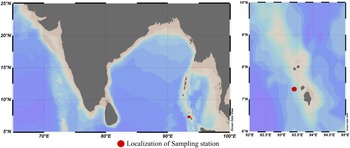
The three specimens of Halieutopsis stellifera reported herein (Referral Centre No. 292 89 22 A, B and C) were collected by the exploratory deep-sea fishery surveys of FORV ‘Sagar Sampada', (Cruise no. 292) conducted by the Centre for Marine Living Resources and Ecology (CMLRE) during December 2011 from off the Andaman coast of India (latitude 07°31′N and longitude 93°39′E; Figure 2) at depths ranging from 480 to 580 m. The specimens were collected by a High Speed Demersal Trawl—Crustacean Version (HSDT-CV) operated at a speed of 3 knots. Immediately after collection the specimens were preserved in a 5% buffered formaldehyde solution.
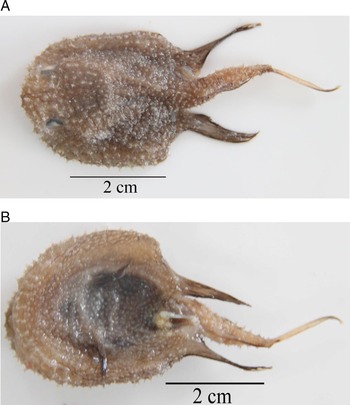
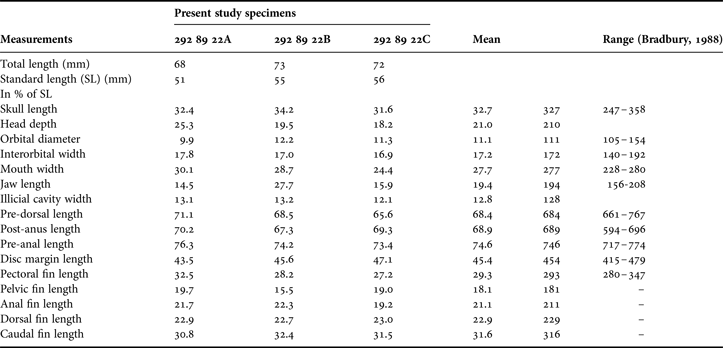
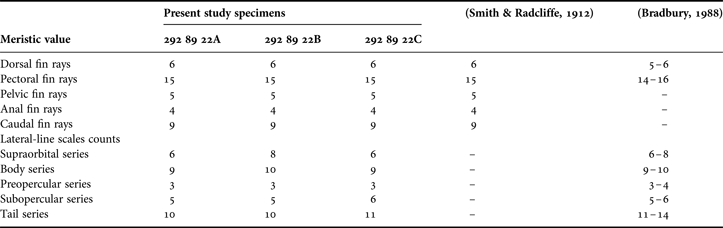
The specimens (Figure 1A, B) were identified as Halieutopsis stellifera following the original description and illustration given by Smith & Radcliffe, in Radcliffe (Reference Radcliffe1912), and Bradbury (Reference Bradbury1980, Reference Bradbury1988). Morphometric and meristic data (Tables 1 & 2) were taken from the preserved specimens following Bradbury (Reference Bradbury1980, Reference Bradbury1988) and Ho et al. (Reference Ho, Hiromitsu and Kazunobu2008b, Reference Ho, Prokofiev and Kwang-Tsao2009). Terminology used in describing angling apparatus follows Bradbury (Reference Bradbury1967). All measurements were made using digimatic callipers with a rated accuracy ±0.001 mm. Morphometric values were expressed as percentage of standard length and defined as follows: skull length, distance between premaxillary symphysis and a groove between posteromedial end of the skull and the 1st vertebra; head depth, distance between the 2nd neuromast of dorsolateral branch of sub-opercular lateral line and joint connecting the opercle and pterotic; orbital diameter, greatest diameter of bony orbit; inter-orbital width, narrowest distance between lateral margins of frontal bones; mouth width measured as greatest overall width; illicial cavity width, greatest width of illicial cavity opening; pre-dorsal length, distance from centre of premaxillary symphysis to base of 1st dorsal fin ray; post-anus length, distance from the symphysial spine of lower jaw to the genital papilla immediately posterior to anus; pre-anal length, distance from symphysial spine of lower jaw to origin of 1st anal fin ray; disc margin length measured on ventral side, distance from posterior swelling of mandible to posterior base of sub-opercular buckler; pectoral fin length, distance from base to distalmost tip of longest fin ray; anal fin length, distance from origin of anal fin to distalmost tip of longest fin ray; dorsal fin length, distance from origin of dorsal fin to distalmost tip of longest fin ray; and caudal fin length, distance from base of caudal fin to distalmost tip.
(A) Halieutopsis stellifera dorsal view; (B) H. stellifera ventral view.

Localization of sampling station.

Morphometric values for Halieutopsis stellifera.

–, not mentioned.
Meristic values for Halieutopsis stellifera.

–, not mentioned.
RESULTS
Diagnosis
A species of Halieutopsis with wide inter-orbital distance, tubercles present on ventral surface of disc, three lateral-line scales on pre-opercular series (Bradbury, Reference Bradbury1988).
Description
Head not as broad as long, elliptical, disc depressed; moderately arched. Mouth moderate, jaws comparatively long, narrow and delicate; narrow bands of villiform teeth on jaws; palate and tongue without any teeth. Inter-orbital space broad and flat; rostrum scarcely projecting beyond the jaws; illicium ending in two large globular lobes and a narrow bifurcated lobe; illicial cavity having a well-marked dorsal median notch. Skin translucent especially on belly portion. Dorsal surface covered with stellate tubercles; usually having six facets, each consists of one weak spine; those on lateral margin of the disc comparatively strong and bifid. Ventral surface of the disc and tail covered with tubercles; but the spine on ventral surface of the disc is minute. Sub-opercular spines slightly developed.
Fins moderately sized, weak; fin membranes and rays delicate. Origin of dorsal fin just above anal opening. Dorsal fin with six rays; pelvic fin with five; pectoral with fifteen; pectoral fin reaching origin of caudal fin. Anal fin with four rays; its insertion under or slightly behind posterior base of dorsal; caudal fin with nine soft rays. Body proportions and counts were compared with original description (Smith & Radcliffe, in Radcliffe, Reference Radcliffe1912) and previous studies (Bradbury, Reference Bradbury1988).
Colour in life
Dorsal surface of the body uniform yellowish brown; all fins are dark brown.
Colour in formaldehyde
In preservative dorsal surface of the body uniform dark brown in one specimen and moderately dark brown in other two specimens. All the fins are dark brown.
DISCUSSION
All measurements of Andaman Sea specimens listed herein fall well within the range described by Bradbury (Reference Bradbury1988). Body shapes of the present specimens were affected by the preservation (especially the disc shape), probably due to weakly calcified skeleton. Some measurements were omitted. The fresh specimen shows relatively wide, round disc with smooth skin and rounded contours (Okamura et al., Reference Okamura, Machida, Yamakowa, Yatou, Nakaya and Kitajima1984; Bradbury, Reference Bradbury1988).
ACKNOWLEDGEMENTS
We are grateful to Hsuan-Ching Ho, Institute of Marine Biology, National Taiwan Ocean University, Taiwan and John H. Caruso, Tulane University, Department of Ecology and Evolutionary Biology, New Orleans, USA for providing the details and references to carry out our study. We also express our gratitude to the participants of Cruise No. 292.