Introduction
The rise of populist movements is one of the most significant recent political developments around the world. Candidates and parties with an anti-establishment, anti-elitist, and in some respects authoritarian platforms have made considerable electoral gains in a diverse set of countries. Even in cases where populist movements have not assumed power, they transformed the political landscape (Golder Reference Golder2016). These developments dashed the optimism of the early 21st century that liberal democratic norms, including separation of powers and respect for pluralism, would deepen in established democracies and become widely adopted in unconsolidated ones (Pappas Reference Pappas2016).
In the face of this challenge to liberal democracy, there has been an emerging scholarly effort to understand the mass appeal of populism. Footnote 1 A review of the literature points to two accounts to explain ‘the populist backlash’ (Mudde and Rovira Kaltwasser Reference Mudde and Rovira Kaltwasser2017). One account emphasizes economic anxiety and discontent felt by particular groups as a result of the transformation of the workforce and the market that can ultimately be linked to globalization (e.g., Ignazi Reference Ignazi2003; Kriesi et al. Reference Kriesi, Grande, Lachat, Dolezal, Bornschier and Frey2008; Rodrik Reference Rodrik2018). A second account explains the rise of populism primarily as a socio-psychological phenomenon, fueled by a cultural counter-reaction to progressive value change (e.g., Hochschild Reference Hochschild2016; Norris and Inglehart Reference Norris and Inglehart2019). These accounts are not necessarily exclusive (Gidron and Hall Reference Gidron and Hall2017).
While the literature on this ‘demand side’ of populism expanded our knowledge to a great extent, studies have typically focused on cases where populist actors have been in opposition. Footnote 2 This focus on populist actors in opposition to analyze the determinants of support for populism stacks the deck in favor of explanations that highlight political, economic, or cultural dissent, since opposition-minded individuals are naturally more likely to be dissatisfied than others. An implication of emphasizing dissatisfaction as the driver of support for populism is that as the level of dissatisfaction in a society decreases, we should expect lower levels of support for populism as well, but this is an open empirical question with important policy implications.
In this study, we argue that scholars’ attention to cases of populism in opposition has led them to overlook the roles of elite messages and partisanship in voters’ adoption of populist attitudes. We contend that support for populism does not need to be rooted in discontent. Specifically, drawing on theories of elite-driven public opinion, we expect those who are more satisfied politically and economically, and partisans of the ruling party to display higher levels of support for populism in cases where populists are in power. In such contexts, voters are bombarded with populist messages conveyed by the ruling populist elites, and voters who are satisfied with the current political and economic state of affairs should be more likely to agree with those messages (Zaller Reference Zaller1992). We also know that partisanship creates a ‘perceptual screen’ that leads voters to process information selectively so that they are more likely to hold opinions in line with their preferred party’s position (Campbell et al. Reference Campbell, Converse, Miller and Stokes1960). Therefore, the ruling party’s partisans should be more likely to display populist attitudes in cases of populism in power.
We provide observational and experimental evidence for our argument by drawing on original data from two nationally representative surveys fielded in Turkey, where a party with a populist agenda, the Justice and Development Party (Adalet ve Kalknma Partisi, AKP), has long been in power. We show that partisans of the ruling AKP and those who are more satisfied with the way democracy works in Turkey and with their economic circumstances display higher levels of populist attitudes. Furthermore, this positive association is especially salient with respect to a specific theoretical dimension of populism: popular sovereignty. That is, while these voters display overall high levels of populist attitudes, they are notably distinguished from others by higher levels of contempt for institutions of check and balances and an emphasis on vertical accountability. Finally, we provide survey experimental evidence for the importance of elite rhetoric in the shaping of populist attitudes – the mechanism that we propose for the results we find in the observational data.
Our study has significant implications for understanding mass support for populism. Contrary to conventional wisdom emphasizing that populism is ‘grounded in a deep discontent’ (Spruyt et al. Reference Spruyt, Keppens and Van Droogenbroeck2016: 342), our findings suggest that elite messages and partisanship can spur populist attitudes as well, even among voters who are satisfied with politics and their economic circumstances. Thus, if the elites choose to pursue a populist platform, populist attitudes can continue to be very prevalent in society even if the resentments that might have fueled a populist movement to power have largely disappeared. Our results also highlight how populism in power is particularly susceptible to democratic backsliding and transition to competitive authoritarianism, as we find that executive encroachment of institutions of horizontal accountability could be endorsed by large segments of society.
Mass appeal of populism, elite messages, and partisanship
Two inter-connected, ‘minimal’ definitions of populism are widely used in the literature. Mudde (Reference Mudde2007: 23) defines populism as ‘a thin centered ideology that considers society to be ultimately separated into two homogeneous and antagonistic groups, “the pure people” versus the corrupt elite, and which argues that politics should be an expression of the volonté generale (general will) of the people’. The definition of Barr (Reference Barr2009: 38) is quite similar: ‘a mass movement led by an outsider or maverick seeking to gain or maintain power by using anti-establishment appeals and plebiscitarian linkages’.
These two definitions together emphasize the following core characteristics of populism. First, populist politicians have a Manichean outlook on politics as a moral struggle of ‘the people’ against the ‘power elite’ where the populist leader represents the people. Therefore, populist politicians frequently employ rhetorical appeals against imagined or real power elite, engaging in ‘anti-establishment’ politics. The target of populist attacks is context-dependent; populists will choose their targets such that ‘the construction of the “us versus them” conflict will most likely take hold’ (Barr Reference Barr2009: 39).
Another core characteristic of populism is an emphasis on the centrality of ‘people’s will’ as the basis of all politics. This ‘general will’ can be best identified through direct, plebiscitarian linkages between the executive and citizens where the latter do not have meaningful participation to political processes beyond referenda and elections (Barr Reference Barr2009). Once elected, populist leaders consider themselves entitled to govern as they see fit, without the need for citizen input beyond the ballot box. Institutions of horizontal accountability, such as the courts or a strong legislature, are frowned upon by populist actors since they are considered as impediments to the exercise of popular sovereignty (Mudde and Rovira Kaltwasser Reference Mudde and Rovira Kaltwasser2017).
One can delineate two perspectives to account for populist movements’ mass appeal. The first one draws attention to the economic roots of populism (e.g., Kriesi et al. Reference Kriesi, Grande, Lachat, Dolezal, Bornschier and Frey2008; Rodrik Reference Rodrik2018). Simply put, trends like rising economic inequality, stagnant wages, shrinking welfare provisions, and heightened job insecurity fuel widespread resentment against the political establishment. In line with this argument, perceptions of economic insecurity are found to be positively associated with support for populist parties (Guiso et al. Reference Guiso, Herrera, Morelli and Sonno2017), while higher income is consistently associated with lower levels of populist attitudes and preferences for populist parties (e.g., Rico and Anduiza Reference Rico and Anduiza2019; Rooduijn et al. Reference Rooduijn, Burgoon, van Elsas and van de Werfhorst2017; Spruyt et al. Reference Spruyt, Keppens and Van Droogenbroeck2016; van Hauwaert and van Kessel Reference Van Hauwaert and Van Kessel2018). Emphasizing the role of emotions, and in particular that of anger, Rico et al. (Reference Rico, Guinjoan and Anduiza2017) report that anger over the state of the economy is a significant predictor of support for populism in Spain.
A second account links the appeal of populism to a socio-psychological reaction to progressive cultural change. Norris and Inglehart (Reference Norris and Inglehart2019), for instance, argue that the traditional value systems of the older generation, the less educated, and men in Western societies have been increasingly challenged, which in turn triggers support for anti-establishment and nativist parties among these groups. Lower levels of education are consistently related to higher levels of support for populist views and parties (Lubbers et al. Reference Lubbers, Gijsberts and Scheepers2002; Rico et al. Reference Rico, Guinjoan and Anduiza2017; Rooduijn et al. Reference Rooduijn, Burgoon, van Elsas and van de Werfhorst2017; Spruyt et al. Reference Spruyt, Keppens and Van Droogenbroeck2016; van Hauwaert and van Kessel Reference Van Hauwaert and Van Kessel2018), and a gender effect, in the sense of men being more likely to have populist attitudes, is reported in some studies as well (Norris Reference Norris2005; Givens Reference Givens2005). Negative attitudes towards immigration are also strongly related to support for populism in the USA and Europe (Hawkins et al. Reference Hawkins, Riding and Mudde2012; Rooduijn et al. Reference Rooduijn, Burgoon, van Elsas and van de Werfhorst2017; van Hauwaert and van Kessel Reference Van Hauwaert and Van Kessel2018).
Beyond these economic and cultural explanations, a sense of dissatisfaction with the society and with the political system is also found to be significantly related to the appeal of populism. Elchardus and Spruyt (Reference Elchardus and Spruyt2016), for example, report that individuals who feel relatively deprived and unfairly treated by society are more likely to have populist attitudes in Belgium. Supporters of populist parties in the Netherlands have significantly lower levels of trust in political institutions (Akkerman et al. Reference Akkerman, Zaslove and Spruyt2017) and higher levels of political discontent (Rooduijn et al. Reference Rooduijn, van der Brug and de Lange2016). Steenvoorden and Harteveld (Reference Steenvoorden and Harteveld2018) show that those who are concerned that ‘the society is in decline’ are more likely to support populist parties in eight West European countries. Bowler et al. (Reference Bowler, Denemark, Donovan and McDonnell2017: 71) highlight that supporters of populist parties in Australia, Canada, and New Zealand are ‘among the most dissatisfied with how democracy worked in their countries’, and van Hauwaert and van Kessel (Reference Van Hauwaert and Van Kessel2018) report a similar finding by drawing on survey data from nine European countries.
The overall picture emerging from empirical studies is that support for populism is positively related to dissatisfaction with one’s economic circumstances, the political system, or the way the society has been changing. Yet as we mentioned earlier, these studies typically present data from cases where populist actors have been in opposition. Therefore, they do not cover the full range of contexts to study the sources of populist attitudes, especially those where populist actors are in power, such as Turkey, Hungary, Poland, or the Philippines. And as we elaborate below, there are reasons why the determinants of support for populism might be different in cases of populism in power than populism in opposition.
We posit that a focus on cases of populism in power should reveal the roles of elite messages and partisanship in voters’ adoption of populist attitudes. First, research on public opinion formation highlights the importance of elite influence on voters’ political attitudes (Druckman and Lupia Reference Druckman and Lupia2000; Zaller Reference Zaller1992). A particular finding relevant to our study is that voters are more likely to adopt the views of politicians they consider to be performing well, that is, voters often evaluate politicians based on performance and then adopt the views of their preferred politician (Lenz Reference Lenz2009, Reference Lenz2012). Drawing on field experiments conducted in the USA, for example, Broockman and Butler (Reference Broockman and Butler2017) report that when state legislators sent their constituents a letter announcing their stance on an issue position, voters were significantly more likely to adopt this position even if the letter included no extensive justification. Similarly, the popularity of US presidents, measured by the percentage of citizens approving ‘handling of their job’, has a positive effect on presidents’ ability to shape public opinion in their favor (Page et al. Reference Page, Shapiro and Dempsey1987).
By definition, we expect populist elites in power to engage in politics on a populist platform, that is, by emphasizing in their discourse the principles of a Manichean view of politics, anti-establishment appeals, people’s will, and popular sovereignty. As such, an implication of theories of elite-driven public opinion is that those voters who are satisfied with the political status quo should be more amenable to embrace the populist principles conveyed by the executive’s messages. There is evidence in the literature for a similar dynamic: Carlin and Singer (Reference Carlin and Singer2011) and Singer (Reference Singer2018), for example, report that Latin American voters who are satisfied with the economy are more likely to support measures to weaken the horizontal accountability of the executive. Accordingly, our first hypothesis is as follows:
Hypothesis 1. In a context of populism in power, voters who are more satisfied with the current state of affairs (e.g., the way democracy works, the economy) should display higher levels of populist attitudes.
In addition, as with any issue opinions, the adoption or refusal of populist principles should be influenced by partisanship, as it serves as a shortcut for voters to make sense of political issues. Partisan considerations also lead to selective exposure to information and processing such that voters are more likely to accept what is favorable to their partisan orientations and refuse information in the opposite direction (Campbell et al. Reference Campbell, Converse, Miller and Stokes1960). As such, our second hypothesis proposes that in a context of populism in power, partisans of the ruling party should be more prone to display populist attitudes, as they are more likely to be exposed to populist messages and more inclined to accept them than others.
Hypothesis 2. In a context of populism in power, partisans of the ruling party should display higher levels of populist attitudes.
Finally, scholars of public opinion have demonstrated that it is possible to shape voters’ policy issue opinions using partisan cues in a diverse set of contexts (e.g., Brader and Tucker Reference Brader and Tucker2012; Nicholson Reference Nicholson2012; Samuels and Zucco Reference Samuels and Zucco2014). If support for populist principles is equally amenable to molding by partisan considerations as we argue, then we should observe that partisan cues are effective in strengthening or weakening populist attitudes among partisans:
Hypothesis 3. Partisans should report higher (lower) levels of populist attitudes when they receive populist messages from their preferred party’s leader (opponent party’s leader).
In the following, we test these hypotheses with observational and experimental data from Turkey.
Populism in the Turkish context
The political regime of Turkey was characterized as an unconsolidated democracy under military tutelage when the current incumbent AKP came to power in 2002 (Somer Reference Somer2017). The secular-Republican elites dominating the military and high-level judiciary determined the contours of democratic competition and resisted AKP’s consolidation of power. This structure of politics was not unique to this period but was a reflection of a framework that has long been used to conceptualize the dynamics of Turkish politics. According to Mardin (Reference Mardin1973), the Turkish Republic inherited a socio-cultural divide from the Ottoman Empire that pitted the ruling elites of the ‘center’ against a traditionalist and religious ‘periphery’. The elites of the center adopted a top-down modernization program during the early Republican period that alienated the conservative, peripheral masses (Kalaycıoğlu Reference Kalaycıoğlu1994). Major political parties have positioned themselves on one side of this central cleavage since the first competitive elections in 1950.
The AKP could be seen as the latest party of the peripheral forces. The unequal power structure between the centrist and peripheral actors has provided a fertile ground for the AKP leadership and Recep Tayyip Erdoğan, AKP’s long-time leader, to employ a populist strategy, as it has been typically the case with peripheral parties (Aytaç and Elçi Reference Aytaç, Elçi and Stockemer2019). These peripheral parties have characterized Turkish politics as a struggle of the conservative, pious majority (‘the people’, with Sunni Islam as the anchor of identity) against the Western-oriented secular ‘elites’ who are holding key institutions of power despite their electoral defeats. The Western-oriented elites are depicted to be alienated from ordinary people’s values, and they are accused of imposing their ‘foreign’ lifestyle against the will of the people in an oppressive and homogenizing manner (Göle Reference Göle1997).
Given that the secular-Republican elites of the center included the judiciary and other institutions of horizontal accountability, Erdoğan has been deeply critical of them, going as far as portraying them as ‘the enemies of the people’, and accusing them of forming ‘an alliance to prevent people from achieving power’ (Dinçşahin Reference Dinçşahin2012: 632). These institutions are depicted as the custodians of the secular establishment that treated ‘the people’ as inferiors. As it is typical of populist leaders, Erdoğan repeatedly highlights the supremacy of the ballot box vis-à-vis these institutions: ‘the ballot box is where all problems are resolved. The decision of the people is… above all other decisions’. Footnote 3 In line with a majoritarian and plebiscitarian view of democracy, Erdoğan frequently resorted to referenda and elections in times of institutional crises, for example, Turkish voters went to the polls seven times during the 5-year period from 2014 to 2018.
By the end of its second term in 2011, the AKP subdued the military-judiciary elite through a series of controversial trials involving senior military officers and constitutional changes aimed at redesigning the high judiciary, thereby ending the era of tutelary democracy (Somer Reference Somer2017). This necessitated an adjustment to Erdoğan’s populist strategy. As the institutions of the military and judiciary had effectively been subdued and even co-opted, they could no longer serve as targets of his populist discourse. Therefore, in the post-2011 era, we seldom observe Erdoğan framing the military and judiciary as part of the elite against the people. The targets of his populist strategy in this period have been the main opposition CHP, academics, intellectuals and journalist who are not aligned with the government, Western powers, and some vaguely defined actors that are imagined to be plotting against the AKP and Turkey (Yılmaz Reference Yılmaz2017).
The AKP’s success in delivering to the expectations of its support base economically as well as on issues of importance to them has likely contributed to the appeal of the party’s populist strategy. The restriction around the religious headscarf of women, for instance, was one of the primary sources of resentment among the conservative masses when AKP came to power (Çarkoğlu Reference Çarkoğlu2010). Footnote 4 The AKP gradually lifted these restrictions, and survey data show that a large majority of voters consider this as one of the most successful policy achievements of the party (Aytaç and Çarkoğlu Reference Aytaç and Çarkoğlu2015). In addition to delivering to their constituency on religious freedoms, the AKP also appears to have been apt at providing targeted economic benefits to its support base. Footnote 5
In short, the center-periphery cleavage emphasized by Mardin (Reference Mardin1973) proves to be a useful framework for understanding populism in Turkey. The sway of secular-Republican elites on politics through non-elected institutions has given politicians of the periphery incentives to engage in populist strategies. As such, an antagonistic narrative of Turkish politics as a struggle between the privileged elites of the center and the conservative majority has been the bread and butter of peripheral parties in electoral competition, including that of the AKP. Thus, the Turkish context presents an opportune setting to study the determinants of the mass appeal of populism in power.
The mass appeal of populism in Turkey
We draw on two original, nationally representative surveys to test our hypotheses. The first survey was fielded in spring 2017 with a probability sample of 1954 respondents. We use data from this survey to analyze the prevalence and correlates of populist attitudes among Turkish voters, that is, to test Hypotheses 1 and 2. To analyze whether it is possible to shift voters’ populist attitudes by partisan cues (Hypothesis 3), we embedded an experiment into a second nationally representative survey fielded in summer 2018 (N = 1648). Footnote 6
Observational evidence
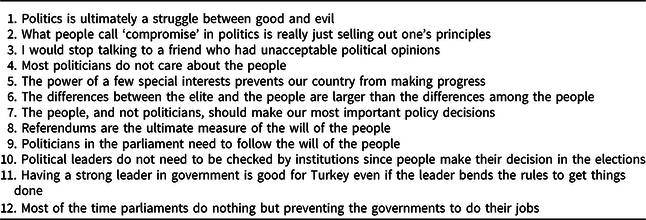
First, we present an analysis of the prevalence and correlates of populist attitudes in the Turkish electorate using data from the 2017 survey. The dominant approach in the literature to measure mass support for populism is to construct a scale of populist attitudes using multiple survey items. Footnote 7 Following this, our dependent variable is an index of populist attitudes constructed by respondents’ agreement or disagreement with a set of statements that reflect the core theoretical dimensions of populism: a Manichean view of politics, anti-elitism, and centrality of people’s will.
In line with recent advances in populism research (e.g., Castanho Silva et al. Reference Castanho Silva, Andreadis, Anduiza, Blanusa, Corti, Delfino, Rico, Ruth, Spruyt, Steenbergen, Littvay, Hawkins, Carlin, Littvay and Rovira Kaltwasser2018, Reference Castanho Silva, Jungkunz, Helbling and Littvay2020; Schulz et al. Reference Schulz, Muller, Schemer, Wirz, Wettstein and Wirth2018) we consider our index of populist attitudes as a latent higher-order construct with distinct first-order dimensions. Castanho Silva et al. (Reference Castanho Silva, Andreadis, Anduiza, Blanusa, Corti, Delfino, Rico, Ruth, Spruyt, Steenbergen, Littvay, Hawkins, Carlin, Littvay and Rovira Kaltwasser2018: 151) emphasize that the different dimensions of populism could exist independently from each other, and since populism sits at the intersection of these dimensions, ‘its measurement should incorporate the different facets separately’. The latent higher-order construct derived from these first-order dimensions, that is, the aggregate index of populist attitudes, would attain highest values for individuals who score high on each of the dimensions of populism.
We considered a total of 12 statements that are frequently employed in studies of populist attitudes (e.g., Akkerman et al. Reference Akkerman, Mudde and Zaslove2013; Hawkins et al. Reference Hawkins, Riding and Mudde2012; Castanho Silva et al. Reference Castanho Silva, Andreadis, Anduiza, Blanusa, Corti, Delfino, Rico, Ruth, Spruyt, Steenbergen, Littvay, Hawkins, Carlin, Littvay and Rovira Kaltwasser2018; Spruyt et al. Reference Spruyt, Keppens and Van Droogenbroeck2016). We asked respondents whether they agreed or disagreed with the statements on a five-point scale, with options ranging from ‘I do not agree at all’ (coded - 2) to ‘I fully agree’ (coded 2), the middle position being ‘neither agree nor disagree’ (coded 0). The first three statements in Table 1 correspond to the dimension of a Manichean view of politics. Populism dichotomizes politics as a moral struggle between virtue and vice where compromise is frowned upon; statements under this dimension reflect this understanding. Statements 4 through 6 tap into the anti-elitist sentiments in populism. The ‘elite’ in populist discourse is constructed as a minority that exploits the political system at the expense of the ‘people’. The question of exactly who constitutes the elite is context-dependent; therefore, the statements refrain from pointing to specific actors.
Statements considered to measure populist attitudes in Turkey

The remaining six statements (7–12) pertain to the centrality of people’s will in populism. Mudde (Reference Mudde2004) and Mudde and Rovira Kaltwasser (Reference Mudde and Rovira Kaltwasser2017) highlight that it is possible to conceptualize this dimension of populism as having two aspects. The first aspect is people-centrism in the sense that politicians must simply respond to people’s demands rather than leading them. Statements 7–9 speak to this aspect of the centrality of people’s will in populism. A second aspect is emphasis on popular sovereignty by downplaying the role of institutions of horizontal accountability. Populism rejects the legitimacy of institutions such as high courts or parliamentary committees because ‘the rule of law and the institutions in charge of the protection of fundamental rights … limit the capacity of the people to exercise their rightful power’ (Mudde and Rovira Kaltwasser Reference Mudde and Rovira Kaltwasser2017: 95). Therefore, populism is hostile to the institutions of liberal democracy and in general to any limitation on the expression of the ‘general will’ (Mudde Reference Mudde2004). Footnote 8 Statements 10–12 emphasize this supremacy of popular sovereignty. Footnote 9 While there is a debate in the literature about whether people-centrism and popular sovereignty can be considered as distinct (see, e.g., Castanho Silva et al. Reference Castanho Silva, Andreadis, Anduiza, Blanusa, Corti, Delfino, Rico, Ruth, Spruyt, Steenbergen, Littvay, Hawkins, Carlin, Littvay and Rovira Kaltwasser2018), we have decided to have a comprehensive set of statements to cover all of the potential aspects of centrality of people’s will.
Exploratory factor analysis of the 12 items reveals four factors, and all statements except one (statement 4, ‘most politicians do not care about the people’) load highly on one of these four factors that correspond to the proposed theoretical dimensions earlier (more details are reported in the Appendix). Therefore, we decided to remove statement 4 from subsequent analyses. Footnote 10 As agreement with the statements indicates support for populist attitudes, we created an index that takes the mean value of the answers given to these statements by a respondent; therefore, the resulting index has a range from - 2 (the most anti-populist position) to 2 (the most populist position). Footnote 11 The distribution of this index of populist attitudes is nearly normal with a mean of 0.36.
While we do not intend to make a contribution to the debates on the dimensionality or measurement of populism in this paper, we conducted a number of additional analyses to alleviate concerns that the reported results might be driven by the way our populist attitudes index is constructed. First, we removed the three statements related to the ‘popular sovereignty’ aspect of populism (statements 10, 11, and 12) from the index, as scholars have expressed reservations with their use (e.g., Castanho Silva et al. Reference Castanho Silva, Jungkunz, Helbling and Littvay2020). Second, we employed a simpler index used in the literature, that of Hawkins et al. (Reference Hawkins, Riding and Mudde2012), with just four items (statements 1, 5, 7, and 9). Finally, we implemented the procedure outlined in Wuttke et al. (Reference Wuttke, Schimpf and Schoen2020) to construct our index. Footnote 12 Our substantive results do not change when we carry out these robustness checks (reported in the Appendix), suggesting that our findings are not just a reflection of the index we use.
We employ three sets of explanatory variables to analyze the drivers of populist attitudes. The first set includes respondents’ gender, age, education level (coded into three categories: those with at most primary school education, middle/high school graduates, and college graduates), monthly household income, religiosity (a binary variable for respondents who report praying daily), and a binary variable for respondents who can speak Kurdish. Footnote 13
A second set of variables is related to respondents’ subjective satisfaction with the way democracy works in Turkey (Democratic satisfaction), and with their economic circumstances (Economic satisfaction). Respondents are asked to evaluate their satisfaction levels on a 0–10 scale with higher values indicating more satisfaction. We also asked whether citizens like them are treated fairly in the current political system (Fair treatment, coded on a 1–4 scale where one corresponds to ‘not treated fairly at all’ and four ‘treated absolutely fairly’) and their level of trust in political parties (Trust in parties, coded on a 1–10 scale with higher values indicating more trust). As discussed previously, findings in the literature would lead one to expect these variables to be negatively associated with populist attitudes.
The final set of variables considers whether support for populist attitudes is related to partisanship. Respondents were asked whether they consider themselves close to a political party, and dummy variables were created for those who consider themselves being close to the four main parties in parliament as of the fielding of the survey – the incumbent AKP, the main opposition Republican People’s Party (Cumhuriyet Halk Partisi, CHP) with a social democratic and secular ideology, the right-wing, Turkish-nationalist Nationalist Action Party (Milliyetçi Hareket Partisi, MHP), and the Peoples’ Democratic Party (Halkların Demokratik Partisi, HDP), a left-wing party associated with the Kurdish political movement. This way it is possible to ascertain whether partisans of a particular party are more likely to support populism than other voters, after controlling for the other relevant factors in the analysis.
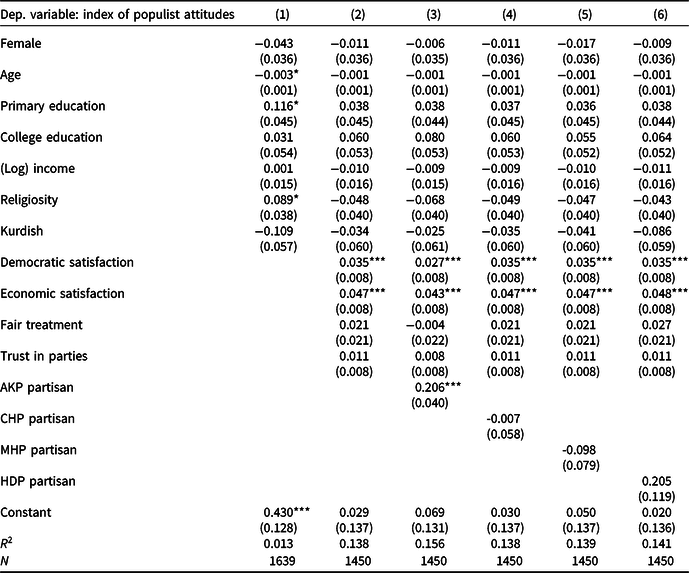
Table 2 presents the results of a series of ordinary least squares regressions of the index of populist attitudes on our explanatory variables. The first thing to note is that the demographic variables we consider have little effect on support for populism. In Model (1), younger individuals, those with primary school education, and more religious individuals seem to be more populist than others, but these effects become indistinguishable from zero once other relevant factors are added to the specification (Models 2 through 6). Thus, contrary to many results reported from other contexts, highly educated and better off Turkish voters are not less likely to hold populist attitudes than those with less education and lower incomes.
Correlates of support for populism in Turkey
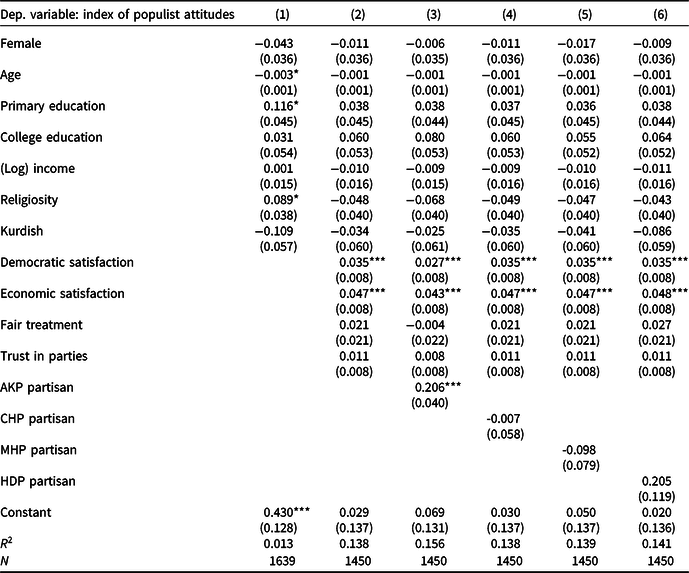
OLS regressions with standard errors in parentheses. Post-stratification weights based on gender, age, education level, and region are applied. * p < 0.05, ** p < 0.01, *** p < 0.001.
Model 2 adds the attitudinal variables into the specification and allows us to test our first hypothesis. We find supporting evidence: Turkish voters who are relatively more satisfied with the way democracy works and with their economic circumstances display higher levels of populist attitudes, even after accounting for several relevant factors. The effect sizes are substantial: for instance, ceteris paribus, the populism score of an individual at the 75th percentile of the distribution of democratic satisfaction variable is about one-third of a standard deviation higher compared to an individual at the 25th percentile. Economic satisfaction has an effect of similar magnitude. While dissatisfaction with the political system and economic circumstances are widely reported in the literature to be positively associated with populist attitudes, the opposite seems to be true in Turkey. The other two attitudinal variables we considered, Fair treatment and Trust in parties, do not have statistically significant effects.
The effects of partisanship on populist attitudes are analyzed in Models 3 through 6 where we sequentially include dummy variables for those who consider themselves being close to the four main parties in parliament. We see that partisans of the ruling AKP are more likely to support populism than other voters (Model 3) and no such effect is observed among the partisans of other parties (Models 4 through 6). The effect of AKP partisanship on our index of populist attitudes corresponds to about one-third of its standard deviation. This observation provides support for our second hypothesis that partisans of the ruling party should be more likely to display populist attitudes than other voters in a context of populism in power.
In Model 3, we also observe that the positive effects of democratic and economic satisfaction on populist attitudes still hold after accounting for AKP partisanship. Of course, these two factors – partisanship and satisfaction with the political system/economy – are not independent of each other; being a partisan of the winning party in elections and positive evaluations of the democratic system and economy are closely related (Anderson and Guillory Reference Anderson and Guillory1997; Evans and Andersen Reference Evans and Andersen2006). This is confirmed in our survey as well: partisans of the incumbent AKP express significantly more satisfaction with the way democracy works in Turkey and their economic circumstances than partisans of other parties (see Figure A1 in the Appendix).
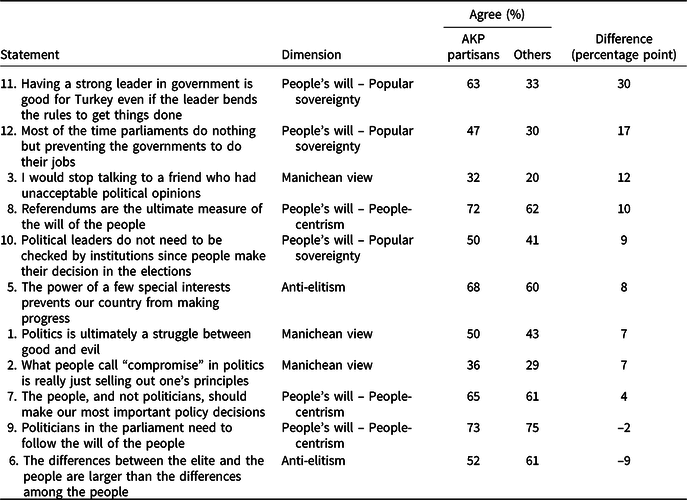
As our index of populist attitudes consists of statements reflecting the different theoretical dimensions of populism, we can explore which dimension(s) are more salient among those with higher levels of overall populist attitudes in our sample. In Table 3, we present the percentages of agreement (somewhat or fully) with each of our populist statements among the AKP partisans and other individuals in our sample separately, ordered by decreasing differences across these two groups. The largest difference across the views of AKP partisans and others is on the statement ‘Having a strong leader in government is good for Turkey even if the leader bends the rules to get things done;’ while 63% of AKP partisans agree with this statement, only 33% of the remaining voters do so. In fact, three of the five statements with the largest differences in agreement across AKP partisans and others are related to the popular sovereignty aspect of populism. We obtain substantively similar results when we group individuals by their democratic and economic satisfaction (reported in the Appendix). That is, voters who display higher levels of populist attitudes in general (AKP partisans and those with higher levels of democratic and economic satisfaction) differ from other voters especially with respect to the populist principles that downplay the role of institutions and checks-and-balances in democratic governance.
Levels of agreement with populist statements among AKP partisans and others in our sample
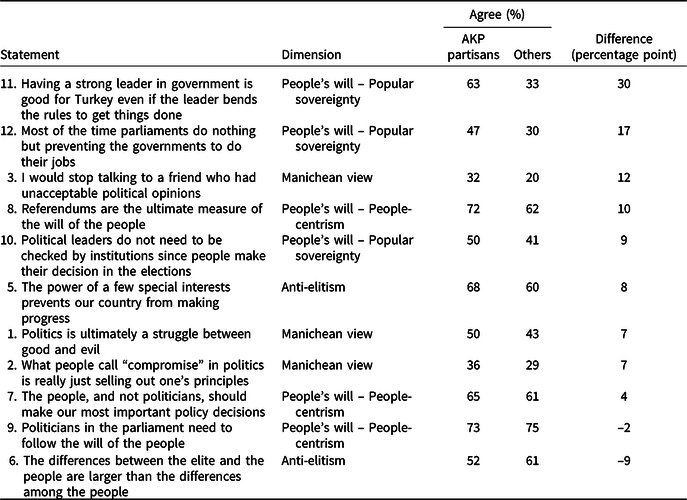
These findings suggest that the dominant characteristic of support for populism in power is an emphasis on popular sovereignty with an accompanying disdain for institutions of horizontal accountability. Successful populism, then, renders it easier for incumbents to weaken these institutions by creating popular consent for such a move. Since these same institutions are critical to check the incumbent’s powers so that they are not used to tilt the playing field against the opposition, their demise inevitably paves the way towards a competitive authoritarian regime (Levitsky and Way Reference Levitsky and Way2010).
Experimental evidence
A concern with the evidence presented so far is related to direction of causality. The observational data essentially show a correlation between partisanship and populist attitudes, after taking into account several observable characteristics of respondents. Yet it is possible that the direction of causality is not from partisanship to populist attitudes as we claim but the other way around. That is, voters with already high levels of populist attitudes might have been more satisfied with the AKP in power (for ideological or other reasons), and perhaps have become partisans of the party. Footnote 14 In this case, we would still observe a correlation between partisanship and populist attitudes.
An experimental research design where one of the variables of interest is exogenously manipulated would be helpful in this regard. A natural extension of our argument is that partisan cues with populist or anti-populist content, that is, statements by partisan actors favoring or opposing a particular view, should be effective in shaping the populist attitudes of partisan voters. If we observe a meaningful difference in the populist attitudes of partisan voters across the randomly assigned treatment (exposure to partisan cues related to populist attitudes) and control (no messages or non-partisan cues) groups, this would constitute supporting evidence for our hypothesis. If populist attitudes came before partisanship or partisan discourse played no role, there would be little reason to expect a difference in populist attitudes across these groups.
To this end, we embedded a partisan cue experiment in the pre-election wave of the 2018 Turkish Election Study (TES 2018), a nationally representative face-to-face survey fielded ahead of the June 2018 general elections. This population-based survey experiment enables us to combine the internal validity of the experimental design with the opportunity to generalize the estimated effects of interest to the voting population of Turkey (Mutz Reference Mutz2011).
Respondents in our survey were randomly assigned to one of the four versions of the survey instrument: three treatment and one control version. Footnote 15 In each of the three treatments, we presented respondents with hypothetical statements about politics in populist and anti-populist terms. We also varied the source of the statement. There were two partisan sources: the leader of the incumbent AKP and President Recep Tayyip Erdoğan, and the leader of the main opposition CHP, Kemal Kılıçdaroğlu. Among the opposition parties, we chose the leader of the CHP as the source of the second partisan cue since the CHP has been the main opposition party throughout the AKP incumbency. In addition to these partisan sources, we had one nonpartisan source as well. Respondents in the control condition received no vignette.
The first treatment vignette gives a strong dosage of populist principles from the leader of AKP:
Speaking at a recent press conference, the chairman of the AKP and President Recep Tayyip Erdoğan said the following: Politics is essentially a struggle between good and evil. People’s will should be the supreme principle in politics, and no institution should have the power to limit this will. The primary source of societal problems is the presence of a powerful and elitist minority that stays away from people’s values and demands.
This short paragraph includes all the essential elements of populism: a Manichean view of politics, emphasis on people’s will at the expense of institutions of checks-and-balances, and anti-elitism. Mutz (Reference Mutz2011: 85–86) highlights that population-based experiments call for especially powerful treatments given the heterogeneity of the samples, and our vignette is likely to satisfy this requirement. And while Erdoğan did not have a speech with this exact passage, he has many similar statements (see, e.g., Aytaç and Öniş Reference Aytaç2014) so that respondents in our survey should find the vignette realistic.
The second treatment vignette has a similar structure, but it conveys a message that is the opposite of the populist principles given in the first treatment. The source of the statement is the leader of the main opposition party CHP, Kemal Kılıçdaroğlu:
Speaking at a recent press conference, the chairman of the CHP Kemal Kılıçdaroğlu said the following: All political issues have positive and negative aspects. In politics, separation of powers and checks and balances are as important as the people’s will. The primary source of societal problems is the inability to compromise and to find a middle ground between the majority and minority views.
In this passage, the leader of the main opposition emphasizes the importance of separation of powers and checks and balances, and also displays a more pluralistic view of democracy by highlighting the role of compromise and respect for minority views. As such, this treatment presents an anti-populist view of politics. Again, this passage should appear realistic to respondents as Kılıçdaroğlu has made many statements in this direction. Footnote 16
Finally, the third treatment vignette conveys the exact same message in the first treatment, but now the source of the statement is nonpartisan, given as ‘political scientists’. Thus, a comparison of the first and this treatment will allow us to assess the impact of the partisan source of the message on populist attitudes. The structure of the experiment is laid out in Table 4.
The structure of the survey experiment

The outcome of interest is an index of populist attitudes as constructed in the observational analyses reported earlier. The only difference is that now we have a total of six statements instead of the original 12 due to space constraints in the survey. Specifically, we use statements 2, 5, 7, 8, 10, and 11 from Table 1 – these statements tap on each of the four aspects of populism and had high factor loadings. Particular attention was paid not to use statements that were very close to the messages given in the treatment vignettes of the experiment. As in the observational analysis, we created an index that takes the mean value of the answers given to these statements by a respondent. Footnote 17 Recall that our third hypothesis predicted that partisans should report higher (lower) levels of populist attitudes when they receive populist messages from their preferred party’s leader (opponent party’s leader). Similarly, we expect them to display lower (higher) levels of populist attitudes when they receive anti-populist (i.e., more liberal democratic or pluralistic) messages from their preferred party’s leader (opponent party’s leader).
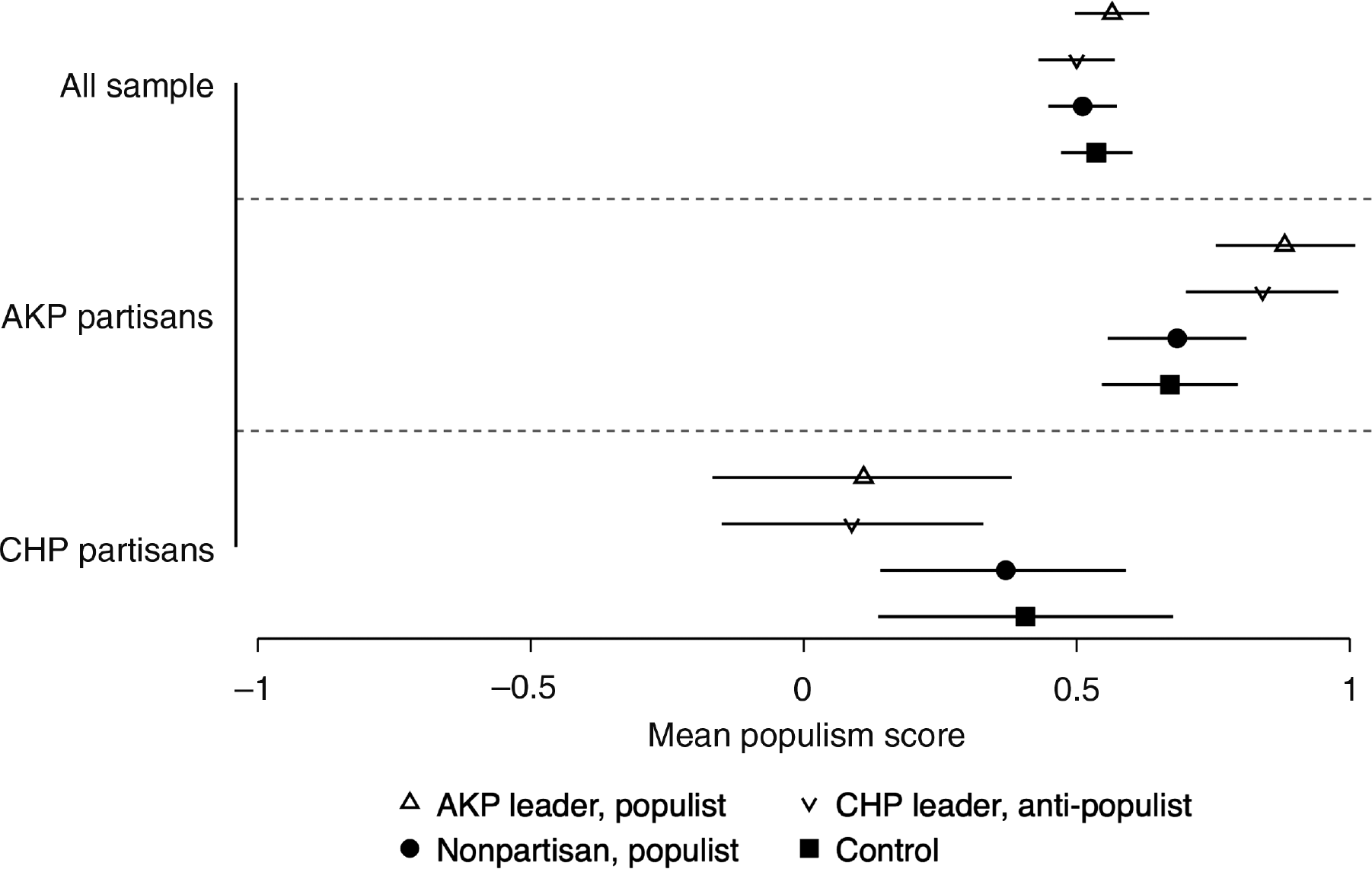
Figure 1 plots the mean populism scores with 95% confidence intervals in the overall sample (top), among AKP partisans (middle) and CHP partisans (bottom) for each condition in the experiment. Footnote 18 In line with observational evidence reported earlier, we see that AKP partisans display more populist attitudes than other voters in general. Second, there are no statistically significant differences in mean populism scores across the experimental groups in the overall sample. This is not unexpected in a partisan cue experiment as the differentiated effects of treatments across opponent partisan groups are likely to cancel each other out in the overall sample.
Mean populism scores across experimental conditions and partisan groups. Horizontal lines display 95% confidence intervals.
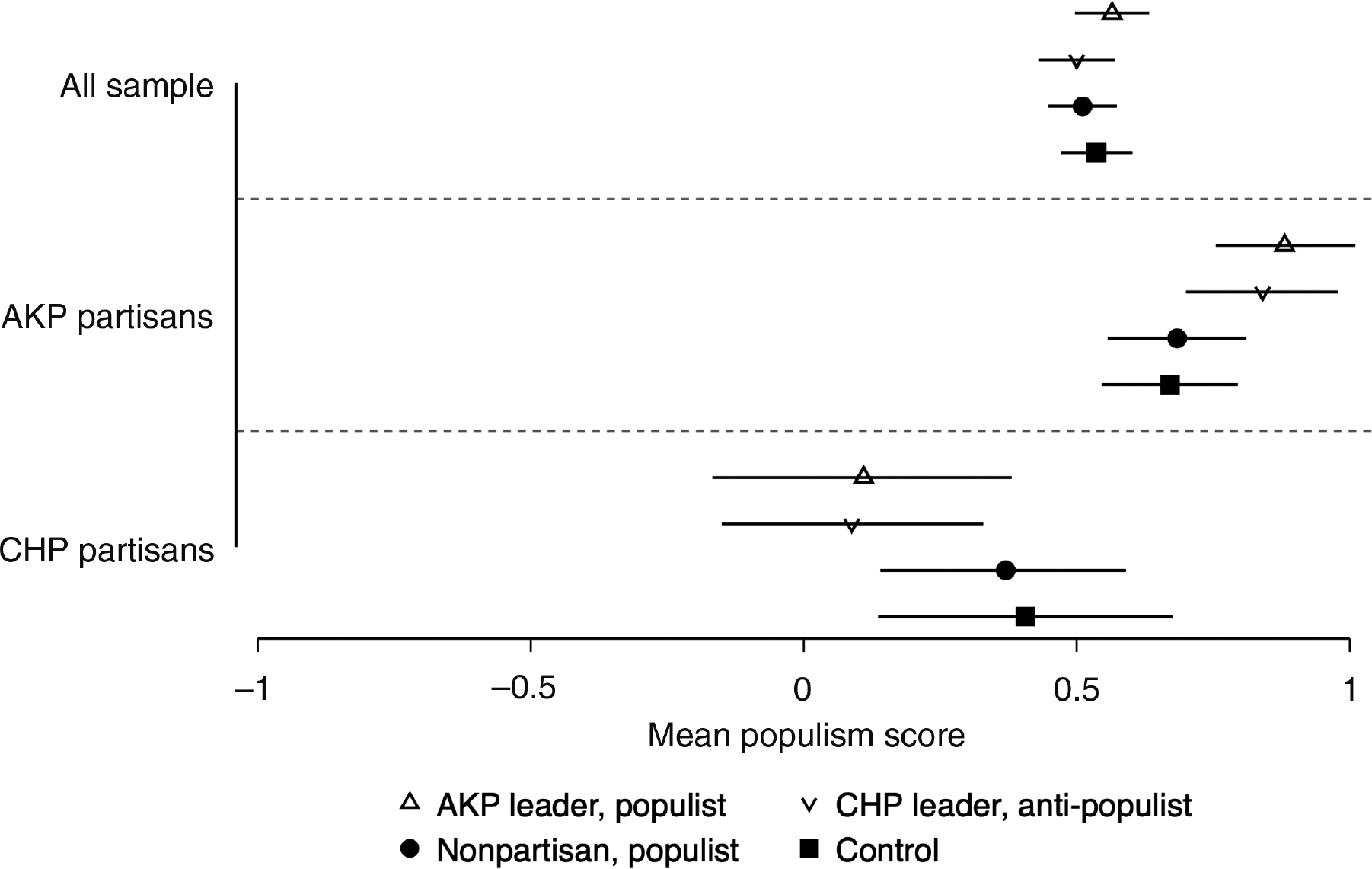
Indeed, examining the effects of our manipulations among partisan groups, we do find supporting evidence for our argument. Both the populist message from Erdoğan (AKP leader) and the anti-populist message from Kılıçdaroğlu (CHP leader) push AKP partisans towards higher levels of populist attitudes compared to their co-partisans in the nonpartisan message and control conditions, and these differences are statistically significant at conventional levels. Footnote 19 These effects are substantively important as well, corresponding to a treatment effect size of about a third of a standard deviation of the outcome variable on average. A similar but opposite pattern emerges for CHP partisans (bottom panel): both the populist message from the Erdoğan and the anti-populist message from Kılıçdaroğlu push CHP partisan towards lower levels of populist attitudes. Footnote 20 The mean populism scores across the control and nonpartisan message groups are nearly identical among both AKP and CHP partisans.
It is worth emphasizing that both in-group and out-group cues seem to be important in the shaping of populist attitudes. For instance, the CHP leader, anti-populist treatment does not make any references to populist principles, yet AKP partisans in this treatment group display higher levels of populist attitudes than their co-partisans in the control condition. In addition, the populist message coming from a nonpartisan source had little and statistically insignificant effects on the populist attitudes of AKP and CHP partisans. Recall that this message was the same as in the first treatment (AKP leader, populist); hence, if it were just the message and not the partisan nature of the source that was moving the populist attitudes of respondents, we would have expected significant effects in this third treatment as well. The fact that we observe null results when the source is nonpartisan points to the relevance of partisanship in shaping populist attitudes.
In light of these results, our population-based survey experiment provides supporting evidence for Hypothesis 3: Partisan cues are effective in shaping voters’ populist attitudes, highlighting the role of partisanship in mass support for populism. Inevitably, the experimental design has some limitations. Given the logistical constraints with fielding a large, face-to-face household survey, we were not able to deploy all the possible source-message combinations in the experiment. Second, partisan cues are just a proxy for the populist politicians’ discourse, and one might question whether they correspond well to the actual informational setting of voters. In this respect, our experimental results highlight the plausibility of the proposed mechanism, and more research is needed in this direction. Finally, we do not claim that partisanship explains the totality of populist attitudes among certain groups; yet, the observational analysis suggests that it has a substantial effect, and experimental results corroborate this.
Conclusion
In this paper, we focused on mass support for populism in power by drawing on observational and experimental data from original, nationally representative surveys in Turkey. Our results point to the importance of elite messages and partisanship in the shaping of populist attitudes in a context of populism in power. In Turkey, partisans of the ruling AKP and voters who are more satisfied with the way democracy works and with their economic circumstances display higher levels of agreement with populist principles, even after accounting for several relevant individual-level factors. We find that among those who display higher levels of populist attitudes in general, an emphasis on popular sovereignty at the expense of institutions of horizontal accountability is particularly salient. We also show through a population-based survey experiment that populist attitudes are malleable by partisan cues, highlighting the role of elite messages. The fact that partisan cues can reinforce populist principles among those with already high levels of populist attitudes (in this case AKP partisans) is worthy of note. To the best of our knowledge, this is the first study documenting the effects of partisan cues on support for populist principles.
These results have significant implications. Beyond documenting a detailed analysis of mass populist attitudes in Turkey, we show that the dynamics of support for populism could be entirely different in a case of populism in power than in cases of populism in opposition, which have been the overwhelming focus of the relevant literature so far. The Turkish case illustrates that those with favorable views of the political system and the economy could also possess strongly populist attitudes, given that their preferred party is in power and engages in politics on a populist platform. Bombarded with profoundly populist messages and discourse (Aytaç and Öniş Reference Aytaç2014), the constituency of the ruling AKP seems to have internalized the core principles of populism, even though they do not feel marginalized in the current political system.
A second implication of our study is that we provide a framework to understand why democracies with populists in power are particularly amenable to a transition to competitive authoritarianism. The messages of the ruling populist elites that, among other things, repeatedly attacks institutions of horizontal accountability and casts them as ‘the enemies of the people’ can be effective among the partisans of the ruling party and among those who are satisfied with the government. We can expect that the more successful the populists in power are in terms of delivering economic and other benefits to large segments of society, the more voters would embrace the messages conveyed by them. This, in turn, provides a solid public support base for an incumbent that seeks to increase its powers at the expense of institutions of checks and balances. When institutions resist such encroachment of their functions, populist politicians typically ‘move’ the conflict to the electoral arena, which Levitsky and Loxton (Reference Levitsky and Loxton2013) define as ‘plebiscitary strategies’, counting on the support of their partisans and of the masses who are satisfied with the government. The success of the populist leaders using these plebiscitary strategies further weakens the institutions to check the executive (Bermeo Reference Bermeo2016), heralding a regime change towards competitive authoritarianism.
Acknowledgements
We thank Nikolay Marinov and participants at the annual meetings of the American Political Science Association, Midwest Political Science Association, European Political Science Association, and the 4th Prague Populism Conference for valuable feedback. Comments and guidance from three anonymous reviewers and editors of the EPSR helped to improve the article, we are most grateful. The 2017 survey was funded by the Open Society Foundation – Turkey and the 2018 survey was funded by Koç University and Sabancı University.
Supplementary material
To view supplementary material for this article, please visit https://doi.org/10.1017/S1755773920000314.