Giant ragweed is among the most highly competitive summer annual weeds in corn (Zea mays L.) and soybean [Glycine max (L.) Merr.] production because of its prolonged emergence period, rapid early-season growth, and large size at maturity (Abul-Fatih and Bazzaz Reference Abul-Fatih and Bazzaz1979; Johnson et al. Reference Johnson, Loux, Nordby, Sprague, Nice, Westhoven and Stachler2007). Crop yield losses due to giant ragweed interference have been reported as greater than any other summer annual weed species (Moechnig Reference Moechnig2003; Schutte Reference Schutte2007). Harrison et al. (Reference Harrison, Regnier, Schmoll and Webb2001) found that a single plant in 10 m2 reduced corn grain yield by 14%, with higher densities causing a maximum yield loss of 90%. In soybean, a giant ragweed density of 1 plant m–2 resulted in a 45% to 77% grain yield loss (Webster et al. Reference Webster, Loux, Regnier and Harrison1994). Furthermore, the competitiveness of giant ragweed dictates that the critical weed-free period in soybean be nearly twice as long compared to many common weeds (Van Acker et al. Reference Van Acker, Swanton and Weise1993). In a recent survey of certified crop advisors throughout the Midwest, nearly half of responding counties cited giant ragweed as one of the most troublesome weeds in crop production, with a majority of these respondents referencing glyphosate-resistant (GR) populations (Regnier et al. Reference Regnier, Harrison, Loux, Holloman, Venkatesh, Diekmann, Taylor, Ford, Stoltenberg, Hartzler, Davis, Schutte, Cardina, Mahoney and Johnson2016).
GR giant ragweed is a unique case in the herbicide-resistant weed arena, as there exist two distinct GR biotypes, hereafter referred to as rapid response (RR) and non-rapid response (NRR). In the RR biotype, lesions begin to appear on mature leaves a few hours after glyphosate treatment and mimic protoporphyrinogen oxidase–inhibitor herbicide symptomology (Van Horn et al. Reference Van Horn, Moretti, Robertson, Segobye, Weller, Young, Johnson, Schulz, Green, Jeffery, Lesperance, Tardif, Sikkema, Hall, McLean, Lawton, Sammons, Wang, Westra and Gaines2017). After 2 d, mature leaves become entirely necrotic, whereas the newly developed immature leaves remain uninjured and resume normal growth within a week. This sacrificial form of glyphosate resistance has been shown to effectively limit glyphosate translocation (Moretti et al. Reference Moretti, Van Horn, Robertson, Segobye, Weller, Young, Johnson, Sammons, Wang, Ge, d’Avignon, Gaines, Westra, Green, Jeffery, Lesperance, Tardif, Sikkema, Hall, McLean, Lawton and Schulz2017). The GR response in the NRR biotype more closely resembles that of other GR weeds, whereby apical meristems become slightly chlorotic with minor stunting of plant growth (Van Horn et al. Reference Van Horn, Moretti, Robertson, Segobye, Weller, Young, Johnson, Schulz, Green, Jeffery, Lesperance, Tardif, Sikkema, Hall, McLean, Lawton, Sammons, Wang, Westra and Gaines2017). The magnitudes of glyphosate resistance have been reported for several giant ragweed populations as 19 to 22 for the RR biotype and 6 for the NRR biotype based on LD50 values (Harre et al. Reference Harre, Nie, Robertson, Johnson, Weller and Young2017). As both biotypes are capable of producing viable seed (Segobye Reference Segobye2013), GR giant ragweed continues to be a management challenge in crop production and is currently found in 13 states in the United States and Ontario, Canada (Heap Reference Heap2017); however, no distinction is made regarding the specific GR biotype within this database. In a recent survey of Indiana GR giant ragweed populations, 12% were uniformly the RR biotype, 37% were uniformly the NRR biotype, and 51% were mixed, with individuals of both biotypes (Harre et al. Reference Harre, Nie, Robertson, Johnson, Weller and Young2017).
A commonly utilized tactic to manage GR weeds is the use of additional herbicide chemistries applied in mixtures with glyphosate to broaden the spectrum of weed control and reduce application costs. Results of this strategy on GR giant ragweed range from near complete control to mere suppression. The herbicides cloransulam, carfentrazone, and bentazon each provided >95% control at 28 d after treatment (DAT) (Norsworthy et al. Reference Norsworthy, Riar, Jha and Scott2011). Glyphosate plus cloransulam reduced shoot dry weight at 56 DAT by 64% to 98% (Follings et al. Reference Follings, Soltani, Robinson, Tardif, Lawton and Sikkema2013; Vink et al. Reference Vink, Soltani, Robinson, Tardif, Lawton and Sikkema2012). Dicamba or 2,4-D plus glyphosate resulted in >90% control in several studies (Belfry and Sikkema Reference Belfry and Sikkema2015; Jhala et al. Reference Jhala, Sandell and Kruger2014; Vink et al. Reference Vink, Soltani, Robinson, Tardif, Lawton and Sikkema2012). Riley and Bradley (Reference Riley and Bradley2014) reported that glyphosate plus fomesafen was the most successful combination for control of GR giant ragweed, providing 63% control at 28 DAT. Atrazine applied in a mixture with glyphosate provided 27% control at 28 DAT, whereas the addition of topramezone improved control to 42% (Belfry and Sikkema Reference Belfry and Sikkema2015). However, none of these reports clarified which of the two GR giant ragweed biotypes was evaluated.
Herbicide combinations may elicit activity that differs from what is expected of each herbicide applied individually. Although additive action is most common, interactions can also be antagonistic or synergistic (Colby Reference Colby1967). Synergy between two herbicides results when the observed level of weed control is greater than what is expected. Conversely, antagonism is the result when herbicide combinations produce less than expected weed control. When observed control is similar to what is expected, the herbicides are additive in action. Reports of synergistic interactions when glyphosate and other herbicides are applied in mixtures are rare in the literature, compared to those citing additive or antagonistic interactions. Combinations of glyphosate plus 2,4-D or dicamba tend to be additive or synergistic in action on broadleaved weeds (Franz et al. Reference Franz, Mao and Sikorski1997; Mann et al. Reference Mann, Masters, McMaster, Peterson, Sorribas Amela and Wright2015); however, the preponderance of synergy is only observed at reduced glyphosate rates (Franz et al. Reference Franz, Mao and Sikorski1997). Antagonism in glyphosate mixtures generally occurs when applied with a soil-residual herbicide such as alachlor, metolachlor, metribuzin, or simazine (Franz et al. Reference Franz, Mao and Sikorski1997; Selleck and Baird Reference Selleck and Baird1981). However, these results were believed to be due to an incompatibility of the herbicides in the mixing process rather than a physiological plant response to the herbicide combination (Selleck and Baird Reference Selleck and Baird1981). Fast-acting, contact herbicides such as glufosinate and several protoporphyrinogen oxidase–inhibiting herbicides are often antagonistic to glyphosate activity. Glyphosate plus glufosinate spray mixtures resulted in less than expected control of common lambsquarters (Chenopodium album L.), ivyleaf morningglory (Ipomoea hederacea Jacq.), Palmer amaranth (Amaranthus palmeri S. Wats.), and velvetleaf (Abutilon theophrasti Medik.) (Bethke et al. Reference Bethke, Molin, Sprague and Penner2013; Reed et al. Reference Reed, Keeling and Dotray2014). Combinations of glyphosate mixtures with fomesafen or sulfentrazone were antagonistic on a number of broadleaved weeds, a result that is attributable to the rapid activity of the latter herbicides minimizing glyphosate transport (Starke and Oliver Reference Starke and Oliver1998; Wehtje et al. Reference Wehtje, Altland and Gilliam2008). The symptomatic effects of glyphosate on the RR biotype of giant ragweed are similar to those observed from contact herbicides, in that photo-oxidative stress (capable of damaging cellular membranes) results in water-soaked lesion formation (Harre et al. Reference Harre, Nie, Robertson, Johnson, Weller and Young2017; Van Horn et al. Reference Van Horn, Moretti, Robertson, Segobye, Weller, Young, Johnson, Schulz, Green, Jeffery, Lesperance, Tardif, Sikkema, Hall, McLean, Lawton, Sammons, Wang, Westra and Gaines2017). Thus, just as contact herbicides can antagonize glyphosate, it is plausible that the glyphosate-induced RR in giant ragweed may antagonize a co-applied systemic herbicide.
Given the difference between the RR and NRR biotypes to glyphosate, control of, and the interaction between glyphosate plus selective herbicide mixtures, may vary based on the specific GR giant ragweed biotype. Therefore, the objectives of this research were to (1) evaluate selective herbicides for potential antagonistic interactions when applied in combination with glyphosate to RR and NRR biotypes in the field and greenhouse; (2) determine if the latter herbicide interactions are influenced by the rate of glyphosate application; and (3) discern whether temporal separation of glyphosate and a selective herbicide can enable greater efficacy than when applied simultaneously.
Materials and Methods
Greenhouse Efficacy Trials
RR and NRR giant ragweed populations, previously characterized for glyphosate resistance (Harre et al. Reference Harre, Nie, Robertson, Johnson, Weller and Young2017), were stratified for 8 wk in a moist 3:1 mixture of sand to soil (Westhoven et al. Reference Westhoven, Davis, Gibson, Weller and Johnson2008) to alleviate seed dormancy. Both populations were susceptible to acetolactate synthase –inhibiting herbicides (data not shown). Seeds were sown in 25- by 50-cm flats containing commercial potting mix (Sun Gro seedling mix, Sun Gro Horticulture, Bellevue, WA) and placed in a greenhouse with day and night temperatures maintained at 30 C and 25 C, respectively. High-pressure sodium bulbs providing 1,100 μmol m–2 s–1 photon flux density on a 16-h photoperiod supplemented natural lighting. Upon reaching the one-node growth stage (first true leaves fully expanded), plants were transplanted to 10-cm square pots containing a growing medium of 50% potting soil, 25% unsterilized field soil, and 25% unsterilized sand. As elucidated by Schafer et al. (Reference Schafer, Hallett and Johnson2012), unsterilized field soil should be included in the growing medium of giant ragweed to avoid false-positive GR results. Plants were watered daily and fertilized weekly with a macro- and micronutrient fertilizer [Jack’s Classic Professional (20-20-20), JR Peters Inc., Allentown, PA].
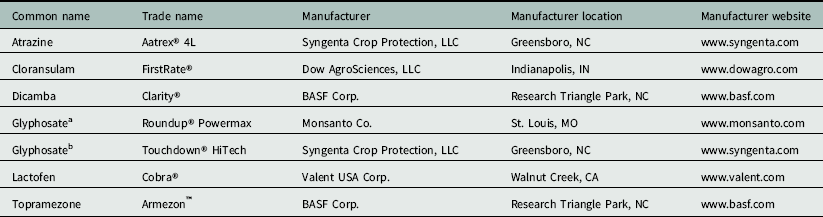
Glyphosate Interaction Experiment. Treatments were arranged as a four (glyphosate rate) by five (selective herbicide) factorial on both biotypes of GR giant ragweed. Glyphosate rates of 0, 420, 840, and 1,680 g ae ha–1 were applied alone and in combination with the selective herbicides: atrazine (370 g ai ha–1), cloransulam (4.5 g ai ha–1), dicamba (50 g ae ha–1), lactofen (35 g ai ha–1), and topramezone (4 g ai ha–1). Because the working hypothesis was that antagonism would be present, these rates were selected based on preliminary work determining the appropriate dose required to achieve 60% to 70% control (data not shown). Herbicide manufacturer information is presented in Table 1. The inclusion of an adjuvant followed labeled recommendations for each herbicide or herbicide mixture. Nonionic surfactant (Activator-90, Loveland Products, Inc., Loveland CO) was added at 0.25% v/v in treatments containing glyphosate. Crop oil concentrate (Prime Oil, Winfield Solutions, LLC, St. Paul, MN) was added at 1% v/v in treatments containing atrazine, cloransulam, and lactofen. Methylated seed oil (MSO Ultra, Precision Laboratories, LLC, Waukegan, IL) was added at 1% v/v in treatments containing topramezone. Treatments were applied to four- to five-node giant ragweed plants using a single-nozzle spray booth calibrated to deliver 140 L ha–1 at a pressure of 210 kPa using an XR 8002 spray tip (TeeJet Technologies, Urbandale, IA).
Sources of commercial herbicides used in field and greenhouse experiments.

a Used in field experiments.
b Used in greenhouse experiments.
Application Timing Experiment. The same selective herbicides and rates used in the previous experiment were applied at five timings with respect to glyphosate: 2 or 1 d before, applied simultaneously in mixture, or 1 or 2 d after. Only a single glyphosate rate of 840 g ha–1 was included, with other herbicide treatments applied as previously described.
For both experiments, visual control ratings were taken at 1, 3, 7, 14, and 21 DAT using a scale of 0 (no control) to 100 (complete control). Shoot plant material above the soil line was harvested at 21 DAT and dried at 45 C until constant weight to determine dry weight reduction compared to the nontreated control. Experiments were arranged as randomized complete block designs with four replications and conducted twice.
Field Efficacy Trial
Field experiments were conducted during the summers of 2015 and 2016 near Lafayette, IN, at the Throckmorton Purdue Agricultural Center (40.2969° N, 86.9036° W). Using the same RR and NRR giant ragweed populations as in the greenhouse experiments, plants were propagated as previously described in the greenhouse before being transplanted in the field at the four-node growth stage.
Site Management. Vegetation in the field trial area was removed by use of a field cultivator and further managed by a broadcast application of pyroxasulfone (179 g ai ha–1) (Zidua, BASF Corp., Research Triangle Park, NC) 5 d prior to transplanting. Four plants of each population were included in 3- by 9.1-m plots and arranged in a serpentine line spaced 1 m apart longitudinally and 1.2 m apart laterally. Transplants were acclimated in the field for 14 d before herbicide treatment at the six-node growth stage.
Herbicide Treatments. Herbicide treatments were applied at recommended field-use rates and included the selective herbicides atrazine (1,120 g ha–1), cloransulam (18 g ha–1), dicamba (280 g ha–1), lactofen (219 g ha–1), and topramezone (18.4 g ha–1) applied alone and in combination with glyphosate (840 g ha–1). All treatments containing glyphosate included ammonium sulfate at 2% w/w. Adjuvants were included as described in the greenhouse experiment. Herbicide applications were performed using a CO2-pressurized backpack sprayer calibrated to deliver 140 L ha–1 at a pressure of 207 kPa through a 2-m-wide hand-held boom equipped with XR 8002 spray tips.
Visual assessments of control were recorded at 1, 3, 7, 14, 21, and 28 DAT using a scale of 0 to 100. Shoot plant material above the soil line was harvested at 28 DAT and dried at 45 C until constant weight to determine dry weight reduction compared to the nontreated control. The experiment was arranged as a split-plot, randomized complete block design with four replications. The whole-plot factor was herbicide treatment, and the sub-plot factor was GR giant ragweed biotype.
Statistical Analyses
Data from greenhouse and field trials were subjected to ANOVA using PROC MIXED in SAS 9.4 (SAS Institute, Inc., Cary, NC) treating replication (block) as a random effect. Data were evaluated for normality and homogeneity of variance using PROC UNIVARIATE and Levene’s test. Data were pooled over experimental runs in the greenhouse because of lack of treatment-by-run interaction. Field data for 2015 and 2016 were analyzed separately because of a significant treatment-by-year interaction (P<0.05).
Interactions between glyphosate and selective herbicides were classified as antagonistic, synergistic, or additive according to the multiplicative survival model, following Colby’s method (1967) to calculate expected growth reduction for herbicide mixtures:
 $$E\, {\equals}\, 100{\minus}\left\{ {\left[ {\left( {100{\minus}x} \right){\times}\left( {100{\minus}y} \right)} \right]{\div}100} \right\}$$
where E is the expected growth reduction as a percentage of the control, and x and y represent the growth reduction as a percentage of the control from the two herbicides applied alone. Expected values were separated from observed values using a Student’s t-test (α=0.05). A herbicide combination was classified as antagonistic if observed control was significantly less than expected control and classified as synergistic if observed control was significantly greater than expected control.
For the greenhouse glyphosate interaction experiment, mixtures of increasing glyphosate rates, with or without selective herbicides, were subjected to analysis of covariance, where biotype was the categorical factor, percentage control was the dependent variable, and glyphosate rate was the covariate. For the application timing experiment, means were compared to the mixture application at 0 d and separated using Dunnett’s test (α=0.05). Means for field experiments were separated using Fisher’s protected LSD (α=0.05).
Results and Discussion
Greenhouse Efficacy Trials
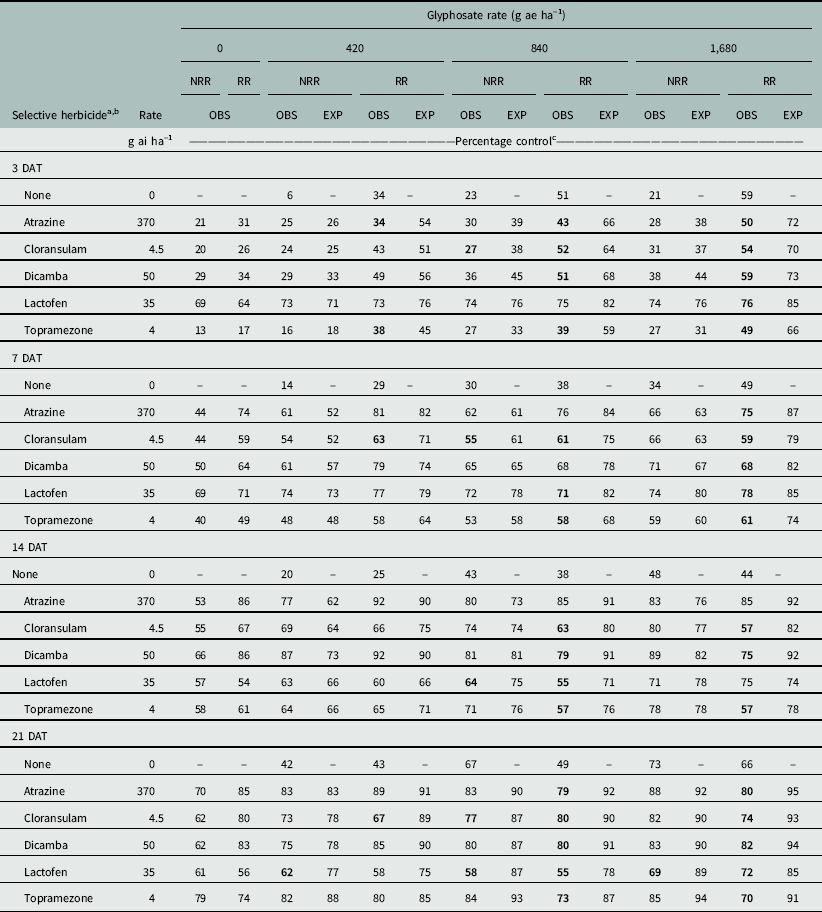
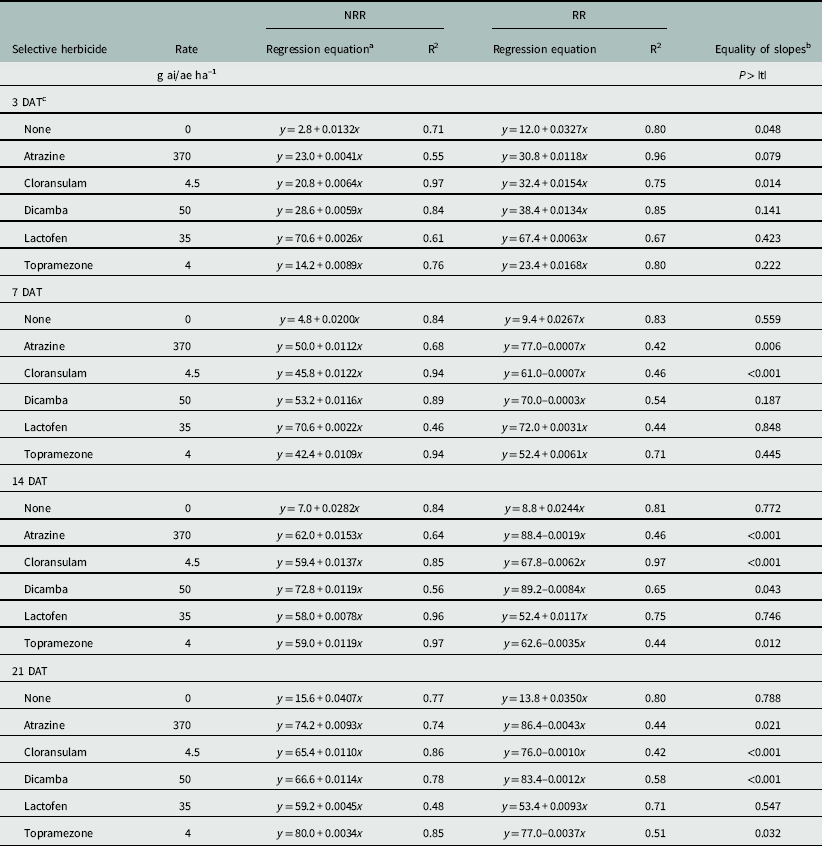
Glyphosate Interaction Experiment. Injury symptoms present at 1 DAT were minor and only visible for treatments containing glyphosate in the RR biotype, or lactofen across both biotypes (data not shown). Symptomology in the RR biotype differed between glyphosate and lactofen only in the location of lesion development, as lactofen injury was present on both mature and immature leaves, whereas glyphosate injury occurred only on mature leaves. At 3 DAT, the highest levels of control (>70%) were observed in glyphosate plus lactofen treatments (Table 2). For the RR biotype, antagonism was present between glyphosate at the 1,680 g ha–1 rate and all five selective herbicides. Similarly, when glyphosate was applied at 840 g ha–1 an antagonistic interaction was found for all selective herbicides except lactofen. At the lowest glyphosate rate (420 g ha–1), antagonism in the RR biotype was only present for mixtures including atrazine or topramezone. The onset of the RR occurs sooner under environmental conditions favorable to high levels of photosynthetic activity (Harre et al. Reference Harre, Weller, Johnson and Young2016; Segobye Reference Segobye2013). Thus, provided the critical effect atrazine and topramezone elicit on photosynthetic electron transport, the initial antagonistic interaction between these herbicides and glyphosate may be due to a slowing of the induction of the RR. Although antagonism was present between glyphosate and selective herbicide mixtures on the RR biotype at 3 DAT, slopes of linear regression models remained positive in response to increasing glyphosate rate (Table 3).
Observed means (OBS) and Colby’s expected responses (EXP) for combinations of glyphosate and selective herbicide mixtures on percentage control of non-rapid response (NRR) and rapid response (RR) glyphosate-resistant giant ragweed in a greenhouse trial.

a Means for 3, 7, and 14 d after treatment (DAT) were evaluated visually, and means for 21 DAT are based on dry weight reduction.
b Dicamba rate units are g ae ha–1.
c Observed means in bold denote an antagonistic interaction according to Colby (Reference Colby1967) (α=0.05). All other herbicide combinations are additive in action.
Linear regression and slope comparisons of control of non-rapid response (NRR) and rapid response (RR) glyphosate-resistant giant ragweed from glyphosate rates of 0, 420, 840, and 1,680 g ae ha-1 applied with or without selective herbicides in a greenhouse trial.

a y=b+mx; where y is percent control, b is the y-intercept, m is slope, and x is glyphosate rate.
b For each selective herbicide, analysis of covariance was used to compare slopes between NRR and RR biotypes.
c Assessments for 3, 7, and 14 d after treatment (DAT) were evaluated visually, and assessments for 21 DAT are based on shoot dry weight reduction.
As symptoms progressed through 7 and 14 DAT, antagonism was detected more often in the RR biotype between the two highest glyphosate rates and all selective herbicides compared to the lowest glyphosate rate (Table 2). For the NRR biotype, the mixture of glyphosate at 840 g ha–1 applied with either cloransulam or lactofen resulted in less than expected control at 7 and 14 DAT, respectively. Although increasing the glyphosate rate with all selective herbicide mixtures improved control of the NRR biotype, the same intervention resulted in diminished control of the RR biotype when applied with atrazine and topramezone at 7 DAT and with atrazine, cloransulam, dicamba, and topramezone at 14 DAT (Table 3).
Based on dry weight reduction at 21 DAT, the highest glyphosate rate and all selective herbicides resulted in an antagonistic interaction for the RR biotype, with the combination of glyphosate plus topramezone having the greatest difference between expected and observed control (Table 2). Glyphosate at 840 g ha–1 was also antagonistic when applied with all selective herbicides for the RR biotype, whereas only the combination of glyphosate plus cloransulam resulted in antagonism at the lowest glyphosate rate. Excluding lactofen, as glyphosate rate increased, control of the RR biotype was reduced across all selective herbicides (Table 3). The onset of H2O2 production associated with the RR occurs sooner when 1,680 g ha–1 glyphosate is applied compared to 420 g ha–1 (Harre et al. Reference Harre, Nie, Robertson, Johnson, Weller and Young2017). Thus, the interaction between glyphosate and selective herbicides for this biotype is contingent upon the speed in which the RR develops. For the NRR biotype, the mixture of glyphosate plus lactofen was the only antagonistic combination across all three glyphosate rates. Antagonism between glyphosate and contact herbicides has been reported by others (Shaw and Arnold Reference Shaw and Arnold2002; Starke and Oliver Reference Starke and Oliver1998) and is attributable to reduced glyphosate absorption and translocation instigated by rapid phytotoxicity symptoms of these mixtures. Increasing the glyphosate rate with selective herbicide mixtures consistently improved control of the NRR biotype (Table 3).
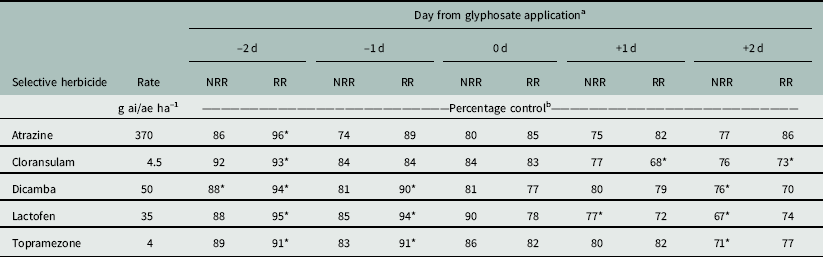
Application Timing Experiment. For the RR biotype, antagonism between glyphosate and all selective herbicides was avoided by applying the latter 2 d before glyphosate treatment (Table 4). Furthermore, application of dicamba, lactofen, and topramezone 1 d before glyphosate treatment improved control over the mixture with glyphosate for the RR biotype. Control of this biotype was marginally less when a selective herbicide was applied 2 d after glyphosate treatment. This difference may be due to less available surface area for optimum absorption of the selective herbicide, because at the time of this application, the RR to glyphosate had greatly reduced the amount of green tissue present on plants. For the NRR biotype, dicamba was the only selective herbicide applied prior to glyphosate treatment in which control improved compared to the mixture with glyphosate. Similar to the results for the RR biotype where selective herbicides were applied after glyphosate treatment, control of the NRR biotype tended to be lower compared to the mixture application. The precise glyphosate resistance mechanism remains unknown for the NRR biotype; however, the target enzyme, 5-enolpyruvylshikimate 3-phosphate synthase, is known to be sensitive (Nandula et al. Reference Nandula, Wright, Van Horn, Molin, Westra and Reddy2015; Van Horn et al. Reference Van Horn, Moretti, Robertson, Segobye, Weller, Young, Johnson, Schulz, Green, Jeffery, Lesperance, Tardif, Sikkema, Hall, McLean, Lawton, Sammons, Wang, Westra and Gaines2017). Therefore, the phytotoxic effects elicited from glyphosate and a sensitive target enzyme may explain the poor control from subsequently applied selective herbicides.
Percentage shoot dry weight reduction of non-rapid response (NRR) and rapid response (RR) glyphosate-resistant giant ragweed from selective herbicides applied in mixture with glyphosate or temporally separated from glyphosate application at 21 d after treatment in the greenhouse.

a Selective herbicides applied 2 or 1 d before glyphosate application (–2 d, –1 d), with glyphosate (0 d), or 1 or 2 d after glyphosate application (+1 d, +2 d).
b Means within each biotype and each selective herbicide followed by an asterisk (*) are significantly different from the 0 d mean according to Dunnett’s test (α=0.05).
Field Efficacy Trial
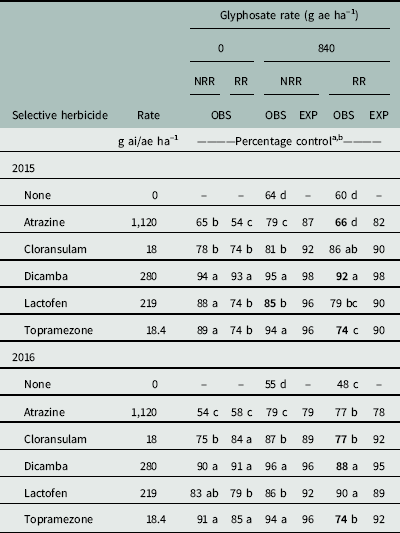
In 2015, glyphosate applied alone reduced dry weight by 64% and 60% for the NRR and RR biotypes, respectively (Table 5). Control in 2016 from the same treatment was 55% for the NRR biotype and 48% for the RR biotype. When applied without glyphosate, dicamba was the only selective herbicide with ≥90% control of both biotypes across 2015 and 2016, whereas control from atrazine was the lowest among the selective herbicides, never exceeding 65%. Glyphosate mixtures with atrazine, dicamba, and topramezone were antagonistic on the RR biotype in 2015. Antagonistic herbicide combinations on this biotype in 2016 included glyphosate mixtures with cloransulam, dicamba, and topramezone. Similar to the greenhouse efficacy trial, glyphosate plus topramezone resulted in the greatest difference between expected and observed control across both years. The mixture of glyphosate plus lactofen in 2015 was the only incidence of antagonism for the NRR biotype.
Observed means (OBS) and Colby’s expected responses (EXP) for combinations of glyphosate and selective herbicide mixtures on percentage shoot dry weight reduction of non-rapid response (NRR) and rapid response (RR) glyphosate-resistant giant ragweed in field trials at 28 d after treatment.

a Observed means in bold type denote an antagonistic interaction according to Colby (Reference Colby1967) (α=0.05). All other herbicide combinations are additive in action.
b Means within each biotype and year not followed by the same letter are significantly different according to Fisher’s protected LSD (α=0.05).
An antagonistic interaction between two herbicides does not necessarily imply that the combination should be avoided for field use. Instead, the most successful herbicide mixtures are those eliciting the greatest level of weed control. For both 2015 and 2016, control of the NRR biotype with glyphosate mixtures followed the order of dicamba=topramezone>lactofen=cloransulam>atrazine (Table 5), with dicamba and topramezone each providing >90% control. For the RR biotype, dicamba was the only selective herbicide when applied with glyphosate providing the greatest level of control across both years; in 2015, cloransulam was equally effective, and in 2016 lactofen was equally effective. All glyphosate mixtures with selective herbicides improved control over glyphosate alone, except for glyphosate plus atrazine on the RR biotype in 2015.
Comparable field results have been reported regarding the high level of control (>80%) achieved by glyphosate plus dicamba on GR giant ragweed (Belfry and Sikkema Reference Belfry and Sikkema2015; Vink et al. Reference Vink, Soltani, Robinson, Tardif, Lawton and Sikkema2012). Additionally, Jhala et al. (Reference Jhala, Sandell and Kruger2014) describe similar effectiveness with the use of another auxinic herbicide, 2,4-D. The efficacy of treatments containing topramezone on GR giant ragweed is much greater here (74% to 94%) than those reported by Belfry and Sikkema (Reference Belfry and Sikkema2015) in southwestern Ontario, in which a three-way mixture of glyphosate plus topramezone plus atrazine never exceeded 50% control. However, the POST application timing in that experiment was based on days after corn emergence, rather than giant ragweed growth. Therefore, the discrepancies in control may be due to differences in application timing. Giant ragweed populations used in these experiments were susceptible to acetolactate synthase–inhibiting herbicides. Control of GR giant ragweed from glyphosate plus cloransulam found here is similar to that of Stachler (Reference Stachler2008) in Ontario, yet in contrast to Riley and Bradley (Reference Riley and Bradley2014) in Missouri, who report <30% control from this combination. Additionally, the glyphosate mixture with lactofen provided 79% to 90% control across both RR and NRR biotypes in this experiment, compared to <40% reported by Riley and Bradley (Reference Riley and Bradley2014), although the specific GR biotype present in their study was not stated. The lack of control of GR giant ragweed from glyphosate plus atrazine found here is in agreement with the findings of Belfry and Sikkema (Reference Belfry and Sikkema2015).
These results specify an antagonistic interaction between glyphosate and selective herbicides when applied to the RR biotype of GR giant ragweed, and this interaction is intensified at increasing glyphosate rates. To circumvent the antagonism between these combinations, application of the selective herbicide should be made at least 2 d prior to glyphosate treatment. Glyphosate mixtures with the phloem-mobile herbicides cloransulam, dicamba, and topramezone most consistently resulted in antagonism for the RR biotype. Increasing the glyphosate rate in mixtures largely improved control of the NRR biotype over selective herbicides applied alone. For the RR biotype, higher glyphosate rates either reduced or did not improve control over selective herbicides applied alone. Although the mixture of glyphosate plus dicamba was antagonistic on the RR biotype, this combination still resulted in the greatest level of control when used at field-use rates on both the NRR and RR biotypes. Thus, this mixture remains a viable management option in both GR corn and glyphosate plus dicamba–resistant soybean production.