1. INTRODUCTION
With the recent advances in high-power lasers, the interaction of plasma with high-intensity laser fields has become possible. Harmonics generated due to the interaction of intense short-pulse lasers with plasmas has been an active area of research in recent years (Gibbon, Reference Gibbon1997). Second-harmonic generation is one of the most widely discussed areas in laser–plasma interactions as it has many applications such as the study of material properties, biological samples etc. It can be used as a diagnostic tool for overdense plasmas since at second harmonic frequency laser can penetrate into such plasmas and may provide us information regarding various phenomena occurring therein.
Engers et al. (Reference Engers, Fendel, Schuler, Schulz and Von der linde1991) have measured the time dependence of second harmonics from plasmas produced by femtosecond laser pulses. Dromey et al. (Reference Dromey, Kar, Bellei, Carroll, Clarke, Green, Kneip, Markey, Nagel, Simpson, Williangle, Mckenna, Neely, Najmudin, Krushelnick, Norreys and Zepf2007) have observed the generation of higher-order harmonics with photon energy hν > 1 keV from petawatt class laser–solid interactions and have presented the harmonic efficiency scaling in the relativistic limit. Linearly polarized intense laser beams on interaction with a homogeneous plasma produces transverse nonlinear plasma currents and thus lead to the generation of coherent harmonic radiation in the forward direction (Mori et al., Reference Mori, Decker and Leemans1993). Esarey et al. (Reference Esarey, Ting, Sprangle, Umstadter and Liu1993) have shown that the presence of transverse gradients in the initial plasma density profile favors the generation of even harmonics. Meyer and Zhul (Reference Meyer and Zhu1987) and Malka et al. (Reference Malka, Modena, Najmudin, Dangor, Clayton, Marsh, Joshi, Danson, Neely and Walsh1997) have shown the relativistic second-harmonic generation under the condition of beam filamentation. Krushelnick et al. (Reference Krushelnick, Ting, Burris, Fisher, Manka and Esarey1995) have experimentally observed second-harmonic generation of stimulated Raman scattered light from a plasma. Jha and Agarwal (Reference Jha and Agarwal2014) have studied analytically the second-harmonic generation by a p-polarized obliquely incident laser propagating in an underdense plasma. Second-harmonic generation in the reflected component of the beam by an obliquely incident, relativistically intense laser polarized perpendicular to the plane of incidence has been reported (Singh et al., Reference Singh, Gupta, Yadav and Tripathi2005). Rax et al. (Reference Rax, Robiche and Kostyukov2000) have analyzed relativistic harmonic generation with ultrahigh-intensity laser pulses in a weakly magnetized plasma. They have considered both permanent magnet and laser-driven wigglers and have addressed and solved important issues of phase matching, pump depletion, and relativistic tapering. Salih et al. (Reference Salih, Tripathi and Pandey2003) have investigated the second-harmonic generation of an intense self-guided right circularly polarized laser beam in a self-created magnetized plasma channel. Generation of second harmonics by a linearly polarized laser beam propagating through an underdense plasma embedded in a transverse magnetic field has been analyzed (Jha et al., Reference Jha, Mishra, Raj and Upadhyay2007). Verma and Sharma (Reference Verma and Sharma2009) have investigated second-harmonic generation by a laser-produced plasma having a density ripple in the presence of an azimuthal magnetic field.
Interaction of ultrahigh-intensity lasers with plasmas induces transverse currents due to quiver motion of the electrons. Laser intensities upto 1020 W/cm2 has been achieved, which while propagating through the plasma makes the electrons move with relativistic velocities and the electron motion becomes nonlinear and thus leads to the generation of harmonics. In the presence of high-power laser fields, the relativistic change in the mass of the electron may affect the dielectric property of the plasma medium. On the other hand, there may be depletion in plasma density from the higher field region due to expulsion of electrons in a radial direction from the axis, resulting in density gradient in the transverse direction. Both of these effects may be a source of second-harmonic emission. In this paper, we present an analytical study of relativistic second-harmonic generation in the reflected component by an obliquely incident s-polarized laser from a cold underdense plasma in the presence of a magnetic field. The electrons acquire an oscillatory velocity  ${\vec v_1}$ at
 $({\rm \omega}, \vec k)$ and exerts a ponderomotive force
 ${\vec v_1} \times {\vec B_1}$ on electrons at
 $(2{\rm \omega}, 2\vec k)$. The ponderomotive force gives rise to oscillatory electron velocities at
 $(2{\rm \omega}, 2\vec k)$ and produces a second-harmonic current
 ${\vec J_2}$ at
 $(2{\rm \omega}, 2\vec k)$. The magnetic field may play a very important role in increasing the efficiency of such a second-harmonic current from a plasma. The magnetic field gets coupled with the relativistic and ponderomotive effects and drastically affects the efficiency of second-harmonic generation. Moreover, the relativistic factor γ becomes a function of the magnetic field and this aspect has been properly taken into consideration in this work. Thus, the presence of magnetic field not only affects the motion of electrons, but it also modifies its relativistic mass. For correct understanding of any phenomena related to interaction between intense laser beam and relativistic plasma electrons in the presence of a magnetic field, it is necessary to incorporate the relation between magnetic field and relativistic motion of the charged particles. In the presence of magnetic field, the relativistic factor γ defined as
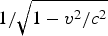 $1/\sqrt {1 - {v^2}/{c^2}} $ is modified and this might have a direct impact on the the interaction of plasma electrons and laser field. Here, we have found an analytical expression for the modified relativistic factor (Qian, Reference Qian2000) in the presence of magnetic field and hence analyzed the effect on the efficiency of second-harmonic generation.
The present paper is organized as follows. Theoretical model has been described in Section 2. In Section 3, a modified expression for relativistic factor γ has been derived in the presence of magnetic field. In Section 4, efficiency of the second-harmonic signal has been obtained as a function of angle of incidence, normalized electric field amplitude of laser beam, normalized electron density, and magnetic field. Results and discussions are presented in Section 5. Conclusions are summarized in Section 6.
2. THEORETICAL MODEL
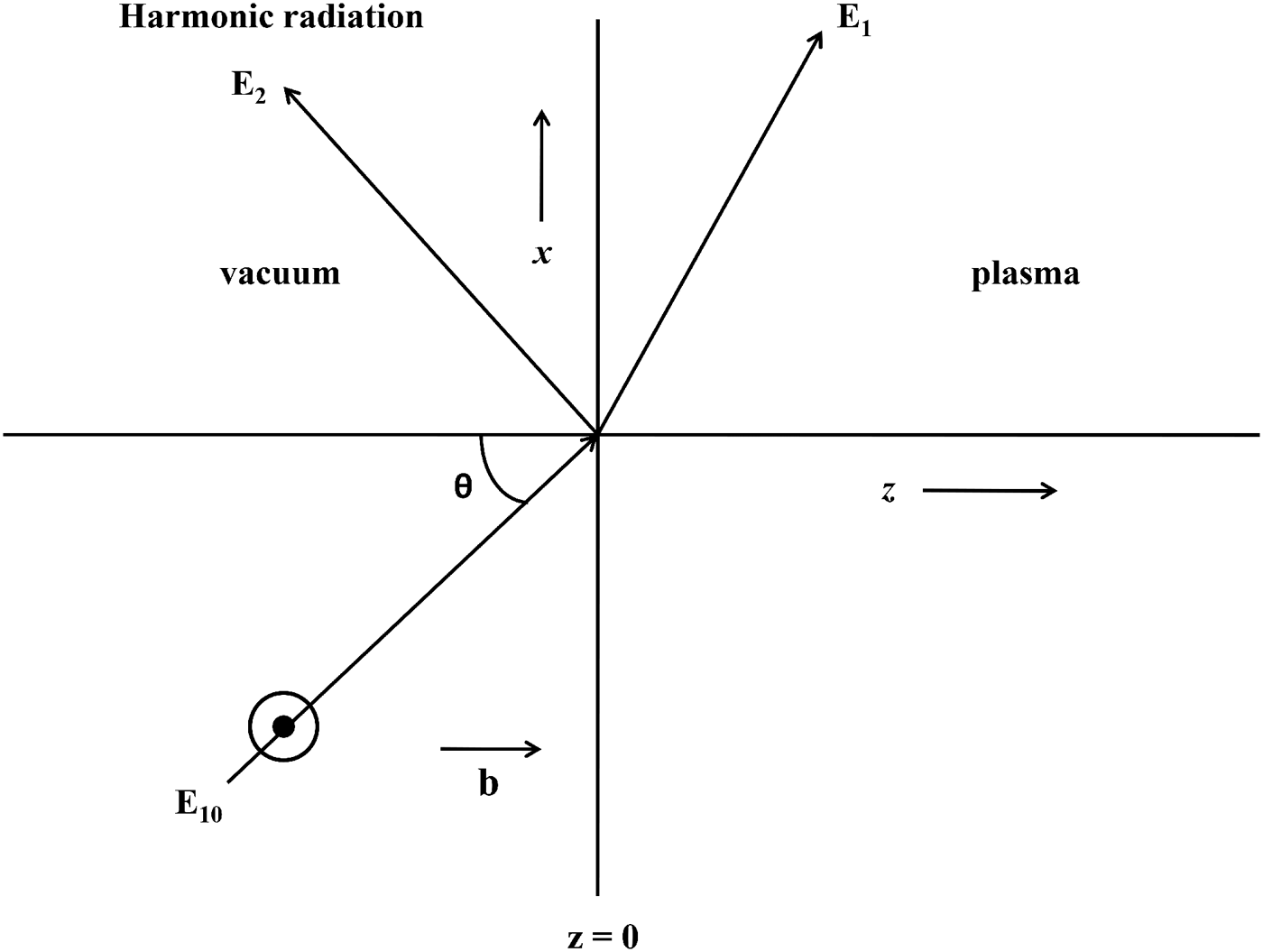
We consider an s-polarized laser beam incident obliquely on a vacuum–plasma interface at z = 0 with z < 0 as vacuum and z > 0 as a uniform plasma of density  $n_0^0 $ embedded in a magnetic field,
 $\vec b = b\hat z$. The laser beam is propagating along the x–z plane at an angle θ with the z-axis as shown in Figure 1. The fundamental laser beam propagating through vacuum can be represented as
 $${\vec E_{1i}} = \hat y{E_{10}}{\rm exp}\left[ { - i\left( {{\rm \omega} t - {k_x}x - {k_{{\rm 0}z}}z} \right)} \right]$$
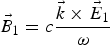
where k x = (ω/c)sinθ and k 0z = (ω/c)cosθ. The electric and magnetic fields of the laser transmitted inside the plasma can be written as
 $${\vec E_1} = \hat y{E_1}{\rm exp}\left[ { - i\left( {{\rm \omega} t - {k_x}x - {k_z}z} \right)} \right]$$
 $${\vec B_1} = c\displaystyle{{\vec k \times {{\vec E}_1}} \over {\rm \omega}} $$
where  ${k_{\rm z}} = {\left[ {\left( {{{\rm \omega} ^2}/{c^2}} \right)\left( {1 - {\rm \omega} _{\rm p}^2 /{{\rm \omega} ^2}} \right) - k_x^2} \right]^{1/2}}$ and a 1 = 2a 0/(1 + k z/k 0z). a 0 = eE 10/m 0ωc and a 1 = eE 1/m 0ωc are the normalized electric field parameters,
 ${\rm \omega} _{\rm p}^2 = 4{\rm \pi} n_0^0 {e^2}/{\rm \gamma} {m_0}$ is the relativistic plasma frequency,
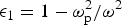 ${{\rm \epsilon} _1} = 1 - {\rm \omega} _{\rm p}^2 /{{\rm \omega} ^2}$ is the dielectric constant where e, m 0, and γ are the electronic charge, rest mass, and time-averaged value of the relativistic factor, respectively.
Schematic of second-harmonic generation process by an obliquely incident s-polarized laser.

3. RELATIVISTIC FACTOR IN THE PRESENCE OF MAGNETIC FIELD
The equation governing electron momentum is given as
 $$\displaystyle{{d{\vec p}} \over {dt}} = - e\, {\vec E}_1 - \displaystyle{e \over c}{\vec v} \times \left( {{\vec B} + {\vec b}} \right)$$
The components of the above eqn. can be written as
 $$\displaystyle{{d{\,p_x}} \over {dt}} = - e{E_1}\displaystyle{{{k_x}} \over {\rm \omega}} {v_y}{\rm cos}\left( {{\rm \omega} t - {k_x}x - {k_z}z} \right) - \displaystyle{e \over c}{v_y}b$$
 $$\displaystyle{{d{\,p_y}} \over {dt}} = \displaystyle{{ - e{E_1}} \over {\rm \omega}} \left( {{\rm \omega} - {k_x}{v_x} - {k_z}{v_z}} \right){\rm cos}\left( {{\rm \omega} t - {k_x}x - {k_z}z} \right) + \displaystyle{e \over c}{v_x}b$$
 $$\displaystyle{{d{\,p_z}} \over {dt}} = - e{E_1}\displaystyle{{{k_{\rm z}}} \over {\rm \omega}} {v_y}{\rm cos}\left( {{\rm \omega} t - {k_x}x - {k_z}z} \right)$$
The equation governing electron energy is given as
 $${m_0}{c^2}\displaystyle{{d{{\rm \gamma} _{\rm t}}} \over {dt}} = - e{E_1}{v_y}{\rm cos}\left( {{\rm \omega} t - {k_x}x - {k_z}z} \right)$$
 $$\displaystyle{d \over {dt}}\left\{ {{\,p_z} - {m_0}c{{\rm \gamma} _{\rm t}}{{({{\rm \epsilon} _1} - {\rm si}{{\rm n}^2}{\rm \theta} )}^{1/2}}} \right\} = 0$$
Thus, we can write
 $${\,p_z} - {m_0}c{{\rm \gamma} _{\rm t}}{\left( {{{\rm \epsilon} _1} - {\rm si}{{\rm n}^2}{\rm \theta}} \right)^{1/2}} = {\,p_{z0}} - {m_0}c{{\rm \gamma} _0}$$
where p z0(= m0γ0v z0) and γ0 are the initial values of electron momentum along z-direction and relativistic factor, respectively.
Using Eq. (8) in Eq. (5) and integrating it using the initial values of electron momentum along x as p x0(= m 0γ0v x0) and integrating Eq. (6) using the initial values of electron momentum along y as p y0(= m 0γ0v y0) we obtain
 $${\,p_x} = mc{{\rm \gamma} _{\rm t}}{\rm sin\theta} - \displaystyle{e \over c}\left( {y - {y_0}} \right)b + {\,p_{x0}}$$
 $${\,p_y} = {\,p_{y0}} + \displaystyle{e \over c}\left( {x - {x_0}} \right)b - \displaystyle{{e{E_1}} \over {\rm \omega}} {\rm sin}\left( {{\rm \omega} t - {k_x}x - {k_z}z} \right)$$
Using Eq. (10) we get
 $$\displaystyle{{{\,p_z}} \over {{m_0}c}} = {{\rm \gamma} _{\rm t}}{\left( {{{\rm \epsilon} _1} - {\rm si}{{\rm n}^2}{\rm \theta}} \right)^{1/2}} + \displaystyle{{{\,p_{z0}}} \over {{m_0}c}} - {{\rm \gamma} _0}$$
Here we define a variable τ such that
 $${\rm \tau} = \displaystyle{z \over c} - t$$
Using Eq. (10) one can obtain
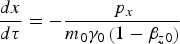 $$\displaystyle{{dx} \over {d{\rm \tau}}} = - \displaystyle{{{\,p_x}} \over {{m_0}{{\rm \gamma} _0}\left( {1 - {{\rm \beta} _{z{\rm 0}}}} \right)}}$$
and
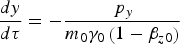 $$\displaystyle{{dy} \over {d{\rm \tau}}} = - \displaystyle{{{\,p_y}} \over {{m_0}{{\rm \gamma} _0}\left( {1 - {{\rm \beta} _{z0}}} \right)}}$$
where βz0 = v z0/c. Using Eqs (11) and (12) in Eqs (15) and (16), respectively, we obtain
 $$x - {x_0} = \displaystyle{1 \over {{m_0}{{\rm \gamma} _0}\left( {1 - {{\rm \beta} _{z0}}} \right)}}\left\{ {mc{{\rm \gamma} _{\rm t}}{\rm sin\theta} - \displaystyle{e \over c}\left( {y - {y_0}} \right)b{\rm \tau} - {\,p_{x0}}{\rm \tau}} \right\}$$
and
 $$\eqalign{y - {y_0} & = \displaystyle{{ - 1} \over {{m_0}{{\rm \gamma} _0}\left( {1 - {{\rm \beta} _{z0}}} \right)}} \cr & \quad \left\{ {{\,p_{y0}}{\rm \tau} + \displaystyle{e \over c}\left( {x - {x_0}} \right)b{\rm \tau} + \displaystyle{{e{E_1}} \over {{{\rm \omega} ^2}}}{\rm cos}\left[ {{\rm \omega} \left( {\displaystyle{z \over c} - {\rm \tau}} \right) - {k_x}x - {k_z}z} \right]} \right\}} $$
Solving Eqs (17) and (18) we obtain
 $$x - {x_0} = \displaystyle{\matrix{ - mc{\rm \tau} {{\rm \gamma} _{\rm t}}{\rm sin\theta} - {\,p_{x0}}{\rm \tau} - {{\rm \omega} _{\rm c}}{\rm \tau} \hfill \cr \quad \left\{ {e{E_1}/{{\rm \omega} ^2}{\rm cos}\left[ {{\rm \omega (}z/(c) - {\rm \tau )} - {k_x}x - {k_z}z} \right] + {\rm \tau} {\,p_{y0}}} \right\} \hfill} \over {{m_0}{{\rm \gamma} _0}\left( {1 - {{\rm \beta} _{z0}}} \right)\left\{ {1 + {\rm \omega} _{\rm c}^2 {{\rm \tau} ^2}} \right\}}}$$
and
 $$y - {y_0} = \displaystyle{\matrix{{{\rm \omega} _{\rm c}}mc{{\rm \gamma} _{\rm t}}{{\rm \tau} ^2}{\rm sin\theta} - {\,p_{y0}}{\rm \tau} + {{\rm \omega} _{\rm c}}{\,p_{x0}}{{\rm \tau} ^2} - \hfill \cr \quad \left( {e{E_1}/{{\rm \omega} ^2}} \right){\rm cos}\left[ {{\rm \omega (}z/(c) - {\rm \tau )} - {k_x}x - {k_z}z} \right] \hfill} \over {{m_0}{{\rm \gamma} _0}\left( {1 - {{\rm \beta} _{z0}}} \right)\left\{ {1 + {\rm \omega} _{\rm c}^2 {{\rm \tau} ^2}} \right\}}}$$
Using Eqs (19) and (20) in (11) and (12), respectively, we obtain
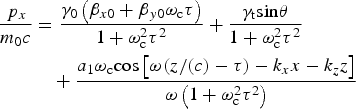 $$\eqalign{\displaystyle{{{\,p_x}} \over {{m_0}c}} & = \displaystyle{{{{\rm \gamma} _0}\left( {{{\rm \beta} _{x0}} + {{\rm \beta} _{y0}}{{\rm \omega} _{\rm c}}{\rm \tau}} \right)} \over {1 + {\rm \omega} _{\rm c}^2 {{\rm \tau} ^2}}} + \displaystyle{{{{\rm \gamma} _{\rm t}}{\rm sin\theta}} \over {1 + {\rm \omega} _{\rm c}^2 {{\rm \tau} ^2}}} \cr & \quad + \displaystyle{{{a_1}{{\rm \omega} _{\rm c}}{\rm cos}\left[ {{\rm \omega (}z/(c) - {\rm \tau )} - {k_x}x - {k_z}z} \right]} \over {{\rm \omega} \left( {1 + {\rm \omega} _{\rm c}^2 {{\rm \tau} ^2}} \right)}}} $$
and
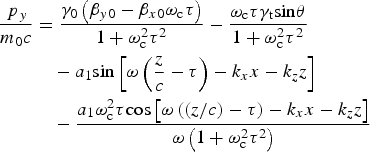 $$\eqalign{\displaystyle{{{\,p_y}} \over {{m_0}c}} & = \displaystyle{{{{\rm \gamma} _0}\left( {{{\rm \beta} _{y0}} - {{\rm \beta} _{x0}}{{\rm \omega} _{\rm c}}{\rm \tau}} \right)} \over {1 + {\rm \omega} _{\rm c}^2 {{\rm \tau} ^2}}} - \displaystyle{{{{\rm \omega} _{\rm c}}{\rm \tau} {{\rm \gamma} _{\rm t}}{\rm sin\theta}} \over {1 + {\rm \omega} _{\rm c}^2 {{\rm \tau} ^2}}} \cr & \quad- {a_1}{\rm sin}\left[ {{\rm \omega} \left( {\displaystyle{z \over c} - {\rm \tau}} \right) - {k_x}x - {k_z}z} \right] \cr & \quad - \displaystyle{{{a_1}{\rm \omega} _{\rm c}^2 {\rm \tau cos}\left[ {{\rm \omega} \left( {\left( {z/c} \right) - {\rm \tau}} \right) - {k_x}x - {k_z}z} \right]} \over {{\rm \omega} \left( {1 + {\rm \omega} _{\rm c}^2 {{\rm \tau} ^2}} \right)}}} $$
where βx0 = v x0/c, βy0 = v y0/c, and ωc = eb/m0cγ0(1 − βz0) is the electron cyclotron frequency. Using Eqs (13), (21), and (22) with  ${\rm \gamma} _{\rm t}^2 = 1 + \left( {\,p_x^2 + p_y^2 + p_z^2} \right)/m_0^2 {c^2}$ and applying initial conditions, βx0 = βy0 = βz0 = 0, γ0 = 1, the time averaged value of the relativistic factor is obtained as
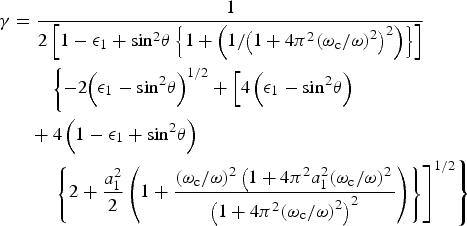 $$\eqalign{{\rm \gamma} & = \displaystyle{1 \over {2\left[ {1 - {{\rm \epsilon} _1} + {\rm si}{{\rm n}^2}{\rm \theta} \left\{ {1 + \left( {1/{{\left( {1 + 4{{\rm \pi} ^2}{{\left( {{{\rm \omega} _{\rm c}}/{\rm \omega}} \right)}^2}} \right)}^2}} \right)} \right\}} \right]}} \cr & \quad \quad \left\{ { - 2{{\left( {{{\rm \epsilon} _1} - {\rm si}{{\rm n}^2}{\rm \theta}} \right)}^{1/2}} + \left[ {4\left( {{{\rm \epsilon} _1} - {\rm si}{{\rm n}^2}{\rm \theta}} \right)} \right.} \right. \cr & \quad + 4\left( {1 - {{\rm \epsilon} _1} + {\rm si}{{\rm n}^2}{\rm \theta}} \right) \cr & \quad \left. {{{\left. {\quad \left\{ {2 + \displaystyle{{a_1^2} \over 2}\left( {1 + \displaystyle{{{{\left( {{{\rm \omega} _{\rm c}}/{\rm \omega}} \right)}^2}\left( {1 + 4{{\rm \pi} ^2}a_1^2 {{\left( {{{\rm \omega} _{\rm c}}/{\rm \omega}} \right)}^2}} \right.} \over {{{\left( {1 + 4{{\rm \pi} ^2}{{\left( {{{\rm \omega} _{\rm c}}/{\rm \omega}} \right)}^2}} \right)}^2}}}} \right)} \right\}} \right]}^{1/2}}} \right\}} $$
4. SECOND-HARMONIC CONVERSION EFFICIENCY
When a laser beam propagates through the plasma, the relativistic and nonlinear effects gives rise to an intensity gradient in the plasma, and this drives a second-harmonic current density. The wave equation governing second-harmonic generation is given as
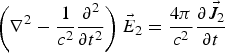 $$\left( {{\nabla ^2} - \displaystyle{1 \over {{c^2}}}\displaystyle{{{\partial ^2}} \over {\partial {t^2}}}} \right){\vec E}_{2} = \displaystyle{{4{\rm \pi}} \over {{c^2}}}\displaystyle{{\partial {{\vec J}_2}} \over {\partial t}}$$
The solution of Eq. (24) can be written as
 $${\vec E_2} = {\vec A_2}{\rm exp}\left[ { - i\left( {2{\rm \omega} t - 2{k_x}x + 2{k_{0z}}z} \right)} \right]$$
The laser imparts an oscillatory electron velocity at  $({\rm \omega}, \vec k)$
 $${\vec v_1} = \displaystyle{{e{{\vec E}_1}} \over {{\rm \gamma} {m_0}i{\rm \omega}}} $$
which produces an oscillating current at  $({\rm \omega}, \vec k)$
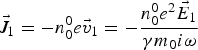 $${\vec J_1} = - n_0^0 e{\vec v_1} = - \displaystyle{{n_0^0 {e^2}{{\vec E}_1}} \over {{\rm \gamma} {m_0}i{\rm \omega}}} $$
 ${\vec v_1}$ beats with
 ${\vec B_1}$ to produce the ponderomotive force
 ${\vec F_2}$ at
 $(2{\rm \omega}, 2\vec k)$
 $${\vec F_2} = \displaystyle{{i\vec kc{{\rm \epsilon} _1}e} \over {2{\rm \gamma \omega}}} {a_1}{E_1}{\rm exp}\left[ { - i\left( {2{\rm \omega} t - 2{k_x}x - 2{k_z}z} \right)} \right] $$
The electron velocity due to  ${\vec F_2}$, self-consistent field
 ${\vec E_2}$ and the external magnetic field
 $\vec b$ at
 $(2{\rm \omega}, 2\vec k)$ is
 $${\vec v_2} = \displaystyle{1 \over {2{\rm \gamma} {m_0}i{\rm \omega}}} \left\{ {e{{\vec E}_2} - {{\vec F}_2} + \displaystyle{e \over c}\left( {{{\vec v}_2} \times \vec b} \right)} \right\}$$
The x, y, and z components of the electron velocities are obtained as
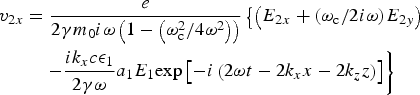 $$\eqalign{{v_{2x}} & = \displaystyle{e \over {2{\rm \gamma} {m_0}i{\rm \omega} \left( {1 - \left( {{\rm \omega} _{\rm c}^2 /4{{\rm \omega} ^2}} \right)} \right)}}\left\{ {\left( {{E_{2x}} + ({{\rm \omega} _{\rm c}}/2i{\rm \omega} ){E_{2y}}} \right)} \right. \cr & \quad \left. { - \displaystyle{{i{k_x}c{{\rm \epsilon} _1}} \over {2{\rm \gamma \omega}}} {a_1}{E_1}{\rm exp}\left[ { - i\left( {2{\rm \omega} t - 2{k_x}x - 2{k_z}z} \right)} \right]} \right\}} $$
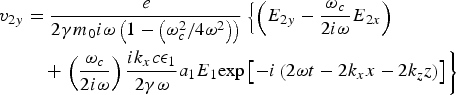 $$\eqalign{{v_{2y}} & = \displaystyle{e \over {2{\rm \gamma} {m_0}i{\rm \omega} \left( {1 - \left( {{\rm \omega} _c^2 /4{{\rm \omega} ^2}} \right)} \right)}}\left\{ {\left( {{E_{2y}} - \displaystyle{{{{\rm \omega} _c}} \over {2i{\rm \omega}}} {E_{2x}}} \right) } \right. \cr & \quad + \left. {\left( {\displaystyle{{{{\rm \omega} _c}} \over {2i{\rm \omega}}}} \right)\displaystyle{{i{k_x}c{{\rm \epsilon} _1}} \over {2{\rm \gamma \omega}}} {a_1}{E_1}{\rm exp}\left[ { - i\left( {2{\rm \omega} t - 2{k_x}x - 2{k_z}z} \right)} \right]} \right\}} $$
and
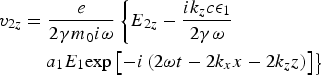 $$\eqalign{{v_{2z}} & = \displaystyle{e \over {2{\rm \gamma} {m_0}i{\rm \omega}}} \left\{ {{E_{2z}} - \displaystyle{{i{k_z}c{{\rm \epsilon} _1}} \over {2{\rm \gamma \omega}}}} \right. \cr & \quad \left. {{a_1}{E_1}{\rm exp}\left[ { - i\left( {2{\rm \omega} t - 2{k_x}x - 2{k_z}z} \right)} \right]} \right\}} $$
Using Eqs (30), (31), and (32), the current densities along x, y, and z-directions are obtained as
 $$\eqalign{{J_{2x}} & = \displaystyle{1 \over {\left( {1 - \left( {{\rm \omega} _{\rm c}^2 /4{{\rm \omega} ^2}} \right)} \right)}}\left\{ { - \displaystyle{{{\rm \omega} _{\rm p}^2} \over {8{\rm \pi} i{\rm \omega}}} \left( {{E_{2x}} + \displaystyle{{{{\rm \omega} _{\rm c}}} \over {2i{\rm \omega}}} {E_{2y}}} \right) } \right. \cr & \quad +\left. {\displaystyle{{{\rm \omega} _{\rm p}^2 {k_x}c{{\rm \epsilon} _1}} \over {16{\rm \pi} {{\rm \omega} ^2}{\rm \gamma}}} {a_1}{E_1}{\rm exp}\left[ { - i\left( {2{\rm \omega} t - 2{k_x}x - 2{k_z}z} \right)} \right]} \right\}} $$
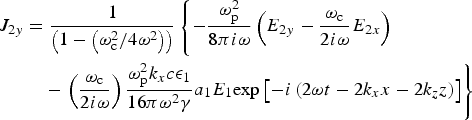 $$\eqalign{{J_{2y}} & = \displaystyle{1 \over {\left( {1 - \left( {{\rm \omega} _{\rm c}^2 /4{{\rm \omega} ^2}} \right)} \right)}}\left\{ { - \displaystyle{{{\rm \omega} _{\rm p}^2} \over {8{\rm \pi} i{\rm \omega}}} \left( {{E_{2y}} - \displaystyle{{{{\rm \omega} _{\rm c}}} \over {2i{\rm \omega}}} {E_{2x}}} \right) } \right. \cr & \quad -\left. {\left( {\displaystyle{{{{\rm \omega} _{\rm c}}} \over {2i{\rm \omega}}}} \right)\displaystyle{{{\rm \omega} _{\rm p}^2 {k_x}c{{\rm \epsilon} _1}} \over {16{\rm \pi} {{\rm \omega} ^2}{\rm \gamma}}} {a_1}{E_1}{\rm exp}\left[ { - i\left( {2{\rm \omega} t - 2{k_x}x - 2{k_z}z} \right)} \right]} \right\}} $$
and
 $${J_{2z}} = - \displaystyle{{{\rm \omega} _{\rm p}^2} \over {8{\rm \pi} i{\rm \omega}}} {E_{2z}} + \displaystyle{{{\rm \omega} _{\rm p}^2 {k_z}c{{\rm \epsilon} _1}} \over {16{\rm \pi} {{\rm \omega} ^2}{\rm \gamma}}} {a_1}{E_1}{\rm exp}\left[ { - i\left( {2{\rm \omega} t - 2{k_x}x - 2{k_z}z} \right)} \right]$$
Substituting Eqs (33)–(35) into the x, y, and z components of wave Eq. (24), and solving for A 2x, A 2y, and A 2z by assuming ∂2/∂z 2 < ∂2/∂x 2, we obtain
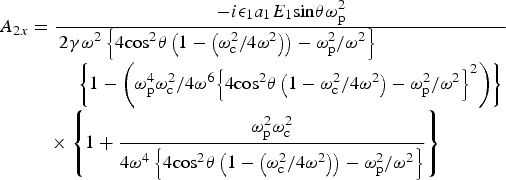 $$\eqalign{{A_{2x}} & = \displaystyle{{ - i{{\rm \epsilon} _1}{a_1}{E_1}{\rm sin\theta \omega} _{\rm p}^2} \over \matrix{2{\rm \gamma} {{\rm \omega} ^2}\left\{ {4{\rm co}{{\rm s}^2}{\rm \theta} \left( {1 - \left( {{\rm \omega} _{\rm c}^2 /4{{\rm \omega} ^2}} \right)} \right) - {\rm \omega} _{\rm p}^2 /{{\rm \omega} ^2}} \right\} \hfill \cr \quad \left\{ {1 - \left( {{\rm \omega} _{\rm p}^4 {\rm \omega} _{\rm c}^2 /4{{\rm \omega} ^6}{{\left\{ {4{\rm co}{{\rm s}^2}{\rm \theta} \left( {1 - {\rm \omega} _{\rm c}^2 /4{{\rm \omega} ^2}} \right) - {\rm \omega} _{\rm p}^2 /{{\rm \omega} ^2}} \right\}}^2}} \right)} \right\} \hfill}} \cr & \quad \times \left\{ {1 + \displaystyle{{{\rm \omega} _{\rm p}^2 {\rm \omega} _{\rm c}^2} \over {4{{\rm \omega} ^4}\left\{ {4{\rm co}{{\rm s}^2}{\rm \theta} \left( {1 - \left( {{\rm \omega} _{\rm c}^2 /4{{\rm \omega} ^2}} \right)} \right) - {\rm \omega} _{\rm p}^2 /{{\rm \omega} ^2}} \right\}}}} \right\}} $$
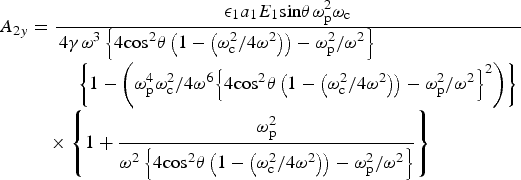 $$\eqalign{{A_{2y}} & = \displaystyle{{{{\rm \epsilon} _1}{a_1}{E_1}{\rm sin\theta \omega} _{\rm p}^2 {{\rm \omega} _{\rm c}}} \over \matrix{4{\rm \gamma} {{\rm \omega} ^3}\left\{ {4{\rm co}{{\rm s}^2}{\rm \theta} \left( {1 - \left( {{\rm \omega} _{\rm c}^2 /4{{\rm \omega} ^2}} \right)} \right) - {\rm \omega} _{\rm p}^2 /{{\rm \omega} ^2}} \right\} \hfill \cr \quad \left\{ {1 - \left( {{\rm \omega} _{\rm p}^4 {\rm \omega} _{\rm c}^2 /4{{\rm \omega} ^6}{{\left\{ {4{\rm co}{{\rm s}^2}{\rm \theta} \left( {1 - \left( {{\rm \omega} _{\rm c}^2 /4{{\rm \omega} ^2}} \right)} \right) - {\rm \omega} _{\rm p}^2 /{{\rm \omega} ^2}} \right\}}^2}} \right)} \right\} \hfill}} \cr & \quad \times \left\{ {1 + \displaystyle{{{\rm \omega} _{\rm p}^2} \over {{{\rm \omega} ^2}\left\{ {4{\rm co}{{\rm s}^2}{\rm \theta} \left( {1 - \left( {{\rm \omega} _{\rm c}^2 /4{{\rm \omega} ^2}} \right)} \right) - {\rm \omega} _{\rm p}^2 /{{\rm \omega} ^2}} \right\}}}} \right\}} $$
and
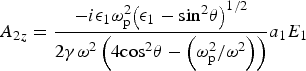 $${A_{2z}} = \displaystyle{{ - i{{\rm \epsilon} _1}{\rm \omega} _{\rm p}^2 {{\left( {{{\rm \epsilon} _1} - {\rm si}{{\rm n}^2}{\rm \theta}} \right)}^{1/2}}} \over {2{\rm \gamma} {{\rm \omega} ^2}\left( {4{\rm co}{{\rm s}^2}{\rm \theta} - \left( {{\rm \omega} _{\rm p}^2 /{{\rm \omega} ^2}} \right)} \right)}}{a_1}{E_1}$$
The resultant amplitude  $\left( {\left\vert {A_2^2} \right\vert = \left\vert {A_{2x}^2} \right\vert + \left\vert {A_{2y}^2} \right\vert + \left\vert {A_{2z}^2} \right\vert} \right)$ of the second-harmonic wave is calculated and the ratio of the reflected second-harmonic power density, P 2 = c|A 2|2/8π to that of the fundamental power density, P 0 = c|E 10|2/8π is obtained to calculate the second-harmonic conversion efficiency, η(= P 2/P 0) as
$$\eqalign{{\rm \eta} & = \left[ {\displaystyle{{{\rm \epsilon }_1^2 {\rm si}{{\rm n}^2}{\rm \theta} {\rm \omega} _{\rm p}^4 } \over \matrix{4{{\rm \gamma} ^2}{{\rm \omega} ^4}{\left\{ {4{\rm co}{{\rm s}^2}{\rm \theta} \left( {1 - \left( {{\rm \omega} _{\rm c}^2 /4{{\rm \omega} ^2}} \right)} \right) - \left( {{\rm \omega} _{\rm p}^2 /{{\rm \omega} ^2}} \right)} \right\}^2} \hfill \cr \quad{\left\{ {1 - \left( {{\rm \omega} _{\rm p}^4 {\rm \omega} _{\rm c}^2 /4{{\rm \omega} ^6}{{\left\{ {4{\rm co}{{\rm s}^2}{\rm \theta} \left( {1 - \left( {{\rm \omega} _{\rm c}^2 /4{{\rm \omega} ^2}} \right)} \right) - {\rm \omega} _{\rm p}^2 /{{\rm \omega} ^2}} \right\}}^2}} \right)} \right\}^2} \hfill} }} \right. \cr & \quad \times \left[ {{{\left\{ {1 + \displaystyle{{{\rm \omega} _{\rm p}^2 {\rm \omega} _{\rm c}^2 } \over {4{{\rm \omega} ^4}\left\{ {4{\rm co}{{\rm s}^2}{\rm \theta} \left( {1 - {\rm \omega} _{\rm c}^2 /4{{\rm \omega} ^2}} \right) - {\rm \omega} _{\rm p}^2 /{{\rm \omega} ^2}} \right\}}}} \right\}}^2} } \right. \cr & \quad \quad + \left. {{{\left( {\displaystyle{{{{\rm \omega}_{\rm c}}} \over {2{\rm \omega}}}} \right)}^2}{{\left\{ {1 + \displaystyle{{{\rm \omega}_{\rm p}^2 } \over {{{\rm \omega}^2}\left\{ {4{\rm co}{{\rm s}^2}{\rm \theta}\left( {1 - \left( {{\rm \omega}_{\rm c}^2 /4{{\rm \omega}^2}} \right)} \right) - {\rm \omega}_{\rm p}^2 /{{\rm \omega}^2}} \right\}}}} \right\}}^2}} \right] \cr & \quad \left. \vphantom{\displaystyle{{{\rm \epsilon }_1^2 {\rm si}{{\rm n}^2}{\rm \theta} {\rm \omega} _{\rm p}^4 } \over \matrix{4{{\rm \gamma} ^2}{{\rm \omega} ^4}{\left\{ {4{\rm co}{{\rm s}^2}{\rm \theta} \left( {1 - \left( {{\rm \omega} _{\rm c}^2 /4{{\rm \omega} ^2}} \right)} \right) - \left( {{\rm \omega} _{\rm p}^2 /{{\rm \omega} ^2}} \right)} \right\}^2} \hfill \cr \quad{\left\{ {1 - \left( {{\rm \omega} _{\rm p}^4 {\rm \omega} _{\rm c}^2 /4{{\rm \omega} ^6}{{\left\{ {4{\rm co}{{\rm s}^2}{\rm \theta} \left( {1 - \left( {{\rm \omega} _{\rm c}^2 /4{{\rm \omega} ^2}} \right)} \right) - {\rm \omega} _{\rm p}^2 /{{\rm \omega} ^2}} \right\}}^2}} \right)} \right\}^2} \hfill} }} { + \displaystyle{{{\rm \epsilon }_1^2 {\rm \omega}_{\rm p}^4 \left( {{{\rm \epsilon }_1} - {\rm si}{{\rm n}^{\rm 2}}{\rm \theta}} \right)} \over {4{{\rm \gamma}^2}{{\rm \omega}^4}{{\left( {4{\rm co}{{\rm s}^2}{\rm \theta} - \left( {{\rm \omega}_{\rm p}^2 /{{\rm \omega}^2}} \right)} \right)}^2}}}} \right] \cr & \quad \quad {\left\{ {\displaystyle{{4{a_0}} \over {{{\left\{ {1 + \left( {{{\left( {{{\rm \epsilon }_1} - {\rm si}{{\rm n}^2}{\rm \theta}} \right)}^{1/2}}/{\rm cos{\rm \theta} }} \right)} \right\}}^2}}}} \right\}^2}} $$It can be seen from Eq. (39) that in the absence of magnetic field, the second-harmonic electric field has only x and z components. Thus, second-harmonic emission is p-polarized in the absence of magnetic field and is dependent on the incident angle θ.
5. RESULTS AND DISCUSSIONS
Second-harmonic generation from plasmas by an obliquely incident s-polarized laser in the presence of magnetic field has been studied analytically in this paper. Considering relativistic mass variation, the expression for modified relativistic factor in the presence of magnetic field has been derived and the second-harmonic conversion efficiency η has been calculated for relativistic laser intensities. Figure 2 represents the variation of the modified relativistic factor γ with normalized electric field amplitude a 0 and magnetic field b. It is observed that γ increases both with a 0 as well as b. This behavior of γ is reflected in almost all the results having the variation of η which is obtained as a function of b. Figure 3 shows the variation of η with b and the angle of incidence θ at a 0 = 1. For normalized electron density  ${\rm \omega} _{\rm p}^2 /{{\rm \omega} ^2} = 0.1$, it is found that η increases with θ. However, θ can be varied upto a maximum of 70° (critical angle) as beyond the critical angle the laser propagation vector becomes imaginary and the laser propagation becomes evanescent. Hence, the second-harmonic conversion efficiency is maximum at the critical angle. It is observed that η decreases with an increase in magnetic field. The dependence of η on b is found to be same in Figure 4 as in Figure 3 which depicts the variation of η with b and
 ${\rm \omega} _{\rm p}^2 /{{\rm \omega} ^2}$. Figure 5(a) displays the variation of η as a function of a 0 and b. Figure 5(b) displays the same variation for unmodified relativistic factor γ′ (Singh et al., Reference Singh, Gupta, Yadav and Tripathi2005). The efficiency increases with a 0 as expected. Second-harmonic conversion efficiency in case of an unmagnetized plasma as shown in Figure 4 (Singh et al., Reference Singh, Gupta, Yadav and Tripathi2005) for a 0 ≈ 1 at the critical angle is about ≈0.2% which agrees with our result in Figure 5(a) when the magnetic field is zero (b = 0 T). A comparison of the results shown in Figure 4 (Singh et al., Reference Singh, Gupta, Yadav and Tripathi2005) with our results as depicted in Figure 5(a) shows that the second-harmonic conversion efficiency increases up to a 0 ≈ 1 and then gets saturated. However, our results show that the conversion efficiency decreases with an increase in magnetic field. When the effect of magnetic field on the relativistic factor is ignored, then it is found from Figure 5(b) that the second-harmonic conversion efficiency increases slightly with the increase in magnetic field. This may be due to the contribution of the magnetic field to the transverse motion of the electrons which is favorable for the generation of the second-harmonic current. However, the introduction of the modified relativistic factor results in a decrease of the efficiency with the magnetic field. This may be attributed to the increase in the value of the relativistic factor γ with an increase in magnetic field.
Modified relativistic factor γ as a function of normalized electric field amplitude a 0 and applied magnetic field b at  ${\rm \omega} _{\rm p}^2 /{{\rm \omega} ^2} = 0.1$, θ = 70°, and ω = 1.88 × 10¹⁴ Hz.
Conversion efficiency η as a function of applied magnetic field b and angle of incidence θ at a 0 = 1,  ${\rm \omega} _{\rm p}^2 /{{\rm \omega} ^2} = 0.1$, and ω = 1.88 × 10¹⁴ Hz.
Conversion efficiency η as a function of applied magnetic field b and normalized electron density  ${\rm \omega} _{\rm p}^2 /{{\rm \omega} ^2}$ at a 0 = 1, θ=70°, and ω = 1.88 × 10¹⁴ Hz.
Conversion efficiency η as a function of applied magnetic field b and normalized electric field amplitude a 0 at  ${\rm \omega} _{\rm p}^2 /{{\rm \omega} ^2} = 0.1$, θ=70°, and ω = 1.88 × 10¹⁴ Hz with (a) modified γ and (b) unmodified γ′.
6. CONCLUSION
We have investigated the effect of magnetic field on the efficiency of second-harmonic generation in a plasma subjected to an intense obliquely incident s-polarized laser beam. In the presence of magnetic field, the relativistic factor gets modified and this has been duly taken into consideration in this work. The conclusions drawn from the above discussions can be summarized as follows:
(i). The efficiency is found to increase with the angle of incidence upto the critical angle.
(ii). Second-harmonic conversion efficiency increases with a 0 which is also revealed in the literature (Singh et al., Reference Singh, Gupta, Yadav and Tripathi2005). However, in the presence of magnetic field, the conversion efficiency starts decreasing as the magnetic field is increased.
(iii). The presence of magnetic field enhances the value of the modified relativistic factor γ, which results in the reduction of the second-harmonic conversion efficiency.
ACKNOWLEDGEMENTS
We are grateful to the Board of Research in Nuclear Sciences (BRNS), Department of Atomic Energy (DAE), Government of India for providing us the financial support via. Project No. 2012/34/61/BRNS.