My interest in biopolitics took a circuitous route. My guiding interest in studying politics is the study of democratic representation. Democracy is a special institution. It holds out the hope that we can resolve our differences in a peaceful way by letting the governed govern themselves. As a graduate student, I was immediately taken by Anthony Down’s (Reference Downs1957) theory of democracy. It just made so much sense. People hold preferences that are ordered and coherent. They derive utility from outcomes. Government policy should, therefore, reflect the distribution of policy preferences that maximizes the utility of the most people. Easy peasy, right?
It turns out that it isn’t so easy. When we get into the nitty gritty of how people actually make decisions, we find a lot of strange things. For one, people often lack coherent policy preferences. According to Anthony Downs, people should have “single-peaked preferences.” This means that within the left/right ideological space, people pick a position that makes them the happiest and their happiness with other options diminishes as they move further away from their ideal point. All well and good, except for many Americans behave as if they have “double-peaked preferences,” which means that they prefer options at the ends of the ideological spectrum to the status quo (Egan, Reference Egan2014).
To give a concrete example of what this would look like, imagine someone whose preference ordering when it comes to health care is: 1) single-payer health care, 2) no government involvement in health care, 3) somewhere in between. If that weren’t bad enough, there is a mountain of evidence that people often hold malleable political attitudes that can twist and turn with the positions taken by partisan elites (e.g., Zaller, Reference Zaller1992). Those partisan cues are so powerful that they also lead many people to resist information that runs counter to them (Arceneaux and Vander Wielen, Reference Arceneaux and Vander Wielen2017).
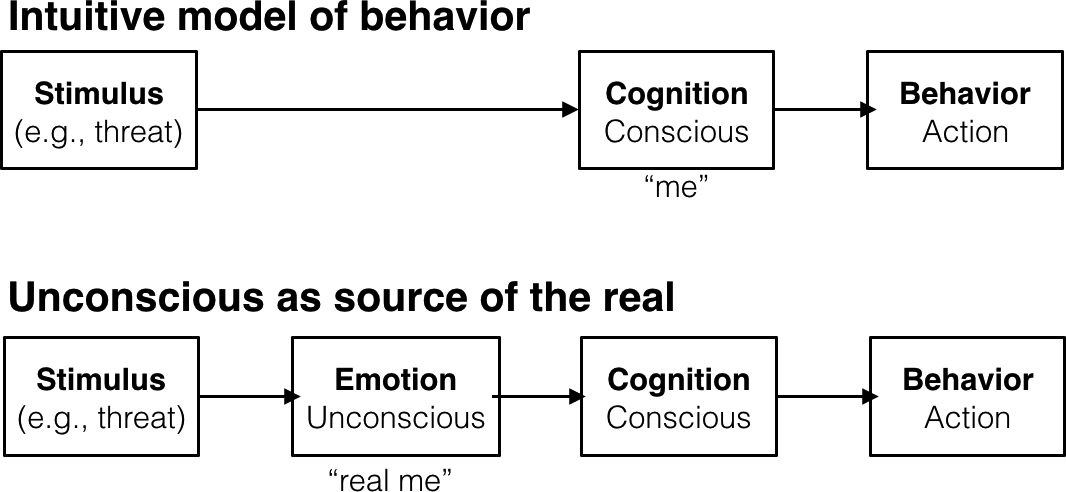
What can delving into biology teach us about attitude formation and behavior? Part of the reason that I was so taken with Anthony Down’s theory of democracy is that it resonated with my intuitive sense of how people made decisions. The top panel of Figure 1 offers a graphical representation. People’s conscious mind processes all external information, weighs it, and acts on it. The conscious part of the mind is where “me” is located and where all my preferences and desires — utility function, if you will — is located. As I began to delve into neuroscience, I began to subscribe to the bottom panel of Figure 1. We unconsciously process external information, imbuing it with an emotional charge, before the conscious mind joins the fun (Bargh and Chartrand, Reference Bargh and Chartrand1999). As a result, our behaviors are not always the result of conscious thoughts but rather submerged mental processes (Lodge and Taber, Reference Lodge and Taber2013). It is intoxicating to think of this submerged part of the mind as the “real me.” If only we could find ways to measure unconscious processes, we could get a window into people’s real motivations.
Simplistic Models of Political Behavior.

There is no “real me”
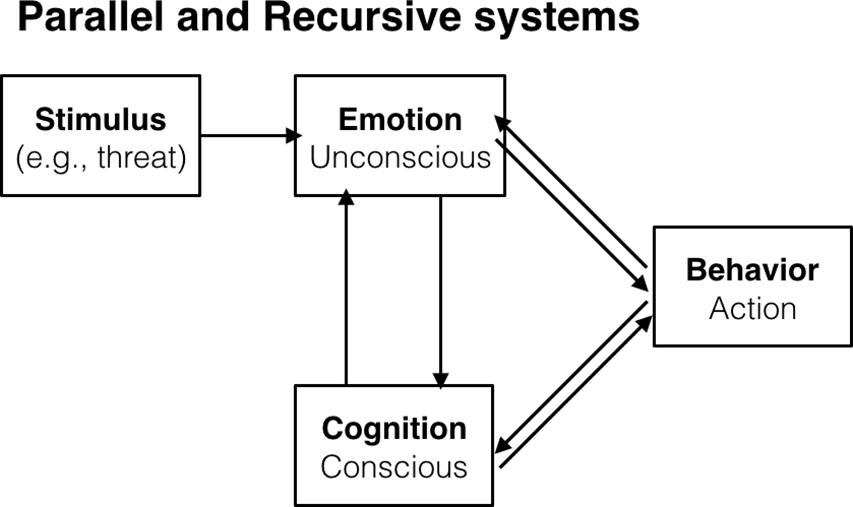
The problem with this unconscious-is-the-real-me model is that it is a gross simplification of how the mind works. While unconscious processes do guide behavior in ways that we do not always appreciate, it is not the case that who we are is housed in a particular place (Kurzban, Reference Kurzban2012). Measures of unconscious processes, such as implicit attitude tests and psychophysiological indicators, offer a measure of a particular set of mental processes, as opposed to the lurking true causes of our behavior. As Figure 2 shows, it is best to think of the mind as a set of parallel and recursive systems. To give an example, Schaefer et al. (Reference Schaefer, Larson, Davidson and Coan2014) showed videos of snakes to a group of people who suffered from snake phobia and a group who did not. They measured people’s physiological responses (e.g., skin conductance) as well as self-reported measures of the emotions that they experienced while viewing the videos. They found a positive correlation between physiological reactions and self-reports among snake phobics and a negative correlation between the two among non-phobics. These findings are not all that odd. Since the 1960s, research in psychophysiology has shown at best a loose concordance among physiology, self-reports, and behavior (Lang, Reference Lang1968).
A more complex model of political behavior.
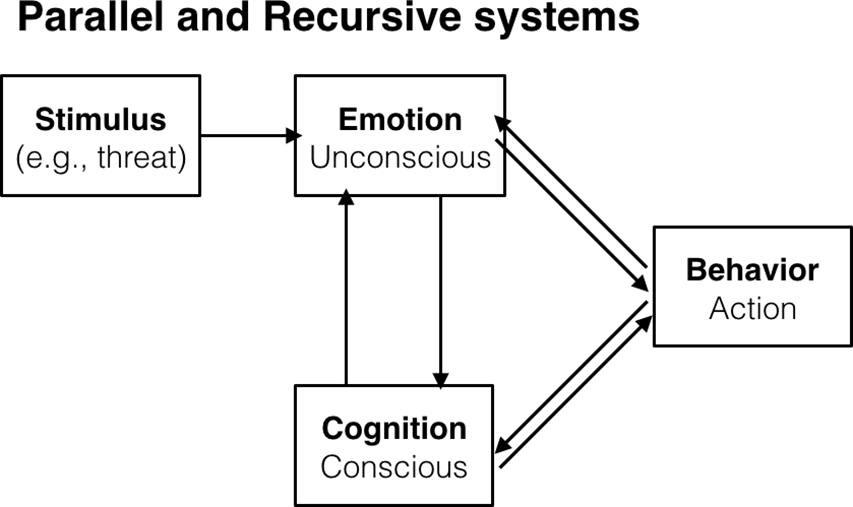
This requires us to more fully unpack useful, but ultimately, inaccurate theoretical models of attitude formation and behavior. Key among these is the notion that we can neatly divide explanations as either “social” or “biological,” because as Frost (Reference Frost2016, 102) explains, “Living organisms do not just happen to exist in an environment that filters into and out of their cells. Instead, they are critically dependent on an environment filtering into and out of their cells.” The human mind is the product of biological processes that depend on input from the environment in which they are immersed. Just as we cannot think of human behavior as solely the product of “learning” and “socialization,” we should not presume that there is a clean causal chain that goes from genes to culture in a nonrecursive, linear way (Miller et al., Reference Miller, Rockstroh, Hamilton and Yee2016).
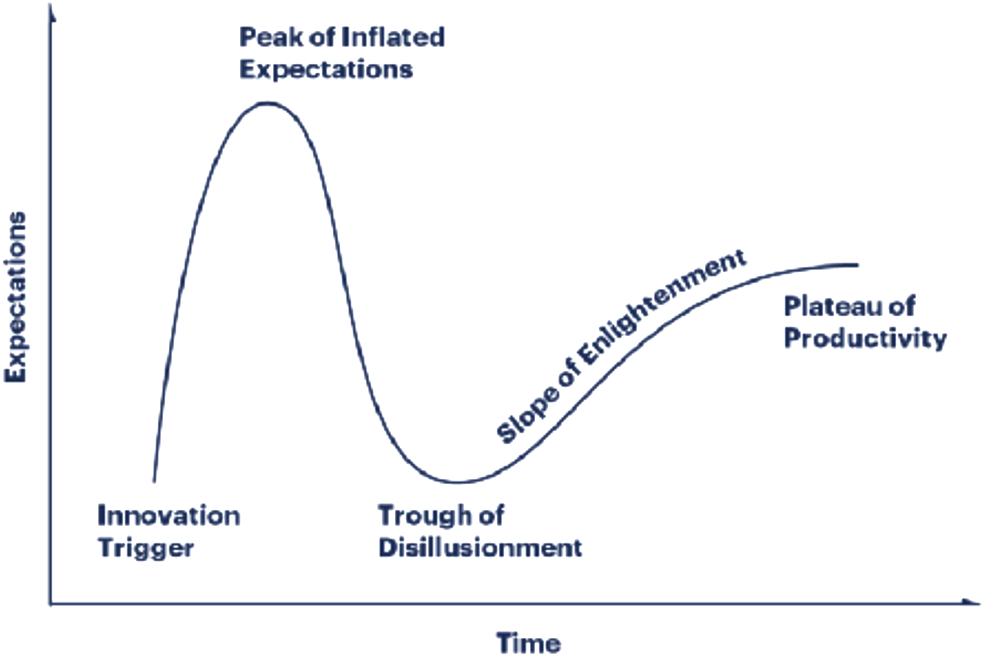
It is crucial for us to unravel the ways in which context matters. Take the fruitful research on implicit attitudes. It follows the outlines of the so-called “hype cycle” used to describe the way in which new technologies develop (see Figure 3). As we became more aware of the important role that the nonconscious mind plays in processing information, storing evaluations, and making decisions, implicit attitudes came to be seen by some political psychologists as the measure of people’s “real attitudes” about sensitive topics, such as racial prejudice. After a “peak of inflated expectations,” inconsistent findings about the relative contribution of implicit and explicit attitudes (Gawronski, Reference Gawronski2019; Kinder and Ryan, Reference Kinder and Ryan2017; Payne et al., Reference Payne, Krosnick, Pasek, Lelkes, Akhtar and Tompson2010) led people to question what all the hype was about. Part of the issue here is that implicit attitudes are not “real attitudes.” Self-reports and automatic responses are just measures that “… capture different aspects of underlying predispositions” (Kinder and Ryan, Reference Kinder and Ryan2017, 257). Moreover, because automatic processes are subject to regulation, we should not expect to find large, unconditional relationships between implicit attitudes and behavior (Gawronski, Reference Gawronski2019).
The hype cycle.

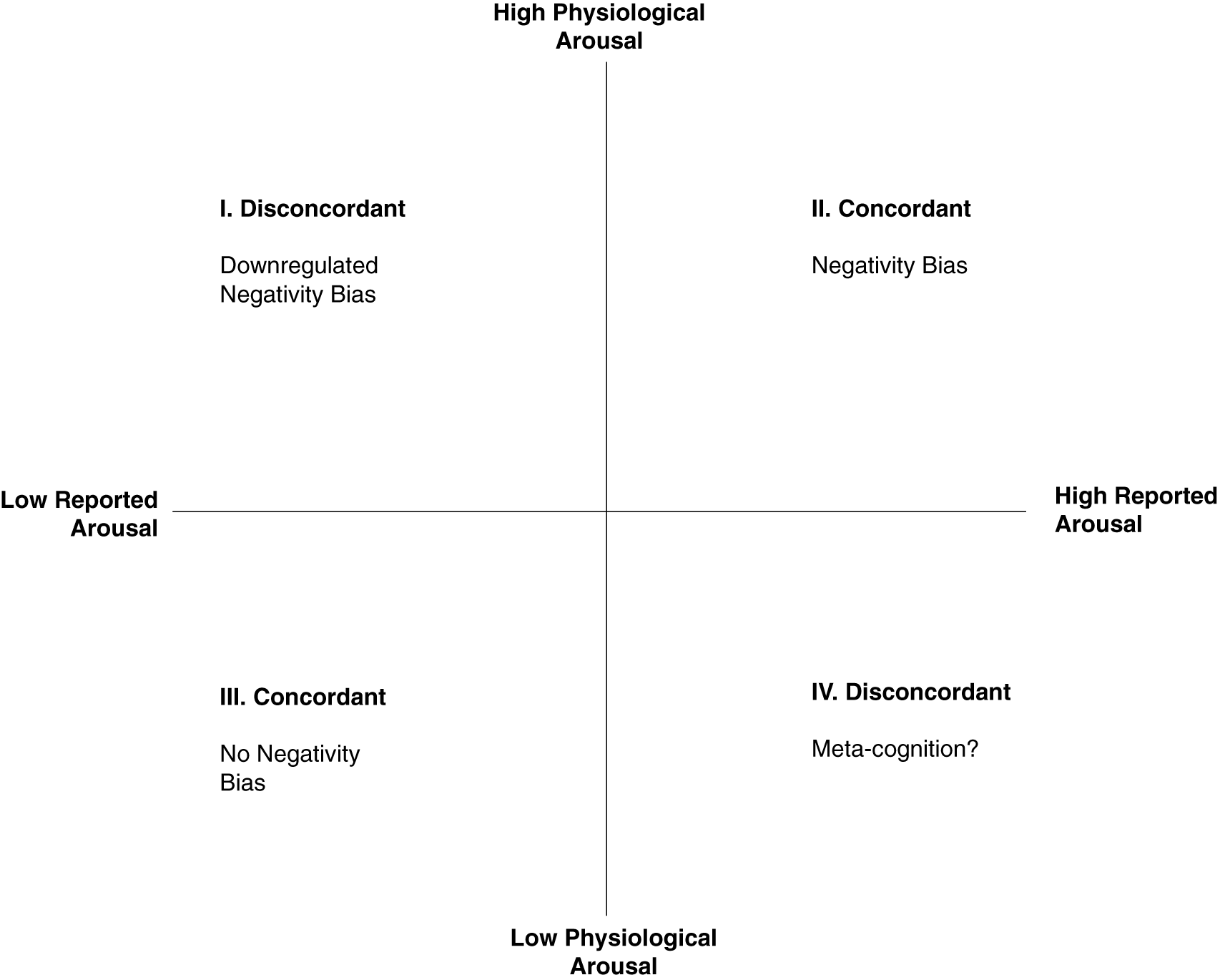
It is also necessary to give more thought to the way in which conscious and nonconscious processes work together to shape attitudes and behavior. In the realm of political ideology, for instance, Bert Bakker and I are studying whether the concordance between automatic and self-reported reactions to negative stimuli provide the boundary conditions for when negativity bias predicts conservatism. While self-reported measures of negativity bias reliably predict social conservatism (Jost et al., Reference Jost, Glaser, Kruglanski and Sulloway2003), the evidence that implicit measures do is more mixed (Bakker et al., Reference Bakker, Schumacher, Gothreau and Arceneaux2019). Figure 4 describes our working hypotheses. We anticipate that when self-reports and physiological responses are aligned, people’s political attitudes are more likely to reflect a desire or need to avoid perceived negative outcomes, which suggests that social conservatives are more likely to fall in Quadrant II. While we could be wrong, we believe that this will open new avenues of research.
Theoretical predictions for negativity bias. The x-axis represents reported emotional arousal in response to negative stimuli. The y-axis represents physiological response to negative stimuli. The predictions in this figure are conditional on the individual expressing negative emotional state in reaction to negative stimuli.

So, what does all of this have to do with democratic representation?
Let’s go back to the initial question: what does all of this teach us about democratic representation? Democratic theory is premised on there being a “real me” — with stable preferences (Dahl, Reference Dahl1956). Self-reports show that this ideal democratic citizen is illusory. Research on public opinion is replete with a “catalog of horrors” (Zaller, Reference Zaller1992, 29) like the ones I opened with. The emerging model of the mind, from the perspective of neuroscience and psychophysiology, suggests that what people want and the reasons for what they want are contextually dependent and, often, partially hidden from awareness. Because actions can be caused by nonconscious processes, people sometimes attribute actions to consciously experienced thoughts that are actually the product of nonconscious processes, creating an illusory “experience of conscious will” (Wegner, Reference Wegner2003). As a result, when we focus on the correlation between self-reports and political behavior, people can seem downright irrational.
On the flip side, if we focus on the nonconscious aspects of human thought and behavior in isolation of the broader workings of the mind sketched out in Figure 2, we risk contributing to the notion that political behavior is on autopilot and people are incapable of using thought to make reasoned choices. It does not logically follow that just because people lack complete knowledge of themselves, they are doomed to being wholly unaware of their inner world. As is this case in nature, it comes down to individual differences. People vary in their ability to be introspective and, as a result, their willingness to reflect on their values and form political preferences that are more or less coherent (Arceneaux and Vander Wielen, Reference Arceneaux and Vander Wielen2017).
Even if people cannot always articulate them and do not always act upon them, they do have stable predispositions. Those predispositions are rooted in the biologically constructed architecture of the mind. Yet that is not to say that predispositions are fully innate modules. As Samantha Frost’s work teaches us, we cannot separate biological explanations from environmental ones in a neat and clean way. We cannot say, “socialization accounts for this attitude and biology for that one.” Biology constrains how we learn from our social surroundings, so if we want a full picture of how people form political predispositions, we cannot restrict our focus to putative social explanations. Moreover, just because variance in political predispositions across people partially arises from individual differences in innate mental modules, such as needs for security and certainty (Jost et al., Reference Jost, Glaser, Kruglanski and Sulloway2003), does not mean that political differences must be implacable and immutable. Political conflict is largely about coalitions of socially constructed groups (Schattschneider, Reference Schattschneider1960), and the human mind is quite supple when it comes to responding to shifts in group coalitions (Kurzban, Tooby and Cosmides, Reference Kurzban, Tooby and Cosmides2001). So, while humans do have a penchant for getting into seemingly intractable and sometimes violent disputes, it need not always be this way.
Consequently, the study of democratic representation would be enriched by considering both conscious and nonconscious aspects of the mind. Rather than relying solely on self-reports to understand how people form political attitudes, we stand to learn much more by including physiological and other measures of nonconscious mental processes into the mainstream toolkit. Doing so will give us insights into how, why, and when particular predispositions are activated by the social context and thrust into the political sphere.
What should we do?
Biopolitics is a wide open area for study. We have learned a great deal over the past several decades as behavioral genetics, psychophysiology, and neuroscience have made inroads into the study of political psychology. Yet there is so much left to learn, and it is important to keep in mind that the cognate fields on which we draw are no more settled than our own. Neuroscientists and psychologists, for instance, still do not have a firmly settled model of emotions — in terms of definition, measurement, mental mechanisms, consequences, etc. (e.g., Fanselow and Pennington, Reference Fanselow and Pennington2018; LeDoux and Pine, Reference LeDoux and Pine2016; Miller et al., Reference Miller, Rockstroh, Hamilton and Yee2016; Melnikoff and Bargh, Reference Melnikoff and Bargh2018). We should not be content waiting for other scholars to resolve these open questions. Instead, we should be part of the vanguard. We, too, can help figure out how fundamental neural processes work as well as how they relate to politics.
As we learn more about how neurophysiology influences political decisions and behavior, we should not expect to uncover large, unmediated effects. We are more likely to find small, contextually contingent effects. As we do, we will confront the standard critique, “so what?” Of course, this critique is unfair. At best, political scientists can point to some large correlations, such as partisan identity and vote choice, but that does not constitute a large effect, because the correlation does not tell us why partisan identities shape voting decisions. As we dig into that question, we are likely to uncover many small causes that aggregate up to one large correlation. For this reason, we should do more to understand how small effects aggregate to generate political phenomenon.
Finally, we need to build credibility. When it comes to studying biological mechanisms and processes, there are a lot of researcher degrees of freedom. For instance, there are a multitude of ways one can measure physiological responses, correct for baselines, identify outliers, and so forth. The best way to overcome suspicion that evidence from biopolitics research is the result of improper research practices is to embrace open science, preregister our studies, and replicate previous findings as a part of the research process. As Chambers (Reference Chambers2019) explains, without direct replications of previous studies being built into hypothesis testing, we risk building our knowledge on sand as opposed to rock. Just because one research team finds evidence that biological process X influences political phenomenon Y does not mean that this is in fact the case. We should not proceed as if findings from previous research are true as we develop hypotheses that build on them, because if it turns out that they are not, it calls into question the premises on which our hypotheses are built. Consequently, the only way we can refine theory and advance knowledge is by verifying that findings from previous research hold up in different settings.
In short, there is a lot to do, but I believe that the payoff will be worth it.
Acknowledgments
I would like to thank my collaborators, Bert Bakker, Claire Gothreau, Ryan Manzler, Valentina Parma, and Ryan J. Vander Wielen without whom my thoughts on this subject would be far more ill-informed than they already are. I also offer a big thank you to the Association for Politics and the Life Sciences (APLS) for inviting me to give the keynote speech at the 2019 APLS Conference that provided the basis for these comments.