Implications
According to EU legislation, growing pigs must have permanent access to enrichment materials such as straw, but this is challenging in pens with partly slatted floors and vacuum slurry systems as these cannot handle large amounts of straw. Current findings show that there were no differences in penmate-directed behaviour when liquid-fed pigs were given 25, 50 or 100 g of chopped straw/pig per day or when they were provided with straw in smaller, frequent portions per day compared with one large portion.
Introduction
In the wild, pigs are dependent on seasonal variability in food resources and exploratory behaviour is therefore essential for survival (Studnitz et al., Reference Studnitz, Jensen and Pedersen2007). Pigs explore surroundings by the use of their snout and mouth: rooting, sniffing, biting and chewing various items, and in spite of domestication the motivation to explore remains strong (Studnitz et al., Reference Studnitz, Jensen, Jørgensen and Jensen2003). Housing in barren environments can cause redirection of the pigs’ exploratory behaviour towards pen components and can result in negative behaviour directed at penmates, such as tail biting or ear biting (van Putten, Reference van Putten1969; Fraser et al., Reference Fraser, Phillips, Thompson and Tennessen1991; Day et al., Reference Day, Kyriazakis and Lawrence1996). Negative penmate-directed behaviour reflects stress of the performing pigs and reduces the welfare of the receiving pigs (Wiepkema et al., Reference Wiepkema, Broom, Duncan and van Putten1983; Edwards, Reference Edwards2006). Especially, tail biting is considered a major problem in the pig industry (Schrøder-Petersen and Simonsen, Reference Schrøder-Petersen and Simonsen2001), since it reduces health and growth of pigs and therefore has considerable economic consequences for pig producers (Edwards, Reference Edwards2006).
Straw can be effective in reducing penmate-directed behaviour among growing pigs (Fraser et al., Reference Fraser, Phillips, Thompson and Tennessen1991; Day et al., Reference Day, Burfoot, Docking, Whittaker, Spoolder and Edwards2002; Tuyttens, Reference Tuyttens2005) and if provided on the floor, all pigs can have access to the straw at the same time. However, in pens with partly slatted floors, it is unavoidable that some straw will pass through slats and enter the slurry system where accumulation of straw and blocking of pipes may occur (van de Weerd and Day, Reference van de Weerd and Day2009, Statham et al., Reference Statham, Green and Mendl2011).
As straw can only be applied in limited amounts in such systems, it is important to determine the minimum amount of straw sufficient to prevent re-directed exploratory behaviour towards penmates. Day et al. (Reference Day, Burfoot, Docking, Whittaker, Spoolder and Edwards2002), showed that aggression, ear chewing, biting, belly nosing and tail biting were reduced when pigs were provided with 92 g straw/pig per day compared with no straw, though these behaviours were not reduced significantly when pigs were provided with 1092 g straw/pig per day. As the interval of amounts between 0 and 92 g straw/pig per day were not studied further by Day et al. (Reference Day, Burfoot, Docking, Whittaker, Spoolder and Edwards2002), the first aim of this study was partly to examine the level of penmate-directed behaviour when pigs were provided with 25 and 50 g straw/pig per day compared with 100 g. A study by Jensen et al. (Reference Jensen, Studnitz and Pedersen2010) showed that 90 g straw/pig per day was enough to assure 45 to 90 kg pigs of permanent access to straw in pens with partly slatted floors, but they also found that penmate-directed behaviour increased readily to the daily straw provision, implying that the residual straw had become unattractive to the pigs and could not occupy them as well as fresh straw. Pigs are curious animals (Studnitz et al., Reference Studnitz, Jensen and Pedersen2007) and they actively search for novel stimuli (Stolba and Wood-Gush, Reference Stolba and Wood-Gush1980; Day et al., Reference Day, Kyriazakis and Lawrence1995), which is why Fraser et al. (Reference Fraser, Phillips, Thompson and Tennessen1991) and Moinard et al. (Reference Moinard, Mendl, Nicol and Green2003) suggested that novelty of the occupational material was important to pigs and that the novelty of a material could be increased by renewing the material regularly. The second aim of this study was therefore to investigate the behaviour of growing pigs when they were provided with straw in smaller portions several times a day as opposed to one large portion of straw daily. In addition, a liquid feeding system was chosen as 50% of finisher pigs in Denmark are grown under these conditions and there is limited information in the scientific literature about the behaviour of pigs in these systems.
We hypothesised that penmate-directed behaviour would decrease with an increase in the amount of straw provision and that several straw provisions per day would reduce penmate-directed behaviour compared with one straw provision.
Material and methods
The experiment was conducted in accordance with the guidelines of the Danish Ministry of Justice with respect to welfare of experimental animals.
Animals and experimental design
The experiment was conducted in a Danish growing–finishing herd (Løgstrup, Denmark), producing 9000 finishers/year. Pigs were commercial (Landrace×Yorkshire)×Duroc crossbreeds. Pigs were assigned to one of the five treatments testing either amount or frequency of straw provision with 20 replicates of each treatment. One pen of pigs was regarded as the experimental unit. The five treatments were: treatment 1, 25 g of straw/pig per day (1×25); treatment 2, 50 g of straw/pig per day (1×50); treatment 3, 100 g of straw/pig per day (1×100); treatment 4, 50 g of straw/pig twice per day (2×50); and treatment 5, 25 g of straw/pig four times per day (4×25). Treatment 3 (1×100) functioned as a control treatment against which the other treatments (amounts (treatments 1 and 2) and frequencies of straw provision (treatments 4 and 5)) were tested. For the groups of pigs provided with one allocation of straw this was given at 0830 h, pigs in treatment 4 were given the straw at 0830 and 1400 h and finally pigs in treatment 5 were given the straw at 0830, 1200, 1400 and 1700 h. Throughout the experimental period (18 month), 13 batches, corresponding to a total of 4330 pigs, passed through the experimental sections and received one of the five treatments.
Housing
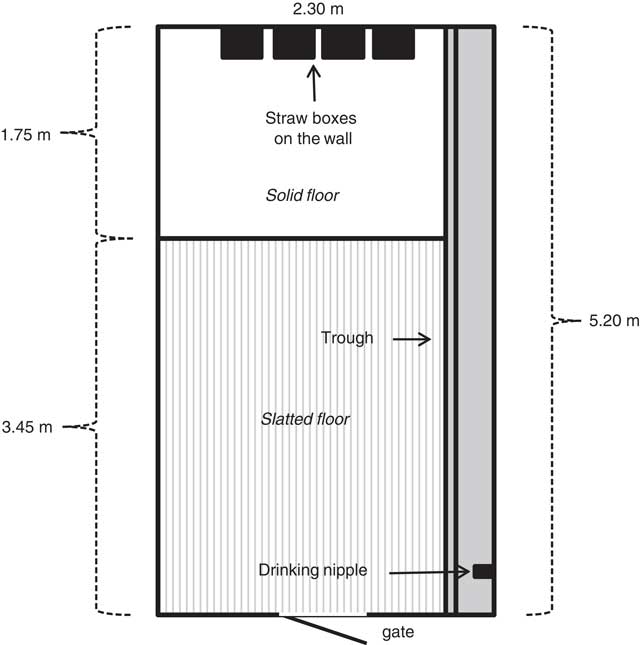
The herd had a liquid feeding system (Skiold A/S, Sæby, Denmark) and consisted of seven identical sections, of which three were used in the experiment. Each section had 20 pens and 18 of the pens were used as experimental pens, while the remaining two pens in each section were used as buffer and sick pens. The experimental pens in the sections were randomly assigned to one of the treatments (unbalanced experimental design). Every 14th day, a batch of ~350 pigs, 12 weeks old, weighing ~30 kg live weight (LW), were delivered to the herd and placed in a clean empty, disinfected section and 19 to 20 pigs were allocated to each of the 18 experimental pens and were distributed randomly according to size and gender (~0.6 m2/pig per pen). After 14 days, the smallest pig of each pen in the section was taken out and placed in a buffer pen. Pigs were housed and raised to ~110 kg LW, before they were slaughtered. Figure 1 shows a drawing of the pen.
Layout of the experimental pen.
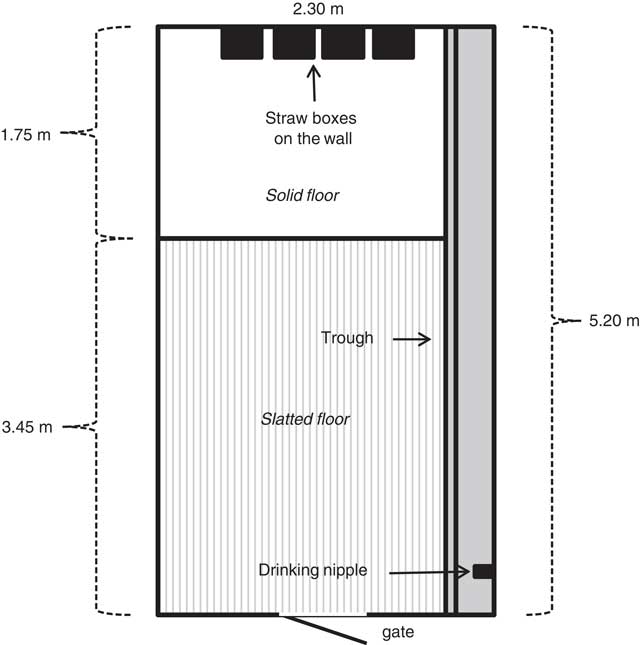
Pens had one-third of solid concrete floor with ‘floor heating’ were water circulated in one long tube between all sections and all pens in the herd. The water was neither heated nor cooled, but merely ensuring the same temperature in all pens by transporting heat from the sections and pens with the largest pigs to the sections and pens with the smallest animals. The remaining two-third of the floor was fully slatted with beams of 8 cm width and openings of 2 cm width. Walls separating pens were 0.95 m high and these were solid along the solid floor. In the slatted areas, walls had 5-cm wide×30-cm high openings with a distance from one another of 15 cm, and this was also the case for the walls towards the aisle. All pens were designed with a long metal trough (same length as pen) allowing all pigs in the pen to eat at the same time. A drinking nipple for water supply was placed above the trough, next to the aisle. Pens were equipped with automatic triggered boxes (W. Domino A/S, Tørring, Denmark), specially designed for the purpose of the experiment. The boxes contained straw and were connected with a timer that triggered them to open at the specific times chosen for straw allocation. When not participating in this study, wooden blocks of tree were used as rooting material on the farm.
The desired room temperature was 19.6°C when pigs were placed in the experimental pens and was slowly decreased until it ended at 14.5°C. The herd had a vacuum slurry system with plugs and low pressure ventilation, where air was taken in and diffused through the ceiling and through air inlets when the room temperature was >4°C above the set temperature. Sprinkling was on between 0800 and 2100 h, with sprinkling for 2 min in intervals of 1.5 h. However, if the ventilation was running at its maximum capacity, the sprinkling was started once every half hour. All sections had windows allowing natural light to enter and, furthermore, artificial fluorescent light was on both day and night during days of video recording.
Management routines
All pigs in the experiment had been tail docked within their first days of life, removing approximately a third of their tails and male pigs had been surgically castrated. Before the experiment, pigs had had no experience of straw and their occupational material had consisted of wooden blocks in chains. When pigs arrived at the herd, a thin layer of straw covered the solid concrete floor of the pens to minimise fighting between the new arrivals. The automatic triggered straw boxes, hanging over the solid floor in each pen, were manually refilled with straw once a day and automatic straw provision, according to treatment, was implemented on day 1 after placement of pigs in the experimental pens. The herd followed general management routines and procedures such as cleaning pens once a day, throughout the experimental period. Pigs were inspected once a day at the first feeding and were treated in case of disease or placed in a sick pen for further care if necessary.
Pigs were fed a liquid diet four times a day at 0800, 1130, 1530 and 2000 h. Feed was mixed in the herd and two feed mixtures with 25% dry matter were used formulated to fulfil the requirements for this genotype of animals. Pigs were fed phase 1 exclusively until they weighed ~50 kg LW. Hereafter, phase 2 gradually substituted the phase 1 and became the exclusive mixture when pigs weighed 80 to 90 kg LW. Phase 1 consisted of a mixture of water and a home-mixed diet of 45.9% wheat, 32.7% barley, 18.2% soybean meal and 3.2% minerals and vitamins, and phase 2 contained 39.6% wheat, 41.0% barley, 16.6% soybean meal and 2.8% minerals and vitamins. Feeding levels were in the beginning at 10.33 MJ/Potential Physiological Energy (PPE) (Boisen, Reference Boisen2001) per pig increasing gradually up to 21.40 MJ/PPE per pig when pigs weighed ~80 kg LW. From this point onwards, pigs were not increased further in PPE per pig per day, but fed restrictively causing the trough to be clean from feed residuals ~15 min after feeding.
Straw used in the experiment was chopped wheat straw, produced by the pig producer himself. Straw had been analysed using sieving, scanning and image analysis (Nørgaard, Reference Nørgaard2006). The mean length of straw was 72.4 mm and the mean width was 3.7 mm.
Behavioural registrations
Three focal pigs in each pen were randomly chosen based on their size and gender at placement in the experimental pens; one pig within the third of the smallest pigs in the pen, one within the third of the medium-sized pigs in the pen and one within the third of the biggest pigs in the pen. The focal pigs were chosen so that half of the pens representing a treatment in a section had two barrows and one female and the other half of the pens had the opposite, two female and one barrow. Focal pigs were ear tagged for individual identification throughout the experiment and were video recorded for one day from 0600 to 2200 h at 40 kg and again at 80 kg LW, respectively. Focal pigs were spray marked on their backs with one, two or three stripes, respectively, to make them recognisable on recordings. The same pigs were used at 40 and 80 kg LW if possible, but in case of death or disease of a focal pig, another pig in the pen, which was similar in size and gender, was chosen as a substitute focal pig.
Recordings and registrations
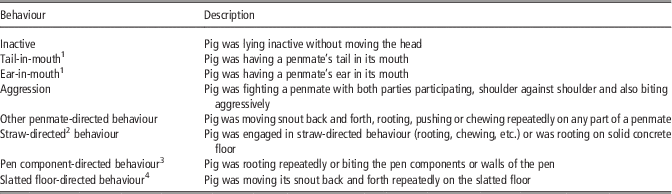
Video recordings were carried out from fall 2010 to spring 2012, with a pause during July and August 2011. Recordings were made using surveillance cameras of the type MONACOR TVCCD-140IR B/W Camera (Loligo Systems, Tjele, Denmark), connected to a computer with PCI video capture cards and MSH-Video Server installed (M. Shafro & Co., Riga, Latvia). Video recordings were done in MSH-Video Server. The MSH-Video Client files were converted into another software programme developed by the Pig Research Centre for making behavioural observations and registrations (RADRA, Pig Research Centre, Denmark), which uses the same principles as MSH-Video Client. Between 0600 and to 2200 h of the recording day, a random quarter of each hour was chosen, and these quarters were continuously monitored and the behaviour of the three focal animals in each pen was registered. The ethogram used for behavioural registrations is described in Table 1.
Ethogram of activity recorded in focal pigs

1 Tail-in-mouth and ear-in-mouth were only registered when ear or tail was visibly in pigs’ mouth, otherwise manipulatory activities near ears and tails were registered as other penmate-directed behaviour.
2 All rooting and licking behaviour directed to the solid part of the floor was registered as straw directed, as it could not be precluded that pigs were manipulating small pieces of straw, not visible to the observer. Also straw-directed behaviour was registered on the slatted floor, if pigs were rooting, nosing or licking in an area were straw was clearly visible to the observer.
3 Behaviour directed at the trough was only registered when pigs were biting the edges of the trough or rooting on the upper part of the trough, since it was impossible to see whether pigs were rooting the trough or simply licking up food left-overs when having their head down in the trough.
4 Manipulation of slatted floor was only registered when pigs were rooting or licking the slatted floor and no straw was visible from where the behaviour was directed.
Registration of residual straw
Registrations of residual amounts of straw in pens before the first straw was provided in the morning were done every 14th day during the experimental period. The scale used for visual assessment was from 1 to 4 with a score of 1 given if there was straw lying in a thin layer, a score of 2 if little straw was left, a score of 3 if only few small straw residues was left and a score of 4 was given if there was soiled straw left. Every pen was registered three to five times throughout the growth period. In addition, signs of wounds or scratches on ears or shoulders (presence or absence of lesions and wounds >3 cm) of the focal pigs, occurrence of and degree of tail biting (presence or absence of a skin wound on the tail) on all pigs in the pens were noted every 14th day.
Calculations and statistical analyses
Activity (expressed as per cent of observed time) for each focal pig was calculated as:
 $${\rm Per\ cent\ active}=\left( {{\rm time\ spent\ active}/{\rm observed\ time}} \right){\times}{\rm 1}00$$
Behaviour (expressed as per cent of active time) for each focal pig was calculated as:
 $${\rm Behaviour}\,{\rm X}\,{\rm in\ per\ cent\ of\ active\ time}=\left( {{\rm time\ of\ behaviour}\,\,{\rm X}/{\rm time\ spent\ active}} \right){\times}{\rm 1}00$$
Owing to the low occurrence of some of the behavioural categories, a combined category ‘penmate-directed behaviour’ was created, which was the sum of ‘other penmate-directed behaviour’, ‘tail-in-mouth’, ‘ear-in-mouth’ and ‘aggression’. The registrations for each of the categories of residual straw was summed and the mean percentage of registrations on each category was calculated.
Data were analysed using the MIXED procedure of SAS ver. 9.3 (SAS Institute Inc., Cary, NC, USA). The following model was used to examine the effect of straw treatment:
 $$\eqalign{Y_{{ijklmn}} =\,\mu {\plus}\alpha _{i} {\plus}\beta _{j} {\plus}(\alpha \beta )_{{ij}} {\plus}\gamma _{k} {\plus}\delta _{l} {\plus}\zeta _{m} {\plus}(\alpha \zeta )_{{mi}} \cr {\plus}(\beta \zeta )_{{mj}} {\plus}\eta _{n} {\plus}\theta _{{imj}} {\plus}{\varepsilon}_{{ijklmn}} $$
where Yijklmn is the dependent variable, μ the overall mean, α i the effect of straw provision (i=25, 50, 100), β j the effect of frequency (j=1, 2, 4), γ k the effect of gender of pig (k=male, female), δ l the effect of size of focal pigs (l=small, medium, large), ζ m the effect of weight (m=40, 80 kg), (αβ) ij the interaction effect between provision and frequency, (αζ) mi and (βζ) mj the interaction between straw treatment and pig weight, η n the random effect of batch, θ imj the random effect of pen and ε ijklmn the error term. If an interaction was not significant (P>0.05), it was removed from the model.
To ensure homogeneity of variance for total penmate-directed, tail-in-mouth, ear-in-mouth, aggression, other penmate-directed, pen component-directed and slatted floor-directed behaviour a square root transformation of the variables was performed. Estimated least squares means are presented for the normally-distributed data (active time, straw-directed behaviour and other active behaviour). For the square root transformed data, the back-transformed data are presented. The estimation method was based on residual maximum likelihood.The statistical significance level was set to P⩽0.05.
Results
Some recordings had to be excluded because of failures in the video recordings, defects in the automatically triggered straw boxes or because the level of hygiene in the pen adversely affected the results of the behavioural registrations. Especially, pen hygiene turned out to be problematic during summer time. Owing to this, 30 of the recordings at 80 kg LW did not proceed in the same pens where the recordings from 40 kg LW were done. Furthermore, five of the large focal pigs from the first recordings were substituted by new large focal pigs in the same pen at second recordings, owing to sickness or death of the originally chosen ones. Therefore, the behavioural registrations were made on 395 focal pigs in total.
In general, the pigs in the herd did not suffer from ear- or tail biting and throughout the experimental period, there were no registrations of wounds or scratches on the tails, ears or shoulders of any of the focal pigs. All pigs in the experiment were examined for signs of tail biting every 14th day, all with a negative outcome. It was the same trained technician who did all the observations. To confirm these observations further, there were no reports of removal of animals from the pens owing to tail biting, ear biting or aggression throughout the experimental period.
Behaviour
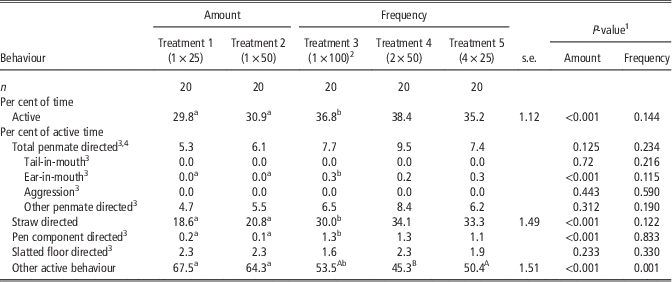
Results of the daily durations of the registered behavioural elements are shown in Table 2, presented as percentage of active time. In general, the pigs were active for about one-third of the day (0600 to 2200 h) corresponding to ~5 h/day. The pigs in treatment 1×100 were more active (343 min/day) than the pigs in treatments 1×25 (281 min/day) and 1×50 (291 min/day) (P<0.001), but activity level was not affected by frequent straw provision. Of the active time, an average of 7% (35 min) was spent on penmate-directed behaviour, 27% (91 min) on straw-directed behaviour, 1% (8 min) on pen component-directed behaviour, 2% (12 min) on slatted floor-directed behaviour and 56% (174 min) on other active behaviour (e.g. locomotion, sitting, lying alert, defecating, eating and drinking). For the subdivisions of penmate-directed behaviours, tail-in-mouth was on average observed for 39 s of the active time, ear-in-mouth for 111 s of active time, and no aggression was recorded, while other penmate-directed behaviour made up the largest part of the category penmate-directed behaviour, lasting for about 6% of the active time corresponding to 32 min.
Daily durations of behavioural elements of growing–finishing pigs provided with different amounts of straw allocated at different frequencies
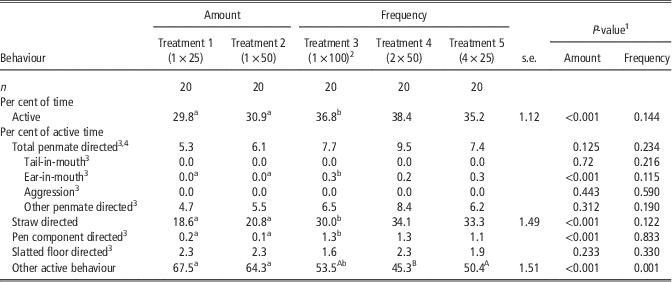
a,b,A,BSmall differing superscripts (a,b) within treatments 1 to 3 indicate significant differences and capital differing superscripts (A,B) indicate significant differences within treatments 3 to 5 (P<0.05).
1 No amount×frequency interactions were observed.
2 Treatment 3 (1×100) was the control treatment for both allocation treatments and frequency treatments.
3 Results presented are back-transformed data.
4 Total penmate-directed behaviour is the sum of tail-in-mouth, ear-in-mouth, aggression and other penmate-directed behaviour.
There was less ear-in-mouth behaviour in treatments 1×25 and 1×50 compared with 1×100 g straw/pig per day (P<0.001), but the amount of straw and frequency of provision did not affect penmate-directed behaviour (P>0.05). Straw-directed behaviour increased with the amount of straw allocated (P<0.001), though several straw allocations per day did not elevate the level of this behaviour. Less behaviour directed at pen components was observed in treatments 1×25 and 1×50 compared with the control treatment of 1×100 (P<0.001). There was no effect of either amount of straw or frequency of straw provision on behaviour directed at the slatted floor. Pigs receiving 25 and 50 g straw/day had more other active behaviour than pigs receiving 100 g (P<0.001).
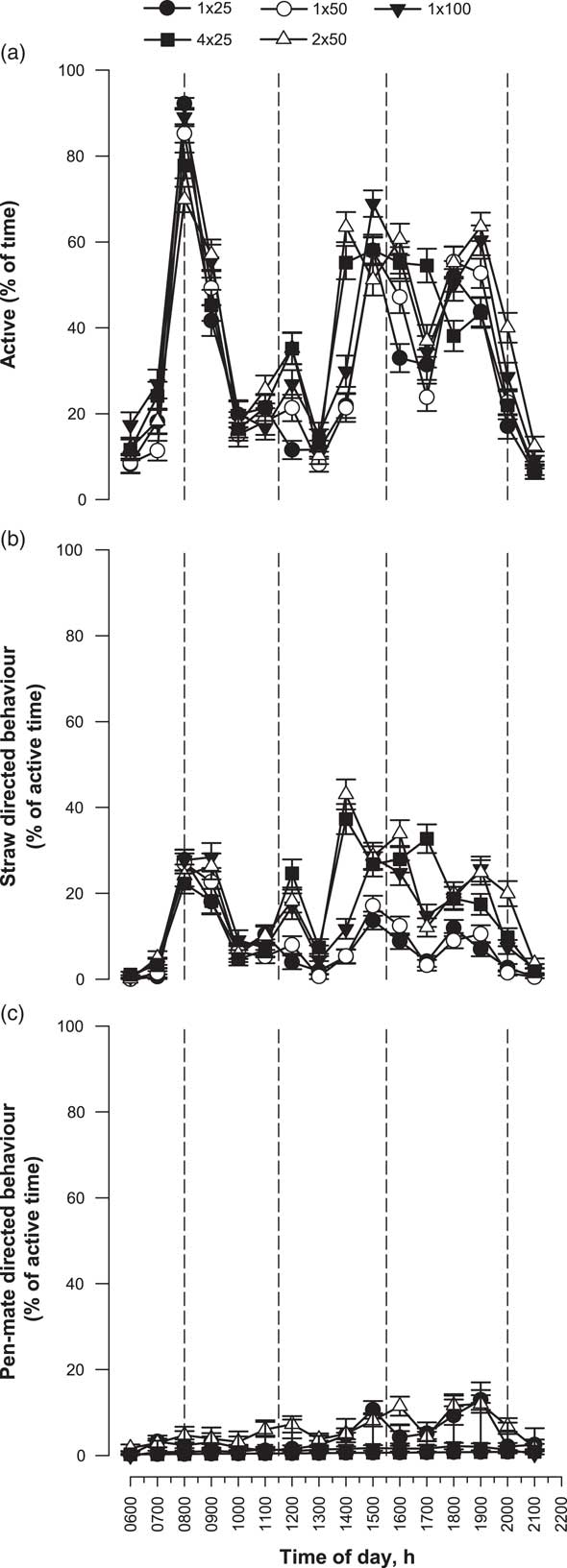
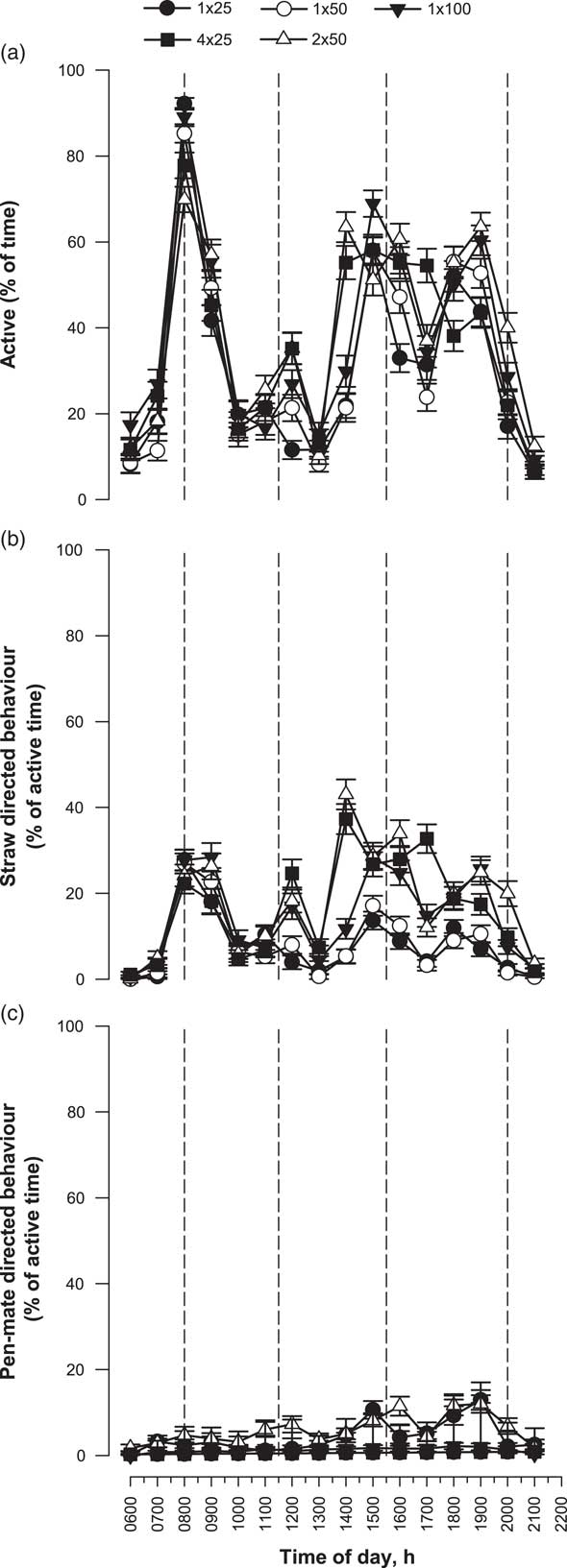
In Figure 2 the diurnal diagrams of active time, straw-directed activity and penmate-directed behaviour are presented. From the diurnal diagram of focal pig activity, it appears that the activity was highly controlled by time of feeding, since activity peaks are seen around feeding. It also appears that activity pattern was very similar between treatments, with a lot of activity occurring during the first feeding at 0800 h and first straw allocation at 0830 h and again during the afternoon and early evening. The diurnal diagram of penmate-directed behaviour showed that the behaviour did increase a little during the day, peaking at around 1900 h. It furthermore appears that there were small peaks in penmate-directed behaviour just before feeding.
(a) Diurnal diagram of focal pig activity (estimated least squares means). (b) Diurnal diagram of straw-directed behaviour of focal pigs (back-transformed least squares means). (c) Diurnal diagram of penmate-directed behaviour of focal pigs (back-transformed least squares means). Vertical dashed lines indicate feeding. 1×25: 25 g of straw/pig per day, 1×50: 50 g of straw/pig per day, 1×100: 100 g of straw/pig per day, 2×50: 50 g of straw/pig two times per day and 4×25: 25 g of straw/pig four times per day.
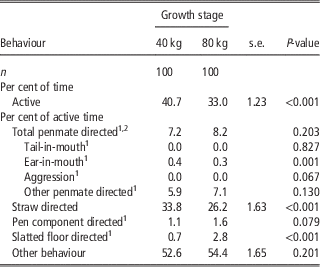
In Table 3, daily durations of behavioural elements, when differentiating between growth stages of the pigs, are presented. Pigs were less active at 80 kg compared with 40 kg LW (P<0.001). There was no difference in penmate-directed behaviour between growth stages, but ear-in-mouth decreased with increasing weight of the pigs (P<0.01). Straw-directed behaviour also decreased from ~34% to 26% of active time, whereas, behaviour directed at the slatted floor more than doubled from 40 to 80 kg LW (P<0.001).
Daily durations of behavioural element of growing–finishing pigs at 40 and 80 kg of live weight
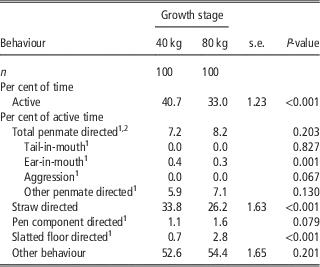
1 Results presented are back-transformed data.
2 Total penmate-directed behaviour is the sum of tail-in-mouth, ear-in-mouth, aggression and other penmate-directed behaviour.
Residual straw in pens
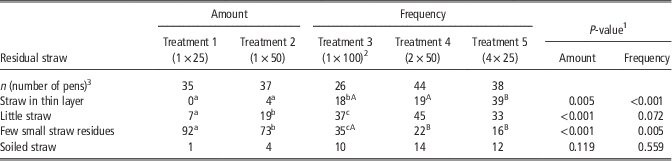
The residual amount of straw in the pens, visually observed in the morning every 14th day just before provision of straw is presented in Table 4. Residual amount of straw was registered in 720 assessments during the experimental period.
Residual straw in pens expressed as per cent of total observations for each treatment
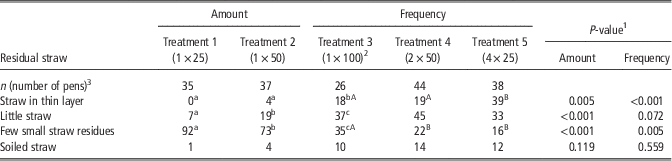
a,b,c,A,BSmall differing superscripts (a,b,c) within treatments 1 to 3 indicate significant differences and capital differing superscripts (A,B) indicate significant differences within treatments 3 to 5 (P<0.05).
1 No amount×frequency interactions were observed.
2 Treatment 3 (1×100) was the control treatment for both allocation treatments and frequency treatments.
3 Pens were each visually assessed 3 to 5 times (720 assessments in total).
There were more registrations of category three (little straw) in pens when the amount of straw provided per day decreased from 100 to 50 and 25 g straw/pig per day (P<0.001). The same applied for registrations of little straw left (P<0.001) and (P<0.01) for 25 and 50 g/pig per day, respectively. Registrations of straw lying in a thin layer also increased as the provided amount of straw increased. There were fewer registrations of only few small straw residues when 100 g of straw/pig per day was provided over two times (P<0.05) or four times (P<0.01). The number of observations of pens with straw lying in a thin layer also increased from 18% to 39% when straw was provided four times instead of one (P<0.001). Finally, pens with soiled residual straw were not affected by the amount of straw provided (P=0.119) nor by the number of straw provisions per day (P=0.559).
Discussion
Amount of provided straw
From the results of the behavioural registrations, it appears that the pigs were more active and performed more straw-directed activities as to an increased level of straw provision, which is in consistency with earlier observations (Day et al., Reference Day, Burfoot, Docking, Whittaker, Spoolder and Edwards2002). However, the level of ear-in-mouth and pen component-directed behaviour increased from 25 and 50 to 100 g of straw/pig per day. That pigs directed more behaviour towards pen components when provided with a larger amount of straw is surprising, as earlier research has shown that pigs manipulate pen components more, when they are housed in barren environments (Fraser et al., Reference Fraser, Phillips, Thompson and Tennessen1991). However, it could be postulated that provision of an enrichment material stimulates a general higher exploratory level in pigs as an artefact to excitement.
A recent study investigating pig behaviour using the same methodology as the current study reported differences in penmate-directed behaviour in pigs provided with 10 g of straw/day compared with 430 and 500 g of straw/day, but no difference between pigs given 10, 80, 150, 220, 290 and 360 g of straw/day (Pedersen et al., Reference Pedersen, Herskin and Forkman2013). Given the results of Pedersen et al. (Reference Pedersen, Herskin and Forkman2013), it cannot be ruled out that providing 100 g straw/pig per day in the current study was insufficient to make a difference. However, the pigs in the study by Pedersen et al. (Reference Pedersen, Herskin and Forkman2013) had ad libitum access to dry feed and therefore not completely comparable to the pigs in the current study as feeding systems are likely to influence the behaviour of the pigs. Nonetheless, the methodologies of the studies have been coordinated to allow for comparison. Other methods for data collection for behaviour of pigs are available as for instance presented by Mullan et al. (Reference Mullan, Edwards, Butterworth, Whay and Main2011) and these methodologies could be considered in future studies investigating behavioural effects of enrichment materials.
Frequency of straw allocations
Treatment 2×50 resulted in a lower amount of other active behaviour compared with the control (1×100) treatment and 4×25 and this result is unexplainable. The finding that more frequent straw provision did not affect the activity, straw-directed and penmate-directed behaviour of the pigs in the current study was in contrast to our hypothesis. However, it might be explained by a number of things: pigs in the current study received the same total amount of straw per day, meaning that pigs provided with straw once a day (1×100) received an amount in the morning that was two and four times bigger, respectively, than the amount of the other groups (2×50 and 4×25). Day et al. (Reference Day, Burfoot, Docking, Whittaker, Spoolder and Edwards2002) showed a decrease in activity and straw-directed behaviour as to a lower amount of straw provided. The finding that there was no reduction in penmate-directed behaviour with increasing frequency of straw provisions may be attributed to the fact that the level of penmate-directed behaviour was highest in the afternoon and early evening as also shown by Beattie and O’Connell (Reference Beattie and O’Connell2002). In addition, all pigs had by 1700 h achieved an equal amount of straw and were therefore equally satiated with respect to straw in relation to behaviour.
Penmate-directed behaviour
The overall level of penmate-directed behaviour in average took place in 7.2% of active time corresponding to levels reported by Beattie et al. (Reference Beattie, O’Connell and Moss2000) who found that pigs spent 6.1% of the observed time nosing pig and 0.9% of observed time biting (biting/chewing/suckling). Beattie et al. (Reference Beattie, Breuer, O’Connell, Sneddon, Mercer, Rance, Sutcliffe and Edwards2005) have previously shown a correlation between ear biting and tail biting and Brunberg et al. (Reference Brunberg, Wallenbeck and Keeling2011) found a similar correlation, when investigating tail biting in relation to other abnormal behaviours. By dividing pigs into non-performers, low-performers and high-performers of tail biting they found that high-performers were specialised in biting behaviours, including ear biting. Tail-in-mouth has occasionally been observed among pigs living under semi-natural conditions (Newberry and Wood-Gush, Reference Newberry and Wood-Gush1988) and Schrøder-Petersen et al. (Reference Schrøder-Petersen, Heiskanen and Ersbøll2004) found a positive relation between tail-in-mouth and social and environmental exploration. It is therefore possible that the little tail-in-mouth behaviour we registered in this present study may not have been re-directed behaviour at all, but instead a form of semi-natural behaviour. As to the other penmate-directed behaviour registered, which lasted ~6% of active time, some of it may be contributed to social behaviour, since recent research have shown that social nosing of penmates (gently touching or nosing) was a part of natural behaviour among pigs and was not related to damaging oral manipulation (Camerlink and Turner, Reference Camerlink and Turner2013). Indeed, pigs receiving social nosing had a higher growth rate than pigs that did not receive social nosing (Camerlink et al., Reference Camerlink, Bijma, Kemp and Bolhuis2012), but the reason for this remains unknown. Camerlink and Turner (Reference Camerlink and Turner2013) found that social nosing was not related to dominance relationships between pigs and suggested that pigs may nose each other for recognition, as affiliated behaviour, to gain olfactory signals or to satisfy an intrinsic need to nose. Owing to the missing correlation to harmful behaviours, social nosing should remain unaffected by efforts to reduce harmful behaviours between pigs (Camerlink and Turner, Reference Camerlink and Turner2013). A lot of the penmate-directed behaviour in this present study was registered just before feeding as seen from the diurnal diagram (Figure 2), when pigs were observed to stand up and massage the belly of each other. It is possible that this behaviour was initiated when pigs could hear the liquid feed system starting. Owing to the fact that the elements of penmate-directed behaviour were not differentiated further, it is impossible to pinpoint the exact motivational background of the behaviour and decide if some of it was simply excitement before feeding, social nosing or if it was in fact re-directed nosing behaviour. In addition, very low levels of aggressions were observed, possibly owing to the fact that pigs were familiar with each other and had established a hierarchy when recordings were conducted. As the aggression level did not elevate when pigs were provided with a small portion of straw (25 g/pig), it seems that the amount of straw and provision method was sufficient for all pigs to participate in straw-directed behaviour at once; causing no competitive aggression as seen in cases with point-source materials (Docking et al., Reference Docking, van de Weerd, Day and Edwards2008).
Weight of pigs
Forty kg pigs were more active than 80 kg pigs and the decrease in activity could be related to the fact that higher BW reduce agility in the pigs and also that space allowance decreases as pigs grow, if the number of pigs in the pen is not reduced continuously, as suggested by Ruiterkamp (Reference Ruiterkamp1985). A decreased activity to age was in agreement with findings of Jensen et al. (Reference Jensen, Studnitz and Pedersen2010) (~40 and 90 LW) and van de Weerd et al. (Reference van de Weerd, Docking, Day and Edwards2005). In the current study, percentage of active time spent on straw-directed behaviour decreased from 33.8% to 26.2% from 40 to 80 kg LW. This could be due to several things, for example, it may have been due to a habituation to straw by the pigs, as van de Weerd et al. (Reference van de Weerd, Docking, Day and Edwards2003) already found pigs’ habituation to enrichment materials happened within 5 days. However, the decrease in straw-directed behaviour could also more likely be related to the increased stocking density, as pigs may have had difficulties approaching the straw due to limited space. Jensen et al. (Reference Jensen, Studnitz and Pedersen2010) observed that in pens with a space allowance of 0.64 m2/pig, a significantly lower percentage of pigs manipulated rooting material than in pens with a high space allowance of 1.0 m2/pig. More pigs may have been able to manipulate the material at the same time when there were lower stocking densities in pens (Jensen et al., Reference Jensen, Studnitz and Pedersen2010). In addition, the decrease in straw-directed behaviour according to increased weight of the pigs may also be attributed to a presumable reduction of amount of straw available in the pens. Straw was supplied in even amounts (25, 50 or 100 g/pig per day depending on treatment) throughout the experimental period; however, the straw consumption was possibly higher in 80 kg pigs than in 40 kg pigs, causing straw to be available for less time as pigs grew bigger. This could also explain why behaviour directed at the slatted floor increased from 40 to 80 kg LW of the pigs, as pigs may have compensated for less straw to manipulate by directing more behaviour at the slatted floor. It may also be that 80 kg pigs directed more behaviour to the slatted floor because their space had become limited forcing some pigs to stay at the slatted floor where they performed exploratory behaviour. Finally, pigs had begun restrictive feeding when they weighed around 80 kg, which may have increased the level of appetitive exploratory behaviour as found by both Zwicker et al. (Reference Zwicker, Gygax, Wechsler and Weber2013) and Day et al. (Reference Day, Kyriazakis and Lawrence1995). In the latter study, pigs were fed 80% of ad libitum.
Conclusions
In this study, penmate-directed behaviour was not different when liquid-fed pigs of 40 to 80 kg LW were allocated 25, 50 and 100 g of chopped straw/pig per day in pens with partly slatted floors and our hypothesis was therefore rejected. This implies that 100 g chopped straw/pig per day was not more efficient than 25 g/pig per day in preventing unwanted behaviour under the mentioned conditions. In addition, the second half of our hypothesis was also rejected as no differences were found in penmate-directed behaviour when the frequency of straw provision was increased, which implies that the novelty of straw was not increased to an extent that could occupy pigs more.
Acknowledgements
This study was financed by The Danish Rural Development Program 2007 to 2013/The European Agricultural Fund for Rural Development (no. 068-401300/32101-U-12-00194) and the Pig Research Centre, Danish Agriculture and Food Council. We would like to thank pig producer Jørgen Nielsen for using his pigs and for engaging in the practical execution of the experiment. We would also like to thank technician Erik Bach for his effort in collecting the data at the production site and Jane Sørensen for participating in behavioural observations from the video recordings.