


INTRODUCTIONFootnote 1
Between 1995 and 2011, remittances to developing world economies grew from US$55 billion to over US$372 billion, to exceed all overseas development assistance to the developing world, and all private debt and portfolio equity flows (Ratha and Silwal Reference Ratha and Silwal2012; World Bank 2011). For Latin America, remittances are a crucial source of foreign exchange and in 2011, US$62 billion was remitted to Latin American households (Ratha and Silwal Reference Ratha and Silwal2012). For countries such as El Salvador and Honduras, remittances have repeatedly comprised over 15 percent of their annual GDP (World Bank 2014). Given the scale of these cross-border financial transfers, particularly relative to the size of the recipient economies, it is no surprise that the importance of remittances for the political economy of policy-making in the developing world is increasingly garnering attention (see Adida and Girod Reference Adida and Girod2011; Ahmed Reference Ahmed2012; Singer Reference Singer2010, Reference Singer2012; Tyburski Reference Tyburski2012).
In this article, I explore the effect of income, remitted to family members from abroad, on social spending in Latin American democracies. I argue that remittances will ultimately result in reduced levels of social security and welfare expenditure across the region. The logic of this argument is straightforward. Remittances go directly into the hands of recipient families and they serve a function that is very similar to social welfare payments. They enable households to purchase basic necessities (see Chami et al. Reference Chami, Barajas, Cosimano, Fullenkamp, Gapen and Montiel2008; Fajnzylber and López Reference Fajnzylber and López2007) and they serve an important compensation and insurance function in response to negative income shocks (see Amuedo-Dorantes and Pozo Reference Amuedo-Dorantes and Pozo2006; Kapur Reference Kapur2004; Yang and Choi Reference Yang and Choi2007). The repeated receipt of remittances will raise the general income and consumption level of recipients, and increase their economic security thereby reducing their perceived income risk. This will alter the preferences of recipients. Specifically, it will dampen the support of remittance recipients in developing world economies for social security and welfare transfers, and government taxation to fund these payments. In time, via an electoral channel, and aided by fiscally pressed governments, this will translate into a reduction in social security and welfare expenditure at the macro-level. Therefore, all else equal, I expect an increase in remittances to a Latin American country to result in a reduction in the level of social insurance and social assistance in that country.
This article builds upon a small but growing literature concerned with the implications of remittances for government policy. This literature has highlighted the role of remittances in reducing poverty and improving access to public goods (e.g., Adida and Girod Reference Adida and Girod2011; López-Córdova Reference López-Córdova2006); affecting exchange rate regimes (see Singer Reference Singer2010); shaping sovereign credit ratings (see Avendano, Gaillard, and Nieto-Parra Reference Avendano, Gaillard and Nieto-Parra2011); reducing government corruption (see Tyburski Reference Tyburski2012); expanding dual citizenship (Leblang Reference Leblang2011); prolonging the tenure of autocratic leaders (see Ahmed Reference Ahmed2012); and shaping overall levels of government expenditure (Ahmed Reference Ahmed2012; Singer Reference Singer2012). To the best of my knowledge, no study has comparatively explored the effect of remittances on social security and welfare transfers in developing democracies.
This article also has implications for the literature on social spending in emerging markets (see Avelino, Brown and Hunter Reference Avelino, Brown and Hunter2005; Brown and Hunter Reference Brown and Hunter1999; Haggard and Kaufman Reference Haggard and Kaufman2008; Huber, Mustillo, and Stephens Reference Huber, Stephens, Mustillo and Pribble2008; Kaufman and Segura-Ubiergo Reference Kaufman and Segura-Ubiergo2001; Rudra Reference Rudra2008; Wibbels Reference Wibbels2006; Wibbels and Ahlquist Reference Wibbels and Ahlquist2011). This work has begun to explore how international integration might shape individual-level preferences and consequently, macro-level policy outcomes (see also Gingrich and Ansell Reference Gingrich and Ansell2012; Mares Reference Mares2005; Rehm Reference Rehm2011; Rickard Reference Rickard2012; Wibbels and Ahlquist Reference Wibbels and Ahlquist2011), but one of the central challenges of this literature continues to be the search for explanations for persistently low levels of spending in some developing democracies and the rather surprising absence of demand for social security transfers in countries with very high levels of inequality and economic insecurity (see Holland Reference Holland2012; Mares and Carnes Reference Mares and Carnes2009). The relationship between remittances, income levels, consumption, and the income risk of recipients can go some way towards explaining this anomaly.
I proceed as follows. The first part of the article discusses existing explanations for the variation in social spending across Latin America. The second section is concerned with remittances across the region and presents the main argument of the article. In the empirical section, I employ an implicit mediation analysis and test the plausibility of the underlying causal mechanism with both individual-level public opinion data, and cross-national data, before examining the main hypothesized relationship for a sample of 18 Latin American countries between the years 1990 and 2009. The results of these estimations indicate that remittances have a substantive negative long-term effect on social security and welfare expenditure in Latin America. I subject the results of my main empirical analysis to a series of robustness tests, and explore the wider global effect of remittances, before concluding.
THEORY
Social Spending
Gallons of ink have been spilled in the quest to understand the heterogeneity of social spending across the advanced industrial democracies. We can now identify a broad consensus from this literature, which highlights both the importance of income levels (e.g., Meltzer and Richard Reference Meltzer and Richard1981; and more recently, Huber and Stephens Reference Huber and Stephens2001) and economic risk (e.g., Iversen and Soskice Reference Iversen and Soskice2001; Rehm Reference Rehm2009; Reference Rehm2011) in shaping individual preferences for redistribution. Those with lower incomes seek government sponsored welfare transfers to protect themselves against poverty, an effect that diminishes as incomes rise (Rehm, Hacker, and Schlesinger Reference Rehm, Hacker and Schlesinger2012), while those facing high levels of individual-level occupational risk (see Gingrich and Ansell Reference Gingrich and Ansell2012; Rehm Reference Rehm2009; Reference Rehm2011), as a consequence of the specificity of their skill-set (e.g., Iversen and Sockice Reference Iversen and Soskice2001), or increased labor market risk due to economic openness (e.g., Cameron Reference Cameron1978; Garrett Reference Garrett1998), will demand expanded social welfare programs in order to insure against adverse future events. Recently, Rehm, Hacker, and Schlesinger (Reference Rehm, Hacker and Schlesinger2012) have suggested that variation in preferences for redistribution is most ably captured by the interaction of income levels and individual economic risk.
We can observe dramatic variation in social security and welfare spending across developing economies (see Avelino, Brown and Hunter Reference Avelino, Brown and Hunter2005; Brown and Hunter Reference Brown and Hunter1999; Haggard and Kaufman Reference Haggard and Kaufman2008; Huber, Mustillo, and Stephens Reference Huber, Stephens, Mustillo and Pribble2008; Kaufman and Segura-Ubiergo Reference Kaufman and Segura-Ubiergo2001; Rickard Reference Rickard2012; Rudra Reference Rudra2008; Wibbels Reference Wibbels2006; Wibbels and Ahlquist Reference Wibbels and Ahlquist2011). With causal mechanisms similarly based upon income levels and risk, contemporary explanations for these patterns highlight the importance of labor market insecurities as a result of economic liberalization and the concomitant volatility in channeling different types of government spending (see Rickard Reference Rickard2012); the cleavage between workers who face high levels of economic insecurity and those who face lower levels of insecurity, and the power balance that exists between these two groups (Mares Reference Mares2005); the concentration of labor market risk among well-paid workers in sheltered sectors resulting from postwar development strategies (see Wibbels and Ahlquist Reference Wibbels and Ahlquist2011; also Haggard and Kaufman Reference Haggard and Kaufman2008); and the divergence in preferences for social transfers among different occupational categories (Haggard, Kaufman, and Long Reference Haggard, Kaufman and Long2013).
These arguments however, struggle to explain why levels of spending have remained consistently low, or have even declined in some countries in the postreform period and in addition, we lack a coherent explanation for the apparent absence of individual-level demand for social transfers in many developing countries (see Haggard, Kaufman and Long Reference Haggard, Kaufman and Long2013; Mares and Carnes, Reference Mares and Carnes2009, 94). In Latin America for example, while social transfers have gradually increased since the 1990s in countries such as Argentina postcrisis, Brazil, Mexico, and Venezuela, in others, such as Bolivia, El Salvador, and Peru, social transfers have either contracted, or remained largely unchanged, over the same period (CEPALSTAT 2014).Footnote 2 Given that this has occurred amidst a global commodity boom and while left-leaning executives were in power in some of these countries, this is somewhat puzzling.
The central causal mechanism of my argument combines both income and risk-based explanations. It is rooted in the manner in which international integration shapes micro-level risk and preferences (see also Gingrich and Ansell Reference Gingrich and Ansell2012; Mares Reference Mares2005; Rehm Reference Rehm2011; Rickard Reference Rickard2012; Wibbels and Ahlquist Reference Wibbels and Ahlquist2011), together with household income levels (Rehm, Hacker, and Schlesinger Reference Rehm, Hacker and Schlesinger2012) and consequently, macro-level policy outcomes. Although remittances are by no means a one shot explanation for variation in social spending across Latin America, they can go some way towards tackling the unexplained heterogeneity of welfare regimes across the region, together with the absence of popular demand for social insurance in countries with high levels of inequality and economic insecurity (see Holland Reference Holland2012; Mares and Carnes Reference Mares and Carnes2009).
Remittances and Social Spending
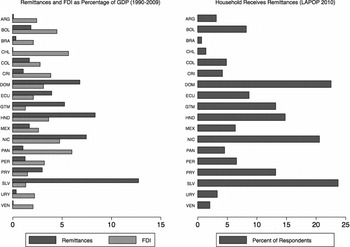
Latin America is a major recipient of remittances. Over 5.2 percent of the region's population are migrants and in 2011, households in the region received 17 percent of all income remitted to the developing world. In the same year, remittances to the region grew by 7.7 percent (Ratha and Silwal Reference Ratha and Silwal2012, 3; World Bank 2011, 25). However, there remains significant variation in the volume of payments remitted to Latin America. The left-hand pane of Figure 1 displays the average volume of remittances and FDI received, as a percentage of GDP, over the period 1990–2009, for 18 Latin American countries. The right-hand pane displays the percentage of respondents, by country, who stated that they or someone in their family received remittances during the 2010 wave of the LAPOP survey.Footnote 3
Remittances across Latin America

For some countries, these financial transfers are an extremely important source of capital. In Argentina, Brazil, Chile, Uruguay, and Venezuela, the volume of remittances is rather small. In El Salvador, Ecuador, Guatemala, Honduras, Nicaragua, and the Dominican Republic on the other hand, the average amount of remittances received between 1990 and 2009 exceeded the average inflow of foreign investment, and in some cases, for example El Salvador, rather substantially. The coverage of remittances is also rather remarkable, particularly for the Dominican Republic, Nicaragua, and El Salvador, where over 20 percent of households receive payments.
Given the scale of these financial transfers, it is no surprise that remittances exert independent political, economic, and social effects. There is now a large literature highlighting the role of remittances in reducing poverty, illiteracy, and income mortality, and improving access to education and public goods (e.g., Adida and Girod Reference Adida and Girod2011; López-Córdova Reference López-Córdova2006; and for overviews see Fajnzylber and López Reference Fajnzylber and López2007; Inchauste and Stein Reference Inchauste and Stein2013). David Singer (Reference Singer2010) has argued that large flows of remittances, by protecting householders against negative income shocks, will increase the likelihood that policymakers in developing world states will adopt a fixed exchange rate. Remitted income may also reduce the dependence of receiving groups on state patronage, thereby disrupting traditional clientelistic networks (Kurtz Reference Kurtz2004; Pfutze Reference Pfutze2013). Michael Tyburski (Reference Tyburski2012) has demonstrated that remittance flows can mitigate government corruption in Mexico by increasing public accountability and therefore the incentives to reform. Also in Mexico, Covadonga Meseguer and Francisco Aparicio (Reference Aparicio and Meseguer2012; Aparicio and Meseguer Reference Aparicio and Meseguer2012) have shown that elected officials will use remittances (and matching grant programs) for strategic political purposes. For David Leblang (Reference Leblang2011), the importance of remittances has induced states to employ dual citizenship as a strategy to maximize capital flows, while Angela O’Mahony (Reference O’Mahony2013) has suggested that remittances may underwrite political change in developing democracies, given the relationship between remittance payments and electoral cycles. Faisal Ahmed (Reference Ahmed2012) has argued that governments within more autocratic polities can strategically channel remittances, together with foreign aid, in order to prolong their tenure in office. In the Dominican Republic, Ahmed (Reference Ahmed2013) has demonstrated that remittances can, on the one hand, erode clientelistic linkages, yet on the other hand, as a consequence of positive economic perceptions amongst recipients, increase support for the incumbent.
There are also a handful of studies that suggest that remittances may exert an effect on government spending. For Chaudhry (Reference Chaudhry1997), remittances have acted as a substitute for social welfare programs in Yemen. For Ahmed (Reference Ahmed2012), remittances allow autocratic governments, due to the small size of their winning coalitions, to divert spending away from the provision of welfare goods and towards patronage. David Singer (Reference Singer2012) on the other hand, contends that remittances will increase the overall size of the public sector, by facilitating increased government taxation and borrowing.
In this article, I focus on social security and welfare spending. By social security and welfare transfers, I refer to all expenditure on contributory social insurance and social assistance. In general, social insurance (against old age, disability, illness, and unemployment) absorbs more than 50 percent of all public spending across the region, and directly concerns who gets what, when, and how (McGuire Reference McGuire, Kingstone and Yashar2011, 1). Social assistance in contrast, comprises revenue-funded cash transfers to indigent individuals, households, and communities, although in general, these programs receive significantly less financial support (McGuire Reference McGuire, Kingstone and Yashar2011, 1–2).
I argue that remittances will reduce support amongst recipients for government taxation and income transfers, which in turn, will translate into reduced social security and welfare spending. This effect operates through a number of complementary causal channels. The first of these channels is based upon individual risk. The functional utility of remittance payments for individual households in the developing world serve a purpose that is remarkably similar to that of social security payments. In the short term, remittances generally provide income to families to purchase basic necessities such as food, utilities, shelter, some durable consumer goods, together with expenditure on health (Adida and Girod Reference Adida and Girod2011; Chami et al. Reference Chami, Barajas, Cosimano, Fullenkamp, Gapen and Montiel2008; Fajnzylber and López Reference Fajnzylber and López2007). Remittances, like social security, prevent households from remaining mired in abject poverty by granting them a higher level of consumption (Barajas et al. Reference Barajas, Chami, Fullenkamp, Gapen and Montiel2009, 3).
Remittances serve an important insurance and compensation function. Income remitted to family members in a migrant's home country increases significantly when that country suffers a macroeconomic shock (Kapur Reference Kapur2004). In fact, remittances serve to increase the stability of the domestic economy and a number of studies have demonstrated that they reduce output volatility (see Chami, Hakura, and Montiel Reference Chami, Hakura and Montiel2009). So, just as social security can compensate those deleteriously affected by liberalization, during economic downturns, migrants will send more money back to family members in order to compensate them for any loss of income (Singer Reference Singer2010, 311).
For example, Yang and Choi (Reference Yang and Choi2007) have demonstrated the insurance function of remittances in the Philippines in response to contractions in income. Over 60 percent of the decline in household income as a consequence of economic shocks was replaced by remittances. In Mexico, evidence suggests that remittances, on average, reduce household income volatility (Amuedo-Dorantes and Pozo Reference Amuedo-Dorantes and Pozo2011), and increases in income risk in Mexico significantly raised both the propensity and the proportion of income remitted to family members (Amuedo-Dorantes and Pozo Reference Amuedo-Dorantes and Pozo2006).Footnote 4 The repeated receipt of remittances therefore will significantly increase the economic security and reduce the perceived income risk of recipients.
But why would remittance recipients not want to continue to benefit from social welfare transfers, in addition to the receipt of remittances, particularly if there were a future risk that remittance payments might decline or stop completely? What is more, remittances are not solely used for family insurance; they are also used for the personal and intergenerational financing of investments (Rapoport and Docquier Reference Rapoport, Docquier, Kolm and Ythier2006), so how might this translate into reduced social security transfers?
I suggest that the answer to these questions lies in the effect remittances have on income levels and the tension that can be found between taxation and consumption in developing economies. In Latin America, social programs and social assistance are funded through taxation, and given the growing informality of the workforce, governments increasingly rely on consumption tax, in addition to income taxes, to raise revenue (Stein and Caro Reference Stein and Caro2013). Therefore, for welfare recipients with higher incomes as a consequence of remittances, a threshold will be reached when the effect of taxation on consumption from remittances outstrips the marginal returns to income from social transfers, resulting in an absence of personal utility from expanded social spending (Meltzer and Richard Reference Meltzer and Richard1981; see also Rehm Reference Rehm2009; Reference Rehm2011). Additionally, those who use remittances for investment will be particularly averse to capital taxation. In the last 15 years, the left in Latin America has been associated with a notable increase in tax revenue (Stein and Caro Reference Stein and Caro2013). Voters therefore will use the left as a heuristic for increased taxation. What is more, voters support redistribution, based not only on their current income, but also their expected future income. Prospects of upward social mobility can render individuals far less supportive of redistribution than they otherwise would be (see Bénabou and Ok Reference Bénabou and Ok2001). It is reasonable to assume that those who begin receiving remittances from abroad on a regular basis will have expectations of higher future income and consequently expectations of upward social mobility.Footnote 5 The end result is that this will temper support amongst remittance recipients for government taxation to fund welfare transfers. Consequently, recipients are likely to support political parties and candidates that favor less redistribution and lower taxes.Footnote 6
Not all of this effect, however, will be driven by a change in individual-level preferences. National governments will also play a part. Ahmed (Reference Ahmed2012) has argued that in autocracies, the government will make the conscious decision to reduce the provision of subsidies and welfare goods and increase patronage, when remittances inflows are large. It is entirely plausible that governments, on both the left and right in fiscally constrained Latin American countries that receive large inflows of remittances, will also decide to pull back on social welfare transfers, given the decline in support among coalitions who traditionally benefitted from them. Indeed, Latin American governments seem to be aware of the substitution effect of remittances. For example, in his annual address to the national legislature in 2012, Ollanta Humala (Reference Humala2012), the left-leaning President of Peru, stated: “In times of economic crisis, remittances were a solution to many Peruvian homes, and they continue to be so in some form.” This will save governments from having to make electorally painful tax increases and allows them to move away from regressive and expensive social welfare programs to cheaper and more targeted social assistance (McGuire Reference McGuire, Kingstone and Yashar2011).
Therefore, all else being equal, the greater the volume of remittances that flow into a country, the larger the coalition with reduced support for social security transfers and government taxation, which in time, will translate into reduced social security and welfare expenditure.Footnote 7
The argument that I present here complements the existing literature on remittances in a number of ways. First, remittances may increase the overall size of the public sector (see Singer Reference Singer2012), but still induce downward changes in specific types of spending. Indeed, Singer's (Reference Singer2012, 11) empirical analysis was “agnostic as to the influence of remittances on the composition of spending,” and his dependent variable was total government consumption expenditure as a percentage of GDP. In this regard, it is important to disaggregate government expenditure, in order to understand the different channels through which remittances might operate. In addition, Ahmed (Reference Ahmed2012) has argued that in autocracies, remittances are a source of unearned foreign income for governments, and the substitution effect of remittances is driven by government calculations to reduce welfare spending and increase patronage. I argue that remittances will result in reduced social welfare transfers in democratic states also, and although this will operate via a bottom-up causal mechanism where remittances alter or change individual preferences towards redistribution and taxation, democratic leaders, in fiscally constrained developing world countries, conscious of the substitution effect of remittances, may expedite this effect.
EMPIRICAL ANALYSIS
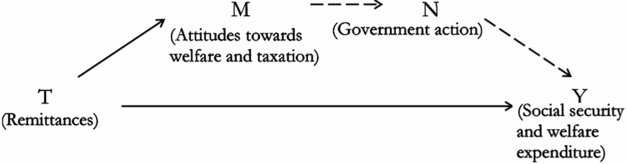
In order to test the argument outlined above, I employ an implicit mediation analysis, as opposed to more formal causal mediation analysis (see Imai et al. Reference Imai, Keele, Tingley and Yamamoto2011; Imai, Keele, and Tingley Reference Imai, Keele and Tingley2010). Causal mediation analysis, based on the potential outcomes framework, is concerned with the identification of a causal mechanism, or the “process whereby one variable [treatment] casually affects another [outcome] through an intermediate variable” (Imai et al. Reference Imai, Keele, Tingley and Yamamoto2011, 767). The implicit mediation analysis I adopt, although it cannot explicitly calculate the average treatment effect (ATE), has an advantage in that it relies on weaker assumptions, but still allows us to trace the effect of remittances on social spending. Figure 2 summarizes the proposed causal mechanism.
The Causal Mechanism

In this diagram, T, the treatment variable (the receipt of remittances), casually affects Y, the outcome variable (social security and welfare spending), through the mediator M. Here, M represents perceptions of social risk and attitudes towards redistribution and taxation, which transmits the causal effect of remittances on to Y. N is a second unobserved mediator, and represents the conscious decision of governments to reduce social security and welfare spending in response to M. The direct line between T and Y represents all other mechanisms (see Imai et al. Reference Imai, Keele, Tingley and Yamamoto2011, 767–769). If my argument is correct, then individuals who receive remittances, Mi (1), should be less willing to support redistribution and taxation than those individuals who do not receive remittances, Mi (0). This is the income effect. I also expect that among individuals who believe that their employment is at risk, remittance recipients will have less support for redistribution and taxation in comparison to nonrecipients. This is the risk effect. In turn, this difference in attitudes should translate into different levels of support for political parties and candidates that advocate redistribution and higher taxes between recipients and nonrecipients. We can assess these claims with individual level survey data, and over time and at the country level, this should result in divergent patterns of electoral support for parties that advocate redistribution and higher taxation. The expected difference between Mi (0) and Mi (1) is the causal effect that transmits T to Y. Taken as a whole therefore, I expect countries that receive greater inflows of remittances to have lower social security and welfare expenditure in comparison to countries that receive less remittance payments.
Preferences towards Redistribution and Taxation
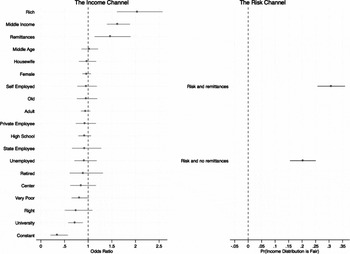
I begin with individual attitudes towards redistribution and taxation. Figure 3 captures the disjuncture in attitudes towards income equality and redistribution amongst those who receive remittances and those who do not. The left-hand pane presents evidence of the income channel and depicts the results of a logistic regression based on data from the 2009 wave of the Latinobarómetro public opinion survey, examining the effect of remittances on individual preferences towards redistribution, controlling for demographic differences and income levels and political preferences.Footnote 8
Remittances and Preferences for Redistribution in Latin America

As a proxy for redistributive preferences, the dependent variable in this model captures whether an individual believes the income distribution in their country to be fair (1) or unfair (0). Remittances, the central explanatory variable, is also a dichotomous variable, and represents respondents who received some form of remittances (1) and those who did not receive any remitted income (0). This graph displays the odd ratios for each variable from this logit model. The lines on either side of the odd ratios represent 95 percent confidence intervals, and where they cross the vertical line, the relationship between this variable and the dependent variable is not statistically significant at this level.
As detailed above, those who receive remittances are more likely to perceive the income distribution in their country to be fair, in comparison to those who do not receive any remittance payments. Holding all other variables at their mean, the probability of remittance recipients stating that the income distribution within their country is fair is 28 percent, in comparison to 21 percent for respondents who do not receive any remitted income whatsoever. This effect also increases with the frequency that respondents receive remittances. For those who receive regular remittances every three months, this probability rises to 36 percent.
The right-hand pane of Figure 3, based on an identical logit model but with an additional measure of perceived occupational risk, presents evidence of the risk channel. This measure of risk is a dichotomous variable. All respondents who stated that they were either very concerned or concerned that they will be left without work or unemployed during the next 12 months were coded as 1, while those who stated they were only a little concerned or not concerned at all about unemployment were coded as 0. This risk variable was interacted with the remittances variable. The right-hand pane of Figure 3 depicts the difference between those who receive remittances and those who do not, for all respondents who perceive that their job is at risk. For those who believe they face a risk of unemployment and who do not receive remittances, the probability of stating that the income distribution within their country is fair is 20 percent, in comparison to 31 percent for respondents who believe they face a risk of unemployment and who do receive remittances. Remittances do seem to mediate the effect of individual-level risk on redistributive preferences.
Of course, this divergence in attitudes may be conditioned by existing welfare institutions. That is, existing institutions, via policy feedback, can create a more uniform system of social risk, thereby reducing the salience of microlevel risk for policy preferences (see Gingrich and Ansell Reference Gingrich and Ansell2012). In this context, this means that the divergence in attitudes towards redistribution we can observe is not driven by remittances, but is rather an artifact of state capacity. Those countries with established welfare systems were less likely to experience migration and consequently have lower inflows of remittances, while the citizenry in general will have higher support for redistribution. Those countries that never had the capacity to establish large social programs experienced higher migration and consequently greater inflows of remittances. This is a particularly pertinent issue in the Latin American context, for in the small Central American states, where remittance inflows are large, social security and welfare spending has traditionally been very low and skewed towards the upper income quintiles (Franzoni Reference Franzoni2008). These countries have also lacked a strong moderate left presence and long uninterrupted periods of democracy, which might have enabled the evolution of cross-class support for welfare regimes (e.g., Huber and Stephens Reference Huber and Stephens2012). Nonetheless, I expect remittances to affect the preferences, via an aversion to taxation, of even those narrow groups who benefit from welfare regimes in these countries.
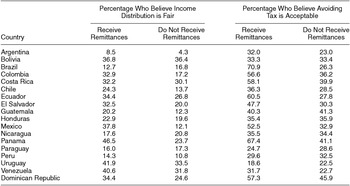
Simple descriptive statistics in Table 1 appear to lend some credence to this assertion.Footnote 9 This table, based on data from the 2009 wave of the Latinobarómetro public opinion survey, displays the percentage of those who believe that the income distribution in their country is fair, divided by remittance recipients and nonrecipients, and also those who believe it is acceptable to avoid paying taxes, again divided by remittance recipients and non-recipients (Latinobarómetro 2009). From this table, the general pattern is clear. For 15 of the 18 countries, a higher percentage of remittance recipients believe the income distribution in their country to be fair in comparison to those who do not receive remittances. Only in Brazil, Nicaragua, and Paraguay is this not the case. There is wide variation in welfare regimes, and experience of left governments, across these 15 countries. With regard to respondents who believe avoiding tax is acceptable, in 12 countries, a higher proportion of remittance recipients, relative to nonrecipients, believe that it is justifiable to avoid paying taxes.
Individual Preferences by Remittance Recipients and Non-Recipients—Latinobarómetro 2009

Even among those who benefit from narrow and regressive welfare regimes, there appears to be a divergence between remittance recipients and nonrecipients. If we break down these preferences by income quintile for some of the small Central American states with the highest inflow of remittances, we can observe notable differences in support for redistribution between recipients and nonrecipients, at different time periods and where the coverage of social insurance is by far the greatest (based on data from LAPOP).Footnote 10 For example, in Guatemala, among remittance recipients who earn over US$500 dollars, the difference in support for government welfare between 2008 and 2012 is 35 percent. In contrast, among nonrecipients, the difference is 17 percent. Footnote 11 In El Salvador, there is a difference in support for government welfare among the top income quintile, where social insurance covers nearly half of this group, between remittance recipients and nonrecipients. We can observe a similar pattern in the top two income quintiles, with the greatest coverage of insurance and pensions, in Nicaragua.
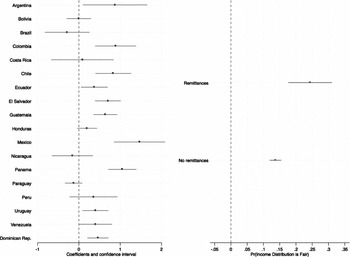
The left-hand pane of Figure 4 examines this issue more formally. Here, I run models for each individual country. The attitudinal divergence we can observe is not a product of existing welfare institutions. Remittances are still driving variation in attitudes towards redistribution, even in countries, such as Chile and Uruguay (at the 0.1 level), with the historically most encompassing welfare institutions, and in countries such as El Salvador and Guatemala, where social transfers have been narrow and regressive (e.g., McGuire Reference McGuire, Kingstone and Yashar2011).Footnote 12 The right-hand pane of Figure 4 isolates the predicted effect of remittances on attitudes towards redistribution, for Chile alone. Even in a state such as Chile, with a large existing welfare system relative to others in the region, those who receive remittances are still less likely to favor redistribution, in comparison to those who do not receive such payments. While the historical record of welfare institutions may partly explain the pattern of migration and consequently remittance inflows, remittances still appear to exert an independent effect on individual preferences.Footnote 13
Remittances and Preferences for Redistribution in Latin America by Country

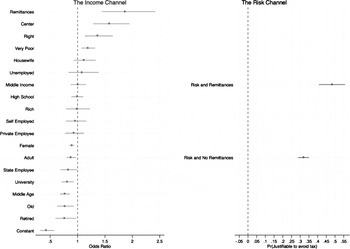
I have suggested that this effect is driven by attitudes towards taxation. The 2009 wave of the Latinobarómetro survey asked respondents how justifiable it is, on a scale of 1 to 10, to avoid paying taxes. Figure 5 replicates the analysis found in Figure 3, except with this question, a rough proxy for support for government taxation as the dependent variable. The difference between recipients and nonrecipients is noticeable. Those who receive remittances have a 45 percent probability of stating that evading taxes is justifiable in comparison to just a 31 percent probability for those who do not receive remitted income. The risk channel is present here also. Among those who believe that their employment is at risk within the next 12 months, there is a 48 percent probability that remittance recipients will agree that tax evasion is justifiable, in comparison to just 32 percent for nonrecipients.
Remittances and Preferences for Taxation in Latin America

Remittances and Vote Choice
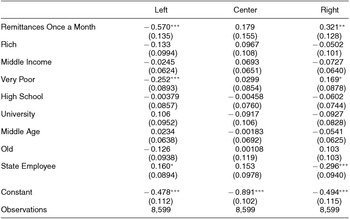
Given this divergence in attitudes, I expect remittance recipients to be less willing to support left-leaning parties, or at least parties that propose greater redistribution and higher taxation. Table 2 presents a series of cross-sectional models, which are based on data from the 2009 wave of the Latinobarómetro survey. The dependent variable is dichotomous and is based on each respondent's answer to the question: “If elections were held this Sunday, which party would you vote for?” The political party named by each individual was coded as left, center, or right.Footnote 14 Here, remittances is also a dichotomous variable, whereby all recipients who stated they receive remittances at least once a month were coded as 1, and 0 otherwise.
Electoral Support of Remittance Recipients for Left-Leaning Parties, Latinobarómetro 2009 (Individual Level)

Note: Logit regression with robust standard errors, clustered by city, in parentheses. Omitted categories: young (17–34 years old), poor, and lowest education; ***p < 0.01, **p < 0.05, *p < 0.1.
Controlling for demographics, education, and income, the regular receipt of remittances has a statistically significant and negative effect on electoral support for left-leaning political parties at the individual level.Footnote 15 If you receive remittances on a regular basis, then the probability that you will vote for the left is roughly 26 percent. If you do not receive remittances on a regular basis, then the likelihood of you voting for the left rises to 38 percent. Indeed, if you receive regular remittance payments, then there is a 43 percent probability that you will choose a right-leaning party, in comparison to just 36 percent for all other respondents.
Elections in Latin America, of course, are about more than social security spending. They are multidimensional affairs, and examining electoral support for the left is but a rough proxy for the argument I present.Footnote 16 In addition, part of this effect is not driven by elections, but by the unobserved conscious decision of right and left governments to pull back on social security programs. This is not confined to electoral events. Nonetheless, if remittances affect preferences towards redistribution and taxation, which is channeled into electoral behavior, then, in countries that receive large amounts of remitted income, we should be able to observe some evidence of reduced support for political parties and candidates who campaign on redistributive platforms.
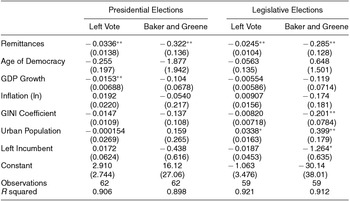
I now examine this proposition with cross-national data. Columns 1 and 2 of Table 3 report the relationship between remittances and support for left-leaning candidates in presidential elections across Latin America between 1992 and 2009. The main dependent variable is the percentage of votes received by presidential candidates on the left. As an added test, I also included the measure of voter-revealed leftism (VRL) developed by Andy Baker and Ken Greene (Reference Baker and Greene2011).Footnote 17 The explanatory variable of interest, remittances, is the average amount of income, as a percentage of GDP, remitted to country i in the three years preceding the election at time t. Columns 3 and 4 replicate these estimations, except in this model the dependent variable is the percentage of votes for parties on the left for legislative elections across Latin America between 1993 and 2009.
The Relationship between Remittance Flows and Electoral Support for the Left in Presidential and Legislative Elections Across Latin America (Macro Level)

Note: OLS regression with robust standard errors in parentheses. Estimated with country and year fixed effects, which are not reported for the sake of presentation; ***p < 0.01, **p < 0.05, *p < 0.1.
The flow of remittances, while controlling for sociodemographic, political, and economic variables, has a negative and statistically significant effect on electoral support for left-leaning presidential candidates and legislative parties across the region. This effect is substantial. For example, when the amount of income remitted to a country moves from the 10th to the 90th percentile, then the percentage of votes for left candidates decreases by 26 percent. This is roughly akin to the difference between the 2002 presidential election in Bolivia that returned Gonzalo Sánchez de Lozada as president, and the election in 2005, which Evo Morales won.
Spending at the Cross-National Level
I now turn to the effect of remittances on social security and welfare spending at the national level. For this, I use an unbalanced panel of 18 Latin American countries between 1990 and 2009.
The dependent variable is social security and welfare expenditure as a percentage of GDP in country i at time t. This figure includes all spending on social security, social assistance, and welfare, officially reported by each state. This measure is not without issues. For example, in the Mexican case, due to the decentralization of welfare transfers, the amount spent on social security and welfare is under-reported. These data are taken from the Comisión Económica para América Latina y el Caribe (CEPAL) and cover the years between 1990 and 2009 (CEPALSTAT 2014). There is substantial variation in the level of social security and welfare spending across the panel.
The central explanatory variable, remitted income, is simply total inward remittances as a percentage of GDP, and is taken from the World Bank Development Indicators (World Bank 2014). This variable is comprised of all current private transfers from migrants, resident in their host country for more than one year, to recipients in their country of origin; all migrant transfers to the country of origin at the time of migration; and compensation of migrants who have lived in the host country for less than a year (World Bank 2014). Some caveats. First, this measure only represents the recorded official inward flow of remittances and does not capture unofficial flows of remitted income. Second, the increase in recorded remittances over time may be a product of migrants moving from unofficial to official channels in order to remit their income, as opposed to increases in the actual level of remittances (see Singer Reference Singer2010, 314).
Simple descriptive statistics appear to lend credence to the general argument. The mean level of social security and welfare spending (CEPAL 1990–2009) for all observations in the sample below the mean level of remittances is 4.95 percent of GDP. For all observations in the sample above the mean level of remittances, the mean level of social spending is 3.4 percent of GDP.
In addition to the central explanatory variable, remitted income, I also include a range of political, economic, and demographic controls that have become standard in studies on social spending in developing democracies (see Avelino, Brown and Hunter Reference Avelino, Brown and Hunter2005; Huber, Mustillo, and Stephens Reference Huber, Stephens, Mustillo and Pribble2008; Kaufman and Segura-Ubiergo Reference Kaufman and Segura-Ubiergo2001; Wibbels Reference Wibbels2006). To capture exogenous economic flows and the pressure on social spending that they may exert, I include the standard measure of trade, which is imports plus exports as a percentage of GDP (World Bank 2014) together with capital openness, which represents the extent of a state's financial integration. This variable is taken from Chinn and Ito's (Reference Chinn and Ito2008) index of capital account openness and is based on information from the International Monetary Fund's Annual Report on Exchange Arrangements and Exchange Restrictions (AREAER). Both trade and capital openness are positively correlated with remittances, but only weakly so. For example, Costa Rica has high levels of trade integration but low levels of remittances, while Chile has high levels of capital openness but very low levels of remittance payments. Alternatively, El Salvador has very high levels of remittance inflows, but relatively low levels of trade integration. Neither trade integration nor capital openness appears to be driving remittances.
Second, I control for the ideological orientation of the government in power. Left government is a dummy variable that takes the value of 1 when the government in power is of the left, and zero when the government is of the center or right. Between 1990 and 2003, this ideological score was based on Coppedge's (Reference Coppedge1997) expert survey of Latin American party positions, together with the updated temporal scores of Grigore Pop-Eleches (Reference Pop-Eleches2009). After 2003, these data were taken from the expert survey data of Wiesehomeier and Benoit (Reference Wiesehomeier and Benoit2009). In the few cases where data were missing, I take the ideological score from Baker and Greene (Reference Baker and Greene2011).
The state of the domestic economy is represented by GDP per capita (logged) and inflation, the logged annual percentage change in consumer prices. As a demographic control, I include the dependency ratio, measured as the percentage of a country's population over 64 years of age and younger than 15. This is a common control in cross-national studies of social spending (see Rickard Reference Rickard2012, 1176). The economic and demographic variables are taken from the World Bank Development Indicators (World Bank 2014).
Finally, given that some countries in the sample have been classed as semidemocratic during the time period in question (Mainwaring and Hagopian Reference Mainwaring, Hagopian, Hagopian and Mainwaring2005), I follow Singer (Reference Singer2010, Reference Singer2012) and control for the level of democracy in country i at time t. This measure is taken from the Polity IV database (Marshall and Jaggers Reference Marshall and Jaggers2007).
Model Specification and Results
As this is an observational study, the receipt of remittances is not randomized. We can statistically adjust for this by including observed variables that may affect social welfare programs, such as levels of dependency, wealth, government ideology, etc., but this assumes no omitted variables (Imai et al. Reference Imai, Keele, Tingley and Yamamoto2011, 768). In reality however, countries with high levels of remittances could be different in terms of social security and welfare expenditure from countries with low levels of remittances for all sorts of unobserved reasons. For example, poor domestic governance might induce both higher migration and therefore higher remittances, and lower levels of social security and welfare expenditure (see also Barajas et al. Reference Barajas, Chami, Fullenkamp, Gapen and Montiel2009, 9). As such, the correlation between remittances and welfare spending could be potentially spurious. In addition, migrants may also alter the amount, and timing, of the money they send back home to family members in response to changes in the level of social spending in their country of origin.
Given these concerns, I employ an instrumental variable approach. There should not be a theoretical reason as to why this instrument would influence social security and welfare expenditure directly, but it also needs to be a good predictor of remittances (see Sovey and Green Reference Sovey and Green2011). As an instrument, I employ the inverse of the distance from the top five countries that receive Latin American migrants and each respective remittance receiving country, weighted by the per capita GDP of these host countries.Footnote 18 Singer (Reference Singer2012) and Acosta et al. (Reference Acosta, Calderón, Fajnzylber and Lopez2008) have employed similar instruments. As there is a cost to moving to another country, particularly countries that are very far away, Latin American migrants should be more likely to settle in destinations that are close to their home country. Great distances therefore, will be associated with lower remittance flows (Singer Reference Singer2012, 22; see also Acosta et al. Reference Acosta, Calderón, Fajnzylber and Lopez2008). The five largest host countries for Latin American migrants are Argentina, Japan, Spain, United States, and Venezuela. In fact, in 2010, these five countries accounted for nearly 90 percent of all remittances to the region (World Bank 2014).
While the distance from migrant receiving countries will affect the volume of remittances received in a given country, there is no theoretical reason as to why it should affect the level of social security and welfare transfers in the recipient country.Footnote 19 Income growth in host countries, through trade links, could possibly affect growth and subsequently income transfers in the remittance receiving country, thereby violating SUTVA (see Sovey and Green Reference Sovey and Green2011), but as Barajas et al. (Reference Barajas, Chami, Fullenkamp, Gapen and Montiel2009, 14–5) argue, the diversification effect will reduce the correlation between the instrument and the growth rate and in addition, they suggest controlling for income growth in the equation, as this will control for any trade effects that may remain in the instrument even after the diversification effect.Footnote 20
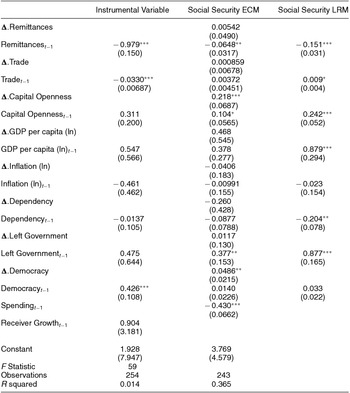
Column 1 of Table 4 displays the results of the second stage of the two-stage least-square model.Footnote 21 As recommended by Barajas et al. (Reference Barajas, Chami, Fullenkamp, Gapen and Montiel2009), I also controlled for the trade-weight growth of host countries. The instrument is suitably strong and a statistically significant predictor of remittances.Footnote 22 The F statistic for the instrument is 59, well above the suggested threshold of 10 (see Staiger and Stock Reference Staiger and Stock1997; Stock and Yogo Reference Stock, Yogo, Andrews and Stock2005). In addition, the results of Hausman tests indicated that remittances are endogenous, and the two-stage model is appropriate.Footnote 23 The results of this model indicate that remittances have a significant negative effect on the social security and welfare expenditure of Latin American governments. The instrumented remittance variable is negatively signed and statistically significant at the 0.01 level. The substantive effect is notable. A one standard deviation increase in remittances will result in a reduction of social security and welfare expenditure of approximately 4.2 percent.Footnote 24 For example, in Mexico, where social welfare transfers account, on average, for approximately 1.7 percent of GDP, in real terms this would equate to a reduction in total social spending of roughly US$702 million.Footnote 25
Remittances and Social Spending in Latin America

Note: Robust standard errors in parentheses; ECM estimated with country and year fixed-effects (not shown); standard errors for the long-run multipliers are generated with the Bewley (Reference Bewley1979) transformation; ***p < 0.01, **p < 0.05, *p < 0.1.
Additionally, in column 2, I report the results of an error-correction model (ECM). This model allows for the interpretation of both the long-run and transitory effects of the independent variables on the dependent variable (De Boef and Keele Reference De Boef and Keele2008, 184–5). I also calculate the long-run multiplier (LRM), which captures the total effect of a variable, that is, all transitory and long-run effects combined (reported in column 3). The standard errors for the LRM are calculated with the Bewley (Reference Bewley1979) transformation (see also De Boef and Keele Reference De Boef and Keele2008).
In the ECM, the lagged remittance variable is also statistically significant. The long-run multiplier in column 3, statistically significant at the 0.01 level, captures the total effect of remittances, comprised of all immediate and lagged effects, on social security and welfare expenditure in Latin America. A one-percentage-point increase in remittances will result in a reduction in social security and welfare spending of 0.15 percent. Remitted income does not appear to have any immediate impact on social welfare spending. Rather, the effect of remittances on welfare transfers is spread across future time periods.Footnote 26 This is what we might expect, as an increase in income remitted to family members is unlikely to result in an immediate reduction in demand for safety-net income transfers amongst recipients.
Taken as a whole therefore, these results demonstrate that remittances have a notable negative effect on social security and welfare expenditure.
Robustness and Heterogeneous Effects
These findings are also robust to a number of alternative specifications. I re-estimated all of the models with two alternative measures of the dependent variable. These are taken from the Social Policy in Latin America and the Caribbean Dataset (Huber, Stephens, Mustillo, and Pribble Reference Huber, Stephens, Mustillo and Pribble2008), which covers the period between 1975 and 2000, and based on data from the International Monetary Fund (IMF), represents social security and welfare expenditure as a percentage of GDP (see Huber, Mustillo, and Stephens Reference Huber, Stephens, Mustillo and Pribble2008; Kaufman and Segura-Ubiergo Reference Kaufman and Segura-Ubiergo2001), and the per capita amount (2005 ppp [purchasing power parity]) spent on social assistance, social insurance, and social security programs from the Statistics of Public Expenditure for Economic Development (SPEED) database (International Food Policy Research Institute (IFPRI) 2013) between 1980 and 2010. For both alternative dependent variables, remittances had a statistically significant and negative effect on social security and welfare expenditure (please see the Online Appendix).
I also reran the models with an alternative instrument, which has been used previously in the literature (see Acosta et al. Reference Acosta, Calderón, Fajnzylber and Lopez2008; Singer Reference Singer2012). This instrument comprises the per capita GDP of the ten top Latin American migrant-receiving countries, weighted by the inverse of the distance of each country to the recipient countries in the sample (Singer Reference Singer2012, 21). This alternative instrument was also negatively signed and statistically significant at the 0.01 level. I also controlled for a host of additional political variables, such as the level of governance. The results remain unchanged.
Finally, I reran the individual level models with two questions from the 2008, 2010, and 2012 waves of the LAPOP survey. These questions concerned attitudes towards government versus individual provision of welfare, and government versus individual responsibility for inequality. For both these questions, and across the three waves of the LAPOP survey, the general results held.
The Generalizability of Effects
Critics may suggest that the findings presented so far are relevant to Latin America alone, given the region's comparatively institutionalized social welfare programs and the high volume of remittances it receives. The rest of the world however, outside of the advanced industrial democracies, is also increasingly reliant on remittances. Remittances now amount to a US$370 billion transfer to emerging economies every year (Ratha and Silwal Reference Ratha and Silwal2012; World Bank 2011) and given the scale of these transfers, it is reasonable to expect that they might also exert some effect on preferences in these countries also.
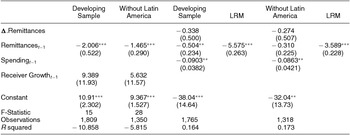
Table 5 provides some evidence that this is the case. It replicates both the IV and ECM analyses for a much larger sample of 104 developing world countries between the years 1980 and 2010, except with remittances as the sole explanatory variable (I also control for the trade-weighted growth of host countries in the IV model). The dependent variable here is the per capita amount (2005 ppp) spent on social protection, broadly encapsulating social assistance, social insurance, and social security programs (see IMF 2001), and is taken from the Statistics of Public Expenditure for Economic Development (SPEED) database (IFPRI 2013). Columns 2 and 5 remove the Latin American countries to ensure that they are not driving the results. To account for cross-country heterogeneity, which may also affect social welfare and security transfers (political institutions, historical context, domestic politics, the national economy, etc.), I estimate the ECM models with country and year fixed effects (the findings remain the same without fixed effects).
Remittances and Social Security (Global Sample 1980–2010)

Note: Robust standard errors in parentheses; ECM estimated with country and year fixed-effects (not shown); standard errors for the long-run multipliers are generated with the Bewley (Reference Bewley1979) transformation; ***p < 0.01, **p < 0.05, *p < 0.1.
The results for the instrumented remittance variable, together with the LRM in the ECM, are consistent with the main findings in Table 4. We must interpret these results with caution however, given these models include no controls, and I am unable to trace the underlying causal mechanism as I did for the Latin American sample. Nonetheless, these results are illustrative of the effect that remittances have on social security and welfare spending in the rest of the world more generally.Footnote 27
DISCUSSION AND CONCLUSION
This article argued that remittances result in lower social security and welfare spending across Latin American democracies. Remittances are a stable cross-border financial flow, which serve an important compensation and insurance function for households in developing economies. The repeated receipt of remittances will bolster the income and economic security of recipients and therefore reduce their income risk. Over time, this will dampen support among this group for government welfare transfers funded by taxation. This will translate into reduced support for political parties who advocate redistribution and higher taxes. The upshot is a reduction in government spending on welfare and social security. The results of a battery of statistical tests provided strong support for this argument.
These findings have a number of important implications. First, the results presented in this article are important for the literature on social spending in the developing world (Haggard and Kaufman Reference Haggard and Kaufman2008; Rudra Reference Rudra2008; Wibbels and Ahlquist Reference Wibbels and Ahlquist2011), by providing an explanation, which is built upon both the income level and risk channels. Although remittances are clearly only one part of what is a heterogeneous and multifaceted process, by linking remittances with income levels and risk together with the individual-level preferences of the electorate, it can go some way towards explaining the patterns of spending we observe, and the heterogeneity in demand for social welfare transfers across Latin America (Mares and Carnes Reference Mares and Carnes2009).
Second, and in line with a number of recent studies (see Ahmed Reference Ahmed2012; Singer Reference Singer2010, Reference Singer2012; Tyburski Reference Tyburski2012), the results confirm the importance of accounting for remittances when considering the political economy of policy-making in the developing world. Clearly, remittances, given the scale of these transfers, like investment and portfolio capital, foreign aid, and international trade, will generate incentives in the political system, which may alter the outcome of public policy. The policy areas that remittances affect, and the exact mechanism through which this occurs, remains a task for future research.
Third, for the developing world more generally, and for Latin America in particular, the effect of remittances on public policy will have long-term implications for these countries. If remittances are acting as a substitute for social transfers, then this will significantly increase the dependence of the developing world on the advanced industrial economies, and given that a household will most likely only receive a remitted income if a family member migrates, then this will render income redistribution in developing world economies, a somewhat stochastic process (see also Rudra Reference Rudra2004). In the long term, it may ultimately even result in higher levels of migration. What is more, if the family member making the investment decision for the remitted income is less skilled at allocating this capital than the government designed social program, then this will have long-term ramifications for the efficiency of domestic investment (see Barajas et al. Reference Barajas, Chami, Fullenkamp, Gapen and Montiel2009).
However, if remittances are leading to a reduction in social security and welfare expenditure, but an increase in overall levels of government expenditure (see Singer Reference Singer2012), where is the money saved from welfare transfers going? An answer to this question might lie in recent work by Rickard (Reference Rickard2012), who argues that the efficiency concerns of economic globalization induce governments to cut expenditure on social welfare in order for governments to fund industry subsidies. Remittances appear to be complimentary to this process. In some respects, for developing world countries, they facilitate the efficiency pressures generated by increased international economic integration. They allow governments in developing countries to withdraw from the provision of social welfare, thereby facilitating increased transfers to domestic industry.
Finally, given that remittances are associated with reduced electoral support for parties who advocate redistribution and higher taxation, this may have serious implications for the axis of political competition across Latin America. In countries with large inflows of remittances, these payments may diminish the importance of the general left-right cleavage and deflate the traditional distributive campaigns of the left. In fact, it may help to explain why in some Latin American countries, we are witnessing the increasing saliency of issues, such as crime and public security, which are orthogonal to the traditional left-right divide (see Wiesehomeier and Doyle, Reference Wiesehomeier, Doyle, Luna and Kaltwasser2014). Or indeed, it may help to explain why some contemporary left-leaning leaders in the region engage in rhetoric less related to redistributive issues, and more to economic nationalism and state presence in the productive sector. As the income and income security of recipients increase, the political space for left-leaning parties will be reduced.
SUPPLEMENTARY MATERIAL
To view supplementary material for this article, please visit http://dx.doi.org/10.1017/S0003055415000416.




Comments
No Comments have been published for this article.