Background
Conducted electrical weapons (CEWs) are considered non-lethal weapons that are increasingly used by law enforcement officers (LEOs), in the United States and world-wide, to control unruly suspected criminals or to neutralize violent situations.Reference Belen, Tipi, Bayyiğit and Helvacı 1 The CEWs have two modes of charge deployment: the “drive stun” mode that works by direct contact, and the “probe mode” that fires two probes from the weapon.Reference Belen, Tipi, Bayyiğit and Helvacı 1 The “Thomas A. Swift Electric Rifle” or TASER (TASER International; Scottsdale, Arizona USA) belongs to the latter category and is the most widely available “with more than 140,000 TASERs in use by police officers in the field in the US, and an additional 100,000 TASERs owned by civilians world-wide.” 2 , Reference Han, Chopra and Carr 3 A TASER fires two metal barbs and delivers, once embedded in the individual’s skin, high voltage (50,000 V) and low current through 19 electrical pulses per second over a period of five seconds. These pulses cause involuntary muscle contractions, pain, and non-lethal incapacitation. 2 – Reference Ho, Dawes, Chang, Nelson and Miner 5
The TASERs are considered relatively safe when used with proper deployment protocols that include compliance with “use-of-force policies, training requirements, operational protocols, and safety procedures.” 2 In fact, the reported overall risk of serious injury to TASERed subjects is around 0.25% (mainly from blunt trauma related to falls), and the overall risk of death that is potentially associated with TASER use is around 0.09%.Reference Bozeman, Teacher and Winslow 6 , Reference Bozeman, Hauda, Heck, Jr, Martin and Winslow 7 However, TASERs still cause a wide variety of injuries that range from simple abrasions to acute medical emergencies such as stroke and death. There are several published case reports from emergency department (ED) and in-hospital settings regarding different types of injuries associated with TASER use. These include: ocular injuries,Reference Jey, Hull, Kravchuk, Carillo and Martel 8 – Reference Kroll, Dawes and Heegaard 11 skin and bone injuries,Reference Winslow, Bozeman, Fortner and Alson 12 , Reference Dunet, Erbland, Abi-Chahla, Tournier and Fabre 13 testicular injuries,Reference Theisen, Slater and Hale 14 pharyngeal perforation,Reference Al-Jarabah, Coulston and Hewin 15 pneumothorax,Reference Hinchey and Subramaniam 16 neurological injuries ranging from intracranial probe penetrationReference Kaloostian and Tran 17 , Reference Rehman, Yonas and Marinaro 18 to acute agitated delirious state,Reference Feeney, Vu and Ani 19 and stroke.Reference Bell, Moon and Dross 20 Additionally, cardiac injuries and dysthymias have been reported, including implantable cardioverter defibrillator oversensing,Reference Paninski, Marshall and Link 21 atrial fibrillation,Reference Multerer, Berkenbosch, Das and Johnsrude 22 myocardial infarction,Reference Baldwin, Nagarakanti and Hardy 23 and ventricular fibrillation or asystole.Reference Naunheim, Treaster and Aubin 24 , Reference Zipes 25
Little, however, is known about the experience of Emergency Medical Service (EMS) providers with these incidents. To date, there are no prehospital studies examining this topic, and the relatively few out-of-hospital studies are law enforcement agency-based or are focused on cardiac arrests after use of CEWs.Reference Bozeman, Teacher and Winslow 6
The National Emergency Medical Services Information System (NEMSIS; Salt Lake City, Utah USA) is a US national EMS database that collects EMS activations from EMS agencies in 48 states and territories.Reference Mann, Kane, Dai and Jacobson 26 Its public-release dataset allows for the examination of evolving patterns and changes in emergency medical conditions that result from implementation of new policies or regulations such as the use of TASERs by LEOs. This study uses five consecutive releases of the NEMSIS dataset (2011-2015) to describe EMS encounters with documented TASER barb removal, characteristics of resulting injuries, and treatment provided by EMS providers.
Methods
Study Design
This was a retrospective study using combined five consecutive NEMSIS public-release research datasets (2011-2015; NEMSIS Version 2.2.1). An exemption for the use of this de-identified dataset was obtained from the Institutional Review Board at the American University of Beirut (Beirut, Lebanon).
Study Setting
The NEMSIS database is a large convenience sample of EMS activations in the US covering 48 states and territories. It includes approximately 83 variables using standardized definitions and formats for patient care reports.Reference Mann, Kane, Dai and Jacobson 26 Data collected by EMS agencies are aggregated at the state level and submitted to the NEMSIS national database.Reference Mann, Kane, Dai and Jacobson 26 Submission rates and inclusion criteria vary by state.Reference Mann, Kane, Dai and Jacobson 26 – Reference El Sayed, Tamim, Mailhac and Mann 29 Every record in the database represents a single EMS activation that is submitted by a single responding vehicle. Thus, the NEMSIS database represents a collection of EMS activations for emergency care rather than a collection of unique patients.Reference Mann, Kane, Dai and Jacobson 26 – Reference El Sayed, Tamim, Mailhac and Mann 29
Study Population
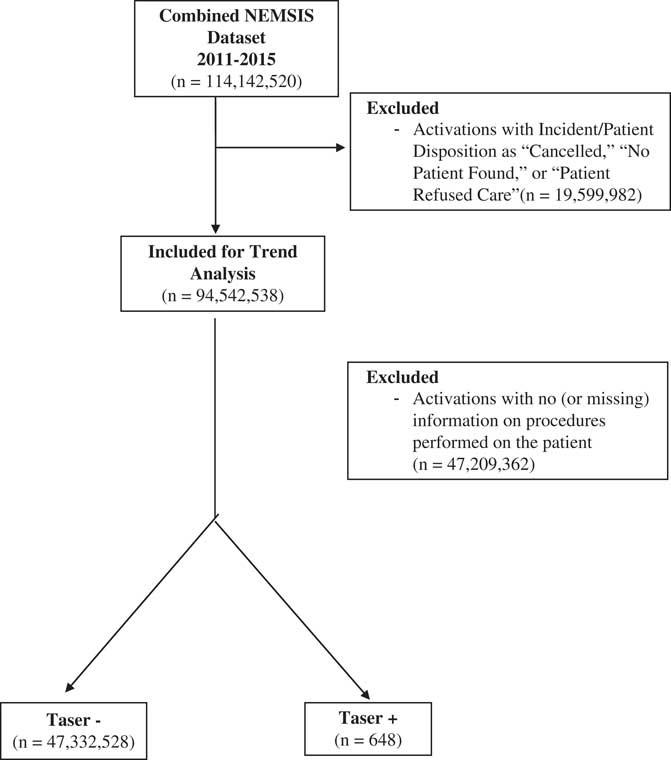
The combined NEMSIS public datasets include information on 114,142,520 EMS activations. The study included only EMS activations with confirmed TASER use and where TASER barb removal was documented. Activations were excluded if “call cancelled” or where no patient was found or if the patient refused treatment. Activations with no information (or missing information) on procedures performed were also excluded from analysis. Figure 1 shows the exclusions done at every step of the analysis, which yielded a total of 648 activations that were included in the final analyses.
Constitution of the Study Population.
Abbreviation: NEMSIS, National Emergency Medical Services Information System.

Available Data
Standardized definitions in the NEMSIS manual were used; TASER use is reported under procedures performed to the patient as “Wound Care - TASER Barb Removal.”Reference Mann, Kane, Dai and Jacobson 26 Additional variables that were analyzed included EMS agency information such as: EMS service area urbanicity (population setting using United States Department of Agriculture [USDA; Washington, DC USA] and Office of Management and Budget [OMB; Washington, DC USA] definitions)Reference El Sayed, Tamim and Mann 27 – Reference El Sayed, Tamim, Mailhac and Mann 29 and reported Center for Medicare and Medicaid Services (CMS; Baltimore, Maryland USA) service level (mainly Basic Life Support [BLS; BLS and BLS emergency] and Advanced Life Support [ALS; ALS Level 1, Level 1 emergency, and Level 2]), in addition to primary role of unit, incident location type, response mode to scene, and transport mode from scene.
Additional event-related information was collected, including patient age and sex, ethnicity, race, complaint reported by dispatch, chief complaint characteristics, provider’s primary impression, barriers to patient care, clinical management information (medications and procedures), and type of destination. Time intervals related to events were also collected, mainly total prehospital time (Public Safety Answering Point to “arrived at destination”).
Data Analysis
Data were extracted from the NEMSIS files and imported into the Statistical Analysis Software (SAS) version 9.1 (SAS Institute; Cary, North Carolina USA), which was used for data management and analyses. Descriptive analyses were carried out with number and percent presented for categorical variables, and mean and standard deviation presented for continuous variables. A comparison of the proportion of EMS activations where TASER use with barb removal was reported was done over the study years using the Cochran-Armitage trend test with P value set at<.05 for statistical significance. Absolute numbers and valid percent are presented in the tables.
Results
During the study period, there were 648 EMS activations for which TASER barb removal was documented, yielding a prevalence rate of 4.55 per 1,000,000 EMS activations. Patients had a mean age of 35.9 years (SD=18.2). The majority were males (80.2%) and mainly white (71.3%). Most EMS activations were in urban or suburban areas (78.3%). Over one-half received ALS-level of service (58.2%). Home or residence was the most common incident location (47.7%; Table 1).
Study Population General Characteristics

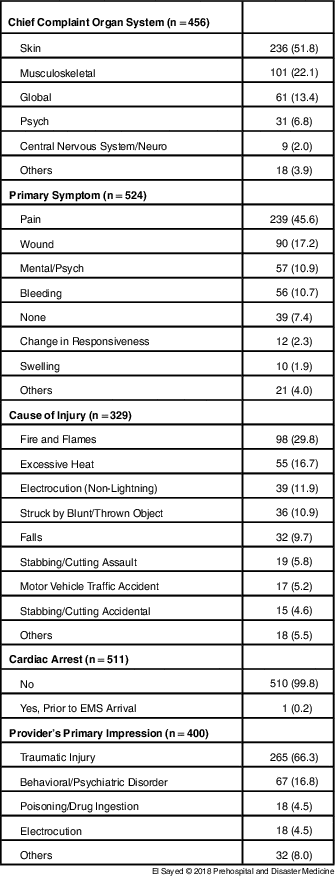
The most common chief complaints reported by dispatch were burns (29.9%), followed by traumatic injury (16.1%) and “unknown problem man down” (12.6%; Table 2). In terms of anatomic location of chief complaint, general/global was most common (22.9%), followed by extremity (upper; 22.5%), back (14.4%), head (11.3%), chest (11.2%), and extremity (lower; 11.0%). Skin was the most common organ system involved (51.8%), followed by musculoskeletal (22.1%). Patients had pain (45.6%) or wound (17.2%) as primary symptom with most reporting possible injury (77.8%). The reported causes of injury were mainly fire and flames (29.8%) or excessive heat (16.7%). The provider’s primary impressions were traumatic injury (66.3%) or behavioral/psychiatric disorder (16.8%). There was only one activation with a reported cardiac arrest (0.2%).
Clinical Characteristics. Abbreviation: EMS, Emergency Medical Services.

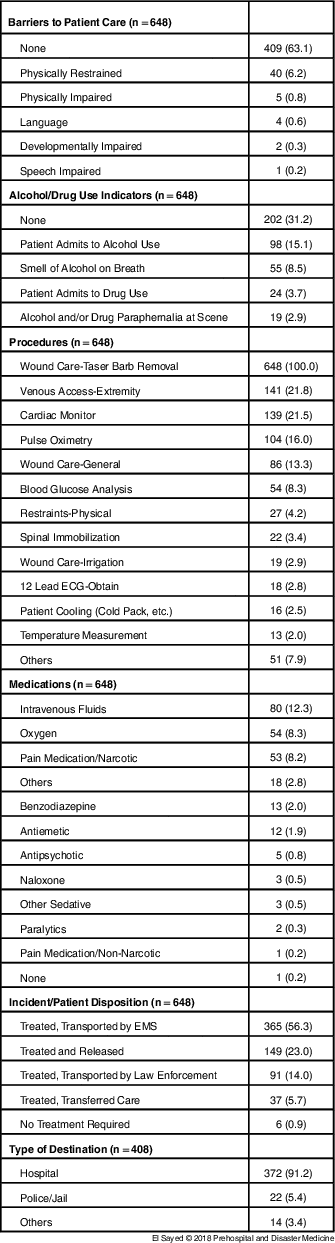
There were no reported barriers to patient care in most activations (63.1%; Table 3). Alcohol use was documented in 23.6% and illicit drugs in 6.6% of EMS activations, respectively. In addition to barb removal, procedures performed by EMS providers included assessment (47.2%), venous access (21.8%), and cardiac monitor (21.5%). Intravenous fluid was the most common medication administered (12.1%), followed by Oxygen (8.3%) and pain medications (narcotic; 8.2%).
Event Management and Outcomes

Abbreviation: EMS, Emergency Medical Services.
Over one-half of activations resulted in patient transports (56.3%), mainly to a hospital (91.2%). In 14.0% of activations, patients were treated and transported by law enforcement. The reason for choosing destination was dictated by LEOs in 14.1% of activations.
The reported prevalence of EMS activations with TASER use and barb removal increased over the study period from 4.55 per 1,000,000 EMS activations in 2011 to 6.92 per 1,000,000 EMS activations in 2015. This increase, however, was not statistically significant (P=.27; Table 4).
Trends for EMS Activations with Documented Barb Removal After TASER Use

Abbreviation: EMS, Emergency Medical Services.
Discussion
This study is the largest to date to describe the EMS experience with documented barb removal after TASER use. Traditionally, EMS constitutes the initial medical contact with patients on-scene, and familiarity with new weapons/restraints methods used by law enforcement agencies is essential for both training and preparedness of prehospital providers for potential medical emergencies when TASERs are used.
The prevalence rate of 4.55 per 1,000,000 EMS activations for encounters with documented barb removal after TASER use is low, despite the widespread deployment of TASERs in the US with over 15,000 law enforcement and military agencies using them. 30 This rate might be an under-estimate of the actual rate of TASER use since the EMS activations that were included in this study involved only those with TASER barbs removal. Some activations where TASER barbs were not removed might not have been included in this study. Most prehospital treatment protocols require leaving in place TASER probes if embedded in sensitive tissues such as the eyes or the genitals. 31 In fact, TASER barbs are often left in place until arrival to EDs, with some cases requiring surgical removal of barbs in the operating room.Reference Han, Chopra and Carr 3 , Reference Jey, Hull, Kravchuk, Carillo and Martel 8 , Reference Rafailov, Temnogorod, Tsai and Shinder 9 , Reference Dunet, Erbland, Abi-Chahla, Tournier and Fabre 13 , Reference Kaloostian and Tran 17 , Reference Rehman, Yonas and Marinaro 18 Standard operating procedures of different law enforcement agencies may have also affected this prevalence rate; some law enforcement agencies “provide officers with the discretion to remove TASER barbs themselves” without activating EMS or to request an EMS response for medical assessment. 2 Other agencies require officers to transport all affected individuals to a hospital for TASER barb removal. An EMS response is requested in this case only “for life threatening needs or when medical treatment is needed” on-scene. 2 Additionally, part of the safety procedures of most law enforcement agencies that use TASERs is to require medical assessment in the ED prior to barb removal for all individuals with barb impact to face or neck area (in all patients) or to breast and groin areas (in female patients). 2 These policies align with findings of a previous study by Haileyesus, et al that examined non-fatal injuries related to CEWs in US EDs, where most subjects (76.8%) were brought to the ED by a police vehicle and only 13.5% out of the 816 cases were transported by EMS or fire rescue.Reference Haileyesus, Annest and Mercy 32
Most EMS activations with documented barb removal after TASER use involved middle-aged patients (mean age 35.9 years [SD=18.2]), mostly of male gender (80.2%). The CEW-related injuries in the US are most common in males (90.1%) and among those in the 20-24-year age group.Reference Haileyesus, Annest and Mercy 32 Use of TASERs is also strongly discouraged for children and pregnant subjects. 2 Most patients were white (71.3%), which might be related to demographics characteristics of the population where these incidents took place. Previously reported figures on 676 use-of-force incidents out of Seattle’s (Washington USA) police department where TASERs and pepper spray were used showed a predominance of male subjects (95.0%) with over one-half being non-white (52.0%). 30 The observed difference between the age group and race of this study subjects compared to those from other studies examining CEW use might be related to the fact that other studies covered additional modes of CEWs (“drive stun”) and used additional inclusion criteria without restriction to barb removal.
Additionally, TASERs are also used on individuals who are “impaired by alcohol, drugs, or mental illness.” 30 In this study, alcohol or drug use was reported in 30.2% of activations with documented barb removal after TASER use. This is similar to a previously reported rate of substance use among subjects with CEWs injuries (28.8%).Reference Haileyesus, Annest and Mercy 32 Most activations (63.1%), however, did not report any barriers to patient care, which might be due to the fact that EMS are involved at a later stage in the encounter when the suspect is subdued.
Complaints reported by dispatch for activations with barb removal after TASER use included mainly burns (29.9%), traumatic injury (16.1%), unknown man down (12.6%), and psychiatric problem (7.8%), among others. Injuries associated with TASERs result from direct impact of barbed probes or from falls after incapacitation. Very few reports of burns from TASER use exist in the literature.Reference Kroll, Ritter and Williams 33 Minor burns are expected from TASERs probe impact.Reference Haileyesus, Annest and Mercy 32 Likewise, TASERs are not to be used near flammable liquids or fumes 2 because of the risk of ignition. In this study, fire and flames were, however, the most common cause of injury (29.8%), followed by excessive heat (16.7%). This finding is likely related to the limited element values available in NEMSIS to describe this type of an injury. Traumatic injury was identified as a common complaint reported by dispatch and as the most common provider’s primary impression (66.3%). This was expected since various TASER-associated injuries have been previously reported in the literature, including puncture wounds, contusions, abrasions, and falls.Reference Haileyesus, Annest and Mercy 32
This study also identified procedures done and medications administered by providers during EMS activations with barb removal after TASER use. These were routine procedures such as assessment, venous access, and cardiac monitoring. Few patients (4.2%) required additional physical restraints. Routine medications were also administered, mainly Oxygen and pain medications (ie, narcotics). Few patients required additional chemical restraints such as benzodiazepines and other sedatives (2.5%). Only one case was identified as a cardiac arrest (0.2%) that took place before EMS arrival. Death in this case might not be related to CEW use, as previous studies that examined the link between CEWs and deathsReference Swerdlow, Fishbein, Chaman, Lakkireddy and Tchou 34 found that death that occurs in excited delirium patients requiring restraints is associated with intake of stimulants or psychoactive active drugs, or with other factors including “evidence for forceful struggle, established natural disease states, and obesity.”Reference Swerdlow, Fishbein, Chaman, Lakkireddy and Tchou 34 , Reference Stratton, Rogers, Brickett and Gruzinski 35 Cardiac arrest in EMS activations with barb removal after TASER use is therefore rare, and most encounters require only routine prehospital care.
Limitations
The study used data from a national database that collects patient care information from EMS agencies across the US. Information submitted to this database vary in reporting compliance, which explains the missing documentation for some variables. All reported injuries in this study population were described without restriction to those directly related to TASER use, since a variable reporting on direct cause of injury is not available in the NEMSIS public dataset. This study also examined only activations with TASERs as CEWs and where barb removal was documented. Currently, TASER is, however, the only available CEW with probes in the US. Additionally, cases where the probes were not removed (specific locations: face, neck, groin, spinal column, or any area deemed to be problematic) might have been missed because of the way the study population was selected (procedure: “TASER Barb Removal”). This selection process might have biased the results of the study.
This study is, however, important in describing the experience of EMS providers in the US with prehospital encounters where TASERs are used by LEOs. Its findings are important for familiarizing the EMS community with current clinical practice in such encounters and are generalizable to US communities where TASERs are being used by law enforcement agencies. This study also highlights the need for better injury descriptors, such as “TASER Exposure” or “CEW Exposure,” and the addition of specific data elements related to CEWs in EMS software and in state and national EMS data sets to capture all cases with CEWs use.
Conclusion
Ultimately, EMS activations with documented TASER barb removal are rare. Although safety and training procedures for TASER use are available for law enforcement agencies, EMS providers do respond to such incidents when medical assessment is needed. Routine care is expected and life-threatening emergencies such as cardiac arrest are not common. All EMS providers should, however, be familiar with local policies and procedures related to TASER use and with other new, non-lethal weapons that might be introduced to the field.
Acknowledgement
The authors would like to acknowledge and thank all of the participating EMS providers, EMS agencies, and state EMS offices who support and provide data to the NEMSIS database.