I. INTRODUCTION
High T c superconducting tapes based on YBa2Cu3O7−δ (YBCO) consist of an epitaxial superconducting layer grown on textured metal substrates. Reference Goyal, Lee, List, Specht, Feenstra, Paranthaman, Cui, Lu, Martin, Kroeger, Christen, Kang, Norton, Park, Verebelyi, Thompson, Williams, Aytug and Cantoni1,Reference Goyal, Nortoa, Kroeger, Christen, Paranthaman, Specht, Budai, He, Saffian, List, Lee, Hatfield, Martin, Klabunde, Mathis and Parka2 In the rolling assisted biaxially textured substrate (RABiTS) technique, the substrate with a strong cube {001}<100> texture and minimal high angle boundaries (HABs) can be obtained by heavy cold rolling and subsequent annealing. The cube texture is transferred via buffer layers to the YBCO film through epitaxial growth and results in a low angle boundary (LAB) in the superconducting layer. Reference Ijaduola, Thompson, Goyal, Thieme and Markend3–Reference Rupich, Schoop, Verebelyi, Thieme, Zhang, Li, Kodenkandath, Nguyen, Siegal, Buczek, Lynch, Jowett, Thompson, Wang, Scudiere, Malozemoff, Li, Annavarapu, Cui, Fritzemeier, Aldrich, Craven, Niu, Schwall, Goyal and Paranthaman5 Ni–W alloys are promising substrate materials for coated conductors. Reference Sathyamurthy, Paranthaman, Zhai, Kang, Aytug, Cantoni, Leonard, Payzant, Christen, Goyal, Li, Schoop, Kodenkandath and Rupich6–Reference Eickemeyer, Selbmann, Optiz, Maher and Prusseit8 Ni5W alloy substrates form strong cube textures (>97%) after heavy rolling and subsequent high temperature annealing. One drawback of the Ni–W material is its comparatively high Curie temperature that results in high energy losses in superconducting tapes used in alternating current applications at typical operating temperatures (∼77 K). Reference Zhou, Ghalsasi, Hanna, Tang, Meng and Salama9,Reference Suo, Gao, Zhao, Zhu, Gao, Wang, Liu, Ma and Ji10
Increasing the tungsten content can suppress ferromagnetism and improve NiW alloy mechanical strength. Reference Goyal, Feenstra, Paranthaman, Thompson, Kang, Cantoni, Lee, List, Martin, Lara-Curzio, Stevens, Kroeger, Kowalewski, Specht, Aytug, Sathyamurthy, Williams and Ericson11 Optimized treatment conditions are necessary to improve the texture quality in highly alloyed NiW alloy substrates since the stacking fault energy (SFE) decreases as the tungsten content increases, as for example in Ni7W and Ni9W. Reference Gao, Suo, Grivel, Zhao, Gao, Liu and Ma12 Recently, a strong cube texture was obtained in Ni7W alloy substrates by intermediate and two-step annealing. Reference Eickemeyer, Hühne, Güth, Rodig, Klauß and Holzapfel13,Reference Eickemeyer, Hühne, Güth, Rodig, Gaitzsch, Freudenberger, Schultz and Holzapfel14 However, previous studies of RABiTS-processed Ni7W alloy substrates focused mostly on microstructures and textures produced by high-temperature annealing, with little effort to characterize the formation of deformation and recrystallization textures. To enable a systematic comparative study, the evolution of deformation and recrystallization textures and the formation of a strong cube texture in the Ni7W alloy substrates are investigated in this work using four circle x-ray diffraction (XRD) and electron backscattering diffraction (EBSD) techniques. An analysis of the texture transition in the Ni7W alloy is not only interesting from a scientific point of view, but could lead to an optimization of the microstructure and the texture of the final substrates.
II. EXPERIMENTAL
A Ni7W alloy was prepared by high-frequency vacuum induction melting of high-purity (99.95 wt%) Ni and W. The ingot was hot-forged at 1200 °C to produce a square 20 mm × 20 mm bar. The hot deformed bar was cooled in air, followed by surface grinding, and was manufactured by intense cold rolling from 20 mm to a 3 mm thickness, followed by a recrystallization anneal at 900 °C for 1 h to form an initial ingot. This ingot was cold rolled by applying 5% reductions per pass to a final thickness of 80 μm. The total thickness reduction by cold rolling for the tapes was 97.3% with a von Mises strain (εvM) of 4.17. To investigate the formation of rolling texture in the Ni7W alloy, deformation reductions of 70, 80, 90, 95, and 97.3 were applied, which correspond to a εvM of 1.39, 1.86, 2.66, 3.46, and 4.17, respectively. The final cold-rolled tapes with a εvM of 4.17 were annealed at 400, 600, 650, 675, 700, 750, and 800 °C for 1 h, respectively, under a flowing Ar–4% H2 gas mixture. In these annealing experiments, the quartz tube containing the specimen was inserted into a preheated furnace and was removed from the furnace after annealing. The cold-rolled tapes were also treated with flowing Ar–4% H2 by high temperature annealing at 1050, 1100, 1150, and 1200 °C for 1 h at 5 °C/min.
The rolling texture and the textures after recovery and recrystallization were investigated by XRD using a Bruker D8 device equipped with an Eulerian cradle. For each measurement, the {111}, {200}, and {220} pole figures were transformed to orientation distribution functions to calculate the volume fractions of the texture components, S {123}<634>, brass {110}<112>, copper {112}<111>, and cube orientations (with a maximum angular deviation of 15°). Microstructures and textures of the samples that were annealed to develop a strong cube texture were examined in a QUANTA FEG 650 field emission gun scanning electron microscope equipped with a Channel 5 EBSD system. A step size of 2 μm was used for collecting the EBSD maps from 400 μm2 × 400 μm2 areas. LAB and HAB were defined as boundaries with misorientations of ∼2–10° and >10°, respectively. The Σ3 boundaries were defined by applying a maximum deviation of 3° from the exact 60° <111> relationship. The area fraction of the cube texture was calculated from the EBSD data within 10° of the corresponding ideal cube orientation.
III. RESULTS
A. Deformation texture
A classical copper-type rolling texture was obtained in the seriously deformed face centered cubic (FCC) metals with high SFE, and a brass-type rolling texture was detected in heavily deformed FCC metals with relatively low SFE. Reference Kalidindi15 In the NiW alloys, the deformation texture was transformed from a copper- to a brass-type rolling texture as the tungsten content increased. Reference Subramanya Sarma, Eickemeyer, Schultz and Holzapfel16 The main components in the copper- and brass-type rolling textures are S, brass, and copper orientations, with the rolling texture being dependent mainly on the volume fraction of each main component. For the Ni7W alloy, the SFE is reduced by the high tungsten content, which affects the rolling texture of the deformed Ni7W alloy.
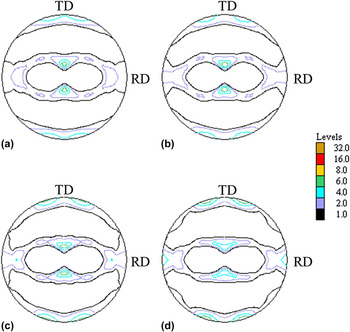
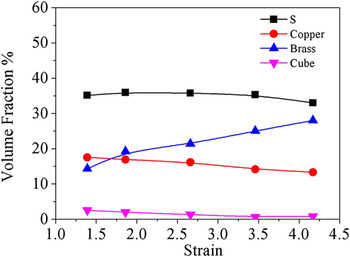
The rolling texture formation of a Ni7W alloy with increasing strain is shown in Fig. 1. A mix-type rolling texture is obtained when the strain increases. Fractions of the main components, S, brass, and copper, in the deformed Ni7W alloy are calculated from the orientation distribution functions and are shown in Fig. 2. As the deformation strains increase from middle (εvM = 1.39) to high (εvM = 4.17) strain, the fraction of S orientation, fs, shows little change, the fraction of brass orientation, f brass, increases significantly from 15 to 28%, and the fraction of copper orientation, f copper, is reduced from 18 to 15%. The fraction of rolling texture (f rolling), which is the sum of the fractions of the three main rolling texture components, was 77% when the Ni7W alloy was cold rolled to a strain of 4.17 with very little fraction of cube orientation.
The {111} pole figures of cold-rolled Ni7W tapes with different strains: (a) 1.86, (b) 2.66, (c) 3.46, and (d) 4.17.

Volume fractions of the main rolling components in the cold-rolled Ni7W samples affected by different strains.

B. Recrystallization texture
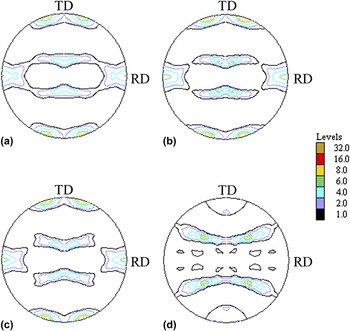
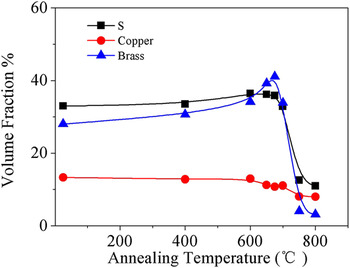
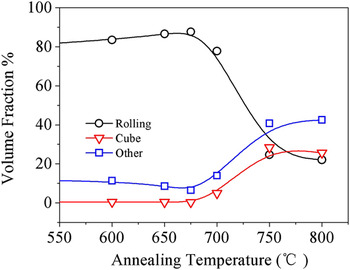
The {111} pole figures collected from the rolling plane of the samples annealed at ∼600–800 °C are shown in Fig. 3. The texture was transformed from a rolling to a recrystallization texture during annealing. After 1 h of annealing at 600 °C, the rolling texture strengthens with respect to the deformed state [see Fig. 3(a)] and the rolling texture is then transformed to a recrystallization texture during annealing, especially for the sample annealed at 800 °C for 1 h [see Fig. 3(d)]. The volume fractions of the main components affected by the annealing temperatures are presented in Fig. 4. During 1 h annealing at ∼400–675 °C, the f S values increase slightly since the f copper is reduced slightly, whereas f brass increases significantly from 28% after cold rolling to 42% after annealing at 675 °C for 1 h. All fractions of the rolling component fractions decrease during recrystallization. f rolling decreases significantly from 88% after annealing at 675 °C to 28% after annealing at 800 °C. Figure 5 shows the fractions of rolling, cube, and other components during recrystallization. The fraction of cube texture, f cube, increases from 1% after annealing at 675 °C to 29% after annealing at 800 °C. The fraction of rolling texture components decreases by 60% during recrystallization, whereas the fraction of cube texture increases by 28%. Most of the rolling components are therefore not consumed by the recrystallized cube grains via HAB migration. Other random orientations besides the three main rolling components also exist, and a cube orientation with a fraction of 43% formed during recrystallization for the heavily deformed Ni7W alloy tapes (see Fig. 5).
The {111} pole figures of Ni7W samples annealed at different temperatures: (a) 600 °C, (b) 650 °C, (c) 700 °C, and (d) 800 °C.

Volume fractions of S, copper, and brass components of the annealed Ni7W samples affected by various annealing temperatures.

Volume fractions of rolling, cube, and other random orientations in the annealed Ni7W samples affected by annealing temperatures.

C. Cube texture
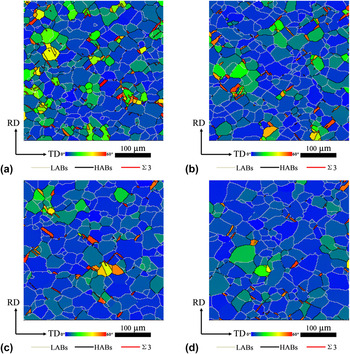
The EBSD maps of the Ni7W alloy after annealing at 1050, 1100, 1150, and 1200 °C for 1 h are shown in Fig. 6. LAB and HAB are represented as silver and black lines, respectively, and the red lines are Σ3 grain boundaries. The misorientation of grains with ideal {001}<110> orientation from ∼0–60° is represented as the color changes from blue to red. The cube texture strengthens with increasing annealing temperature. For the cube grain growth at high temperature, the average grain size increases from ∼14 μm after annealing at 1050 °C to ∼24 μm after annealing at 1200 °C. Cube grain growth in the Ni7W alloy also produces more LAB and less Σ3 grain boundary for the higher temperature annealing condition.
EBSD maps of the Ni7W alloy substrates annealed at different temperatures: (a) 1050 °C, (b) 1100 °C, (c) 1150 °C, and (d) 1200 °C for 1 h.

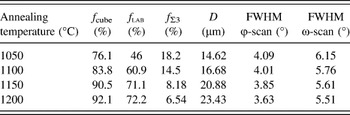
The microstructure and texture parameters of the cube-textured Ni7W alloy substrates are shown in Table I. The fraction of cube texture with a misorientation of 10° increases from 76.1 to 92.1%, whereas the Σ3 grain boundaries decrease from 18.2 to 6.54% when the annealing temperature increases from 1050 to 1200 °C. Approximately 28% HAB still exists in the Ni7W substrate after annealing at 1200 °C.
Parameters of the microstructure and texture of the cube-textured Ni7W alloy substrates.

The in- and out-of-plane textures of the Ni7W alloy after annealing at 1050, 1100, 1150, and 1200 °C for 1 h were investigated by XRD (111) ϕ-scan and (002) ω-scan (Table I). The full width half maximum values for the x-ray ϕ-scan and ω-scan parallel to the rolling direction decreased with increasing annealing temperature, which corresponds to the increasing cube texture in the EBSD maps. In the Ni7W alloy, the full width half maximum values of the ϕ- and ω-scan are 5.51° and 3.63°, respectively, after annealing at 1200 °C for 1 h.
IV. DISCUSSION
A. Deformation texture
Ordinarily, the deformation texture has classical copper- and brass-type textures, which depends mainly on the volume fractions of each rolling texture component for the heavily deformed FCC metals. Reference Leffers and Ray17 To distinguish the copper- and brass-type textures from relationships of the fractions of rolling texture, Gervasyeva et al. Reference Gervasyeva, Rodionov, Sokolov and Khlebnikova18 proposed that a copper-type rolling texture can be considered when the ratio of consumed fractions of S and copper orientations to twice the fraction of brass orientation, R = (f copper + f S)/2f brass, is higher than 1, otherwise a brass-type texture could be considered.
The brass-type texture deviates from the copper-type texture from an early stage of texture development, as confirmed by Leffers and Ray. Reference Leffers and Ray17 In this work, the R-value is higher than 1 when the Ni7W alloy deformed to middle strain, which corresponds to a copper-type rolling texture. The R value decreases as the strains increase, and it decreases to 0.827 since f brass is enhanced significantly at a strain of 4.17. The deformation texture transforms gradually from copper- to brass-type texture with increasing strains (see Fig. 1). Compared with the classical brass-type texture detected in the Ni9W alloy, the f brass of the heavily deformed Ni7W alloy is not as strong as f brass of the Ni9W alloy. Reference Subramanya Sarma, Eickemeyer, Mickel, Schultz and Holzapfel19 The results indicate that the rolling texture of the heavily deformed Ni7W alloy is a mix-type rolling texture between the classical copper- and brass-type rolling textures and is more characteristic of the brass-type rolling texture.
The rolling texture formation depends mainly on the SFE for the FCC metals, which lead to different deformation mechanisms. Development of the copper-type rolling texture can be explained by the straightforward {111} <110> slip. Deformation twinning is the general explanation for the formation of brass-type rolling texture by overshooting/latent hardening introduced by closely spaced twin lamellae. Reference Subramanya Sarma, Eickemeyer, Schultz and Holzapfel16 In the NiW alloys, the SFE decreases significantly with increasing tungsten content, and the classical copper- and brass-type rolling textures were detected in the heavily deformed Ni5W and Ni9W alloys, respectively. Reference Tian, Suo, Qiu, Ma, Liu, Wang, Wang and Wang20 The SFE of the Ni7W lies between that of the Ni5W and Ni9W alloys, which leads to a mixed type of texture after heavy cold rolling.
B. Recrystallization texture
The evolution of microstructure and texture during recovery confirmed that the rolling texture components increased whereas the microstructure was coarsened in the heavily deformed Cu–Ni alloy and Al and the recrystallization nucleus developed from the coarsened recovery microstructures. Reference Tian, Suo, Mishin, Zhang, Juul Jensen and Grivel21,Reference Zahid, Huang and Prangnell22 The fraction of rolling texture increases during the recovery process for the Ni7W alloy tapes, especially for the brass orientation (see Fig. 4). At the start of recrystallization annealed at 675 °C, the f brass value increases by 16% with respect to the deformed sample. The brass orientation therefore coarsens significantly more than other main rolling components, especially at the end of the recovery process. The results indicate that the coarsened brass orientation would be the nucleus at the start of recrystallization, and that the brass orientation would be more favorable for nucleation than other rolling texture components.
In the isochronal annealing experiment, a pronounced recrystallization occurs in between 675 and 800 °C (Figs. 3–5). Recrystallization in the Ni7W alloy was accompanied by a strong reduction in rolling texture components. However, the fraction of cube orientation did not increase significantly while the rolling texture components were consumed, whereas a large amount of other random orientation resulted. This result contradicts experimental observations of recrystallization in FCC metals with high SFE. In the recrystallization of heavily deformed Cu–Ni alloys and the Ni5W alloy, the fraction of cube orientation increases significantly whereas the rolling texture components are reduced, and a cube texture with fraction higher than 50% is formed after primary recrystallization. Reference Bhattacharjee, Ray and Tsuji23,Reference Zhang, Godfrey, Liu, Liu and Juul Jensen24 The average size of recrystallized cube grains is coarser than grains with other orientations. This is consistent with previous findings, which indicate that cube grains gain a growth advantage compared with other grains during recrystallization. Reference Zhang, Godfrey, Liu, Liu and Juul Jensen24
The difference in recrystallization behavior between the Ni7W and Ni5W alloys presented as different texture transitions during annealing, which depends mainly on the fraction of each rolling texture component. The fraction of brass orientation in heavily deformed Ni7W alloys is much higher than that in Ni5W alloys, and f brass also has a strong enhancement during recovery. After primary recrystallization annealing, a large amount of other random orientations resulted. It would be more difficult to form a strong cube texture in Ni7W compared with Ni5W under the same conditions. Reference Wang, Suo, Ma, Wang and Wang25
C. Grain growth
Since further grain growth in the recrystallized microstructure occurs in the presence of a strong cube texture, the fraction of HAB decreases as the growing cube grains encounter one another to form new LAB (see Fig. 6). This result also agrees with experimental observations of grain growth in strong cube-textured Cu, Ni, Cu–Ni alloys, and Ni5W. Reference Tian, Suo, Mishin, Zhang, Juul Jensen and Grivel21,Reference Zhang, Godfrey, Liu, Liu and Juul Jensen24,Reference Mishi and Gottstein26,Reference Wulff, Mishin and Grivel27 The high fraction of other random orientations in the Ni7W samples after primary recrystallization makes it difficult to build a strong cube texture compared with Ni5W alloy substrates under the same annealing conditions. The fractions of cube texture and HAB are 92.1 and 27.8%, respectively, when the Ni7W alloy substrates are annealed at 1200 °C. Even though a higher fraction of the cube texture is already developed after annealing at 1200 °C for 1 h, this value still needs to be improved for the use of Ni7W alloy substrates for YBCO-coated conductors. Therefore, intermediate annealing during cold rolling and two-step recrystallization annealing were used to improve the microstructure and texture for the final annealed Ni7W alloy substrates. Reference Eickemeyer, Hühne, Güth, Rodig, Klauß and Holzapfel13
V. CONCLUSIONS
The texture evolution of Ni7W alloy samples was investigated by cold rolling, recrystallization, and grain growth. A mixed-type rolling texture between the copper- and brass-type rolling texture was obtained after heavy cold rolling of the Ni7W alloy. The rolling texture increases during the recovery process, especially for the brass orientation. The rolling texture components were reduced significantly during recrystallization. The fraction of cube orientation reached 26% after primary recrystallization. A large amount of random orientation (43%) formed, which leads to a comparatively difficult formation of stronger cube texture in the Ni7W alloy. The fractions of cube texture and HAB were 92.1 and 27.8%, respectively, after annealing the Ni7W alloy substrate at 1200 °C for 1 h. The in- and out-of-plane textures of the full width half maximum values for the cube-textured Ni7W alloy substrates were 3.63° and 5.51°, respectively.
ACKNOWLEDGMENTS
The authors gratefully acknowledge the support from the National Science Foundation of China (51171002), Beijing Municipal Natural Science Foundations (2132011 and KZ201310005003), the Doctoral Program of Higher Education of Special Research Fund (20121103110012), the Project of Construction of Innovative Teams and Teacher Career Development for Universities and Colleges Under Beijing Municipality (IDHT20130510), as well as the Project supported by the Beijing Postdoctoral Research Foundation (Q6009001201402).