Introduction
Before the universal adoption of fences in Australia, flocks of sheep were tended by shepherds. When the First Fleet landed in Sydney in 1788, the very few sheep and cattle were herded by convicts using long-proven techniques from Britain. As the flocks increased and spread across the landscape, shepherds were crucial to guard the flocks against theft by Aborigines, predation by dingoes, and to prevent sheep wandering off. A typical squatter's sheep run would have one or more outstations each with a hut and hutkeeper, two flocks of sheep, each with its own shepherd, and two sets of yards or folds made of moveable hurdles (Pickard in press). Each morning, shepherds counted their flocks out of the folds, and took them out to pasture, and watched over them during the day while the sheep fed. Each evening, the sheep walked back to the station, where they were counted back into the folds and spent the night protected against dingoes by the hutkeeper.
The transition from managing sheep with shepherds to allowing flocks to roam in fenced paddocks is one of the most important technological revolutions in Australian pastoral development. In this paper I re-examine a range of evidence and allegations about the transition. Far from being simple, it involved a series of changes in legislation, social conditions, colonial development, technology, attitudes of managers, the economy and the environment. One intriguing aspect is the rediscovery of older techniques, technology and approaches. In some cases, the lessons were forgotten and had to be relearnt after only two decades. This shows that changes in pastoral technology were not linear and unidirectional and that the sequence of events leading to universal fencing was more complex that most authors have realised.
The transition to fences: progressive loss of barriers
Before fences could become universal, each of the following changes had to occur:
a. a recognition and acceptance that open camping was better than nightly yarding;
b. the introduction of new legislation granting land tenure so that squatters and pastoralists would invest in improvements including fences;
c. the eradication of dingoes;
d. the reduction of theft by Aborigines;
e. the availability of better technology in the form of iron (and subsequently steel) wire; and
f. an increase in wages when shepherds were scarce.
A final change accelerated fencing:
g. the need to demarcate boundaries clearly and protect property when freehold land was purchased.
These changes were not sequential, flowing as a logical sequence. Rather, many (e.g. a, c, and d) were developing together.
a. Open camping was better than nightly yarding
Even before squatters and pastoralists began extensive and intensive fencing, some knew that camping sheep was more productive than yarding them every night. It was the sedentary nature of shepherding that led to many problems recognised by early flock-owners, and pre-conditioned them to accept more readily some of the subsequent changes. Butlin (1962: 327) made a key error in considering shepherding as ‘nomadic’.
There were no dingoes in Tasmania so close shepherding was unnecessary. Not only did flock owners save on wages, they also found that open-camped sheep were more productive (Curr, Reference Curr1824: 73–4; Widowson, Reference Whitington1829: 141). However, the mainland squatters had to persist with nightly yarding until dingoes were eradicated. Then the virtues of camping were re-discovered by many squatters independently.
One early mainland practitioner of open camping was Benjamin Boyd. His shepherds managed flocks of up to three thousand sheep, and Boyd claimed that he had no losses from dingoes (Boyd, Reference Boyd1843: 41–5). Edward Curr (1883: 358) does not say why he gave up folding or yarding his flocks, but by about 1845 he was open camping sheep: ‘a great improvement, which I believe I was the first to adopt’. Howitt (1855, vol. 1: 142) believed that this rediscovery was prompted by a lack of labour. Ignoring the Tasmanian experience, George William Rusden offers an explanation that was bound to appeal to the egalitarian ‘Jack's as good or better than his master’ ethos of Australians. A shepherd on the Liverpool Plains of New South Wales ‘who first proved the gain’ of open camping offered to open camp two thousand sheep in return for a considerable pay rise. ‘The flock grew fatter and lazier; the wool was improved in quantity, and to a certain extent in quality’ (Rusden, Reference Rothery1897, vol. 1: 364). By January 1851, Mundy (1852, vol. 3: 285) reported open camping next to huts in Victoria where the ‘Blacks are rarely troublesome’. The advantages were re-rediscovered late in the nineteenth century near Carnarvon in Western Australia (Carter, Reference Carter1987: 83) and the Peak Downs district of Queensland (de Satgé, Reference de Satgé1901: 225–6), but only when fencing was becoming universal and dingoes were controlled.
Overseas in the Americas, open camping of sheep near the shepherds’ camps was accepted practice among Spanish sheep-owners from the seventeenth century in what was to become New Mexico (Thompson, Reference Thompson and John1942: 111; Baxter, 1987). This was despite the presence of predators such as wolves and coyotes.
b. Legislative change granting tenure
Squatting was initially the illegal occupation of Crown lands, but was subsequently legalised through annual licences. But there was no real security of tenure, and worse, if evicted by the government, the squatter would receive no compensation for any improvements. Under such a regime until 1847, it is not surprising that Brodribb (1976: 33) would ask:
Who would think of expending money in . . . fencing in paddocks, &c., when the tenure under which the Crown lands were occupied by the squatters, . . . viz.: a mere annual license defining no boundaries nor extent, or offering any promise for the value of your improvements, should the Home Government extend the limits for purchase (italics in original).
Other pastoralists of the time echoed these sentiments, e.g. Joyce (1949: 98).
However, there are contrary observations on the utilisation of fences before the advent of secure tenure. James (1838: 190) describes intensive fencing at Bogolong in New South Wales where although : ‘every inch of land belongs to Government, yet there is just as much fencing and cultivation going on as if it belonged to the temporary occupants’. This suggests that the lack of secure tenure was not a strong inhibitor of fences as claimed by Brodribb and Joyce. The 1847 Orders-in-Council provided better security, but still little incentive to invest in improvements. Thus shepherding remained a better management option than fencing (Bolton, Reference Bolton1992: 57). This changed radically with the pressure to ‘unlock’ the lands and allow disillusioned gold-seekers to select farms. To protect their lands, many squatters bought the freehold when it was made available, and fenced to protect it (Peel, Reference Peel1974: 58; Dingle, Reference Dingle1984: 80–1). This is discussed further below.
c. The eradication of dingoes
Although squatters hated dingoes as cowardly curs that dispersed flocks, killed a few sheep and injured dozens more, losses due to dingoes are essentially impossible to quantify (Thompson and Perkins, Reference Telfer1987: 112–3). Reliable figures are few, but they suggest that losses of up to 1.5% were common. Although this seems low, squatters urged the government to introduce bounties, and some pastoralists offered bounties themselves. From as early as 1852, specific dog-proof fences were available from Scotland (Charles D. Young and Company, post-1851: 4–6; Plates 1–3), but they were prohibitively expensive.
Dingo control remained elusive until the poison strychnine was discovered by two French pharmacists in 1818 (Simon, Reference Shumack1999: 507). Its first use in the Australian colonies seems to have been in the mid-1840s. By 1848, the progressive pastoralist George Russell of the Clyde Company properties in Victoria was ordering strychnine as ‘we have for some time past found it of great use in destroying the native dog’ (Brown, Reference Brown1959: 350). Five years later one optimist believed that ‘[The dingo] has been nearly exterminated in Victoria by the aid of strychnine’ (Anon, 1853: 135). While this may have been the case in the well-settled districts, it was not so in the rugged and forested ranges. At least one Victorian pioneer, William Moodie believed that ‘the dingoes were eventually wiped out by a terrible plague of distemper’ (Palmer, Reference Palmer1972: 37). No one else seems to have reached this conclusion, but it is entirely plausible. Canine distemper both infects and affects most canids, including dingoes, and often has a very high mortality rate (Deem et al., Reference Deem2000).
By the 1860s when fencing was rapidly increasing and pastoralists were dispensing with shepherds, strychnine was used to poison dingoes so that sheep could be run free in the newly formed paddocks in Victoria (‘A pioneer’, 1893: 143) and Queensland (de Satgé, Reference de Satgé1901: 256). Despite the widespread use of strychnine in Victoria since the mid-1840s, it was re-discovered near present-day Canberra two decades later where ‘Strychnine was unknown until 1861, when it was introduced by John Cameron, who was for a time overseer at Ginninderra’. But even in November 1865 ‘dingoes wrought havoc with the sheep in our charge’ (Shumack, 1967: 33, 46).
Even more intriguing is the loss of collective memory about dingoes later in the century in several widely spaced locations. Sheep were left to roam free in large newly fenced paddocks in north western Victorian in the 1870s. Depredations by dingoes forced the reintroduction of shepherds and nightly yarding (Anon, 1880: 135). Similarly, in arid South Australia, Yardea station was fenced in the mid-1870s and ‘the sheep turned adrift but long before the lease expired [in 1888] the proprietors realized that the country was untenable unless some means were adopted to cope with the dingo trouble’ (Richardson, Reference Piesse1925: 13). Dingoes caused similar problems near Cobar in New South Wales in 1877, and again, shepherds were rehired (Macpherson, Reference Macpherson1920). These three examples show that forgetting a simple but expensive lesson, that dingoes kill sheep, was widespread. It is difficult to understand how pastoralists could forget that eradication of dingoes was an essential prerequisite for unshepherded sheep. It is another example of how successful techniques needed to be rediscovered.
d. The reduction of theft by Aborigines
As the Aboriginal population was displaced by expanding and intensifying pastoralism, diseases, violence, and deliberate killing, the thefts of sheep fell. In most areas, by the time fences were being seriously contemplated, pastoralists were no longer concerned about sheep losses to Aborigines. This period overlapped with the reduction in numbers of shepherds, and extermination of dingoes in most areas.
e. The introduction of iron and then steel wire
In addition to the lack of secure tenure, a major barrier to building fences was the cost. Although brush and log fences were relatively cheap, the more advanced post-and-rail fences were laborious to build and expensive (Pickard, Reference Pickard2005). Moreover, they required a large amount of timber. In c.1842 John D. McHaffie erected some forty-eight kilometres of five-wire fence using posts fifteen feet apart and iron wire three eighths of an inch (9.5 mm) diameter on Phillip Island, Victoria (Piesse, Reference Pickard1960). Although this wire seems massive by today's standards, it was widely used in English fences of the period and later. Thus, Charles D. Young and Co. (1847: 2) advertised cattle, horse and sheep fences with four gauge wire (11.5 mm diameter assuming the Birmingham Wire Gauge). In 1853 George Russell imported iron fences and erected them in Victoria (Brown, Reference Brown1963: 526, 554).
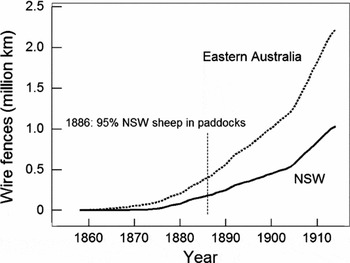
Starting slowly in the 1860s, more pastoralists erected wire fences and within a decade the number was growing rapidly (figure 1). An example of the scale of fence building is provided by Peter Waite who imported 265 tons of wire in 1870 to fence three of his large South Australian properties (Anon, 1951: 752). This quantity would fence about 660 km, assuming fences with four eight Birmingham Wire Gauge wires, typical of Peter Waite's lightning fences (Pickard, Reference Pickard1992). Although this seems a considerable length, the area of these properties suggests that Waite would only have been able to ring (or boundary) fence, and add a few key internal fences. There is no truth in the assertion that he ‘appears to have been the first to appreciate the advantages of fencing over the shepherding of flocks’ (Anon, 1951: 752), but Waite subsequently developed a revolutionary management system using four-wire fences to separate relatively small paddocks, each with a water point (Lange et al., Reference Lange1984).
Cumulative length of wire fences erected from 1860 to 1915 in New South Wales and eastern Australia.
Sources: Fences: Winslade (Reference Wilson1994); paddocked sheep: Coghlan (1887: 325).

f. Savings in wages when shepherds were scarce
The first response of the squatters to the shortages of shepherds was the classic response of employers: to increase the work-load, and so flock sizes were doubled (Pickard, in press: figure 3), reducing the wages cost of shepherding (Pickard, in press: figure 4). There appears to be no logical reason why a shortage of shepherds per se should lead to fencing. More likely, pastoralists found that fencing, once dingoes were controlled, led to substantial savings in wages. For example, Jesse Gregson, manager of the Australian Agricultural Company, estimated a ten per cent reduction in the number of employees at Warrah once fencing was complete in 1875 (Gregson, pre-1922).
Essentially the squatters replaced labour with capital (McMichael, Reference McMichael1984: 217). With hindsight this seems relatively simple, but it must have been a high-risk gamble for the first pastoralists who made such a bold change in management. Wages could be paid from earnings from selling wool, but capital mostly had to be borrowed. The magnitude of the risk can be seen on the property Elsonora where 131.25 miles of wire fencing in the 1880s accounted for 30.8% of the capital improvements on the property (Butlin, Reference Butlin and Barnard1962: 335).
g. Securing boundaries when freehold land was purchased
Although lack of secure tenure may have inhibited fence erection, once the squatters had purchased the freehold title in their land, they seemed to embark on a frenzy of fencing to protect it from neighbours and disease, and to facilitate improved management. This was particularly so on the rich land of the Darling Downs of Queensland (Waterson, Reference Ward1968: 61) and the Western Districts of Victoria (Peel, Reference Peel1974: 58). Many settlers bought their land as a ‘conditional purchase’ and among the conditions were requirements to invest in improvements: fencing, watering points, and clearing or ringbarking. Once the conditions were satisfied, and the full price paid, freehold title was granted. Similar conditions were attached to leases.
All colonies had similar legislation, but the following brief summary focuses on New South Wales. Initially fencing was not explicitly listed as an improvement, but it was regarded as one because fenced land could carry more stock. Section eighteen of the Crown Lands Alienation Act 1861 (NSW) essentially required the purchaser to spend a minimum of one pound per acre on improvements. Erecting a perimeter fence around a 640 acre (one square mile) block in the 1860s would cost from £60 (brush fence) to £220 (post and wire fence). On its own, this would not have satisfied the improvement criterion. Section fifteen of the Crown Lands Occupation Act 1861 (NSW) allowed run holders to apply for a ten-year extension on their leases if they could demonstrate that their improvements increased the stock carrying capacity by fifty per cent. As shown below, fencing alone would probably achieve this. The definition of improvements in Section three of the same Act as ‘any work or erection of a fixed character and such as would render more beneficial the occupation and use of the said land’ clearly includes fencing. Furthermore, if the value of the improvements exceeded forty pounds, the land was exempt from conditional sale or pre-emptive lease by others. Thus a squatter could protect his leases by investing in improvements.
A few years later, Section two of the Lands Act Further Amendment Act 1880 (NSW) halved the value of improvements in Section eighteen of the Crown Lands Alienation Act 1861 (NSW) to just ten shillings per acre. Section three of the 1880 Act extended the time available for making improvements from three to five years, and Section thirteen specified that the improvements be ‘of a fixed and durable character erected constructed or effected bonâ fide for the working and beneficial occupation of the run’. This provision was not aimed directly at fencing, but certainly would have precluded any sub-standard construction being passed off as one. When the morass of New South Wales legislation was completely over-hauled with the Crown Lands Act 1884 (NSW), Section thirty-three specifically required conditional purchase land to be fenced ‘with a substantial fence of any of the prescribed classes of fencing’. Regulation 64 under the Act listed the prescribed classes of fences. These were amended several times, usually adding additional types, e.g. in 1887 (NSW, 1887). Subsequent legislation varied the conditions, but the essential requirement of fencing remained, thus hastening the spread of fences, and the end of shepherding.
Alternative explanations
Many accounts, both semi-contemporary and subsequent, of the transition from shepherding to fencing are incomplete, confuse causes, are simplistic and attribute the change to single causes, and often make historically factual errors in the sequence of events. The story of the transition from shepherding to fencing has suffered from ‘the doctrine of retrospective inevitability: “It seems perfectly logical to us now, so it must have seemed equally logical to them back then”’ (Hart, Reference Hart1998: 206). Despite the complexity of the transition, a persistent historical myth attributes a single cause: the lack of shepherds during the gold-rushes of the early 1850s. The core of the dominant labour myth is high wages, but by increasing flock sizes, flock-owners increased the productivity of shepherds, and also reduced costs per head of sheep (Pickard, in press: figure 4). Although flock-owners were aware of fences, they changed labour practices to cope with labour shortages. They had no reason to replace labour with capital in the form of fences.
The originator of the labour myth may have been George William Rusden, author of the influential three-volume History of Australia:
When gold was found, and shepherds abandoned the crook for the pick-axe, it became impossible to tend sheep in the accustomed manner . . . . Shepherds could only be dispensed with if the runs were fenced. Irretrievable confusion would have ensued (even if there had not been wild dogs) by letting flocks roam at large . . . . Runs were fenced in. (Rusden (1897, vol. 1: 364–5).
Although Rusden describes exterminating dingoes, it is clear that he believed that the shortage of shepherds led directly to fencing. In a variation, John Phillips described how squatters reduced costs by increasing flock sizes:
Making one man do the work that was formerly allocated to two . . . It was this necessity that originated the fencing of our runs into large paddocks, so that eight or ten thousand sheep, or a thousand head of cattle could be turned loose and allowed to shift for themselves, without shepherds or stockkeepers. (‘A pioneer’, 1893: 140–1)
Why Rusden used this explanation is difficult to know, because Howitt (1855, vol. 1: 141) had dismissed it in December 1852 during the gold rushes. In fact, he says very plainly that the only result was open camping of sheep. The shepherd assembles his flock:
near his hut at night, and there it lies quietly till morning. It is found that this suits the flocks amazingly. They are not crowded together in a fold of hurdles. They get some food often in the night, and they are stronger and better. The cry has raised the wool-market at home, and the squatters have kept it up as long as they could, by pretending that the flocks were diminished by a want of proper shepherding, and that the amount of wool will be naturally diminished. It is all fudge. The flocks are just as numerous, as healthy and as productive of wool as ever, as the exports of wool prove.
A century later, Noel Butlin (1962: 328) comprehensively debunked the labour myth, concluding that ‘It is doubtful if labour shortages in the 1850s played much part at all’. It is worth noting, however, that although Butlin (1962: 327–8) alluded to the gradual change from shepherding to fences, he underestimated the complexity of prerequisites. Despite Butlin's reassessment, Michael Cannon (1973, vol. 2: 89) repeated the myth arguing that: ‘When a large proportion of shepherds absconded from service to join in the gold rushes, the squatter was impelled to fence the outer boundaries of his run, often at high cost, so that his stock could be left to shift for itself’. The influential historian Russel Ward also repeated it: ‘when the old hands deserted the runs en masse for the diggin's’, pastoralists had to begin fencing their station. In time this did away with shepherding, the most degrading of outback occupations’. (1978: 176).
Allied to the central myth are several others, masquerading as explanations for the transition from shepherding to fencing. Although most of the single-factor explanations have been dispelled at various times, it is worth listing them to show how robust they are, and how attractive to some observers and historians.
Not content with the theory of absconding shepherds, Rusden (1897, vol. 2: 185) considered that flock-owners employed shepherds in the late 1830s to early 1840s because ‘The subsequent practice of fencing with more or less rough material had not been thought of, nor could it have been adopted without capital’. While correct about the lack of capital during the depression of the early 1840s, he is totally incorrect about fences. Not only had they been thought of, they were also being built (Abbott, Reference Abbott1971: 100–1; and passim).
The development of fencing in Queensland was attributed to a single cause by Timothy A. Coghlan, the New South Wales Colonial Statistician: in 1868 ‘The [Queensland] pastoralists, anticipating that prices were going still lower, endeavoured to reduce the cost of working their runs as much as possible. The practice of fencing runs with this object became common’ (Coghlan, Reference Coghlan1918, vol. 2: 1061–2). However, Walker (1988: 119) disagrees. Instead he considers that fencing ‘was more a response to the talked-about productive advantages of fencing and to their attraction of being able physically to secure their land’. Both Coghlan and Walker provide examples of the savings (e.g. a reduction from fifteen to twenty shepherds to four or five boundary riders; and labour costs falling by two-thirds). Walker concludes that ‘Despite the high cost of fencing, and a certain prejudice against it, by 1871 the question was no longer whether fencing was preferable to shepherding – pastoralists either fenced in or lost money’.
Ignoring the shortage of shepherds and high wages, Garran and White (1985: 203) consider that ‘In the 1840s two events occurred which made fencing on a wide scale economically possible’. These were legislative changes granting leases and rights in improvements; and the introduction of strychnine to kill dingoes. They concede the impact of the gold-rushes arguing that ‘the effect of the gold-rushes should not be underestimated in depleting sources of labour’ (p. 208). Blainey (1982: 184–5) adds problems of straying stock and new technology of iron and steel wire in his explanation of the start of fencing. However, his suggested linear sequence (p. 290) of shepherds being replaced by post-and-rail fences, and these in turn by wire fences, is incorrect (Pickard, Reference Pickard2005). Many of the early fences were brush or log, and many squatters went directly from shepherding to wire fences. Other suggested causes include the need to protect recently purchased freehold and better stock husbandry (Bolton, Reference Bolton1992: 82–3), and keeping diseased animals away from uninfected flocks (Butlin, Reference Butlin and Barnard1962: 327). Severe droughts in the mid-1860s may have contributed to the decision to fence the large South Australian property Bungaree in 1868 (Hawker and Linn, Reference Hawker1992: 130).
The (alleged) advantages of paddocking
The previous discussion has already listed a number of the benefits of fencing and paddocking sheep instead of shepherding. As early as 1867, Patrick Gordon (1867: 10–11) gave the first clear statement of the advantages of paddocking:
1. The sheep carry more wool, and the wool is of sounder staple.
2. A run on being fenced in would carry nearly double the number of sheep which it did before.
3. There would be a saving in wages and rations, and the stockmaster would not be at the mercy of careless, or inexperienced shepherds.
4. Foot rot would not be so prevalent.
5. The sheep would grow to a larger size, and fatten better.
6. There would be a larger per centage [sic] of lambs from maiden ewes than if they were lambed down in the usual way in yards and hurdles; and
7. Coast district and scrubby country, at present considered unavailable for sheep-farming, could be utilized by being fenced in.
This list was subsequently re-used and essentially plagiarised by the Chief Inspector of Stock (Bruce, 1875–6: 719) and several times by Coghlan (e.g. 1890: 327; 1893: 572; 1902: 584; 1918, vol. 3: 1196–7). It is impossible to test many of these claims as fencing was not the only thing changing over this period. Even Coghlan, the New South Wales Colonial Statistician, provides relatively little data to support the claims. In the following sections, I examine each of the claims seriatim to determine their validity.
1. More wool per head, and wool is of sounder staple
Stock-owners have known for centuries that separating male and female stock is essential for better breeding. The expansion of fences allowed Australian sheep growers to increase their efforts towards better breeding, consequently any direct effect of fencing on the wool cut was confounded with gains from breeding. A specific example of an increase in fleece weight comes from Balala station on the New England tableland of New South Wales (Walker, Reference Thompson1957: 73). The increase came not from fencing, but from substituting wethers for locally bred ewes. However, Bruce (1875–76: 719) provides New South Wales data showing that paddocked sheep yielded 17.8% more greasy wool and twenty-three per cent more scoured wool per head than shepherded sheep. Fyfe (1983: 70) reported thirty per cent increases in greasy wool after twelve months of paddocking. However, the key question is whether any increase, together with increases in stocking rates and reductions in wages, were sufficient to pay for the capital cost of erecting and amortising fences.
There are no data to test the assertion that paddocking leads to better staple, i.e. an even diameter over the length of the wool fibre, with no reductions in diameter caused by stress or hunger during the year. If Bruce meant cleaner wool, then he was probably correct because nightly yarding exacerbated any dirt contamination of the fleece with dust thrown up by the hooves of the sheep in the confines of the yard.
2. Increased carrying capacity
Many pastoralists reported increases in carrying capacity of thirty to one hundred per cent. Most confused ‘stocking rate’ (the number of sheep on the property) with ‘carrying capacity’ (a difficult measure, but essentially the long-term sustainable stocking rate) (Pickard, Reference Pickard2001). In 1864 Joyce (1949: 209) anticipated a thirty-three per cent increase. Before fencing Warrah, the manager talked with Victorian sheep-growers who told him that wire fences and paddocks could lead to a fifty per cent increase in carrying capacity. After fencing part of Warrah, the results were good enough for the Company to invest very heavily in a major programme of fencing the entire estate (Gregson, Reference Gregson1907: 248, 256). Cuthbert Fetherstonhaugh (1917: 314) achieved a 109% improvement in carrying capacity after the fencing of 315,000 acres at Brookong in southern New South Wales was completed in 1868, with an increase from 46,000 to 96,000 sheep. This was later raised to 300,000 when trees were ringbarked and paddocks provided with water points (dams and tanks). Such a high stocking rate was never sustainable in this locality; Fetherstonhaugh like so many of his contemporaries, grossly exceeded the carrying capacity through overstocking. One of his examples implying a five hundred per cent increase beggars belief (Fetherstonhaugh, Reference Fetherstonhaugh1917: 391). Unquantified increases were reported from the Peak Downs district of central Queensland (de Satgé, Reference de Satgé1901: 255–6) and Western Australia near Carnarvon (Carter, Reference Carter1987: 82–3).
However, as Fetherstonhaugh recorded, fences were not the only improvement at the time. Any landholder who had invested scarce capital in purchasing freehold title was anxious to get maximum returns from the land. In many cases this was achieved by ringbarking trees to promote more grass production, and by planting exotic grasses. Between 1848 and 1884, a group of thirteen sheep stations increased their stocking rates by 120%, primarily through ringbarking (Walker, Reference Thompson1957: 73). Despite his poor spelling and lack of grammar, William Telfer (1980: 121) offers acute observations on the landscape impacts of the combination of paddocking and ringbarking on the Liverpool Plains:
In the old shepperding times the sheep were on a fresh place every day and did not do so much damage to the pastures in the old times as they do now in the paddocks if there is a favourite spot the sheep will stop on it till they have eaten this quite bare in a paddock so you see the difference . . . . a paddock will run more sheep than the old system at the expence of destroying the natural pasturage as they have to ringbark the timber to make the grass grow thicker in a paddock than if they were shepperded using artificial means as against natural ones this destroying the green timber which is a shelter for the stock in a cold winter such as we have had the last twenty five years.
At least one contemporary observer (Hamilton, Reference Hamilton1923: 46–7) reported that after fencing, his stock weighed less. He had increased his sheep numbers from thirty thousand to fifty thousand, but his sheep ‘degenerated in size’ from body weights of thirty-four to thirty-eight kilograms to scarcely eighteen kilograms. What Hamilton failed to admit was his own role in this. As manager, he had the responsibility to adjust stock numbers to maximise his income. Instead he apparently chose to run the maximum number of stock, which is always considerably higher than the number to maximise income (Wilson et al., Reference Williams1984: figure 9.1b), with the inevitable result of smaller animals due to semi-starvation caused by over-stocking.
3. Savings in wages
Of all the claims, this appears to be the easiest to demonstrate, and came about from a reduction in the number of employees. Where previously a run ‘in the northern district [of Queensland] with about 40,000 sheep, which had required fifteen or twenty shepherds, there were, after fencing, only four or five boundary riders employed’ (Coghlan, Reference Coghlan1918, vol. 2: 1062). Employees on Jondaryn station on the Darling Downs fell from about 135 in the 1860s to sixty-six in the 1870s (Walker, Reference Walker1988: 79) ‘This reduction by half was largely the result of the erection of miles of wire fencing’. Reporting directly on savings in wages due to fencing Warrah, McMichael (1984: 217) records an increase of twenty-two per cent in wages, but increases in sheep of fifty-eight per cent and in cattle of forty-four per cent between 1868 and 1875 when fencing was completed.
A related claim that fencing reduced the running costs of the station depends partially on what are defined as ‘costs’ (Gordon, Reference Gordon1867: 16–19; Joyce, Reference Joyce1949: 98). It is facile to include only wages and rations because the capital cost of improvements and the interest on borrowed finance were major components of the overall financial structure of the enterprise. In support of fencing, Gordon (1867: 16–19) presented a financial analysis of fencing a thirty-one thousand hectare run (boundary and twelve paddocks) using 158 kilometres of fences, including the cost of interest on money borrowed to pay for the fences. He found a thirty-six per cent saving in comparable costs (shepherds and hutkeepers and rations and labour at lambing versus boundary riders, rations, horses and saddles, and interest on borrowed money). Few other commentators seem to have realised that fencing did not occur in a financial, legislative or social vacuum.
During, but especially after the gold rushes, disappointed diggers wanted their own land rather than returning to wage servitude in the burgeoning cities or as rural labourers. This is not the place to discuss the political and social turmoil of the period but the end result of legislative change was that free selection of land was permitted on the squatters’ runs. To protect ‘their’ lands, many squatters bought up selections, and while this ensured that they now owned their lands, they were also burdened by massive debts. Including the cost of purchasing the freehold title to the land and the interest on this money raised costs per sheep three-fold, and all these expenses had to be met from sale of wool and surplus sheep (Joyce, Reference Joyce1949: 98). Joyce was correct in his wry observation that ‘it has to be good land’ to generate sufficient income from a combination of increased wool per head and increased sheep numbers to pay the additional costs. Many squatters went bankrupt as a consequence (Williams, Reference Widowson1962: 425), but the landscape was irrevocably changed by a multitude of smaller selections, most with legislative requirements for fencing.
4. Less foot-rot
One of the constant problems with nightly yarding in folds was foot-rot of the sheep. The primary reason for regular, even daily, moving of the hurdles was to ensure that the sheep spent the night on uninfected ground. Hamilton (1923: 46) describes continual problems with foot-rot and nightly yarding, saying ‘We never got clear of foot rot until the runs were fenced, when trouble of that sort disappeared’. Other anecdotal evidence supports this, even though foot-rot remains a problem to this day. If we extend the claim to the two other key, highly infectious diseases of sheep (scab and catarrh), then further anecdotal evidence also supports it.
Scab (psoroptic mange) decimated flocks from the early 1800s. One of the shepherds’ tasks was to keep their flocks separated, and most certainly away from travelling flocks. Even when pastoralists in western Victoria used mounted shepherds and moved to open camping at night, scab continued to be a problem. Sheep catarrh was equally contagious and serious. In both cases, infection came from neighbouring flocks, and travelling stock. With the crystal clarity of hindsight, Forth (1985: 32) considered that ‘The obvious solution to the problem of ‘scabby strays’ and the high cost of shepherding was of course the extensive fencing of runs’. However, it may not have been as obvious to the squatters of the time. Indeed fencing was no guarantee of avoiding scab as William Moodie found :
When at last the place was fenced we found that it was still not immune to scab infection which could be passed from the noses of sheep by tiny insects when they were greeting each other through a fence. (Palmer, Reference Palmer1972: 61)
Most of Moodie's fences were brush, and would have been about one metre wide, but even so, his sheep were infected. Protection against diseased stock was a major reason for boundary fencing before paddock fencing in south east South Australia (Bowes, Reference Bowes1963: 29).
5. Sheep grow larger and faster
There are essentially no data to test this claim. Indeed, the only data seem to disprove it, but this was Hamilton's (1923) report of decreasing body weights that were almost certainly a consequence of over-stocking.
6. Increased lambing percentages
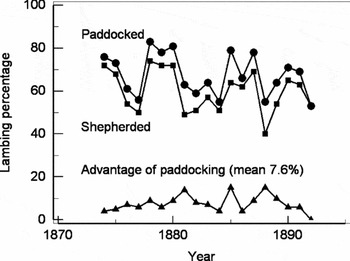
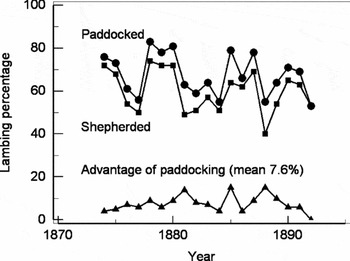
Lambing success is measured by the numbers of lambs surviving until ‘marking’, i.e. when male lambs are marked (castrated), tails are docked, and lambs are weaned. In New South Wales from 1874 to 1892 the mean advantage of paddocking was an increase of 7.6 per cent, a significant gain for pastoralists (figure 2). In good seasons, the advantage could be more than double at fifteen per cent.
Trend in lambing percentages of New South Wales sheep for 1874–1892, and the advantage of paddocked sheep over the same period.
Sources: Bruce (1875–76: 719) and Coghlan (1893: 572).
7. Using scrubby and coastal country
There are no data to support this claim. Presumably a detailed analysis of settlement patterns in these areas, and a search of archived files could provide the information. But it is likely to be confounded with the other factors changing at the time, e.g. legislative and government policy changes releasing this type of country for settlement.
The sum of advantages
Regardless of the lack of official data, there is no doubt that pastoralists recognised all or some of the advantages in fencing. The sum of these advantages must have made financial sense, or the pastoralists would not have adopted fences and discarded shepherds. Unfortunately, there are no statistics before 1886 showing the change in management from shepherding to paddocking. By 1886, the vast majority of sheep in New South Wales were managed in paddocks (figure 1) with very few either shepherded (3.8%) or shepherded in paddocks (2.5%). The change had occurred in the previous decades, and was essentially complete. By 1898, shepherding declined further to 0.9%, and paddocking increased to 97.9%. A few sheep (1.4%) were still managed by shepherds inside paddocks (Coghlan, Reference Coghlan1887–1900).
Fencing spreads across Australia
Although the first fences in the colonies appeared within a very few months of settlement at Sydney in 1788, relatively few farms were fenced for many years (Pickard, Reference Pickard1999). The cost was prohibitive for many struggling colonists, and fencing was not a good use of capital as Peter Cunningham (1827, vol. 2: 185) explained:
Capital expended in building, clearing of land, fencing, and the like, where such are not pressingly wanted, is completely lost to you for a time at least; but by expending it in stock, which will make you a speedy return of from twenty to thirty percent, you are soon enabled to carry on such improvements out of your income, while increasing your capital also. [emphasis in original].
Besides, English common law required stock-owners to fence their stock in, rather than farmers having to protect their crops by fencing stock out (Pickard, Reference Pickard1998). Once colonists found the rich grazing lands west of the Blue Mountains in 1813, flocks quickly expanded and were shepherded. Illegally occupying the land, the squatters had no incentive to fence.
As early as the late 1820s, the Land Commissioners for Van Diemen's Land (McKay, Reference McKay1962: 85) advocated fencing as a way of improving production. At this time, there were indeed fences and hedges, but most farms were not enclosed (Widowson, Reference Whitington1829). Even by 1850, fencing was not a ‘general characteristic of land holdings’ in Tasmania (Hartwell, Reference Hartwell1954: 130).
Although John McHaffie fenced his Phillip Island property with wire around 1842 this was exceptional. A decade later, at the time of the Victorian gold rushes, the most common fences were still either brush or the more expensive post-and-rail fences. In October 1852 north of Melbourne, Howitt, an astute observer of Australian landscapes, could not escape his British background. He wistfully described fence development as a simple linear progression leading inevitably to the zenith of fences: hedges in the English style:
The fields are enclosed by what they call brush fences, that is, simply the trees as they are felled thrown along in long lines, and their branches piled upon them. That is the first rude fencing of a new country, and we passed plenty of it. After these come posts and rails; and finally as cultivation and wealth advance, will planted hedges succeed. (Howitt, Reference Howitt1855, vol. 1: 53–4).
However, this was not to be. Cornish travelled by train west from Melbourne in the 1870s:
Through what seems an endless stretch of meadow-land, hedge-less and almost tree-less, yet divided into large rectangular fields by strong bar-fences about four feet in height. Sometimes these fences are varied with alternate lines of wood and wire, sometimes they consist of wire alone; but the bar-fence is the great characteristic of the country (1880: 147).
The supporters of live fences (hedges) had lost out to the technology of iron and steel. In a bizarre reading of history, Peel (1974: 58) conflates independent events in the early 1850s into cause and effect, suggesting that ‘post-and rail fencing became so expensive that wire fencing was quickly introduced’. Wire was already being tried, and found superior. In fact, wire fences were the first that many squatters and other land-holders built.
In the remote Kimberley region of Western Australia, fencing began in the 1880s, and because of the lack of suitable timber for posts, pastoralists imported iron posts as well as wire (Fyfe, Reference Fyfe1983: 147). The primary incentive was the lack of competent Aboriginal shepherds. On the margins of the Nullarbor Plain in southern Western Australia, shepherds were still being employed in 1898 (Gilbert, Reference Gilbert2000: 81–2). Fencing in the Northern Territory was much later. East of Alice Springs, Alex Kerr:
left the shepherding more and more to the natives because he had decided the time had come for him to begin fencing; the practice was still unknown among the sheep-owners in the district. There were some, like [his neighbour Charles] Chalmers, who contended that shepherding still had advantages over open grazing of sheep in paddocks, but even Chalmers admitted that the real argument against fencing was the prohibitive cost. Despite this Kerr decided to go ahead with it.
Some time later in 1937, Chalmers fenced his property where he and the Aborigines had previously shepherded (Ford, Reference Ford1966: 154, 172).
Not everyone was convinced that fencing was good in the long-term. Seeming to confuse almost wilful over-stocking in paddocks with a rosy backwards view of shepherding, Whitington (1897, unpaginated) suggested that:
What is wanted is a return to the shepherding days on advanced and improved lines. When the country was first taken up in the fifties it was pretty much all alike; and in the shepherding times, which continued up to about 1874, when fencing began.
Sheep were deliberately moved around the watering points to better use the pastures. Sheep were also moved from summer to winter camps to follow rain, and allow the country to recover. According to Whitington:
The land improved during the shepherding days, and was on the whole in a better condition when the sheep were turned adrift into the large paddocks than it was when first taken up. But the owners continued year after year to live on their capital. The stock were left on the same country all the year round, and they slowly but surely ate it out around the wells without the lessees realizing what was taking place . . . . Put in a nut shell, the whole matter amounts simply to this. Through want of legislation, or through lack of knowledge, these paddocks have too long been left too large, and the natural bush has been eaten out round the permanent waters.
Whitington was actually criticising poor management rather than fences per se. He was one of the very first to realise what remains a national problem of poor management of Australian semi-arid rangelands (McKeon et al., 2004). There is some irony that earlier observers criticised shepherding from fixed huts and hurdle yards as causing similar problems.
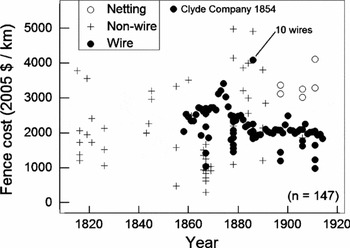
As fencing expanded, costs fell (figure 3) and wire fencing became more and more cost-competitive with other fence styles, with the bonus of somewhat easier maintenance and better resistance to fires than cheaper brush and log fences. In 1854 the Clyde Company paid the extraordinary sum of £200 per mile ($5555 km−1 in 2005 dollars) for wire fencing with iron posts (Brown, Reference Brown1968: 70). Within a few years, prices were fifty per cent lower, and steadily fell in the early twentieth century to about $2000 km−1. In 2006, a typical wire fence costs about $2500 km−1.
Fence costs (in 2005 Australian dollars) from 1815 to 1914. Two exceptional values are noted: $5555 km−1 paid by the Clyde Company in western Victoria in 1854 for iron fences, and a ten-wire fence in south-western Queensland in 1886.
Sources: multiple contemporary sources. Clyde Company: Brown, Reference Brown1968: 70; ten-wire fence: Rothery, 1879: 53.

Conclusion: the necessary and sufficient conditions for fencing
The acquisition and adoption of agricultural technology in third-world countries is far from a simple process (Bell, Reference Bell and Cooper1973). It is not too far-fetched to regard colonial Australia as third world in today's terms. There are numerous hurdles, including prior experience with an existing technique which may lead to inertia. The difficulty of trying to understand the adoption of fencing in the Australian colonies is that many things were changing simultaneously: sheep breeds (and thus yields), dingo control, wages, prices, security of land tenure, cost of finance, etc.
Responding to acute labour shortages and concomitant high wages in the 1840s, flock-owners increased flock sizes (Pickard, in press: figure 3), thus reducing the cost per head of shepherding (Pickard, in press: figure 4). This is the classic response of employers to expensive labour: force an increase in productivity. An alternative response would be to substitute capital, i.e. fences, for labour. However this did not happen widely because of the lack of capital and costs of servicing debts. It was not because of lack of knowledge of either fences or of the advantages of open-camping sheep. Both were well-known by 1851. With strychnine controlling dingoes, and better land tenure, conditions were ripe for the end of shepherding. During the gold rushes when the population suddenly increased many-fold leading to seemingly limitless demand for meat, the balance finally tipped against labour. The shortage of shepherds meant that squatters either had to invest in fences, or miss reaping the benefits of the booming market. Typically they did not erect traditional fences, rather, they adopted the relatively new technology of wire.
Although shepherding now seems quaint, it was and remains an ideal sheep management system under a broad range of social, cultural and environmental conditions. It has survived relatively unchanged for millennia, because it is cost-effective, productive, and in many societies, an integral part of community life. However, the sheep management system being developed in nineteenth century Australia was based on forced and later hired labour with no commitment to the flock, and once export markets were established, the sheep were simply the start of a global industrial system, far removed from the family units of traditional pastoralism. With no social conditioning to maintain shepherds, flock-owners exploited every opportunity to increase the productivity of their workers. The first came with increased flock sizes. The second was open-camping, a more complex change, but one leading to better production. This was a technological change from the British shepherding system adopted in Australia. The subsequent change to fences was a technological revolution, replacing labour with capital.
The transition from shepherding to fencing in South Africa offers informative parallels with Australia. The system of head stations and out-stations was similar, but much older, arriving at ‘the Western Cape some 2000 years ago, having taken a further 6000 years to travel down the continent from North Africa’ (Archer, Reference Archer, Dovers, Edgecombe and Guest2002: 126). In the late nineteenth century the traditional shepherd-and-kraal (i.e. shepherd and yards) system was widely accepted to have the same problems as shepherding in Australia some three decades earlier. Evidence at an 1889 Select Committee could well have come from Gordon's (1867) pamphlet, as witnesses described the advantages of fencing in almost identical terms (South Africa, 1889). Pastoralists faced a more difficult choice in South Africa because labour was relatively very cheap compared with Australia, and thus was less important in the decision to invest in fences. However in a remarkable parallel to the huge increase in demand for meat during the Australian gold rushes, a similar rise occurred on the Kimberley diamond fields in 1870. Fencing, to increase production, suddenly became a profitable investment (Archer, Reference Archer, Dovers, Edgecombe and Guest2002: 123).
The advantages of using fences instead of shepherds had been known for centuries: ‘And thoughe a man be but a farmer, and shall haue his farme xx yeres, it is lesse coste for hym, and more profyte, to quyckset, dyche, and hedge, than to haue his cattell goo before the herdeman’. (Fitzherbert, Reference Fitzherbert1534: 77) [Translation: ‘Although a farmer's tenancy may be only twenty years, it is cheaper for him, and he will make more profit if he fences with ditch and hedge, than to have his stock roam freely in front of the shepherd’.] So perhaps the question should be ‘why did fencing take so long?’ rather than ‘why did shepherding persist so long in the colonies?’ The simplest answer appears to be that the fencing revolution could not be widespread in Australia until an historical conjunction of technological and economic changes: effective poisoning of dingoes with strychnine (from 1819), introduction of iron wire (1840s), better land tenure (from 1847), progressive reduction of Aboriginal populations, huge demand for meat (from 1851) and high wages (from 1851).
It is difficult to understand why Australian flock-owner apparently lost, and then re-discovered key aspects of the transition to fences. Examples are mainland owners ‘discovering’ the advantages of open-camping decades after Tasmania; forgetting in many places and over many decades that dingoes ate sheep; and rediscovering the advantages of strychnine two decades after its introduction to Australia. But perhaps the biggest re-discovery of technology was adopting fences, a suggestion made some five hundred years earlier. Regardless of this delay, and the uneven adoption and spread of fences in Australia, today tens of million of kilometres of fences subdivide the landscape, forming the basic unit of flock management: the paddock.
Acknowledgements
The Department of Physical Geography, Macquarie University provided funding for parts of this study. I thank Associate Professor Geoff Humphreys (Department of Physical Geography) and Dr Trish Fanning (Graduate School of the Environment, Macquarie University) for numerous helpful comments and suggestions on the manuscript. Dr Sean Archer (Economics Department, University of Cape Town) generously gave me a copy of the rare report of the 1889 South African Select Committee on Fencing.