Implications
Amniotic fluid (AF) covering the neonate has a dual function in regulating maternal behaviour in the ewe. AF stimulates maternal responsiveness towards neonates, facilitating their initial acceptance by mothers. AF also carries individual olfactory cues from the neonate, facilitating the establishment of a selective maternal bond. Therefore, when considering fostering of alien lambs, AF may have contradictory effects: while facilitating maternal responsiveness, it also provides cues leading to the rejection of the lamb to be fostered. The identification of the chemical compounds involved in these two aspects of maternal care is necessary for using AF as an aid to fostering.
Introduction
Bonding between the parturient ewe and her neonate develops in two tightly interconnected steps (Poindron et al., Reference Poindron, Keller and Levy2007). First, under the influence of physiological factors, the parturient mother displays an immediate interest in her neonate or an alien newborn lamb that is presented to her at that time (Hersher et al., Reference Hersher, Richmond and Moore1963; Poindron and Le Neindre, Reference Poindron and Le Neindre1980; Lévy and Fleming, Reference Lévy and Fleming2006). Second, while she is licking her neonate and interacting with it, the mother establishes a selective bond within less than 2 h. Thereafter, the mother accepts only her own lamb at the udder and rejects any alien lamb that tries to suckle (Smith et al., Reference Smith, Van-Toller and Boyes1966; Poindron and Le Neindre, Reference Poindron and Le Neindre1980; Keller et al., Reference Keller, Meurisse, Poindron, Nowak, Ferreira, Shayit and Levy2003). The establishment of this maternal selectivity relies on the learning by the mother of the olfactory individual signature of her lamb (Kendrick et al., Reference Kendrick, Da Costa, Broad, Ohkura, Guevara, Lévy and Keverne1997; Lévy and Fleming, Reference Lévy and Fleming2006).
The immediate interest of the mother in her neonate, and thus the initial establishment of contact between them, depends largely on the olfactory attraction that the mother displays towards amniotic fluid (AF) at parturition (Lévy et al., Reference Lévy, Poindron and Le Neindre1983; Lévy and Poindron, Reference Lévy and Poindron1987). This attraction is not specific to the identity of the neonate on which it has been collected. At parturition, ewes are attracted by any AF regardless of its origin, as long as it belongs to the same species (Lévy et al., Reference Lévy, Poindron and Le Neindre1983; Arnould et al., Reference Arnould, Piketty and Lévy1991). Furthermore, the presence of AF on an alien lamb facilitates its adoption by a parturient ewe (Poindron et al., Reference Poindron, Le Neindre, Raksanyi, Trillat and Orgeur1980 and Reference Poindron, Le Neindre, Lévy and Keverne1984). Conversely, removing AF from the coat of the lamb by washing the neonate with water prevents the onset of maternal behaviour in parturient ewes without previous experience. These inexperienced mothers fail to accept their lamb at the udder and display aggressive behaviour towards them (Lévy and Poindron, Reference Lévy and Poindron1987). In ewes with previous maternal experience, washing the neonate only disturbs licking behaviour, but mothers still display all the signs of maternal care and accept their lamb at the udder (Lévy and Poindron, Reference Lévy and Poindron1987).
In addition to its general attractiveness, AF may also contain cues about the identity of the neonate and may therefore influence the development of the second step of maternal behaviour, maternal selectivity. For example, even though smearing a dry alien lamb with any AF facilitates its acceptance by a parturient ewe, the inhibition of aggressive behaviour is more marked with AF from the mother’s own neonate (Lévy and Poindron, Reference Lévy and Poindron1984). The presence of individual olfactory cues in AF may also explain why about 30% of mothers already displayed maternal selectivity as soon as the foetus was expelled in the study of Keller et al. (Reference Keller, Meurisse, Poindron, Nowak, Ferreira, Shayit and Levy2003), as these mothers had prepartum access to individual olfactory cues of their lamb by consuming AF on the ground after the rupture of the water bag. Nonetheless the role of AF in the establishment of maternal selectivity has still to be demonstrated. If AF carries some individual olfactory cues from the lamb as indicated by the results of Lévy and Poindron (Reference Lévy and Poindron1984), it could be expected that washing AF off the coat of the neonate will impair maternal selectivity.
Access to AF by the mother can also be impaired by placing the neonate in a double-wall weld-mesh cage preventing the consumption of AF (Poindron et al., Reference Poindron, Lévy and Krehbiel1988 and Reference Poindron, Keller and Levy2007; Otal et al., Reference Otal, Lévy, Cornilleau, Moussu, Keller and Poindron2009). Similarly to washing AF off the coat of the neonate, this caging of the lamb led to its rejection in half of the inexperienced mothers, while no effect was found in experienced mothers (Otal et al., Reference Otal, Lévy, Cornilleau, Moussu, Keller and Poindron2009). In addition, preventing physical contact between the mother and her neonate for 4 h impaired the establishment of maternal selectivity in experienced mothers, suggesting that AF contains some individual olfactory cues contributing to the establishment of maternal selectivity.
As maternal selectivity is a factor preventing adoption of orphan lambs by alien mothers in sheep, the impairment of bonding by caging the lamb could be beneficial to improving the success of fostering techniques. However, even though depriving the mother of access to AF by caging impairs the establishment of maternal selectivity in experienced ewes, the effects are not sufficient to make this technique attractive to performing adoptions on a practical basis (Otal et al., Reference Otal, Lévy, Cornilleau, Moussu, Keller and Poindron2009). On the other hand, the consequences of depriving maternal access to AF by washing the neonate on maternal selectivity have not been documented to our knowledge. The combination of these two techniques of sensory deprivation may be complementary to preventing perception of individual olfactory cues from the neonate contained in AF. Their combination could prove more successful to delaying maternal bonding efficiently and facilitate the adoption of alien lambs. This seems particularly relevant to testing in experienced ewes, as neither washing of the neonate nor deprivation of its physical contact impair the ability of the parturient mother to care for a lamb. Therefore, in the present study we investigated whether depriving experienced mothers of access to AF, either alone or in association with the privation from physical contact with the lamb during 4 h, could delay the establishment of maternal selectivity.
Material and methods
Animals and general maintenance conditions
Animals were Ile-de-France ewes coming from the main flock maintained at the Experiment Farm of INRA, Nouzilly, France. Only ewes with previous maternal experience – thereafter called multiparous – were used. Details of breeding management were the same as those described by Otal et al., Reference Otal, Lévy, Cornilleau, Moussu, Keller and Poindron2009. Briefly, ewes are kept indoors in groups of 30 animals or more and fed according to the requirements of their physiological state. Reproduction is synchronized at mating, so that groups of at least 30 females that mated the same day are available for experimentation.
The experiment was carried out in March and April 2009, on two successive waves of lambing 1 week apart. The experimental groups were balanced over the two waves. For each wave, 30 ewes were housed in a building equipped with individual pens in which they were transferred 3 days before the start of the experiment. On day 145 of pregnancy, parturition was induced with an intramuscular injection of 16 mg of dexamethasone (Dexadreson, 2 mg/ml, Intervet, Beaucouze, France), to ensure the grouping of births within a time window of 48 h, starting 36 h after the injection of dexamethasone. Only ewes lambing during this time window were used in the experiment.
Experimental design and management during the experiment
Two independent factors were studied, resulting in a 2 × 2 design and four experimental groups (Table 1). The first factor consisted of washing the neonate or not with water immediately after birth, as in the experiment of Lévy and Poindron (Reference Lévy and Poindron1987). No detergent was used, as the results of that previous study had shown that it did not improve the effect of washing and using only water also avoided the possibility of contamination with the odour of the detergent. The second factor was the privation of physical contact between the mother and her own lamb during the first 4 h following birth, before testing maternal behaviour and selectivity. The acceptance of lambs was tested at 4 h post partum, when 80% or more of mothers have already established maternal selectivity, accepting their own lamb at the udder and rejecting any alien that tries to suckle in undisturbed conditions (Smith et al., Reference Smith, Van-Toller and Boyes1966; Poindron and Le Neindre, Reference Poindron and Le Neindre1980; Keller et al., Reference Keller, Meurisse, Poindron, Nowak, Ferreira, Shayit and Levy2003).
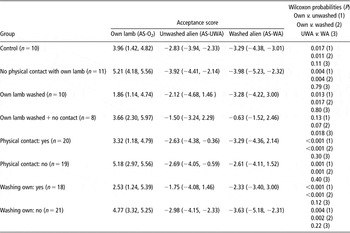
Comparison of acceptance scores (median and quartiles) between the own and unwashed or washed alien lambs in multiparous Ile-de-France ewes

Control = unwashed lamb free to interact with its mother; Washed = lamb washed just after birth and free to interact with its mother; No physical contact = unwashed lamb caged inside its mother’s pen; Washed + no contact = lamb washed just after birth and caged inside its mother’s pen.
For the washed alien condition, alien lambs were washed just after birth. The tests were performed at 4 h post partum. Only ewes that accepted their own lamb are included.
Four experimental groups were thus constituted:
1. Control group (C, n = 10): Ewe kept with own unwashed lamb, with full physical contact and interaction between the mother and her lamb for 4 h.
2. Washed group (W, n = 10): Ewe kept with own lamb washed at birth, with full physical contact and interaction between the mother and her lamb for 4 h.
3. No physical contact group (NPC, n = 12): Ewe kept with own unwashed lamb, placed in a double-wall wire mesh cage (60 cm × 60 cm × 60 cm), with its lid closed so that the mother could not have any physical contact with her lamb for 4 h.
4. Washed and NPC group (W + NPC, n = 15): Ewe kept with own lamb washed at birth and placed in a double-wall wire mesh cage as in the NPC group.
When a ewe was about to lamb, she was allocated to one of the four experimental groups. In case of multiple births, only the first-born lamb was used. Ewes from the control group were allowed to lamb normally and could consume AF spilled on the straw litter before giving birth to the first lamb. When expulsion was imminent (head and forelegs out), an observer assisted the ewe in the last phase of expulsion and took the lamb to another room, where it stayed 20 min before being returned to its mother. This time corresponded to the time necessary to wash the lambs before returning them to their mothers in the W and W + NPC groups (see below). In the meantime, the presence of additional lambs was verified and the lambs were taken away to a nursery room where they were artificially reared. For ewes allocated to the NPC group, the procedure was the same, except that upon reunion with the mother, the lamb was placed in a double-wall wire mesh cage for 4 h. In the two groups in which mother–young contact was prevented (NPC and W + NPC groups), the lambs were fed with 75 ml of de-frozen cow colostrum at 2 h post partum with a gastric probe. To this end, the lamb was taken out of its cage and fed in front of the pen. The procedure took at most 3 min and the ewe could see her lamb all the time, while physical contact was prevented by the presence of the cage between her and the experimenter. In the groups in which the lamb was caged, the width of the pen was reduced to 80 cm during the 4 h of treatment, so that mothers stayed in close contact with their lamb.
For washing, the lamb was taken to a contiguous room and placed in a bathtub for babies filled with water at 35°C to 38°C. The lamb was cleaned by two persons, one holding it and the other cleaning its coat in two sessions by scrubbing with a soft brush for 5 min each time and changing the water between each session. Then, the lamb was rinsed again twice in another bathtub, using clean water each time. When the washing procedure was finished, the lamb was dried as much as possible with disposable paper towels before being returned to its mother and allocated to its experimental group.
Behavioural test
After 4 h of treatment, the own lamb was separated from its mother, the cage removed from the pen if applicable, and the mother underwent two successive tests of acceptance of an alien lamb, followed by a test of acceptance of her own lamb. One of the two tests with an alien was performed using a lamb that had been washed at birth and the other test with an alien lamb that had not been washed. Thus, a given ewe was tested with one alien lamb that had the same treatment and physical aspect as her own (washed or not washed), as well as with an alien of the other condition. Each test lasted 3 min and the order of testing for the two types of alien lambs was balanced within each group. The alien lambs came from the last mother–young pairs that had been tested just before, so that the ages of the alien lambs were as close as possible as that of the own lamb. However, because of this constraint one mother of the control group and one mother of the W + NPC group could not be tested with a washed alien lamb. During the test, the following behavioural variables were recorded by two trained observers on preformatted sheets of paper:
Acceptance behaviours:
1. Number of low-pitched bleats (emitted mouth closed; LB).
2. Number of acceptances at the udder (number of times that the lamb engaged the head in the inguinal region, without any sign of rejection by the mother; AU).
3. Nursing time (s) (time spent by the lamb at the udder, head engaged in the inguinal region during at least 5 s without any interruption by the lamb or the ewe; NT).
4. Duration of licking of the lamb by the ewe (s; LT).
Rejection behaviours:
1. Number of high-pitched bleats (emitted mouth open; HB).
2. Number of aggressive behaviours (head butts and threats; AG).
3. Number of udder rejections (number of times that the lamb engaged the head in the inguinal region and was interrupted within less than 5 s by the ewe moving away, back leg movement or aggressive behaviour; RU).
Analysis of the data
Data were analysed in two steps. First, the behaviour of mothers towards their own lamb was compared between the groups to verify any possible effects of washing and privation of contact on the maintenance of maternal behaviour. Second, maternal selectivity towards the two types of alien lambs was analysed, excluding mothers that had failed to accept their own lamb during the test, as selectivity of maternal behaviour can be studied only in mothers that are maternal towards their own lamb. Both for the own and the alien lambs, the analysis of the data was carried out using two complementary approaches. A qualitative approach was used to classify each ewe as maternal or not maternal and, for maternal ewes, as selective or not selective. In addition, a quantitative approach was taken to compute an acceptance score, which was then compared between groups and types of lambs.
Behaviour towards the own lamb
The following criteria were used to classify qualitatively each mother individually as maternal or not maternal:
A mother was considered to be acceptable of her own lamb if:
1. She nursed her lamb and did not display any aggressive behaviour during the test.
2. Or if, in the absence of nursing and of any aggressive behaviour, she displayed more acceptance behaviours than rejection behaviours. With respect to vocalisations, if the mother emitted more low-pitched bleats than high-pitched bleats (ratio LB/(LB + HB) ⩾0.5), this was considered as an acceptance behaviour.
A mother was considered as rejecting her own lamb if:
1. She displayed some aggressive behaviour and no nursing during the test.
2. Or if, in the absence of these two behaviours, she displayed more rejection behaviours than acceptance behaviours. With respect to vocalisations, if the mother emitted fewer low-pitched bleats than high-pitched bleats (ratio LB/(LB + HB) <0.5), this was considered as rejection behaviour.
In all other cases, that is, if there were as many acceptance behaviours as rejection behaviours, the acceptance of the lamb was classified as ambiguous.
Regarding the quantitative score of acceptance, it was computed as follows. Each behavioural variable recorded during the test for the own lamb (VARi) was standardized (Z VARi, mean = 0, s.d. = ±1), so that all the variables would have the same weight. Then, the acceptance score for the own lamb, AS-O. was computed by adding all standardised behaviours of acceptance and subtracting all standardised behaviours of rejection, according to the following formula:

The higher the algebraic value of AS-O is, the more marked is the acceptance of the lamb. It is important to bear in mind that the values of this score are relative and that a negative score for a group or an individual mother does not necessarily mean a lack of acceptance of her lamb, but only that the level of acceptance displayed in that group or by that given mother is lower than that for a score with a higher value.
It is also important to emphasize that the individual values of the acceptance score depend on the animals included in the standardisation and that for each type of comparison, scores must include only the animals involved in the comparison. Therefore, for the own lamb, two acceptance scores were used. First, an acceptance score AS-O1 was computed using the behavioural data for the own lambs of all ewes, to study the effects of treatment on maternal behaviour towards the own lamb. Second, to compare the acceptance score of the own lamb with that of each type of alien lamb, another score AS-O2 was computed, taking into account only the ewes that had been classified as maternal according to the qualitative criteria presented above, and included in the standardisation process the data of the two alien lambs (washed and unwashed; see below).
Behaviour towards the alien lambs (selectivity)
Only ewes that were qualitatively classified as maternal towards their own lamb were used in the analysis of selectivity. For the qualitative analysis, the ewes were individually classified as selective (rejecting both alien lambs), non-selective (accepting both alien lambs) or ambiguous (accepting one of the alien lambs and rejecting the other), according to the same criteria of acceptance as those used for the own lamb.
For the quantitative analysis of the behaviour towards the alien lambs, the same approach was taken as for the own lamb. A quantitative score of acceptance of the alien lambs was computed using the same formula (1) as for the own lamb. In this case, we compared the acceptance scores among the four groups, but also among the three lambs to test whether maternal selectivity was affected by the treatments applied to the own lamb and/or by the fact that the alien lamb used during the test had also been washed or not. Comparing acceptance scores between the two types of alien lambs offered the opportunity to investigate the overall effect of washing neonates on their fostering by an alien mother. To compute these acceptance scores, we standardised each variable in a single step in including the values of the own, the washed and the unwashed alien lambs, to produce an acceptance score for each lamb (own: AS-O2; unwashed alien: AS-UWA1; washed alien: AS-WA1). The acceptance score for the own lamb AS-O2 differed from AS-O1 for two reasons: (a) only maternal ewes were taken into account and (b) data for the alien lambs were also included at the time of standardisation.
Statistical analyses
Proportions of maternal and of selective mothers were compared among the four groups with the test of the exact probabilities of Fisher–Freeman–Halton for R × C tables, and with exact probabilities of Fisher for 2 × 2 comparisons (StatXact, version 6, Cambridge, MA, USA; Cytel Studio© 2004). The comparisons of proportions for the dependent samples were carried out using a McNemar test for change. For the analysis of quantitative data, non-parametric statistics have been used, given the small size of groups and large heterogeneity of variance. Overall differences of acceptance scores between groups have been tested by Kruskal–Wallis tests, followed by the comparison of the control condition v. the Washing and the contact deprivation conditions by the Mann–Whitney tests. Acceptance scores among the own, unwashed alien and washed alien lambs were compared using Friedman and Wilcoxon tests (Systat 10, SPSS, Chicago, IL, USA, 2000).
Ethical note
Animal care and experimental treatments complied with Guidelines A37801 of the French Ministry of Agriculture for animal experimentation. Non-experimental lambs and lambs that were rejected by their mother during the experiment were artificially reared as part of the routine procedure for supernumerary lambs on the farm. All experimental and non-experimental lambs survived and did not show any signs of growth impairment or health disturbances.
Results
Behaviour towards the own lamb
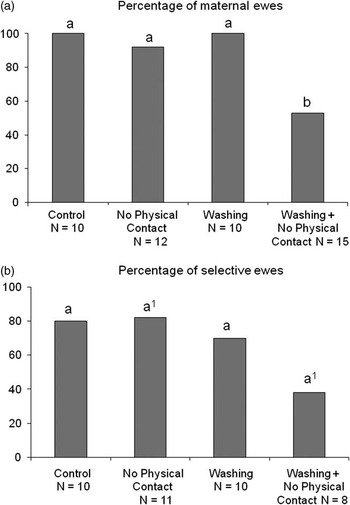
The proportion of mothers that accepted their own lamb at the end of the 4 h of treatment differed among the groups (Fisher–Freeman–Halton, P = 0.003; Figure 1). The proportion of mothers accepting their own lamb following washing or deprivation of physical contact did not differ significantly from that found in control mothers (P = 1), whereas this proportion was significantly lower than in any other group when both treatments were combined (W + NPC group v. C group, Fisher’s exact P = 0.02; W + NPC v. NCP, P = 0.04; and W + NPC v. W, P = 0.02).
Proportions of maternal (a – top) and selective (b – bottom) mothers at 4 h post partum in multiparous Ile-de-France ewes, whose young had been either washed or not at birth, and/or deprived of physical contact by caging the lamb before testing; C = unwashed lamb free to interact with its mother; NPC = unwashed lamb caged inside its mother’s pen; W = washed lamb free to interact with its mother; W + NC = washed lamb caged inside its mother’s pen. Histograms with different letters differ significantly (two-tailed Fisher’s exact P < 0.05; bottom: a1, P = 0.07).

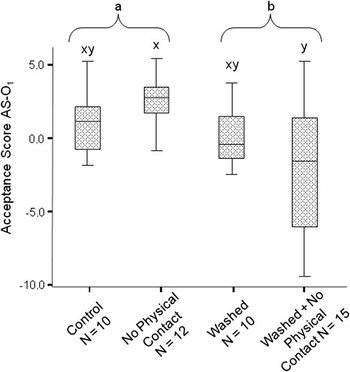
The acceptance score for the own lamb AS-O1 differed significantly among mothers of the four groups (Kruskal–Wallis = 8.05, P = 0.045; Figure 2), although no experimental group differed significantly from the control group (Mann–Whitney test, C v. NPC, P = 0.09; C v. W, P = 0.50; C v. W + NPC, P = 0.12). Nonetheless, AS-O1 was significantly higher in the NPC group than in the W + NPC group (Mann–Whitney U = 136, P = 0.03). In addition, when pooling data according to whether neonates had been washed or not, AS-O1 was significantly lower for the lambs that had been washed than for the lambs that had not been washed (W and W + NPC: −0.50 (−2.91, 1.49); C and NPC: 1.95 (0.36, 3.05); U = 388, P = 0.02). On the other hand, there was no significant effect of deprivation of contact as a whole: AS-O1 did not differ significantly between mothers that had been deprived of contact with their neonate and those that could interact fully with them (C and W: 0.58 (1.24, 1.84); NPC and W + NPC: 1.73 (−3.94, 3.01); U = 277, P = 0.88).
Acceptance score (median and quartiles) of the own lamb at 4 h post partum in multiparous Ile-de-France ewes, whose young had been either washed or not at birth, and/or deprived of physical contact by caging the lamb before testing. (Kruskal–Wallis; P = 0.045); control = unwashed lamb free to interact with its mother; washed = washed lamb free to interact with its mother; no physical contact = unwashed lamb caged inside its mother’s pen; washed + no contact = washed lamb caged inside its mother’s pen. Groups with different letters differ significantly, Mann–Whitney test (a v. b: P = 0.02; x v. y, P = 0.03).

Behaviour towards the alien lambs
Only ewes that accepted their own lamb during the test at 4 h were included in the study of maternal selectivity.
Proportion of selective mothers
The proportion of maternal ewes that rejected both washed and unwashed alien lambs did not differ significantly among the four groups (Fisher–Freeman–Halton, P = 0.20; Figure 1). In addition, despite being the lowest, the proportion of selective mothers in the W + NPC group, combining washing and privation of physical contact, did not differ significantly from those observed in the other groups (W + NPC v. C: P = 0.14; W + NPC v. NPC: P = 0.07; W + NPC v. W, P = 0.34). Furthermore, the total proportion of selective mothers did not differ between mothers whose own lamb had been washed (W and W + NPC groups, 10/18) and those whose own lamb had not been washed (C and NPC groups, 17/21, Fisher’s exact P = 0.16). Besides, the proportion of mothers accepting an alien lamb did not differ according to whether it had been itself washed or not (washed: 26/37, unwashed: 25/37; Mc Nemar test for change, P = 1.0).
Comparison of the acceptance score between the own lamb and the two types of alien lambs and depending on the treatment
There was an overall difference between the acceptance scores of the own (AS-O2), unwashed alien (AS-UWA) and washed alien lambs (AS-WA) in the C, NPC and W + NPC groups (Friedman test ⩾8.00, P ⩽ 0.018; Table 1), and the difference was close to significance in the W group (Friedman test = 5.6, P = 0.06; Table 1). AS-WA and AS-UWA differed significantly from AS-O2 in the C, W and NPC groups (Wilcoxon test, Z ⩾ 2.40, P ⩽ 0.017), whereas the difference did not reach significance in the W + NPC group (own v. unwashed alien: Z = −1.52, P = 0.13; own v. washed alien: Z = 1.82, P = 0.07). The difference between the score of the own lamb and the two alien lambs was also significant when considering all the mothers whose own lamb had been washed v. not washed or depending on whether the mothers had been deprived or not of physical contact (Table 1).
When comparing the acceptance of the two alien lambs, there was a significant difference only in the W + NPC group, in which AS-WA was higher than AS-UWA (Wilcoxon, Z = −2.37, P = 0.02). In all other cases, no significant differences were found (P ⩾ 0.11; Table 1).
Effects of the treatment applied to the own lamb on the acceptance of washed and unwashed alien lambs at 4 h post partum.
Washed alien lamb
The acceptance score of the washed alien lamb AS-WA differed significantly among the four groups (Kruskal–Wallis test = 7.79, P = 0.05; Table 1). In the pair-wise comparisons among the groups, AS-WA was significantly higher in the W + NPC group than in the control group (U = 6, P = 0.007), whereas it did not differ significantly between the W or the NPC groups and the control group (P ⩾ 0.37). In addition, when comparing all ewes whose own lamb had been washed v. those whose lamb had not been washed, AS-WA was significantly higher when the own lamb had been washed (U = 100, P = 0.03), whereas this was not the case for the deprivation of physical contact (U = 146.5, P = 0.23; Table 1).
Unwashed alien lamb
The acceptance score of the unwashed alien lamb, AS-UWA, did not differ significantly among groups (Kruskal–Wallis test = 2.52, P = 0.47; Table 1) or between any treatment conditions (P ⩾ 0.23 in all cases).
Discussion
In this study, depriving mothers of access to AF during the first 4 h post partum had significant consequences both on maternal responsiveness and on maternal selectivity, supporting the main hypothesis that AF is important for the development of these two components of maternal behaviour in sheep. Maternal responsiveness, as measured by the acceptance score for the own lamb, was reduced in ewes whose neonates had been washed. This effect of washing was even heightened when access to AF was prevented more severely, by combining washing and privation of physical contact, which resulted in the rejection of the neonate in nearly 50% of the mothers. Finally, in mothers that did not reject their young, privation of AF by washing the neonate also impaired to some extent the formation of an exclusive maternal bond with the own lamb, as it resulted in a better acceptance score of the washed alien lamb but not of the unwashed alien. Again, as for maternal responsiveness, the impairment on selectivity was most marked in the W + NPC group, in which washing the own neonate and prevention of contact were combined.
Previous results had shown that AF is important for the immediate display of maternal behaviour and for its maintenance in inexperienced ewes, whereas its absence could be compensated for in experienced mothers (Lévy and Poindron, Reference Lévy and Poindron1987; Otal et al., Reference Otal, Lévy, Cornilleau, Moussu, Keller and Poindron2009). The significant impairment encountered in this study when using a more severe deprivation (washing and preventing physical contact) indicates that AF is also critical for the maintenance of maternal responsiveness in experienced mothers. This major effect of combining washing and deprivation of physical contact could be interpreted as the result of adding deprivation of tactile cues from the neonate important to the mother to the privation of olfactory cues by washing. For example, tactile cues are known to play an important role in the regulation of post partum maternal care in the rat (Numan et al., Reference Numan, Fleming and Levy2006). Nonetheless, this seems unlikely in this study as, if anything, privation of contact by itself tended to result in an increase of the acceptance score for the own lamb (Figure 2). In addition, no evidence of an effect of tactile deprivation has been reported in any of the previous studies in which nursing or all physical contact had been prevented for periods ranging from 4 to 8 or 12 h (Poindron and Le Neindre, Reference Poindron and Le Neindre1980; Poindron et al., Reference Poindron, Lévy and Krehbiel1988; Otal et al., Reference Otal, Lévy, Cornilleau, Moussu, Keller and Poindron2009). Rather, results from the literature indicate that depriving the mother of physical contact with her neonate impairs the perception of olfactory cues from the young, even when acceptance of the neonate is not disturbed (Poindron et al., Reference Poindron, Keller and Levy2007; Otal et al., Reference Otal, Lévy, Cornilleau, Moussu, Keller and Poindron2009). Therefore, it is most likely that the major impairment of acceptance of the neonate in the W + NPC group resulted from a more efficient deprivation of olfactory cues from the lamb in that group than that obtained by washing or prevention of physical contact alone.
With regard to maternal selectivity, our results indicate that AF contributes to the establishment of exclusive bonding, as washing the own lamb resulted in a more positive acceptance score for the alien lamb, at least for washed alien lambs. This effect of washing the neonate may be explained by at least two distinct and non-exclusive mechanisms. First, washing may reduce the general level of maternal attention towards the neonate, as AF has a stimulating effect on licking and maternal responsiveness (Poindron et al., Reference Poindron, Le Neindre, Raksanyi, Trillat and Orgeur1980; Lévy and Poindron, Reference Lévy and Poindron1984 and Reference Lévy and Poindron1987). This could in turn impair the efficiency of the mother in memorizing relevant olfactory cues involved in bonding, as well as the time she will be exposed to them. Second, if AF contains individual olfactory cues from the lamb, washing will reduce not only the time during which these cues are perceived by the mother, but it will also reduce to very small amounts the quantity of individual olfactory cues to which the mother can have access through licking. This reduction of olfactory stimulation would in turn impair the establishment of maternal selectivity. The fact that maternal selectivity was consistently impaired only when washing of the own neonate and of the alien lamb was combined, supports this last possibility. If the impairment of selectivity by AF deprivation were only due to a lack of attraction and reduced focusing towards the own lamb, it would have similarly affected the acceptance of both types of alien lambs. The same would also apply if washing had only reduced the time of exposure to cues that were not contained in AF. Although impairment of selectivity related with the general attractiveness of AF is possible, it cannot explain the better acceptance of the washed alien lamb compared with that of the unwashed one encountered here. Rather, this difference indicates that washing the neonate reduces the source of individual cues normally contained in AF, which are used by mothers not only to bond to their own young, but also to reject alien lambs.
Another possibility to explain that only the acceptance of washed alien lambs was facilitated by washing the own lamb could have been that this better acceptance was due to some supra-individual resemblance between the own and the alien lambs because they had both been washed. If this had been the case, the same effect would have also been observed for the unwashed alien lamb, which should have been better accepted than the washed alien by mothers whose own lambs had not been washed. However, this was not the case. Therefore, the better acceptance of washed alien lambs found when washing the own neonate, is best explained by the reduction of the source of individual cues of the own lamb available for learning the individual signature, combined with the reduction of the source of individual cues of the alien available at the time of testing.
Contrary to washing of the neonate, there was no indication that deprivation of physical contact alone had any significant effect on maternal selectivity. This indicates that when AF is present, individual cues can be perceived sufficiently well for a majority of mothers to establish a selective bond. This agrees with previous results (Poindron et al., Reference Poindron, Lévy and Krehbiel1988 and Reference Poindron, Keller and Levy2007). In contrast with this limited effect of only deprivation of contact (see also Otal et al., Reference Otal, Lévy, Cornilleau, Moussu, Keller and Poindron2009), combining washing and privation of contact (W + NPC group) resulted in the highest effect, presumably as perception of all olfactory cues was minimal in this group. In addition, only 38% of mothers were selective in this W + NPC group, twice lower than in the other groups. Therefore, as for the acceptance of the own lamb, the combination of washing the neonate and caging produced the strongest disturbances of maternal selectivity, even though the differences did not always reach significance, because of the reduced number of mothers that remained maternal in that group.
To conclude, AF has a dual function for maternal behaviour. On the one hand, AF possesses a general supra-individual attractive quality for all parturient mothers (Lévy et al., Reference Lévy, Poindron and Le Neindre1983 and Reference Lévy, Kendrick, Keverne, Porter and Romeyer1996) and this facilitates the acceptance of any lamb, including aliens (Poindron et al., Reference Poindron, Le Neindre, Raksanyi, Trillat and Orgeur1980; Lévy and Poindron, Reference Lévy and Poindron1984 and Reference Lévy and Poindron1987; Lévy et al., Reference Lévy, Locatelli, Piketty, Tillet and Poindron1995). On the other hand, AF also carries individual cues from the lamb that help in developing maternal selectivity and recognition of the own neonate, thus preventing the acceptance of alien lambs whose AF bears a different olfactory signature. However, preventing the perception of AF cues by washing the neonate and caging is not sufficient for these treatments to be used as effective fostering methods on a practical basis, precisely because of this dual function of AF. Further studies are therefore necessary to identify the compounds of AF involved in the stimulation of maternal responsiveness and in maternal selectivity, in order to take full advantage of AF attractiveness to improve fostering techniques.
Acknowledgements
The authors are grateful to Chantal Moussu, Fabien Cornilleau, E. Archer, Ludovic Calandreau and Nicole Jouaneau for their help and care of the animals during the experiment and to the staff of the UEPAO farm of the INRA of Nouzilly for providing the animals and technical support for reproduction.