The goal of this text is to explain the significant increase in tariffs (and in the effective level of tariff barriers) in Czechoslovakia that occurred in the years 1921–23 (and consequently in 1926 in the case of agricultural tariffs). Czechoslovakia was the first industrialized economy to substantially increase tariffs after the First World War. At that time, Czechoslovakia was highly export-oriented—and particularly dependent on the export of industrial goods, with a large trade surplus in these goods. This took place in an economy that was expanding rather rapidly and had no major problems with foreign debt, and did not suffer from the initial pains of industrialization experienced by other countries in the region. The protection of central European markets between the World Wars has traditionally been explained by the concept of economic nationalism, but our analysis shows that we have to look for subtler motives behind the façade of economic-nationalist rhetoric, and we have to consider Czechoslovakia as a special case. Economic nationalism helps to explain some specific policies in other central European countries (such as the specific way Poland industrialized the Katowice Region), but Czechoslovak motivation goes deeper—indeed, it is structural. The particular sequence of early and high protectionism of Czechoslovak industry led to calls for equal protection of agricultural production and led to the introduction of these tariffs in 1926. This harmed economic and political relations with agricultural producers such as Romania, Yugoslavia, Hungary, and Bulgaria, and contributed to these countries’ economic and political rapprochement with Germany in the 1930s. Apparently, “taming” local German industry inside Czechoslovakia was more important than fostering exports in the region.
The main argument of this paper therefore is that the introduction of these tariffs was a consequence of the ethnically heterogeneous structure of the economy in general and of ownership in particular. Some industries in the Czechoslovak economy were overwhelmingly controlled by distinctive ethnic groups. These industries significantly differed in their comparative advantage. While German capital controlled the (export-oriented) light and consumer goods industries, Czech capital dominated in industries that were far less export-oriented or even import-competing, such as machinery, transportation equipment, and electrical goods. Yet although trade and exchange-rate policy preferences clearly differed, the policy decision-making process (at least until 1926) was completely controlled by Czechoslovaks and Czech capital, explicitly committed to a nationalist takeover of Czechoslovakia's economy. That is why it was possible to implement an exchange rate and trade policy that ran contrary to the theoretical expectations based on the general (national aggregate) indicators of the national economy.
In the first section, we introduce the concept of economic nationalism, discuss the unique elements of the Czechoslovak economy, and analyze existing literature on the topic. This is followed by quantifying the degree and structure of the tariff increase at the time period under investigation. Then, we add our own analysis of the sequence of specific tariff changes that resulted from these exchange rate and price level alterations. Next, we explore developments that occurred after the increase of the effective tariff level; to do so, we rely on a thorough investigation of primary-source materials, including statistical reports, legal decrees, and explanatory statements. These come from stenographic records of parliamentary sessions and minutes of committees and governmental meetings, as well as newspaper searches. In sum, the main goal of the text is to explain why Czechoslovakia—which from a conventional point of view would be one of the least likely cases for a tariff increase in industrial goods—undertook precisely this step in the course of its trade policy.
The Concept, Rhetoric, and Practices of Economic Nationalism
There are several reasons why conventional theories about the political economy of trade policy would struggle with this specific case of protectionism. Most Czechoslovak industry was export-oriented. The relatively limited domestic market could not adequately compensate for any serious losses in export markets. The most influential political representatives emphasized the need for international economic cooperation with western Europe and, with some reservations, in a regional context as well.Footnote 1 The parties of the left were notably critical of any form of trade protectionism, seeing it as undermining the interests of consumers.
High tariffs in Czechoslovakia were not the result of industrialization efforts, a trade deficit, or indebtedness. The de facto tariff increase of 1922–23 was never publicly discussed by the Czechoslovak government or in the press.Footnote 2 In contrast, economic nationalism, which Harold James dismissed as a “very unsatisfactory explanation,” is in our view nonetheless the most relevant explanatory aspect of Czechoslovak trade policy during the 1920s.Footnote 3 We argue that this nationalist aspect has even more to do with the ways the Czech political elite dealt with the strong economic position of the German ethnic minority within the new republic.Footnote 4 The powerful position of the German minority in the Czechoslovak economy and its dominance in a variety of export sectors became one of the main causes for the peculiar trade policy of the country implemented by Czech elites. That is why we analyze the establishment of high Czechoslovak tariffs in the 1920s as a historically specific sequence of political events, not a pure product of economic reasoning.Footnote 5
The concept of economic nationalism has long played an important role in Czech and Czechoslovak economic policies and political discourse, as it has in other countries of east central Europe. Economic nationalism had proven to be a very powerful tool of political competition between Czechs and Germans, and consequently Czech and German industry and commerce, as early as 1873, on the heels of economic depression. Albín Bráf, a conservative economist-politician, developed the idea of Czech economic nationalism as a protectionist strategy to support the development of ethnically Czech industry, financially backed by Czech banks; Bráf tried to combine the advantages of a large Austrian-Hungarian market with a “Czech first” economic policy.Footnote 6
Compared to other east central European countries, however, Czechoslovakia was exceptional in terms of its relative stability, its level of industrialization, and the pace of its postwar economic recovery.Footnote 7 The Czech lands were the most industrialized in central Europe. Czechoslovakia was not subject to hyperinflation, in contrast to Austria, Germany, Poland, Hungary, and the Balkan countries, and it reached its prewar level of GDP per capita earlier than the majority of other central European countries.Footnote 8 The rate and volume of capital accumulation and the corresponding higher level of economic development “far exceeded progress in other countries of east central Europe.”Footnote 9
Immediately after the war, Czechoslovakia actively intensified economic contacts with neighboring countries, including Austria and Germany. Czechoslovak industry was attractive for foreign investors from western Europe.Footnote 10 At the same time, Czech banks “assisted” their Hungarian and Austrian counterparts in the processes of nostrification in other east central European countries.Footnote 11
Agricultural producers in Czechoslovakia were compensated for enduring high industrial tariffs from 1921–23 by the levying of significantly higher grain and flour tariffs in 1926. This disrupted exchange between Czechoslovakia and the Balkan countries, which was based on complementarity of their respective economies.Footnote 12 Czechoslovakia was a key supplier (often intermediated through Vienna) of industrial goods, and at the same time an important consumer of agricultural products from the Balkans and Hungary. The economic nationalism manifested by the agricultural tariffs also spurred industrialization efforts among exporters of agricultural goods. For all these reasons, we could have assumed that Czechoslovak foreign economic policy might be more prone to maintain a liberal economic regime, but Czechoslovak policymakers instead decided to follow steps toward economic isolationism and protective measures that were typical for other, far less industrialized, east-central European countries.Footnote 13
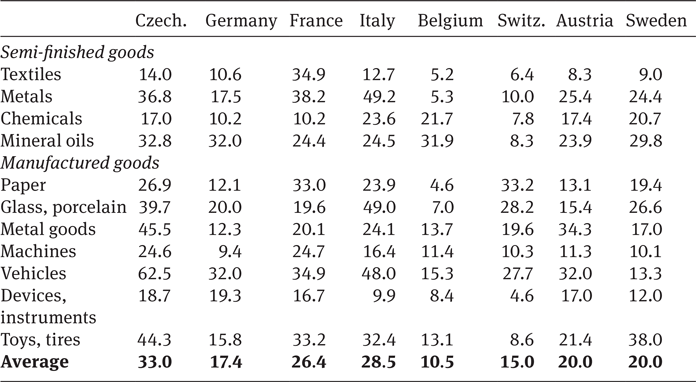
Czechoslovakia was, of course, far from being alone in its attempts to impose tariff protections (Table 1). The literature provides various estimates of general ad valorem tariffs for the time.Footnote 14 period that this text is concerned with, yet detailed analysis that would explain deviation from the level that was typical for European industrial economies, including those that were most similar to Czechoslovakia structurally (Austria, Germany) is lacking.Footnote 15
Tariffs on industrial goods, 1927 (continental industrial economies, percentages)

Based on Heinrich Liepmann, Tariff Levels and the Economic Unity of Europe (1938), 383–93.
The Czechoslovak economy ran a substantial surplus in industrial goods soon after the war as well as during the entire 1920s, and the general economic conditions of the 1920s were largely favorable. Nevertheless, we see the establishment of high tariffs on industrial goods. These increases clearly did not emerge as a response to structural problems of the economy. The available literature offers no complex explanation for the specific causes of this development, presuming misleadingly that some sort of victory of protectionist interests in heavy industry led to increased tariffs in other sectors.Footnote 16 Even in the Czech literature, which outlines a basically fair account of the mechanisms of Czechoslovak tariff growth, there is a lack of ambition to explain why this occurred.Footnote 17 Therefore, we decided to tackle the issue directly and explain how it was possible that—in contradiction to the expectations of political economy—trade policy would be completely dominated by “import-competing” groups from heavy industry associated with the National Democrats—a party with limited voter support but which employed Czech economic nationalism to a great extent.Footnote 18
The Extent and Importance of Tariff Increases in Czechoslovakia (1914–23)
The change in the effective level of Czechoslovak tariffs (for industrial and later agricultural goods) is particularly noteworthy in that it took place during a time of relative economic success. From 1920 to 1929, the economy grew by 6% per year on average, with rapid growth taking place as soon as 1920 and 1921, in contrast to western Europe and the US.Footnote 19 Unlike the majority of central, southeast, and east European states, Czechoslovakia had no fundamental problems with foreign debt. Total government debt of the country amounted to about 4.35% of its GDP in 1921, with foreign debt making up only 1.07% of GDP. Until 1929, foreign debt rose only to 2.84% of GDP. For comparison, the trade surplus amounted to about 9.3% of GDP in 1922.Footnote 20 This indicates that indebtedness, which served as a strong incentive for protectionism among other states in the region, did not play a significant role in the Czechoslovak case.
The structure of the Czechoslovak economy made it dependent on the import of raw materials, and therefore the overall trade surplus was the result of major activity in the area of industrial production.Footnote 21 This pattern of trade became typical throughout the 1920s.Footnote 22 Per-capita exports of industrial goods for Czechoslovakia compared well with many leading countries. In 1925, this amounted to 131.6 French francs, which was similar to the levels of Germany (129.9), Sweden (124.0), and the Netherlands (147.5). This was significantly higher than that of the US (74.7), though also lagging far behind the UK (332.4) or Switzerland (416.8).Footnote 23 In the first years after the war, Czechoslovak political and business elites assumed that Czech industrial exports would dominate the chiefly agrarian regions of central, southeastern, and eastern Europe, especially when their main competition—Germany and Austria—had been fundamentally weakened.Footnote 24
In spite of all this, sharp increases in the ad valorem equivalent of tariffs in the years 1921 to 1923 occurred. It is crucial to point out that in 1921, the level of tariffs in individual categories of commodities and products corresponded to the level before the First World War. This increase was thus not affected by the war, or a postwar collapse of commercial relations, or structural problems in the economy associated with the establishment of the new state. As a matter of fact, Act 379/1919 retained the autonomous tariff schedule of Austria-Hungary from 1906, which was organized on the basis of specific duties.Footnote 25 The reception of the 1906 tariff was understood to be a temporary measure, with a new autonomous tariff supposedly in the works that was indeed announced several times.Footnote 26 In the first years after the war, tariffs played a relatively small part in the protection of the economy at the time due to extensive administrative trade barriers. Nevertheless, as Czechoslovakia was highly industrialized—it had inherited about two-thirds of the industrial capacity of the old empire—the structure of the Austrian tariffs, which had been designed to support the industrialization of the empire, was not well-suited for the new republic.Footnote 27
The Czechoslovak economy of the time was oriented towards the production and export of finished consumer goods in light industry (textiles, clothing, glass, porcelain, jewelry, paper, footwear). We can describe these industries as “export-oriented.” At the same time, it was also a rather diversified industrial economy, with extraction, metal, steel, and machinery industries that were more oriented to the domestic (Austrian imperial, and later Czechoslovak) market. Since the international competitiveness of these industries, similarly to that of some newly formed sectors (electrical equipment, automobile production, advanced chemicals) was quite low, we will consider these sectors “import-competing.”
The act adopting the rates of Austria-Hungary was followed by the imposition of several levels of surcharges to specific duties in 1920 and coefficients multiplying the tariff rate in 1921.Footnote 28 This tariff schedule was then left largely unchanged until the early 1930s.Footnote 29 What did substantially change, however, were the ad valorem equivalents of the established specific tariffs—which created a high level of effective protection of the market.
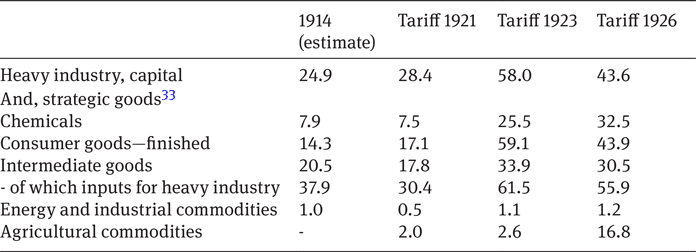
It is important to note that these surcharges and coefficients cannot actually be considered increases in tariff levels. As our calculations demonstrate, the overall effective tariff level of 1921 did not significantly differ from that of 1914 (see Table 2 and the Data attachment).Footnote 30 The actions taken by the Ministry of Trade and the government thus were largely uncontroversial, as they maintained the ad valorem equivalent at roughly the level of the tariff schedule established by the act applying the 1906 Austrian tariff in the new republic. The exchange rate of the Czechoslovak Koruna (CSK) vis-à-vis the USD was 16.2 times lower in 1921 than in the case of the Austro-Hungarian Krone in 1914. Price levels had increased similarly.Footnote 31 Therefore, it was necessary to multiply the original specific tariff rates by a coefficient of roughly sixteen to achieve the same level of protection.Footnote 32 In contrast, retaining specific tariffs at the given level without regard for the dramatic shift in the CSK exchange rate in 1922 (see below) led to a dramatic change in the ad valorem equivalent of tariffs.
Ad valorem tariff equivalents according to the category of goods in given years: weighted average (for individual categories); tariffs in percentages.

Selected individual items, their classification into categories, and calculated tariffs for individual periods of time can be found in the Data attachment (Tables 2.1—2.7.).Footnote 34
A Comparison of Tariffs and Differences among Groups of Goods
As mentioned above, Czechoslovakia employed specific tariffs—a specific amount of money levied per unit of import. To determine the real level of trade barriers in the market, we need to calculate ad valorem equivalents of tariffs at the particular time. To do this, it is necessary to determine the nominal prices of a given good according to some sort of data. We typically do this on the basis of the volume and value of foreign trade.
Our analysis begins with the tariff schedule laid down by an Executive Order from December 1921 (460/1921). We calculated ad valorem equivalents of tariffs for 1921 and 1923 on the basis of the volume and value of trade.Footnote 35 The tariff for 1926 was then calculated on the basis of average annual prices (Zahraniční obchod RČS [Foreign Trade Statistics], 1926). We estimated tariff levels for 1914 based on the shift in the USD/Krone exchange rate (in July 1914) and the USD/Koruna rate (in December 1921). The fall of the Koruna against the USD roughly corresponds to the change in the overall price level. This is clear from comparisons of price indexes at the time. The wholesale prices index increased from 100 in July 1914 to 1,674 in December 1921.Footnote 36 The retail price index for Category I goods (foodstuffs, fuels, heating oil, and soap) increased to 1,554; for Category II goods (textile fabrics, footwear, hats), it increased to 2,200.Footnote 37 The analysis was undertaken for three periods: 1921, 1923, and 1926, and thus before and after the increase of the effective level of the tariffs, and after the imposition of agricultural tariffs and the elimination of the remaining administrative barriers to trade.
The results of our analysiss that there was no significant increase in the ad valorem equivalent of tariffs between 1914 and 1921. However, between 1921 and 1923 there were very important increases: from 28.4% to 58% in the case of heavy industry, capital, and strategic goods; from 7.5% to 25.5% in the case of chemicals; from 17.1% to 59.1% for finished consumer goods; and from 30.4% to 61.5% regarding intermediate inputs for heavy industry. On the other hand, raw materials and energy remained mostly tariff-free for the whole period under discussion. In other words, the moderate tariff levels of the early 1920s grew to be the highest of all European industrial countries by 1923, and remained very high for the rest of the interwar period. Agricultural tariffs were a specific case. Most agricultural commodities were imported tariff-free. It remained this way until 1925 and 1926, when a coalition of Czechoslovak and German agrarian, Catholic, and middle-class parties pushed through the so-called “balancing” of tariff policy by significantly increasing agricultural tariffs. The weighted average of relevant imports of agricultural goods increased to 16.8%. This was still well below the level of protectionism of domestic industry, as well as below the protectionist levels of agricultural tariffs in Germany and Hungary, Czechoslovakia's most important trade partners at that time. However, unlike industrial tariffs, the protection of agriculture was an extremely controversial issue, debated for 30 hours in the Chamber of Deputies between 9 and 11 June 1926.
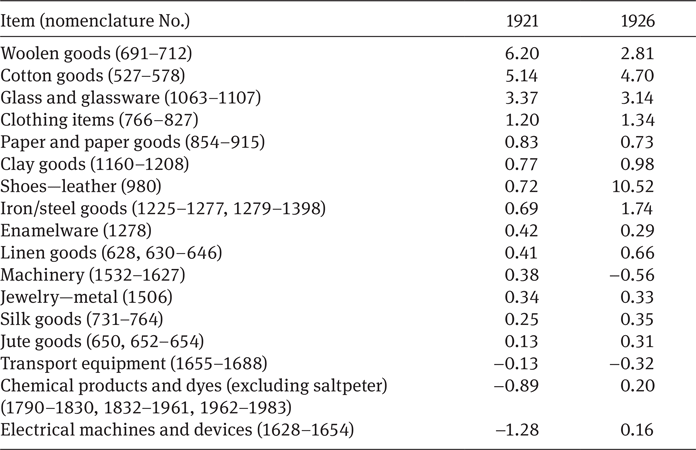
To assess the level of international competitiveness and the export orientation of individual industries in Czechoslovakia, we calculated the Lafay Index for 1921 and 1926 (see Table 3).Footnote 38 The Czechoslovak economy had the strongest comparative advantage in textile and clothing, glass, paper, and clay goods, while transportation equipment, chemical products, and electrical machinery were at a comparative disadvantage.
Comparative advantage of the Czechoslovak economy—Lafay Index, 1921 and 1926

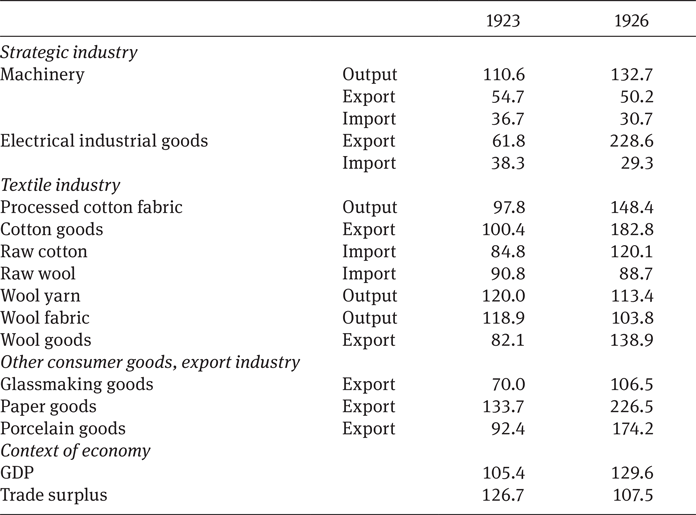
In the 1920s, the Czechoslovak economy witnessed a significant buildup in the industries of machinery, metal processing, electrical goods, and the production of transportation equipment. High tariffs clearly contributed to this buildup. In contrast, the (export-oriented) textile, glass, and food industries experienced the slowest growth (see Table 4).
Development of production and trade in selected industries—volume (index, 1921 = 100)

Derived from Historical Statistical Almanac (1985) and Zahraniční obchod ČSR (1921; 1923; 1926).
While the output of individual industries grew between 1921 and 1923 (only cotton goods experienced stagnation), their exports decreased significantly. This was true for strategic goods (machinery, electrical components), as well as for export-dependent consumer goods industries (exceptions include the increase of export volume in the paper industry and stagnation in the cotton industry). The volume of imports in the consumer goods industry was negligible. We included indices for the import of materials for the textile industry only to illustrate the contraction of the textile industry between 1921 and 1923. This contraction took place even though the prices of materials had moved in favor of the Czechoslovak textile industry. While the output of the textile industry generally stagnated in 1920s, it remained the strongest contributor to Czechoslovakia's strong export performance and its trade surplus. On the other hand, the imports of materials for strategic industries grew (the strong currency was an advantage here), while imports of finished products in these industries decreased, since they were crowded out by domestic production in a heavily protected market. The relevance of these findings will become apparent once we discuss the relative position of Czech and German capital in individual industries.
Explaining the Tariff Policy in Light of Actors’ Interests and the Structure of the Political System
We have already established that the Czechoslovak tariff increases in the 1920s did not occur in connection with the implementation of various reforms to the tariff schedule or any officially debated and approved measure whose primary goal was the regulation of international trade.Footnote 39 To a great extent, these tariff hikes occurred as a result of the significant strengthening of the Koruna and the resulting fall in prices of imported goods on the domestic market. Therefore, to explain the unusually high tariffs in Czechoslovakia during the critical years of 1921 to 1923, it is necessary to at least briefly examine the reasons for the country's deflationary policy. Here we have to answer the question why “import-competing” interests could control the trade policy in an economy that was so dependent on exports of industrial goods.
In the literature, there is a consensus that the economic policies of the Czechoslovak state were directed by a relatively small group of men belonging to National Democracy, which in turn relied on the financial power of Živnostenská Banka.Footnote 40 National Democracy was a nationalist, right-wing political party whose voter base outside the capital city was rather limited.Footnote 41 Nevertheless, after the founding of the state, it held a great deal of influence in day-to-day politics and was able to obtain “issue ownership” in economic policy.Footnote 42 This was undoubtedly a result of the significant support of the party by the most dominant group of financiers in Czechoslovakia—those related to Živnostenská Banka. This group established the most prominent industrial conglomerate in the country. Under the leadership of Jaroslav Preiss, the bank became a shorthand for nationally “Czech” capital, having already begun to strengthen its economic influence in the Czech lands even in the days of the old empire. When the new state was established, Preiss was generally seen as the top man in the economic elite, and was entrusted with developing a draft version of Czechoslovakia's economic policy.Footnote 43 He enjoyed a significant level of popularity among Czechs at this time as well. One reason for this was that during World War I, he had been arrested by the Austrian authorities for sabotaging the war effort and sentenced to death (later reduced to a prison term). He was tried with Karel Kramář—later Czechoslovakia's first Prime Minister, and Alois Rašín—after the war the most influential person at the Czechoslovak Ministry of Finance. All were members of National Democracy, which filled the posts of Minister of Finance, Minister of Industry and Trade, and Minister of Foreign Trade with their members (Augustin Novák, Bohdan Bečka, Jan Dvořáček, Ladislav Novák). It is illustrative that National Democracy usually recruited these ministers from the board of directors of Živnostenská Banka. In spite of the limited and declining voter support of National Democracy, many ethnic Czechs saw this group of men as the de facto economic government, and the natural representatives of Czechoslovakia's national economic interests.
President of the Republic Tomáš G. Masaryk and Minister of Foreign Affairs Edvard Beneš accepted the influence of National Democracy and Živnostenská Banka on the economic policies of the state. Their interests overlapped to a certain extent.Footnote 44 Both sides were in favor of strengthening the influence of Czech capital in the Czechoslovak economy at the expense of ethnically German capital, as the law on nostrification demonstrated.
Insofar as two-thirds of Czech industrial workers worked for ethnically German firm owners and managers, the Czech takeover of industry in the territory of Czechoslovakia was considered a vital national interest. Preiss himself claimed he was “Czechifying” the nation's industry (by hostile takeovers of German firms; the installation of Czech nationals on boards of firms where the majority of the shares were acquired) whenever the opportunity presented itself.Footnote 45 We think that this perspective should be kept in mind when attempting to understand the deflation policy.Footnote 46 The nostrification process, discrimination in public procurement, and the execution of land reform (which many Czechs considered a just reparation for the Holy Roman Empire's victory at the Battle of White Mountain in 1620) also should be understood in this context.Footnote 47 This dovetailed with the attitude of Minister of Finance Rašín (the National Democratic politician who oversaw the deflationary policy), who claimed that Czechoslovaks had every right to arrange their own affairs without regard to minorities, to act as if they did not exist.Footnote 48 While in many aspects the treatment of minorities in Czechoslovakia was well above the European standard of the time, this did not apply to the arena of management of the national economy.
The main goal of Živnostenská Banka—to gain control over the key parts of the Czechoslovakia's economy by pushing Germans aside—was (together with resistance to socialism) at the core of National Democracy's economic program. This later materialized in the aforementioned nostrification policy, but also in the exchange rate and tariff policy, and in general, in increasing control over official economic policies at the expense of other groups.Footnote 49
The very process of increasing Czechoslovak tariffs during the 1920s consisted of a sequence of peculiar political events. Among these events is the deflationary policy of Alois Rašín that de facto led to a dramatic increase in tariffs, and which by strengthening the exchange rate threatened the competitiveness of Czechoslovak exports. Despite frequent protests, the dominant export groups failed to influence the exchange rate policy, with its implications for trade policy more generally.Footnote 50 Also, high tariffs for domestic industry in combination with negligible agricultural tariffs soon led to calls for compensatory measures by agricultural interest groups that materialized after the Agrarian Party won in the 1925 elections.Footnote 51 The imposition of import tariffs on flour and grain in 1925 and 1926 further shifted the Czechoslovak economy towards more protectionism and more self-sufficiency. This had negative effects on economic and political relations with important trade partners, especially two key allies that were agricultural exporters—Romania and Yugoslavia. All this took place years before other industrial economies increased their agricultural and eventually also industrial tariffs.
The main proponent of the so-called “deflationary policy” carried out after the beginning of 1922 was Alois Rašín. As the first Minister of Finance of the new state (Nov. 1918–July 1919), Rašín steered the uncoupling of the Czechoslovak Koruna (CSK) from the Austrian Krone in 1919. This, however, failed to completely stem the fall in the exchange rate and rising inflation. His most important successor, Karel Engliš (May 1920–March 1921), supported stabilizing the Koruna “at the postwar level” (and thus far below the value of the former Austrian currency). Rašín vehemently argued for a major strengthening of the Koruna, ideally back to its prewar level.Footnote 52 Rašín's motivations behind this policy were political as well as symbolic and, in his view, also moral. The values of diligence and thrift, symbolized by the strengthening Koruna, were to be put in stark contrast with the decadent inflationary and populist policies of Germany and Austria. Rašín considered the economic crisis in Czechoslovakia to be not only temporary, but also educational in this context. The policy was embraced by the nationalists and successfully communicated to a large part of the public, but more liberal economists, such as Engliš, strongly opposed itFootnote 53 The conflict between both men ended with Engliš's defeat and ouster.
Rašín's policies on both questions were a result of the effects of various factors. In the fiscal sphere, he represented the intense opposition of National Democracy politics vis-à-vis the leftist government of the time. His position on the proposed exchange-rate and monetary policies was presented as a national necessity to sever the fate of the Koruna from the weakened currencies of Austria and Germany. A strong and growing currency was to be evidence of a stabilized national economy and a competently administered country.Footnote 54 Czechoslovakia supported the strengthening of the exchange rate by all means—removing currency from circulation, verbal interventions, and securing reserves of foreign exchange through foreign loans.Footnote 55 The exchange rate vis-à-vis the CHF and the USD strengthened approximately threefold.Footnote 56 This led to a dramatic fall in the price competitiveness of Czechoslovak exports, economic crisis, and significant unemployment. A key question then obviously arises: why this policy was accepted, and ultimately supported, by the strongest domestic political and economic interest groups? In addition to the problem of incompetence in the economic area—for the majority of actors, an argument of national necessity and pride was sufficiently effective—it is necessary to look at the specific interests of the group around Živnostenská Banka, supported by the nationalist ideology of National Democracy.
Živnostenská Banka in Political Pursuit of its Economic Interests against German Industry
The deflationary policy was extremely beneficial for Živnostenská Banka, by far the largest lender to Czechoslovak industry, and the position of this key creditor in such a deflationary context would improve significantly. Živnostenská Banka was at the same time very active in the development of an industrial conglomerate. As the economic crisis began, the bank quickly bought up firms under advantageous circumstances. Even more important was the process of “stock repatriation”: Živnostenská Banka—again in the “national interest”—purchased significant amounts of stock and even gained controlling shares of important firms operating on Czechoslovak territory from banks in Vienna, as well as from the former German Empire. In a situation in which the value of Austrian and German currencies were rapidly falling and the Koruna was strongly rising, stocks were extremely affordable. It was logical that the acquisition activities of Živnostenská Banka (and the consortium of Czech banks that it dominated) would focus on Czechoslovakia's largest publicly traded companies. From the point of view of the tariff policies discussed here, it is crucial to bear in mind that these were firms in heavy industry: machinery, automobiles, iron and steel, electrical goods, and chemicals. With a few exceptions (some products of the Poldi works, Vítkovice steel, Mannesmannröhren-Werke, and Škoda), Czechoslovak production in heavy industry and capital goods was sold on the domestic market, since these products were uncompetitive in the international context. Furthermore, this sector was dependent on the imports of a variety of key raw materials (iron ore, metals, chemicals), as well as prefabricated materials, and the most modern machinery. The domestic cost of these imports decreased significantly after the strengthening of the Koruna. It is exactly this particular constellation of Živnostenská Banka's industrial conglomerate that explains why the most significant effect of the deflationary policy—a dramatic increase in tariffs and changes in prices of exports and imports—was acceptable for the Czech business elite.
On the other hand, the steep increase in the Koruna's exchange rate was a major problem for sectors of Czechoslovak industry that were highly dependent on exports, such as the textile, glass, jewelry, and paper industries.Footnote 57 The bulk of Czechoslovak exports (excluding brown coal, under the control of the Jewish-German Petschek family) were products of light industry. To understand the relatively weak political position of export industries, it is necessary to understand the dominant control of ethnically German (Austrian, Reich, and domestic German) capital in these sectors. The vast majority of production in light industry took place in border regions with a predominantly German-speaking population, and remained under the control of ethnic Germans and German capital.Footnote 58 The average size of production facilities in these regions was traditionally smaller, and the nostrification and stock repatriation actions affected them to a lesser extent. These sectors were also exempted from the efforts by the government to support the buildup of “missing” modern production in strategic industries (energy, electrical equipment, chemicals and explosives, weapons).
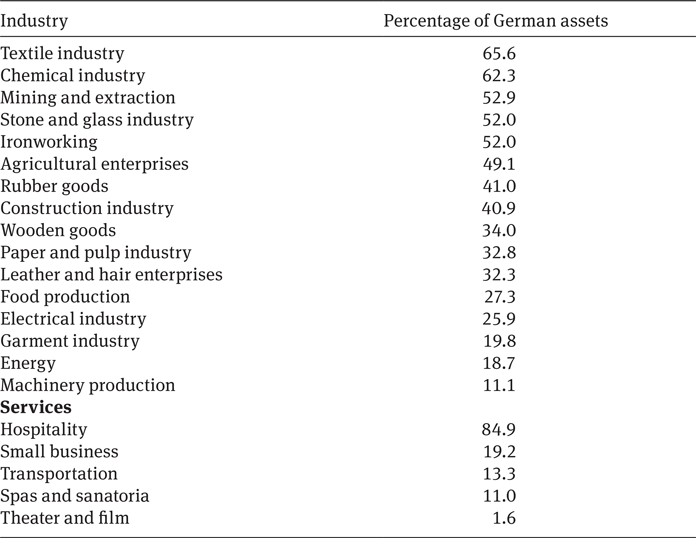
To analyze the competing interests in Czechoslovak trade policy, we introduced an indicator of the importance of ethnicity in industry. We estimated the share of German firms in individual sectors by using the share of German assets relative to the overall assets in a given sector. This confirms the dominance of German capital in the textile sector, as well as in glassmaking and porcelain (but also only occasional success of Czech capital in effort to take over the sectors of mining and metals). This indicator also reveals the predominance of Czech firms in the areas of machinery production, energy, electrical equipment, and foodstuff production; the vast majority of these were “import-competing” (Table 5). We also consider it important that a range of key non-trade service sectors were controlled by Czech business owners. This was true for the construction, trade, and transportation sectors, which (while not internationally traded) were neither directly affected by the falling price competitiveness of Czechoslovak exports nor by retaliation from Czechoslovakia's trade partners as a reaction to high tariffs.
Share of German assets relative to total assets in Czechoslovakia's enterprises (in percentages, 1927)Footnote 59

Derived from the data from the Statistická příručka [Statistical Handbook], 1932, pp. 151–55.Footnote 60
While the ethnicity-related problems in commercial affairs (the typically disproportionate influence of German or Jewish ethnicities) was present in other countries of the region (particularly in Poland, but also in Hungary), nowhere else did it have the same weight as in Czechoslovakia, where Czechs comprised 50.3% of the population, and Slovaks 15.2%. Germans were 23.4% of the inhabitants (SÚS 1924).Footnote 61 In other countries of the region, the main ethnic group held far larger majorities.Footnote 62
While most of the textile industry and other light consumer goods industries were in hands of Germans, most firms in machinery, transportation equipment, and electrical industries were controlled by Czech capital. Based on the data above, we tried to estimate the average Lafay Index for Czech and German firms (based on the share of control of Czechs or Germans in individual industries). We therefore calculated the average Lafay Index for both ethnic groups. While the average comparative advantage of ethnic Czech business in 1921 was 0.617, the comparative advantage for German firms was 1.565. We conclude that most German businesses were export-oriented, while a significant part of Czech businesses were import-competing.
From this, it follows that there were significant differences in trade and exchange-rate policy preferences between the abovementioned ethnic groups. A typical Czech business could gain from the de facto increase in import tariffs and (as major importer of raw materials and capital goods) benefited from the Koruna's appreciation. A typical German business was much more export-oriented and therefore had no interest in the de facto high import tariffs, and was vulnerable to any large increase in the value of the Koruna. The diverging paths of Czech and German-controlled businesses can be illustrated by the calculation of the Index for 1926. To a significant extent, the de facto increase in tariffs (with their positive impact on Czech industry) and the strengthening of the Koruna (with its negative impact on German industry)—in a context of a generally increasing trade surplus and an expanding Czechoslovak economy as a whole—led to a significant rise in the Index among Czech businesses (to 1.551), while that of German businesses practically stagnated (1.667).
To explain why exporters failed not only to achieve but even properly voice their interests, we have to point out to some additional institutional characteristics of the Czechoslovak political system in the 1920s. Regardless of their strong election results, German parties were not invited to enter any government coalition until 1926. Key policy decisions were made by an informal institution of the leaders of the Czech parties—the “Pětka.” From 1921 to 1926, the political system was led by a quintet of Czech and Czechoslovak parties (the Social Democrats, the Agrarians, the National Democrats, the Socialists, and the Christian-Democratic People's Party) which together comprised the “National Coalition.” The German parties, though they represented 23% of the citizens of Czechoslovakia, had very little influence over the policymaking process. The fact that export-oriented industry was primarily German-owned explains why a policy that hit this sector so hard was never confronted with significant resistance within the political system. Instead, the negatively impacted export-oriented industries resorted to attempts to compensate for the loss of revenue from exports by way of sales in the (now heavily protected) domestic market. Part of the rent gained this way was then used to export at dumping prices.Footnote 63
The dramatic increase in tariffs was thus quickly accepted by export-oriented sectors as a given, to which they adapted and exploited the relatively high price level on the domestic market (brought about from those same tariffs).Footnote 64 Subsequently, the German parties representing the German middle classes preferred to keep the industrial tariffs high during discussions on the imposition of agricultural tariffs. Eventually in 1926, in direct connection with the establishment of agricultural tariffs, these parties joined the coalition government.
Our comprehensive research of primary sources as well as other materials all fail to verify the idea that the remarkable de facto tariff increases were an articulated goal of any government member, deputy, or political party representative.Footnote 65 With the exception of the increase in tariffs on automobiles, any political discussion of tariffs in the first half of 1920s was almost nonexistent. Political parties never addressed issues of economic nationalism in their manifestos before the end of the 1920s, and the main concerns in those manifestos addressed agricultural ownership.Footnote 66 There were two main reasons for this. The first was the ethnic Czech takeover of the economy and the broad political and public support for it. The second was the concentration of power and influence over economic policy in the hands of few specific key players (such as Jaroslav Preiss) operating without significant political oversight.
In this paper, we have argued that Czechoslovak trade barriers (initially the highest in industrialized Europe) were a consequence of several historically specific features of Czechoslovakia in the early 1920s. The sharp increase of these barriers in 1922–23 was a consequence of the country's deflationary policy, which pursued nationalistic economic and political objectives. This policy created ideal conditions for the formation of Živnostenská Banka's banking and industrial conglomerate, run by an openly nationalist management, closely cooperating with the nationalist National Democrats. As a part of an economic revolution, the most significant capital groups in the Czechoslovakia gained control over a number of companies, particularly in heavy industry. As these companies produced mostly for the domestic market, supplying it with their own products shielded by high industrial tariffs, the revaluation was not something they wished to prevent. Newly developed and heavily protected infant industries (energy, electrical equipment, chemicals, and even aerospace) were also predominantly in Czech hands (occasionally with western—French and British—financial participation).
In contrast, the majority of typical export industries (light industry, the production of consumer goods) that were responsible for the maintenance of a significant trade surplus even in the difficult circumstances of the 1920s remained in the hands of ethnic Germans, and occasionally even foreign German capital. Support of their interests was not a priority to the groups steering Czechoslovak trade policy. Nationalist ambitions shaped monetary and exchange rate policy, which in turn led to heavy protectionism. The awkward combination of the export-dependent character of the economy with a strengthening currency and high tariffs can only be explained by the specific national/ethnic economic structure, which largely corresponded to the divide between export-oriented sectors and import-competing sectors. One aspect that was very helpful in this regard was the specific extra-constitutional institutional solution of policymaking in the new republic, denying representatives of Czechoslovak Germans any significant influence over economic policy. It then becomes clear that protectionism in Czechoslovakia was a specific result of a unique historical, political, and socioeconomic situation, where the interests of foreign economic policy were almost completely subordinated to the logic of domestic ethnic competition and internally oriented sectors of the (ethnically) Czech economy. The question is whether this issue represents an exception or just one of many historically specific cases of economic policies that represent a challenge to most commonly used approaches to the analysis of economic policy. Such considerations go, however, beyond the scope and aims of this case study.
Supplementary material
The supplementary material for this article can be found at https://doi.org/10.1017/slr.2021.149