Is there something peculiar about modern nation-states that implicates their creation in a definitive process of forced migration? Arendt posits that the exhaustive apportionment of international territory between states causes those “thrown out of one of these tightly organized closed communities” to find themselves without protection altogether.Footnote 1 Haddad extends her argument, asserting that the successful establishment of a state hinges on its ability to draw a bounded national identity;Footnote 2 the “other”, in opposition to whom the nation defines itself, must be evicted from the state's borders in order to bring this process of identity formation to conclusion. This, to Haddad, indicates that forced migration is the “inevitable … consequence of the nation-state system”.Footnote 3 Zolberg echoes this sentiment, warning that the creation of new states in coming years will also be marked by the forced migration of “misfits”.Footnote 4 Yet, none of the three point to a specific feature of modern nation-states that demands the fabrication of a “misfit”; that unavoidably compels some to be “thrown out” of the community; or that precipitates the formation of bounded, exclusionary identities. Until such features are singled out, one cannot conclude whether forced migration truly is an unavoidable trait of state-formation. Further, even if some migration is inevitable, this practice of identification is vital to discern which parts of it can be mitigated. This paper will identify and examine one feature of state-formation that may be implicated in the identity-building process that impels forced migration: the doctrine of uti possidetis.
Uti possidetis is a rule of customary international law that is applied to delimit the borders of newly formed states. Wherever a previously unified territory is to give way to two or more states, this rule dictates that the international frontiers of such states cannot be drawn de novo; instead, their borders must be selected from pre-existing administrative boundaries that run through the territory.Footnote 5 Originally formulated to enable safe, predictable transitions to statehood for former colonies, the rule was extended to all types of state-formation by the Badinter Commission supervising the dissolution of Yugoslavia.Footnote 6 As a result, the rule is now an intrinsic, constitutive feature of the modern nation-state system.
Much ink has been dedicated to picking apart the uti possidetis claim of guaranteeing peaceful relations during territorial transitions. However, almost all such literature examines the claim exclusively through the lens of interstate violence.Footnote 7 The role of uti possidetis in producing intrastate violence has been entirely overlooked. Critically, it is the latter form that is linked to the forced migration of state-creation, per Arendt, Haddad, and Zolberg. It is this gap in the literature that this paper seeks to plug. By examining how the construction of international borders impacts identity formation in the territories so divided, this paper examines uti possidetis as a contributory trigger for intrastate violence and forced migration.
In order to make this argument, the paper will focus on the application of uti possidetis in South Asia, particularly the Radcliffe Line used to divide Punjab. This is for three reasons: first, a significant body of writing on identity formation through the Radcliffe Line is readily available,Footnote 8 making the task of linking it to uti possidetis simpler. Second, although the Radcliffe Line has witnessed extreme intrastate violence, it has eluded any form of interstate armed conflict:Footnote 9 this renders it the ideal candidate to test the paper's hypothesis. Third, perhaps most crucially, scholarship on uti possidetis has entirely neglected its application in South Asia. The reasons for this will be examined below. However, extending the study of uti possidetis to South Asia has compelling consequences for the legal arguments raised to challenge this rule. Studying these consequences enables one to understand how the application of this doctrine can be curbed; i.e. if uti possidetis is found to be implicated in producing forced migration during state-creation, the study of its practice in South Asia holds the key to understanding how such migration can be mitigated through legal alternatives.
In order to successfully assemble its argument, the paper will proceed as follows: Part I provides an overview of the uti possidetis rule, examining its creation and outlining the criticisms raised against it. In this, the impact of South Asian practice on the efficacy of each critique is, in particular, emphasized. Part II offers an explanation for the conspicuous absence of South Asian practice in scholarship on uti possidetis. It also provides evidence for the application of this rule in the Indian subcontinent, directing its attention to the process by which the Radcliffe Line was drawn. Part III furthers the central argument of this paper, analyzing the impact of uti possidetis on identity formation and self-determination in Punjab, probing its role as a trigger for the intrastate violence and forced migration that ensued.
Much like any piece of respectable writing, this paper is haunted by its limitations. The space permitted to it does not allow for a detailed examination of other boundaries in South Asia that have also been drawn via uti possidetis. They exist and will be listed in the final section as opportunities for further research. Although conclusions drawn in this paper are sought to be made generalizable, their veracity will undoubtedly be enriched by such expanded study. Further, a detailed exposition of legal alternatives to uti possidetis is also not feasible, given the paper's bounded length. A brief outline of the literature on such alternatives will, however, be offered in the concluding section to indicate how the role of uti possidetis in forced migration could be mitigated. Finally, any project that seeks to critically engage with the process of state-formation must invariably confront the villainy of nationalist and imperialist historiographies. To minimize this impact, the paper has attempted, wherever possible, to rely on primary sources to draw its conclusions on questions of history. Mansergh's Transfer of Power collectionFootnote 10 has proved instrumental in this task. Where secondary sources have been relied on, the paper has sought to be reflexive about the institutional and personal predilections of their authors. An interpretivist understanding of history suggests that subjectivity can never truly be eliminated; yet explicit bias has been expunged as far as possible.Footnote 11
I. LINES ETCHED IN SAND: THE CREATION AND CRITIQUE OF UTI POSSIDETIS
This section begins by analyzing the content of uti possidetis, outlining its creation as a rule of customary international law. It then examines and responds to legal critiques that challenge its foundation in international law. The section concludes by discussing the functional critique of uti possidetis.
A. The Crystallization of Uti Possidetis
When colonial empires crumbled into nation-states, the fissures along which they cracked were predetermined. To ensure a predictable and safe transition to independence, it was mandated that nascent states could emerge only along existing colonial administrative boundaries. Freedom from foreign rule was attained, yet only within the confines of lines drawn by the foreign ruler. And so, the empire continued to rear its ugly head from beyond the grave to haunt the political entities that took its place. This, in essence, is the unhappy history of uti possidetis.
The rule of uti possidetis prescribes that “new States will come to independence with the same boundaries they had when they were administrative units within the territory … of a colonial power”.Footnote 12 As such, when a colony was partitioned into multiple states, the “principle … upgraded former administrative delimitations, established during the colonial period, to international frontiers”.Footnote 13
The origins of this rule can be traced to the Roman private law edict of uti possidetis ita possidetis (“As you possess, so may you possess”), an interim remedy granted in the initial stages of litigation over immoveable property.Footnote 14 Uti possidetis commenced its metamorphosis into a rule of international law with the Spanish withdrawal from Latin America in the nineteenth century. When Latin American successor states proclaimed their independence from Spain, they invoked uti possidetis and agreed to accept colonial administrative divisions as the basis for their frontiers.Footnote 15 Uti possidetis was embedded into the constitutions of these states, which defined the territorial scope of their sovereignty by reference to the Spanish administrative units that predated their creation.Footnote 16 The rule was subsequently applied in boundary delimitation disputes between successor states. Notably, in this transformation of uti possidetis from a norm of private law to one of international character, it lost the provisional status it held under Roman law: it was no longer a temporary measure that preceded further deliberation, but a final, binding disposition of territorial title.Footnote 17 Indeed, returning the principle to its roots by interpreting it as a provisional allocation of borders has been recommended in academia and will be discussed in this paper's “Conclusion” as a means to more effective and stable border delimitation.
The second precedent that helped crystallize uti possidetis into custom is the decolonization of Africa. While the entirety of African territory was never subject to colonial administration, the continent had been carved up into “spheres of influence” assigned to different colonial powers to prevent armed conflict between them.Footnote 18 The territorial units forged from these “spheres of influence” were used by colonial powers and the local elite to draw the borders for modern African states on independence.Footnote 19 Through the Cairo Declaration, Member States of the Organization of African Unity pledged themselves to respect these colonial borders, hoping that by doing so they could forestall territorial disputes that might arise between them.Footnote 20 In doing so, they helped cement the rule of uti possidetis in international law. In the Guinea v. Guinea-Bissau Maritime Delimitation Arbitration, the tribunal ruled that the principle which was
solemnly proclaimed in Cairo on 21 July 1964, when the Heads of State and Heads of Government of the Organization of African Unity declared that all Member States pledged to the boundaries existing at the time they reached their independence … [is] held to reflect customary rules of international law.Footnote 21
In the Case Concerning the Frontier Dispute (Burkina Faso v. Mali), the International Court of Justice [ICJ] further held that:
[t]he fact that the new African States have respected the administrative boundaries and frontiers established by the colonial powers must be seen not as a mere practice contributing to the gradual emergence of a principle of customary international law, limited in its impact to the African continent as it had previously been to Spanish America, but as the application in Africa of a rule of general scope.Footnote 22
The state practice and jurisprudence described above is collectively relied on in legal scholarship to assess the status of uti possidetis as a rule of customary international law. Conspicuous in this literature is the absence of any discussion on decolonization and boundary formation in South Asia. That British India was one of the largest and most important imperial projects of the nineteenth and twentieth centuries makes this omission noteworthy.Footnote 23 While KaikobadFootnote 24 and MahmudFootnote 25 acknowledge the application of the uti possidetis rule in the Indian subcontinent, neither examines the manner of its application or the ensuing consequences in any detail. Other jurists, too, allude to the application of uti possidetis in the Indian subcontinent, but they do so by referencing the Rann of Kutch Arbitration Award,Footnote 26 a decision that explicitly recognized the inapplicability of uti possidetis to its facts.Footnote 27 The sections that follow will examine possible reasons for this omission in academic literature, and will seek to plug this gap as best they can.
At this point, however, it is important to note that any study of uti possidetis is incomplete without examining its application in South Asia. This is for two reasons: first, if the claim that uti possidetis was applied in South Asia is found to be true, it significantly impacts the legal arguments used to critique the foundation of this rule; second, the consequences that uti possidetis precipitated in South Asia are different from those studied in Africa and Latin America, and thus play a critical role in widening the functional critique currently levied against the rule. Each of these claims is examined in the sections below.
B. The Legal Status of Uti Possidetis
Arguments that challenge the foundation of uti possidetis in international law do so through two limbs: first, that the rule lacks sufficient basis to constitute a rule of customary international law; and second, that the rule conflicts with the right of self-determination, which supersedes it by virtue of its peremptory status in international law. Each limb will be examined in turn, discussing the impact of South Asian state practice on the merit of the argument.
1. The customary status of uti possidetis
The customary status of uti possidetis has been the subject of heated debate in legal scholarship. AkweendaFootnote 28 and MurphyFootnote 29 argue that uti possidetis lacks sufficient state practice to constitute a norm of custom. Sarvarian,Footnote 30 and Castellino and Allen,Footnote 31 argue that, while global practice is insufficient to constitute a norm of general custom, uti possidetis does constitute a norm of regional custom in Latin America and Africa. BartosFootnote 32 builds on such critique to argue that uti possidetis ought to be considered a general “principle” of international law which guides the interpretation of other rules, rather than a rule itself. LalondeFootnote 33 posits that there is sufficient state practice that applies the rule, referencing instances of its application in the Middle East and Europe in addition to the Latin American and African practice outlined above. However, she argues that there is little direct evidence of opinio juris supporting the customary status of uti possidetis.
PetersFootnote 34 correctly points to instances of opinio juris ignored by the above critics, referencing written submissions of thirty-seven intervening states in the Kosovo Advisory Opinion proceeding before the ICJ that concur on the customary status of uti possidetis. AntonopoulosFootnote 35 examines written submissions by states in Latin American boundary dispute cases, as well as provisions in their boundary treaties and constitutions to establish opinio juris in support of the rule. KaikobadFootnote 36 uses the Organization of African Unity's Cairo DeclarationFootnote 37 and the Non-Aligned Summit Conference DeclarationFootnote 38 as further instances of opinio juris. Yet, all such attempts to establish the customary status of uti possidetis remain restricted in the breadth of state practice they draw on; indeed, their ability to respond effectively to the regional custom critique is critically inhibited by the fact that they largely rest on Latin American and African practice to draw their conclusions. Were such arguments to draw on South Asian practice, they could broaden their scope, relying on the Afghan-Pakistan Durand Line, the Iran-Pakistan Goldsmith Line, the Indo-Pakistani Radcliffe Line, and the Sino-Indian McMahon Line, as well as the colonial borders of Nepal, Bangladesh, and Myanmar to establish the general customary status of uti possidetis more effectively.
2. Uti possidetis and self-determination
Much effort has been spent discussing the potential conflict between uti possidetis and self-determination. ShawFootnote 39 argues that the lines uti possidetis transforms into international borders were drawn to benefit colonial authorities in administration, carving up territories for revenue-collection, legal-jurisdiction, or resource-extraction purposes; they were drawn without any consultation with the people they divided, and often cut through communities with deeply entrenched economic, cultural, and linguistic ties. MazruiFootnote 40 highlights how such boundaries often prioritized geographic and geometric considerations over human ones. Mutua posits that the 1890 Anglo-French Convention partitioned West Africa to ensure an equitable distribution of natural resources between the two empires, with little regard for the people inhabiting its territory.Footnote 41 Similarly, Mahmud argues that the Durand Line was used to create a buffer zone for the British Empire but split the Pashtun community of Afghanistan across an international border.Footnote 42
Saxena,Footnote 43 Gayim,Footnote 44 and KolodziejFootnote 45 discuss how uti possidetis in Nigeria, Eritrea, Ethiopia, Rwanda, and Burundi forced ethnically and culturally fractured communities into artificial units. Bartos extends this critique to the post-colonial period, describing the division of communities in South Ossetia, Abkhazia, Nagorno-Karabakh, and Transdniestria due to the freezing of boundaries drawn by the Soviet Union.Footnote 46 Such arguments highlight the destructive effect of uti possidetis on identity, reasoning that the forced division of a culturally, linguistically, and ethnically homogenous people across international borders inhibits their ability to collectively determine their future in a single political unit, thereby inhibiting their right to self-determination.
Critically, this literature presumes that identities remain stable and unaltered by the freezing of colonial boundaries. Indeed, legal scholarship on uti possidetis ignores developments in the social sciences that discuss the social-constitutive effects of borders,Footnote 47 and the impact of bordering as a process on a peoples’ identity.Footnote 48 While Castellino and Allen allude to the crystallization of artificial identities through uti possidetis, they stop short of a full exposition of this process.Footnote 49 This constructive effect of borders on identity is well studied in the literature that discusses the impact of colonial boundaries on identities in Bengal and Punjab.Footnote 50 Consequently, broadening the study of this rule to South Asia plays an important role in extending the legal critique of uti possidetis. This extension demonstrates that uti possidetis alters the very “peoples” entitled to self-determination, indelibly shaping their future for them. This constructive effect will be examined in the third section of this paper.
C. The Functional Critique of Uti Possidetis
The principal utility offered by uti possidetis is that, by providing a clear and foreseeable territorial outcome in the process of state-formation, it prevents “fratricidal struggles” over border disputes by nascent successor states and, in doing so, preserves international stability.Footnote 51 This functional utility is, however, disputed. First, as Castellino and Allen highlight, internal administrative lines are rarely demarcated physically, as international frontiers are, and hence their precise location is ambiguous.Footnote 52 As a result, even with uti possidetis, there is scope for border disputes in the process of demarcation. Second, per PetersFootnote 53 and Shaw,Footnote 54 uti possidetis is intrinsically ambiguous, since different administrative lines often overlap, and the rule offers little clarity on which is to be prioritized. Third, where boundaries divide communities, as detailed in the preceding section, uti possidetis fuels irredentist desires to “reclaim” the community's territory, contributing to the possibility of conflict.Footnote 55
However, the empirical veracity of such arguments is highly contested. While Mazrui asserts that uti possidetis successfully prevented international conflict in Africa,Footnote 56 NeubergerFootnote 57 and AkweendaFootnote 58 point to its contribution to border conflicts in Somalia, Morocco, and Namibia. MalanczukFootnote 59 and DominguezFootnote 60 assert its success in Latin America, while Kacowicz,Footnote 61 Zacher,Footnote 62 and BartosFootnote 63 argue that it played a role in conflicts in Peru and Ecuador. Franck asserts that the doctrine fuelled “post-modern tribalism” and led to irredentist conflicts,Footnote 64 but Hensel and Allison counter that uti possidetis produced less conflict than instances of departure from administrative boundaries.Footnote 65
Notably, almost all such legal scholarship evaluates the success of uti possidetis by focusing exclusively on interstate violence. Discussions on intrastate violence are occasionally referencedFootnote 66 yet rarely form the crux of the functional critique. Curiously, however, the colonial boundaries of South Asia have largely eluded the form of interstate violence discussed above, with such borders rarely serving as the basis for armed conflict.Footnote 67 However, the borders are heavily implicated in some of the largest and most calamitous instances of forced migration of the past century: during the Partition of India, the secession of Bangladesh and, more recently, the Rohingya persecution in Myanmar.Footnote 68 By broadening the discussion on uti possidetis to South Asia, the rule can be examined through the dual lenses of forced migration and identity construction and destruction. Through this, the functional critique of uti possidetis can be expanded to encompass its role in producing intrastate violence and contributing to forced migration. The third section of this paper will seek to do this.
II. FROZEN FRONTIER: THE RADCLIFFE LINE
This section provides evidence for the application of uti possidetis in South Asia by examining the partition of Punjab through the Radcliffe Line. It begins by explaining why this boundary has been overlooked in legal scholarship. It then confirms that the international frontier in Punjab is, indeed, etched upon pre-drawn colonial boundaries. The section concludes by unearthing the role these boundaries played in the social upheaval that transpired post-partition.
A. The Duplicity of the Radcliffe Line
The delimitation of the Radcliffe Line has never been examined as an application of uti possidetis. This is the consequence of three factors: first, that the colonial government sought to depict the boundary-drawing process as one driven by locals; second, that they sought to portray the line itself as a judicially determined settlement; and third, that there was scant evidence to challenge such representations at the time uti possidetis was debated in legal scholarship. Each will be examined in turn.
1. The boundary-drawing process as a local undertaking
The popular narrative on the construction of the Radcliffe Line proceeds as follows: that the partition of Punjab was a local demand emanating from the Muslim League, accepted by the Indian National Congress (the two prominent political parties operating in British India), and confirmed by a vote in the provincial assembly;Footnote 69 that this local demand led to the constitution of the Punjab Boundary Commission, composed entirely of native judges, but chaired by an eminent British lawyer, Cyril Radcliffe;Footnote 70 that Radcliffe was chosen by local leaders, and his appointment was based on his impartiality and legal expertise;Footnote 71 that the Boundary Commission drew the partition line collectively and from scratch; and they did so to best suit local needs, surmised from submissions made in public hearings.Footnote 72 Finally, that the Commission's award bore little responsibility for the violence that followed partition; instead, such violence was the consequence of deeply entrenched communal hatred that could not be checked by the newly formed governments of India and Pakistan.Footnote 73 Understandably, this account leaves little scope to consider the Radcliffe Line a product of uti possidetis. However, each component of this narrative rests on an unsound footing.
Jalal's revisionist work on partition history demonstrates in detail that the division of Punjab was not a demand that emerged from the Muslim League.Footnote 74 Rather, “the idea of Pakistan … was inextricably linked with an undivided Punjab” for the League and for Jinnah, its leader.Footnote 75 Instead, the decision to partition the province came from Mountbatten, the Viceroy of India, as part of his “3rd June Plan”.Footnote 76 Moreover, this decision was driven largely by British interests. Maintaining British rule in India was proving to be a costly exercise for the debt-ridden colonial government after the World War II.Footnote 77 This was why Mountbatten was tasked with unwinding Britain's involvement in India as swiftly as possible. Any alternative to partition, however, would have required a time-consuming negotiated settlement that the British government could ill afford.Footnote 78 A speedy transition of power was also favourable to the local elite: Jinnah, who was in the terminal stages of tuberculosis, and Nehru, mentally exhausted after multiple rounds of imprisonment, were eager to take over the reins.Footnote 79 This was why they agreed to the British proposal to partition Punjab.
Additionally, as Chatterji demonstrates, the vote in the provincial assembly was a farce: the assemblies were artificially divided on religious lines for the vote, to impress the inevitability of partition upon its members; the assembly members were not informed on whether their constituency would fall within India or Pakistan if partition were to occur; and, notably, the West Punjab assembly voted for accession to Pakistan only if the province remained undivided.Footnote 80 Yet, the vote was used to confer legitimacy on the decision to divide Punjab, portraying it as a local decision when, in fact, it was based entirely on the interests of the British administration and the Indian political elite.Footnote 81
Further, even though Radcliffe's name, as head of the Boundary Commission, was proposed by the British administration, Mountbatten manipulated records of meetings to make it appear that the name had been proffered by Jinnah.Footnote 82 The subsection below demonstrates why Radcliffe was far from an impartial arbiter in this process. Finally, even though the Boundary Commission's award was completed well in advance of the independence days of India and Pakistan, its publication was delayed specifically to ensure that the outcome would appear to be a local decision, and responsibility for it would be borne by the successor governments.Footnote 83 The transcripts of Mountbatten's meetings explicitly record him stating that “[w]ithout question, the earlier it was published, [the] more the British would have to bear the responsibility for the disturbances which would undoubtedly result”.Footnote 84 As a result, the narrative of the construction of the Radcliffe Line as a locally driven process was intentionally fabricated by the British government to confer greater legitimacy on it.Footnote 85
2. The Radcliffe Line as a judicial decision
A critical element in the attempt to legitimize the partition of Punjab was its depiction as a judicially determined settlement. The chairman of the Boundary Commission, Cyril Radcliffe, was pivotal to this end. Much writing on the Commission justifies his appointment based purely on his legal expertise and neutrality.Footnote 86 However, more critical pieces have picked apart this presumption. French deems him the “ultimate Establishment figure”, deeply embedded in the British imperialist project.Footnote 87 Radcliffe had little knowledge of India, and no expertise in boundary delimitation; he was chosen largely to protect British interests while cloaking politically motivated choices under the garb of judicial neutrality.Footnote 88 Chester provides a comprehensive analysis of Radcliffe's life to further this point: he hailed from a military family; his father and brothers were professional soldiers in the British army – one brother even died whilst serving the Empire in India.Footnote 89 Radcliffe was educated in Haileybury, an elite public school that Chester terms “the training ground for aspirants to the East India Company”.Footnote 90 He went on to serve in the British Admiralty and the Ministry of Information, and much of his writings betray a strong imperialist leaning. During Radcliffe's sojourn in India to partition Punjab, he met with and wrote to Mountbatten extensively.Footnote 91 Mountbatten's secretary during this period, Christopher Beaumont, confirms that Radcliffe's award was directly influenced by Mountbatten to suit British interests through these communications.Footnote 92
In addition, while the Punjab Boundary Commission comprised four South Asian judges, it was only the decision of the chairman, Radcliffe, that constituted the final legally binding award.Footnote 93 That Radcliffe distrusted his colleagues is well documented.Footnote 94 Indeed, Radcliffe himself notes that the final award was written with negligible contribution from the other judges, whom he rejected as “partisan”.Footnote 95 Similarly, while the Commission held public hearings to receive arguments from interested parties, Radcliffe perplexed litigants and judges alike by choosing not to attend any hearing.Footnote 96 Although transcripts of such proceedings were dispatched to Radcliffe, Mosley highlights the suspicion with which he treated them; he was recorded alleging that the “two sides were always up to their tricks” in the hearings.Footnote 97 More unsettlingly, while parties were expected to make submissions to the Commission on the future boundary line, they were not given access to any official government maps, which remained classified following World War II.Footnote 98 It is not surprising, therefore, that Radcliffe ultimately drew his line with little insight from locals, by consulting British officials, British maps, and British census figures.Footnote 99 As Liaquat Ali Khan, the first Prime Minister of Pakistan, noted in his letter to Lord Ismay, the British Chief of Staff at the time, the Radcliffe award was “a political decision, and not a judicial one”.Footnote 100
3. The paucity of proof
The narrative of the Radcliffe Line as a locally driven judicial outcome could only be cemented by concealing all evidence that betrayed its true nature. This was accomplished through three principal means: first, Radcliffe provided no reasoning to support his decision in the award, and insisted on refusing explanations of the award for the rest of his life.Footnote 101 He even later acknowledged that the absence of justification was intentional, to ensure the legitimacy of the award could not be questioned.Footnote 102 Second, all documents he relied on to make the final award were destroyed, so there was little scope to piece together his reasoning through them.Footnote 103 Third, all other official documents and communications concerning the Boundary Commission were withheld as “classified” until 1983, when a select few were published in the Transfer of Power collections.Footnote 104 Much of the critical historical writing on the Boundary Commission, therefore, could only emerge after this period. By relying on these declassified documents, as well as on submissions made in the Commission's hearings and interviews with surviving members of the Boundary Commission, the British colonial administration and Radcliffe's family, writers like Chester, Chatterji, and Gyanesh were able to uncover much of the reasoning underlying the final award. It is only through their writing that the possibility of critiquing the Radcliffe Line as an application of uti possidetis emerged. However, the bulk of legal scholarship on uti possidetis was produced in the 1960s, following the decolonization of Africa, and the early 1990s, following the Badinter Commission's decisions on Yugoslavia.Footnote 105 Understandably, as a consequence of the colonial narrative built on the Punjab Boundary Commission and the absence of evidence to challenge it, such scholarship had little opportunity to examine the Radcliffe Line.
B. Uti Possidetis in Punjab
Most cases of uti possidetis examined in the first section of this paper relied on boundaries from the largest administrative units available whilst drawing the international frontier. The method of applying uti possidetis in Punjab, however, was peculiar; the international frontier was not drawn using the boundaries of the “province”, the primary unit in the federal structure of British India. As the preceding section revealed, committing to the boundaries of the unified Punjab province would have required rejecting its partition, which did not suit the interests of the British government. As a result, the international border between India and Pakistan was drawn on the boundaries of administrative subunits within the province of Punjab. Nevertheless, as PetersFootnote 106 and ShawFootnote 107 point out, uti possidetis does encompass the use of such subunits as well; indeed, this was precisely how the ICJ applied the rule in the Land, Island and Maritime Frontier Dispute.Footnote 108
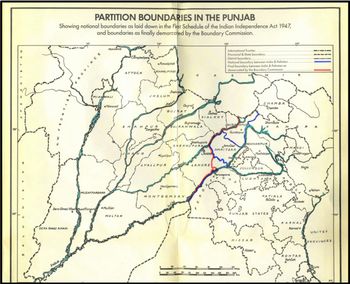
Even a perfunctory reading of the Punjab Boundary Commission award reveals that it is little more than a straightforward selection of tehsil (revenue collection unit) and district (administrative unit) boundaries. A brief section of the Radcliffe Line in the Kasur region of Lahore does deviate from the district and tehsil boundaries, but this section, too, is drawn using colonial administrative boundaries: those of thanas (criminal jurisdiction units) and villages.Footnote 109 The map in Figure 1, recovered from declassified British Foreign Office documents, illustrates how the final border was drawn. The orange line, representing the Radcliffe award, is etched entirely on colonial administrative lines. Within the Lahore district, the Radcliffe award deviates from the district border but follows a faintly dotted line representing thana boundaries.Footnote 110 In places where the boundary closely follows natural features, such as rivers, Radcliffe plainly states that it is the pre-existing administrative boundary and not the natural feature that constitutes the international frontier.Footnote 111 That this award was simply a selection of administrative lines is also confirmed by ChesterFootnote 112 and Chatterji,Footnote 113 who appropriately critique Radcliffe for adopting flawed colonial boundaries instead of redrawing more natural, defensible boundaries as was proposed in the submissions made to the Commission.
The Radcliffe Line Drawn on Colonial Administrative BoundariesFootnote 114

Shaw points out that the legal foundation of uti possidetis is usually secured through domestic legislation, as done in Latin America and Africa.Footnote 115 In Punjab, Chester demonstrates how this was done using the Indian Independence Act of 1947, drafted by the British government.Footnote 116 The provisions of this Act made the administrative boundaries used in the Radcliffe award legally binding on the successor states, leaving the leaders of India and Pakistan with few options to redraw the border. The governments even set up committees to mount legal challenges to the border but were informed by their respective lawyers that the selected colonial boundaries were “legally unassailable”.Footnote 117 Although the words “uti possidetis” do not appear in the legislation or the award, AkweendaFootnote 118 and LalondeFootnote 119 list several instances where this doctrine has been applied without directly referencing it by name—most notably in the Organization of African Unity's Cairo Declaration. Moreover, the Tribunal in the Bay of Bengal Maritime Boundary Arbitration subsequently acknowledged the Radcliffe Line as a product of uti possidetis, though it neglected to provide any direct examination of the delimited boundaries, as carried out above.Footnote 120 Mahmud, too, confirms the use of this doctrine in the partition.Footnote 121 As such, there can be little doubt that uti possidetis was applied to fashion the international frontier that fragmented Punjab.
C. Colonial Lines and Social Upheaval
The application of uti possidetis contributed to the social upheaval that followed the partition of Punjab. It did so for three reasons: first, it was based on flawed colonial cartography; second, the boundaries employed had no physical existence on the ground; and third, the criteria used to select these lines were deeply misguided. Each will be examined in turn. It is pertinent to note that, while the first two critiques have been levelled against uti possidetis before, the third arises only in the context of its application to South Asia.
1. The cleavages of colonial cartography
The map is a well-documented tool of imperialism that bears the biases of its maker: when used in imperialist projects, it carried little semblance to local realities, and simply echoed the gaze of the colonizer and their ideology.Footnote 122 This was certainly true in British India. The maps with which Radcliffe drew his line were all produced by the Survey of India, an imperialist institution.Footnote 123 These maps were produced to serve British colonial interests: military expansion and revenue collection.Footnote 124 This was reflected in their content.
Wolffhardt describes how the Survey's maps only accurately depicted those features that were of concern to the colonial government.Footnote 125 Roads, railways, forts, canals, oil pipelines, and revenue-collection units were all well marked; human settlements, religious sites, farmlands, local markets, and industries were glaringly omitted, represented only as blank space on the map's canvas. As a consequence, the administrative boundaries for tehsils, districts, villages, and thanas were largely drawn by prioritizing geometric considerations over human ones.Footnote 126 In order to reduce the territory to an ordered, mathematized space, the British administration relied on the Survey's maps to blithely draw boundaries that cut through individuals’ farmlands and homes, split villages in half, divided industries from the sources of their raw material, parted religious communities from their shrines, and cut irrigation channels off from their headworks.Footnote 127 Moreover, as Chester points out, the maps provided to Radcliffe were drawn at far too small a scale (1:1,000,000) to deduce even a hint of the local social, economic, cultural, and religious ties that inhabited the spaces they depicted.Footnote 128 As a result, it is hardly surprising that Radcliffe's use of colonial maps and administrative boundaries to partition Punjab contributed materially to the social upheaval that ensued. His award transformed imagined cleavages that previously existed only on the sheets of British charts into lived reality for twenty-eight million individuals.Footnote 129
2. Invisible boundaries
The primary benefit offered by uti possidetis, according to its advocates, is the stability and predictability it provides in periods of transition.Footnote 130 Ratner, however, offers an apt response to this claim: the internal administrative boundaries used by uti possidetis to draw an international border are rarely demarcated physically, on the ground, prior to partition.Footnote 131 Indeed, demarcation offers little functional utility while such boundaries remain internal administrative divisions. As a consequence, the belief that such boundaries offer stability or predictability is misguided; by lacking a physical existence they provide local populations and government agencies as much support in predicting the future border as a freshly drawn line with no historical basis.Footnote 132 Such a critique is borne out by the experience in Punjab.
District and tehsil boundaries were rarely demarcated in the province, since they were abstract constructs that existed only for administrative convenience.Footnote 133 As such, these boundaries were of little significance to the people they divided. Moreover, even when such boundaries were marked out, there were discrepancies between their physical location and their notional delimitation on the map, rendering the true location of the administrative boundary unclear.Footnote 134 Consequently, when the Radcliffe Line was announced, it offered anything but a stable, predictable outcome. Newspaper reports from the period describe perilous confusion, as people scrambled to make sense of the award and understand which state they had been parcelled off to.Footnote 135 Border forces were unable to prevent the looting and mass violence that followed partition since they, too, were uncertain about the location of the boundaries they were tasked to defend.Footnote 136 As Jenkins, the Governor of Punjab at the time, noted in numerous communications to Mountbatten, false rumours and speculation on the location of the boundary were often triggers that precipitated violence following the award's announcement.Footnote 137 One can conclude that the application of uti possidetis in Punjab, far from offering a predictable outcome, contributed to the instability and violence of partition by relying on invisible lines that carried little meaning to those they sought to separate.
3. The criteria for division
Since the “province” did not serve as the basic unit for uti possidetis in Punjab, the drawing of the partition line involved a choice: Radcliffe had to pick which administrative subunits would lend their boundaries to the international frontier. The only criterion he was offered to guide him in making this choice was religion: the Boundary Commission's terms of reference explicitly required Radcliffe to partition Punjab by drawing a line between “contiguous Muslim and non-Muslim majority areas”.Footnote 138 Moreover, he was specifically instructed by the British government not to consider the defensibility of the line, natural features, or administrative convenience while delimiting his final boundary.Footnote 139 Although Radcliffe was given some leeway to consider “other factors”, he opted to use this sparingly, and then only to preserve the integrity of colonial infrastructure projects.Footnote 140 As a consequence, Punjab was divided solely on identity. More distressingly, it was divided solely on an artificial identity.Footnote 141 Although religious cleavages existed within pre-independence Punjab, their content was more nuanced than the simplistic “Muslim and non-Muslim” formula employed by the Boundary Commission. Within “Muslims” the Ahmadiyyas and the Pashtun were seen as a distinct identity, while “non-Muslims” were internally fractured between Hindus, Christians, Mazhabi, and Ramdasia Sikhs.Footnote 142 Crucially, the Commission's terms of reference also misunderstood the priority of religion as an identity in Punjab: Khan points out that caste, class, and linguistic criteria were far stronger markers of identity than religion in the province.Footnote 143 By dividing Punjab on contrived religious grounds whilst relying on ill-conceived and poorly demarcated boundaries, the use of uti possidetis fuelled the destruction of pre-existing identities while moulding new, unfamiliar ones. It was this identity transformation that ultimately played a pivotal role in the violence and forced migration that followed the partition of Punjab.Footnote 144 The next section of this paper will examine this process in greater detail.
III. IDENTITY AND INTRASTATE VIOLENCE: THE CONSTRUCTION OF COMMUNAL CONSCIOUSNESS IN PUNJAB
This section begins by unearthing the syncretic spiritual and cultural identity of punjabiyat that pervaded Punjab prior to its partition. It then examines the corrosion of this identity, and the creation of a new communal consciousness, through colonial policies and local political opportunism in the lead-up to independence. The section concludes by postulating that the Radcliffe Line was pivotal in completing this identity transformation, unearthing its role in the violence and forced migration that followed partition.
A. Identity in Pre-Partition Punjab
When Malcolm Darling, the Assistant Commissioner of Punjab, travelled through the province on the eve of partition, he observed: “in crossing the Chenab we entered the central Punjab where Muslim and Sikh are as intermingled as barley and wheat sown together, where too the Muslim is for the most part a converted Hindu. There are many villages where Muslim and Sikh are of the same tribe, and both of Hindu ancestry with still some customs in common.”Footnote 145 Indeed, it is difficult to come across writing on nineteenth- or early twentieth-century Punjab that does not comment on its shared, composite culture.Footnote 146 This despite the zealous attempts of Indian and Pakistani nationalist historiographies to paint the province as one historically fractured on religious lines.Footnote 147 Recent scholarship has even attempted to uncover traces of this pluralist identity, titled “punjabiyat”, that survive through contemporary Punjabi art, music, and literature.Footnote 148
A common punjabiyat was imbued across the province through several ingredients. The bedrock of the identity was laid upon language: Punjabi, written in both the gurmukhi and shahmukhi scripts, was spoken almost exclusively through the province, irrespective of class, caste, or religion.Footnote 149 This enabled the creation of common literary traditions. The Sufi poetry of Waris Shah, Baba Farid, and Bulleh Shah gained immense popularity even amongst Hindu and Sikh communities, transcending religious lines.Footnote 150 Punjab shared a rich history of folk musicFootnote 151 and a remarkable oral narrative custom, called qisse,Footnote 152 which helped bind generations of Punjabis by shaping common social norms and nurturing a shared cultural imagination of the province. A unique cuisine and dress furthered Punjab's cultural divide from its surrounding provinces while bringing its residents together.Footnote 153 Secular agrarian festivals like basant and baisakhi, celebrated across religions, also paved the way for a distinct provincial identity.Footnote 154
Central to this identity was a fused spiritual consciousness that cut across the confines of individual religions. The cross-communal worship of sufi pirs was a noted Punjabi practice,Footnote 155 with the shrines of Sakhi Sarwar Sultan or Pak Pattan attracting enormous crowds of Hindus and Sikhs, in addition to Muslim ones.Footnote 156 Famously, the Sakhi Sarwar shrine in Nigaha accommodated the tomb of a Muslim saint, a Sikh shrine for Baba Nanak, and a Hindu temple of Vishnu within its confines—an illustration of the shared piety that permeated Punjab.Footnote 157 A critical element in the Punjabi spiritual identity was the local deity, as indicated by the prominence of Guga Pir, Sitala Devi, or the Panj Pir.Footnote 158 Such deities did not belong to a single religion or community; rather, their affiliation was geographically determined. As Ibbetson, the Commissioner of the Punjab Census, noted: “on the borderlands where these great faiths meet … the various observances and beliefs which distinguish the followers of the several faiths are so strangely blended and intermingled that it is often impossible … to decide in what category the people shall be classed.”Footnote 159 Census reports of the period also record large numbers of Sikhs and Muslims who performed ostensibly “Hindu” life-cycle rituals, as well as Sikhs and Hindus who performed pilgrimages to Muslim shrines.Footnote 160 Remarkably, the dasam granth, a Sikh religious scripture, contains an entire section composed in Persian and derived directly from Islamic texts, titled Zafar-namah.Footnote 161 The participation of “non-Hindus” in festivals such as Holi, as well as that of “non-Muslims” in Muharram processions, is also well recorded.Footnote 162 Prominent spiritual leaders in the province, such as the Gulabdasi Piro, drew on Hindu Vedanta philosophy and Sikh ideals as well as Sufi ideas in their sermons and writings.Footnote 163 Singh and Talbot note that “such practices were not isolated pleas for religious toleration, but they emerged from a cultural milieu in which members of all communities shared in each other's celebrations”.Footnote 164
The existence of punjabiyat does not, admittedly, negate the possibility of cleavages within Punjabi society. Indeed, such cleavages did exist; however, as Tharoor points out, the divisions were local, based on jati (caste) or biradri (clan/tribe), not religion.Footnote 165 As Anderson demonstrates, pre-colonial Punjab lacked the technological capacity necessary to enable a province-wide mobilization based on religious identity.Footnote 166 Moreover, relying on the instances of cross-communal practices highlighted above, Kaviraj highlights that the religious marker, far from being a primary source of identity, only served as the basis for a “fuzzy consciousness” in pre-independence Punjab.Footnote 167 The process by which this “fuzzy consciousness”, subsumed within a broader fluid punjabiyat, was transformed into a rigid foundation for identity will be examined below.
B. The Carving of a Communal Consciousness
No identity is inherent or naturally occurring; it must be constructed.Footnote 168 Once constructed, however, identities can be altered and reshaped. To enable such “switching” and provide individuals with a new frame of reference for self-perception, new signals of identity must be assembled and communicated until they eventually become embedded within social structures, i.e. the newly-shaped identity “takes”.Footnote 169 The signals are rarely “objective” or “real” differences; rather, they are often artificial or imagined markers that actors choose to accept and, over time, emerge as significant.Footnote 170 Crucially, such signals must be emphasized iteratively, over time, in order to succeed: individual waves may only shift a few grains of sand, but collectively, and with time, they can carve entirely new coastlines.Footnote 171 So it is with identities.
That the creation of a communal, religious identity in Punjab began with the British is well documented.Footnote 172 While some consider this the product of an intentional colonial “divide and rule” policy,Footnote 173 others believe the British accidentally projected their own social divisions upon the Indian subcontinent.Footnote 174 An examination of the reasons that motivated this policy lies outside the scope of this paper; an exposition of its facets, however, does not.
The creation of communalism began through the codification of personal laws. The British wished to govern the subcontinent using local laws but, misguidedly, sought to unearth these laws within religion.Footnote 175 Unaware of how religion functioned within the subcontinent, the British imposed a Judeo-Christian structure upon it in order to derive workable moral norms—they applied unified Gentoo (Hindu) and Mohammedan Codes, which were written by and subject to the authoritative interpretations of a “priest” class, which the colonial administration selected from Brahmin pandits and Muslim ulema.Footnote 176 Dispute resolution that had earlier resided within the jati and biradri was now abruptly brought within religion.Footnote 177 More worryingly, in codifying religion, the British imposed an inflexibility on it that had never existed before. Spirituality across India had always been highly diverse, subject to local customs that varied over time and space; now it was confined to strict criteria laid out by a small set of the religious elite.Footnote 178 It was only through the rigid uniformity imposed by such codes that the possibility of a common interprovincial religious consciousness ever arose.Footnote 179
The census provides the next piece of the puzzle. An integral part of the colonial enterprise was the desire to classify and bring order to the conquered society, in order to produce knowledge about the “other”.Footnote 180 Census operations were key to this process. The first British census of Punjab was conducted in 1868 and, predictably, relied on religion as the primary grouping to order Punjabi society.Footnote 181 As Metcalf observes, “the British came to believe that adherence to one or the other of these religions was not merely a matter of belief, but defined membership more generally in a larger community”.Footnote 182 However, this neat separation of groups in the census was far from an accurate depiction of the syncretic Punjabi society, described above. As Ibbetson, the author of the second census reported, it is “difficult in many cases to draw the line between one Indian creed and another for the distinctions of faith, being based upon and attended by no deep spiritual conviction, are marked by a laxity of practice which would be impossible to a bigot or an enthusiast”.Footnote 183 He elaborates on this observation, noting that “the Musalman peasantry of the Delhi territory are still in many ways almost as much Hindu as their unconverted brethren; that the Sikh of Sirsa is often a Sikh only in speech and habit; that the Hindu of Lahul is almost more of a Buddhist than a Hindu”.Footnote 184 Nonetheless, Kaviraj explains that, by dividing society into discrete religious categories and by publicly enumerating the strength of those categories, the census played a vital role in creating communal consciousness in Punjab: it reduced a previously illusory notion into a quantifiable one.Footnote 185 By creating a perception of vulnerability in the communities it classified as “minorities”, the census played a pivotal role in their subsequent political mobilization.Footnote 186
The rewriting of Indian history was also a necessary step in the construction of communal identities. Writers such as Mill and Mueller divided the subcontinent's history into two periods, labelled “Hindu” and “Muslim”, projecting their questionable newly fashioned categories into the past as monolithic, unchanging entities.Footnote 187 They portrayed the “Hindu” period as the golden phase of Indian history, tarnished by Muslim “foreign invaders” who used forced conversions “by the sword” to bring Islam to the subcontinent.Footnote 188 In truth, Islamic practices entered Indian society far before the Delhi Sultanate and the Mughal empire, through trade with the Arab world.Footnote 189 Past wars that were fought on political or economic grounds were repainted through a religious lens to portray the near-primeval incompatibility of these faiths, providing ideological fodder for communal antagonism in the present.Footnote 190
Finally, the colonial government used the category of “faith” religiously in its day-to-day administration, embedding it into every structure and institution it built. Administrative divisions were publicly justified by pointing to the necessity of separating “incompatible” Hindu and Muslim populations—most famously, Curzon's separation of Bengal in 1905.Footnote 191 Recruitment to the British-Indian army, as well as employment in the civil services, was carried out through reservations based on religion.Footnote 192 Even whilst granting a limited democracy to the colonial provinces, the Minto-Morley and Montague-Chelmsford reforms carved out separate Hindu and Muslim electorates, reiterating that neither group could be trusted to represent the interests of the other.Footnote 193 It was through a combination of these policies that the British administration laid the groundwork for a communal consciousness in the subcontinent, and in Punjab.
Not all blame, however, can be borne by the British. Local political opportunism was also pivotal in formulating a communal identity in Punjab. The Hindu, Sikh, and Muslim local elite leveraged the religious cleavage created at the centre by the colonial government to derive political benefits within the province. Hindu outfits like the Arya Samaj and the Hindu Mahasabha orchestrated a “shuddhi” (purity) movement through the province that sought to challenge syncretic practices and “reconvert” Christians, Buddhists, and Muslims in the province back to their “native” Hinduism.Footnote 194 Leaders such as Bhai Parmanand and Swami Shraddhanand readily co-opted British histories of the subcontinent, calling for a return to the golden Vedic period in Punjab.Footnote 195 Sikh outfits like the Shiromani Akali Dal also called for an increasingly rigid interpretation of their faith, emphasizing ritualistic orthodoxy and recognizing only baptized khalsa Sikhs as its real members.Footnote 196 Its leader, Master Tara Singh, used census results to create the belief that the faith was under threat, whilst reminding followers of the faith's military and political prowess during the rule of Ranjit Singh, creating a competing Sikh version of Punjab's “golden period”.Footnote 197 Wealthy Muslim zamindars (landlords) and capitalists such as Hayat Khan and Fazl-i-Hussain created the Punjabi Muslim League through which they called for supplanting the use of the Punjabi language in the province with urdu, a strict adherence to Islamic texts, and a removal of Hindu and Sikh icons from sufi pirs—all in an attempt to use the province's Muslim majority to consolidate their power.Footnote 198 It was through such iterative re-emphasis of religious attributes at the centre by the British, and in the province by local leaders, that a communal consciousness began to take shape in Punjab. However, the Radcliffe Line was vital in ensuring the success of this consciousness.
C. A Line Drawn in Blood
Despite all the efforts described above, the communal identity could not take full root in Punjab, even whilst it cut through the rest of British India. In the 1946 provincial assembly elections, widely regarded as a referendum on partition, the Muslim League obtained a resounding victory in the subcontinent.Footnote 199 It won over seventy-five percent of the Muslim vote, winning every seat reserved for Muslims in Bombay, Madras, UP, and Bihar, and forming the government in every Muslim-majority province but one.Footnote 200 Punjab, where Muslims constituted 57.1 percent of the population, voted emphatically for the secular Unionist and Congress parties, which had actively distanced themselves from the communal politics of the League, the Mahasabha, and the Akali Dal.Footnote 201 Although the Muslim League did, notably, increase its vote count in comparison to the 1937 elections—indicating a definite growth in communal consciousness within the province—it was the intercommunal appeal of the Unionists that ultimately resonated most strongly with Punjab's population.Footnote 202 Remarkably, while the rest of the subcontinent began to erupt in communal violence, leading to the imposition of central rule in most provinces, Punjab remained strikingly tranquil in this period with the Unionist government at the reigns.Footnote 203 Evidently, the syncretic identity remained resilient in the province even on the eve of partition. How, then, did Punjab become the site of the worst communal massacres in the subcontinent's history mere months after this election? A part of the answer lies in how the Radcliffe Line was drawn.
That the Radcliffe Line was implicated in the violence in Punjab is not difficult to establish: Aiyar, in examining historical records of such violence, notes that communal killings in Punjab began almost immediately after the boundary award was announced and continued well into the following months.Footnote 204 Despite such conspicuous timing, little scholarship directly examines the contribution of the boundary-drawing process to the ensuing violence.Footnote 205 This may well be a result of the success of subsequently written nationalist histories, which depicted the violence as an inevitable consequence of deeply embedded religious divisions in the province.Footnote 206 Yet, as shown above, communal consciousness had still not embedded itself into the Punjabi psyche at the time of partition. It was, in fact, the drawing of the boundary that sealed the fate for Punjab's pre-existing syncretic identity whilst bringing to the fore its communal one.
The Radcliffe Line constituted both a symbolic and practical impediment to the survival of punjabiyat. Prior to the construction of the line, communalism in Punjab remained a largely abstract notion that lived in British-penned histories and census books. In contrast, punjabiyat possessed numerous tangible markers in the lives of the province's residents: in the pirs and shrines they visited, the qisse and poetry they recounted, the clothes they wore, or the cuisine they consumed. As such, the syncretic identity was directly discernible; its perceptibility provided it with meaning and significance in the eyes of the people of the province.Footnote 207 By drawing a line on the ground exclusively on religious criteria, assigning one slice of territory to the mussalmans and another to the Hindus and Sikhs, building a literal fence between the two, and enabling the creation of entire state structures premised on this religious cleavage, the Radcliffe Line gave abstract communalism a corporeal manifestation.Footnote 208 By constructing an international territorial boundary based on faith, by doing so through highly contested and widely followed public hearings, and by publicly announcing the boundary award and publishing maps depicting the final line, the process of boundary delimitation opted for in the partition of Punjab made communalism a symbolically significant identity, on a par with punjabiyat.
In addition, by cutting an international frontier through the heart of a shared province, the Radcliffe Line created a concrete barrier to the cultural exchange necessary for the survival of punjabiyat. It cut off intercommunal access to sufi pirs, Sikh gurudwaras, or Hindu shrines, precluding the common celebration of holi and muharram, basant and baisakhi.Footnote 209 Poetry, folk music, and qisse were forestalled from travelling across the province, as were the sermons and writing of sufi and gulabdasi leaders.Footnote 210 Local deities fell into obsolescence because their territorial remit was no longer meaningful, having been carved up between two states.Footnote 211 Through this process of bordering, the shared cultural and spiritual imagination of Punjab broke down, leaving the fractured province and its fractured people vulnerable to the “pull forces” of nationalism and communalism exerted by the centre.Footnote 212 Ultimately, these forces succeeded in clipping away the punjabi language and the gurmukhi script, replacing it with urdu and the Persian script in the Pakistani half, and with hindi and the devanagri script in the Indian one.Footnote 213 With the bedrock of punjabiyat eroded and the very possibility of communication denied, the identity inevitably fell away into desuetude.
Understanding the delimitation of the Radcliffe Line as a trigger for identity transformation in Punjab enables us to better understand the nature of the violence that ensued, and to tease out the role of the boundary in the subsequent forced migration. Brass points out that, although nationalist histories describe partition violence as “sporadic”, “disorganized”, and “senseless”, it was, in truth, a carefully orchestrated exercise, planned and executed by the leaders of communal outfits like the Akali Dal and the Hindu Mahasabha.Footnote 214 The violence itself was also of a fundamentally distinct character from that conducted during the communal riots that plagued the rest of the subcontinent in the lead-up to partition, even though writers have tried to portray the two as connected.Footnote 215 Riots in the rest of India had always required a local trigger, usually cow slaughter or overlapping festivals; crucially, they had always been restricted to public spaces, and had involved clashes between armed adult men.Footnote 216 Post-partition violence, by contrast, was externally orchestrated against unarmed individuals, was carried out within peoples’ homes, and was perpetrated in equal, if not greater, measure against women and children.Footnote 217 These differences are vital to understanding the nature and purpose of the violence.
Barth famously argued that the construction and revision of new identities is carried out at their notional boundaries.Footnote 218 Violence plays an integral role in creating these boundaries, helping to transform previously unstable identities into secure ones by eradicating “cross-cutting ties” that link its members to others.Footnote 219 As such, the “contact hypothesis” is flawed: deeper intercommunal ties and relations exacerbate rather than diminish violence in periods where a new identity is being constructed, since the disentanglement of “cross cutting ties” and the creation of new, stable social boundaries, under such circumstances, can be achieved only through force.Footnote 220 In this fashion, violence is leveraged to play a constructive social role: as Harrison reasons, “groups don't make war, war makes groups”.Footnote 221
The post-partition violence in Punjab can be understood through this framework as an attempt to unwind the cross-cutting ties of punjabiyat and to demarcate the social boundaries of the new communal identity, once this transformation had been triggered by the construction of a new territorial boundary. Brass echoes this position, stating: “the deliberate use of violence was a principal mechanism … to carry the implications of partition itself to its logical conclusion, namely, the concentration of all peoples defined in categorical terms as belonging to particular religious groups on opposite sides of the partition line.”Footnote 222 Kaldor argues that the purpose of such identity-constituting violence is not strategic but ideological: it aims to sow mutual fear, hatred, and mistrust within members of the identities to be constituted.Footnote 223 As a result, armed groups on both sides target civilians rather than one another—a feature of post-partition violence. Women, seen as biological reproducers of the identity, and children, seen as its legacy, are often singled out for these reasons in such violence.Footnote 224 Remarkably, Butalia points out how much of the slaughter of women during partition was carried out by members of their own religious community, to prevent their capture and preserve the “purity” of their identity.Footnote 225 Menon and Bhasin detail the brutal rape, forced impregnation, and sexual violence committed against members of the opposing faith during partition, highlighting that such violence was political because it sought to instil psychological boundaries in people's minds that matched the geopolitical ones constructed by the Radcliffe award.Footnote 226 Virdee successfully demonstrates how much of the violence was targeted specifically at sites of intercommunal harmony—the sources of “cross-cutting ties”—such as the pirs and shrines of Sheikhupura, which witnessed some of the worst massacres during partition.Footnote 227 Butalia also points out how individuals who challenged these notional boundaries were singled out for exemplary violence, focusing on the treatment meted out to individuals in intercommunal relationships or those who sought to retain their syncretic practices.Footnote 228
Post-partition violence, consequently, was neither sporadic nor senseless. It served a very deliberate purpose: eliminating the cross-cutting ties that ran through the province due to the syncretic punjabiyat identity and building up psychological boundaries based on the newly forged communal one. The forced migration that followed reflected this intention. Prior to partition, the western territories of Punjab possessed a 29.1 percent Hindu population and a 14.9 percent Sikh population that, through migration, had been reduced to zero by 1951.Footnote 229 Similarly, the Muslim population of the eastern territories shrank from thirty-five percent to two percent in the aftermath of partition.Footnote 230 The artificial criteria on which the Radcliffe Line was drawn became a self-fulfilling prophecy; identity-violence and forced migration transformed an erstwhile syncretic Punjab into two territories divided by faith.
A small glimpse into what might have been without the Radcliffe Line is provided by Bigelow'sFootnote 231 and Virdee'sFootnote 232 studies of the princely state of Malerkotla. Host to a near-even distribution of Muslims, Hindus, and Sikhs, Malerkotla bordered Punjab but escaped any form of partition-based violence or migration. Notably, Punjabi princely states like Malerkotla were not subject to a division on uti possidetis, as British Punjab was, but were given the freedom to accede in entirety to a state of their choice. Copland notes that such princely states experienced remarkably low degrees of violence and migration than divided Punjab.Footnote 233 Malhotra and Mir observe that Malerkotla remains one of the few places in Punjab where one can still witness public signs in both gurmukhi and shahmukhi, where the Muslim dargah of Haider Sheikh is worshipped by Hindus and Sikhs, where Muslims pray to Guru Gobind Singh, and where some semblance of a syncretic punjabiyat lives on.Footnote 234
IV. CONCLUSION
Uti possidetis in South Asia, far from the “objective”, “neutral” solution it is often proclaimed to be,Footnote 235 has been shown in this study to be little more than a series of political choices disguised in judicial garb.
In Punjab, this is demonstrated through four principal means: first, the choice to rely on district and tehsil lines to draw the border instead of provincial boundaries was one driven by British interests: to quicken independence and cut the costs of governing an exorbitant colony following the expenses of World War II. While the province itself voted against this choice of partition, seeking to preserve its unity, the provincial assembly's vote was mischaracterized as one conferring legitimacy on the decision to divide. Second, the choice over which district and tehsil lines to use to draw the international frontier was tainted by the colonial gaze, which misunderstood the province as one fractured on religious lines. By cutting through the province solely on religious criteria, the border disrupted its pre-existing syncretic identity and provided the ideological ground for communalism to lay its roots. Third, the lines themselves were originally drawn to serve British political aims: conquest and revenue collection. As such, they paid little heed to local interests, splitting up farmlands and homes, villages and towns, industries, spiritual communities, irrigation networks, and infrastructure. Fourth, the choice to delay the publication of the award was motivated by a desire to veil British responsibility for the award and pass off blame to the newly formed successor states. As a result, Punjab's boundary forces had little opportunity to pre-empt or prevent the massacres that took place in the border regions—a matter only exacerbated by the undemarcated nature of the boundaries.
While it would be impossible to determine whether violence in the subcontinent was an inevitable consequence of partition, it can certainly be deduced from this paper that uti possidetis contributed to and aggravated such state-formation violence in meaningful ways. By disrupting the local economy and infrastructure, corroding a unified provincial identity, fuelling a communal consciousness, and relying on undemarcated, unprotected boundaries, the application of uti possidetis triggered identity-based violence and forced migration in Punjab that rendered its two fractured halves ethnically homogenous, bringing to fruition the ill-conceived British vision of the province. From a province marked by a shared culture and spirituality with a history of secular governance, partition transformed Punjab into a hotbed of religious antagonism: identity has played a major role in every assembly election since partition, with the Sikh-based Shiromani Akali Dal emerging as a major player in the region; communal riots, a rare occurrence in the past, have been a regular part of post-partition Punjab's legacy; religious identities have become more rigid, with the complete elimination of syncretic practices, such as the reading of the Zafar-namah in Sikh gurudwaras; urdu and the shahmukhi script have become taboo for their perceived connection to Islam.Footnote 236 The application of uti possidetis in Punjab definitively shaped its future.
Punjab's history offers detailed insight into the role of uti possidetis as a contributory trigger to identity formation and intrastate violence that impels forced migration during state-creation; however, its experience also offers a solution. South Asian practice significantly strengthens the second legal critique levied against uti possidetis, based on self-determination. It demonstrates that the rule can alter the very identity of the “peoples” entitled to this right, indelibly shaping their future for them. As a result, Ratner's claimFootnote 237 that these communities can be protected though legal guarantees following partition internally, within successor states, proves to be insufficient; the border itself refashions the identity of communities even before they can exercise such guarantees. Even if Brilmayer's argumentFootnote 238 on self-determination as a right that only operates after the formation of states is accurate, the Punjabi experience demonstrates that the lasting impact of uti possidetis and its boundaries continues to shape people's futures long after the state-formation process has been completed. Such experience also responds effectively to Peters by demonstrating that the constitutive effect of uti possidetis on identity is as divisive as the “contextualised” boundaries she alludes to, justifying the need for alternative approaches to border formation which mitigate the possibility of forced migration.
While a detailed examination of such alternatives lies outside the scope of this paper, a brief outline of the options available is apt. Cassese correctly points out that, as a result of the peremptory status of self-determination in international law, any conflict of this right with uti possidetis would have to be resolved in favour of the former.Footnote 239 For Mutua, this implies the wholesale redrawing of artificial colonial boundaries that have been used to fracture national communities in Africa and the Middle East.Footnote 240 Shaw offers a more moderate alternative: applying the principle of equity infra legem to adjust administrative borders to better account for local interests, as is done with maritime boundaries, whilst still retaining uti possidetis as a default rule.Footnote 241 Ratner, too, recommends that uti possidetis be retained, but suggests that it be applied only as a temporary solution: freezing status quo while newly independent states negotiate their boundaries by consent, much like how the doctrine was applied in Roman law.Footnote 242 Castellino and Allen argue that all international boundaries ought to be judicially determined, based on rules and principles agreed upon by the states concerned: uti possidetis should simply be one of many rules that states can choose from.Footnote 243 Mahmud reasons that international law must also accommodate non-linear traditional frontiers, such as those that existed between Afghanistan and Pakistan, to better accommodate local practices.Footnote 244 Although this paper cannot provide a definitive answer on which alternative offers the most promising future, the arguments presented in the preceding sections clearly demonstrate why a closer examination of these alternatives is required: the lessons offered by uti possidetis extend beyond the rule. Any process of boundary formation will have a profound impact on the territories and people it divides. Its consequences must be comprehensively understood before it is applied.
The study of uti possidetis in South Asia is far from complete. While the Radcliffe Line provides a glaring example of this rule's impact on the subcontinent, there are other equally compelling instances to be studied: The Afghan-Pakistan Durand Line, the Iran-Pakistan Goldsmith Line, the Indo-Bangladeshi Radcliffe Line, and the Sino-Indian McMahon Line, as well as the colonial borders of Nepal, Bangladesh, and Myanmar.Footnote 245 Several of these have been the sites of calamitous forced migrations: during the secession of Bangladesh and, more recently, the Rohingya persecution in Myanmar.Footnote 246 Their examination offers promising opportunities for further research and will undoubtedly enrich the arguments forwarded and conclusions drawn in this paper.