The case study is a well-known genre of writing within the social sciences and humanities, but its meaning differs slightly depending on the discipline. In the mainstream social sciences such as sociology and economics, it usually refers to an in-depth piece of research on a single subject. Here are two typical definitions: it is “an intensive study of a single unit for the purpose of understanding a larger class of (similar) units” (Geering Reference Geering2004:342) and “usually, ‘case study’ refers to research that investigates a few cases, often just one, in considerable depth” (Gomm et al. Reference Gomm, Hammersley and Foster2000:3). Case studies are often contrasted with more comparative or cross-case studies that aim for breadth rather than depth and seek to find broader patterns and statistical regularities across multiple cases (Flyvbjerg Reference Flyvberg2001, Reference Flyvberg2004; Geering Reference Geering2004; Gomm et al. Reference Gomm, Hammersley and Foster2000; Morgan Reference Morgan, Cartwright and Montuschi2014). We certainly recognize this distinction in archaeology between what used to be called a particularizing versus generalizing approach. Ribeiro (Reference Ribeiro2019) has recently drawn on this distinction in his call for reasserting the qualitative case study as a counterbalance to the quantitative reductionism of big data and the third science revolution. Yet we would qualify this by arguing that archaeological case studies can be heavily quantitative, although they still carry a broad connotation of being a focused study on a particular subject.
In this article, we define in more detail what we mean by the case study as it is used in (mostly Anglo-American) archaeology. We first examine what functions the case study plays in archaeology, especially in relation to theory, by exploring some of its different inflections and tracing a rough genealogy from the 1960s to the present. Second, we offer a critical rethinking of what the case study is and might be and how this relates to a reconfiguration of what theory is and might be. Indeed, at the heart of our article is the conviction that what makes a critical reflection on the case study so important for our discipline is the implications it has for our conception of theory and its role.
Despite its omnipresence in archaeological theory, the role or status of the case study is rarely overtly discussed. Indeed, when we began our research, we found it extremely difficult to locate any explicit statements or reflections on the role of case studies in archaeology. Investigating a particular area or site or studying an assemblage or a type of artifact has “always” been considered a self-evident part of archaeological practice. Indeed, given archaeology's commitment to such cases and fieldwork, it may not be an overstatement to claim that all archaeological research in some sense is based on case studies. This long-held direct habitual engagement with the subject matter differentiates archaeology from most other social sciences and humanities disciplines, where the case study (though often referred to also as “participant observation,” “qualitative research,” or “fieldwork”; Gomm et al. Reference Gomm, Hammersley and Foster2000:2) emerged later and as an often optional method that needed explicit justification and thus also caused critical reflection (see Flyvbjerg Reference Flyvberg2001, Reference Flyvberg2004).
To begin, let us specify the archaeological conception of the case study, which differs from the conventional sociological use of the term. As in the social sciences, an archaeological case study is usually focused on a very specific topic or empirical context, such as a particular site or type of artifact. Yet if that were all that defined a case study in archaeology, then arguably almost everything archaeologists produce would be case studies, as we alluded to earlier. Indeed, this is where the use of the term in archaeology begins to diverge from its sociological cousin. Over and above the focus on a particular topic or context, the archaeological case study has also increasingly gained the connotation of being abbreviated or shallow, as opposed to a deep study (e.g., the site monograph). In this sense, the archaeological case study has come to mean the opposite of the sociological version, which is usually all about depth. Although an archaeological case study can be quite detailed, it is often conceived of as a substitute for or prelude to an in-depth study; indeed, for the academic audit culture that we inhabit today, the shallow case study is increasingly becoming the only viable kind of research. But the idea of presenting a particular study explicitly as a case study in archaeology has more specific meanings, and it is those that we unravel here.
The Case Study as Exemplar and Example
However we define the case study, the larger question is really about what epistemic function it serves: What does a case study do? In characterizing the archaeological case study as often brief or shallow, we find it useful to think of it as an example but one that functions in two very different ways that we distinguish by using the terms exemplar and example. By exemplar, we mean a case that acts as an ideal or model; exemplars have a prominent normative element. An example, on the other hand, is a case that is an instance or representative of a broader concept or class of phenomena.
The recent volume Engaging Archaeology: 25 Case Studies in Research Practice (Silliman Reference Silliman2018) is a good representative of an exemplar. It is a collection of 25 papers that each describe how an archaeologist planned and executed a research project according to very different empirical and theoretical goals. Its aim is not to use these case studies to draw out any general rules about how to conduct research; indeed, the editor explicitly argues against any kind of cookbook approach. Rather, the case studies are seen as simply “exemplars”: concrete examples from which the readers (primarily students) can draw their own inferences. In other words, what is crucial here is how others make use of the case studies, applying them to other settings based on some notions of “fit” or applicability (Lincoln and Guba Reference Lincoln, Guba, Gomm, Hammersley and Foster2000). This conception of a case study is typical of many textbooks too, such as the seven editions of Archaeology: Theories, Methods and Practice (Renfrew and Bahn Reference Renfrew and Bahn2016), which uses box insets to showcase exemplars of the particular topic under discussion. When case studies function as exemplars, the implication, which is usually unstated, is that these cases are not randomly chosen but are selected because of their presumed heuristic value or their being models of good practice. However, occasionally, an example of bad practice might be selected to show what not to do (Lidén and Eriksson Reference Lidén and Eriksson2013).
The case study as “example,” in contrast, is commonly associated with theory: the case study acts as a concrete demonstration and application of a more general and abstract theory. This type of case study seems to be more often used in archaeology—where it emerged as part of the general rise of theoretical archaeology as a subfield in the 1960s—than in other disciplines. This kind of case study also may be characteristic of Anglo-American archaeology, at least historically. But although it grew out of New Archaeology and processualism, it became an equally prominent feature of postprocessualism, and many working within theory across the world still regard the case study as example as a key justification for “doing theory.” A main reason for this is that they see a case study as the only way to answer skeptics who regard theory as either too abstract or not applicable to archaeological data—a skepticism that has applied to all theory, whatever stripe or -ism it happens to be. Thus, Ian Hodder's (Reference Hodder1987a:vii) edited volume The Archaeology of Contextual Meanings is an explicit rebuttal to critics of his first works who thought his postprocessual approach could not be applied.
Like case study exemplars, case studies within archaeological theory focus on a concrete example using a particular subject; however, case studies as examples are primarily offered not as a model (though they might subsequently take on this role) but as a demonstration or “proof” of a theory. This difference is important for our argument here because our discussion initially focuses on case studies as examples, although our subsequent critique plays off the role of exemplars. Indeed, the two types or uses of the case study can be connected to a deeper history of the role of examples in scientific and scholarly discourse, which we turn to later. But first let us explore the nature of the example or theoretical case study in archaeology.
Grounding Theory: The Case Study in Archaeological Theory
In relation to its usage as part of theory, the “example” case study announces its ambitions to accomplish something more than just finding out “what happened here.” It creates expectations of a wider theoretical, methodological, or interpretive payoff, whose advent seems reasonable to associate with New Archaeology and the processualist program. To offer some clarity to an issue that has received almost no scrutiny, we use a broad brush to sketch the most salient points, using cases from the history of the discipline to make our argument. We begin by distinguishing two types of “example” case studies based on the material used: control cases, which use contemporary or historical data to illustrate a method or theory, and test cases, which deploy archaeological data. The former also situates the case study in relation to the long debate on the use of analogy in archaeological reasoning (e.g., Ascher Reference Ascher1961; Hodder Reference Hodder1982a; Ravn Reference Ravn1993; Spriggs Reference Spriggs2008; Wylie Reference Wylie1985); although we do not address ethnographic analogies directly, we touch on a more general connection between the case study and analogical reasoning.
The Control Case Study
Comparative contemporary or historical data are almost always used because they offer an ideal case or situation that can control for factors often missing from archaeological data. For example, consider Oscar Montelius's famous 1899 study of typology, which attempted to show how “rudimentary” and no longer functional attributes may still survive in the later sequences of a typological series. To illustrate and validate such stylistic afterlives, he used the development from horse-pulled (diligence) stagecoaches to railway coaches as a case study. He showed how earlier stagecoach forms (e.g., the shape and placement of windows), though no longer constrained by space, survived for decades in the larger and spatially very different railway coaches (Montelius Reference Montelius1899:261–264).
A methodologically related example is found in Ed Dethlefsen and James Deetz's study of colonial New England gravestone design (Deetz Reference Deetz1977; Dethlefsen and Deetz Reference Dethlefsen and Deetz1966). One goal of their analysis of the popularity of three basic gravestone carving motifs—the death's head, the cherub, and the urn—and their stylistic development in various areas of New England between 1680 and 1820 was to “test and refine methods and assumptions that were developed initially in the context of prehistoric archaeology” (Deetz Reference Deetz1977:67). Deetz was particularly interested in the seriation method for artifact sequences and dating, as refined by James Ford, for which one premise was that the career of any cultural trait would pass through the stages of modest beginnings and peak popularity before finally fading. The study of gravestone design supported the basic premise of the method but also added nuances and exceptions to how style reflects behavior.
The Deetz example is a little more complex as we see later, but what it shares with Montelius's study is the use of historical data to help explain or justify an important archaeological method—seriation in the case of Deetz, typology in the case of Montelius. Many other case studies deployed historical data in similar ways, such as Pitt-River's (Reference Pitt Rivers1875) use of Australasian weaponry to illustrate the typological evolution from simple to complex or Ascher's (Reference Ascher and Chang1968) study of a wrecking yard to illustrate formation processes. In the same context, some studies, especially those conducted in the 1960s and 1970s, have been used as “cautionary tales.” Cases like Bonnichsen's Millie's Camp experiment were used to expose the weaknesses in common inferences about the archaeological record; we return to this case in more detail (Bonnichsen Reference Bonnichsen1973; also see Heider Reference Heider1967; Ucko Reference Ucko1969). Moreover, although most control cases use contemporary or historical data, sometimes an archaeological example is put forward for the same reasons. For example, the Pueblo site of Duckfoot in Colorado became a key control case for accumulations research because of its total excavation and high-resolution dating through dendrochronology (Varien and Mills Reference Varien and Mills1997; Varien and Ortman Reference Varien and Ortman2005).
Furthermore, although such case studies using contemporary or historical data initially were methodologically oriented, they also—and sometimes as an unintended outcome—became part of theory building. Thus, an important case for modern archaeological theory was Ian Hodder's (Reference Hodder1979) study of the relationship between social and culture stress and material culture patterning. It was primarily based on an ethnoarchaeological case study from the Baringo district of Kenya (see also Hodder Reference Hodder1982b), in which Hodder had observed that the material expression of ethnic differences between groups of pastoralists varied from hardly visible to very articulated. On closer inspection he noticed that very articulated expressions were confined to areas with competition and conflicts over resources, particularly pastures, which led to the (middle-range) theory of how the degree of social and economic stress is crucial for material signaling of ethnic and cultural borders. Hodder (Reference Hodder1979; cf. Reference Hodder1982b) applied this stress theory to interpret developments in the southern French Neolithic, and it subsequently became very influential among both processual and postprocessual archaeologists (e.g., Jones Reference Jones1997; McGuire Reference McGuire1982; Plog Reference Plog1983; Sackett Reference Sackett1985; Wiessner Reference Wiessner1983).
Although Hodder's work straddles the transition between processualism and postprocessualism, the growth of middle-range theory and ethnoarchaeology in the 1970s and 1980s also reveals the lack of separation between method and theory at that time, at least within Anglo-American archaeology. The numerous case studies published during these two decades using ethnographic and contemporary material are as much methodological as theoretical, exemplified perhaps most famously by Binford's multiple studies on the Nunamiut (Reference Binford1978, Reference Binford1980, Reference Binford1983; also see Gould Reference Gould1980; Yellen Reference Yellen1977). Indeed, many archaeologists saw processualism's reduction of theory to method as exemplified by middle-range theory as a wrong turn (Conkey Reference Conkey2007; Hodder Reference Hodder1986; Moore and Keene Reference Moore and Keene1983). Under postprocessualism, however, the methodological aspect receded, and control case studies arguably became more theoretical (e.g., Hodder Reference Hodder1987a, Reference Hodder1987b; Shanks and Tilley Reference Shanks and Christopher1987; Spriggs Reference Spriggs1984; Tilley Reference Tilley1991). In doing so, however, the divorce from methodology only accentuated the importance of the case study in theory; more than ever, empirical demonstration was deemed essential to guarantee the “proof of the pudding.” At the same time and for the same reasons, such control cases also became less important, and much greater value was placed on using specific archaeological data, not ideal cases from ethnoarchaeology.
The Test Case Study
Control case studies were generally ideal scenarios or situations where there were rich datasets to analyze. However, at the end of the day, it was always about whether a theory or method worked in an archaeological situation with “real” archaeological data. Thus, alongside the control case study, there are also those that primarily use archaeological data. An early example is William Longacre's well-known work, Archaeology as Anthropology: A Case Study (Reference Longacre1970). He began by presenting two theoretical and methodological foundations for his study, both of which were essential to the new archaeology. The first was the idea of “culture as systemic whole, composed of interrelated subsystems” (e.g., the social, the technological, and the religious), whereas the second and more methodologically oriented premise was “that the archaeological remains of a site are patterned, and that this is the result of the patterned behavior of the members of an extinct society” ( Longacre Reference Longacre1970:2). In other words, behavior can be archaeologically known. However, to discover these patterns and infer past behavior from them, a quantitative approach that enables measurement of “the mutual covariation of all classes and types of archaeological data” (Longacre Reference Longacre1970:2) is mandatory.
In Longacre's work, the case study became a means for testing hypotheses about the past, both those arrived at deductively from general anthropological theory and those, it seems, derived inductively from patterns observed in the archaeological record (Reference Longacre1970:2–3). He justifies his selection of his case study, the Carter Ranch site, by the extent of its earlier investigations and the high standards of US Southwest archaeology, which made the region “an ideal testing ground” and even “a laboratory for the paleoanthropologist” (Longacre Reference Longacre1970:3). However, apart from these justifications and what can be inferred from his research design or methodology, Longacre does not, despite the subtitle of his book, discuss the case study as an explicit instance of archaeological reasoning and working. He does, however, make an interesting observation in the last paragraph of his theoretical and methodological introduction: “This monograph must be viewed as a ‘case study’ and the research as a somewhat crude and initial effort” that moreover (and “admittedly”) is “incomplete and only suggestive” (Longacre Reference Longacre1970:3). Thus, despite the solid empirical foundation of his study, Longacre here actually points to the conception of the archaeological case study that was to become very common: as a preliminary and shallow effort. He may have felt his case study was too empirically and narrowly focused; Longacre's downplaying of his own work and the quotation marks he places around “case study” may be read as an apologetic response to the preference for general and cross-case approaches characterizing the New Archaeology of the time.
Yet Longacre's work, along with his peer James Hill's work at Broken K Pueblo, became role models for the new processualism: they served as key examples of the application of a scientific method used in Watson, LeBlanc, and Redman's (Reference Watson, LeBlanc and Redman1971) book, Explanation in Archaeology. Indeed, Hill (Reference Hill, Binford and Binford1968:104) may have been more confident than his peer in the value of his own work, offering it as “an example of a general methodological approach that should prove useful in nearly all archaeological studies, regardless of the kinds of remains being considered.” Nevertheless, during the coming decades, and not least with the advent of postprocessual archaeology, the status and format of the case study changed. More often than not, what became designated as case studies were short “applications” or exemplifications following a longer theoretical exegesis (e.g., Shanks Reference Shanks1992; Shanks and Tilley Reference Shanks and Christopher1987; Sørensen Reference Sørensen2000; Thomas Reference Thomas1996; Tilley Reference Tilley1994, Reference Tilley2008). This evolution in the case study can be related to the divergence between method and theory in postprocessualism while the postprocessual emphasis on historical and ideographical approaches, as opposed to more general and nomothetic ones, may have advanced such “particularizing” studies. Yet as theory became more prominent and divorced from method, the need for application became more urgent (e.g., Hodder Reference Hodder, Cunliffe, Davies and Renfrew2002; Johnson Reference Johnson2006, Reference Johnson2020; Urban and Schortman Reference Urban and Schortman2019; Van Dyke Reference Van Dyke and Van Dyke2015).
These repeated calls for how to apply or “anchor” theory also led to giving more prominence to case studies as a way forward for theoretical reasoning. The rationale for this exposure seems to have been both pedagogical/heuristic and affirmative—to show that theory “works” and can be operationalized to produce interpretations and explanations. As Robert Preucel (Reference Preucel2010:17) states in the introduction to his Archaeological Semiotics, “Throughout the book, I have made liberal use of case studies. I have done this in the firm belief that examples are the best way to demonstrate complex theoretical ideas. This can be seen as a form of pragmatism because if theories cannot be shown to have an effect on the interpretation of actual data then they are indeed of limited value.”
Indeed, many archaeological books that could be described as “theoretical” typically begin with a series of chapters outlining different dimensions of the concept in question, followed by one or more chapters of case studies to illustrate the theoretical discussion (Fogelin Reference Fogelin2019:22). Even one of the first author's books adopted this structure (Lucas Reference Lucas2005), and many other examples could be cited (e.g., Hamilakis Reference Hamilakis2014; Jones Reference Jones2007; Preucel Reference Preucel2010). Archaeological “theory” papers are structured similarly and generally follow the same logic: a leading theoretical part is followed by a concrete case study to show how it works (e.g., Brück Reference Brück1999; Fowler and Harris Reference Fowler and Harris2015; Marshall and Alberti Reference Marshall and Alberti2014).
We should hasten to add that in most of these texts, the leading “theoretical” part is not devoid of examples but, in fact, is often peppered with short, illustrative examples. Indeed, some theory books and papers simply stick with brief examples integrated into theoretical discussion and do not feel the need for a separate “case study” or, at the least, an explicit designation of one (e.g., González-Ruibal Reference González-Ruibal2019; Olivier Reference Olivier2011; Olsen Reference Olsen2010; Schiffer Reference Schiffer1999). But the extended though brief case study is arguably still viewed as the ideal or ultimate “proof” of theorizing, and even if a text does not include it, there is an expectation that it should appear in subsequent publications.
Indeed, it is the almost taken-for-granted status of the case study that has perhaps made it so immune to critical reflection. It has become black-boxed, incorporated as a part of “normal science,” and the reason why is simple: it embodies a very particular view of theory, one that is taken for granted and is held by processualists, postprocessualists, and others alike. For despite universal proclamations of the interdependence of theory and data, this relation is asymmetric: data may be theory-laden or underdetermined, but theory is never described as data-laden. Somehow, the dependency of theory on data is something we need to achieve, whereas the dependency of data on theory is always a given. In other words, as we discuss in more detail later, what makes critical reflection on the case study so important is that it exposes some of our deeply held preconceptions about theory.
Case Studies, Examples, and Theorizing
In the preceding sections, we discussed two different genres of the “example” or theory type of case study in archaeology: the control case and test case. Both are premised on the same idea—a case study has a demonstrative or probative value in relation to a more abstract or general method or theory—and thus they act as an example in the sense defined earlier. And yet this description does not quite capture the full subtlety of some archaeological case studies. In fact, if we reexamine these case studies, an alternative and more active perspective opens up their potential and role in relation to archaeological theorizing. To illustrate this, let us return to the Deetz study mentioned earlier.
Recall that the study of New England gravestones was, at least on the face of it, an attempt to show the reliability and probity of a classic archaeological method: seriation. What makes the study even more interesting, however, is that it was not simply methodological but was also a prelude to a theoretical inquiry as part of a larger career devoted to understanding the ideology of colonial North America during the seventeenth and eighteenth centuries and its transformation through what Deetz called the “Georgian mindset.” This leads us to a more crucial question: Can Deetz's major book In Small Things Forgotten be taken as a case study and, if so, in what sense? To demonstrate a theoretically inspired interpretation or to develop one? The guiding thread of this book is that an idea of order, individuality, and privacy was carved out and embodied in solid materials; this mental conception is thought to have existed prior to—and thus was the cause for—its material realization. As he later states (with Patricia Scott Deetz), “Vernacular architecture is not made with plans, but is rather the idea of what a house should be like that is carried in the minds of people,” concluding with paraphrasing Henry Glassie that “houses don't change, but ideas do” (Deetz and Deetz Reference Deetz and Deetz2001:173). In other words, all these material changes starting around 1760 really reflect a change in the American way of thinking. The structuralist inspiration is obvious but begs the question: Did Deetz find a structuralist perspective attractive because of the material patterning he discovered, or did the material become patterned because he was influenced by structuralism? The question is perhaps unfair, if not unanswerable, because both alternatives can be true. For example, we know that Deetz was heavily influenced by Henry Glassie's work on vernacular houses in Virginia, which also drew on structuralism but more explicitly; therefore, was Deetz as influenced by Glassie's concrete study of housing as he was by the general theory of structuralism?
Similar questions can be raised about Hodder's (Reference Hodder1990) book The Domestication of Europe and indeed about his “stress theory” addressed earlier. In this book he theorizes that the advent of farming was not a matter solely of the domestication of animals and plants but was as much about how humans were tamed to accept the new and more constrained conditions of agriculture. Thus, he explicitly uses archaeological evidence to ground a theory of ideological or “mental” domestication, one based on a symbolic opposition between the wild and domesticated, nature and culture, agrios and domus. He highlights the evidence for increased symbolism and ritual activities at sites such as Çatalhöyük in Turkey and Lepenski Vir in Serbia at the time immediately before and after this change. At Çatalhöyük, he notes features such as paintings of leopards, wild animals, and hunting scenes on the walls of houses, as well as the insertion of skulls of wild animals into those walls. At Lepenski Vir there was an emphasis on decorating areas next to hearths and ovens. Much of this symbolism seems focused on the house representing the domesticated, reassuring, and ordered versus the wild being “other,” dangerous, disordered, and thus in need of being “brought in” and tamed.
Like Deetz's book, a weak structuralism suffuses Hodder's analysis through symbolic oppositions like the domus and agrios. Like Deetz, Hodder does not especially foreground this theoretical legacy, although for those familiar with his early work the influences are obvious. Both Deetz's and Hodder's studies deal with the relation between the case and more general or theoretical concepts—modernity in one, domestication in the other—as articulated through a latent structuralism. Yet both raise some doubts over the usual directionality between the case and the theory, where the case usually acts in a probative or demonstrative role toward this more general framework. For example, to what extent does the chosen case or example actually favor or predetermine one theoretical or conceptual framework over another? In Deetz's case, did the particular material he focused on—house plans, plates, gravestones, and so on—predispose him to adopt a structuralist position? And what about Hodder's analysis of houses and hearths, iconography, and ritual deposits? Perhaps this may be seen as a chicken-and-egg kind of question, but at some level, it can be suggested that often specific case material does lend itself better to certain theories in a suggestive or formative way.
Consider Tim Ingold's (Reference Ingold2013) use of baskets and textiles as cases to elucidate his theory of materials and materiality as meshworks and his rejection of the hylomorphism of conventional design. Ingold's examples align with his conceptualization of materiality in a way that building houses out of bricks or knapping stone tools would not—although, of course, when he redirects his theory of materiality onto these latter materials, it opens up new perspectives on them. Levi Bryant (Reference Bryant2016) makes a similar point when he suggests that specific contexts familiar to philosophers may have influenced their approach to philosophy: “Descartes, for example, was a mathematician, scientist, and soldier. Leibniz was a mathematician, diplomat, engineer, and many other things besides. Spinoza was a lens grinder. Locke was a physician. For all of these thinkers there was something else, a sort of “matter,” that introduced a little bit of the real, a little bit of alterity, and which constrained their speculation” (emphasis in original). For Bryant the example is more than a pedagogical or heuristic device: it affords and informs a certain theorizing that otherwise would have been difficult or different, and thus places the example “at the core of theoretical work.”
This relevance of the matter at hand is something we return to in the final section. Here, we want to simply stress how Bryant's discussion of the role of example within philosophy may have a broader relevance. In other words, may there be an important bridge between the “theoretical” case study in archaeology and the philosophical example that we have not yet explored? To answer this question, we delve into the history of the example, because through it, other important concepts emerge that are deeply implicated in the language of archaeological theory (for a related discussion in anthropology, see Højer and Bandak Reference Højer and Bandak2015).
Paradeigma, Casuistry, Exemplum
Recalling our two conceptions of the case study in archaeology as “exemplars” (normative models) and “examples” (instances of a more general pattern/idea), we explore this difference in more detail in this section and refine what was originally a simple definition by linking it to a deeper history of the example. The case study as exemplar works in a way that is very close to the Aristotelian concept of example in his rhetoric (McKeon Reference McKeon2001). It is intended to bring out or elucidate a point but in an indirect or analogical way. Exemplars work in the same way as parables or fables that might illustrate a moral issue or like anecdotes that reveal by showing, rather than telling. Interestingly, the word Aristotle uses for “example” in Greek is paradeigma: paradigm (Lyons Reference Lyons1989). Today, however, we usually think of a paradigm as some overarching theoretical framework, a usage inherited from Thomas Kuhn's work on scientific revolutions (Kuhn Reference Kuhn1970; Lucas Reference Lucas2017). Even though Kuhn (Reference Kuhn and Kuhn1977) later unsuccessfully tried to return the concept to its original and humbler meaning as an exemplar or model solution (see also Agamben Reference Agamben2009), it is probably pointless for us to suggest a return to this understanding. Instead, let us stick with calling these kind of case studies exemplars and, as such, reflect on how they work.
Exemplars work by juxtaposition and by analogy (e.g., see Bartha Reference Bartha2010; Hesse Reference Hesse1966); the 25 case studies in Silliman's earlier mentioned volume obtain their value and power by serving this function. In this sense, they have very close affinities with a particular genre of moral reasoning known as casuistry. Casuistry is mostly associated with medieval theological disputation in which moral dilemmas arose through the conflict of ethical or religious principles. It got a bad name after Pascal heavily critiqued it in the late seventeenth century for enabling lax morals, and although there has been some attempt to rehabilitate it, it remains relatively marginalized (e.g., see Jolles Reference Jolles2017; Jonsen and Toulmin Reference Jonsen and Toulmin1988; see also, more recently, Ginzburg and Biasiori Reference Ginzburg and Biasiori2019). Yet conceiving of the case or case study in the context of casuistry is quite a powerful way of rethinking the case study in archaeology, because it gives it greater agency and power in constructing theory, not only reflecting or expressing it. In this context the case acts not as probative or demonstrative but rather as revelatory or disclosive. Such case studies, moreover, often work best when they deal with the marginal, the anomalous, the aberrant because they expose contradictions or blind spots when they juxtapose two norms or conceptual frameworks; this is exemplified in Ginzburg's (Reference Ginzburg1980) analysis of the trial of a sixteenth-century miller in Italy in which orthodox Catholicism meets vernacular culture. This is how case study law works in contrast to statutory law; for example, through the role of precedent. Instead of the case operating as a particular manifestation or application of a more general theory, it works as a concrete exemplar in the interstices of theory.
This “paradigmatic” or “casuistical” version of the case study is very different from the second conception of the case study that is the primary focus of this article; namely, as a specific instance of a more general theoretical approach or rule. This way of conceptualizing the case study is tied more closely to the etymology of the word “example.” In medieval Latin, exemplum, which derives from the verb eximere, means to cut out or cut away: the example is thus an excised or extracted part of a larger whole, rendered as a particular instance of a more general phenomenon (Lyons Reference Lyons1989). The conception of the case study in archaeological theory draws precisely from the Latin etymology.
We can also see now how this conception of the case study is connected to the sociological conception. If the sociological case study works from the bottom up by inferring a generalization from a particular, the theoretical archaeology case study works from the top down by demonstrating a generalization from a particular. Yet, archaeology and sociology both employ top-down and bottom-up approaches (see Lucas Reference Lucas2015), and in many ways, their differences are less important than their similarities. In both versions, the case study is entangled in the shadows of a syllogistic logic, of the relation between the general and the particular; moreover, because it falls foul of the problem of induction, the sociological version of the case study has been subject to much critique (Flyvbjerg Reference Flyvberg2001, Reference Flyvberg2004).
This brief exposition reveals how case studies can serve two quite different functions in archaeology: (1) they elucidate and work by a lateral movement of juxtaposition and analogy, and (2) they demonstrate and work by invoking a vertical relation between the general and the particular. We find this second function problematic because it also implicates a very particular view of what is theory. Cases that elucidate, however, are used to draw out new aspects or dimensions of a theory, potentially even contradictory or conflicting ones. In the final part, we explore in more detail how we may reimagine the case study through, appropriately enough, an example. We revisit a classic case study from the 1970s, Millie's Camp: An Experiment in Archaeology, by Robson Bonnichsen (Reference Bonnichsen1973).
Millie's Camp Revisited
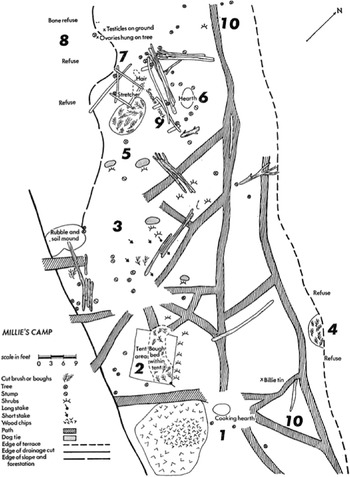
At the time of Bonnichsen's study, Millie's Camp was a recently abandoned Cree campsite situated near the mining town of Grande Cache in west-central Alberta, Canada. An encounter with Millie, one of its former occupants, led to the idea of using the abandoned camp as an experiment of material inference that tested archaeological interpretations made of the camp against Millie's intimate knowledge of it. Based on the methodological assumption that observed material patterns reflect aspects of residents’ behavior and social organization, the focus was on how “organizational units” could be identified from correctly interpreted activity areas (Bonnichsen Reference Bonnichsen1973:277). For that purpose, the camp was thoroughly documented and mapped, and 10 activity areas were identified: two cooking areas, two refuse areas, two tent areas, a dog-tie area, a hide-working area, and a corral area. In addition, trails crisscrossing the camp were also identified as an activity area (Figure 1).
Plan of Millie's Camp showing numbered activity areas (after Bonnichsen Reference Bonnichsen1973:Fig.1, reproduced with permission).

Based on the dual cooking, tent, and refuse areas, Bonnichsen (Reference Bonnichsen1973:284) concluded that the camp was occupied by two families, one residing in the southern part and the other in the northern area. The southern family was thought to have consisted of an adult man, a woman, and a boy, whereas the northern family included a man, woman, boy, and baby. It was further suggested that the southern family had stayed in the camp longer and, on the northern family's departure, had extended its activities to the northern part. The many commercial items found indicated that the occupants were integrated into a cash economy that was partly supplemented by hunting, as seen from traces of a killed animal, ammunition, presumed traps, and a hide-working platform. Carvings found in the bark of some trees were interpreted as possible symbolic representations of a large power line constructed across the southern end of the camp (Bonnichsen Reference Bonnichsen1973: 280).
After the interpretations were completed, Millie was asked to judge their validity. Despite many of the interpretations being correct, Bonnichsen chose to write only about the wrong or incomplete ones: “Correct interpretations need not be discussed here. Rather, those interpretations which proved to be incorrect . . . will form the basis of discussion” (Reference Bonnichsen1973:285; emphasis added). Then, what was incorrect? Millie recalled that the permanent residents of the camp were only herself, her teenage daughter, and her eight-year-old son. During weekends, however, they were joined by her husband and two older sons, who all worked in the nearby Grande Cache coal mines. When they were present, the two sons slept in one of the tents, while the rest of the family used the other and larger tent. The event of a deer being shot and brought to the camp for processing explained the shift of activities from the southern to the northern part of the camp. Other mistakes were interpreting one activity area as a horse corral, confusing a rawhide strip used for hide stretching with a snow goggle, and misinterpreting dynamite wires that were used as playthings as snares; in addition the presumed symbolic carvings of the power line turned out to be not so symbolic but were made by Millie's teenage daughter (Bonnichsen Reference Bonnichsen1973:285–286). Bonnichsen's focus on the negative aspect of the case study has clearly contributed to its largely cautionary reception (e.g., Legendre Reference Legendre, Blaising, Driessen, Legendre and Olivier2017:153; O'Connell Reference O'Connell1987:74; Olivier Reference Olivier2019:17; Schiffer Reference Schiffer1983:667; Simms Reference Simms and Wandsnider1992:188; Skibo et al. Reference Skibo, Schiffer and Kowalski1989:403; South Reference South1979:214–216; Symonds and Vareka Reference Symonds and Vareka2014:190).
The theoretical inspiration for Bonnichsen's study (Reference Bonnichsen1973:277) was clearly processual: it was a test case study based on the premise that behavior is patterned and results in patterned remains. To prepare for the investigation Bonnichsen had visited contemporary Cree camps in the area and read ethnographic studies. However, these potential analogic sources were used intuitively and not treated with any systematic rigor as Bonnichsen himself admitted (Reference Bonnichsen1973:279). Thus, when the reconstructions failed, it was not the theoretical proposition that was wrong but his failure to use contemporary sources to develop testable forms of analogic reasoning (Bonnichsen Reference Bonnichsen1973:278, 287).
What we find significant, however, is precisely the pivotal role assigned to the theoretical framework and the urge to detect structured behavior and organizational units. The emphasis given to wrong interpretations, especially those considered seriously skewed, was to a large extent determined by these expectations and thus what in advance was considered significant; that is, “social” and behavioral reconstructions. It is legitimate to ask, however, whether it was such inquiries the site was able to respond to and thus whether they are the most significant given what actually showed up? What would have happened if the varied and detailed finds had been equally allowed to influence the study as theoretical canons and ethnographic narratives? That is, what if we instead saw Millie's camp as a casuistical case and then tried to learn and theorize from the material so meticulously documented by Bonnichsen?
To do so, we would have to consider this material in some detail. In addition to the features mapped on the site plan, loose objects were also collected and documented. These were listed as assemblages relating to the activity areas, but only a few were used in the interpretation of the site. To Bonnichsen's credit, all finds are presented as an appendix to the paper, allowing for some secondhand reflections. This list accounts for 171 finds that were grouped into the following categories: miscellaneous (70), food (50), tobacco (12), shelter/construction material (9), toys (7), cloths (7), medication (6), hunting equipment (5), and cosmetics (5).
These finds constitute a very mixed assemblage relating to crucial aspects of human experience, such as consumption, everyday life, childhood, Native culture, routines, hardships, and pleasures. However, rather than requiring them to reveal a preestablished conceptual correspondence with a social world, we suggest using an approach that appreciates their idiosyncrasies and the potential modes of knowing that are already present in them (Stewart Reference Stewart2008:73). What is important is these things’ unique capacity of remembering that, given the crucial but largely unquestioned role that memory plays in this study, deserves attention. We use the concept of memory here in a non-anthropocentric sense, underlining its distributed and material nature; this is not simply about memory as external or extended cognition (e.g., Clark Reference Clark2008; Malafouris Reference Malafouris2013; Stiegler Reference Stiegler1998; Sutton Reference Sutton, Malafouris and Knappett2008) but memory as a property of materiality to carry the past into the future, which is arguably the very basis of all archaeology (Lucas Reference Lucas2010, Olivier Reference Olivier2011; Olsen Reference Olsen, Graves-Brown, Harrison and Piccini2013; Tamm Reference Tamm2013).
Thus, take a moment to consider how “food items”—bones, peels, cans, boxes, and bags—accurately reflect meals and culinary moments involving T-bone steaks, Boston Corn Beef, Kraft sandwich spread, Robin Hood Oats, Lipton's chicken noodle soup, Canada no. 2 grade potatoes, pancakes made from Aunt Jemima's mix, and, not to forget, smoked deer meat. The things left also recall candies such as Nelson's Burnt Almond chocolate, Mackintosh's toffee, and Willard's Swell chocolate bar, as well as eggs, macaroni, onion, salami, popcorn, sugar, orange, apples, bread and crackers, and drinks: lots of Fanta, Red Rose Blue Ribbon and other teas, but no alcohol or coffee. Stimulants seem confined to tobacco in the form of readymade and home-wrapped filter cigarettes from Cameo, Player, and Export A, although pipes were also used as recalled by the presence of Amphora pipe tobacco. Medication was basic and witnessed primarily by bandages and Vick's cough and cold remedies (often for children). Memories of childhood and play include a yellow toy parachute jumper, a leg of a black toy spider, arms of a white plastic skeleton, a pink bird whistle, and a Dinky Toy Land Rover; traces of clothing were the debris of homemade products of buckskin and cotton (possibly misinterpreted) and, more definitively, the label of one pair of Rider Cowboy jeans and a box for Kingtread boots. Hair dressing and fragrance are remembered well by a perfume bottle, hair curlers, and a box for a Salo hair styling product. In the category of hunting equipment, we find rightly and wrongly placed artifacts such as yellow dynamite wire, a metal trap (for mice!), and cartridge boxes; shelter/construction materials include tent pegs, spruce branches, and white poplar stakes. As expected, the large “miscellaneous” assemblage is the most varied, exhibiting mnemonic items such as wood chips; charcoal; Scotch tape; two pages of the Eaton's Mail Order Catalogue; Kodak and Ilford film packaging; a safety pin holder; a psychedelic green plastic bottle cap; a leather knife sheath laced with dynamite wire; one bead box (Quality Beads, “color m.o. blue”); a piece of knotted hemp rope; a Cree manual dated June 7, 1969; a Corning ware box labeled “used clothes for mission”; and an empty matchbook with “Thank You” written on it (Bonnichsen Reference Bonnichsen1973:287–290).
These immensely varied and informative items might perhaps also recall organizational units like a “nuclear family,” but maybe they are not particularly good at that. And why should they be marshaled to recall precisely that, rather than what they remember about themselves, the events they were involved in, and the affects and sensations they created? Is the happiness felt for a new pair of Rider Cowboy jeans less important than a wrongly interpreted horse collar? And what about the care for a coughing child remembered by a jar of Vick's VapoRub? How many of the memories so faithfully held by these things could ever have been recalled by a human mind? It is likely that Millie could have elaborated and added to these material memories, but we do not get to know much about what she said or even if she got to see the things retrieved. Such “excesses” likely became at best ornamental and without any place in the search for patterned behavior, where the “native” or “Indian” imprint probably created further restrictions on what to expect (e.g., authenticity, traditions, symbolism).
What we have tried to do in revisiting Millie's Camp is to invert the way it works. Although Bonnichsen had set it up as a classic control case study, we hint at its potential as an extended example: a case that is not meant to test our prior theories or assumptions but rather one through which we can theorize. Let us try and draw out some of the key threads here. First, we are not arguing that prior assumptions and theories play no role; of course, we cannot avoid bringing conceptual framing and prejudices into any situation. Rather, the point is precisely that we use the case or example to expose these prejudices, to reveal inconsistencies, to make us think. As argued by Stewart (Reference Stewart2008:72), the things we encounter “don't just add up but take on a life of their own as problems of thought.” Here, the role of the anomalous or aberrant is critical but, again, in a way very different from the traditional case study where they tend to be seen as part of the test: either as refutations or falsifications of a theory or, more commonly, as indicating complexities with factors outside the reach of the current paradigm. What makes the anomalous and aberrant different in our approach is that they operate not against a theory, but rather theory works with and from them. The anomalous or aberrant is distributed across theory and data.
In our theorizing of Millie's Camp, the first anomaly was in the way Bonnichsen focused solely on wrong interpretations rather than the correct ones. Yet the very tension between these two became the basis for a different way of engaging with the case. When we delved into his appendices, we were struck by the details that were lost in the generalizing interpretation. The materials found were not just store-bought items or consumer goods but Kraft sandwich spread, Robin Hood Oats, and Lipton's chicken noodle soup. The very specificity of these objects becomes very powerful when released from their generic categorizations as packaged foods or as evidence of integration into a cash economy.
The very specificity also demands much more of the reader and of the archaeologist because such specificity is much more recalcitrant in the face of an imported theory or model. Specificity breeds aberrance. But it also raises a third kind of anomaly: between the memories carried by the objects themselves and those of Millie. Bonnichsen's testing of his interpretations was solely conducted in relation to Millie's memory of what happened there. But why should we privilege this particular account, especially because she was only consulted after the interpretations were made and then to answer only those questions relevant to Bonnichsen? We raise this issue not to question how reliable her memory is but rather to understand better how her recollection was shaped by the stance taken in the study. We never get to know what she could have added about other understandings, beyond the framework of Bonnichsen's questionnaire. Moreover, why is human testimony considered more reliable than the memory of things? We are not interested in anthropomorphizing things but rather point to the need to theorize through the case and question some common assumptions about what memory is. What happens when we think through the site using what is actually found there?
Concluding Remarks
We are not suggesting that our brief revisit of Millie's camp is the best or only way to treat the case differently. Our primary aim has been to illustrate an alternative approach to the case from that used most commonly and not to prescribe some new methodology, let alone a substantive rereading of Millie's Camp. Let us offer some thoughts here about the implications this alternative approach has for conducting archaeological research and, more specifically, our conception of archaeological theory. These implications are important because the conventional case study is deeply integrated into research practice at a pedagogic level, in terms of how we teach our graduate and doctoral students to plan their own research, and in writing grant proposals and peer-reviewed publications.
The traditional version of the case study inevitably implies a hierarchy. The case study is consciously selected and carried out as a specific control or test case and is thus thought of as suitable or instructive for the inquiry scrutinized or the theory to be operationalized as “working.” This implied hierarchy is, of course, also an outcome of how theory is conceived of and the way it may or may not accommodate anomalies, disturbances, or alternatives. Theory is commonly seen as general and abstract, rather than situated and concrete. In the Concise Oxford Dictionary of Archaeology, archaeological theory is described as “(a) body of philosophical and theoretical concepts providing both a framework and a means for archaeologists to look beyond the facts and material objects for explanations of events that took place in prehistory” (Darvill Reference Darvill2008; emphasis added). This aligns well with the common conception of theory as a sphere contrasted to practice and thus set off from our doings and the world as immediately manifested and experienced (cf. Johnson Reference Johnson2006). Although there is a difference between so-called top-down and bottom-up theorizing, the elevated position of theory itself is still held firm by both types (Pétursdóttir and Olsen Reference Pétursdóttir and Olsen2018:103–104).
But what happens if we think of theory and the case study in different terms, as entities that relate in ways unforeseen and unfinished and that constantly are affected by each other? In this conception, which goes beyond definition, prescription, and finitude, there is always an unanticipated potential for change. Emphasizing “the practice of theorizing over theory” (Lucas Reference Lucas2015:28–29), it should also matter to theory what it matters for (Pétursdóttir and Olsen Reference Pétursdóttir and Olsen2018:102). It should matter whether it encounters the floor of a barrack in a POW camp in the far north, gravestones in New England, or skulls in a Çatalhöyük mud wall in the same way that it mattered to structuralism and semiotics when encountering anthropology rather than linguistics, and to agency theory when bumping into things and ruins rather than people (Pétursdóttir and Olsen Reference Pétursdóttir and Olsen2018:113).
So, what does this entail in terms of how theory and case study relate? It means we should not think of theory as the program we load at the start and impose on the material; it means the problem of theory is not how to apply it or to operationalize it. Instead of framing the case study, it means that theory operates among things, in the shadows or interstices of the case—allowing the matter at hand to articulate with theory and thus to expose things as matters of theoretical concern. It also means that the case study is not a venue for testing or demonstrating the validity of a theory but a site of encounter where propositions and theories are modified, developed, and challenged. Adopting this new approach means radically altering the way we think about, teach, and practice research, but we believe it will have major consequences for our discipline and the status of theory within it.
Acknowledgments
We would like to thank Alison Wylie for kindly reading a draft of this article and providing much-needed critical distance and feedback. We also thank two anonymous reviewers for helping us clarify our argument and our definitions of how the case study is conceived in archaeology. We take full responsibility for all that is written herein.
Data Availability Statement
The authors confirm that all the information supporting the findings of this study are available within the article and in cited references.