

INTRODUCTION – THE SITEFootnote 1
During the Hellenistic period wine and olive oil constituted major components of the rural economy of Crete, and amphorae were the main medium of distribution.Footnote 2 However, not much archaeological evidence exists for amphora production workshops of this period in Crete. The seminal work by J.-Y. Empereur, Ch. Kritzas and A. Marangou (Reference Empereur, Kritzas and Marangou1991) has demonstrated the presence of such production centres in central and east Crete on the basis of field survey data.Footnote 3 The rescue excavation carried out in a private plot at Loutra (Rethymnon, west Crete) during the years 2003–4 brought to light a pottery workshop mainly producing amphorae (Tsatsaki in press). The workshop forms part of a farmstead. The present study focuses on the pottery deriving from the kiln as well as from other areas of the farmstead. The integrated approach of typology and thin-section petrography is aimed at characterising the clay pastes and investigating the origin of the raw materials used in the workshop, as well as detecting the presence of potential imports.
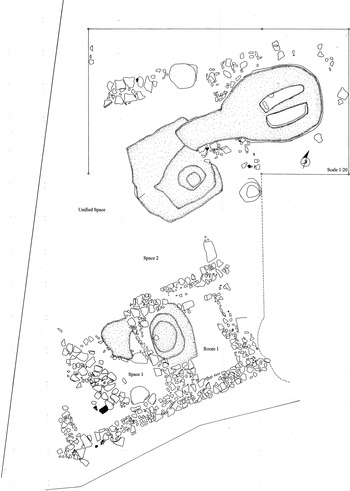
Loutra lies on a low plain east of the modern town of Rethymnon, in the broader area of Stavromenos-Chamalevri (Tsatsaki in press). The excavated area of the farmstead preserves the pottery kiln, two refuse pits near the kiln entrance, and five rooms, four of which lie south of the kiln, one to its north-west (Fig. 1). The kiln is U-shaped: it measures 4.40 m in length and 2.20 m in diameter; the two parallel walls support the grate. Two more Hellenistic kilns of the same type are known in Crete, one excavated in ‘House B’ at Eleutherna (Kalpaxis Reference Kalpaxis and Gavrilaki1996) and one at Knossos (Eiring Reference Eiring2000, 450, fig. 1C).
Loutra excavation: plan of the site. Drawing by J. Androulidakis.

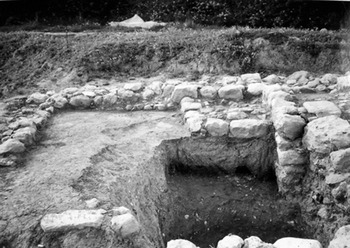
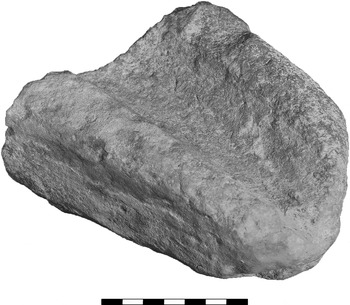
The rooms south of the kiln are poorly preserved. The spaces immediately adjacent to the kiln are badly damaged, although the two distinguishable rooms beyond them are in better condition. At the south-west corner of one of the rooms a beam press has been revealed, comprising an upraised and built rectangular base with a pit to the north (Room 1, Fig. 2), as well as the spout of the beam press (Fig. 3). Carbonised olive pips recovered in Room 1 indicate that the structure was used for the extraction of olive oil. Attached to Room 1 is Space 1, where there is a shallow pit and a layer of semi-dressed stones to the south-east used for levelling the floor, compensating for the natural south–north inclination of the ground surface. The layer of stones was covered with yellow earth to form the floor. The finds from this room consist of many amphora fragments, bowls with both incurved and everted rims, basins, cooking pots, pithoi and mould-made (‘Megarian’) bowls.
Loutra, the beam press.

The spout of the beam press.

To the north-west of the kiln entrance there is one more room, with part of a wall and a floor of beaten earth. The course of the walls indicates that the farmstead continues to the west: first below the road leading to Loutra and Pangalochori, and then into the further roadside plot where the foundation of a wall and amphora toes were recovered. An extensive destruction layer was removed from Room 1 and Space 1.
The chronology of the workshop is provided by two bronze coins found in the area west of the kiln. They were minted at Knossos and show Zeus with a thunderbolt levelled in his raised right hand on the obverse side and an eagle on the reverse. These coins are dated between 40 and 30 bc (Sidiropoulos Reference Sidiropoulos, Livadiotti and Simiakaki2004a, 194, fig. 1στ; Reference Sidiropoulos and Gigourtakis2004b, 643–4, pls. 5:61–62, 6:64,66–67).Footnote 4 Corroborative evidence comes from fragmented mould-made (‘Megarian’) bowls discovered on the floor of one of the rooms, with parallels in ‘House A’ at Eleutherna dated from the mid-second to the first century bc (Ioannidou Reference Ioannidou, Kalpaxis, Furtwängler and Schnapp1994, 155). The workshop of Loutra can, therefore, be dated fairly securely to the Late Hellenistic period, i.e. from the end of the second century bc to the third quarter of the first century bc (on relevant finds, cf. Tsatsaki in press).
THE POTTERY
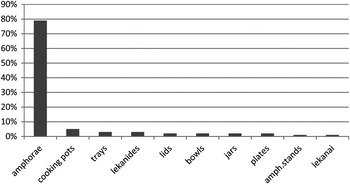
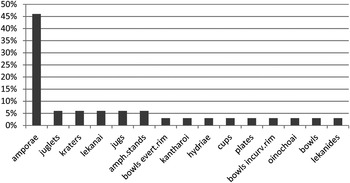
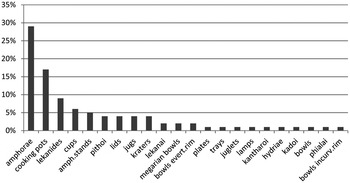
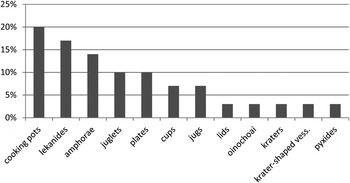
The study and quantification of the potteryFootnote 5 from the excavation of the farmstead at Loutra indicates a predominance of amphorae in the areas connected with pottery production, i.e. the kiln, the refuse pits and the extensively damaged areas to the south (‘Unified Space’ and Space 2). The amphorae constitute 79% of the shape repertoire deriving from the kiln and the two refuse pits near the kiln entrance (Fig. 4), 68% from the ‘Unified Space’ (Fig. 5),Footnote 6 and 46% from Space 2 (Fig. 6). From the lower level of the kiln chamber many amphora toes and a piece of a burnt handle were recovered. In Room 1 with the olive beam press a more elaborate shape repertoire emerges, with amphorae still being the predominant form, although now with a presence of only 29% (Fig. 7). In Space 1 west of Room 1 the percentage of amphorae is yet lower (14%), below cooking pots at 20% and lekanides at 17% (Fig. 8).
The pottery of the kiln.

The pottery of the ‘Unified Space’.

The pottery of Space 2.

The pottery of Room 1.

The pottery of Space 1.

The Shapes
Amphorae
The amphorae constitute the majority of the ceramic repertoire at Loutra. They are rather fragmentary; only a percentage can be identified and classified according to the known shapes. They are encountered in a variety of sizes and types: small- and medium-sized, all with pointed (toe) bases, double-barrelled handles or handles of elliptical section, some of which come to an angle on their upper part (like a ‘wishbone’). On the basis of their morphological characteristics the majority of the identifiable amphorae belong to amphora type 3 according to the typology of Markoulaki, Empereur and Marangou (Reference Markoulaki, Empereur and Marangou1989, 570–4, fig. 23a), and some to type 7 according to the typology of Empereur, Kritzas and Marangou (Reference Empereur, Kritzas and Marangou1991, 506–7, fig. 30f).
a) amphorae connected with Cretan amphora type 3 (AC3) (for further analysis of Cretan amphora type 3, cf. Marangou-Lerat Reference Marangou-Lerat1995, 82–4)
-
P1 (MR Π 33244): Part of amphora, preserving shoulder to rim and handles. It has a brown clay (5YR 7/4), except for part of the body which is greenish (5Y 7/3) due to high firing. This recalls the type 3 of Cretan amphorae of which older examples have been found at Knossos and dated to the years of Augustus. The pot was reassembled from sherds that were found west of the kiln entrance and among the refuse to the south-west of the kiln entrance. Preserved height 17.5 cm. Figs. 9, 10.
-
P2 (MR Π 34451): Non-joining rim fragment, neck and body sherds of a single amphora with one handle of elliptical section and forming an acute angle on its upper part. It is made from a pale-grey clay (10YR 7/2). Its shape relates also to the Cretan amphora type 3. These pieces were found among the refuse to the south-west of the kiln entrance. Preserved height 17.6 cm. Figs. 11, 12.
-
P3 (MR Π 33241): Amphora rim and upper body fragment with trace of handle below rim. In a brown/yellow clay (10YR 8/4), it is of a similar type to P1 and P2. This example reveals the shape of the amphorae produced in this particular workshop, as it was found inside the kiln chamber, at the lower part of the grate. Preserved height 13.9 cm. Fig. 13.
-
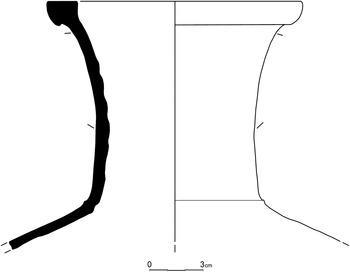
P4 (MR Π 33238): Amphora preserving part of the neck and body, reassembled from many fragments. There are also non-joining fragments, i.e. one intact handle of elliptical section and part of the second, as well as other body sherds. The clay is yellowish on the exterior (2.5YR 8/4), and greenish (5Y 7/3) on the interior and the over-fired parts. The vessel was found in the kiln space, to the west side and south-west of the kiln entrance. The body is partially distorted due to over-firing. The internal surface of the vessel has intense wheel marks. Its handles are similar to those of amphora P2 (MR 34451) discussed above, and resemble those of the type 3 of Cretan amphorae. Preserved height 34.6 cm. Figs. 14, 15.
P1 (MR Π 33244). Amphora recalling the Cretan amphora type 3. Drawing by J. Androulidakis.

P2 (MR Π 34451). Amphora. Drawing by J. Androulidakis.

P3 (MR Π 33241). Amphora. Drawing by J. Androulidakis.

P4 (MR Π 33238). Amphora with handle. Drawing by J. Androulidakis.

b) amphorae connected with Cretan amphora type 7 (AC7) (for further analysis of Cretan amphora type 7, cf. Marangou-Lerat Reference Marangou-Lerat1995, 67)
-
P5 (MR Π 33243): Button-shaped amphora base, in a brown clay (5YR 7/4). It was found to the south-west of the kiln entrance. The shape resembles those bases of the type 7 Cretan amphorae that have been found in Keratokampos and are dated to the 2nd, and mostly to the 1st, century bc. Preserved height 10.2 cm. Figs. 16, 17.
P5 (MR Π 33243). Button-shaped amphora base. Drawing by J. Androulidakis.

c) others
-
P6 (MR Π 34452): Button-shaped amphora base, in a pale-brown clay (7.5YR 7/4). It was found inside the kiln. Preserved height 4.9 cm. Fig. 18.
-
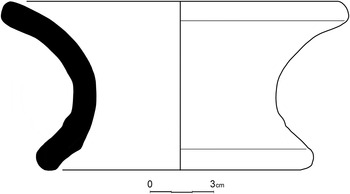
P7 (MR Π 33240): Amphora with double handles, preserving part of the rim and neck, one handle and the attachment of the other. It is made from a brown clay (7.5YR 7/6). It was found to the west in front of the kiln entrance. It is very similar to a partially surviving amphora from Knossos, with the difference that the Loutra example has a carination between the rim and the neck. According to Eiring (Reference Eiring, Coldstream, Eiring and Forster2001, 129–30, fig. 3.19:d) the Knossian amphora is a local imitation of a Rhodian type dated to the 2nd or 1st century bc; the same seems to be the case also for the Loutra amphora. Preserved height 18.3 cm. Fig. 19. The amphorae of this type may have single instead of double handles (Fig. 20).
P6 (MR Π 33452). Button-shaped amphora base. Drawing by J. Androulidakis.

P7 (MR Π 33240). Amphora with double handles. Amphora of same type as P7, but with single handles. Drawing by J. Androulidakis.

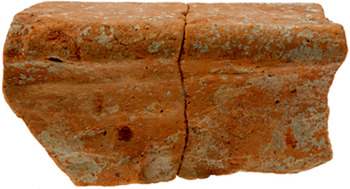
Macroscopic examination of the amphorae has identified three main groups of clay fabrics. The predominant one includes those manufactured from a brown clay of varying hues; this was also used for the manufacture of stands. Another fabric found in the amphora assemblage is a yellowish to buff clay, also used for stands. Finally there is a group of amphorae in several variations of a pinkish clay, which was also used in kiln supports as well as in stands. The grey and green colours, or a combination thereof as observed in some amphorae, can be attributed to high firing, since the same coloration appears also in the kiln wasters. The latter include fragments of pots either stuck together or distorted by high firing; many are of a grey-green clay (5Y 5/2) with greenish vitrification on part of their surface from high firing (Fig. 21). A few isolated cases concern amphorae of orange or reddish clay. Also encountered are some stands of orange/red clay, a colour that is more commonly associated with pithoi or lids of pithoi.
Kiln wasters.

Two amphora fragments include mica in their clay; they are considered to be imported. One is an amphora neck with double-barrelled handle made of a rather pale brown to yellow-buff clay with mica (10YR 8/3); it was found in Space 2 (Fig. 22a ). The second is an amphora body sherd in a white-buff clay with mica (5YR 8/1), which derives from Room 1 (Fig. 22b ).
Amphora sherds in micaceous fabrics: (a) petrographic sample LTR 10/1; (b) petrographic sample LTR 10/2. See Table 1.

Amphora stands
The majority of the stands in the Loutra assemblage were designed to support amphorae with toe bases.Footnote 7 They were found within the kiln and in other areas of the farmstead, wherever there was the need to support such amphorae. Other types of kiln supports were recovered from the chamber of the kiln and the refuse pits; they were intended for stacking other types of vessels which have been presented elsewhere (Tsatsaki in press).
At Loutra the great majority of the amphora stands have a curved profile which is in accordance with Eiring's (Reference Eiring, Coldstream, Eiring and Forster2001, 129, fig. 3.18:g) conclusions on the Knossian finds: stands were made with a straight profile in the second century bc, but concave profiles became common in the Late Hellenistic period and after.
-
P8 (MR Π 33234): Amphora stand with curved profile, in a pinkish clay (7.5YR 8/2). It was found among the refuse south-west of the kiln entrance. Height 8 cm. Fig. 23.
-
P9 (MR Π 33235): Amphora stand with curved profile, in a pale-brown clay (10YR 8/4). It was found in Room 1. Height 8 cm. Fig. 24.
P8 (MR Π 33234). Amphora stand. Drawing by J. Androulidakis.

P9 (MR Π 33235). Amphora stand. Drawing by J. Androulidakis.

Cooking pots and lids
Numerous among the finds in all areas of the farmstead are the cooking pots, mainly chytrai. Footnote 8 Their state of preservation is fragmentary, with only body sherds surviving in most cases. Also recovered were several lids, some intended for chytrai, others for pithoi.
-
P10: Non-joining body sherds and part of a curved base of a cooking pot (chytra). The clay is red (2.5YR 5/6), marked by traces of fire on the internal and external surfaces. It was found in Room 2.
-
P11: Flanged rim of a cooking pot (chytra) indicating the attachment of a lid, in a red clay (2.5YR 5/8). It derives from Room 2. Preserved height 2.3 cm. Diameter 18 cm. Fig. 25.
-
P12 (MR Π 34453): Fitted lid, conical with a button-shaped handle, in a brown clay (7.5YR 7/6). It was found in Room 1. Height 2.4 cm. Diameter 7.8 cm. Fig. 26.
-
P13 (MR Π 34454): Lid, disc-shaped, for pithos or jar, in an orange clay (2.5YR 6/8). It is decorated with four incised concentric circles on its upper surface: two at the centre and two on the periphery. It was found in Room 1. A similar disc-shaped lid, but without incised concentric circles, is known from the finds of ‘House B’ at the site of Nisi in Eleutherna; it belongs to an assemblage dated to the last third of the 2nd century bc (Tsatsaki Reference Tsatsaki2000, 46, 50, table 23β). Height 1.5 cm. Diameter 26 cm. Figs. 27, 28.
P11. Cooking pot rim.

P12 (MR Π 34453). Lid. Drawing by J. Androulidakis.

P13 (MR Π 34454). Lid with incised decoration. Drawing by J. Androulidakis.

The orange clay of the above-described disc-shaped lid is not encountered in any of the amphorae, but only in some of the pithoi, and other disc-shaped lids. Both these last shapes are represented in the kiln, indicating that they were being produced in this particular workshop. Characteristic is a fragment of pithos rim, made in this orange-coloured clay (Fig. 29).
Pithos rim in an orange clay.

Terra Sigillata
The imports are not limited to amphorae. There are two terra sigillata dishes, found in different areas of the site.
-
P14: Fragments of a terra sigillata dish with slightly in-turning rim, in a yellowish clay with orange gloss on the inside which at places fires red (7.5YR 8/4). It comes from the pit found in the north-eastern part of Space 1.
-
P15: Terra sigillata dish similar to the previous, with rouletting decoration on the base. It is also made from the same yellowish clay (7.5YR 8/4), with red gloss internally and externally. It was found in the ‘Unified Space’. Figs. 30, 31, 32.
P15. Terra sigillata dish with rouletting decoration. Drawing by J. Androulidakis.

Both dishes seem to be imported. Their shape and decoration, as well as their clay and gloss, relate to the so-called Eastern Sigillata A plates, which began being produced in the middle of the second century bc. The dishes from Loutra can be identified as some of the earlier examples of this ware, which Forster generally describes as characterised by broad bases, and with internal surfaces decorated with groups of rouletted circles (Forster Reference Forster, Coldstream, Eiring and Forster2001, 139, fig. 4.1:a,g).
PETROGRAPHIC ANALYSIS
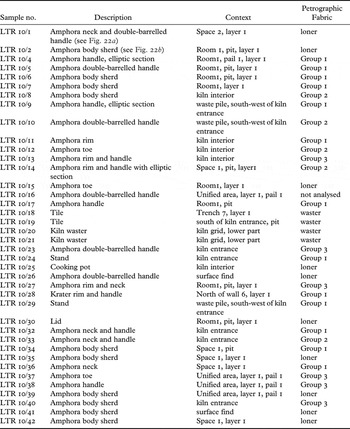
The petrographic analysis of 42 pottery samples from Loutra involved representative shapes of the assemblage, deriving from the kiln as well as contexts across the site. The samples include mainly amphorae and selected sherds of domestic vessels, kiln wasters and tiles. The aim of the analysis was to characterise the ceramic fabrics, discuss the array of recipes present in the assemblage and draw inferences on their provenance and on the technology of their manufacture. Three main fabric groups were identified on the basis of the mineralogical composition and the texture of the samples. The remaining samples were grouped either in small sets of two to four samples or were loners. Table 1 shows the concordance between fabrics and shapes, while full petrographic descriptions are set out in the Appendix.
Table of concordance between shapes and petrographic fabrics.

A brief overview of the geology of the area
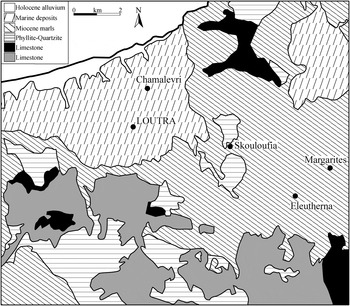
Loutra is situated on a low plain, near the coast, characterised by alluvial deposits, with Pliocene and Pleistocene deposits further inland composed of grey and white clays and marls, occasionally with fossils. The geological background is composed of phyllites and quartzites of the Upper Triassic and of limestones and dolomites of the Tripolis series (Hellenic Institute of Geology and Mineral Εxploration [IGME] 1991) (Fig. 33).
Geological map of the area (after Hellenic Institute of Geology and Mineral Exploration [IGME] 1991).

These deposits constitute potential sources of raw materials for pottery manufacture. The petrographic analysis of prehistoric pottery from Chamalevri (Nodarou Reference Nodarou, Vlazaki and Papadopoulou2011) and the small-scale clay sampling carried out in the area provide comparative evidence for this research.
Fabric groups
Petrographic analysis of the material from Loutra identified three main groups with similar compositional and textural characteristics: the raw materials used are calcareous, with micritic limestone and microfossils as the dominant components. The firing is rather high, as indicated by the optically inactive matrix suggesting a kiln temperature of c.800–900°C, or even higher in cases where the matrix turns greenish.Footnote 9 The criteria differentiating the three groups are mainly quantitative (certain components being less or more abundant) and/or textural, especially with regard to the granulometry of the inclusions and the firing temperature affecting the colour of the clay matrix.
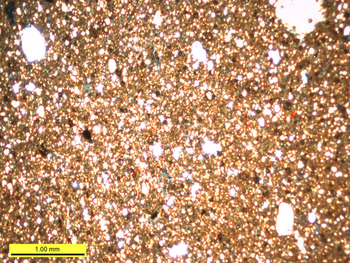
Fabric group 1
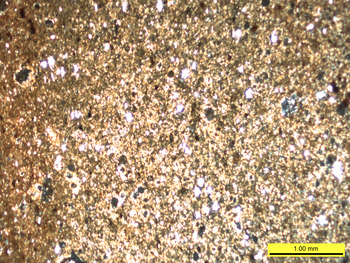
Calcareous with micritic limestone and microfossils (Fig. 34)
Fabric group 1 (XP, ×50). Note phyllite fragment at top centre of the field.

Samples: LTR 10/ 4, 5, 6, 7, 9, 11, 17, 24, 28, 29, 32, 34, 36
This group comprises the majority of the samples, mainly amphorae, one krater and one stand. The clay matrix fires a fine brown; it is composed primarily of micritic limestone and microfossils. The secondary non-plastic inclusions consist of a few quartz fragments, biotite mica and rare metamorphics (phyllite and schist). There are also a few shell fragments and rare sponge spicules. The mineralogical composition indicates the use of calcareous raw materials deriving from Neogene marls. The presence of the rare phyllite and schist fragments indicates a residual component from the Phyllite-Quartzite series in the Neogene sediments. The metamorphics are widely available in the broader area of Loutra, as indicated by the phyllitic fabrics of Bronze Age Chamalevri (Nodarou Reference Nodarou, Vlazaki and Papadopoulou2011). The rock and mineral suite of this fabric group is, therefore, compatible with the broader area of Loutra. Corroborating evidence for the local origin of the fabric is provided by the presence of sponge spicules and the comparative clay samples. Sponge spicules are white, needle-shaped particles, usually easily discernible on the surface of the vessels; they are fairly frequent in west Cretan fabrics and more specifically in a number of Bronze Age fabrics from Chamalevri (Moody et al. Reference Moody, Lewis-Robinson, Francis, Nixon and Wilson2003, 97). Their presence in the most frequently encountered fabric at Loutra indicates the broadly local origin of the raw materials used for the manufacture of the amphorae. This evidence is further enhanced by a clay sample (CS 06/24) deriving from a Neogene marl deposit some 2 km south of Stavromenos which contains sponge spicules (Fig. 35). Moreover, another clay sample (CS 06/25) deriving also from the area south-east of Loutra (towards Skouloufia) is very similar to the amphora fabric, with micritic limestone as the predominant component and also microfossils (Fig. 36).
Clay sample CS 06/24 (XP, ×50).

Clay sample CS 06/25 (XP, ×25).

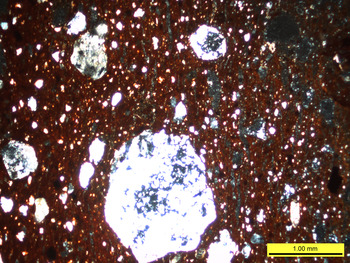
Fabric group 2
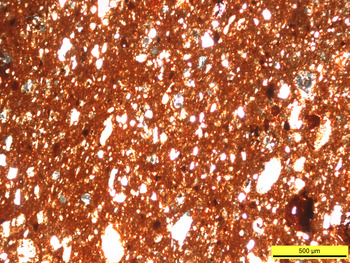
Red with micritic limestone (Fig. 37)
Fabric group 2 (XP, ×50).

Samples: LTR 10/ 8, 10, 12, 14, 33
This group comprises only amphorae. The matrix is dark red to brown-firing and optically inactive. The mineralogical composition is fairly similar to that of Fabric group 1, with micritic limestone now being the predominant component. The main difference is the brighter colour of the matrix, the absence of metamorphic rock fragments, and the presence of a significantly smaller amount of microfossils. Moreover, the base clay contains bright red and optically active clay pellets which are not seen in Fabric group 1. These differences seem to reflect the use of a similar raw material, but not one deriving from the same source as that used for Fabric group 1; rather it probably originates from an alluvial deposit.
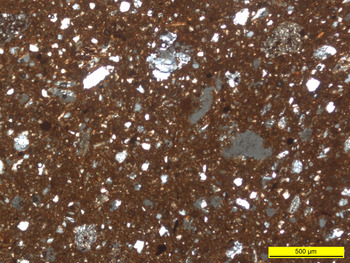
Fabric group 3
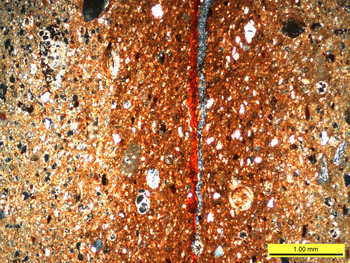
Calcareous with crystallitic b-fabric (Fig. 38)
Fabric group 3 (XP, ×25).

Samples: LTR 10/ 13, 23, 27, 37, 38, 40
The vessels represented are all amphorae. This fabric is finer than the other two groups. It is characterised by a fine calcareous matrix ranging in colour from brown to greenish-brown due to the increased percentage of calcium and the high firing temperature. The main characteristic is the presence in the matrix of crystallitic b-fabric.Footnote 10 The very few non-plastics include quartz, rare metamorphics, fossils and shell fragments.
Small groups and loners
The assemblage from Loutra presents a high degree of compositional homogeneity, which may be expected from a kiln site, especially when production focuses around a limited range of shapes (amphorae in this case). From the analysed material there are only a few samples that were not from the main fabric groups: they constitute petrographic loners, except for the kiln wasters that form a small group. A selection is presented here with special reference to imports.
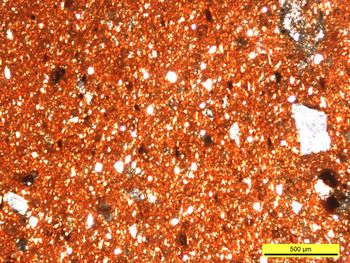
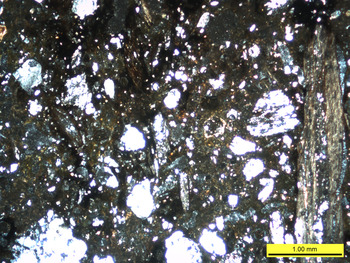
LTR 10/ 1, 2 (Figs. 22a, 22b ): these two samples differ in the colour of their matrix but have a similar composition; for that reason they were considered to belong in the same group. In sample LTR 10/1 (Fig. 39) the micromass is greenish, which is indicative of a calcareous raw material and high firing temperature. In sample LTR 10/2 (Fig. 40) the micromass is brown, which is also indicative of a calcareous raw material but one in which the firing temperature will have been lower. The non-plastic inclusions consist of mono and polycrystalline quartz, very few weathered volcanic materials, and significant amounts of muscovite mica, which gives the final product its characteristic shiny surface. Both samples are amphorae.
Sample LTR 10/1 (XP, ×25). Import from Kos?

Sample LTR 10/2 (XP, ×25). Import from Kos?

This rock and mineral suite with the abundant mica and the weathered volcanics is not compatible with the Cretan geology. Although the exact origin of these vessels cannot be identified with certainty, the fabric is reminiscent of the Koan fabric class 4 discussed by Whitbread (Reference Whitbread1995, 91–3). Moreover, this association with Kos fits with Hellenistic amphorae and micaceous raw materials reported from Kardamaina (Hein et al. Reference Hein, Georgopoulou, Nodarou and Kilikoglou2008, 1057).
LTR 10/15 (Fig. 41): this fabric is characterised by a brown and optically inactive matrix, and non-plastic inclusions of varying granulometry: small fragments of quartz, micritic limestone, phyllite and mica laths, and there are also larger grains of micritic limestone, quartzite and clay pellets unevenly distributed in the groundmass. The mineralogical composition is not diagnostic of origin, but it could be a Cretan product. The vessel represented is the base of an amphora with piriform toe.
Sample LTR 10/15 (XP, ×25).

LTR 10/26 (Fig. 42): this is a calcareous fabric; the micromass has a golden-brown colour and is optically moderately active. The non-plastic inclusions consist of micritic limestone, less quartz, very rare metamorphics, and microfossils. There is nothing to suggest a non-local origin; it could be a variant of Fabric groups 1 and 2. The sample represented is an amphora handle.
Sample LTR 10/26 (XP, ×25).

LTR 10/35 (Fig. 43): a very fine calcareous fabric with a golden-brown colour and optically inactive micromass. The margins of the section are green-brown due to the calcium content and the high firing temperature. There are rare non-plastic inclusions consisting mainly of small quartz fragments, quartzite and serpentinite whose colour ranges from dark red and optically active to almost black. There is also a significant amount of crystallitic b-fabric. This rock and mineral suite is in accordance with Whitbread's Rhodian Fabric Class 1 (Whitbread Reference Whitbread1995, 60–1). The Rhodian origin of this vessel is also corroborated by a close petrographic parallel from Trypetos, which has been identified archaeologically and petrographically as an import from Rhodes. The vessel represented is an amphora.
Sample LTR 10/35 (XP, ×25). Import from Rhodes?

LTR 10/39 (Fig. 44): this is a calcareous fabric and the micromass has a light orange-brown colour with a pinkish core; it is optically active. The non-plastic inclusions consist mainly of micritic limestone and quartz, as well as a few metamorphic rock fragments, rare serpentinite, biotite mica and a little white mica. There are also microfossils, shell fragments and characteristic plastic inclusions, namely dark-red clay pellets and clay striations, the latter suggesting incomplete clay mixing. The vessel represented is an amphora (body sherd). The pinkish core and the clay features do not leave any doubt as to the provenance of the specific vessel, namely Corinth. Petrographic parallels on Crete have been identified at Trypetos, and these observations are in accordance with Whitbread's descriptions of Corinthian amphora type A (Whitbread Reference Whitbread1995, 270). The vessel represented is an amphora.
Sample LTR 10/39 (XP, ×25). Import from Corinth.

LTR 10/41 (Fig. 45): this fabric is characterised by a dark red-brown and optically inactive micromass. The rare non-plastic inclusions are unevenly distributed in the groundmass and consist of monocrystalline quartz, chert, rare metamorphics, a little white mica and significant amounts of biotite mica laths. This composition is not diagnostic of origin, but the amount of biotite mica indicates an import. The vessel represented is an amphora (body sherd).
Sample LTR 10/41 (XP, ×50).

LTR 10/42 (Fig. 46): this is a highly calcareous fabric characterised by a golden-brown colour and an optically inactive matrix. The non-plastic inclusions are fairly small and consist mainly of micritic limestone, rare quartz and very rare metamorphics. It is not possible to determine provenance, although a Cretan origin cannot be excluded. The vessel represented is an amphora (body sherd).
Sample LTR 10/42 (XP, ×25).

LTR 10/25 (Fig. 47): this is a coarse non-calcareous fabric with a dark red-brown and optically inactive micromass. The non-plastic inclusions consist of subangular quartz and quartzite fragments; the base clay seems to be connected to an alluvial deposit. A similar recipe for cooking wares has been identified in the Late Minoan IIIB/C assemblage from Chamalevri (Nodarou Reference Nodarou, Vlazaki and Papadopoulou2011, 384), and a clay sample (CS 06/50) from a red earth deposit in the area of Margarites has a very similar matrix (Fig. 48). The vessel analysed is a cooking pot and seems to represent broadly local production.
Sample LTR 10/25 (XP, ×25).

Clay sample CS 06/50 (XP, ×25).

LTR 10/30 (Fig. 49): this fabric is characterised by a fine red-brown and optically inactive micromass. The non-plastic inclusions consist of small fragments of quartz, larger fragments of metamorphic rocks (mainly phyllite) and large angular elongate fragments of micritic limestone. The composition is not diagnostic of origin, but the size and shape of the micritic limestone is not of the usual sort seen in the Cretan fabrics (i.e. small and rounded). The vessel represented is an amphora lid.
Sample LTR 10/30 (XP, ×25).

LTR 10/ 18, 19, 20, 21: these samples constitute kiln wasters. They have been over-fired, as is evident macroscopically from their dark colour and distorted surface and the spongy texture of the fabric. Under the microscope the over-fired matrix is characterised by a greenish to black micromass due to the calcium present in the clay, and large circular bloating pores due to the high temperature that must have exceeded 1000°C and so caused the vitrification of the base clay (Fig. 50). The non-plastic inclusions consist of large fragments of metamorphic rocks (phyllites/metamorphosed siltstones and quartzites) and some quartz, while in sample LTR 10/21 (Fig. 51) the voids in the micromass are characteristic of tempering with organic matter. Samples LTR 10/ 18, 19 belong to tiles, samples LTR 10/ 20, 21 are tiles or bricks.
Sample LTR 10/18 (XP, ×25).

Sample LTR 10/21 (XP, ×25). Note large voids characteristic of tempering with organic matter.

CONCLUSIONS
The three systematic survey campaigns conducted in the early 1990s (Markoulaki, Empereur and Marangou Reference Markoulaki, Empereur and Marangou1989; Empereur, Kritzas and Marangou Reference Empereur, Kritzas and Marangou1991; Empereur, Marangou and Papadakis Reference Empereur, Marangou and Papadakis1992) across Crete were seminal – and not only in that they mapped a multitude of amphora-producing workshops. This earlier work concerned mainly Roman and, to a smaller extent, Hellenistic amphora production. In any case, it was important in that it demonstrated the spread of pottery workshops in the Cretan landscape. Most significantly, the topography of the workshops and the study of the material demonstrated that (a) amphora production was not a specialised ‘industry’ confined to a small number of centres, but that such workshops existed along the coast and the lowlands of the island, (b) these centres did not produce amphorae exclusively, and (c) more than one type of amphora was being produced in each centre.
Being located at the centre of the island and very close to the north coast, the pottery workshop of Loutra seems to conform with the above picture presented by the field survey; it is located at an easily accessible point on the low plain, in close proximity to the olive oil producing areas and also to the coast. Production was oriented to amphorae, as indicated by the plethora of amphorae (79%) in the kiln material, but other types of domestic vessels were also produced, mainly cooking pots, lids and basins. Finally, the array of amphorae produced at Loutra comprises mainly types AC3 and AC7, the former also produced at Dermatos, Knossos and Keratokampos, the latter only at Keratokampos (Empereur, Kritzas and Marangou Reference Empereur, Kritzas and Marangou1991).
The importance of the kiln site at Loutra lies not just in the nature of the findings and the preservation of the architecture, but mainly in the fact that the site has been excavated. Thus the evidence is stratified and well dated, thanks to the presence of characteristic types of pottery such as relief-decorated skyphoi and imported terra sigillata dishes, as well as from the parallels for the amphorae and stands, let alone the numismatic evidence. The workshop can therefore be dated to the Late Hellenistic period, more precisely from the end of the second century bc to the third quarter of the first century bc.
The excavation, despite its rescue character, provided us with the opportunity to assess the kiln structure in the broader architectural context of a farmstead, with the adjacent buildings and the olive beam press. It seems that a range of activities were combined at the same place in order to bring together the containers (amphorae) and the final product (olive oil). This same proximity allowed other practices: for example, the use of the olive pips as fuel for the kiln.
The pottery that derived from the kiln interior mainly comprises amphorae, but also lids for pithoi, a jar handle, a basin, cooking pots and cooking trays. From the refuse pits were collected broken supports, kiln wasters – mainly of amphora sherds – and examples of a few other shapes, such as kraters, cooking pots, basins, bowls with incurved rims, amphora stands and tiles. The presence of tiles in the kiln might indicate (i) the occasional use of the kiln for producing roofing materials or (ii) that fragments of such coarse objects were used to support or separate the amphorae inside the kiln, and so prevent them from cracking.
The combined study of typology and petrographic analysis has allowed the establishment of the main recipe for the production of the amphorae (Fabric group 1), which represents the local component of the assemblage alongside two variants (Fabric groups 2–3). All three groups are characterised by the presence of micritic limestone and, despite differences in the clay matrix and texture, they seem to be following a similar clay recipe and technology of manufacture. The raw materials derive from the broader area of Loutra–Chamalevri and towards Skouloufia, as is indicated by the geological samples. Petrographic analysis has also confirmed the local origin of the cooking pots also produced in the workshop, as indicated by an example found inside the kiln.
The study and analysis of the pottery has also identified a range of imports. The two cases of highly micaceous amphorae (samples LTR 10/ 1 and 2) are definite imports and have similarities in their fabric to that of published material from Kos. Moreover, there are securely defined imports from Corinth and most likely Rhodes, which should not come as a surprise in the case of a farmstead producing amphorae and olive oil. A similar phenomenon has been observed at other sites producing oil or wine, and it seems to be connected with the products contained in these amphorae.Footnote 11 The fact that a local amphora appears to imitate the Rhodian type can be interpreted as its being modelled on imported ones of that type.
Imports of pottery were not limited to amphorae, but are mostly noticeable in the terra sigillata dishes (Eastern Sigillata A). Dishes were indeed produced in the workshop of Loutra, but their numbers were small and indicate their rather insignificant place in the local production, especially when compared to the amphorae.
An issue that will remain open until more data become available is the position of the industrial complex of Loutra within the economy of the broader area. The systematic excavation of the Hellenistic settlement at Eleutherna and the rescue excavations carried out in the broader area of Rethymnon have brought to light important sites of the Hellenistic period; Panormo near the coast (Andreadaki-Vlazaki Reference Andreadaki-Vlazaki, Gavrilaki and Tzifopoulos2006, 35), Perama (Andreadaki-Vlazaki Reference Andreadaki-Vlazaki and Andreadaki-Vlazaki2012, 325–6), Skouloufia (Andreadaki-Vlazaki Reference Andreadaki-Vlazaki, Gavrilaki and Tzifopoulos2006, 31–2) and Eleutherna (Kalpaxis, Furtwängler and Schnapp Reference Kalpaxis, Furtwängler and Schnapp1994; Tsatsaki Reference Tsatsaki, Ladstätter and Scheibelreiter2010) in the hinterland indicate that Loutra was not situated in an empty landscape. It has been suggested that the sites of Sfakaki, Stavromenos, Chamalevri and, now, Loutra form part of the territory of a major centre in the area (Faraklas et al. Reference Faraklas, Kataki, Kossyva, Xifaras, Panagiotopoulos, Tasoulas, Tsatsaki and Chatzipanagioti1998, 70–1, 186; Tsatsaki in press) and provide evidence about potential trade routes in the area (Fig. 52). Depending on the degree of agricultural intensification and productivity, Loutra may also have participated in a more complex exchange network between the countryside, the nearby settlements and the coast, involving different forms of economic activity (as suggested by Alcock [Reference Alcock and Chaniotis1999, 177–9]).
Map with Hellenistic sites in the vicinity of Loutra and the broader area.

A final comment should be made on the use of amphorae as containers for the transportation of olive oil. In the existing literature Hellenistic and Roman amphorae in Crete are connected primarily with the trade in wine, hence the term wine amphorae. Footnote 12 The evidence from Loutra brings compelling evidence for oil production, and enhances the argument expressed a few years ago by Lund (Reference Lund, Eiring and Lund2004, 215–16) for the use of amphorae for the trade in olive oil on a local and regional scale. The presence of settlements of different size and magnitude in the broader area indicates that olive oil was involved in the regional trade networks and was valued as a commodity in local trade. So far, it has not been feasible to associate specific amphora types with a certain product, and therefore it remains an open issue whether, and to what extent, olive oil also participated in the off-Crete trade, but it is hoped that the excavation of more structures/farmsteads like the ones at Agia Pelagia and Loutra, combined with analytical work on organic residues, will shed new light on the issue of amphora contents. It would probably indicate areas of interest for one or the other product. Moreover, further mineralogical and compositional analysis of amphorae on and off Crete would indicate the trade routes of the vessels and their contents. The location of the workshop in the plain, rather than on the coast, shows the importance of the Cretan hinterland in intra- and inter-regional trade during a period of great mobility of goods and people.
APPENDIX: PETROGRAPHIC DESCRIPTIONS
The petrographic analysis was carried out at the Institute for Aegean Prehistory (INSTAP) Study Center for East Crete using a Leica DMLP polarising microscope. The descriptions follow the system introduced by Whitbread (Reference Whitbread1995). The following abbreviations are used: a: angular, r: rounded, sa: subangular, sr: subrounded, wr: well rounded, tcf's: textural concentration features, PPL: plane polarised light, XP: cross polarised light.
Fabric group 1
Calcareous with micritic limestone and microfossils
Samples: LTR 10/ 4, 5, 6, 7, 9, 11, 17, 24, 28, 29, 32, 34, 36
Microstructure
Few meso and micro vesicles, round in section, and very rare meso and macro vughs and planar voids. The vesicles are occasionally due to the burnt-out microfossils. Voids and vesicles are double- to open-spaced. Voids and non-plastic inclusions are randomly oriented. There are significant quantities of crystallitic b-fabric.
Groundmass
Homogeneous throughout the section. The colour of the matrix ranges from orange-brown to brown in PPL (×50) and from dark red-brown to dark brown in XP. The micromass is optically inactive.
Inclusions
c:f:v 10μm = 30:62:8
Coarse fraction: 1.0–0.1 mm long diameter
Fine fraction: <0.1 mm long diameter
The matrix is very fine with fairly densely packed small-sized inclusions. The presence of the cystallitic-b fabric gives the impression of a more dense packing. The grain size distribution is almost unimodal as the mean diameter of the non-plastic inclusions is almost the same. The non-plastic inclusions are poorly sorted and their sorting is single- to double-spaced. It is matrix supported (wackestone texture).
Coarse fraction
- Dominant to frequent:
-
Micritic limestone, equant to slightly elongate, r–sr. Size: 1.0–0.1 mm long diameter
- Frequent to common:
-
Monocrystalline quartz, equant and rarely elongate, a–sa. Mode: 0.1 mm long diameter. Size: 0.35–0.10 mm long diameter
- Common:
-
Microfossils (foraminifera) mostly identified by their casts
Shell fragments
- Very few to rare:
-
Phyllite, elongate, in a red-brown colour, composed mainly of biotite and quartz. Size: 0.80–0.20 mm long diameter
Quartzite, equant, sa, occasionally elongate grading into schist. Size: 0.55–0.20 mm long diameter
- Very rare to absent:
-
Sponge spicules, identified by their ellipsoidal shape and the grey opaque colour
Fine fraction
- Frequent:
-
Monocrystalline quartz
- Common:
-
Biotite mica laths
- Very rare:
-
Phyllite fragments
Micritic limestone
Textural concentration features
There are few tcf's, equant to slightly elongate, sr–r, fairly homogeneous in colour and texture: they range from dark red-brown to black (in XP); the smaller fragments are devoid of non-plastics, the larger ones contain small inclusions of quartz, quartzite and rarely mica laths. They are discordant with the micromass and occasionally there are also clay striations in the same dark-brown colour indicating clay mixing. They are clay pellets. Size: 0.5– <0.1 mm long diameter.
Fabric group 2
Red with micritic limestone
Samples: LTR 10/ 8, 10, 12, 14, 33
Microstructure
Very few meso and micro vesicles, round in section, indicating the presence of burnt-out microfossils. There are also rare vughs filled with secondary calcite. Voids and non-plastics are randomly oriented.
Groundmass
Homogeneous throughout the section. The colour of the matrix is red-brown in PPL (×50) and dark red-brown in XP. The micromass is optically inactive.
Inclusions
c:f:v 10μm = 20:75:5
Coarse fraction: 0.5–0.1 mm long diameter
Fine fraction: <0.1 mm long diameter
The matrix is very fine with small-sized inclusions dispersed in the clay matrix. The grain size distribution is almost unimodal, with the majority of the non-plastic inclusions having a mean size diameter around 0.1 mm. The non-plastic inclusions are poorly sorted and their sorting is single- to open-spaced. It is matrix supported (wackestone texture).
Fabric group 3
Calcareous with crystallitic b-fabric
Samples: LTR 10/ 13, 23, 27, 37, 38, 40
Microstructure
Few meso and micro vesicles, round in section, indicating the presence of burnt-out microfossils. There are also rare vughs. Vesicles and vughs are occasionally filled with, or have a rim composed of, secondary calcite. Voids and non-plastics are randomly oriented.
Groundmass
Homogeneous throughout the section. The colour of the matrix ranges from brown to grey-brown in PPL (×50) and from dark brown to dark greenish-brown in XP. The micromass is optically inactive.
Inclusions
c:f:v 10μm = 20:72:8
Coarse fraction: 0.5–0.1 mm long diameter (with the exception of a single grain of phyllite which is 1.25 mm long diameter and is seen in sample LTR 10/38)
Fine fraction: <0.1 mm long diameter
The matrix is very fine, with small-sized inclusions dispersed in the clay matrix. The grain size distribution is almost unimodal, with the majority of the non-plastic inclusions having a mean size diameter around 0.1 mm. The non-plastic inclusions are moderately well sorted and their sorting is single- to double-spaced. It is matrix supported (wackestone texture).