Introduction
Cognitive–behavioural therapy (CBT) is an established psychological intervention recommended by the International Guidelines for people diagnosed with schizophrenia (National Institute for Clinical Excellence, 2009). For schizophrenia and related disorders, CBT is usually provided as an adjuvant to antipsychotic medication, and is mostly directed at positive psychotic symptoms. In CBT, it is assumed that not the events themselves, but rather thoughts, interpretations and expectations about these events evoke negative feelings. CBT directed at positive psychotic symptoms focuses on changing these negative cognitions, as well as their accompanying dysfunctional behaviours. While reducing the distress caused by positive psychotic symptoms is important in its own right, there is growing consensus that targeting negative symptoms is essential to improve outcome. Negative symptoms make an impact on long-term functioning, e.g. people are less able to actively participate in society (work, education, friendships) (Strauss et al. Reference Strauss, Horan, Kirkpatrick, Fischer, Keller, Miski, Buchanan, Green and Carpenter2013). The need for effective treatment of negative symptoms is further underscored by a study showing that people with schizophrenia consider the reduction of apathy or lack of initiative as one of their most important treatment goals (Sterk et al. Reference Sterk, Winter van Rossum, Muis and de Haan2013).
The proposition that negative symptoms of schizophrenia are amenable to change is relatively new. Negative symptoms have long been considered to be largely the result of hedonic deficits. Attempts to alter negative symptoms with prevailing antipsychotic treatment have had only limited effect (Leucht et al. Reference Leucht, Corves, Arbter, Engel, Li and Davis2009; Arango et al. Reference Arango, Garibaldi and Marder2013; Staring et al. Reference Staring, Ter Huurne and van der Gaag2013). However, since it is now assumed that, instead of being a consequence of fixed deficits solely, negative symptoms can at least partly be accounted for by dysfunctional expectancies about one's aptitude for pleasure and one's cognitive and social abilities (Gard et al. Reference Gard, Kring, Gard, Horan and Green2007; Oorschot et al. Reference Oorschot, Lataster, Thewissen, Lardinois, Wichers, van Os, Delespaul and Myin-Germeys2013), psychotherapeutic interventions may have a potential beneficial effect on negative symptoms. Also, defeatist beliefs (e.g. ‘If you cannot do something well, there is little point in doing it at all’) were shown to mediate the association between impaired cognitive functioning and negative symptoms (Grant & Beck, Reference Grant and Beck2009). This suggests that patients’ beliefs about their own impairments play a crucial role in the extent to which these impairments lead to withdrawal and inactivity.
As altering dysfunctional beliefs is key in CBT, two trials have recently been carried out specifically focusing on untrue expectancies that may underlie negative symptoms (Grant et al. Reference Grant, Huh, Perivoliotis, Stolar and Beck2012; Staring et al. Reference Staring, Ter Huurne and van der Gaag2013). In the first study, a large randomized controlled trial (RCT) in chronic low-functioning patients with schizophrenia, CBT significantly enhanced motivation (Grant et al. Reference Grant, Huh, Perivoliotis, Stolar and Beck2012). The second, an open pilot trial among 21 adult out-patients, resulted in a large reduction of negative symptoms (Staring et al. Reference Staring, Ter Huurne and van der Gaag2013).
In the majority of published clinical trials and reviews of CBT in patients diagnosed with schizophrenia the effect on negative symptom severity is considered a secondary outcome parameter. However, a meta-analysis by Wykes et al. (Reference Wykes, Steel, Everitt and Tarrier2008) showed that the positive symptom reduction in CBT interventions, which were primarily designed to target positive symptoms, also resulted in a beneficial effect on negative symptoms (effect size = 0.44). Their meta-analysis, though, comprised only studies conducted until 2006.
Interestingly, two more recent meta-analyses do not support the hypothesis that conventional CBT for psychosis is successful in reducing negative symptoms (Jones et al. Reference Jones, Hacker, Cormac, Meaden and Irving2012; Jauhar et al. Reference Jauhar, McKenna, Radua, Fung, Salvador and Laws2014), as has long been assumed. In an examination of the influence of possible sources of bias, Jauhar et al. (Reference Jauhar, McKenna, Radua, Fung, Salvador and Laws2014) did not find one source of bias that could fully account for the change in effect size when more recent studies are included.
In the present study, we examined in closer detail the factors that may have accounted for the decline in effect sizes. Specifically, we investigated the immediate, short- and long-term effectiveness of conventional CBT treatments (including all trials conducted up to July 2013) in reducing negative symptoms. We examined the effect of CBT interventions targeting negative symptoms as primary and secondary outcomes separately. The main questions were: (1) does the beneficial effect of CBT on negative symptoms as reported by Wykes et al. (Reference Wykes, Steel, Everitt and Tarrier2008) generalize when including more recent CBT studies; and (2) can possible heterogeneity in effect sizes of the different studies be attributed to treatment characteristics, sample characteristics, quality of the study design, or year of publication?
Method
Search terms
Database searches of publications from 1993 (year of the first published CBT trial) to July 2013 of RCTs of CBT in recent-onset or established psychotic disorders were conducted in PsychInfo, PubMed and the Cochrane central register of controlled trials by combining the following sets of keywords: (1) ‘psychosis’, OR ‘psychotic’, OR ‘schizophrenia’; (2) ‘cognitive therapy’ OR ‘cognitive behaviour* therapy’, OR ‘cognitive behavior* therapy’; and (3) ‘random’ OR ‘randomised control trial’ OR ‘clinical trial’ OR ‘trial’.
Combining the three searches resulted in 1534 retrieved references. Two more were identified after manually searching through the reference lists of relevant reviews (Wykes et al. Reference Wykes, Steel, Everitt and Tarrier2008; Saksa et al. Reference Saksa, Cohen, Srihari and Woods2009), resulting in a total of 1536 publications that were screened for eligibility.
Inclusion and exclusion criteria
We only included publications: (1) that reported on a negative symptom sum score as one of their end-of-treatment outcomes; (2) that were written in English; (3) in which CBT was targeted at one of the following outcome domains: psychotic symptomatology, negative symptoms, (social) functioning, self-esteem or cannabis use; (4) in which the CBT intervention contained at least one behavioural (e.g. exposure or activity scheduling) and one cognitive (e.g. challenging dysfunctional beliefs) technique; and (5) in which there was a randomized allocation procedure.
We restricted our search to peer-reviewed published RCTs, and therefore abstracts and conference proceedings were not included. To avoid confounding with other treatment modalities, trials were excluded if CBT was not the main ingredient of the intervention tested, or if the main intervention target was reducing potential side effects of the antipsychotic medication, e.g. weight gain. If more than one paper reported results from the same trial, we combined the results of these papers to provide the most complete data on post-treatment outcomes of negative symptoms. For comparison reasons, if a trial involved two control conditions (Tarrier et al. Reference Tarrier, Sommerfield, Pilgrim and Humphreys1999; Garety et al. Reference Garety, Fowler, Freeman, Bebbington, Dunn and Kuipers2008; Lecomte et al. Reference Lecomte, Leclerc, Corbiere, Wykes, Wallace and Spidel2008), we chose to compare the CBT arm with the condition arm most resembling treatment as usual (TAU). In addition, we separated out trials specifically designed to reduce negative symptoms from those in which negative symptoms were examined as a secondary outcome measure.
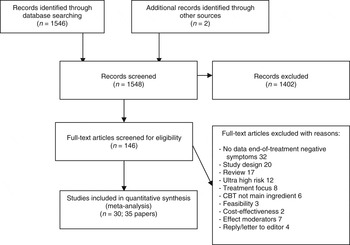
The negative sum score of the study of Grant et al. (Reference Grant, Huh, Perivoliotis, Stolar and Beck2012) was not yet available as of July 2013 (the study only reported on change in avolition score), leaving a total sample of 35 papers covering 30 CBT trials reporting on standard deviations and changes in the mean of negative symptoms in 2312 patients (see Fig. 1).
Flowchart of included studies. CBT, Cognitive–behavioural therapy.

Measures and data analyses
Outcome measures
The main outcome of our meta-analysis was Hedges’ g, the adjusted standardized negative symptom change score calculated by dividing the difference between the negative symptom total score between baseline and follow-up by the pooled standard deviation and multiplying the outcome by a correction factor (Borenstein et al. Reference Borenstein, Hedges, Higgins and Rothstein2009, pp. 26–27). See the Statistical analysis section for a more detailed explanation of the calculations.
Potential effect modifiers
Treatment characteristics
Examining the heterogeneity of the effect sizes in more detail, we investigated the potential moderating effect of the study target (social functioning or self-esteem v. positive symptoms). Because all CBT inevitably includes cognitive restructuring methods, we were particularly interested in the differential treatment effect accounted for by the number of behavioural techniques of an intervention. To establish a ‘relative behavioural score’, D.H.N. and C.M., qualified CBT psychologists and blind to the outcome of the meta-analysis, ranked the studies on the number of behavioural techniques of the CBT design. A total of seven behavioural aspects were rated as present or absent based on the behavioural scale developed by M.v.d.G.: (1) focus on the present; (2) activity scheduling; (3) focus on the environment/active involvement of others; (4) encouraging (new) social behaviour; (5) behavioural experiments and experimental learning; (6) focus on cognitive and behavioural obstacles to adequate functioning; and (7) focus on specific cognitions related to hedonic, social and cognitive capacities (scale available on request) as described in the intervention protocol. A consensus score was reached in consultation with M.v.d.G. if ratings were inconsistent. Based on this ‘relative behavioural score’ the studies were subsequently categorized as either studies with few (1–4) or substantial (5–7) behavioural aspects.
In addition, we assessed whether the number of attended CBT sessions was related to the effect size. Moreover, we examined the moderating effect of treatment setting (group, individual), treatment ingredients (CBT v. ‘CBT plus’; e.g. CBT with motivational interviewing), in- v. out-patient population (or both), and strictness of control condition [TAU v. enriched TAU condition (e.g. social skills training in addition to TAU)].
Patient characteristics
We subsequently investigated the moderating effect of age, illness duration and gender on change in negative symptoms. Studies were further classified on illness severity. For the sake of comparison, for this analysis we only included the 18 studies using Positive and Negative Syndrome Scale (PANSS) negative and positive sum scores. Study samples were given a ‘high’ or ‘low’ negative and positive symptom score (i.e. we used a median split and classified studies with, respectively, a mean PANSS-positive score >15.9 or a mean PANSS-negative score >14.2 as high).
Study characteristics
We examined whether differences in effect sizes could be explained by study quality. Before conducting the meta-analysis, each study was independently assessed on quality of its design by two of the authors (C.M. and E.V.). In keeping with Wykes et al. (Reference Wykes, Steel, Everitt and Tarrier2008), we made use of the Clinical Trials Assessment Measure [CTAM; added as a supplementary table in Tarrier & Wykes (Reference Tarrier and Wykes2004), a measure that has shown to have adequate internal consistency]. The CTAM assesses the following six domains: sample size, recruitment method, allocation to treatment, assessment of outcome, control groups, description of treatments, and analysis.
Publication characteristics
Finally, we examined the effect of publication year: before 2004; 2004 until 2006; 2007 until 2008; 2009 or more recent (⩽2003, ⩽2006, ⩽2008, ⩾2009).
Statistical analysis
The end-of-treatment, short-term and long-term reductions in negative symptoms across the trials were estimated with random-effects meta-analysis (Comprehensive Meta-Analysis version 2.2; www.meta-analysis.com). For each study, we calculated Hedges’ g (a standardized mean difference). Hedges’ g is a corrected Cohen's d. The latter is calculated by dividing the difference in mean change of the negative symptom total score between the CBT group and control group by the pooled standard deviations of both groups. Hedges’ g applies a correction factor to adjust Cohen's d, which is considered slightly biased and consequently is a more valid effect size measure. By means of a χ 2 test we examined the homogeneity of the effects. A significant χ 2 test value indicates heterogeneity in the effect sizes. With the I 2 statistic we checked whether no (0%), low (25%), moderate (50%) or high (75%) heterogeneity must be assumed (Higgins et al. Reference Higgins, Thompson, Deeks and Altman2003).
Publication bias was quantified by means of a funnel plot and Begg & Mazumdar's rank correlation test (Begg & Mazumdar, Reference Begg and Mazumdar1994). We used Duval and Tweedie's fill-and-trim procedure to correct for the bias due to selective publication (Duval & Tweedie, Reference Duval and Tweedie2000).
We used a meta-regression framework to evaluate whether heterogeneity in outcomes across the reviewed studies can be explained by intervention characteristics, study population or quality and year of publication. The modifying effects of dichotomous and categorical variables on effect size were assessed separately by a Q test based on analysis of variance (Borenstein et al. Reference Borenstein, Hedges, Higgins and Rothstein2009). The effects of continuous variables on the effect size were assessed by univariate meta-regression analysis.
We used multivariate meta-regression (Stata release 12; StataCorp LP, USA) analysis to elucidate what could explain the association between publication year and negative symptom reduction.
Results
Included studies
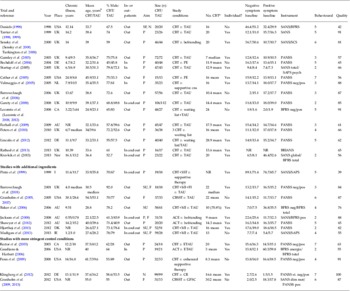
A total of 30 published RCTs on CBT had data available on changes in mean negative symptoms (see Table 1 for an overview of the characteristics of the included studies). Of these, 27 studies involved the treatment of a chronic or mixed (chronic and recent-onset) patient group (n = 2088), of which two specifically focused on the older schizophrenia population (n = 134) and four studies involved patients with co-morbid substance abuse (n = 345). Three studies reported on the treatment of a recent-onset population (n = 224). Most studies focused on (distress caused by) positive symptoms. Two studies were directed at negative symptoms in general and four were focused on an improvement of functioning.
Sample and therapy characteristics
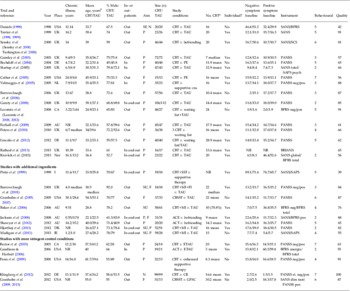
CBT, Cognitive–behavioural therapy; TAU, treatment as usual; SF, social functioning; SE, self-esteem; N, negative symptoms; SANS, Scale for Assessment of Negative Symptoms; BPRS, Brief Psychiatric Rating Scale; P, positive symptoms; SCS, Schizophrenia Change Scale; PANSS, Positive and Negative Syndrome Scale; DE, Germany; PE, psycho-education; SAPS psych, Scale for Assessment of Positive Symptoms psychotic subscale; F, (social) functioning; NL, Netherlands; cns, counselling; neg, negative; pos, positive; CA, Canada; AU, Australia; NR, not reported; BRIANS, Brief Assessment of Negative Symptoms Scale; Nor, Norway; I, Italy; SST, social skills training; SU, substance use; MI, motivational interviewing; FI, family intervention; CBSST, cognitive–behavioural social skills training; ACE, Active Cognitive Therapy for Early Psychosis; DK, Denmark; IE, Ireland; ETAU, enhanced TAU; ACT, Acceptance-based cognitive–behavioural therapy; CR, cognitive remediation; st., standard scale; GFSC, goal-focused supportive contact; SANS dim mot, SANS diminished motivation.
a If the mean number of CBT sessions was not provided, we used the median score, or if this was not available either, the number of sessions described in the research protocol.
b Reported over entire sample. If data only separately available, then first CBT and second control condition.
Publication bias
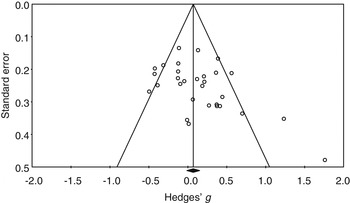
The regression test for funnel plot asymmetry was significant (see Fig. 2; Begg and Mazumbar's rank correlation test: Kendall's τ with continuity correction t = 0.303, z = 2.355, p = 0.018, two-tailed). Duvall and Tweedie's trim-and-fill procedure showed that the effect size would change from a point estimate of 0.113 [95% confidence interval (CI) −0.230 to 0.248] to −0.007 (95% CI −0.016 to 0.142) after adjustment for this bias. Both the uncorrected and corrected effect estimates showed an almost negligible effect.
Funnel plot of publication bias.
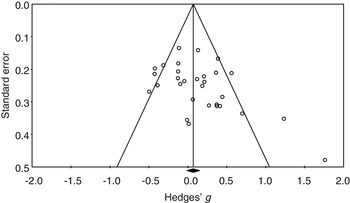
As can be deduced from Fig. 2, the indicated publication bias could be entirely attributed to only two studies with a small sample size (Pinto et al. Reference Pinto, La Pia, Mennella, Giorgio and DeSimone1999; Hall & Tarrier, Reference Hall and Tarrier2003). After removing these two studies from the publication bias analyses, Kendall's τ with continuity correction was no longer significant (t = 0.198, z = 1.482, p = 0.138, two-tailed). For sensitivity reasons we therefore decided to report our main statistics both with and without including these two publications throughout the present paper.
Meta-analysis of CBT studies in patients with psychotic disorders
Immediate effects
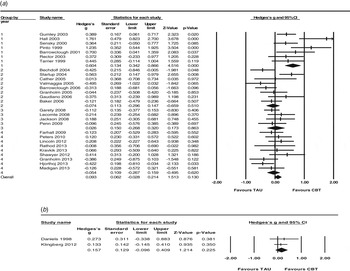
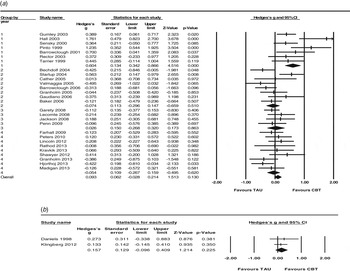
We applied two random-effect meta-analyses to estimate the effect sizes (Hedges’ g's): one based on the 28 studies with negative symptoms as a secondary outcome, and the other based on the two studies with negative symptoms as the primary treatment target (see Fig. 3). This resulted in a combined estimate for Hedges’ g of 0.093 (95% CI −0.028 to 0.214, p = 0.130) in the analysis and 0.157 (95% CI −0.010 to 0.409, p = 0.225) in the studies specifically focusing on negative symptom reduction. Both meta-analyses yielded a small and non-significant effect on negative symptom change. Outcomes of the 28 studies with negative symptoms as secondary outcome were heterogeneous [χ 2 = 72.392, degrees of freedom (df) = 27, p < 0.0001; τ 2 = 0.093, I 2 = 62.703] and differences between the trials could not be attributed to sampling error alone. Excluding the two outlier studies (Pinto et al. Reference Pinto, La Pia, Mennella, Giorgio and DeSimone1999; Hall & Tarrier, Reference Hall and Tarrier2003), effect sizes removed some of the heterogeneity, but the effect sizes remained heterogeneous (Q = 48.067, df = 25, p = 0.004, τ 2 = 0.049, I 2 = 47.989), with a combined Hedges’ g of 0.043 (95% CI −0.82 to 0.169, p = 0.498).
Forest plot of the random effects of the end-of-treatment effects of cognitive–behavioural therapy (CBT) trials on negative symptoms of schizophrenia, stratified by study year. (a) Studies with negative symptoms as a secondary treatment target (1 ⩽2003; 2 ⩽2006; 3 ⩽2008; 4 ⩾2009). (b) Studies with negative symptoms as the primary treatment target. CI, Confidence interval; TAU, treatment as usual.
Short- and long-term effects of CBT trials
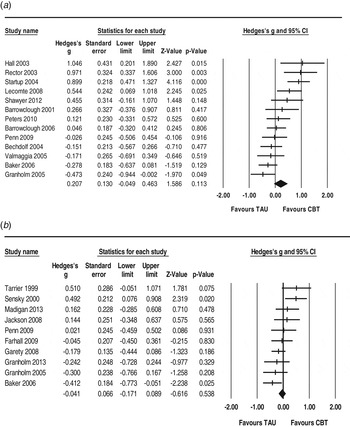
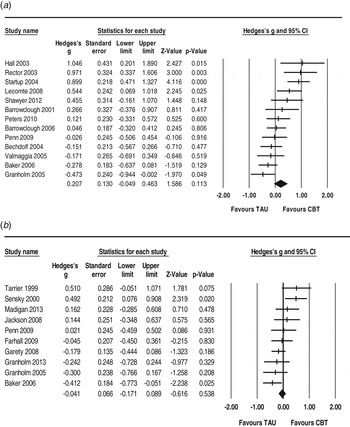
A total of 13 studies reported on short-term (3–6 months) and 10 on longer-term (9–12 months) effects of the CBT trials (see Fig. 4). Effect sizes were comparable with the immediate effects. The meta-analysis on short-term effects yielded a combined Hedges’ g of 0.207 (95% CI −0.049 to 0.463, p = 0.113), and excluding the outlier (Hall & Tarrier, Reference Hall and Tarrier2003) a Hedges’ g of 0.161 (95% CI −0.093 to 0.415, p = 0.213). None of the outlier studies reported on long-term outcome. The long-term effects yielded a pooled Hedges’ g of −0.01 (95% CI −0.020 to 0.182, p = 0.922).
Forest plot of the random effects of the short- and longer-term effects of cognitive–behavioural therapy (CBT) trials on negative symptoms of schizophrenia. (a) Random effects at short-term follow-up (3–6 months). (b) Random effects at longer-term follow-up (9–12 months). CI, Confidence interval; TAU, treatment as usual.
The effect of potential effect modifiers
Treatment characteristics
The low number of studies with negative symptoms as the primary target rendered further interpretation of their modifying factors impossible, and they were therefore left out of the further analyses. To assess which factors might explain the heterogeneity in effect sizes of the remaining 28 studies, we first examined the association between negative symptom reduction and intervention target. Four RCTs specifically focused on functioning; one on self-esteem. Despite the substantial overlap with negative symptoms, analyses indicate that these interventions had only a small effect in terms of negative symptom reduction. The pooled Hedges’ g of 0.137 (range = −0.301 to 0.574) was somewhat larger than the combined effect size of the 24 CBT positive trials (Hedges’ g = 0.108, range = −0.051 to 0.267) although this difference was not statistically significant. The one study specifically focusing on the improvement of self-esteem in patients with schizophrenia (Hall & Tarrier, Reference Hall and Tarrier2003) had a large effect on negative symptom outcome (pooled Hedges’ g = 1.76, range = 0.823 to 2.70, p < 0.0001).
Although we found no significant difference between studies with few v. a substantial number of behavioural techniques, studies with more behavioural techniques seemed to yield a somewhat larger effect size compared with those with fewer behavioural components (pooled Hedges’ g = 0.253, p = 0.035 v. 0.020, p = 0.839; Q value difference = 2.24, df = 1, p = 0.134). The number of behavioural techniques was not associated with heterogeneity in effect sizes when the outlier studies (Pinto et al. Reference Pinto, La Pia, Mennella, Giorgio and DeSimone1999; Hall & Tarrier, Reference Hall and Tarrier2003) were excluded.
CBT trials providing individual treatment were significantly more effective in reducing negative symptoms than those providing group therapy (pooled Hedges’ g 0.210, p = 0.011 v. −0.174, p = 0.204; Q value difference = 5.866, df = 1, p = 0.015; excluding the two outlier studies Q value = 5.302, df = 1, p = 0.021).
Treatment effect was not significantly associated with the number of CBT sessions, treatment ingredients (CBT v. ‘CBT plus’), study population, or strictness of the control condition (TAU or enhanced TAU).
Sample characteristics
The sample characteristics illness duration, percentage male, age and positive and negative symptomatology did not account for the heterogeneity in treatment outcome (see online Supplementary Table S1).
Publication year and study quality
We found a highly significant difference between trials when stratified by study year (see Fig. 3): studies published before 2004 were significantly more effective in reducing negative symptoms compared with more recent studies (Q value difference = 18.818, df = 3, p < 0.0001); this effect remained significant after removing the outliers (Q value difference = 11.210, df = 3, p = 0.011).
In addition, a higher study quality rating was associated with a lower effect size (Q value difference = 11.83, df = 1, p = 0.0006). This difference was a trend after removing the outliers from the analyses (Q value difference = 2.808, p = 0.094).
Similar results were obtained when we repeated the analyses after excluding studies focused on symptoms thought to be associated with negative symptoms (social functioning or self-esteem).
Meta-regressions
To examine what could account for the large reduction in the effectiveness of newer CBT studies in altering negative symptoms, we repeatedly combined publication year with one or two other factors in meta-regression in Stata (version 11). Entering publication year (⩽2003; ⩽2006; ⩽2008; ⩾2009), study quality (continuous) and treatment setting (group v. individual) in one model, treatment setting did no longer significantly contribute to the prediction of negative symptom change (b = −0.156, s.e. = 0.137, t = –1.14, p = 0.267; 95% CI −0.44 to about 0.129). However, the heterogeneity between studies accounted for by study quality (b = −0.011, s.e. = 0.004, t = –2.28, p = 0.03, 95% CI −0.021 to about −0.001) and publication year (⩽2003; b = −0.60, s.e. = 0.16, t = –3.37, p = 0.001, 95% CI −0.939 to about −0.268) could not be explained by the other two factors. Also, when combining publication year and study quality with other potential modifying factors in meta-regression, the effect of publication year and study quality consistently held (analyses available on request).
Discussion
Our main research question was whether the beneficial effect of CBT on negative symptoms as reported by Wykes et al. (Reference Wykes, Steel, Everitt and Tarrier2008) generalizes to more recent CBT studies. Our study clearly shows that Wykes's findings cannot be generalized to the more recent investigations. After stratifying studies by publication year, effects of studies conducted later than 2004 were small and no longer statistically significant. Almost none of the newer studies reported significant reductions in negative symptoms.
To answer our second research question we evaluated which factors (treatment characteristics, sample characteristics, quality of the study design, or year of publication) influenced the large heterogeneity of the effect sizes among the different studies. Some studies reported substantial improvements in negative symptoms (moderate to large effect sizes); others found no or even adverse effects. These differential effects could not be explained by differences across the studies in terms of age and gender of the participants, study sample, number of treatment sessions, characteristics of the control condition, severity of baseline positive and negative symptoms, the number of treatment components and illness duration. Our analyses suggest that, possibly due to the limited number of studies available and heterogeneity in CBT approaches, trials specifically directed at negative symptoms or social participation were not significantly more beneficial in improving negative symptoms. Therapies presented individually were more successful in reducing negative symptoms than group interventions. This suggests that a more intensive and personalized approach is better suited to tackle disruptive thought patterns underlying, for example, social withdrawal.
A further examination of possible modifying factors suggests two possible explanations for the differences in effect sizes between older and newer studies. First, the designs of the older studies (1996–2003) were of significantly lower quality in terms of trial reports. Although specifics could not always be clearly derived from the different publications, aspects such as insufficient blinding of researchers in older studies may have led to an overestimation of negative symptom change. Second, a trend effect was found, suggesting that studies with more behavioural techniques were slightly more effective in reducing negative symptoms. Older studies may have been more behaviourally oriented, as compared with newer studies. An exclusive focus on cognitions may be less effective than exposure to pleasure and success – experiences that might result from participating in activities.
However, a meta-regression with these two factors as predictor could not fully explain the difference in effects between older and newer studies, indicating that other (less obvious) differences between old and new CBT treatment approaches might have played a role. Although not confirmed by the present data, a third explanation for the smaller effects of newer studies may be that contemporary CBT-based interventions more often focus on a single clear-cut treatment target. Indeed, specific treatments focusing on, for example, auditory hallucinations (Penn et al. Reference Penn, Meyer, Evans, Wirth, Cai and Burchinal2009) are increasingly common, making it less likely to have an effect on negative symptom outcome; it may be possible that older studies paid more attention to general complaints, and thus were taking both positive and negative symptoms into account.
Negative symptoms: a hedonic deficit or appraisal problem?
For years, researchers and clinicians have been debating about the possible determinants of negative symptoms in schizophrenia, some focusing on hedonic deficits (Kirkpatrick et al. Reference Kirkpatrick, Castle, Murray and Carpenter2000), and others on appraisal problems (Grant & Beck, Reference Grant and Beck2009). The heterogenic results between studies – and more importantly the large variation of studies – tentatively suggest that there may be several pathways to negative symptoms, which may require different treatment approaches. This assumption is supported by a recent factor analysis of negative symptoms that found two separate negative symptom clusters: one ‘expressive deficit’ factor and one more behavioural factor ‘social amotivation’ (Liemburg et al. Reference Liemburg, Castelein, Stewart, van der Gaag, Aleman and Knegtering2013). This may also explain why studies targeting negative symptoms did not yield significantly larger effect sizes, as compared with other trials. Its participants, selected on the presence of prominent negative symptoms, may have largely represented a subgroup with so-called ‘primary’ negative symptoms, stemming from expressive deficits and probably more treatment resistant to CBT than ‘secondary’ negative symptoms, related to dysfunctional expectancies about one's aptitude for pleasure and one's cognitive and social abilities (Gard et al. Reference Gard, Kring, Gard, Horan and Green2007; Oorschot et al. Reference Oorschot, Lataster, Thewissen, Lardinois, Wichers, van Os, Delespaul and Myin-Germeys2013).
Personalized treatment of negative symptoms
Different aetiological mechanisms may require tailored and personalized treatments, and therefore warrant further scrutiny. For example, a patient whose negative symptoms primarily stem from the dysfunctional belief that she/he is not capable of functioning at work (in the absence of severe objective cognitive impairment) may benefit from CBT with an emphasis on exposure and behavioural activation. Behavioural activation has proven effective in the reduction of depression (Kircanski et al. Reference Kircanski, Mazur and Gotlib2013) and it might also reduce negative symptoms in (a subgroup of) patients diagnosed with schizophrenia with the above-mentioned dysfunctional beliefs as well. Our results tentatively suggest that a second focus of CBT should be on boosting self-esteem. Support for this approach was found in an open trial by Staring et al. (Reference Staring, Ter Huurne and van der Gaag2013), which needs to be followed up by an RCT. Behavioural techniques such as exposure may, however, have an adverse impact on negative symptoms of patients who tend to withdraw from social contact due to severe cognitive problems, such as slow processing speed. In this case, cognitive remediation as an adjuvant to vocational training may be the first treatment of choice, but more research is needed to support its efficacy (National Institute for Clinical Excellence, 2009).
Limitations and methodological recommendations
Our meta-analytic findings must be considered in the light of some limitations.
First, although we tried to separately investigate studies that included subjects on the presence of negative symptoms, studies in our meta-analysis varied widely in study design and target population. A strength of meta-analysis, however, is that generalizability of findings from one type of study to the next (different) type of study can be addressed formally (Borenstein et al. Reference Borenstein, Hedges, Higgins and Rothstein2009).
Second, most studies were not specifically designed to address negative symptom reduction, and patients were therefore not selected on the severity of negative symptoms. Consequently, negative symptoms were mostly reported as total score, forcing us to treat them as a monolithic construct. Focusing on more specific subdimensions in future studies would provide more detailed information on which negative symptoms are most amenable to change.
Third, the small effect sizes reported in our study may have been partly accounted for by the instruments that were used to assess negative symptoms. Both the PANSS and the Scale for Assessment of Negative Symptoms (SANS) have been questioned with regard to their ‘outdated’ item content and sensitivity to change (Daniels, Reference Daniels1998; Blanchard et al. Reference Blanchard, Kring, Horan and Gur2011). New instruments have recently been proposed, but their psychometric properties still warrant further examination (Blanchard et al. Reference Blanchard, Kring, Horan and Gur2011; Kirkpatrick et al. Reference Kirkpatrick, Strauss, Nguyen, Fischer, Daniel, Cienfuegos and Marder2011).
Fourth, we were not able to separate out the effect of antipsychotic medication in the CBT trials.
Fifth, due to the unavailability of relevant data, we had to exclude some CBT studies (Lewis et al. Reference Lewis, Tarrier, Haddock, Bentall, Kinderman, Kingdon, Siddle, Drake, Everitt, Leadley, Benn, Grazebrook, Haley, Akhtar, Davies, Palmer, Faragher and Dunn2002; Grant et al. Reference Grant, Huh, Perivoliotis, Stolar and Beck2012). However, as we were able to include a large proportion of all retrieved CBT trials, we do not believe that the data from these studies would have made a significant impact upon the overall results. Finally, most studies only provided limited data on patient characteristics. It would have been interesting to examine patient characteristics in more depth, for example regarding neurocognitive deficits, particular in the light of the possible different pathways that may lead to negative symptoms that were mentioned above.
To overcome some of these limitations in future research, new CBT studies should always report positive and negative symptom severity, including scores on the specific items of the PANSS negative symptoms scale, as well as medication prescription. Also, more detailed information about the specific content of the treatment would shed more light on the potentially effective ingredients of CBT studies in reducing negative symptoms.
Conclusions
Our meta-analysis provides new insights in the effect of CBT on the reduction of negative symptoms, showing that the beneficial effects of CBT interventions on negative symptoms in older trials no longer hold for recent trials. This suggests that CBT studies focused on psychotic symptoms might not work as well in reducing negative symptoms as previously thought. It is also possible that recent CBTs (which are specifically targeted at certain positive symptom domains, and are often less behavioural and more cognitively oriented) are less comprehensive and therefore less beneficial in terms of negative symptom reduction. This implies that in the treatment of patients diagnosed with schizophrenia, in addition to interventions targeting positive symptoms, specific interventions targeting negative symptoms should be applied. Our findings also suggest that individual interventions are more effective than group interventions in this regard.
To date, few interventions are available for negative symptoms, highlighting the need for new interventions that specifically target these debilitating symptoms. Our meta-analysis showed that the few CBT studies that focused on negative symptoms have thus far yielded only modest results. Two recent trials evaluating interventions with a specific focus on dysfunctional expectancies about one's own abilities showed promising results (Grant et al. Reference Grant, Huh, Perivoliotis, Stolar and Beck2012; Staring et al. Reference Staring, Ter Huurne and van der Gaag2013). However, because of the study design and unavailability of relevant data we had to exclude them from our analyses and more research is needed to support their efficacy. The main active ingredients of these targeted CBT studies, as well as those from several older studies, should be considered when developing new interventions focusing on negative symptoms. In addition, it is utterly important to assess the key factors that could have contributed to a reduction in negative symptoms in the older studies included in Wykes's meta-analysis (Wykes et al. Reference Wykes, Steel, Everitt and Tarrier2008).
Supplementary material
For supplementary material accompanying this paper visit http://dx.doi.org/10.1017/S0033291714001147.
Acknowledgements
This work was supported by the European Community's Seventh Framework Program Project EU-GEI (grant no. HEALTH-F2-2009–241909 to E.V., L.d.H. and M.v.d.G.) and the Netherlands Organization for Scientific Research (VENI grant no. 451-13-035 to A.-K.J.F., and grant no. Nl46776.018.13 to E.V., C.M., L.d.H., A.B.P.S., F.S. and M.v.d.G.).
Declaration of Interest
None.