Introduction
There is a substantial body of literature that examines the harmful effects of exposure to extreme traumatic stress. In most of the studies that have evaluated therapeutic interventions, the interventions were applied after the exposure to the traumatic events, and not during the time of exposure to prolonged trauma.Reference Bryant and Harvey1,Reference Mayou, Ehlers and Hobbs2 Only a handful of studies have examined hospital personnel during traumatic events, and none were conducted during exposure to prolonged war stress.Reference Luce, Firth-Cozens, Midgley and Burges3–Reference Palgi, Ben-Ezra, Langer and Essar5 All of these studies were quantitative, and screened for and diagnosed post-traumatic stress disorder (PTSD) only. The current study was a pilot demonstration of a tentative therapeutic procedure to prevent the development of PTSD symptoms. This pilot study involved group clinical interventions during the Second Lebanon War.
On July 12, 2006, a war between Israel and Lebanon erupted, resulting in 163 Israelis killed (44 civilians and 119 soldiers) and 2,400 wounded (2,000 civilians and 400 soldiers). During that time, the Rambam Hospital in Haifa was targeted by >40 missiles that exploded in the vicinity of the hospital. This situation created an immediate threat to the lives of hospital personnel. Another stressor was the threat to the special army administrative staff’s (SAAS’s) family members and friends living within missile range.
In the hospital, a small group of SAAS were in charge of admitting casualties of the war (those who were wounded or who died on their way to the hospital). Their duty was to contact the necessary authorities in order to process and treat the admitted soldiers, as well as to contact the families of the casualties. As part of their duties during the war, personnel in this group were exposed to sights of severe injuries, mutilated bodies, and death. This research sought to examine the development of vulnerability and resilience narratives during a pilot group intervention of a new therapeutic procedure for the SAAS, conducted during exposure to extreme war stress.
In the literature, the first and most common intervention for exposure to traumatic events is debriefing.Reference McNally, Bryant and Ehlers6 There are several debriefing intervention models, most of them consisting of five stages: (1) an “Introduction” phase, in which the treatment goals are explained; (2) a “Facts” phase, in which the patients describe the facts as they experienced them; (3) a “Thoughts” phase, in which the thoughts of patients during the event are introduced; (4) a “Reactions” phase, in which there is a reconstruction of the trauma narrative along with the integration of emotions; and (5) a “Summary” phase, in which the treatment is concluded.Reference Sijbrandij, Olff, Reitsma, Carlier and Gersons7 Although some studies indicate such debriefing interventions are beneficial,Reference Campfield and Hills8,Reference Kaplan, Iancu and Bodner9 others do not find any differences in the development of traumatic symptoms over time.Reference Sijbrandij, Olff, Reitsma, Carlier and Gersons7,Reference Marchand, Guay, Boyer, Iucci, Martin and St-Hilaire10 Some studies found that, in some cases, the symptoms among people who underwent debriefing were exacerbated.Reference Mayou, Ehlers and Hobbs2,Reference Hobbs, Mayou, Harrison and Worlock11
The problems with the debriefing treatments could be related to prematurely direct confrontation with the traumatic nucleus. The excessive emotional feelings elicited in the debriefings may have been too great and too difficult to assimilate, exacerbating the symptoms.
Due to the problems with the debriefing technique, an alternative intervention was suggested. Instead of focusing on the difficult scenes to which the soldiers were exposed, and returning again and again to these painful experiences, focus was placed on the preparation for confronting such events. This was based on the group’s narrative “anchoring points” that were assessed at the first meeting. Anchoring points are essential pieces of information that contradict the traumatic narrative and present past situations of preparedness to cope with traumatic events. The anchoring points enhance one’s healthier, non-traumatic narrative. These anchors, which contain strengthening and immunizing components, can be found easily within every person who has undergone professional preparation for an upcoming traumatic exposure. This training preparation, which can be achieved via workshops, exercises, professional training, and other means, leads to the construction of possible narrative scripts for successfully coping with traumatic events.Reference Palgi and Ben-Ezra12
The innovation of this therapeutic intervention lies in the premise that, during the first weeks after exposure to a traumatic event, it may be harmful to focus on the trauma nucleus. Instead, it is suggested that, despite preparation, one can be surprised by certain aspects of actual events.Reference Palgi and Ben-Ezra13 One then perceives oneself as unprepared, and later, this serves as the basis for the traumatic narrative. In line with this alternative approach, the therapeutic intervention in this study aimed to retell and extend the previous preparation, and to interpret the surprise as a healthy, neutral phenomenon that has no relation to the preparation for the event.
The present therapeutic intervention focused on the preparation for exposure to traumatic events in the hospital during a war. The intervention was detailed in a previously published study.Reference Palgi and Ben-Ezra12
It was assumed that instead of focusing on the traumatic scenes to which the SAAS were exposed, focusing and broadening personal and professional preparedness narratives would enhance resiliency and reduce vulnerability, and in turn, would reduce symptoms among the soldiers. Therefore, the hypothesis was that as a result of the therapeutic intervention, there would be more resiliency (more positive statements), less vulnerability (fewer negative statements), and lower levels of PTSD symptoms. Due to the war situation and the preliminary nature of the therapeutic technique, the aim of this study was to pilot the utility of such an intervention.
Methods
Participants and Background
Thirteen special army administrative staff (SAAS) from the Rambam Medical Center in Haifa participated in seven group-support sessions during the war. The group sessions took place once a week, with the exception of sessions 6 and 7, which were two weeks apart. Between Session 3 and Session 6, there was a ceasefire that officially ended the war, and no missiles targeted the hospital or any part of northern Israel during the months that followed.
During the war, two meetings were conducted by an experienced clinical psychologist; an additional meeting was conducted two days after the ceasefire, and because the participants reported their experiences from the past week, it was considered a wartime meeting. Four meetings were conducted in the weeks following the truce between Israel and Lebanon. The first three meetings (sessions 1–3) were compared to the second set of meetings (sessions 4–6). Session 7 was omitted from the comparison so as to compare an equal number of sessions.
Instruments
Demographic data were collected using a questionnaire that included items regarding age, gender, origin, nationality, level of religiosity, and previous exposure to war-related stress.
Symptoms were assessed through the 22-item Impact of Event Scale-Revised (IES-R).Reference Weiss, Marmar, Wilson and Keane14 The IES-R was used to assess levels of post-traumatic stress symptoms during the past seven days in response to war stress. Total scores >33 indicate a clinical level of distress.Reference Creamer, Bell and Failla16 This measure has been shown to be reliable and valid,Reference Weiss, Marmar, Wilson and Keane14,Reference Ozer, Best, Lipsey and Weiss15 a finding confirmed by Israeli studies.Reference Ben-Ezra and Soffer17,Reference Ben-Ezra, Palgi, Wolf and Shrira18
Vulnerability and resilience were assessed by eliciting responses to the opening question “What made you feel bad and what made you feel good this week?” Vulnerability was defined as every phrasing ascribed to bad feelings, whereas resilience was defined as every phrasing ascribed to good feelings. The number of the two types of responses was used as the measure of the total vulnerability and resilience statements. In addition, a simple measure of the relation between vulnerability and resilience contents was created by subtracting the number of negative contents from the number of positive contents. The results could be negative results, reflecting a shift toward vulnerability, or positive results, reflecting a shift toward resilience. A similar procedure was used for evaluating affect relations.Reference Fredrickson and Losada19
The participants’ responses to the opening question were recorded verbatim during the session. The responses were divided into meaning units, coded, and grouped into categories of different types of vulnerability and resilience according to the Grounded Theory method of content analysis.Reference Strauss20 During the first six weeks of the intervention, a short demographic questionnaire and the IES-R were administered. The IES-R was administered during the second week of war, since it addressed trauma that occurred during the past seven days. The questionnaires were administered in order to get another perspective of the change in the clinical picture of each soldier, in addition to the clinical impression of the group leader. Although this procedure may have introduced bias due to the fact that answers were spoken out loud and may have influenced other participants, it represents the atmosphere during the sessions accurately. The use of the questionnaires was intended to show a trend of symptoms during the war, after the first week of the war, and after the follow-up.Reference Ben-Ezra, Palgi, Shrira, Sternberg and Essar21
This study was part of a larger study about medical personnel during the Second Lebanon War, and was formally approved according to the Helsinki Committee’s ethical requirements. All participants gave their written consent to use the material presented.
Two psychologists and a psychiatrist reviewed the responses recorded during the meetings, coded the contents according to vulnerability and resilience, and later, assembled them into categories according to types of vulnerability and resilience.
Results
The mean age of the SAAS was 23±6 (range 18–41 years). The SAAS were mostly women (n = 11, 86.4%), not married (n = 11, 86.4%), and secular (n = 10, 76.9%). All the participants resided in the greater Haifa area targeted by missiles during the war. None of the participants had a history of war-related stress.
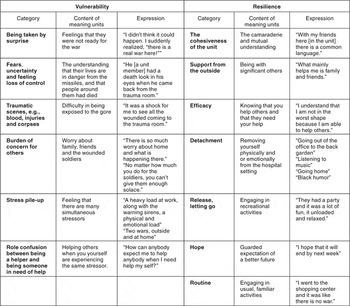
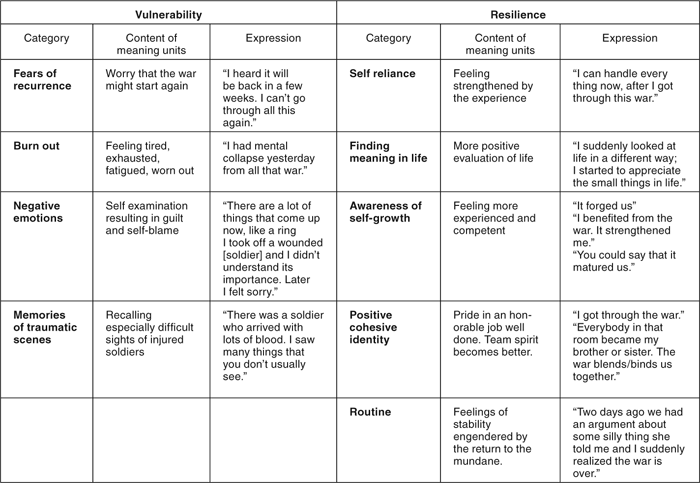
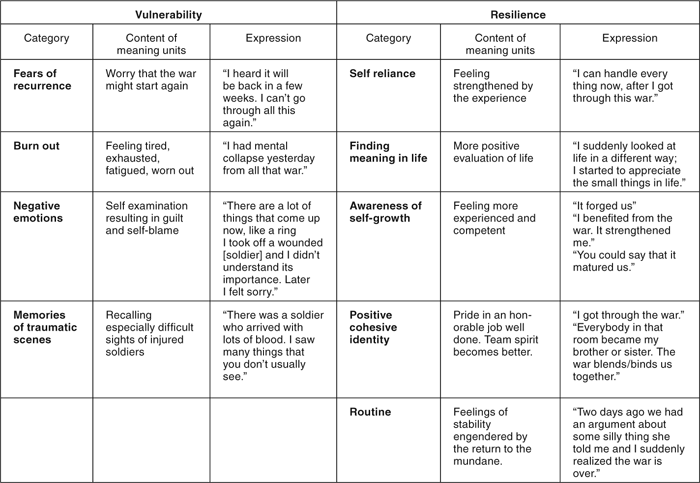
The overall number of vulnerability meaning units declined from 52 during the war to 23 after the war. The overall number of resilience contents remained about the same, 34 during the war and 37 after the war. The main content and expressions of vulnerability and resilience units during and after the war, by category, are shown in Tables 1 and 2. In order to compare an equal number of sessions during and after the war, the meaning units of the seventh session were not included in the computation. Had they been included, the decline in vulnerability content would have been even more dramatic; in the final session, there was only one expression of vulnerability.
Main contents of vulnerability and resilience units during the war (total number of vulnerability meaning units = 52, total number of resilience meaning units = 34)

Main contents of vulnerability and resilience units after the war (total number of vulnerability meaning units = 23, total number of resilience meaning units = 37)
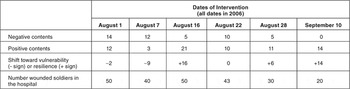
The general trend shifted from negativity in the first and second sessions (-2 and -9 negative indication contents, respectively, as shown in Table 3) to positive indications (+16 positive indicated contents). After the ceasefire, there was a sharp decline to low positive indication, and then a shift back to high positive indication contents (+6 and +14 positive contents respectively) during the six and seventh sessions.
Positive and negative shifts in contents and contents subtraction during six successive intervention sessions

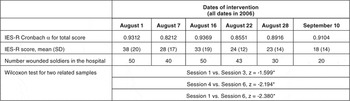
In order to determine the effects of the therapeutic intervention, the mean IES-R score during the second week after the eruption of the war (Session 1 mean = 38±20, range 14–87) and one week before the ceasefire (Session 3 mean = 33±19, range 7–81) were compared (Table 4). Due to the small number of participants, a Wilcoxon test for two related samples (Session 1 vs. Session 3) was used in order to show the effect of the therapeutic intervention while the war still was raging, and SAAS personnel still were exposed to war-related stress. A statistically significant decrease in post-traumatic symptoms (z = -2.134, P = .033, Cohen’s d = 1.18) was identified. Following the above analysis, a Wilcoxon test for two related samples (Session 4 vs. Session 6) was conducted in order to show the effects of lowered exposure to war-related stress on the SAAS personnel. The mean IES-R score during the fifth week after the eruption of the war and the first days after the ceasefire (Session 4 mean = 24±12, range 3–47) was calculated, and also during the final session at the follow-up week (Session 6 mean = 18±14, range 9–52). The results revealed a significant decrease in post-traumatic symptoms (z = -2.194, P = .028, Cohen’s d = 1.21). Afterward, a comparison was conducted between the mean IES-R score during the second week after the eruption of the war (Session 1 mean = 38±20, range 14–87) and during the follow-up week (Session 6 mean = 18±14, range 9–52). In order to show the effect of exposure level and the therapeutic intervention, a Wilcoxon test for two related samples (Session 1 vs. Session 6) (exposure to war related stress vs. no exposure to war related stress) was computed. A significant decrease in post-traumatic symptoms (z = -2.380, P = .017) was identified.
IES-R psychometric properties, score, number of soldiers hospitalized and Wilcoxon test results

* P = .05
In sum, the reduction of PTSD symptoms was associated with the therapeutic intervention and with the reduction in exposure to war-related stress.
Discussion
In this pilot intervention, as hypothesized, there was a decline in PTSD symptoms during the war and during the weeks after the war that probably was connected to the therapeutic intervention, as well as to the reduction in exposure to war-related stress. Previous studies found that, in many cases, when conventional debriefing was used, the treatment effectiveness was moderate at best,Reference McNally, Bryant and Ehlers6,Reference Marchand, Guay, Boyer, Iucci, Martin and St-Hilaire22 and in some cases, led to harmful results.Reference Mayou, Ehlers and Hobbs2,Reference Herbert, Sageman and Rosen23 This study presents a demonstration of a new therapeutic procedure to treat PTSD symptoms during and immediately after the exposure to the stressor. The results suggest that a therapeutic intervention that focuses on the preparation for the traumatic event might be effective in reducing PTSD symptoms.
In contrast to the commonly used debriefing procedure, the therapeutic technique used in this study did not focus on the traumatic events themselves.Reference McNally, Bryant and Ehlers6 Some of the explanations that are given for the problematic outcomes of the debriefing intervention claim that the stimulation of venting causes harmful emotional flooding. The critics of debriefing suggest that a period of rest and detachment from the event can enable the process of healing, especially during and immediately after the exposure.Reference Bryant, Harvey, Dang, Sackville and Basten24,Reference Ursano, Fullerton, Vance, Wang, Raphael and Wilson25
Another advantage of the suggested intervention is that the focus on preparation prior to the traumatic event, along with the strengthening of professional identity, gives a sense of continuity. Some researchers believe that in the first days after the traumatic event, “digging into” the trauma can be more harmful than effective, since it prevents the activation of the neutral repression process.Reference Gray and Litz26,Reference Loftus, Garry and Feldman27 Additionally, it has been found that the centricity of the event was related to growing vulnerability in the aftermath of the trauma.Reference Seery, Cohen, Holman, Ence and Chu28,Reference Rubin, Berntsen and Bohni29
Limitations
Although this study was supported by statistical data, it is essentially clinical research. There may be a problem of confounding in this study’s statistical results, since the two post-war measures are subjected to objective reduction in the magnitude of the external stressor and in the gradual reduction in the number of war casualties admitted to the hospital. Additionally, the absence of a control group decreases the study’s explanatory power. Therefore, the results presented here warrant further study in order to substantiate the benefits of this alternative intervention technique.
Conclusion
The conditions of this study offered a rare opportunity to analyze the consolidation of traumatic vulnerability and resilience as they formed. The tentative therapeutic intervention presented may be used as a possible substitute intervention for the better known, increasingly controversial, debriefing technique.
Abbreviations:
PTSD = post-traumatic stress disorder
SAAS = Special Army Administrative Staff