Introduction
The snail Omphiscola glabra acts as an intermediate host in the life cycle of several Digenea. In central France, this lymnaeid is known to naturally sustain the larval development of Haplometra cylindracea (Goumghar et al., Reference Goumghar, Abrous, Ferdonnet, Dreyfuss and Rondelaud2000). Natural infections of O. glabra with Fasciola hepatica or with Paramphistomum daubneyi have also been found since 1995 in wild watercress beds located in this region (Dreyfuss et al., Reference Dreyfuss, Vignoles and Rondelaud2003, Reference Dreyfuss, Vignoles and Rondelaud2005). The prevalence of natural infections of O. glabra with H. cylindracea can be up to 70% (Goumghar et al., Reference Goumghar, Abrous, Ferdonnet, Dreyfuss and Rondelaud2000), although the prevalence values are lower for F. hepatica and P. daubneyi and do not overall exceed 2% or 2.5%, respectively (Dreyfuss et al., Reference Dreyfuss, Vignoles and Rondelaud2005).
The prevalence of infections of these digeneans is well documented in central France, but little information is available on the intensity of snail infections, especially the numbers of free rediae and cercariae which develop within the body of the snail. Such intensities are clearly important in determinining the degree of adaptation between the snail host and the digenean (Boray, Reference Boray1969). The intensity of snail infections is difficult to study in naturally-infected snails, so that Dreyfuss et al. (Reference Dreyfuss, Vignoles and Rondelaud2005) were only able to quantify the number of cercariae-containing rediae of F. hepatica or P. daubneyi to demonstrate progressive adaptation between these digeneans and O. glabra. Hence it is necessary to undertake experimental infections in O. glabra to determine how many rediae and cercariae of, for example, F. hepatica the snail might produce within its body and to establish whether or not the intensity of infection changes in concurrent infections with, for example, P. daubneyi under the same conditions. Experimental infections of juvenile O. glabra (4 mm in height) with F. hepatica or P. daubneyi were thus carried out to determine the number of free rediae and cercariae on days 60 and 75 post-exposure (p.e.) at 20°C. Miracidia of Fascioloides magna were also used for these infections, as the snail could be a potential intermediate host of this digenean in central France, as cercarial shedding was previously observed by Rondelaud et al. (Reference Rondelaud, Novobilský, Vignoles, Treuil, Koudela and Dreyfuss2006).
Materials and methods
Two populations of O. glabra originating from central France were used for these experiments. Samples of population A were collected from a road ditch (46°34′77″ N, 1°24′52″ W) at Lande, commune de Thenay, department of Indre and population B from a road ditch (45°53′13″ N, 1°5′80″ W) at Le Grand Moulin, commune de Veyrac, department of Haute Vienne. Previous investigations on juvenile and adult snails (6 mm and more in height) between 1998 and 2002 demonstrated the absence of natural trematode infections in snails. Snails measuring 4 mm in height were regularly collected from sites A and B in February–March during 2003, 2004 and 2005. Eggs of F. hepatica were collected from the gall bladder of heavily infected cattle from the slaughterhouse of Limoges, department of Haute Vienne. To obtain eggs of P. daubneyi, adult worms were collected from the paunch of the same cattle and placed in a saline solution (NaCl 0.9%, glucose 0.45%) for 4 h at 37°C. Eggs of Fascioloides magna were collected from the liver of red deer from the Brdy mountains, forest district Mirošov, Central Bohemia, Czech Republic. All eggs were washed several times with spring water and incubated at 20°C for 20 days in the dark as described by Ollerenshaw (Reference Ollerenshaw1971) for F. hepatica.
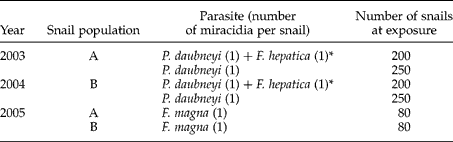
The number of snail groups for each year and the protocol for undertaking snail infections are given in table 1. Two groups of snails were subjected to double miracidial exposures as previously reported by Abrous et al. (Reference Abrous, Rondelaud and Dreyfuss1996) who had shown that a first infection of juvenile snails with P. daubneyi facilitated subsequent larval development of F. hepatica, whereas infections of these snails with F. hepatica only were unsuccessful. Snails from the other four groups were individually subjected to routine monomiracidial exposures for 4 h. After exposure, snails were subsequently reared for 30 days in polypropylene boxes (1 m × 55 cm, 15 cm deep) with 40 or 50 snails per box as previously described by Abrous et al. (Reference Abrous, Roumieux, Dreyfuss, Rondelaud and Mage1998b). Lettuce grown without chemical treatment, plus stalks of Glyceria fluitans (Poaceae) were used to feed O. glabra. Snails within these boxes were maintained in an air-conditioned room with a constant temperature of 20° ± 1°C and a diurnal photophase of 12 h with a 3000–4000 lux light intensity.
The main characteristics of the six groups of Omphiscola glabra used for experimental infections with Fasciola hepatica, Fascioloides magna and Paramphistomum daubneyi.
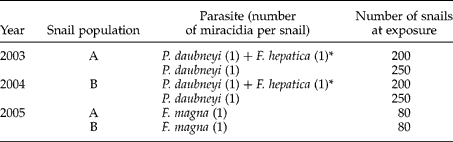
* Each snail was first exposed to a single miracidium of P. daubneyi for 4 h and second subjected to a single miracidium of F. hepatica for the next 4 h.
At day 30 p.e., surviving snails were individually placed in 35-mm diameter Petri dishes, with 2–3 ml of spring water. A small piece of lettuce and a 1-cm long fragment of G. fluitans leaf were put into each dish. The dishes were maintained under the same conditions as the boxes. Each day, the water was changed, and the metacercariae were counted before their removal from dishes. At day 60 p.e., 50% of surviving snails from each group were dissected under a stereomicroscope to identify the trematode infections and to count larval forms. A similar protocol was used on day 75 for the other surviving snails. The total number of free rediae (redial burden) and that of fully-grown rediae, containing cercariae of F. hepatica, cercariae of F. magna, or procercariae of P. daubneyi (differentiating cercariae, each having a short tail), were determined in the first phase. The number of larval forms containing cercariae in the case of P. daubneyi was not considered, as most intraredial embryos emerged at the procercaria stage from the body of the rediae (Sey, Reference Sey1979). Free cercariae and those which were still present in the body of rediae (F. hepatica, or F. magna) were counted in the second phase.
The first three parameters were the survival of snails at day 60 p.e., the prevalence of snail infections (determined by adding the numbers of infected snails noted at day 60 or at day 75 p.e., and dividing the sum by the number of surviving O. glabra recorded at day 60 p.e.), and the increase of shell height between snail exposure and the date of snail dissection. The four parameters characterizing the intensity of snail infections were the total number of free rediae, that of fully-grown rediae, the quantity of free cercariae (including metacercariae recorded before day 60 or before day 75 p.e.), and that of intraredial cercariae (for F. hepatica, or F. magna). The individual values recorded for each of the last five parameters were averaged and standard deviations were established, taking into account the group of snails. A comparison test of experimental frequencies and a three-way analysis of variance (Stat-Itcf, 1988) were used to establish levels of significance.
Results
Characteristics of snail infections
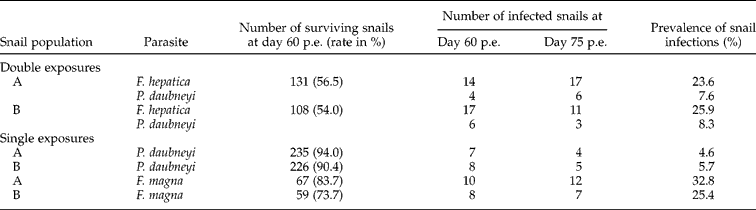
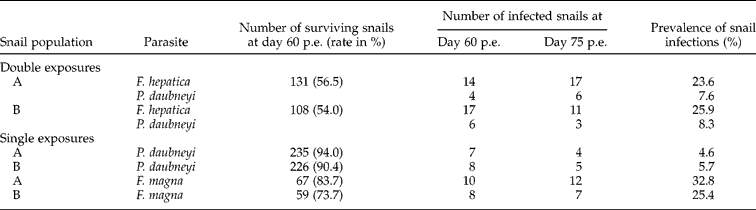
In snails doubly exposed to P. daubneyi and F. hepatica (table 2), the survival of O. glabra on day 60 p.e. was significantly lower (A snails: F = 9.44, P < 0.05; B snails: F = 8.77, P < 0.05) than that recorded in groups with P. daubneyi only. In contrast, the differences recorded between populations A and B for each type of infection (double exposures, or P. daubneyi) were insignificant. In the case of F. magna, the values ranged from 73.7 to 83.7% and no significant difference was found between both populations. The prevalences of snail infections with F. hepatica ranged from 23.6 to 25.9% and there was no significant difference between the populations of snails. However, values of P. daubneyi infections in double-exposed groups were significantly lower (A snails: F = 3.57, P < 0.05; B snails: F = 3.44, P < 0.05) than those recorded in snails with F. hepatica only, but differences in prevalences for P. daubneyi infections were insignificant. Lastly, the prevalence of infections with F. magna was in the same scale as that recorded for F. hepatica and no significant differences were found.
Survival of Omphiscola glabra at day 60 p.e. and prevalence of infections in the six groups of snails infected with Paramphistomum daubneyi/Fasciola hepatica (double exposures) or with a single species (P. daubneyi or Fascioloides magna).
The increase in shell height between snail exposure and the date of snail dissection (data not shown) ranged from 6.8 ± 1.1 mm to 8.0 ± 2.9 mm, but these differences were insignificant.
Redial and cercarial burdens
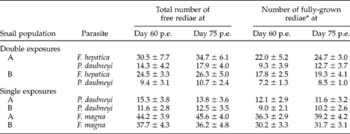
The total number of free rediae (table 3) showed significant variations in relation to the snail population (F = 9.76, P < 0.001) and parasite species (F = 28.43, P < 0.001), while the duration of experiment had no effect. The highest burdens on day 75 p.e. were those of F. magna (36.2 and 45.6 rediae per snail), followed by F. hepatica (26.3 and 34.7 rediae per snail), while the mean number of free rediae (10.7 to 17.9) of P. daubneyi was clearly lower. A similar result was noted for the number of fully-grown rediae (table 3), as snail population (F = 11.64, P < 0.001) and parasite species (F = 31.54, P < 0.001) had significant effects, while the duration of experiment had no effect. Fascioloides magna produced the highest number of fully-grown rediae, with a mean of 36.3 and 39.2 rediae in snail population A compared with lower numbers of 22.0–24.7 and 9.3–12.7 rediae in F. hepatica and P. daubneyi, respectively.
Mean values and S.D. for the total number of free rediae and that of fully-grown rediae in six groups of experimentally-infected Omphiscola glabra in relation to the species of digenean and the date of snail dissection.

* Number of cercariae-containing rediae (Fasciola hepatica or Fascioloides magna) or number of procercariae-containing rediae (Paramphistomum daubneyi).
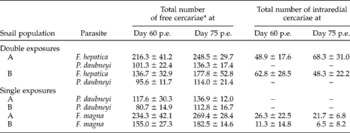
Table 4 gives the total number of cercariae recorded in the snail groups, indicating that snail population (F = 7.29, P < 0.01) and parasite species (F = 18.08, P < 0.001) had significant effects on the total number of free cercariae, while the duration of experiment had no effect. However, if parasite species only is considered, the number of free cercariae recorded for P. daubneyi (112.8–136.9 per snail at day 75 p.e.) was alone responsible for this significant difference, as values found for F. hepatica and F. magna did not significantly differ. In the case of intraredial cercariae, parasite species had a significant effect (F = 5.21, P < 0.05) on this parameter, while snail population and the duration of experiment had no effect. If the free and the intraredial cercariae are grouped, the total production of cercariae per infected snail ranged from 226.1 to 316.8 for F. hepatica, from 189.0 to 296.1 for F. magna, and from 114.0 to 136.0 for P. daubneyi (data not shown).
Mean values and S.D. for the total number of free cercariae and that of intraredial cercariae in six groups of experimentally-infected Omphiscola glabra in relation to the species of digenean and the date of snail dissection.

* Cercariae released by snails before day 60 p.e. (or before day 75 p.e.) were added to the corresponding number of free cercariae.
Low numbers of P. daubneyi metacercariae ( ≤ 9 per snail) were reported for snails harbouring live larval forms of this digenean. The mean numbers of metacercariae were less than 50 in the case of F. hepatica and less than 27 for F. magna (data not shown).
Discussion
In the six groups of O. glabra, the characteristics of snail infections showed significant variations which must be related to the parasite species. If the prevalence of infections with F. magna was close to the values reported by Rondelaud et al. (Reference Rondelaud, Novobilský, Vignoles, Treuil, Koudela and Dreyfuss2006) for other populations of O. glabra, the rates found in snails infected by F. hepatica and P. daubneyi were more surprising. Firstly, the prevalences of F. hepatica infections (23.6% and 25.9%) were clearly higher than those found in naturally-infected O. glabra (0.4% to 1.8%; Dreyfuss et al., Reference Dreyfuss, Vignoles and Rondelaud2005) or in experimentally-infected snails (13.6% for Abrous et al., Reference Abrous, Rondelaud and Dreyfuss1996, 17.2% for Abrous et al., Reference Abrous, Rondelaud, Dreyfuss and Cabaret1998a). Secondly, the values for P. daubneyi infections (4.6 to 8.3%) were higher than those noted by Dreyfuss et al. (Reference Dreyfuss, Vignoles and Rondelaud2005) in naturally-infected snails (up to 2.4%) but they were clearly lower than those reported by Abrous et al. (Reference Abrous, Rondelaud and Dreyfuss1996) in experimentally-infected O. glabra (13.0%). Two hypotheses may explain these differences. The first would be to suggest a progressive adaptation of O. glabra to sustain the larval development of F. hepatica or that of P. daubneyi throughout years, as demonstrated by the progressive increase of annual prevalences since 1996 in naturally-infected populations of O. glabra from central France (Dreyfuss et al., Reference Dreyfuss, Vignoles and Rondelaud2005). The second hypothesis would be the existence of interpopulation variations in the susceptibility of O. glabra to F. hepatica or to P. daubneyi, due to the frequency of natural encounters between each population of snails and parasites. An argument supporting this approach is the variation in prevalences that Dreyfuss et al. (Reference Dreyfuss, Vignoles and Rondelaud2003) reported for F. hepatica infections in some populations of O. glabra which differ by their habitat location and the frequency of natural contact with domestic or wild mammals.
The number of free rediae found for F. hepatica or for P. daubneyi (see table 3) in O. glabra agreed with values reported by previous authors in another snail species, Galba truncatula when 4-mm high snails were subjected to single-miracidium exposures (F. hepatica: Rondelaud & Barthe, Reference Rondelaud and Barthe1987; P. daubneyi: Abrous et al., Reference Abrous, Rondelaud and Dreyfuss1997). In contrast, the higher number of free rediae of F. magna (36.2 to 45.6 per snail) might be explained by the finding of Erhardová-Kotrlá (Reference Erhardová-Kotrlá1971), who demonstrated that each redia of the first generation, formed by the sporocyst (up to 6 rediae), produces 4 to 9 rediae of the second generation. Thus, the larval development of F. magna would produce redial burdens which were greater than those noted for F. hepatica, as regulation of redial generations, by means of the first redia of the first generation, exists for F. hepatica (Augot et al., Reference Augot, Rondelaud, Dreyfuss, Cabaret, Bayssade-Dufour and Albaret1998, Reference Augot, Abrous, Rondelaud, Dreyfuss and Cabaret1999). If this hypothesis is valid, it is difficult to see why the number of free rediae in O. glabra is so high, as this snail has an elongated, narrow shell (Hubendick, Reference Hubendick1951) and, consequently, a body volume less than that found in G. truncatula of similar size. Further studies are therefore necessary by evaluate the number of free rediae in relation to their generation in several lymnaeid species known to be potential intermediate hosts of F. magna.
Cercarial production of F. hepatica in O. glabra (226.1 to 316.8 per snail) was clearly lower than that in G. truncatula of similar size (379.5 cercariae per snail; Belfaiza et al., Reference Belfaiza, Rondelaud, Moncef and Dreyfuss2004) and this difference can be explained by the smaller bodies of O. glabra. On the other hand, despite the difference between the body volume of O. glabra and that of G. truncatula, cercarial production of P. daubneyi in O. glabra ranged in the scale of values reported by Abrous et al. (Reference Abrous, Rondelaud and Dreyfuss1999) for G. truncatula. If cercarial production for both lymnaeids is explained by the low number of mature rediae which develop within these snails, another hypothesis cannot be excluded. Indeed, the low number of free rediae and, consequently, the cercarial burden found in O. glabra might correspond to a progressive adaptation of this snail to the parasite, as reported by Dreyfuss et al. (Reference Dreyfuss, Vignoles and Rondelaud2003) for the redial development of F. hepatica in O. glabra. However, in the case of P. daubneyi, this adaptation would be slow and likely to take a long time. This hypothesis is partly based on the low number of P. daubneyi metacercariae recorded in the present study, and also on the fact that cercarial shedding of P. daubneyi from experimentally-infected O. glabra was not reported by Abrous et al. (Reference Abrous, Rondelaud and Dreyfuss1996, Reference Abrous, Rondelaud, Dreyfuss and Cabaret1998a). The results concerning the cercarial production by F. magna are more difficult to interpret, as little information is available on the number of cercariae which develop in the snail intermediate hosts. Compared with the high numbers of fully-grown rediae found in O. glabra, cercarial production by F. magna seems limited, as each cercaria-containing redia produced a mean of 7.5 and 5.9 cercariae for A and B infected snails, respectively, at day 75 p.e. (tables 3 and 4). This might be explained by high numbers of rediae reducing the avaibility of nutrients for cercarial differentiation within the snail. To verify this hypothesis, cercarial productivity of F. magna in relation to different redial generations should be studied in a natural intermediate host such as G. truncatula.
Acknowledgements
This study was supported by grant no. 524/03/H133 from the Grant Agency of the Czech Republic.