




No CrossRef data available.
APSA Treasurer's Report
Published online by Cambridge University Press: 10 May 2005
Extract
With its mission broadening and budgets tightening, APSA has continued to operate efficiently and responsibly, and fiscal year 2004 ended within budget and with a growth in net value. In the fall of 2003, the Council made the decision to approve a deficit budget of $43,000. This planned deficit allowed the Association to tap into its reserves to implement an extensive technology plan that included transforming the APSA web site and upgrading the headquarters' aging cabling and network infrastructure. APSA accomplished these projects—and a number of others—and managed to finish the year ahead of budgeted costs, with a deficit of less than $2,000 from programmatic and general operating activities. APSA also ended the year with a significant increase in its net assets.
Information
- Type
- Association News
- Information
- Copyright
- © 2005 by the American Political Science Association
With its mission broadening and budgets tightening, APSA has continued to operate efficiently and responsibly, and fiscal year 2004 ended within budget and with a growth in net value. In the fall of 2003, the Council made the decision to approve a deficit budget of $43,000. This planned deficit allowed the Association to tap into its reserves to implement an extensive technology plan that included transforming the APSA web site and upgrading the headquarters' aging cabling and network infrastructure. APSA accomplished these projects—and a number of others—and managed to finish the year ahead of budgeted costs, with a deficit of less than $2,000 from programmatic and general operating activities. APSA also ended the year with a significant increase in its net assets.
APSA Investments
For the fiscal year ending June 30, 2004, APSA's audited financial statements, which also include the figures for investments, endowed programs, and grant-funded activities, show an increase in total net assets of $3.2 million for the fiscal year, compared to successive declines in total net assets of $763,433 and $3.2 million for fiscal years 2003 and 2002. The healthy gain in net assets in the current fiscal period was due chiefly to a much more favorable investment climate. The Association's overall financial position continues to be strong, with assets of over $23 million, a headquarters building that continues to appreciate in value, no debt, and a stable operating budget (please refer to Table 1 for the APSA Balance Sheet).

APSA's investment advisor reports that the value of the Trust and Development Fund investments (which include the Centennial Campaign and Award funds) earned 21.9% for the fiscal year, and the Congressional Fellowship Fund investments earned 24.6%. By way of comparison, the S&P 500 earned 19.1% for the same period. The investment market performance for 2004 helped APSA in its recovery from the losses in recent fiscal years. APSA's portfolios have historically outperformed the S&P 500.
With guidance from the Association's investment advisor, Cedarpoint Capital Management, Inc., the APSA Trust and Development Board of Trustees carefully monitor investment performance. Following established guidelines calling for periodic external review, the T&D Board commissioned a review in 2002 to ensure that the best possible returns are being achieved within the existing investment guidelines, and engaged in informal review discussions this year. The results have been positive, and the Board has continued to work with Cedarpoint Capital Management. (Please refer to Table 2 for more information on APSA's investment portfolio).

Overall, APSA ended fiscal year 2004 with assets of $23.7 million and liabilities of $1.6 million, resulting in a net worth of $22.1 million. Of this amount, $9.2 million is restricted as to its use and $12.9 million is unrestricted. The net assets can also be keyed to the funds: $11.0 million in the Congressional Fellowship Program endowment, $4.0 million in Trust and Development, $4.3 million in Centennial Campaign, just under $2.0 million in general operating funds, and $1.0 million in Endowed Award funds (all at market value as of June 30, 2004).
Operating Budget
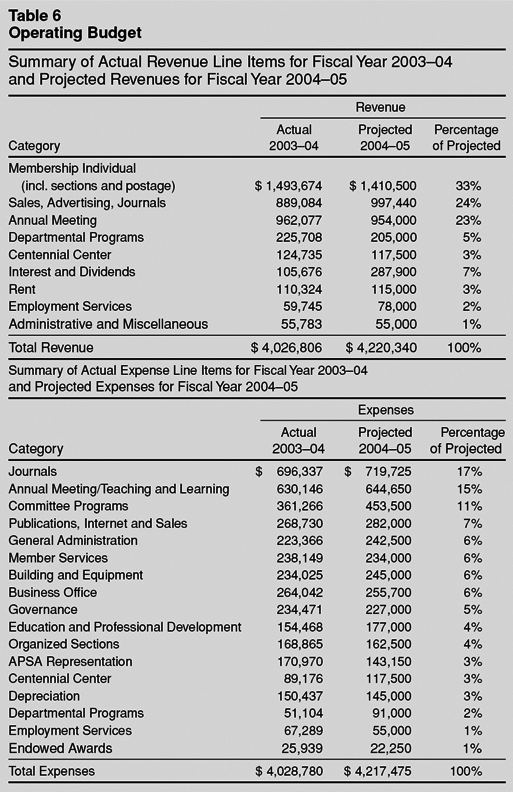
In terms of earned revenue and program expenses, the outcome for the fiscal year was well within budget expectations. APSA earned approximately $4.027 million in operating revenues and incurred operating expenses of $4.028 million. Actual revenue increased during this fiscal year by a little less than $320,000 over the prior year, and expenses increased by $366,000. Both revenue and expense came in just slightly lower than anticipated, at 99% and 98% of budget, respectively.
In fiscal year 2004, APSA realized the benefit of the second full year of its journal publishing agreement with Cambridge University Press and one full year of Perspectives on Politics. The Cambridge agreement has increased both revenue and expense for APSA by shifting the bulk of the publishing operation to the publisher. The publisher has direct responsibility for collection of institutional (library) dues, the sale of journal advertisements, and the management of royalties and permissions, as well as the PROceedings project and other electronic services. APSA receives a share of the revenue that Cambridge brings in from each of these areas. In addition, the publisher provides funding for all three of the editorial offices (APSR, PS and Perspectives on Politics). On the expense side, Cambridge is responsible for marketing, production, printing, and distribution for all three journals. Under this arrangement, APSA has continued to streamline its operations, reduce costs in several areas, and was able to establish a third journal, Perspectives on Politics, without having members bear additional expense.
Revenue growth from individual memberships was due to a modest increase in dues rates, and an increase in the number of members (up 710 from July 2003 to June 2004). The cost to deliver key services in major program areas—journals, committees, departments, representation, Annual Meeting, publications, member services, organized sections, education and professional development, employment, awards, and sections—increased 9.2% over the prior year. Supporting these major program areas, the costs for core operations (general administration, building and equipment, business office, and depreciation) increased 9.5% in 2003–2004. Even though, as in past years, we planned to take a drawdown from the endowment to support core operations, we did not need to use those funds (please see Tables 3, 4, and 5 for multi-year comparisons).


For the fiscal year ending June 30, 2004, the operating budget anticipated revenues of $4.049 million, expenses of $4.092 million, and a net loss of $42,850. In this budget cycle the Council authorized additional capital expenditures from reserves to support a technology plan to upgrade the APSA physical computer network, improve network security, initiate a records archive process, and introduce content management capabilities for the APSA web site. During the year, the actual net loss of less than $2,000 was the result of timing associated with some projects and significant savings in the cost of the content management system. (Please see Table 6 for a detailed comparison of fiscal year revenue and expenses compared to budget.)

The Council approved a modest annual membership dues increase, which went into effect on July 1, 2004. This resulted in an increase of one dollar for students and increases ranging from two to six dollars for professional members. Student dues are now $37 per year; professional dues range from $78 (for those earning less than $40,000 per year) to $190 (for those earning more than $100,000).
The fiscal year 2004–2005 budget projects a revenue increase of 4.2% over the prior year and an increase in expenses of 3.0%. The budget forecasts that 33% of total revenue will come from individual memberships, 24% from journals, sales, and advertising, and 23% from Annual Meeting and Teaching and Learning Conference activities. The remaining 21% will derive from administrative sources (rent, investment income, etc., aggregated at 12%), departmental programs (5%), the Centennial Center (3%) and employment services (1%).
On the expense side of the ledger, costs for the three journals are expected to account for 17% of all operating expenses in fiscal year 2005, followed by the Annual Meeting and Teaching and Learning Conference at 15%, committee programs at 11%, and building and equipment (including depreciation costs) at 10%. Each of the following programs will constitute 5–6% of operating costs: governance, business office, general administration, and member services. At 5% or less are costs related to departmental programs, organized sections, representation, education and professional development, employment services, the web site and technology services, the Centennial Center, program review, and endowed awards.
APSA Operations in 2003–2004
APSA had numerous accomplishments in fiscal year 2003–2004, including key transitions in several important program areas. Michael Brintnall served his second full year as Executive Director. The restructuring of staff responsibilities resulted in the placement of three directors—Pauline Karpowicz, Christina Scarmeas, and Sean Twombly—into senior leadership positions. Program support positions were fully staffed during the year as well. The headquarters building also sustained extensive restructuring on two fronts. First, following major interior renovations to the top three floors of the headquarters building, APSA launched the Centennial Center for Political Science and Public Affairs in the fall of 2004. Additionally, APSA completed extensive restoration of its headquarters brickwork and exterior surfaces.
The 2003 Annual Meeting in Philadelphia and the 2004 Annual Meeting in Chicago were both hugely successful events. Online resources, including Annual Meeting programming, myApsa, and department services capabilities have afforded APSA members expansive opportunities to enjoy direct access to and control of Association services and membership renewal.
APSA Operations in 2004–2005
The current fiscal year, 2004–2005, also promises many important achievements. The purchase of a townhouse office building adjacent to the Association headquarters was completed in July 2004. The implementation of the APSA web site content management system, which will simplify staff updates to web content, further extend content management to our external audiences, and support collaborative workspaces for committees and members, is underway as this report is written.
The Council has enthusiastically endorsed a wide range of significant programs to serve APSA's members. These include initiatives on public presence, mentoring, and international and graduate education, among others. APSA's leadership and staff are taking advantage of ever-increasing opportunities to serve our members and the profession. It is our ongoing challenge to find cost-effective ways to maintain and expand the Association's programs while at the same time protecting APSA's assets and ensuring its sound financial future.
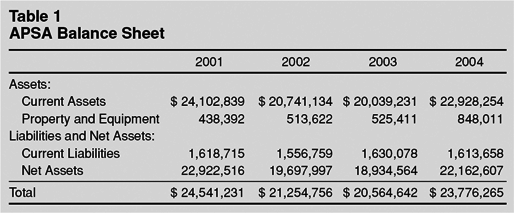
APSA Balance Sheet
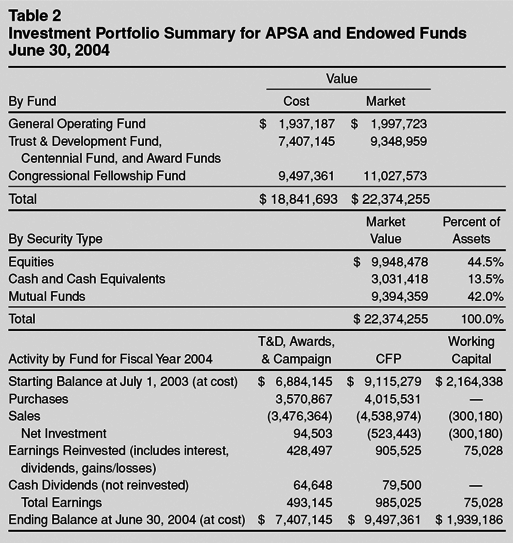
Investment Portfolio Summary for APSA and Endowed Funds June 30, 2004
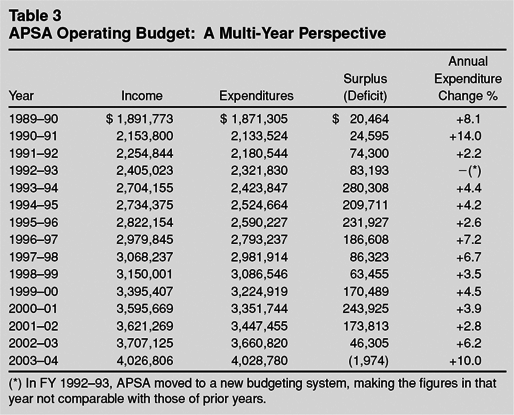
APSA Operating Budget: A Multi-Year Perspective
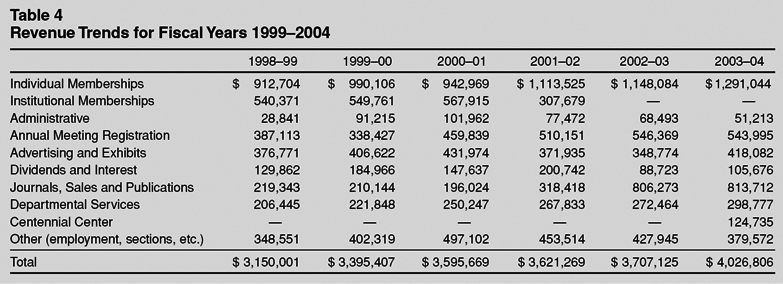
Revenue Trends for Fiscal Years 1999–2004
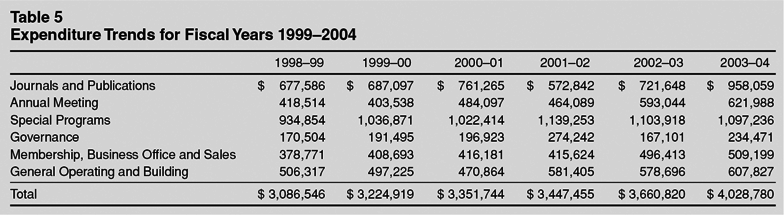
Expenditure Trends for Fiscal Years 1999–2004
Operating Budget
 You have Access