Heavy metal concentrations in marine mammals are the net difference between uptake of the metal and subsequent elimination by excretion. Several features such as the subject metal, its specifications, inter-metal competition for available sites, synergistic and antagonistic effects, the subject organism and its biological characteristics (e.g. sex, age and diet) can affect the rates of uptake and bioaccumulation of heavy metals in these animals (Bowles, Reference Bowles1999). The present study compares the distribution of mercury (Hg), cadmium (Cd) and zinc (Zn) in two coastal cetacean species in northern Rio de Janeiro State, south-eastern Brazil, the franciscana, Pontoporia blainvillei Gervais & D'Orbigny, 1844 and the boto-cinza, Sotalia guianensis Van Bénéden, 1864. The cutlassfish, Trichiurus lepturus L. 1758, which is the preferential prey species of the boto-cinza was also analysed for interspecific comparisons.
The sampling area is situated in northern Rio de Janeiro State, south-eastern Brazil (21°18′S–22º30′S), where the cetaceans and the cutlassfish specimens were obtained through the local fisheries. The specimens of cetaceans analysed in the present study, boto-cinza (N = 6) and franciscana (N = 7), were collected between 1998 and 2000 after incidental entanglement in gill-nets. The specimens of cutlassfish (N = 10), that are considered common targets in gill-net fisheries, were collected between 1999 and 2000 in the local fish markets.
The muscle and liver samples taken from the specimens of cetaceans were analysed in order to determine the concentrations of Hg, Cd and Zn. In the case of the cutlassfish, muscle samples were taken and the analysis included only Hg. All the tissues were stocked in freezers until the chemical analysis.
The body length of the cetaceans was measured along the longitudinal axis of the body, from the tip of the upper jaw to the notch of the flukes (0.1 cm). Age was estimated by counting the number of growth layers groups (GLGs) in the dentine and cementum. The previously described GLG pattern for both species was adopted (Ramos et al., Reference Ramos, Di Beneditto and Lima2000). Considering the cutlassfish, the body length of each specimen was measured along the longitudinal axis of the body, from the tip of the upper jaw to the end of the tail (0.1 cm), and the total weight was measured to the nearest 0.1 g.
The digestion procedure for total Cd and Zn determination was performed using 1 g ±0.001 of wet samples placed in a Teflon bomb with an acid mixture (HNO3/H2O2, 3:1) in an oven (110°C) for 12 h (Krause et al., Reference Krause, Erbslöh, Niedergesäb, Pepelnik and Prange1995). For Hg determinations the samples were also wet digested using a distinct methodology, with an oxidant mixture (H2SO4/HNO3, 1:1) and KMnO4 5% (Bastos et al., Reference Bastos, Malm, Pfeiffer and Cleary1998). In order to test the precision and the accuracy of the analytical methodology, certified reference fish material was analysed (Standard Reference Material DORM 1–NIST), using the same procedure described above.
An internal reference material supplied by the Instituto de Biofísica Carlos Chagas Filho–IBCCF (Universidade Federal do Rio de Janeiro–UFRJ) was also used to test the methodological procedures. Both tests showed a recovery higher than 80% for all the studied metals and the variation coefficients for analytical replicates were below 10%. All metal determinations were performed by ICP-AES (Varian Liberty Series II), using a VGA accessory for Hg.
The total length of the analysed specimens (4 females and 2 males) of the boto-cinza varied from 86 to 196 cm and the age from new-born (one month) to 30 y old. Concerning the franciscana, specimens varied from 82 to 120 cm and the age from new-born (one month) to four years old. Among all seven analysed specimens six were males and only one was female.
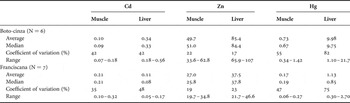
The heavy metal concentrations for the cetacean species showed the following averages in muscle and liver tissues, respectively: boto-cinza ⇒ Cd = 0.10/0.34 µg.g−1 wet weight, Zn = 49.7/85.4 µg.g−1 wet weight and Hg = 0.73/9.98 µg.g−1 wet weight; and franciscana ⇒ Cd = 0.21/0.11 µg.g−1 wet weight, Zn = 27.0/37.5 µg.g−1 wet weight and Hg = 0.17/1.13 µg · g−1 wet weight. The values were always higher in the liver except for Cd in the franciscana. This species also presented a change in the total abundance for heavy metals, with Cd showing higher concentration in muscle tissue than Hg. In general, the average of total abundance in muscle and liver tissues was the same (Zn > Hg > Cd) for both cetaceans species (Table 1).
Heavy metal concentration (μg.g−1 wet weight) in cetaceans from Rio de Janeiro State, south-eastern Brazil.

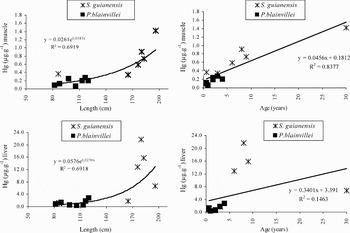
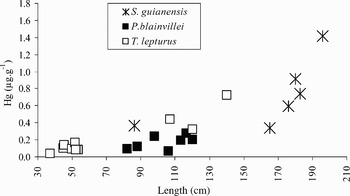
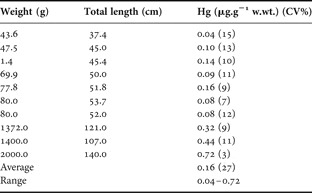
Although there was no significant correlation (P > 0.05) of Cd and Zn concentrations with body length and age in the muscle and liver tissues of both cetaceans species, Hg presented a positive and significant correlation with body length and age in both species (P ≤ 0.05) (Figure 1). Mercury content in the cutlassfish presented an average concentration of 0.16 µg.g−1 (coefficient of variation = 27%), ranging from 0.004 up to 0.72 µg.g−1 wet weight, and the highest concentrations were observed in the larger and heavier specimens (Table 2). The comparison of the Hg concentrations in the muscle of the studied species indicated similar values between the franciscana and the cutlassfish. The highest concentrations were recorded in the boto-cinza specimens (Figure 2).
Mercury concentration in muscle and liver tissues against length and age of the boto-cinza (Sotalia guianensis) and franciscana (Pontoporia blainvillei) specimens from Rio de Janeiro State, south-eastern Brazil.

Comparison of the mercury concentration in muscle tissue against length of the boto-cinza (Sotalia guianensis), franciscana (Pontoporia blainvillei) and cutlassfish (Trichiurus lepturus) specimens from Rio de Janeiro State, south-eastern Brazil.

Biological data and mercury concentration (μg.g−1 wet weight) of the cutlassfish (Trichiurus lepturus) specimens from Rio de Janeiro State, south-eastern Brazil.

CV, coefficient of variation.
The differences detected in the metal abundance between the two cetacean species are probably determined by the predominant food items in each species diet and/ or related with their body size and physiology (Rebelo et al., Reference Rebelo, Di Beneditto, Pinto, Malm and Ramos1999; Monteiro-Neto et al., Reference Monteiro-Neto, Italvo and Moraes2003). The highest values observed for Zn, when compared with the other two studied metals, are probably due to the fact that this element presented higher abundance in nature and also took part in many metabolic processes in enzymatic reactions (Amiard et al., Reference Amiard, Amiard-Triquet, Berthet and Metayer1987). Essential metals tend to show less variation in concentration and burdens within and between species because organisms are able to regulate them (Bowles, Reference Bowles1999).
In general, liver tissue presented the higher metal concentrations for all the studied elements when compared to muscle tissue in both cetaceans. Several authors have already observed the same trend in other cetacean species. André et al. (Reference André, Ribyere and Boudou1990) and Augier et al. (Reference Augier, Park and Ronneau1993) studying Hg distribution in distinct organs of the striped dolphin (Stenella coeruleoalba) find the following order: liver ≥ spleen ≥ blubber, kidney, pancreas ≥ stomach, lungs ≥ skeletal muscles, intestine, heart, brain and skin. In long-finned pilot whales (Globichephala melas) hepatic concentrations were ten times higher than those in the kidney, which contains the second highest concentration, and in the white-beaked dolphins (Lagenorhynchus albirostris) the concentration was three times higher than those in the kidney (Muir et al., Reference Muir, Wagemann, Grift, Norstrom, Simon and Lien1988). According to Bowles (Reference Bowles1999), differences between tissues can be high and are probably due to the role of some organs (e.g. liver and kidney) in the detoxification mechanism and/or in the metal storage by binding with metal-binding proteins (the metallothioneins).
The boto-cinza always showed higher metal concentrations than the franciscana in both tissues (with the exception of Cd in muscle). This result is probably related to the animal body size and physiology, and it is in agreement with the relation described by Rebelo et al. (Reference Rebelo, Di Beneditto, Pinto, Malm and Ramos1999). Considering heavy metals in liver, the boto-cinza presented the higher values for Hg (7 times), Zn (3.5 times) and Cd (3 times).
According to Monteiro-Neto et al. (Reference Monteiro-Neto, Italvo and Moraes2003), differences in the metal concentrations could also be attributed to differences in the feeding habits. Di Beneditto & Ramos (Reference Di Beneditto and Ramos2001, Reference Di Beneditto and Ramos2004) had already described the preferential diet of these cetaceans in northern Rio de Janeiro State, where the populations have restricted migration and present a strong association with the Paraíba do Sul River. According to these studies, the teleost species are important prey for both species, but franciscana feed mainly on prey of up to 10 cm length, including a large variety of juveniles and small size species from the families Sciaenidae, Clupeidae and Engraulidae. On the other hand, the boto-cinza feed preferentially on cutlassfish specimens of up to 70–100 cm length. The diet difference is probably responsible for the higher heavy metal values observed in the boto-cinza due to the fact that metals tend to present higher concentrations in larger and older organisms. This trend was also confirmed by the present study, where higher Hg concentrations were observed in larger specimens of the cutlassfish, which is the main prey of the boto-cinza.
Among all the cutlassfish individuals, only one specimen (140.0 cm length and 2,000 g weight) showed Hg concentration above the maximum permissible value. According to the literature, this carnivorous fish species seems to have a positive relation between Hg and body weight (Lacerda & Salomons, Reference Lacerda and Salomons1998), and our results showed the same trend.
The high concentrations found in this fish species and the higher metal results observed in the boto-cinza when compared to the franciscana are probably related to the fact that the latter feed on other prey species which have smaller size. As metal concentrations seem to increase with body length and weight, predators that usually feed on larger and heavier prey are more susceptible to higher metal ingestion and thus will present higher metal concentrations in their tissues.
In northern Rio de Janeiro State, Bittar (Reference Bittar2007) investigated the diet overlap between the cutlassfish and the franciscana, describing that both carnivores feed on the same prey species, of different dimensions. According to our data, the Hg concentrations in the muscle tissue of the franciscana and the cutlassfish specimens were also rather similar, which could reflect their feeding habits in the study area.
Comparing the present results with other studies involving the same cetaceans' species, it is possible to note that, in general, our specimens showed lower heavy metal levels (Marcovecchio et al., Reference Marcovecchio, Gerpe, Bastida, Rodrigues and Morón1994; Monteiro-Neto et al., Reference Monteiro-Neto, Italvo and Moraes2003), except for the Hg concentration in the liver of the boto-cinza, which was 1.5 times higher than the value recorded by Monteiro-Neto et al. (Reference Monteiro-Neto, Italvo and Moraes2003) for the specimens from north-eastern Brazil.
Some studies have already shown that the soils and riverine, estuarine, coastal lagoon and continental shelf sediments from northern Rio de Janeiro State presented Hg concentrations above the background levels for the region (Lacerda et al., Reference Lacerda, Carvalho, Rezende and Pfeiffer1993; Primo et al., Reference Primo, Carvalho, Calasans and Suzuki2004). According to these studies, the high Hg concentrations in those soils and sediments are probably due to two main sources: (1) former gold mining activity in the Paraíba do Sul River basin; and (2) the large past use of Hg fungicides in the regional sugarcane plantations. The Hg concentrations observed in the drainage basin as well as in the coastal areas are probably contaminating the marine biota in the study area.
Our results provide new information about the possible Hg pathway for coastal cetaceans contamination in south-eastern Brazil. As the boto-cinza and franciscana populations have restricted migration and present a strong association with the Paraíba do Sul River in northern Rio de Janeiro State, investigations on the contamination levels along the local trophic chain are required to better elucidate the pathways for the uptake of metals into these animals.
ACKNOWLEDGEMENTS
The authors thank the fishermen from Atafona fishing harbour and Silvana Gomes, who provided the studied specimens. We also thank the referees for critical review on this manuscript. C.E.V. Carvalho; A.P.M. Di Beneditto and C.E. Rezende were supported by the Conselho Nacional de Desenvolvimento Científico e Tecnológico/CNPq and Fundação Carlos Chagas Filho de Apoio a Pesquisa do Estado do Rio de Janeiro/FAPERJ (C.E.V. Carvalho is supported by CNPq 300322/03-8; A.P.M.D.B. is supported by CNPq 305160/06-0 and C.E. Rezende is supported by FAPERJ E-26/151.949/2004 and CNPq 306.188/04-0). This manuscript is contribution number 103 of the Graduate Programme of Ecology and Natural Resources/Universidade Estadual do Norte Fluminense and is a part of the Millennium Institute Estuaries supported by CNPq 420.050/05-1.