I. INTRODUCTION
The applicability of metallic cobalt and nickel thin films is growing, resulting in an enhanced research interest concerning the fabrication of pinhole-free homogeneous layers. Ferromagnetic cobalt and nickel layers recently paved the way for spintronic applications,Reference Bader1,Reference Michaeli, Varade, Naaman and Waldeck2 harnessing the dependence of the electrical resistance from an external magnetic field. Their capacity to eliminate hydrogen radicals on their surface make them excellent catalysts for the growth of graphene.Reference Ago, Ito, Mizuta, Yoshida, Hu, Orofeo, Tsuji, Ikeda and Mizuno3,Reference Losurdo, Giangregorio, Capezzuto and Bruno4 In addition, they are used as anode materials for solid oxide fuel cells,Reference Falk-Windisch, Claquesin, Sattari, Svensson and Froitzheim5,Reference Beckel, Bieberle-Hutter, Harvey, Infortuna, Muecke, Prestat, Rupp and Gauckler6 as well as for the fabrication of interconnect materials in CMOS devices.Reference Reader, Vanommen, Weijs, Wolters and Oostra7 Constant miniaturization of devices and at the same time aiming for an increasing device performance lead to challenges in thin film engineering. In comparison to other commonly used vapor phase deposition methods, such as chemical vapor deposition (CVD) or physical vapor deposition (PVD), atomic layer deposition (ALD) offers superior step coverage and control over film thickness at atomic scales due to the self-limiting nature of the process.Reference George8–Reference Lu, Elam and Stair19 However, the progress of ALD technology largely depends upon the availability of precursors that are, on the one hand, stable at the deposition temperature and, on the other hand, sufficiently reactive towards co-reactant and substrate.Reference Ma, Guo, Gordon and Zaera20–Reference Maimaiti and Elliott27 Most ALD precursors are very sensitive toward air or temperature due to liability of the ligands, which imposes a challenge in handling and processability.Reference Miikkulainen, Leskela, Ritala and Puurunen28,Reference Ramos, Saly and Chabal29 Especially in the case of cobalt and nickel metal deposition, the variety of suitable precursors is rather limited as the reduction of the M2+ cation to the metallic state has to overcome a redox potential of −0.28 V (Co2+/Co) and −0.23 V (Ni2+/Ni) respectively.Reference Ramos, Saly and Chabal29 However, there are several reports on the preparation of pure cobalt and nickel metal films using molecular precursors (H2, NH3) as the reducing agents.Reference Lee, Kim, Lee, Kim, Heo, Hwang, Park, Hong and Kim30–Reference Lim, Rahtu and Gordon32 Gaseous and volatile precursors like carbonyl compounds suffer from high toxicity and increased susceptibility toward process parameters.Reference Lee and Lee33–Reference Deo, Bain, Montgomery and Gamble41 Metallocene complexes (CoCp2/NiCp2) and their derivativesReference Lee, Son and Kim42–Reference Pugh, Cosham, Hamilton, Kingsley and Johnson45 belong to a very well investigated precursor class, which were found to favor carbide formation upon the required process temperatures due to the strong interaction between the metal cation and the Cp unit.Reference Lee, Kim, Jeon, Lee, Kim and Yeom46,Reference Kim, Lee, Han, Park, Lee, Kim, Yeom and Jeon47 Cobalt and nickel amidinateReference Lim, Rahtu and Gordon32,Reference Lim, Rahtu, Park and Gordon48,Reference Dai, Kwon, Halls, Gordon and Chabal49 and aminoalkoxide precursorsReference Han, George, Lee, Han, Park, Kim, Son, Lah and Chung50,Reference Kalutarage, Martin, Heeg and Winter51 can be used for metal deposition under thermal conditions. Recent reports from Klesko et al. feature cobalt metal film deposition, using an azadienyl-cobalt precursor, which is reduced by formic acid,Reference Kerrigan, Klesko, Rupich, Dezelah, Kanjolia, Chabal and Winter52 as well as nickel metal film deposition via reduction of preformed acetylacetonate-layer with methanol.Reference Sarr, Bahlawane, Arl, Dossot, McRae and Lenoble25 Since the β-diketonates so far resemble the only air-stable precursor class, all other processes necessitate circumstantial processing techniques.Reference Premkumar, Turchanin and Bahlawane53,Reference Premkumar, Bahlawane, Reiss and Kohse-Hoeinghaus54
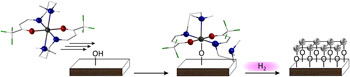
In this work, we demonstrate the applicability of a new set of precursors based on a tridentate chelating ligand system for the plasma-enhanced ALD of metallic cobalt and nickel thin films. A subsequent hydrogen plasma treatment as follow-up procedure on the as-deposited films results in metallic thin films with good structural quality and enhanced crystallinity. The chemical interactions of the precursor molecules with the surface anchored functional groups were studied by surface analysis techniques to elaborate the chemisorption mechanism.
II. EXPERIMENTAL
A. Precursor synthesis
If not mentioned otherwise, all solvents and reagents were used without further purification. Potassium tert-butoxide (KOtBu, Acros Organics, Geel, Belgium) was purified by sublimation prior to use. (E)-4-ethoxy-1,1,1-trifluorobut-3-en-2-on (tfae) and [Ni(NH3)6]Cl2 were prepared according to literature procedures.Reference Hojo, Masuda, Kokuryo, Shioda and Matsuo55 Mass spectra were recorded on a Finnigan MAT 95 (EI, 20 eV, Thermo Fisher Scientific, Waltham, Massachusetts), elemental analyses were performed on a HEKAtech CHNS Euro EA 3000 (HEKAtech GmbH, Wegberg, Germany), and TG measurements were carried out on a TGA/DSC1 (Mettler-Toledo GmbH, Gieϐen, Germany) apparatus with a heating rate of 10 °C/min under nitrogen atmosphere. Nuclear magnetic resonance (NMR) spectra were recorded on a Bruker Avance II spectrometer (Bruker, Billerica, Massachusetts) operating at 300 MHz, chemical shifts are quoted in parts per million (ppm) relative to TMS (1H and 13C) and CCl3F (19F). Data collection for X-ray structure elucidation was performed on a STOE IPDS II diffractometer (STOE & Cie GmbH, Darmstadt, Germany) using graphite-monochromated Mo-Kα radiation (0.71071 Å). The data were corrected for Lorentz and polarization effects. A numerical absorption correction based on crystal shape optimization was applied for all data. The structure solution and refinement was performed using STOE’s X-Area (STOE & Cie GmbH, Darmstadt, Germany) and the WINGX suite of programs, including SIR-92 and SHELXL-97 (Farrugia, Glasgow, United Kingdom). The hydrogen atoms were placed in idealized positions and constrained to ride on their parent atom. The last cycles of refinement included atomic positions for all atoms, anisotropic thermal parameters for all nonhydrogen atoms and isotropic thermal parameters for all hydrogen atoms.
1. Synthesis of N,N-(4,4,4-trifluorobut-1-en-3-on)-dimethylethyldiamine (Htfb-dmeda, 3a)
N,N-Dimethylethyldiamine (2a) of 4.488 g (50.9 mmol) were cooled to 0 °C and 8.758 g tfae (1, 52.1 mmol) were added dropwise. The reaction mixture was stirred for 2 h at room temperature. The red-brown liquid was purified by distillation under reduced pressure (80 °C, 10−3 mbar) and the pure product was obtained as a yellow oil with a yield of 87% (9.341 g, 44.4 mmol). 1H NMR (300 MHz, 25 °C, CDCl3): δ [ppm] = 10.30 (br, 1H, NH), 7.12 (dd, 1H, H4, 3J H,H = 7 Hz, 3J H,NH = 14 Hz), 5.28 (d, 1H, H3, 3J H,H = 7 Hz), 3.35 (q, 2H, H6), 2.43 (t, 2H, H7), 2.20 (s, 6H, H9). 13C NMR (75 MHz, 25 °C, CDCl3): δ [ppm] = 178.2 (C2), 158.0 (C4), 117.4 (C1), 87.0 (C3), 58.8 (C7), 47.3 (C6), 45.3 (C9). 19F NMR (282 MHz, 25 °C, CDCl3): δ [ppm] = −76,9 (1J F,C = 289 Hz, 2J F,C = 33 Hz). CHNS (found/calculated) [%]: C (45.42/45.71), N (13.46/13.33), H (6.17/6.23). EI-MS (20 eV, 25 °C): m/z (intensity) = 210 (8% [M]+), 153 (16% [M]+–HCN(Me)2), 85 (8% [M]+–HCN(Me)2–CF3), 72 (22% [(CH2)2N(Me)2]+), 58 (100% [H2CN(Me)2]+), 44 (87% [N(Me)2]+).
2. Synthesis of N,N-(4,4,4-trifluorobut-1-en-3-on)-dimethylpropyldiamine (Htfb-dmpda, 3b)
N,N-Dimethylpropyldiamine (2b) of 26.426 mL (210 mmol) were cooled to 0 °C and 35 g tfae (1, 208 mmol) were added dropwise. The reaction mixture was stirred for 1 h and purified by fractional distillation under reduced pressure (100 °C, 10−3 mbar) to yield an orange oil in 74% (154 mmol, 34.51 g) yield. 1H NMR (300 MHz, 25 °C, CDCl3): δ [ppm] = 10.30 (br, 1H, NH), 7.07 (dd, 1H, H4, 3J H,H = 7 Hz, 3J H,NH = 14 Hz), 5.26 (d, 1H, H3, 3J H,H = 7 Hz), 3.37 (q, 2H, H6), 2.28 (t, 2H, H8), 2.16 (s, 6H, H10), 1.70 (qui, 2H, H7). 13C NMR (75 MHz, 25 °C, CDCl3): δ [ppm] = 176.7 (C2), 158.0 (C4), 117.1 (C1), 86.1 (C3), 56.0 (C8), 48.0 (C6), 44.8 (C10), 27.6 (C7). 19F NMR (282 MHz, 25 °C, CDCl3): δ [ppm] = −76,9 (1J F,C = 284 Hz, 2J F,C = 33 Hz). CHNS (found/calculated) [%]: C (47.76/48.21), N (12.44/12.49), H (6.96/6.74). EI-MS (20 eV, 25 °C): m/z (intensity) = 225 (18% [M]+), 153 (5% [M]+–(CH2)2N(Me)2), 85 (6% [M]+–(CH2)2N(Me)2–CF3), 72 (28% [(CH2)2N(Me)2]+), 58 (100% [H2CN(Me)2]+), 44 (2% [N(Me)2]+).
3. Synthesis of [Co(tfb-dmeda)2](4a)
Anhydrous cobalt(II) chloride of 1.831 g (14.1 mmol, 1.0 eq.) were suspended in dry THF under nitrogen atmosphere for 45 min, after which the suspension turns ultramarine. 5.23 g (24.9 mmol, 1.8 eq.) Htfb-dmeda (3a) were dissolved in 20 mL dry THF under nitrogen atmosphere. 2.794 g (24.9 mmol, 1.8 eq.) KOtBu were dissolved in 30 mL dry THF under nitrogen atmosphere and added to the Htfb-dmeda solution. The resulting solution was stirred for 15 min before it was added to the stirred CoCl2 solution, which subsequently turned black. Stirring was continued overnight at 65 °C to give a brown solution. The solvents were removed under reduced pressure before the remaining solid was freed of liquid by-products by distillation (96 °C, 10−3 mbar) and finally sublimed under reduced pressure (170 °C, 10−3 mbar) to yield 3.37 g (7.06 mmol, 50%) [Co(tfb-dmeda)2] 4a as a brown-orange solid. CHNS (found/calculated) [%]: C (41.99/40.26), N (11.43/11.74), H (5.03/5.03). EI-MS (70 eV, 100 °C): m/z (intensity) = 477 (12% [M]+), 268 (10% [M]+–[tfb-dmeda]), 58 (100% [H2CN(Me)2]+).
4. Synthesis of [Co(tfb-dmpda)2](4b)
The synthetic procedure was like the one described for (4a), starting from 1.831 g (14.1 mmol, 1.0 eq.) anhydrous cobalt chloride, 5.593 g (24.9 mmol, 1.8 eq.) Htfb-dmpda (3b) and 2.794 g (24.9 mmol, 1.8 eq.) KOtBu. 3.265 g (6.46 mmol, 46%) of the product were obtained upon sublimation (140 °C, 10−3 mbar) as red–orange crystals. CHNS (found/calculated) [%]: C (41.86/42.78), N (10.89/11.09), H (5.64/5.54). EI-MS (70 eV, 70 °C): m/z (intensity) = 505 (28% [M]+), 282 (100% [M]+–[tfb-dmpda]), 224 (8% [tfb-dmpda]+), 58 (80% [H2CN(Me)2]+).
5. Synthesis of [Ni(tfb-dmeda)2](5a).
[Ni(NH3)6]Cl2 of 3.426 g (14.8 mmol, 1.0 eq.) were suspended in 50 mL dry THF under nitrogen atmosphere at room temperature for 60 min 4.115 g (36.7 mmol, 2.46 eq.) KOtBu were dissolved in 50 mL dry THF under nitrogen atmosphere. 7.710 g (36.7 mmol, 2.46 eq.) Htfb-dmeda (3a) were dissolved in 25 mL dry THF under nitrogen atmosphere, and the KOtBu solution was added slowly to the stirred solution of (3a). The mixture was added to [Ni(NH3)6]Cl2 and the resulting solution turned dark green. After heating overnight at 65 °C, the solvent was removed under reduced pressure and excess Htfb-dmeda was removed by vacuum distillation. The remaining solid was further purified by sublimation at 180 °C (10−3 mbar) and yielded 3.97 g [Ni(tfb-dmeda)2] (8.32 mmol, 56%) as a bright green solid. CHNS (found/calculated) [%]: C (39.87/40.28), N (12.16/11.74), H (4.76/5.07). EI-MS (70 eV, 115 °C): m/z (intensity) = 476 (13% [M]+), 325 (8% [M]+–F3CCO(CH)2NCH2), 267 (10% [M]+–[tfb-dmeda]), 209 (4% [tfb-dmeda]+), 58 (100% [H2CN(Me)2]+).
6. Synthesis of [Ni(tfb-dmpda)2](5b).
The synthetic procedure was similar to that described for (5a), starting from 2.225 g (9.60 mmol, 1.0 eq.) [Ni(NH3)6]Cl2, 2.4 g (21.4 mmol, 2.2 eq.) KOtBu and 4.401 g (19.63 mmol, 2.0 eq.) Htfb-dmpda (3b). 3.5 g (6.93 mmol, 72%) of the product were obtained upon sublimation (150 °C, 10−3 mbar) as a brown solid. CHNS (found/calculated) [%]: C (42.66/42.8), N (11.16/11.09), H (5.53/5.58). EI-MS (70 eV, 85 °C): m/z (intensity) = 504 (12% [M]+), 280 (30% [M]+–[tfb-dmpda]), 223 (38% [tfb-dmpda]+), 58 (100% [H2CN(Me)2]+).
B. Material deposition
Film deposition was carried out in a commercially available TFS 200 (Beneq, Vantaa, Finland), equipped with a CESAR RF Plasma setup from Advanced Energy (Fort Collins, Colorado). Metal film deposition was conducted in a two-step process.
The first step consisted of an alternating sequence of precursor and co-reactant (hydrogen plasma) pulse and purge cycles: The precursor was heated to the respective sublimation temperature (Table S1) in a carrier-gas assisted source and introduced into the reactor chamber with 2 s pulse length followed by a purge of 8 s. Hydrogen plasma as co-reactant was introduced with 8 s pulsing and 10 s purge. Nitrogen carrier-gas flow was 150 sccm, plasma gas flow was 200 sccm of pure hydrogen gas combined with a forwarded power of 300 W. Plasma generation took place in a direct plasma source with grid electrode right over the substrates and at a distance of 4.5 cm from the plasma generating electrode, at RF = 13.56 MHz. Film deposition occurred in a hot-wall reactor on both flat and structured silicon (100) wafers. The substrate temperature was kept at 190 °C to avoid precursor condensation (<190 °C) or thermal decomposition (>190 °C).
The second step consisted of an in situ post-deposition hydrogen plasma etching step: after deposition of 25 ALD cycles, corresponding to a film thickness of ∼80–100 nm, another 500–1000 cycles of pure hydrogen plasma with a 3-s pulse and a 7-s purge each were exposed to the film. The purge time was selected to avoid particle formation inside the reactor chamber.
Crystallinity and phase analysis were evaluated by using a STOE-STADI-MP X-ray diffraction system (STOE & Cie GmbH, Darmstadt, Germany) using Cu Kα radiation (λ = 1.540 Å). The X-ray photoelectron spectroscopy (XPS) analysis was performed with an ESCA M-Probe (Surface Science Instruments, Mountain View, California), using monochromatic Al-Kα radiation (λ = 8.338 Å). Scanning electron microscopy (SEM) imaging was carried out with a Nano SEM 130 (FEI, Hillsboro, Oregon), using an acceleration voltage of 30 kV. Resistivity has been measured in a four-point probe setup, Keithley SMU 2400 (Keithley Instruments, Solon, Ohio). Atomic force microscopy (AFM) was performed with a Park System AFM X100 (Park Systems, Santa Clara, California) in contact mode. Nuclear reaction analysis was performed at Helmholtz-Zentrum Dresden-Rossendorf.
III. RESULTS AND DISCUSSION
For the preparation of air stable ALD precursors with suitable volatility and reactivity, a new ligand concept was developed based on tridentate enaminones: N,N-(4,4,4-trifluorobut-1-en-3-on)-dimethylethyldiamine (Htfb-dmeda, 3a) and N,N-(4,4,4-trifluorobut-1-en-3-on)-dimethylpropyldiamine (Htfb-dmpda, 3b), which differ in the length of the alkyl amino chain (Scheme S1).
These ligands feature a similar ligand backbone as our previously reported tetradentate enaminones, which were successfully used in the CVD of CeO2.Reference Schlafer, Graf, Fornalczyk, Mettenborger and Mathur56 Replacement of the diaminoalkyl backbone by a single dimethylamino alkyl function (ethylene, 3a and propylene, 3b) was expected to enhance the reactivity of the corresponding cobalt and nickel precursors toward surface hydroxyl groups with the N-metal bond being the predetermined bond-breaking site. Based on our previous reports, the presence of fluorine-containing groups in the ligand periphery enhances the volatility of the precursor.
3a and 3b were synthesized in a two-step process. First (E)-4-ethoxy-1,1,1-trifluorobut-3-en-2-on (tfae, 1) was prepared according to the literatureReference Hojo, Masuda, Kokuryo, Shioda and Matsuo55 and subsequently reacted with either N,N-dimethylethyldiamine (2a) or N,N-dimethylpropyldiamine (2b). The resulting products, 3a and 3b, were purified via distillation (80 and 100 °C, 10−3 mbar) and obtained in yields of 87% and 74%, respectively. As shown by 1H NMR spectroscopy, both ligands predominantly exist as Z-isomers in CDCl3 stabilized by the formation of intramolecular hydrogen bonds between the acidic NH protons and the carbonyl oxygen atoms. As observed with structurally related enaminones, the E:Z ratio of these ligands increases in more polar solvents.Reference Schlafer, Graf, Fornalczyk, Mettenborger and Mathur56 The corresponding cobalt and nickel compounds [CoII(tfb-dmeda)2] (4a), [CoII(tfb-dmpda)2] (4b), [NiII(tfb-dmeda)2] (5a) and [NiII(tfb-dmpda)2] (5b) were synthesized in a straight-forward salt metathesis reaction using either anhydrous CoCl2 or [Ni(NH3)6]Cl2 and the corresponding in situ prepared potassium salts of the ligands. The products were purified via sublimation (140–180 °C, 10−3 mbar) and were obtained in yields ranging from 46 to 72%.
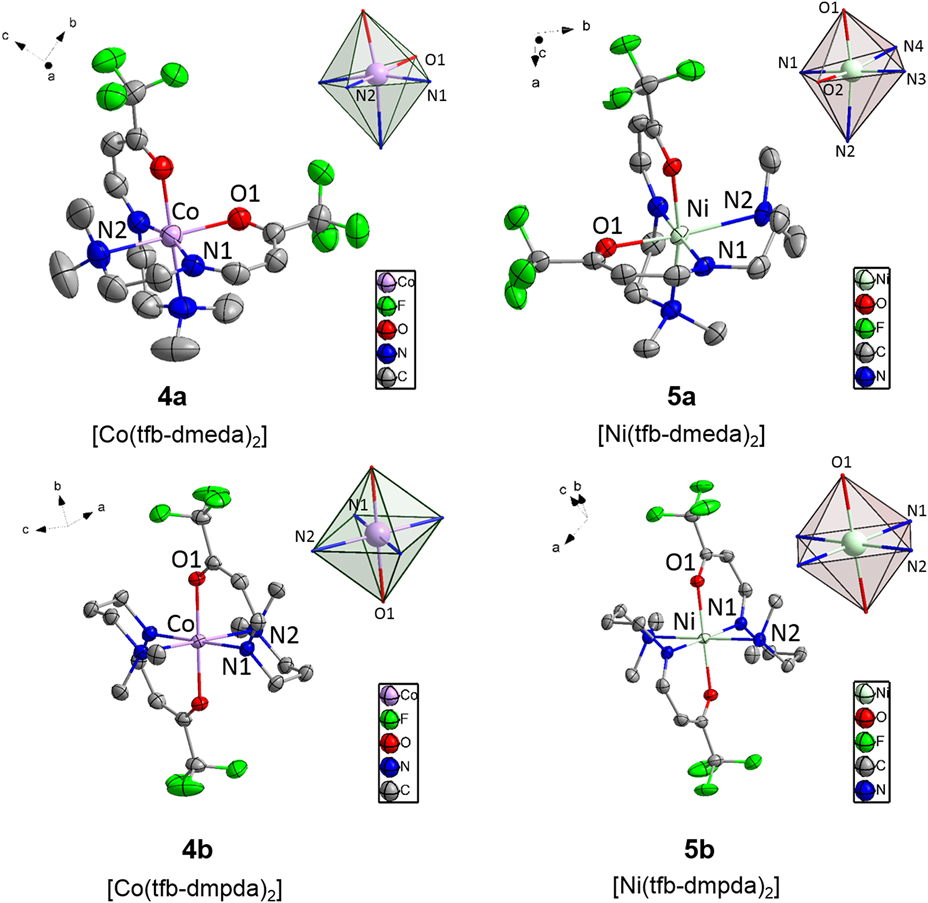
Single crystal diffraction analysis of all four compounds revealed both cobalt (4a and 4b) and nickel (5a and 5b) centers in octahedral configuration formed by tridentate chelation of substituted enaminone ligands around Co2+ and Ni2+ cations. The metal atoms (M = Co2+/Ni2+) exhibit a distorted octahedral coordination sphere, wherein the ligand (L = tfb-dmeda) coordinates in a meridional fashion (Fig. 1). The O1 and N1 atom of each ligand span a plane with the central metal atom and are tilted by 87.9° with respect to each other. In contrast to that, 4b and 5b (L = tfb-dmpda) reveal a facial coordination isomerism.
Molecular structures of 4a, 4b, 5a, and 5b. Thermal ellipsoids are shown at 50% probability level and hydrogen atoms are omitted for clarity. Selected bond lengths for: 4a [Å] Co–O1 2.069(3), Co–N1 2.044(4), Co–N2 2.456(5); 4b [Å] Co–O1 2.048(2), Co–N1 2.075(2), Co–N2 2.352(2); 5a [Å] Ni–O1 2.039(2), Ni–N1 2.002(3), Ni–N2 2.313(3), Ni–O2 2.049(2), Ni–N3 1.995(3), Ni–N4 2.305(3); 5b [Å] Ni–O1 2.038(1), Ni–N1 2.043(1), Ni–N2 2.298(2).

Comparison of metal–oxygen (M–O) and metal–nitrogen (M–N1) bond lengths (∼2.05 Å) of the chelating enaminone backbone in all cobalt and nickel complexes revealed no remarkable difference, whereas the metal–nitrogen bonds of the amine groups (M–N(Me)2) were elongated by ∼0.3–0.4 Å (cobalt) and ∼0.25–0.3 Å (nickel). From the higher atomic distances, a weaker interaction between the metal center and the dialkyl amino nitrogen can be deduced, which accounts for a facile dissociation of the respective (N(Me)2)-function.Reference Hausmann and Gordon57 This can be regarded as molecular predetermined breaking point and thus accounts for the reactivity of the complexes toward the substrate (Scheme S2).
Replacing the ethylene spacing with a propylene moiety provides more freedom for relaxational alignment. The impact on the crystal packing is examined by comparing the distances of the fluorine atoms from the CF3-group of the nearest neighboring molecules within a 2 × 2 × 2 supercell. Due to the different coordination isomerism (meridional versus facial), the F–F distances increase with the elongation of the ligand chain resulting in an increased volatility (Table S1).
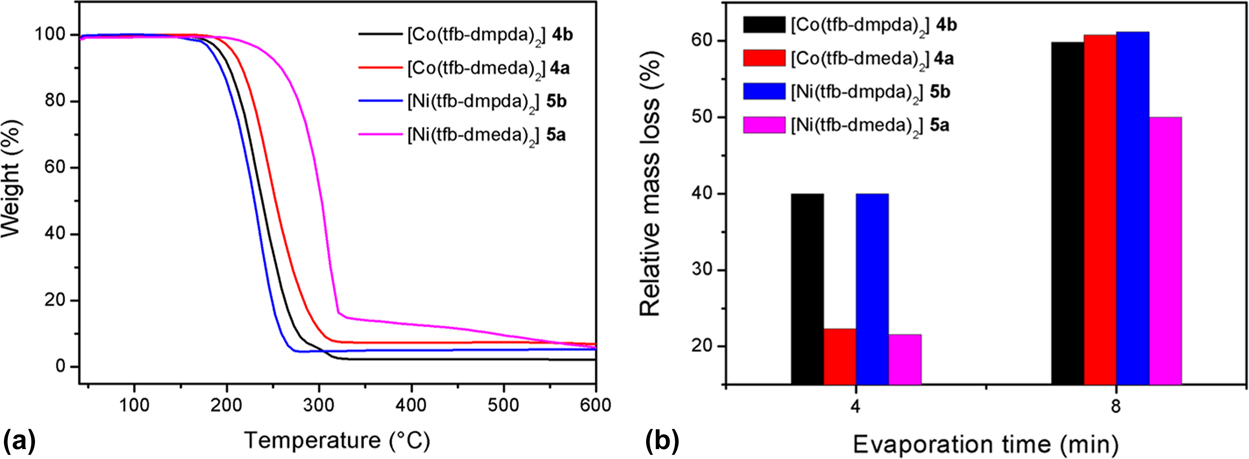
TG profiles of all compounds exhibit a single weight-loss step with residues of 2–7 wt% for 4a, 4b, and 5b, pointing toward the intact evaporation of the precursor molecules [Fig. 2(a)] at the measurement conditions. The tail end of the TG-curve of 5a hints at a partial decomposition along with an evaporation of the precursor resulting in a residue of 6 wt%, which is lower than the calculated wt% for the expected elemental nickel (∼12 wt%). The evaporation of the precursor molecules during TG measurements does not allow any conclusion on the decomposition behavior of the precursors other than that their thermal stability and volatility allow an intact transport through the gas phase even at elevated temperatures. For verifying the suitability of the new precursors for ALD processes, the evaporation temperatures for all four compounds were examined [Fig. 2(b)].
(a) TG measurements of precursors 4a, 4b, 5a, and 5b. (b) Volatility data of the precursors to elucidate the gas phase saturation behavior.

Intact vaporization of 4a and 5a occurred at approximately 180 °C, whereas 4b and 5b already evaporated at approximately 140 °C. As presented in Fig. 2(b), the relative mass losses of 4b and 5b (∼40%) after shorter periods (4 min) denote a faster vapor phase saturation, compared to 4a and 5a (∼20%). These experiments indicated that 4b and 5b are more suitable as potential ALD precursors.
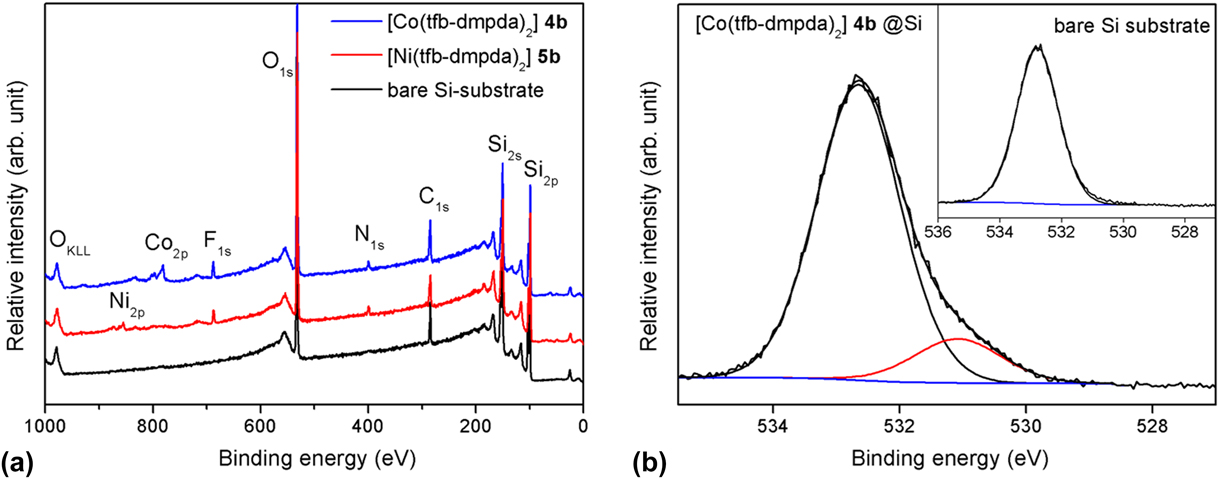
To investigate the mechanism of precursor adsorption and decomposition during the ALD process, detailed XPS studies were undertaken. In a first step, the chemisorption of the first precursor monolayer on the hydroxyl groups of the silicon substrate were elucidated. After the first precursor pulse and purge cycle, signals of the corresponding precursor atoms (N, F, Co/Ni) were visible in the survey scan XPS spectrum [Fig. 3(a)]. The O 1s narrow scan spectra were recorded to investigate the binding mode of the precursors (exemplarily of 4b) [Fig. 3(b)]. Whereas the spectrum of the bare silicon substrate [the inset of Fig. 3(b)] showed a single signal at 532.78 eV, the spectrum of the precursor exposed silicon substrate additionally displayed a small shoulder at 531.10 eV indicating a chemical bonding between 4b and the surface hydroxyl groups of the substrate. The shoulder at lower binding energy is due to the negative charge distribution around the metal atom, which decreased the bond polarity of the metal–substrate oxygen bond.Reference Keranen, Guimon, Liskola, Auroux and Niinisto58
(a) Survey scan XPS spectra of bare and precursor exposed silicon substrate. (b) High resolution O 1s XPS spectra of the bare (inset) and precursor 4b exposed silicon substrate.

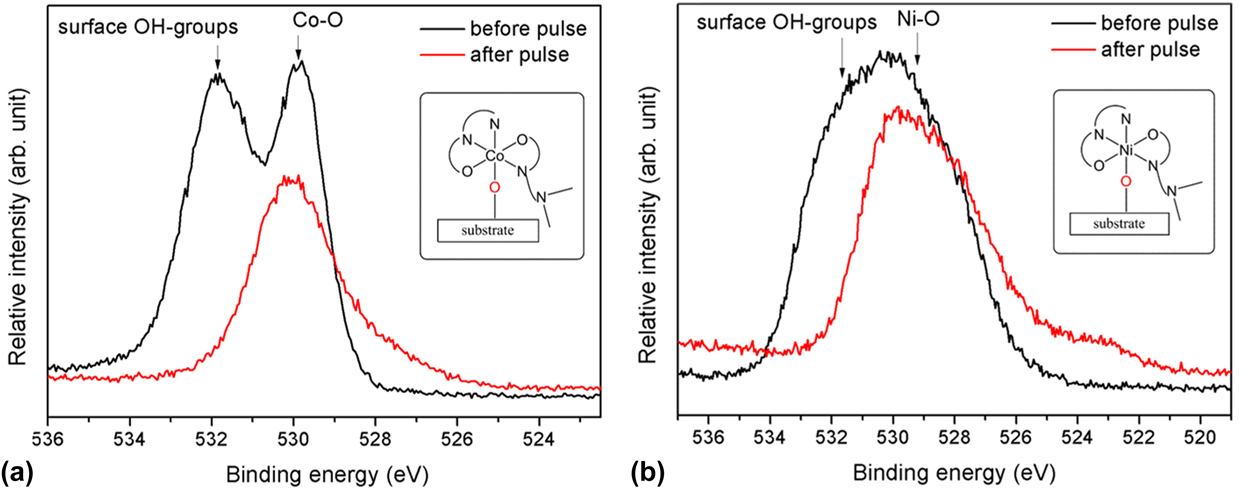
In a follow-up experiment, precursors 4b and 5b were used to deposit cobalt and nickel oxide films using oxygen plasma as the reactant to analyze the chemisorption of the precursors onto the growth layer. The high-resolution O 1s XPS spectra of the grown oxide surfaces before and after one precursor pulse were recorded (Fig. 4). The O 1s spectrum of bare nickel oxide displayed a broad signal at 530.2 eV, resulting from an overlap of the Ni–O and surface –OH signals [Fig. 4(b)]. The spectrum of bare cobalt oxide showed two almost resolved signals at 529.9 and 531.9 eV, which could be attributed to the surface OH- and cobalt-oxygen signals [Fig. 4(a)].Reference Biesinger, Payne, Grosvenor, Lau, Gerson and Smart59 After one precursor pulse, both spectra showed the disappearance of the surface OH-signals and a small shoulder at lower binding energies. This confirmed the chemisorption of 4b and 5b to the surface hydroxyl-groups of the corresponding metal oxides. To further analyze the binding of the precursor to the growth layer, high-resolution spectra of the N 1s and O 1s binding energy region (see Supplementary Material, Fig. S1) of the chemisorbed precursor were compared to spectra of the free ligand. This revealed no observable change in the binding energy or peak shape suggesting that both, the cobalt and the nickel precursor, exclusively form a chemical bond between the metal and the surface hydroxyl group after cleavage of the amine-moiety without any interaction of the ligands to the substrate surface.
High-resolution O 1s XPS spectra of (a) cobalt oxide and (b) nickel oxide surfaces before (black line) and after (red line) one precursor pulse using 4b and 5b, respectively.

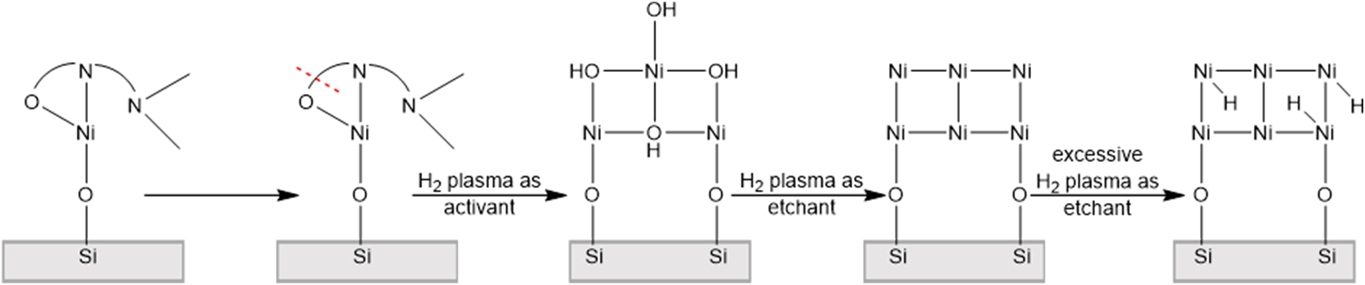
Even when using hydrogen plasma instead of oxygen plasma as the activant, the initial formation of metal hydroxides was observed (Scheme S3). The high oxophilic nature of nickel and cobalt facilitates preferred scission of the C–O bond of the enol functionality in the ligand instead of the M–O bond in the precursor molecules resulting in the formation of homogenous and pinhole-free hydroxide films at the growth stage. Thus, the role of hydrogen plasma as etchant in a subsequent step was essential to induce a recrystallization process, transforming as-deposited hydroxide films into pure metallic coatings.Reference Sasinska, Ritschel, Czympiel and Mathur60,Reference Choi, Yun and Rhee61
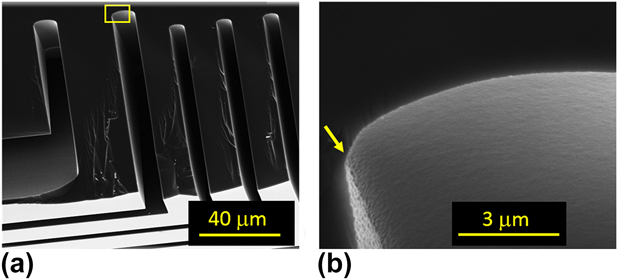
SEM (Fig. S2) and AFM analysis (Fig. S3) of the hydrogen plasma treated films after the etchant step showed a smooth surface with a RMS roughness value of 0.2 ± 0.06 nm for the cobalt film. Surface analysis of the metallic nickel film displayed a similar surface decorated with larger crystallites in the micron range (Fig. S3). The cross-sectional SEM analysis (Fig. S2) showed that growth rates for nickel films are lower than those observed for cobalt, which can be explained by a faster chemisorption of the cobalt precursor 4b. This observation is in line with previous investigations reporting lower growth rates for nickel.Reference Lim, Rahtu and Gordon32 ALD processes onto trenched silicon wafers with ranging aspect ratios from 4:1 up to 30:1 revealed that homogeneous deposition can be achieved even on structured substrates (Fig. 5); however, due to the high recombination rate of hydrogen atoms at the surface, the conformity is limited.Reference Kariniemi, Niinisto, Vehkamaki, Kemell, Ritala, Leskela and Putkonen62–Reference Schindler, Logar, Provine and Prinz64
SEM analysis: (a) Metallic Ni film deposited onto a trenched silicon wafer. (b) Magnified view of a conformal coating across the whole trench width.

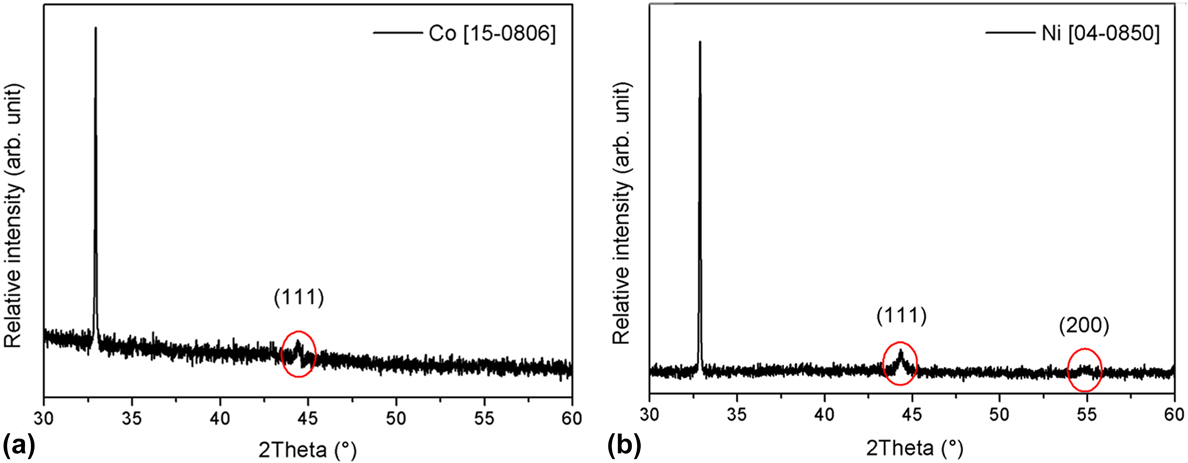
X-ray diffraction (XRD) analysis (Fig. 6) of hydrogen plasma treated cobalt films after the etchant step showed a small peak at 2θ = 44.4° corresponding to the (111) plane of the cubic crystal structure of the pure metal (JCPDS-No. 15-0806). The nickel films exhibited a small peak at 2θ = 44.3° and 51.8°, which can also be assigned to the (111) and (200) plane of the cubic crystal structure (JCPDS-No. 04-0850) of the pure metal. As-deposited cobalt and nickel films were found to be amorphous (XRD) and post-growth hydrogen plasma treatment was found to be essential for inducing crystallization through the reduction of metal oxide and hydroxide domains present in the ALD films.Reference Miikkulainen, Leskela, Ritala and Puurunen28,Reference Choi, Yun and Rhee61
XRD patterns of (a) cobalt and (b) nickel thin films after hydrogen plasma post-treatment.

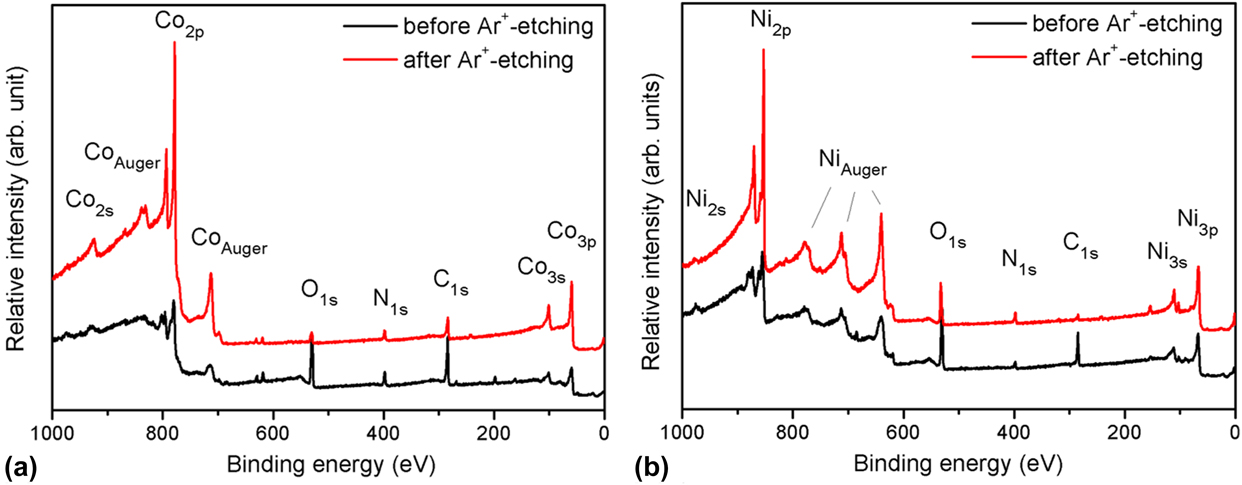
The XPS measurements performed on the post-treated films (Fig. 7) showed metallic cobalt and nickel deposits with remaining impurities from ligand atoms. The relatively high oxygen and carbon contents are due to atmospheric oxidation under ambient conditions that was inevitable when transferring the samples from the ALD reactor to the XPS chamber. Besides the characteristic 2p transitions, both samples exhibited intensive metal 2s-, 3s-, 3p-, and Auger-transitions still underlining a good sample quality (Fig. 7).
Survey scan XPS spectra of (a) cobalt and (b) nickel thin films before and after surface etching with argon plasma.

High-resolution scans of the Co 2p- and Ni 2p-signals revealed the presence of metal oxide passivation layers, which were removed via argon plasma etching for 120 s (see Supplementary Material, Fig. S4) in the XPS chamber.Reference Biesinger, Payne, Grosvenor, Lau, Gerson and Smart59,Reference Mcintyre and Cook65 To exclude argon plasma induced reduction,Reference Choudhury, Saied, Sullivan and Abbot66 control experiments were performed subjecting as-deposited metal hydroxide films (prepared without subsequent hydrogen plasma treatment) to argon sputtering. Narrow scan spectra of these films in the Co 2p- and Ni 2p-binding energy region only showed the presence of cobalt(II) and nickel(II) oxide (see Supplementary Material, Fig. S5). In general, metallic nickel films have a lower tendency to undergo oxidation reactions due to their passivation behavior as confirmed by additional annealing experiments under argon atmosphere (see Supplementary Material, Fig. S6).
Resistance measurements revealed an increase of metallic conductivity up to 500 cycles of post-deposition hydrogen plasma treatment. Raising up to 1000 cycles of post-deposition, hydrogen plasma treatment resulted in a diminution of the metallic conductivity (Fig. S7). For the determination of the hydrogen content within the films, nuclear reaction analysis has been performed. An excessive hydrogen plasma treatment was found to be detrimental as it reacted with the metallic films, probably transforming them into metal hydrides (Fig. S8).
This competitive interplay of deposition and in situ etching enables tailoring the chemical composition of the deposited thin films and also provides fresh insight into the reactivity of etchants that can alter the composition of the film material (Fig. 8).
Schematic illustration of the role of hydrogen plasma as the activant and etchant during the ALD process.

IV. CONCLUSION
The new class of cobalt and nickel enaminone complexes are efficient precursors for ALD of thin and conductive metallic films. The potential of the new ligand system was manifested in their improved volatility and reactivity toward hydroxylated substrate surfaces that was confirmed by chemisorption studies via XPS of the first monolayer. In addition to their chemical attributes, the metal enaminolates produced well-adherent and conformal coatings on 3D-substrates and trenches up to an aspect ratio of 30:1. Compositional analysis of the as-deposited films showed hydroxide formation when using hydrogen plasma in the second ALD half-reaction, presumably occurring from C–O bond cleavage within the ligand. A post-deposition hydrogen plasma treatment led to purification and reduction of cobalt and nickel atoms, resulting in conformal metallic thin films with smooth surface. The energy input upon the plasma treatment resulted in recrystallization of local domains, whereas the metallic state was prone to an enhanced hydrogen uptake on excessive plasma exposure eventually producing metal hydrides. The catalytic dissociation of molecular hydrogen on transition metal surfaces occurs already at low activation energies, which can change the role of hydrogen plasma from an etchant into a reactant.
Supplementary Material
To view supplementary material for this article, please visit https://doi.org/10.1557/jmr.2018.379.
ACKNOWLEDGMENTS
All authors gratefully acknowledge Dr. L. Rebohle, Dr. J. Winkelmann, and Dr. R. Heller from Helmholtz-Zentrum Dresden-Rossendorf for performing nuclear reaction analysis and for helpful discussions. This work has been conducted with financial support by SIEMENS AG, which is gratefully acknowledged. S.M. and his group are thankful to the University of Cologne and the Helmholtz-Center Berlin for providing the infrastructural support. A.S. is thankful for financial support from the BMBF in the frame of KMU-innovativ NANOFLEX (03X0125C). J.L. is thankful to Fonds der chemischen Industrie for a Ph.D. fellowship. The financial support in the framework of the DFG priority program (SPP 1613; “Fuels Produced Regeneratively Through Light-Driven Water Splitting: Clarification of the Elemental Processes Involved and Prospects for Implementation in Technological Concepts”) is gratefully acknowledged. The authors S.M. and S.H.C. acknowledged a strategic collaboration between the Christiansen research group at Helmholtz-Zentrum Berlin für Materialien und Energie and the RG Mathur. S.H.C. acknowledges the Helmholtz-Zentrum Berlin für Materialien und Energie and financial support by the DFG within the CRC951-Hybrid Inorganic/Organic Systems for Opto-Electronics (HIOS).