I. INTRODUCTION
Gene delivery has been considered a promising tool for the treatment of cancer for more than a decade. During this period, various obstacles for gene delivery and their potential solutions have been investigated with the development in technology. The challenges such as limited gene transfer efficiency, targeting to specific cells and tissues, safety etc., have been addressed by strategies based on viral and nonviral vectors. Reference Boulaiz, Marchal, Prados, Melguizo and Aranega1–Reference Guo and Huang3 The concerns in using engineered viral vectors such as biosafety, cost of production, nonspecific interactions, and loading capacity, have limited their clinical application and pushed the roadmap of research to safer nonviral vector alternatives, mainly based on polymers. Reference Guo and Huang3–Reference Pezzoli and Candiani5 Unlike viruses, which have naturally evolved to internalize into the host, the nonviral vectors face multiple extracellular and intracellular barriers such as adhesion on the cell surface, cellular entry, escape from the endosome, and release of the nucleic acids into their intracellular target sites, to safely deliver the cargo. Reference Nguyen and Szoka6–Reference Lee and Kataoka9 These challenges have encouraged the development of internal/external stimuli responsive smart polymers, which represent an exciting and rapidly growing area of polymer science. Reference Fleige, Quadir and Haag10–Reference Onaca, Enea, Hughes and Meier12
The designed stimuli responsive polymers have been capable of undergoing reversible macroscopic changes by transforming their physicochemical properties in response to various endogenous (pH, redox potential, enzyme concentration etc.) or exogenous (temperature, light etc.) stimuli. Reference Fleige, Quadir and Haag10–Reference Zha, Banik and Alexis14 The major distinguishing feature of these smart polymeric systems is the temporal and spatial controllability allowing for minimizing side effects by site-specific therapy. The desired properties of a smart polymeric multifunctional delivery system such as conformation, hydrophilicity/hydrophobicity, surface charge etc. can be controlled by varying the copolymer architecture (monomer sequence, length, composition etc.), overall molecular weight and chemistry of functional groups. The attachment of stimuli-responsive moieties to copolymer architectures using functional monomers or linkers make it possible to trigger assembly/disassembly via bond cleavage or conformational, hydrophilicity/hydrophobicity, surface charge or solubility changes, depending on the stimulus and the type of chemistry. Reference Du, Wang, Zhang and Li15–Reference Zhang, Ko and Oh17 Therefore, cellular uptake, endosomal escape, intracellular targeted payload release, and overall gene delivery efficiency of nonviral vectors have been enhanced by stimuli responsive polymers. Reference Shim and Kwon11,Reference Zhang, Ko and Oh17
This review overviews the recent advances in the use of responsive polymers to overcome the key hurdles facing nucleic acid delivery for in vitro and in vivo applications. The review mentions the stimuli responsive strategies using various polymer combinations that can be applied for the delivery of all types of nucleic acids such as DNA, siRNA, or miRNA despite their structural differences. At the beginning, the current challenges and problems (such as, stability, cellular entry, endosomal escape, cell/organelle specific targeting etc.) of gene delivery (including DNA, siRNA, and miRNA) and necessity of responsive polymers to solve these problems are outlined. Then, the review specifically focuses on pH, temperature and redox potential stimuli-triggered mono, dual or multi responsive polymer based gene delivery systems and strategies for in vitro and in vivo applications. In addition, different polymer synthesis/modification methods are reviewed and literature findings regarding the stimuli responsive properties (pH, temperature, and redox potential) and the performance of the polymers to overcome the outlined delivery challenges are discussed. A separate subsection based on the delivery of gene editing tools such as the CRISPR-Cas9-sgRNA system is also discussed. The chapter ends with mentioning current clinical trials, concluding remarks, and future perspectives.
II. BARRIERS FOR NON-VIRAL GENE DELIVERY
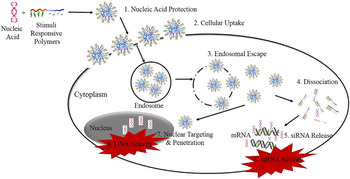
The success of nonviral gene therapy completely depends on the ability of the vector system in overcoming the several critical intracellular and extracellular barriers and, thus, achieving high delivery efficiency. These barriers include effective circulation in blood, diffusion through the extracellular matrix, stability and protection from enzymatic degradation, cellular association and uptake, endosomal escape, unpacking of the vector system, and release of the nucleic acid cargo in the cytoplasm or in nucleus (Fig. 1). Reference Bora, Gupta, Mukkur and Saini18–Reference Jones, Chen, Ravikrishnan, Rane and Pfeifer22 Failure at any of these steps significantly reduces the delivery and transfection efficiency.
Barriers for gene (DNA or small RNAs) delivery.

Nucleic acids (DNA or small RNAs), which are double-stranded, negatively charged, and hydrophilic bio-macromolecules in nature, have difficulties in crossing the cellular membranes in their naked form and are subject to enzymatic degradation by the endogenous nucleases upon the cellular entry. Reference Scholz and Wagner20,Reference Kwok and Hart23 In traditional approaches, the cationic polymers are electrostatically complexed with negatively charged nucleic acids forming polyplexes to prevent enzymatic degradation and serum protein induced dissociation, which may possibly result in premature release, extracellular degradation, and poor cellular uptake of nucleic acids. Reference Ballarin-Gonzalez and Howard24–Reference Varkouhi, Mountrichas, Schiffelers, Lammers, Storm, Pispas and Hennink28 The dense and stable polyplexes are desired for nuclease and serum stability concerns; however, electrostatically weaker complexation is needed at the target site to provide unpacking of the polyplexes and the subsequent release of free nucleic acid. Reference Ballarin-Gonzalez and Howard24–Reference Varkouhi, Mountrichas, Schiffelers, Lammers, Storm, Pispas and Hennink28 In addition, these vectors should be capable of avoiding immune response, nonspecific interactions with blood components and nonspecific uptake by reticuloendothelial system (RES), and be transported into the target tissue or cells. Transport of macromolecules and nucleic acid carrier systems is far easier across the tumor endothelium than that of the normal endothelium due to their leaky and discontinuous vascular structures. While this situation allows permeation, the poor lymphatic drainage leads to poor retention in the tumor tissue. The EPR effect can be enhanced by providing surface modification or using stimuli responsive polymers; therefore, the vectors escaping from RES are able to target tumor sites through EPR effect. Because of this, during the circulation in blood, a vector with neutral and hydrophilic corona is preferred to prevent nonspecific interactions; however, this protective corona inhibits efficient cellular uptake and endosomal escape properties. Reference Heidel and Davis29,Reference Jokerst, Lobovkina, Zare and Gambhir30 Therefore, these contradictory requirements can be solved by the use of stimuli responsive vectors.
The stable nonviral vectors are uptaken by cells usually via endocytosis or a different mechanism depending on the vector chemistry. Reference Zhao, Zhao, Liu, Chang, Chen and Zhao31,Reference Mukherjee, Ghosh and Maxfield32 However, it is crucial to provide cell/organelle specific targeting to avoid random interactions which may possibly lead to undesired mutations. Reference Tortorella and Karagiannis33,Reference Khalil, Kogure, Akita and Harashima34 Following the association with the target cell and cellular internalization, the risk of vector/nucleic acid complex degradation through acidic pH and acid activated enzymes in the endosome/lysosome exists. The endosomal compartments of cells are significantly more acidic (pH 5.0–6.2) than the cytosol or intracellular space (pH 7.4) in the early endosomal stage due to the ATP-mediated proton accumulation. Following the early endosome, the endosomal content is then gradually acidified (pH 4.5) to the lysosomes and contains various nucleases that induce the degradation of nucleic acids. Reference Varkouhi, Scholte, Storm and Haisma35 The ability of escaping from the low pH and endosomal digestive processes while avoiding premature decomplexation is the most critical step to be overcome by the vector. Proton sponge effect is a commonly used strategy in designing polymer based nonviral vectors with the ability of efficient endosomal escape. Through the proton sponge mechanism, the protonation of amine groups in cationic polymers destabilizes the endosomal membrane and subsequent inflow of ions and water leads to rupture of the endosomal membrane and cytosolic release of the entrapped components. As an example, tertiary amine groups' hydrophobic chains accumulate in endosomes and upon protonation, and they cause disruption of the membrane. Reference Varkouhi, Scholte, Storm and Haisma35,Reference Vicentini, Borgheti-Cardoso, Depieri, Mano, Abelha, Petrilli and Bentley36
Following endosomal escape, intracellular targeting determines the overall gene delivery efficiency. The targeted release site of nucleic acids varies depending on the nucleic acid type. For example, plasmid DNA must be localized in the nucleus, where gene expression is initiated by transcription, whereas siRNA or miRNA acts in the cytoplasm, where it targets the homologous messenger RNA (mRNA). Reference Scholz and Wagner20,Reference Kwok and Hart23 Therefore, the vector systems designed for DNA delivery should be further directed to the nucleus, while the endosomal escape and cytoplasmic release should be sufficient for the vectors designed for siRNA or miRNA delivery. However, reaching the cytoplasm or nucleus does not ensure the success of the system unless the vector efficiently releases its cargo and shows activity. As mentioned earlier, the vector should not only protect the loaded nucleic acid on the way to nucleus or cytoplasm, but also provide an efficient dissociation and release on the site of action to achieve a successful activity and functional delivery.
Overall, the key to designing effective nonviral gene carriers to overcome the external and internal hurdles lies in the analysis of biological response and physicochemical characteristics of the living tissues/cells. Thus, the extra and intracellular environments can be used as biological triggers to develop stimuli responsive polymer based gene delivery vectors.
III. BIOLOGICAL STIMULI RESPONSIVE POLYMERIC DESIGNS
Many different physiochemical/biological changes occur in healthy or diseased tissues/cells during their regular life cycle. These changes, mostly involving pH, temperature and redox potential, can be used to manipulate the properties and efficiency of gene delivery systems. For instance, a conventional multifunctional polymeric vector design involves cationic segments or cleavable chemical conjugation sites for condensing/attaching nucleic acids, temperature responsive hydrophilic segments for enhancing stability, cellular entry, and biocompatibility via steric shielding and pH responsive segments providing endosomal escape. Reference Guo and Huang3,Reference Fleige, Quadir and Haag10–Reference Kelley, Albert, Sullivan and Epps13,Reference Zhang, Ko and Oh17 Therefore, block copolymer systems allowing the incorporation of multiple functionalities into a single polymer structure have been declared as promising candidates for gene delivery applications.
There are two widely-used approaches to synthesize these responsive polymers: reversible addition fragmentation chain transfer (RAFT) and atomic transfer radical polymerization (ATRP), which enable control over the polymer architecture, molecular weight, molecular weight distribution, functionality, and composition. RAFT polymerization allows for the design of macromolecules with complex architectures including block, graft, comb, and star structures with predetermined features. In RAFT chain transfer agents, such as thiocarbonylthio compounds, mediate the polymerization via a reversible chain-transfer process. The advantage of RAFT polymerization involves the use of various solvents, wide temperature ranges, high functional group tolerance, and absence of a metal catalyst. However, the specificity of particular RAFT agents for a limited set of monomers and requisition of multistep procedure and subsequent purification for synthesis is the main drawback of RAFT. Moreover, the gradual decomposition of the dithioester moiety in unstable RAFT agents yield small sulfur compounds and pungent odor. Reference Rizzardo, Chen, Chong, Moad, Skidmore and Thang37,Reference Chong, Moad, Rizzardo, Skidmore and Thang38 Although the presence of sulfur moieties and color in the resulting polymer may be undesirable, this can be eliminated with further chemical and physical purification steps. As an alternative to RAFT, ATRP has been widely used in the research holding the most citations in the literature in preparation of polymers with precisely controlled molecular weight, narrow molecular weight distribution, and high degree of chain end functionalities, topologies, and compositions. ATRP is much more tolerant of functional groups than ionic polymerizations resulting in facile introduction of various functionalities into the polymer structure. The use of functional initiators or substitution of the terminal halogen atom provides end-functionalized polymers whereas the direct polymerization of functional monomers or polymerization of protected monomers followed by post-polymerization chemical transformations yields polymers with multiple functionalities along the backbone. ATRP uses simple initiators, mainly alkyl halides containing one or more halogen atoms. The architecture of the prepared polymers can be varied from linear (alkyl halides with a single halogen atom), to star-like or brush-like (multiple halogen atoms in the initiator) depending on the initiator structure and the number of halogen atoms. Reference Coessens, Pintauer and Matyjaszewski39,Reference Matyjaszewski and Tsarevsky40 One drawback of the classical ATRP method is the use of large amounts of the CuX/ligand catalyst complex, which require tedious purification. Nevertheless, both ATRP and RAFT are the most widely used methods to synthesize the stimuli responsive multifunctional polymers intended for gene delivery applications. This section overviews polymer based stimuli responsive nonviral vectors developed to effectively address the extra and intracellular barriers by responding to pH, temperature, and redox potential dependent biological stimuli.
A. pH responsive designs
pH changes in extracellular or intracellular environments play a critical role in the design of functional gene delivery vectors. Different from the normal tissue, the extracellular pH in cancer tissues varies around pH 6–7, which makes pH-responsiveness an important tool to target tumors with chemotherapeutics. On the other hand, in intracellular environments, the pH values vary from 5–6 in early endosome to 4–5 in late endosome/lysosome, which can be used as an efficient tool to provide endosomal membrane disruption. These extra and intracellular pH gradients can be used to design gene delivery vectors that facilitate selective targeting and endosomal escape. There are also differences in endosomal pH of cancer and noncancer cells, which we have exploited in Zhang et al. Reference Zhang, Kanapathipillai, Bisso and Mallapragada41
Several strategies/chemistries have been identified for the design of pH-responsive copolymer assemblies for delivery of nucleic acids (DNA or small RNAs), such as the formation of polymer–peptide conjugates, introduction of acid-labile functional groups to the copolymer backbone or along the copolymer chain, or use of pH-triggered bond cleavage or conformational change disrupting the hydrophobic/hydrophilic balance or degrading the copolymer. The chemistry coupled with the controlled self-assembly of copolymers and their responses to pH changes can be manipulated through changing the balance between the blocks with different features (hydrophobic/hydrophilic balance, electrostatic interactions, block length, molecular weight etc.) or adding some active groups to create effective conjugation sites in the structure. Reference Beyerle, Merkel, Stoeger and Kissel42–Reference Zhou, Chen, Wang, Yang and Zhang51
Among these strategies, polymer–peptide conjugates are an attractive class of materials that undergo pH-dependent conformational changes. The pH-dependent changes in these conjugates mainly depend on the transformation ability of polypeptide secondary structure from random coil to α-helix, which manipulates the changes in the chain configuration facilitating cellular entry and endosomal escape and targeting issues. Reference Segura and Hubbell52–Reference Hoyer and Neundorf57 However, fusogenic peptides alone are not good enough to complex/interact with negatively charged nucleic acids, restricting their co-localization with nucleic acids, which is important for endosomalytic release. Thus, due to a lack of interactions, the peptide itself may escape from the endosome without causing serious damage in the endosomal membrane and leaving nucleic acids in the endosome. These drawbacks of fusogenic peptides led to their use in combination with cell penetrating peptides or cationic polymers. Reference Cantini, Attaway, Butler, Andino, Sokolosky and Jakymiw58 Nevertheless, in these cases, the rapid elimination of polymers modified by fusogenic peptides during the blood circulation were observed in some in vivo studies addressing further optimization and the use of shorter peptide moieties. Reference Sakurai, Hatakeyama, Sato, Akita, Takayama, Kobayashi, Futaki and Harashima59–Reference Hatakeyama, Ito, Akita, Oishi, Nagasaki, Futaki and Harashima61
The conjugation of drug/nucleic acid molecules to copolymer structures via acid-labile linkers has been proposed as another strategy. Covalent attachment of drug/nucleic acids to carriers provides different potential benefits including stability, enhanced circulation times, targeted cellular uptake, endosomal escape, and promoted release. These chemistries used in copolymer assemblies include acid-labile hydrazine, Reference Lee, Saito, Lee, Lee, Shibasaki, Oishi and Kim62,Reference Oishi, Nagasaki, Itaka, Nishiyama and Kataoka63 carbamate, Reference Lee, Saito, Lee, Lee, Shibasaki, Oishi and Kim62 catechol, Reference Su, Chen, Cryns and Messersmith64 and Schiff base, Reference Xin and Yuan65 which simply take advantage of the acidic conditions in the lysozyme to release the cargo without enzymatic degradation. However, the selection of the linker changes depending on the specific chemical groups (i.e., therapeutics must have suitable ketone and aldehyde moieties to form hydrazine), cancer, and active agent type. This specificity brings about the nonuniversal use of linkers. In addition, possible cleavage of linkers at physiological pH causes premature release and the fragmented parts of polymer backbone or linker may cause undesired nonspecific interactions. Reference Chen66
As an alternative, the vector systems based on pH responsive polymers and their derivatives have been garnering attention. The proton sponge is considered as the main endosomal escape mechanism which relies on the use of materials possessing high buffering capacity and swelling property when protonated. The rupture of the endosomal membrane and release of the entrapped components occur upon the protonation induced inflow of ions and water into the endosomal environment. Tertiary amine groups with a hydrophobic chain in the polymer structure have been shown as the main component to accumulate in acidic endosomes resulting in disruption of the membrane upon protonation. Reference Varkouhi, Scholte, Storm and Haisma35 In the work of Convertine et al., a modular design of diblock polymer that combines the siRNA condensing ability of positively-charged dimethyl aminoethyl methacrylate (DMAEMA) block and the pH-responsive endosomal releasing block composed of DMAEMA and propylacrylic acid (PAA), together with butyl methacylate (BMA) was developed using reversible RAFT polymerization technique. This technique enables precise control over molecular weight polydispersities and eliminates the need for stringent reaction conditions. The membrane disruption was mediated by the hydrophilic-to-hydrophobic transition of PAA, which was induced by the gradual protonation of carboxylic acid residues along the polymer backbone at endosomal pH. The boosting effect of increased hydrophobicity in nucleic acid delivery has been demonstrated in previous works; however, after a certain point this may lead to a possible phase-separation eliminating carrier properties. Therefore, a tradeoff still exists with solubility and efficacy. Moreover, although the protonation of carboxylic acid residues triggers the membrane disruption process, their negative charges cause electrostatic repulsion affecting the nucleic acid loading and stability of complexes. Their overall in vitro results emphasize that variation of the ratios of different polymer blocks and polymer/siRNA charge ratio exhibits a great control over the pH-dependent endosomal escape and the cellular uptake. The endosomal escape property can be controlled with the molecular weight of the polymer; however, it should remain below 45–50 kDa which is the limit for renal clearance. Although the possible adverse effects of electrostatic complexation of nucleic acids with positively charged polymers (such as excessive cationic charge, toxicity, poor nucleic acid release etc.) have already been known, it is possible to achieve efficient activity at certain ratios. The positively charged complexes are open to nonspecific protein adsorption and showed poor stability in in vivo applications; however, at certain ratios the surface charge of the polyplexes were found to be very close to neutral, which prevents undesired protein adsorption and enhance circulation time. Reference Convertine, Benoit, Duvall, Hoffman and Stayton43 Beside these tradeoffs, the vector design strategy also changes depending on the type of the nucleic acid, order, and length of the polymer blocks. Reference Cheng, Convertine, Stayton and Bryers67 In our previous work, which will be described in greater detail in the following sections, we were able to use pentablock copolymers providing a pH-responsive proton sponge effect for the in vitro delivery of both DNA and siRNA. Reference Agarwal, Unfer and Mallapragada68–Reference Uz, Mallapragada and Altinkaya71
In some cases, the block copolymers need further modification in combination with other strategies to enhance its properties through different architectures. For example, Lin et al. designed degradable, pH-sensitive, membrane destabilizing, and comb-like diblock polymers. The first block involves a copolymer of pH-sensitive ethyl acrylic acid (EAA) monomers and hydrophobic butyl methacrylate (BMA) or hexyl methacrylate monomers, while the second block is a homopolymer of N-acryloxy succinimide (NASI) or ß-benzyl L-aspartate N-carboxy-anhydride (BLA-NCA) monomers. The second block was functionalized by acid-labile hydrazone linkages to provide controlled grafting of hydrophobic hexyl methacrylate (HMA) and cationic trimethyl aminoethyl methacrylate (TMAEMA) copolymers. These polymers were electrostatically complexed with siRNA to form pH-sensitive particles. The membrane-destabilizing backbone and the hydrophobic monomers embedded in the comb-like grafts synergistically disrupt the endosomal membrane and release the nucleic acid cargo providing advantage over the existing systems. These comb-like polymers with a molecular weight below 45–50 kDa can degrade into smaller fragments in acidic environment minimizing their toxicity and facilitating the in vivo renal excretion. Reference Lin, Jiang, Birrell and El-Sayed72
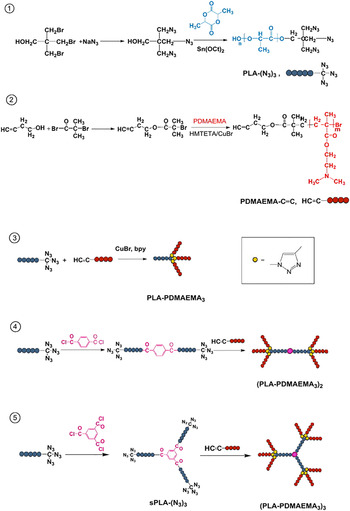
In another study, Synatschke et al. investigated the effect of the number of arms and molecular weights of star shaped PDMAEMAs on in vitro transfection efficiency of DNA. Their results indicate that the minimum possible molecular weight and branched architecture are the keys for successful transfection. Reference Synatschke, Schallon, Jérôme, Freitag and Müller73 Similar strategies using different polymer architectures were also used for miRNA delivery. Qian et al. reported amphiphilic star-branched copolymers comprising of polylactic acid (PLA) and polydimethylaminoethyl methacrylate (PDMAEMA) with different molecular architectures for combined delivery of doxorubicin and miR-21i (Fig. 2). They obtained various polymer architectures by a combination of ring-opening polymerization, atom transfer radical polymerization (ATRP), and click chemistry via an “arm-first” approach. Their polymers are capable of forming nano-sized micellar structures and the in vitro and in vivo results suggest that the gene transfection efficiency and tumor inhibition ability show a remarkable dependence on their molecular architecture. Reference Qian, Long, Shi, Liu, Qiu, Sheng, Pu, Yuan, Ren and Kang74
Synthesis of star-branched PLA-PDMAEMA block copolymers. Reproduced with permission from Elsevier. Reference Qian, Long, Shi, Liu, Qiu, Sheng, Pu, Yuan, Ren and Kang74

It is known that the presence of hydrophilic blocks in the delivery systems may enhance stability and blood circulation; however, they may also inhibit the cellular uptake. Similarly, the electrostatic complexes of polymers and nucleic acids having net positive charge show good stability and promote cellular uptake, whereas the excessive positive charge may cause severe toxicity and inhibit gene release. The introduction of micelles in the polymer structure has been shown to provide benefit in solving these issues and induce cellular uptake. For instance, Convertine et al. enhanced their previously described diblock copolymer siRNA carriers, composed of BMA, PAA, and DMAEMA blocks, by inducing their micelle formation ability through the incorporation of a longer endosomolytic block with increased hydrophobic content. They obtained siRNA loadings through electrostatic interactions and found out that the siRNA binding to the cationic shell block does not perturb micelle stability. The presence of micelles trigger the cellular uptake of the systems by 3-fold, and therefore showed enhanced mRNA knockdown in vitro. Reference Convertine, Diab, Prieve, Paschal, Hoffman, Johnson and Stayton75 In another work, Ripoll et al. designed novel pH-responsive photopolymerized diacetylenic amphiphile (PDA) micelles for the intracellular delivery of siRNAs (Fig. 3). In their design, the hydrophilic histidine head-group provided improved in vitro siRNA delivery by allowing the endosomal escape via imidazole protonation without showing severe toxicity. Reference Ripoll, Neuberg, Kichler, Tounsi, Wagner and Remy76
pH-responsive photopolymerized diacetylenic amphiphile (PDA) micelles for the intracellular siRNA delivery. Reproduced with permission from American Chemical Society. Reference Ripoll, Neuberg, Kichler, Tounsi, Wagner and Remy76

As a different strategy, Lin et al. used pH responsive micellization of star shaped polymers for the in vitro combined delivery of imiquimod and plasmid DNA. They developed dual functional unimolecular micelles based on a pH-responsive amphiphilic star polymer (PLA-b-PDMAEMA-b-PEtOxMA) through combined electron-transfer atom-transfer radical polymerization and ring-opening polymerization. Their results show efficient pH dependent delivery through pH-responsive unimolecular micelles. Reference Lin, Yao, Li, Hanson, Han, Wang and Zhang77
Micellization strategy was also used for miRNA delivery. In the work of Kumar et al., they used methoxy poly(ethylene glycol)-blockpoly(2-methyl-2-carboxyl-propylenecarbonate-graft-dodecanol-graft-tetraethylene-pentamine) (mPEG-b-PCC-g-DC-g-TEPA) polymers to coformulate miR-let7b and GDC-0449 into micelles for both in vitro and in vivo delivery. Their copolymer self-assembled into micelles and encapsulated hydrophobic GDC-0449 into its core, while allowing complex formation between miR-let7b and its cationic pendant chains. Their results show decreased tumor cell proliferation with increased apoptosis in the in vivo experiments. Reference Kumar, Mondal, Slavik, Rachagani, Batra and Mahato78
The presence of micelles can also be used to trigger the release of membrane destabilizing agents. Yu et al. reported amphotericin B (AmB) loaded, dual pH-responsive micelleplexes, which were self-assembled from poly[2-(dimethylamino) ethyl methacrylate]-block-poly[2-(diisopropylamino)ethyl methacrylate] (PDMA-b-PDPA) diblock copolymers, for in vitro siRNA delivery. The micelleplexes were formed by loading AmB into the hydrophobic PDPA core, and complexing siRNA with a positively charged PDMA shell. They hypothesized that the PDMA-b-PDPA/siRNA micelleplexes can dissociate in early endosomes and release endosomal membrane destabilizing AmB to significantly increase siRNA activity. Reference Yu, Zou, Wang, Huang, Huang, Sumer, Boothman and Gao79
The main problem with the electrostatically formed polyplexes is the poor release of nucleic acids due to the strong electrostatic interactions. Thus, the pH responsive polymeric micelles are also used to facilitate the release of nucleic acids. The protonation of the hydrophobic inner part of the micelle causing a pH triggered disassembly, endosomal membrane disruption, and subsequent release of the cargo is considered as a common strategy. Such a behavior was achieved previously with a poly(L-histidine)-b-PEG (PHis-b-PEG) and poly(L-lactic acid)-b-PEG-b-polyHis-ligand (PLLA-b-PEG-b-PHis-ligand) bearing different targeting moieties. Reference Lee, Na and Bae80,Reference Lee, Gao, Kim, Park, Kwon and Bae81
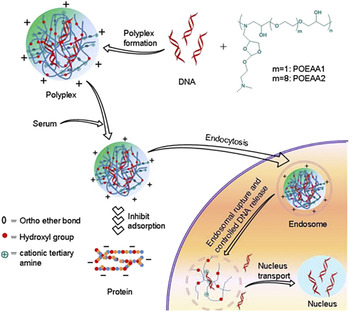
Stimuli response to pH can also be used for reversible shielding or masking strategies developed through dynamic covalent linkages or noncovalent interaction. Reference Du, Wang, Zhang and Li15 The modifications with neutral hydrophilic polymers, such as PEG, provide stability and prolonged circulation in blood. However, they cause poor transfection efficacy due to inefficient cellular uptake and/or endosomal escape. Reference Zheng, Librizzi, Kilic, Liu, Renz, Merkel and Kissel50,Reference Cho, Cho, Jeong, Choi, Han, Shin, Hong, Chung, Jeong and Cho82 In addition, some cationic fusogenic peptides and synthetic endosomolytic polymers were found to be cytotoxic due to their excessive positive charge and strong interaction with plasma membranes. Reference Elbakry, Zaky, Liebkl, Rachel, Goepferich and Breunig26,Reference Lee, Green, Love, Sunshine, Langer and Anderson83–Reference Fischer, Li, Ahlemeyer, Krieglstein and Kissel85 Therefore, pH-sensitive responsible polymers and related chemistries can also be used to solve these issues. The use of acid labile block copolymers with hydrazone, Reference Walker, Fella, Pelisek, Fahrmeir, Boeckle, Ogris and Wagner86 acetal, Reference Murthy, Campbell, Fausto, Hoffman and Stayton87 cyclic orthoester linkers Reference Lin, Du, Wang, Ji, Liang, Yu and Li88 unmasked the polymer backbone at the endosomal pH and induced membrane-disruptive properties and cytoplasmic delivery of the therapeutic agents upon the endocytosis. With a similar strategy, Rozema et al. reported polyconjugates based on an amphipathic membrane disruptive poly(vinyl ether) (PBAVE) backbone in which oligo PEG (as a shielding agent) and N-acetylgalactosamine (targeting ligand) were attached through acid labile maleamate linkages. The advantage of this system over the above mentioned systems is the siRNA attachment through cleavable disulfide bonds, which efficiently facilitate the siRNA release and in vivo activity. Reference Rozema, Lewis, Wakefield, Wong, Klein, Roesch, Bertin, Reppen, Chu, Blokhin, Hagstrom and Wolff89 In another study, Lai et al. synthesized an acid-labile cationic copolymer, consisting of a hydrophilic poly(ethylene glycol) (PEG) block and a polymethacrylamide block bearing tertiary amines linked by acid-labile ortho ester rings in side chains (PAOE), via RAFT polymerization for in vitro DNA delivery. Their copolymers efficiently condensed plasmid DNA at neutral pH by forming nanoscale polyplexes while the efficient dissociation of polyplexes accompanied by an enhanced DNA release was observed through the hydrolysis of ortho ester group in the side-chains of PAOE at mildly acidic pH. The in vitro results suggest that with further modifications, this pH-triggered DNA release strategy can be a promising approach for the efficient intracellular delivery of not only DNA but also other nucleic acid therapeutics. Reference Lai, Xu, Tang, Ji, Wang, Wang and Wang90 Recently, Yu et al. proposed a new type of linear copolymer, poly(ortho ester amino alcohols) (POEAAs), obtained by ring-opening polymerization (Fig. 4). Their POEAAs possess uniform distribution of tertiary amine main-chains among the abundant hydroxyl groups and acid-cleavable tertiary amine side-chains. The cytotoxicity, hydrophilicity, and DNA condensation ability of these polymers were controlled through the amount of diglycidyl ether moieties. The hydrolysis of ortho ester bonds at mildly acidic pHs through the cleavage of tertiary amines in the polymer side chains enhance the in vitro transfection efficiency and DNA release. Reference Yu, Zhang, Wang, Tang, Yan, Cao and Wang91
Illustration of POEAAs mediated controlled DNA release and serum tolerance. Reproduced with permission from Elsevier. Reference Yu, Zhang, Wang, Tang, Yan, Cao and Wang91

The pH responsive miRNA delivery has recently been investigated in the work of Jung et al. They designed doxorubicin (DOX)-tethered linear polyethylenimine (LPEI) conjugates linked via a pH-responsive hydrazone bond (LPEI-HZ-DOX), which was further complexed with miRNA-34a for the co-delivery. The designed biocompatible system provides successful simultaneous release at acidic pH resulting in synergistically enhanced in vitro toxicity and antiproliferation activity against PC-3 cancer cells. Reference Jung, Kim, Lee and Mok92
Most of the pH-responsive polymers and their counterparts modified by dynamically covalent linkages mentioned above have been used mainly based on the endo/lysosomal pH-triggered endosomal escape, shielding/masking or micelle triggered release. However, there are very few studies addressing the tumor targeting issues using pH-responsive materials since it is difficult to respond small pH changes as in tumor tissues. Considering this, Bae et al. developed a polymer system which can respond to small pH changes and used this polymer to target acidic extracellular matrix of tumors. They electrostatically coated the polyplexes with ultra pH-sensitive poly(methacryloyl sulfadimethoxine)-b-PEG diblock copolymer. The cytotoxic and transfection effect of their gene delivery system drastically changes upon the change in pH 7.4 (normal tissue) to 6.6 (tumor). Furthermore, they developed a biodegradable pH-sensitive diblock copolymer (poly(L-cystine bisamide-gsulfadiazine)-b-PEG) as an alternative coating material for positively charged polyplexes or other nanoparticles. Reference Lee, Gao and Bae93 In another study, Tangsangasaksri et al. developed polyion complex (PIC) micelles coupled with a smart polymeric shell and a pH responsive peptide that are capable of targeting tumor and escaping endosome for enhanced siRNA delivery. They used disulfide cross-linking and copper-free click reaction in their design. This delivery system enabled a charge change from negative to modestly positive in slightly acidic tumor environment (pH ∼6.7) and further highly positive charge state in late endosomal compartments where the pH is lower (pH ∼5.0). This stepwise charge change strategy provides selective binding to cancer cell surfaces and subsequent endosome disruption. Their results show improved silencing activity which are correlated with the facilitated cellular uptake at the acidic pH and the efficient endosomal escape. Reference Tangsangasaksri, Takemoto, Naito, Maeda, Sueyoshi, Kim, Miura, Ahn, Azuma, Nishiyama, Miyata and Kataoka94 Very recently Fan et al. proposed a novel pH-responsive strategy based on the conjugation of poly(ethylene glycol) modified by catechol group (PEG-Cat) and phenylboronic acid terminated polyethylenimine (PEI-PBA) via the borate ester formed between PBA and Cat. The pH-dependent stability of borate ester in aqueous medium makes it possible to shield the PBA ligand during the systemic circulation to provide tumor targeting. The PEG domain was detached to expose the tumor to PBA at acidic tumor environment (pH ∼6.5) while the PBA ligand enhanced the cellular internalization through binding with overexpressed sialic acid residues on cancer cells. In this design, siRNAs were used as both a payload coupled with PBA moieties through their 3′-ends, and pH-responsive intermolecular cross-linker, providing stability during blood circulating and pH triggered release at acidic endosome/lysosome. Their results indicate promising in vitro and in vivo performance. Reference Fan, Kang, Chen, Sun, Jin, Wang, Bae, Huang and Gao95
This section briefly summarizes that the pH-responsive polymers and related chemistries can be used in many different ways to solve different obstacles of gene delivery. However, the sole use of pH-responsive polymers is not sufficient to address all of the hurdles of gene delivery.
B. Temperature responsive designs
Temperature responsive polymeric materials have been extensively used in the construction of new systems intended for gene delivery applications. These polymeric materials containing thermo-responsive units can reversibly exhibit phase transition at certain temperatures, which results in changes in conformation, solubility and hydrophilic–hydrophobic balance. For the polymers becoming soluble upon heating, the transition temperature is defined as upper critical solution temperature (UCST), while for the polymers, which turn insoluble upon heating, the transition temperature is defined as lower critical solution temperature (LCST). The polymers with LCST possess extended conformation below the phase transition temperature, whereas above LCST, they collapse and cannot interact with the surroundings. Reference Ward and Georgiou96
In gene/drug delivery applications, the collapse of polymer structure upon endogeneous temperature increase can be used as a strategy to control tumor targeting, cellular uptake and release of the cargo. Since the endogenously local temperature of a solid tumor is slightly higher than that of the normal body temperature, the LCST of a thermosensitive block copolymer can be set to a desired point by manipulating the block ratio to provide accumulation of the designed delivery system into the tumor site. In addition, these thermoresponsive block copolymers form micelles upon temperature changes favoring cellular uptake and efficient cargo release.
The thermoresponsive copolymers have been synthesized by different methods such as ATRP, Reference Zhang, Shi, Wu and An97 radical addition fragmentation transfer (RAFT) polymerization Reference Schilli, Zhang, Rizzardo, Thang, Chong, Edwards, Karlsson and Müller98 and condensation of both polymer parts together by activating the terminal end group and coupling it with an amine from the second polymer. Reference Wei, Zhang, Zhou, Cheng and Zhuo99 The literature survey revealed that the ATRP is the most-used method for the development of thermo-responsive copolymers due to its precise control over the polydispersity and molecular weight.
Among the wide range of synthesized thermally responsive block copolymers, N-isopropylacrylamide (NIPAAM) is the most used block in the development of drug/gene delivery systems due to its LCST (ranges between 30 and 50 °C). Its properties can be controlled through co-monomer composition, hydrophilic/hydrophobic balance and stereochemistry. The co-polymerization of NIPAAM with other hydrophilic or hydrophobic monomers results in the tuning of LCST of PNIPAAM. Reference Alexander100,Reference Talelli and Hennink101 The water soluble PNIPAAM possessing flexible coil conformation at low temperatures collapses into a globule conformation upon the temperature increase above LCST. Reference Alexander100,Reference Salcher, Wagner, Bielke and Erbacher102,Reference Mao, Ma, Yan, Yan, Gao and Shen103 These polymers become amphiphilic in aqueous solution above body temperature and self-assemble to encapsulate or integrate hydrophobic and/or hydrophilic molecules. Many thermoreversible copolymers based on PNIPAAM have been reported in literature for the development of novel nonviral vectors for gene therapy, including N-N,N-trimethyl chitosan chloride-g-(N-isopropylacrylamide), Reference Mao, Ma, Yan, Yan, Gao and Shen103 poly(llysine)-g-poly(N-isopropylacrylamide), Reference Oupický, Reschel, Koňák and Oupická104 PNIPAAM-b-polyethyleneimine. Reference Turk, Dincer, Yulug and Piskin105,Reference Turk, Dincer and Piskin106 It was pointed out that the majority of temperature sensitive nonviral vectors are limited to PNIPAAm-based copolymers. Reference Calejo, Cardoso, Kjoniksen, Zhu, Morais, Sande, Cardoso, Pedroso de Lima, Jurado and Nystroem107,Reference Gu, Wang, Liu, Zhao, Wang, Gao and Wu108 However, PNIPAAm based temperature responsive copolymers synthesized by conventional free radical polymerization do not possess narrow polydispersities and well-defined architecture. Furthermore a recent study demonstrated that PNIPAAm shows a potential safety issue with an increased toxicity at physiological temperature. Reference Gu, Wang, Liu, Zhao, Wang, Gao and Wu108,Reference Cooperstein and Canavan109 Constructing a safe and nontoxic thermoresponsive polymer-based vector with well-fined molecular architecture, controlled molecular weight and polydispersity motivated researchers for new alternatives. Calejo et al. synthesized copolymers of NIPAAM and (3-acrylamidopropyl)trimethylammonium chloride (AMPTMA) [PNIPAAMn-b-PAMPTMAm (+)], which were distinct in terms of the length of the temperature-responsive PNIPAAM and the positively charged PAMPTMA block. Contrary to the other studies, they used lower molecular weight polymers with shorter charged blocks to reduce the cytotoxic potential of the system. The synergetic effect of cationic and hydrophilic segment and thermo responsive segment contracting upon endogenous temperature provide an advantage over the existing systems in higher DNA loadings. Reference Calejo, Cardoso, Kjoniksen, Zhu, Morais, Sande, Cardoso, Pedroso de Lima, Jurado and Nystroem107 With a similar strategy Ma et al. synthesized a novel temperature responsive polymer poly PDMNIB possessing main and side chains with different functions. The main chain contains 2-(dimethylamino)ethyl methacrylate which can interact with DNA, while, the side chain, grafting onto the main chain by cis-butenedioic anhydride, contains N-isopropylacrylamide which is sensitive to temperature. This structure provides a separation in two different functional chains of PDMNIB. The unique structure of PDMNIB bearing grafted moieties on the polymer backbone provides a good advantage over its counterparts in terms of efficiency. However, the LCST of this polymer (∼20 °C) makes its application restricted in some parts of the body. Reference Ma, Hou, Ji, Yao and Feng110 Yang et al. synthesized thermo-responsive poly[2-(2-methoxyethoxy)ethyl methacrylate]-b-poly(2-hydroxyl methacrylate) block copolymers (PMEO2MA-b-PHEMA) which were then grafted with LMW PEI1200, to form PEI-g-(PMEO2MA-b-PHEMA) copolymer vectors. The increase in grafting number of PEI on block copolymer increases the LCST due to the increase in hydrophilicity of macromolecular chains. While temperature was elevated above LCST, PEIMH was shown to condense DNA more efficiently due to the shielding effect of collapsed PMEO2MA chains. Moreover, the simultaneous contraction of PMEO2MA chains led to more surface positive charges of PEIMH-1/pDNA complexes, which is favorable for gene transport. Although it may not be feasible for most cases, a short-time cooling shock could increase the transfection efficiency. In addition, temperature response dependent transfection efficiency of this system was changed according to cell type indicating cell specificity. Reference Yang, Zhang, Tang, Sun, Liu, Sun, Zuo and Liang111 The overview of these mentioned studies points out that the structure, point of attachment and conformation of responsive segments play a critical role in the temperature responsive dependent transfection efficiency. This determines how well the responsive segment demonstrates its efficiency as shown in recent studies. It was noted that the use of grafted block copolymers provide better results than that of their counterparts. Unlike the above mentioned studies, in our previous works, we proposed the use of temperature responsive Pluronic F127 triblock copolymer in the construction of cationic and amphiphilic pentablock copolymers for in vitro and in vivo DNA and siRNA delivery applications. In our approach, the middle Pluronic F127 block acted as stabilizer, shielding agent and enhanced cellular uptake through temperature responsive micellization, showing very promising results. Reference Zhang, Kanapathipillai, Bisso and Mallapragada41,Reference Agarwal, Unfer and Mallapragada68,Reference Agarwal, Vilensky, Stockdale, Talmon, Unfer and Mallapragada112–Reference Zhang and Mallapragada114
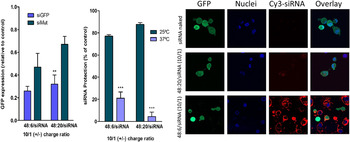
Different thermo-responsive polymer combinations have also been used recently. Tachaboonyakiat et al. used poly(vinylamine-co-N-vinylisobutylamide) or poly(VAm-co-NVIBA) to stabilize double-stranded DNA (dsDNA) through the controlled formation or dissociation of PICs. In their design, the cationic poly(vinylamine) (VAm) block enables electrostatic complexation with anionic DNA while the thermally responsive poly(N-isobutylamide) (NVIBA) block enables protection of DNA helical structure and limits the strength of the electrostatic interaction. Their results show that the use of thermoresponsive polymer blocks is a promising strategy to control the formation/dissociation of the copolymer/dsDNA complexes and maintain the DNA helical structure. Reference Tachaboonyakiat, Ajiro and Akashi115 In another work, Cardoso et al. evaluated the ability of thermoresponsive block copolymers comprised of N-isopropylacrylamide and (3-acrylamidopropyl)trimethylammonium chloride blocks for enhanced in vitro siRNA delivery (Fig. 5). They indicated that the cloud point and therefore the transition temperature of the polymer, where the aggregation or precipitation of the polymer molecules becomes thermodynamically more favorable, determines the toxicity and silencing efficiency of their design. Reference Cardoso, Calejo, Morais, Cardoso, Cruz, Zhu, Pedroso de Lima, Jurado and Nyström116
Thermoresponsive block copolymers comprised of poly(N-isopropylacrylamide) and of poly[(3-acrylamidopropyl)trimethylammonium chloride] blocks for enhanced in vitro siRNA delivery. Reproduced with permission from American Chemical Society. Reference Cardoso, Calejo, Morais, Cardoso, Cruz, Zhu, Pedroso de Lima, Jurado and Nyström116

The thermo-responsive nonviral vectors have also been developed for the disruption of the endosomal/lysosomal compartment. Park et al. reported a different temperature-sensitive gene delivery system based on hydrogel nanoparticles, which were achieved by crosslinking activated Pluronic with PEI, through a modified emulsification/solvent evaporation method. These nanoparticles show a thermally reversible swelling, which in turn induces the endosomal disruption, upon the temperature decrease from 37 to 20 °C. Reference Choi, Lee and Park117 They noted that when the nanoparticles were used for in vitro siRNA delivery, the applied cold-shock treatment enhanced the siRNA activity. Reference Lee, Choi, Kim and Park118 This observation is in accordance with the findings in literature indicating that cold-shock treatment enhances plasmid expression or RNAi activity. However, the cold-shock treatment is not easy to apply to practical in vivo uses.
Another use of thermo-responsive polymers can also be used for cancer-targeted gene delivery in response to hyperthermic conditions in the tumor. For example, poly(N,N-diethylacrylamide-co-acrylamide)-block-poly(γ-benzyl L-glutamate) based self-assembled thermo-responsive nanoparticles were designed for targeted drug delivery in localized hyperthermia. Considering the local hyperthermia (about 43 °C) as stimuli, the lower critical solution temperature (LCST) of nanoparticles was adjusted to a desired level. Reference Yuanpei, Shirong, Wei and Zhuo119 In another work, PEI and NIPAM-derived cationic thermo-responsive copolymers with a tunable LCST between 37 and 42 °C effectively condensed DNA and formed small, charge neutral polyplexes. Reference Zintchenko, Ogris and Wagner120 Significant accumulation of the thermo-responsive polyplexes in the hyperthermically treated neuroblastoma tumor in mice and subsequent enhanced DNA transfection in vivo was reported. Reference Schwerdt, Zintchenko, Concia, Roesen, Fisher, Lindner, Issels, Wagner and Ogris121
The thermo-responsive hydrogels and nanogels were also preferred to provide on-off type controlled release profile due to their ability of shrinking/expanding and the close packing of the fully collapsed gel upon heating. For example, the polymer network composed of PNIPAAM and poly(teramethylene ether glycol) (PTMEG) shows no release of active agent at temperatures around 30 °C, whereas they enable an increased release at lower temperatures. Reference Bae, Okano and Kim122 The properties of those thermo-responsive hydrogels can further be enhanced to provide additional responsive properties such as pH-responsiveness. For example, PNIPAAM was cross-linked with dendritic polyglycerol modified with acrylate groups to form a nanogel using a precipitation polymerization method. The presence of the polyglycerol enhanced the water solubility, the biocompatibility, and allowed fine-tuning of the thermo-responsive behavior of the nanogel. Reference Cuggino, Alvarez, Strumia, Welker, Licha, Steinhilber, Mutihac and Calderon123
The mentioned studies indicated that the thermoresponsive polymers need further optimization in terms of safety aspects and applicable temperature range. The findings proved that when the temperature responsiveness is used with other stimuli responses, such as pH or redox potential, the higher gene delivery efficiencies are possibly achieved.
C. Redox potential responsive designs
The difference of redox potential existing between the oxidative extracellular space and the reductive intracellular space has been used as an efficient strategy for the development of responsive gene delivery vectors. The redox potential mainly stems from the intracellular and extracellular glutathione concentration difference, which is used as a triggering mechanism. Reference Cai, Dong, Xia, Wen, Li, Yu, Li and Shi124 As mentioned earlier, the conventionally used cationic homopolymers suffer from the toxic effects due to their excess cationic charge and inhibition of cargo release caused by their strong electrostatic interactions. On the other hand, the use of redox responsive chemical conjugation alone or in combination with electrostatic interactions enhance nucleic acid release and decrease toxicity. Reference Uz, Mallapragada and Altinkaya71 Breunig et al. hypothesized that disulfide cleavable carrier systems are favorable for the release of siRNA into the cell cytoplasm. They tested various PEI derivatives (linear PEI, disulfide cross-linked PEI, and branched PEI) electrostatically complexed with siRNA. The results indicate that the in vitro cellular uptake of siRNA is enhanced by branched PEI; however, an efficient siRNA release was achieved by cleavable disulfide cross-linked PEI. Hence, they suggested a combination of a high branching density and reductively cleavable bonds within the PEI-based carrier system as a potential siRNA delivery system. The only concern regarding this study is the potential toxic effect of PEI at certain doses and off target effects. Reference Breunig, Hozsa, Lungwitz, Watanabe, Umeda, Kato and Goepferich25 The facilitated release accompanied by proper targeting features can be provided by multiconjugate strategy. York et al. developed N-(2-hydroxypropyl) methacrylamide-s-N-(3-aminopropyl) methacrylamide (HPMA-s-APMA) copolymer by using multifunctional cross linker, N-succinimidyl 3-(2-pyridyldithio)-propionate (SPDP), attaching a fraction of the primary amine, APMA, to thiolated siRNA through a disulfide exchange reaction while the unmodified APMA portion was coupled to amine reactive folates for targeting. These modifications resulted in the formation of a multifunctional copolymer both capable of in vitro cellular targeting and providing easy siRNA release. Reference York, Huang and McCormick125
The advantages of micellization in delivery systems such as enhanced blood circulation, stability and cellular entry have already been mentioned. The use of polymeric micelles in combination with chemical conjugation strategy was also proposed to further enhance the efficiency of the systems. Matsumoto et al. reported a poly ion complex (PIC) micelle in vitro siRNA delivery system based on poly(ethylene glycol)-blockpoly(L-lysine) (PEG-b-PLL) block copolymer modified with 2-iminothiolane (2-IT) cross-linking reagent. The reversible nature and susceptibility to reduction at the subcellular level makes the covalent disulfide cross-links particularly attractive for micelle core stabilization. The free sulfhydryl groups provide enhanced stability through disulfide cross-linking in the micelle core while the cationic amidine groups allowed PIC formation with anionic siRNAs. However, micelle formation occurs only at specific molar ratios of polymer/siRNA, which can be controlled by IM content in the PLL block. This situation could possibly stem from the instability of amidines formed with 2-iminothiolane. Reference Matsumoto, Christie, Nishiyama, Miyata, Ishii, Oba, Koyama, Yamasaki and Kataoka126 The formation and properties of the micelles were also changed depending on the type of cross linker used and degree of cross linking, which in turn determines the polymer charge density and optimal conditions for micelle formation. The higher crosslinking degrees decrease the polymer charge density leading to the use of higher polymer amount for complexation with nucleic acids. On the other hand, the higher micelle stability, which also brings loss of sensitivity to disulfide reducing conditions, leads to lower siRNA activity. Therefore, the degree of reversible micelle stability is critical to achieve high gene silencing at the target site. Reference Christie, Miyata, Matsumoto, Nomoto, Menasco, Lai, Pennisi, Osada, Fukushima, Nishiyama, Yamasaki and Kataoka127
The redox potential response is also used for miRNA delivery. Li et al. used bio-cleavable disulfide linkage to develop an amphiphilic cationic graft polymer [polyethylenimine-cystamine-poly(ε-caprolactone) (PSSP)] based on coupling of poly(ε-caprolactone) (PCL) with polyethylenimine (PEI) blocks for miR-34a delivery. They reported that the degradable micelles provided low cytotoxicity, intracellular redox potential triggered miRNA release and high in vitro transfection efficiency. Reference Li, Jiang, Zhao, Fu and Sun128
The mentioned studies above did not address endosomal escape property since the redox potential itself is not sufficient to solve the problems related to the endosomal escape. However, it can be used along with the pH-responsive endosomal escaping polymers to facilitate the nucleic acid release. Lundy et al. described neutral, ampholytic conjugatable diblock polymer micelles composed of a hydrophilic poly(N-(2-hydroxypropyl)methacrylamide-co-N-(2-(pyridin-2-yldisulfanyl)ethyl)methacrylamide) (poly[HPMA-co-PDSMA]) block to promote aqueous stability and facilitate thiol-disulfide exchange reactions and an ampholytic block consisting of propylacrylic acid (PAA), dimethylaminoethyl methacrylate (DMAEMA), and butyl methacrylate (BMA). These block copolymers are capable of forming self-assembled polymeric micelles under aqueous conditions. Neutral hydrophilic micelles with membrane destabilizing activity at acidic pH-induced the endosomal escape, while the attachment of thiolated siRNA via the disulfide exchange reaction with the pyridal disulfide groups facilitate the release. Reference Lundy, Convertine, Miteva and Stayton129 There are also some cases in which the redox potential was used for conjugating peptides to polymers to enhance properties. Segura et al. reported the synthesis of ABC triblock copolymer composed of poly(ethylene glycol) (PEG), poly(propylene sulfide) (PPS), and a positively charged peptide (PEG-PPS-peptide) for siRNA delivery applications. They synthesized the diblock copolymer PEG45-PPS5,10 through the anionic polymerization of propylene sulfide upon a PEG macroinitiator. The hydrophobic portion of this polymer facilitates the self-assembly having hydrophilic core. Following this, the TAT or oligolysine peptide was coupled to the PPS terminus via disulfide exchange reaction using N-terminal cysteine residue on the peptide. The peptide was designed to interact electrostatically with siRNA to both condense siRNA and enhance cellular entry. Reference Segura and Hubbell52 In another study, Zhang et al. reported polyarginine disulfide-linked PEI for in vivo miR-145 delivery to prostate cancer (Fig. 6). The systemic administration of the R11-SSPEI/FAM-miR-145 complex to the peritoneal mouse tumor model resulted in miR-145 delivery into the tumors, tumor growth inhibition and prolonged survival time in vivo. Reference Zhang, Xue, He and Hsieh130
Schematic illustration of R11-SSPEI/miR-145 polyplex synthesis. Reproduced with permission from Elsevier. Reference Zhang, Xue, He and Hsieh130

Supramolecular complexes can also be achieved using redox potential responsiveness. Hu et al. developed a polymer-based nanosystem for functional gene therapy by synthesizing a supramolecular complex self-assembled from polycations and functional adamantyl modules for miR-34a delivery. Their design provided proton sponge effect by polycations for endosomal escape, PEGylation protection for stability, and controlled release by breakdown of disulfide bonds through redox-responsiveness, therefore enabling enhanced in vitro and in vivo activity. Reference Hu, Wang, Sun, Li, Fu, Liang and Tang131
As a short conclusion, the use of redox potential to provide a better release of nucleic acids at desired target site is an efficient strategy to enhance the nucleic acid activity. With this tool, the difficulties in electrostatic complexes such as poor release and possible toxicity caused by excess cationic charge can be overcome. However, the redox potential itself is not sufficient to deal with the other hurdles of nucleic acid delivery such as cellular entry and endosomal escape; therefore, it should be used in combination with other stimuli responses.
D. Dual and multi responsive designs
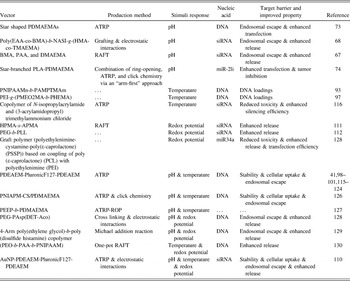
The presence of multiple barriers in gene delivery has brought the use of polymeric vectors possessing simultaneous dual or multiple response properties. Various combinations of internal stimulus (such as pH-temperature, pH-redox potential, temperature-redox potential or pH-temperature-redox potential etc.) can be achieved by bringing polymers with different stimuli responsiveness together (Table I). In these designs, each polymer segment is used to overcome a different barrier.
Polymer based stimuli responsive gene (DNA and small RNAs) delivery vectors.

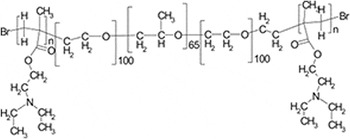
Different dual or multiple responsiveness combinations have been used to address the problems of gene delivery. In our group, we have synthesized pH and temperature responsive pentablock copolymers, composed of temperature responsive Pluronic F127 [poly(ethyleneoxide)-block-poly(propyleneoxide)-block-poly(ethyleneoxide) (PEO-b-PPO-b-PEO)] and pH-responsive cationic PDEAEM [poly(2-diethylaminoethyl methacrylate)] blocks, via ATRP. These polymers were specifically used for both pDNA and siRNA delivery, as well as a vaccine carrier, due to their several advantages in eliminating the intra/extra cellular barriers over their counterparts. The central triblock Pluronic F127 in the pentablock copolymer contributes to the temperature responsive micellization and has been reported to be able to promote cellular entry while the pH-responsive cationic end blocks, PDEAEM, facilitate nucleic acid condensation and endosomal escape. Reference Zhang, Kanapathipillai, Bisso and Mallapragada41,Reference Agarwal, Unfer and Mallapragada68–Reference Agarwal, Unfer and Mallapragada70,Reference Zhang and Mallapragada113,Reference Zhang and Mallapragada114,Reference Adams and Mallapragada132–Reference Agarwal and Mallapragada139 Thermoreversible micellization occurs in aqueous solutions because of the lower critical solution temperature (LCST: ∼8 °C) of the hydrophobic poly(propyleneoxide) (PPO) block in the middle of Pluronic F127. The presence of hydrophobic PPO chains provide copolymers with the unique ability to be incorporated into cell membranes by enhancing cell interactions and increase translocation of delivery systems into the cells, with minimal damage to the cell membrane integrity. Reference Agarwal, Vilensky, Stockdale, Talmon, Unfer and Mallapragada112,Reference Batrakova, Li, Vinogradov, Alakhov, Miller and Kabanov133,Reference Melik-Nubarov, Pomaz, Dorodnych, Badun, Ksenofontov, Schemchukova and Arzhakov140 The end blocks, poly(diethylaminoethyl methacrylate) (PDEAEM), are the essential functional cationic segments (pKa ∼7.3) to complex with pDNA or siRNA and to provide pH buffering capacity at low pH of the endosome with their protonatable tertiary amine groups that aid in the release of entrapped delivery systems from the acidic endosomal vesicles through the proton sponge mechanism (Fig. 7). Reference Zhang, Kanapathipillai, Bisso and Mallapragada41,Reference Agarwal, Unfer and Mallapragada68,Reference Agarwal, Vilensky, Stockdale, Talmon, Unfer and Mallapragada112
Structure of pentablock copolymers. The number of repeating units of the PDEAEM blocks, n, was varied to control the properties of the copolymer. Reproduced with permission from Elsevier. Reference Agarwal, Unfer and Mallapragada68

Unlike with the use of cationic polymers such as PEI, the cytotoxicity of these pentablock copolymers can be tuned by changing the balance between the cationic and nonionic blocks. Reference Agarwal, Unfer and Mallapragada70 In addition to their use in polyplex form, these distinguished polymers have recently been proven to be eligible candidates for the development of multilayered siRNA delivery nanostructures. Reference Uz, Mallapragada and Altinkaya71
ATRP reactions can also be used in combination with other methods. For example, Bao et al. proposed a comb-like dual hydrophilic graft chitosan terpolymer by means of ATRP and click chemistry. Following the synthesis of PDMAEMA and PNIPAM via ATRP and subsequent substitution of the halide end groups with azido groups, the azide modified polymers were grafted to the alkynyl modified chitosan backbone via click chemistry. They demonstrated that the core–shell structured micelles with PNIAPM as a core and CS/PDMAEMA as a shell were formed in acidic environment (pH < 4) at elevated temperature (> 38 °C), whereas the unimers turned into the micelles with CS/PDMAEMA cores in alkaline solutions (pH > 7) at room temperature. Reference Bao, Li, Gan, Ping, Li and Ravi141 As another approach, Liu et al. synthesized pH- and temperature-responsive double-hydrophilic poly(ethylethylene phosphate)-block-poly[2-(dimethylamino)ethyl methacrylate] (PEEP-b-PDMAEMA) diblock copolymers via the combination of ring-opening polymerization (ROP) and ATRP intended for gene delivery applications. Reference Liu, Ni, He and Zhang142
Redox and pH-sensitive dual responsive polymers have also been used for gene delivery applications. Sanjoh et al. described a multifunctional pDNA delivery vector which is able to enhance the endosomal escape and cytosolic release of cargo through the pH-responsive membrane-destabilizing activity in acidic late endosomal/lysosomal compartments and reduction of disulfide cross-links in the intracellular environment, respectively. The ternary polyplexes formed based on a template binary polyplex of thiol group bearing poly(L-lysine) and pDNA, obtained through disulfide crosslinking, and subsequent coating of this binary polyplex with poly(ethylene glycol)-b-poly(aspartamide(DETAco)) (PEG-PAsp(DET-Aco)) through electrostatic interactions. PEG-PAsp(DET-Aco) assists in the endosomal escape of pDNA following endocytosis through its degradation at acidic pH while the existing cleavable disulfide bonds provide reversible stability and facile pDNA release. The system showed good transfection efficiency without significant toxicity. However, it lacks cell targeting features. Reference Sanjoh, Miyata, Christie, Ishii, Maeda, Pittella, Hiki, Nishiyama and Kataoka143 An et al. synthesized 4-arm poly(ethylene glycol)-b-poly(disulfide histamine) copolymer by Michael addition reaction to address the pH-targeting gene delivery. Their copolymer was able to rapidly dissociate to promote DNA release in the presence of 10 mM glutathione (intracellular reducing environment) and reveal pH-responsive surface charges at low pH values (pH 6.3 tumor microenvironment). It is hypothesized that the polyplexes of the copolymer have a neutral surface under physiological conditions. However, the positive surface in an acidic tumor microenvironment obtained by the protonation of imidazole groups in histamine residues induced the cellular uptake of the polyplexes in tumor cells. Their results represent enhanced transfection efficacy in cancer cells under acidic conditions (pH 6.3–7.0). Reference An, Zhao, Lin and Liu144
Qian et al. proposed folate-decorated hydrophilic cationic star-block terpolymer, [poly(L-glutamic acid c-hydrazide)-b-poly(N,N-dimethylaminopropyl methacrylamide)]3-g-poly(ethylene glycol) ((PGAH-b-PDMAPMA)3-g-PEG), with disulfide linkages between the PEG and PDMAPMA blocks, for targeted co-delivery of doxorubicin and Bcl-2 small interfering RNA (siRNA) into breast cancer cells. They used a combination of ring-opening polymerization, reversible addition-fragmentation chain transfer polymerization, PEGylation and hydrazinolysis for the polymer synthesis. They conjugated the terpolymer to doxorubicin via an acid-labile hydrazone linkage while simultaneously forming electrostatic complexes with siRNA. They found that doxorubicin and siRNA showed pH and reduction dual dependent release characteristics. Their overall results indicate that this vehicle design can provide targeted intracellular co-delivery of doxorubicin and therapeutic siRNA and be a promising strategy in cancer therapy. Reference Qian, Xu, Suo, Xu, Liu, Liu, Yao and Wang145
Unlike the other studies, Xu et al. used temperature-responsive triblock copolymer, which was (PEO-b-PAA-b-PNIPAAM) synthesized by a one-pot RAFT polymerization and further cross-linked using cystamine after vesicle formation, to provide temperature and cleavable disulfide bond dependent cargo release. Reference Xu, Meng and Zhong146 On the other hand, Wen et al. designed a dual functional gene carrier system of redox-sensitive star-shaped cationic polymer with multiple arms consisting of pDMAEMA linked to a β-cyclodextrin (β-CD) core with bioreducible disulfide bonds (βCD-SS-pDMAEMA) and adamantyl end capped pMPC (Ad-pMPC). Their system was responsive to degradation by disulfide bond reduction and zwitterionic phosphorylcholine based extracellular stabilization and induced cellular uptake. Reference Wen, Zhang and Li147
Although the dual responsive systems may address most of the problems with the gene delivery, there are still some deficient aspects. For instance, a pH and temperature responsive system can facilitate endosomal escape through pH responsiveness and enhance cellular uptake and stability through temperature responsiveness. However, such a system complexed with DNA or siRNA through electrostatic interactions may face some difficulties in efficient cargo release. On the other hand, a system using redox potential to facilitate gene release and pH response to provide endosomal escape may suffer from stability or cellular uptake. Considering these pros and cons, multiresponsive polymer based gene delivery systems have been proposed to address all the current issues.
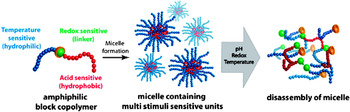
For instance, Klaikherd et al. reported a triple stimuli-sensitive block copolymer assembly which shows response to temperature, pH and redox potential (Fig. 8). Their block copolymer design constitutes an acid-sensitive THP-protected HEMA as the hydrophobic core and a temperature-sensitive PNIPAM as the hydrophilic shell with a redox-sensitive disulfide bond at the interface. The hydrophobic core involves acid-sensitive cleavable cyclic acetal functionality. The transformation of hydrophobic core to hydrophilic PHEMA following the acetal group cleavage results in an imbalance in the hydrophilic/lipophilic ratio disruption of the micelle leading to the release of cargo. The cleavage of disulfide bond, connecting the hydrophobic and hydrophilic blocks, in presence of glutathione causes micelle disruption and the release of the cargo. Their results show that multi stimuli responsiveness gives the opportunity of fine tuning of the release kinetic properties and targeted delivery. Reference Klaikherd, Nagamani and Thayumanavan148
Multi-stimuli sensitive amphiphilic block copolymer assemblies. Reproduced with permission from American Chemical Society. Reference Klaikherd, Nagamani and Thayumanavan148

Dong et al. reported a novel multiple stimuli-responsive polymeric micelle composed of a photoresponsive shell and a temperature/pH responsive core. They prepared light-sensitive pyrene chromophore incorporated temperature/pH sensitive polymer, poly(dimethylaminoethyl methacrylate) (PDMAEMA), via ATRP. PDMAEMA exhibits hydrophilicity below the LCST, while hydrophobicity above the LCST. PDMAEMA chains are hydrophilic at low pH due to protonated tertiary amine groups, whereas PDMAEMA chains are hydrophobic at high pH due to the uncharged tertiary amine groups. The micelles dissociate under UV irradiation and shrink when the temperature is increased above the LCST and swell/dissociate (pH 3) or collapse (pH 10) depending on the pH. They proposed that this system works well for the controlled release applications. Reference Dong, Wang, Zhang, Zhan, Zhu, Yang and Wang149
In recent work, Ma et al. used traditional host-guest interactions to develop a delivery system based on the poly(methyl vinyl ether-alt-maleic acid) [P(MVE-alt-MA)], host polymer bcyclodextrin-grafted P(MVE-alt-MA) [P(MVE-alt-MA)-g-b-CD], and guest polymer azobenzene-grafted P(MVE-alt-MA) [P(MVE-alt-MA)-g-azo]. They obtained multiple stimuli-responsive physical P(MVE-alt-MA)-g-b-CD/P(MVE-alt-MA)-g-azo supramolecular hydrogels through the simple mixing of host and guest polymers. These supramolecular hydrogels exhibited photo-, pH-, and thermo-sensitivity. Ovarian cancer SKOV3 cells can survive within different hydrogel layers, which were observed by confocal microscopy. They suggested these multiple stimuli-responsive P(MVE-alt-MA)-based supramolecular hydrogels as a three-dimensional (3D) cell culture matrix or as a vehicle for the delivery of drugs and therapeutic cells. Reference Ma, Zhou, Zhang, Guo, Hu, Zhu, Ma and Gu150
Polymers can be used in combination with other nanoparticles (such as gold, silica, iron oxide, quantum dots etc.) to create multicomponent/layer gene delivery systems to provide multiple responsiveness. In particular, gold nanoparticles (AuNP) have been used in combination with polymers due to their available surface chemistry for the introduction of cleavable redox responsive disulfide bonds which facilitate nucleic acid release and enhance activity. Reference Lee, Green, Love, Sunshine, Langer and Anderson83,Reference Cheng, Feng, Meng, Deng, Feijen and Zhong151–Reference Varkouhi, Verheul, Schiffelers, Lammers, Storm and Hennink157 Considering this fact, in our recent study, we have used temperature and pH responsive cationic and amphiphilic pentablock copolymers, which consist of the temperature responsive triblock Pluronic F127 sandwiched between the pH responsive PDEAEM [poly(2-diethylaminoethyl methacrylate)] end blocks, for the first time in the development of AuNP based multicomponent siRNA delivery systems (MCSs). We developed a multicomponent system (MCS) by the subsequent deposition of siRNA and pentablock copolymers on the AuNP surface through cleavable disulfide bonds (to enhance siRNA release) and through the electrostatic interactions (to protect siRNA, enhance cellular uptake, endosomal escape, and siRNA activity), respectively. In addition to the temperature and pH responsiveness stemmed from pentablock copolymer, the presence of cleavable disulfide bonds provide the redox response making the whole system multi responsive. Our results indicate that the MCS shows a very good siRNA protection and stability, cellular uptake, endosomal escape, and transfection efficiency without severe toxicity. Reference Uz, Mallapragada and Altinkaya71
E. CRISPR/Cas9-sgRNA gene editing tool delivery
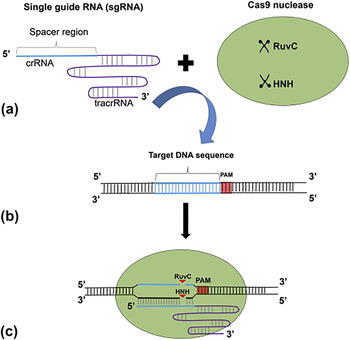
CRISPR/Cas9, a new gene editing technology, was recently developed following the discovery of a new immune system in prokaryotes. Reference Jo, Suresh, Kim and Ramakrishna158 This system was developed by archaea and bacteria as a defense mechanism against viruses and plasmids. In this mechanism, a segment of invading DNA is copied into the host genome at a locus of clustered regularly interspaced short palindromic repeats (CRISPR), which serves as a genomic memory of invading pathogens for future invasions. Reference Jo, Suresh, Kim and Ramakrishna158–Reference Platt, Chen, Zhou, Yim, Swiech, Kempton, Dahlman, Parnas, Eisenhaure, Jovanovic, Graham, Jhunjhunwala, Heidenreich, Xavier, Langer, Anderson, Hacohen, Regev, Feng, Sharp and Zhang161 Therefore, during the upcoming invasions, the specific locus transcribes corresponding CRISPR RNA (crRNA) that is able to recognize and base pare with the foreign DNA. The crRNA coupled with an endogenous CRISPR-associated endonuclease (Cas) causes double strand breaks in the pathogenic DNA, inhibiting integration and replication of the pathogen. Reference LaFountaine, Fathe and Smyth162,Reference Wang, Li, Dang, Liang, Wang, He, Liu, Li, Wu, Xu, Lu and Zhang163 Following this discovery, the novel CRISPR/Cas system has begun to be tested in eukaryotic cells through the optimization of the Cas9 endonuclease to include nuclear localization signals for human cells and synthesis of single guide RNA (sgRNA) to target any 20-bp DNA sequence. Reference Wang, Li, Dang, Liang, Wang, He, Liu, Li, Wu, Xu, Lu and Zhang163 An illustration of the CRISPR/Cas9 system is shown in Fig. 9.
Schematic representation of the CRISPR/Cas9 complex. (a) The CRISPR/Cas9 system with a single guide RNA (sgRNA) and CRISPR-associated protein 9 (Cas9). (b) The target DNA sequence. (c) sgRNA targets the complementary target DNA sequence, and Cas9 nuclease follows to generate a double stranded break at the target site. Reproduced with permission from Elsevier. Reference Jo, Suresh, Kim and Ramakrishna158

The CRISPR/Cas9 system is capable of binding to any interested target DNA sequences via sgRNA to achieve double strand breaks. However, the in vivo delivery of CRISPR/Cas system is limited by its large size (∼4.2 kb), which makes it challenging to load to a carrier vector. Reference LaFountaine, Fathe and Smyth162,Reference Wang, Li, Dang, Liang, Wang, He, Liu, Li, Wu, Xu, Lu and Zhang163 Although it is possible to load CRISPR/Cas9 system to a cationic liposome or PEI based vectors, the limitation in the endothelial gap size of blood vessels prevents the delivery to target tissues for efficient genome editing. A few cases of off-target mutagenesis resulting from CRIPSR/Cas9 in human cells have been reported, raising the concerns regarding the target-specific delivery of CRIPSR/Cas9. Reference LaFountaine, Fathe and Smyth162,Reference Wang, Li, Dang, Liang, Wang, He, Liu, Li, Wu, Xu, Lu and Zhang163 However, this was addressed by sgRNA optimization showing limited to no off-target mutagenesis in vitro and in vivo. Reference Liu and Shui164 Therefore, further research on CRISPR/Cas9 specificity, optimization and delivery strategies will be needed for efficient therapeutic applications.
Various cationic liposome based nonviral delivery vectors have been developed for an efficient CRISPR/Cas9 system delivery, which was discussed elsewhere in detail. Reference LaFountaine, Fathe and Smyth162–Reference Liu and Shui164 As an alternative, cationic polymer based nonviral vectors have also been investigated for CRISPR/Cas9 system delivery. Mostly polyethyleneimine (PEI) based vectors have been tested for CRISPR/Cas9 system delivery so far. The molecular weight, linearity and degree of branching of PEI determines the properties of the designed system such as toxicity, protective effect, endosomal escape through the proposed proton sponge effect. For example, PEI-CRISPR/Cas9-mediated somatic genome disruption was recently used to achieve the in vivo targeting and deletion of tumor suppressor genes in the mouse brain. In addition, various modifications of PEI were developed to improve the transfection efficiency and decrease the cytotoxicity for efficient genome editing. Reference Wang, Li, Dang, Liang, Wang, He, Liu, Li, Wu, Xu, Lu and Zhang163 Unfortunately, there have not been many studies investigating the possible use of stimuli responsive polymers for the CRISPR/Cas9 system delivery yet, which can be addressed as a future direction.
F. Stimuli responsive polymer based gene delivery systems for clinical trials
The clinical application of gene-based therapy for treating cancer has been investigated over the past two decades. However, the presence of various barriers summarized in the previous sections has limited the success of clinical trials, which could be enhanced by the development of better functional carriers. Despite the limitations, viral vectors have been used in approximately 70% of the clinical gene therapy trials so far. Reference Yin, Chen, Zhang and Han165 Nevertheless, nonviral vector based gene therapy has the potential to not only address the current limitations of the viral vectors such as safety, immunogenicity, lower payload, and easy synthesis, but also to allow novel designs with multiple functionalities. These functionalities are possible to achieve by the use of stimuli responsive polymers. Reference Yin, Kanasty, Eltoukhy, Vegas, Dorkin and Anderson2,Reference Yin, Chen, Zhang and Han165 However, there are very few clinical trials involving the use of stimuli responsive polymer based vectors for gene therapy. One example includes PEGylated PLL for DNA delivery minimizing the nonspecific interaction with serum components and increasing blood circulation time. This system went to Phase I clinical trials showing some evidence of gene transfer. Reference Konstan, Davis, Wagener, Hilliard, Stern, Milgram, Kowalczyk, Hyatt, Fink, Gedeon, Oette, Payne, Muhammad, Ziady, Moen and Cooper166 In humans, PEI has been studied for gene therapy of different cancer types in various forms. A PEG–PEI–cholesterol lipopolymer is under clinical investigation for immuno-therapy of ovarian and colorectal cancers through forced expression of the cytokine interleukin-12 (IL-12).
Among various other stimuli responses, the pH and redox potential responsiveness are the most commonly used, along with PEGylation for the clinical trials. Reference Yin, Kanasty, Eltoukhy, Vegas, Dorkin and Anderson2 However, a majority of these clinical trials are for drug delivery. Vicent et al. designed a HPMA copolymer-based conjugate, PHPMA-GPLG-AGM-Dox, where PHPMA is poly[N-(2-hydroxypropyl) methacrylamide], using GPLG tetrapeptide linker (Gly-Phe-Leu-Gly) that can be cleaved by lysosomal thiol-dependency. This redox potential-responsive system went clinical trials. Reference Vicent, Greco, Nicholson, Paul, Griffiths and Duncan167
A PEG-poly(aspartic acid) polymer-based micellar formulation was designed for paclitaxel delivery. The encapsulation of paclitaxel was facilitated through increasing the core hydrophobicity by modifying half of the carboxylate groups of poly(aspartic acid) with 4-phenyl-1-butanol PEGpoly (asp–phe). At physiological pH, the free pendant carboxylate groups, located in the cores of the micelles, are deprotonated providing the stability for the micelles while at acidic pH, they get protonated and accelerate the drug release. The promising results obtained from Phase 1 and 2 clinical trials have led to Phase 3 trial in patients with metastatic breast cancer. Reference Matsumura168–Reference Hamaguchi, Matsumura, Suzuki, Shimizu, Goda, Nakamura, Nakatomi, Yokoyama, Kataoka and Kakizoe170
Various delivery system designs have been using hydrazone linking and some of these designs have been tested clinically. For instance, PEG polyaspartate block copolymer attached with epirubicin via a hydrazone bond was developed to enhance the antitumour activity. The acidic conditions triggered the epirubicin release due to the cleavage of acid labile hydrazone bond. Preclinical studies indicate that 74% of the drug release occurred at the tumor site. The studies resulted in proceeding to clinical trials with patients possessing various cancer types. Reference Takahashi, Yamamoto, Yasunaga, Koga, Kuroda, Takigahira, Harada, Saito, Hayashi, Kato, Kinoshita, Ohkohchi, Hyodo and Matsumura171,Reference Harada, Bobe, Saito, Shibata, Tanaka, Hayashi and Kato172
The use of small RNA delivery for gene-based therapy has been proposed as a promising strategy based on the current in vitro and in vivo investigations; however, small RNA therapeutics and stimuli responsive polymer based systems have not yet been fully tested in clinical trials. Nevertheless, the recent progress in this field along with the development of new vectors encourages the efforts. Reference Yin, Kanasty, Eltoukhy, Vegas, Dorkin and Anderson2 One of these efforts was the development of cyclodextrin polymer (CDP)-based nanoparticles as an siRNA delivery system that enters Phase I clinical trials for cancer treatment. Reference Bartlett and Davis173,Reference Hu-Lieskovan, Heidel, Bartlett, Davis and Triche174
Progress in the use of stimuli responsive polymer-based polynucleotide delivery systems in the clinical trials cannot be underestimated; however, there is still a long way for a successful treatment.
IV. CONCLUSIONS AND FUTURE OUTLOOK
Driving gene therapy to translation and clinical applications is the main target of all gene delivery research. Among the various strategies, polymer based gene delivery systems play a crucial role in this regard. Although the currently existing systems have been addressed to overcome some of the extracellular and intracellular barriers, an ideal system aimed at all the conflicting demands of the gene delivery has not yet been proposed. The delivery systems responding only one stimulus and lacking multifunctionality may not be efficient enough to achieve a significant in vivo therapeutic activity. Therefore, the development of virus-mimicking, multi-functional stimuli-responsive polymer based gene delivery systems have been proposed as an efficient strategy for in vivo applications. Such an ideal polymer based system developed for in vivo applications should possess several functionalities that can be activated at certain stages of gene delivery. The selected materials should be nontoxic, nonimmunogenic, and biodegradable to prevent any side effects or undesired interactions with the body compartments. The formed system is expected to protect the loaded nucleic acids from nuclease enzymes or serum proteins and provide stability during the circulation in the body. This can be achieved by hydrophilic shielding components, such as PEG chains, providing stability and stealth properties during circulation in the blood and reducing possible toxicity while at the same time being able to be removed at a certain site of action as a response to a stimuli to facilitate cellular uptake and endosomal escape. The ligands on the system surface can be used to recognize a specific cell/tissue, and facilitate cellular uptake through receptor-mediated endocytosis. The temporary nucleic acid loading through electrostatic interaction, covalent conjugation, or physical encapsulation is expected in the inner part of the delivery system to provide protection against premature release and enzymatic degradation. Besides the nucleic acids, it is also applicable to incorporate other drugs or imaging probes into delivery system structure to enhance therapeutic efficacy and theranostic features. The stable inner part should be able to disassemble at the desired site of action (nucleus or cytoplasm) upon an internal or external stimuli such as redox potential, temperature change or pH change, to enable efficient nucleic acid release. siRNA functions in the cytoplasm while pDNA has to enter the nucleus for effective gene expression. Therefore, the structure/functionalities of the developed system can vary depending on the type of nucleic acid, drug or imaging probe. In addition, it is preferred that the inner part contains pH responsive endosomolytic components or linkers that help the endosomal escape. It is possible to achieve the mentioned properties using stimuli responsive (pH and reduction potential, or temperature) polymers, however, it is still far off to gather all of these properties in one unique and universal system.
As overviewed in this article, various stimuli-responsive strategies have been used to develop nonviral nucleic acid carriers that efficiently overcome multiple extracellular and intracellular barriers by altering their physico-chemical properties in response to a variety of extracellular and intracellular stimuli. Multifunctional nanotheranostics based on responsive polymers integrating both imaging probes and nucleic acids have also been developed for disease diagnosis and targeted gene delivery. Currently developed systems were shown to be able to protect the loaded nucleic acids from external effects like nuclease degradation. However, nucleic acids electrostatically complexed with polymers are faced with difficulties in efficient release at target sites due to strong electrostatic interactions and toxicity problems caused by excess cationic charge. This situation was partly resolved by the attachment of nucleic acid to the polymer based system through cleavable bonds responsive to redox potential. The cleavable disulfide bonds reduced by the higher glutathione concentrations in cytoplasm are commonly used to facilitate the cytoplasmic siRNA release and reduce toxicity. However, the same strategy cannot work for pDNA since it needs to penetrate and release in the nucleus to show activity. Although this makes the cleavable bond strategy specific to the type of nucleic acid and non-universal, it still helps to decrease the toxic effect of the cationic complexes. In addition, the use of cleavable bonds may cause premature dissociation and release during the blood circulation which ends up with the nucleic acid degradation.
Most of the proposed systems in the literature involve hydrophilic moieties, such as PEG, to increase the stability and stealth properties. Although these components enhance stability and blood circulation times, their hydrophilic nature inhibits the cellular uptake. This situation was eliminated by using some ligands or receptors to provide both cell targeting and enhanced cellular uptake. As a better alternative, amphiphilic temperature or pH-responsive polymers with micellization properties were used in combination with ligands or receptors to provide both stability and stealth properties accompanied with efficient cellular uptake. The current studies also strongly addressed the problem of endosomal escape by using pH-responsive polymers or linkers. The problem with pH-responsive linkers is their specificity to the used chemistry and possible risk of premature dissociation. The pH-responsive polymers provide endosomal escape through proton sponge effect, which was argued that not all the polymers with buffering capacity are applicable. Also, the cationic nature of these pH-responsive polymers involve possible toxicity issues. Beyond these problems, the gene therapy mainly suffers from the lack of safe and efficient delivery systems for therapeutic nucleic acids in the stage of clinical trials. The potential toxicity and systemic clearance of developed systems have not been fully understood. Other than the acute toxicity and inflammatory response, the long-term pharmacological and toxicological effects of the developed systems and materials should be evaluated as well. Therefore, better characterization tools and in vivo animal models should be addressed for major safety evaluations before translation to clinical stage. In addition, the unmodified nucleic acids causing off-targeting effect and possible triggering of the innate immune system should also be considered before clinical application. Although chemical modifications may avoid off-targeting effects and reduce immunostimulatory activity, the global gene expression and immune response are still significantly influenced by the used material. Therefore, polymeric materials used in the development of multifunctional gene delivery systems have to be biocompatible, biodegradable and nonimmunogenic. Moreover, the major relationships between the material’s physicochemical properties and its cytotoxicity, cellular internalization, and intracellular trafficking can be reevaluated.
The complex process of nucleic acid delivery makes it difficult to clearly identify all the factors affecting successful gene therapy. Despite the significant advances in the design and generation of novel stimuli-responsive materials, there is a continuous need to do the basic research addressing the structural effects of responsive polymers, such as molecular weight, polydispersity, charge density, hydrophilicity/hydrophobicity, functionality and so forth, on the nucleic acid condensation capability, stability, physicochemical properties, and cellular interactions of the formed delivery systems. These properties of polymers can be controlled by applying novel synthetic methodologies such as controlled radical polymerization, click chemistry, or combination of various methodologies, to achieve well-defined structures. In particular, the optimization of controlled polymerization techniques allows for the synthesis of novel copolymers with well-defined architectures, reproducible molecular weights, low polydispersities, and end-group functionality. In addition, the straightforward conjugation chemistries allow the facile incorporation of responsive groups (or attachment of drugs) into polymer structures. The combination of controlled polymerization and conjugation methods enables the development of well-defined and tunable structures through copolymer self-assembly. Therefore, advances in stimuli-responsive copolymer assemblies obtained by polymer synthesis and macromolecular design strategies will be the solution to developing an ideal delivery system.
ACKNOWLEDGMENTS
We would like to thank the US Army Medical Research and Materiel Command (Grant number W81XWH-10-1-0806) and the Stanley Endowed Chair in Interdisciplinary Engineering for supporting the work.