Disasters occur frequently, affecting a large number of people worldwide by disrupting urban operations, transportation links, and the safety of people and their property. Reference Fisher, Hagon and Lattimer1,2 According to the 2018 World Disasters Report, from 2008 to 2017, a total of 2 billion individuals were affected by disasters that caused 718,302 deaths; 5 countries, including China, were the most frequently hit by disasters. Reference Fisher, Hagon and Lattimer1 In 2017, a total of 140 million Chinese residents were affected by natural disasters, with direct economic losses of approximately RMB 302 billion (1 RMB ≈ 0.146 US dollars). 2 Earthquakes, typhoons, and floods are 3 of the most frequent natural disasters in China. Reference Huang, Yang and Zhao3 Shenzhen is close to the Pacific Ocean; due to the influence of subtropical anticyclones, Reference Wu, Wang and Nan4 the city is frequently affected by typhoons and rainstorms in summer and autumn, which caused extensive damage and enormous economic losses. 5–8 Other disasters such as large fires, explosions, transportation accidents, and infectious diseases also may occur in Shenzhen, which can be deadly, far-reaching, and cause panic. Reference Huang, Yang and Zhao3
Disasters have a disproportionately negative impact on individuals with physical disabilities or poor health. Reference Kessler9,Reference Mokdad, Mensah and Posner10 People with chronic disease who required continuous health care or had affected self-care ability are particularly vulnerable when disasters occur because of difficulty in receiving alerts or notifications, loss of elevator access and transportation, Reference Murakami, Siktel and Lucido11 and the difficulty or inability to take appropriate action. Reference Tomio, Sato and Mizumura12,Reference Bethel, Foreman and Burke13 During disasters, people with chronic disease may lose their medical records, delaying treatment regimens due to repeated diagnostic testing. Reference Arrieta, Foreman and Crook14 Moreover, people with chronic disease may have their conditions worsened by disasters, such as loss of access to essential medication, lack of continuous or specialized medical care, exposure to extreme heat or cold, and lack of potable water and food. Reference Murakami, Siktel and Lucido11,Reference Woersching and Snyder15,Reference Hung, Lam and Chan16 Thus, individuals with chronic disease are at an increased risk of adverse health outcomes resulting from disasters. Reference Tomio and Sato17–Reference Yin, Chen and Wang21
To develop strategies to enhance the disaster preparedness of residents, and particularly vulnerable groups, it is essential to obtain a better understanding of the disaster perception and preparedness of residents. Some surveys in other countries reported the disaster preparedness among vulnerable populations including the elderly and people with chronic disease or disability. Reference Murakami, Siktel and Lucido11–Reference Bethel, Foreman and Burke13,Reference Eisenman, Zhou and Ong22–Reference Adams, Eisenman and Glik26 However, the current literature on how the vulnerable populations prepared for a disaster is limited in China; the studies of disaster preparedness at the individual level mostly focused on students, health professionals, and residents. Reference Cheng, Liu and Kang27–Reference Chan, Yue and Lee35 This study examined the disaster perception and preparedness of residents in Shenzhen, China. Specifically, the objectives were to measure the awareness of residents with and without chronic disease on the types of disasters that might occur in Shenzhen, the sources of information considered useful in preparing for disasters, and how individuals and families prepare to deal with disasters.
Methods
Study Design and Setting
This study was part of a large community survey on the general health and lifestyle of the residents in Shenzhen, China. This study specifically focused on the part of the disaster perception and preparedness of the residents.
Study Population and Recruitment Procedures
Residents who visited 1 of the 24 community health service centers (CHSC) affiliated with Huazhong University of Science and Technology Union Shenzhen Hospital (HUSTUSH) for a periodic wellness visit or a consultation for chronic diseases or a mild acute medical condition were targeted for participation. The inclusion criteria were: (1) aged ≥ 18 y; (2) able to communicate in Chinese; (3) currently residing in Shenzhen. The exclusion criteria were: (1) those lived in Shenzhen for < 1 y; (2) psychologically or physically unable to answer the questionnaire with the help of the research assistants; (3) unable to provide informed consent.
Sampling and Data Collection
Nanshan district, 1 of the districts in Shenzhen, had a population (aged ≥ 18 y) of 1,356,307 at the end of 2016. 36 Assuming the expected prevalence of all chronic diseases was 30%, and considering a 5% type I error, 2800 participants were needed to achieve 80% power for this study. A stratified sampling method was used to recruit participants. First, the number of needed participants in each age group (ages 18-24, 25-34, 35-44, 45-54, 55-64, and 65+ y) was determined by referring to the distribution of age and gender in the Nanshan population. Of the participants who visited a CHSC, approximately 0.4% of the visitors aged ≥ 18 y in the CHSCs were recruited in this study.
A total of 9 part-time research assistants were trained by the chief project investigator; they invited all the subjects (≥18 y) who visited the CHSCs to join the study between February to December 2018. Screening was performed according to the inclusion and exclusion criteria. The research assistants explained the program to all participants and obtained their informed consent before administering the questionnaire. All questionnaires were collected before the participants left the CHSC. If necessary, the research assistants helped complete the questionnaire in a face-to-face interview, for instance, participants with poor eyesight or low education level, who can answer the questionnaire with the help of the research assistants.
Questionnaire
The questionnaire was developed based on the questionnaire used in the Hong Kong studies on disaster preparedness. Reference Fung and Loke37,Reference Loke, Lai and Fung38 After discussion by the research team, a few items were reworded with terminology to suit the context: the research group added 2 options (pets, certificate or diploma) in the “essential items you would choose during evacuation,” and merged radio and television into public media in “sources of information considered useful in preparing for a disaster.” There were 74 measurable items in the questionnaire. The questionnaire was validated by a panel of 4 nurses with expertise in disaster education (2) and public health (2): 1 was a member of the Asia Pacific Emergency and Disaster Nursing Network, another was the leader of a disaster research theme in the School leading disaster-related research, another 2 were professors of public health in the school. Their feedback on the relevance of the items was collected using a scale of 1-5 (1-absolutely irrelevant; 5-very relevant), and if 2 or more panelists rated the relevance of a statement ≤ 3, the item would be removed. After this step, 69 items remained, with a high content validity of 0.93.
The questionnaire consisted of 2 parts. Part 1 was to collect the demographic data of participants. Participants were also asked if they have any chronic disease, and to indicate the chronic diseases they may have from a list of chronic diseases (including hypertension, diabetes mellitus, chronic obstructive pulmonary disease, hepatitis, heart disease, asthma, stroke, cancer, migraine) provided in the questionnaire that required health service follow-up or limited self-care ability. The participants were also to indicate if they have any other chronic disease in an open-ended question that was not included in the list. Part 2, item 1: asked about the types of disasters that the participants thought were likely to happen in Shenzhen, using a linear numeric response format (absolutely impossible to very possible). For data analysis, those who indicated “possible” and “very possible” were grouped into the category of those who considered the disaster likely to happen, while those who responded “not possible,” “not very possible,” and “absolutely impossible” were categorized as considering the disaster unlikely to happen. Reference Fung and Loke37 Part 2, item 2: asked the participants about whether they had prepared for disasters, 39 including questions about what necessities and items for survival they had stocked at home, as recommended in the emergency survival checklist by the American Red Cross and United States Department of Homeland Security. 40 Participants who prepared more than half of the survival items for disasters at home (≥5 out of 8 items) were categorized as “prepared with survival items,” and those family members who prepared more than half of the disaster and evacuation items (≥5 out of 8 items) were categorized as “family members prepared for disaster.” These 2 categories were grouped as “prepared for disaster.” Reference Loke, Lai and Fung38 Part 2, item 3: essential items to take along in an evacuation. Part 2, items 4-7: the sources of information related to disasters.
Ethical Considerations
This study was approved by the HUSTUSH and the Human Research Committee of Hong Kong Polytechnic University (HSEARS20180521004). The research assistants obtained informed consent of the participants before administering the questionnaire. All participants volunteered for the survey and were provided with a telephone number to call if they had any questions or concerns about the project. The questionnaires were anonymously completed, and it was made clear that a refusal to participate in the study would not affect the services at the CHSC. The data were stored in a confidential folder by the principal investigator, and only researchers involved in the project were permitted to access the data for research purposes.
Data Analysis
All data were analyzed by SPSS version 25.0. Descriptive statistics were generated for the demographic variables. Chi-squared test was used to compare the perceptions of disaster, sources of information, and preparedness between individuals with and without chronic disease. Chi-squared test was also used to compare the demographic characteristics of those who were considered prepared and unprepared for disasters.
Multivariate logistic regression analyses, adjusted for all potential confounding factors, were used to identify the factors associated with “prepared for disasters” (participants who prepared more than half of the survival items for disasters at home (≥5 out of 8 items) and those family members who prepared more than half of the disaster and evacuation items (≥5 out of 8 items), and adjusted odds ratios (ORs) with 95% confidence intervals (CIs) for each variable in the final model were reported. A P value <0.05 was considered statistically significant. The dependent variable “prepared for disaster” served as the reference category. Independent Variables that were associated with “prepared for disaster” at P ≤ 0.25 in the univariate analysis were retained in the multivariate logistic regression model. Reference Bursac, Gauss and Williams41 A study in the United States observed that marital status was related to disaster preparedness Reference McCormick, Pevear and Xie42 ; thus, marital status was included in the model. Independent variables included gender, age, marital status, educational level, job status, monthly income, years residing in Shenzhen, and chronic disease. The group with the lowest risk of “prepared for disaster” was chosen as reference categories.
Results
Demographic Characteristics of the Participants
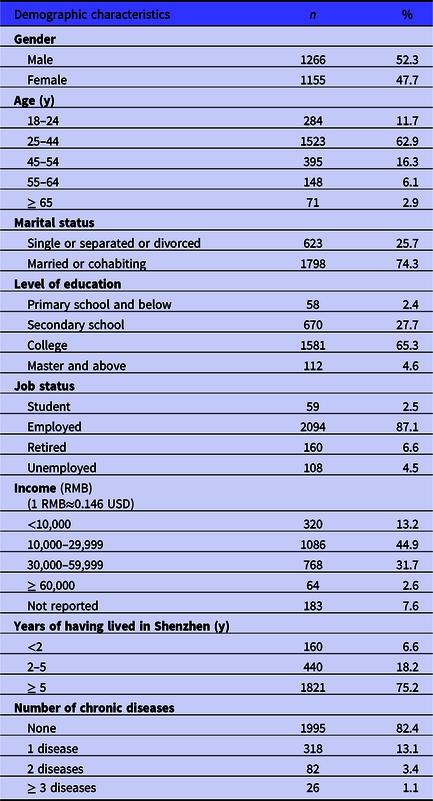
The research assistants invited 8373 eligible subjects to participate in the survey, and 2905 subjects completed the questionnaires. A total of 484 questionnaires with more than 10% missing data were excluded. Reference Steyerberg43 Finally, 2421 questionnaires were included for statistical analysis, comprising males (52.3%) and females (47.2%). Most of the participants were aged 18 -54 y (90.9%) and married or cohabiting (74.3%). More than two-thirds (69.8%) had a college education or above and had lived in Shenzhen ≥ 5 y (75.2%). Nearly half had an average family income ranging from RMB 10,000 to 29,999. Of the participants, 82.4% reported having no chronic disease, while 13.2%, 3.4%, and 1.1% reported that they had 1, 2, and ≥ 3 kinds of chronic diseases, respectively (Table 1). A total of 23 participants reported other chronic illnesses not in the list (including rheumatoid arthritis, ankylosing spondylitis, systemic lupus erythematosus, myasthenia gravis, psoriasis) by the open-ended question.
Demographic characteristics of the participants (n = 2421)

Perceptions of Participants on Disaster-Related Concerns
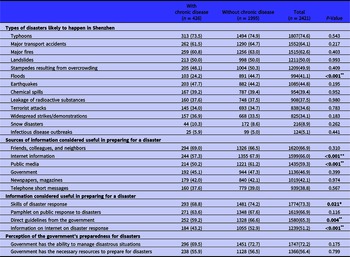
Comparisons between participants with chronic disease (≥ 1) and those without, the 3 types of disasters that participants considered most likely to happen in Shenzhen were typhoons (73.5% vs 74.9%), major transport accidents (61.5% vs 64.7%), major fires (60.8%vs 63.0%), with no statistically significant differences (Table 2). However, the groups without chronic disease considered the disaster of flooding significantly more likely to happen in Shenzhen (44.7% vs 24.2%; P < 0.001).
Perceptions of participants on disaster-related concerns (n = 2421)

Note: Data are expressed as n (%).
* P < 0.05.
** P < 0.01.
Regarding the sources of information, the 3 most common channels of information considered useful in preparing for disasters between the 2 groups were people (friends, colleagues, and neighbors) (69.0% vs 66.5%, P = 0.310), Internet (57.3% vs 67.9%; P < 0.001), and public media (50.2% vs 61.2%, P < 0.001). In this category, individuals without chronic disease had higher proportions in the “skills of disaster response” than those with (74.2% vs 68.8%; P = 0.021), “direct guidelines from the government” (66.6% vs 59.2%; P = 0.004), and “information on Internet on disaster response” (52.9% vs 43.2%; P < 0.001) (Table 2). Respondents aged 18-45 y were more likely to choose the internet as their source of information, while respondents aged 45 y or older preferred to get information from friends, colleagues, and neighbors (Supplementary Material Table S2).
At-Home Preparedness of Participants for Disasters
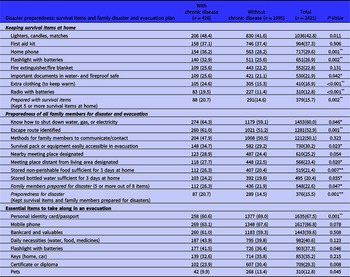
As shown in Table 3, individuals with chronic disease were more likely to keep at least 5 survival items at home than those without (20.7% vs 14.6%; P = 0.002).
At-home preparation and preparation of family members for disasters: comparison between those with and without chronic disease (n = 2421)

* P < 0.05.
** P < 0.01.
For the items of “preparedness of all family members for disaster and evacuation,” higher proportions of participants with chronic disease than those without had prepared family members by ensuring that they knew “how to shut down water, gas, or electricity at home,” identified “escape routes,” kept a “survival pack easily accessible,” and had “a designated meeting place distant from their living area” (P = 0.001-0.046). Less than a third of participants had survival packs or equipment that were easily accessible in case of evacuation, or had designated a nearby or distant meeting place. Among the participants with and without chronic disease, a minority had stockpiled enough nonperishable food (26.3% vs 20.4%; P = 0.007) and bottled water (24.2% vs 19.6%; P = 0.035) for at least 3 d. For the disaster preparedness of all family members, those with chronic disease were better prepared, compared with those without (26.3% vs 21.9%; P = 0.047). Among the participants with and without chronic disease, only a small percentage were classified as “prepared for disasters” (20.7% vs 14.5%; P = 0.001).
For the essential items that participants would take along with them during an evacuation, most participants, both those with and without chronic disease, would take their personal identity card or passport (60.6% vs 69.0%; P = 0.001), mobile phone (63.1% vs 67.6%; P = 0.078), and bankbook and valuables (61.0% vs 59.3%; P = 0.508).
Comparison of the Characteristics of Participants Prepared and Unprepared for Disasters
People ≥ 65 y were significantly more prepared than the group of aged 18-64 y (29.6% vs 14.9%; P = 0.001). Likewise, retirees were significantly more prepared than students, employed, and unemployed (P < 0.001). Those with chronic disease were better prepared than those without (20.4% vs 14.6%; P = 0.003). Participants with 1 or 2 chronic diseases were more prepared than those without; however, there was no significant difference among participants with 1, 2, or ≥3 chronic disease (Supplementary Material Table S1).
Multivariate Logistic Regression Analyses
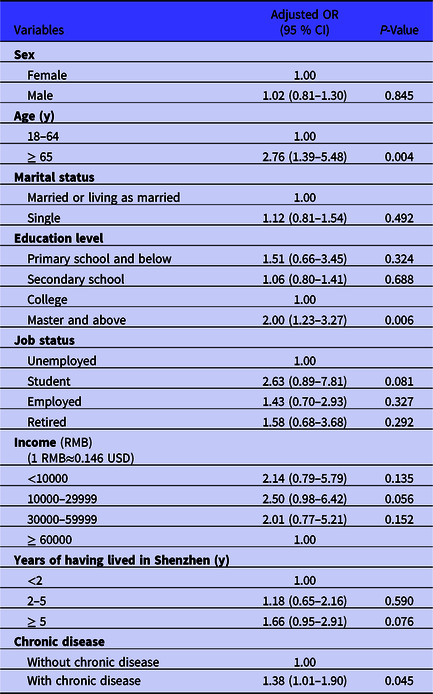
As shown in Table 4, people aged ≥65 y, respondents who obtained a Master’s degree or above, and individuals with chronic disease were more likely to be prepared for disasters than younger people (OR = 2.76; 95% CI 1.39-5.48), those with a college degree (OR = 2.00; 95% CI 1.23-3.27), and those without chronic disease (OR = 1.38; 95% CI 1.01-1.90).
Multivariate logistic regression analyses for people who were prepared for a disaster (n= 2421)

Limitations
Several limitations of this study should be noted. First, there was potential sampling bias because of the participants sampled from the 24 CHSCs of Nanshan District, and the results may not be generalized to the Shenzhen residents, although the participants reflect the population of Shenzhen in gender, age, marriage, income, and self-reported chronic disease. Second, the possibility of bias associated with self-reported data may have made some misclassification of chronic disease status and disaster preparedness levels. Third, this study treated people with different chronic diseases as the same group, but the management methods for people with different chronic diseases (eg, individuals with diabetes, cancer, or end-stage renal disease on dialysis) might differ after the disaster. People with special diseases have different needs when dealing with disasters, such as individuals with end-stage renal disease on dialysis need specially prepared potassium-lowering drugs and peritoneal dialysate. Last, as the findings were based on a cross-sectional design, the causal relationship between the characteristics of participants and their preparedness could not be confirmed.
Discussion
The sample size was around 0.022% of the adult population in Shenzhen. 44 The following demographic characteristics were similar to the total population of Shenzhen, suggesting the sample was representative of the population in Shenzhen: gender, the percentage of younger (18-64 y) and older (≥65 y), the percentage of employed, marriage, and family income. 44–46 The percentage of self-reported chronic disease is similar to a large study in Shenzhen. Reference Xu, Lei and Liu47 The percentage of those with a college degree is significantly higher than those in the total Shenzhen population. 48 However, this study revealed that there was no significant difference in disaster preparedness between those with a college degree and a lower education level.
Most participants were aware of disasters that are likely to affect them in Shenzhen, including typhoons, major transportation accidents, and fires. This result was partially consistent with the findings of another study that enrolled elderly people (≥60 y) who had installed an emergency call service in Hong Kong and contacted by a telephone interview Reference Loke, Lai and Fung38 ; most participants considered that major traffic accidents and major fires, but not typhoons, would be likely to happen in Hong Kong. Another 2 studies focus on the disaster perception of families with children under the age of 15 and registered nurses in Hong Kong. These studies revealed that participants considered infectious disease outbreaks as one of the most likely disasters Reference Fung and Loke37,Reference Fung, Lai and Loke49 ; however, only 5-5.9% of the participants perceived an infectious disease outbreak as likely to happen in Shenzhen. These studies in Hong Kong were conducted between 2008 and 2010, and the vivid memory of the severe acute respiratory syndrome (SARS) outbreak could have affected their disaster perception. The participants were parents with small children and nurses, who tended to pay more attention to infectious diseases. This study was conducted in 2018, 15 y after the SARS outbreak, and most subjects did not live in the province most affected by it. Therefore, the dim memory about SARS might not have affected the perception of the participants.
The types of disasters that participants with and without chronic disease considered most likely to happen in Shenzhen were not statistically significantly different, except for flooding. Shenzhen is a coastal city, and flood disasters occur frequently, there were rainstorms in approximately 1 quarter of the days of summer and autumn. The possible reason for the differences was that the proportion of employed people in those without chronic disease was much higher than those with, and employed people need daily commuting; they are more sensitive to weather and climate situations.
The top 3 sources of information on disaster preparedness were people (friends, colleagues, and neighbors), the Internet, and public media. Reflecting the characteristics of interpersonal communication and kinship in China, Reference Yang50 the largest proportion of the participants indicated that they would rely on information from friends, colleagues, and neighbors in the event of a disaster. With the rapid development of the Internet industry (Internet penetration rate was 59.6% as of December 2018), 51 a considerable proportion of participants also preferred to get disaster information from the Internet. Participants with chronic disease preferred to get information from friends, colleagues, and neighbors, while those without chronic disease were more likely to choose the Internet. Further analysis indicated that more than half of the participants with chronic disease were aged ≥45 y (58.2%) and most participants without were aged 18-44 y (81.7%). Similarly, participants aged ≥45 y preferred to get information from friends, colleagues, and neighbors, whereas participants aged 18-44 y were more likely to choose the Internet. The results differed from the 2 studies conducted in Hong Kong, which found that both the younger (aged 18-44 y) and older groups (aged ≥ 60 y) relied on the public media (television or radio) to provide them with information on a disaster. Reference Fung and Loke37,Reference Loke, Lai and Fung38 These findings suggested that the government should make use of Internet or public media to release disaster information to the public.
In this study, half of the participants considered direct guidelines from the government to be useful sources of information. The majority of participants also believed that the government has the ability to manage disastrous situations and has the necessary resources to prepare for disasters. These findings suggested that public education should be delivered from credible sources, such as government agencies, with a high degree of visibility in the community.
Perhaps the residents considered Shenzhen was a relatively safe place and no need to prepare for disaster like Hong Kong residents did. Reference Fung and Loke37 The results indicated that the majority of participants were unprepared for disasters, with only 15.5% of participants prepared for disasters. This result agreed with the findings of several studies that revealed that only a minority of residents were well prepared for disaster. Reference Li, Hao and Wu31,Reference Chen, Xu and Dai33 Even some health-care professionals (eg, medical students, nurses) did not have enough knowledge related to disaster preparedness and were inadequately prepared for disasters in China. Reference Cheng, Liu and Kang27–Reference Xu, Sheng and Li29 This study revealed that communities or countries should increase the awareness of their citizens to the importance of disaster preparedness. As disasters are becoming more frequent globally, public health professionals should be aware of the possibility of these disasters, recognize their role in promoting disaster awareness and preparedness, and be equipped with the competency to provide information to the public on how to prepare for disasters. Reference Jakeway, LaRosa and Cary52 For example, regular training on disaster preparedness should be staged to help the public gain the knowledge and skills of disaster preparedness; pamphlets should be circulated to provide information on how to respond to disasters, with stated guidelines for the public to follow; and public health professionals should work with government officials to ensure the infrastructure needed for a response is in place.
The results indicated that participants with chronic disease were more likely to be prepared for disasters. In contrast, most studies provided evidence that those in poorer health were less likely to prepared for a disaster or to have adequate supplies at home. Reference Tomio, Sato and Mizumura12,Reference Bethel, Foreman and Burke13,Reference Eisenman, Zhou and Ong22 However, the finding in this study agrees with a survey conducted at a public health center among older adults in Korea, in which respondents with poorer health or multiple chronic diseases were more likely to have a complete set of disaster preparedness supplies. Reference Kang23 Further studies are needed to explore the relationship between residents with chronic disease and disaster preparedness in other region of China.
In contrast to findings from a telephone interview with the elderly conducted in Hong Kong and a part of the Health and Retirement Study conducted by the University of Michigan, Reference Al-Rousan, Rubenstein and Wallace24,Reference Loke, Lai and Fung38 this study showed that those aged ≥65 y were more likely to be prepared for disaster. The opposite finding may be related to the living status of the elderly in China, as many of the elderly aid with child care Reference Huang, li and He53,Reference Nie54 and their children may ensure that they have the appropriate emergency supplies. A study from Korea reported that participants aged ≥65 y were more likely to be prepared for disaster, including having an emergency evacuation plan and a 3-d supply of prescription medication. Reference Kang23
Participants with a Master’s degree and above education levels were more likely to be prepared for disaster, consistent with the finding from an online survey on factors affecting home-based disaster preparedness among school-aged children’s parents, which revealed that parents with graduate school education degrees had higher disaster preparedness scores. Reference Jung, Kim and Choi55 This survey did not show any association between marital status and disaster preparedness, contrary to the study carried by McCormick et al. which reported a significant correlation between marital status and disaster preparedness. Reference McCormick, Pevear and Xie42 The reason for this difference is unknown, and further studies are needed to explore this relationship.
Conclusions
Although participants with chronic disease were better prepared than those without, the overall preparedness of Shenzhen residents was inadequate. The majority of families did not have a disaster plan and did not possess basic disaster preparedness supplies, resulting in vulnerable groups if a disaster occurs. To reduce the overall adverse impacts from future disasters, government officials, agencies, public health professionals, and community organizations should strive to educate the public to improve the overall disaster preparedness. Particular attention should be paid to the specific groups who were less prepared for disaster: younger people, residents with college degree and below, and those without chronic disease. The government should make use of the Internet or public media to release disaster information to the public.
Supplementary Material
To view supplementary material for this article, please visit https://doi.org/10.1017/dmp.2021.354.
Acknowledgments
The authors gratefully acknowledge the support received from the research team of the School of Nursing, the Hong Kong Polytechnic University, and from the research assistants in the collecting of data and interviewing of participants. The authors thank AiMi Academic Services (www.aimieditor.com) for English language editing services.
Author Contributions
YJ.Q. and JH.L. contributed equally to this study. The specific contributions are described as follows: conceptualization, YJ.X., AY.L., and BR.M.; methodology, YJ.X., AY.L., and BR.M.; validation, YJ.X. and AY.L; investigation, YJ.Q., JH.L., YJ.X., and BR.M.; data curation, YJ.Q., JH.L., XL.L., SL.W., and AY.L.; writing-original draft preparation, YJ.Q., JH.L., AY.L.; writing-review and editing, YJ.Q., JH.L., XL.L., AY.L., BR.M.; supervision, AY.L. and BR.M.; project administration, AY.L. and BR.M.; funding acquisition, BR.M. All authors have read and approved the final manuscript and act as guarantors for the study.
Conflict(s) of Interest
None