Introduction
Much research on cross-national differences in intergenerational monetary transfers from parents to their children focuses on the role of welfare regimes, and to distinguish types of welfare regimes, Esping-Andersen's (Reference Esping-Andersen1990) formulations in Three Worlds of Welfare Capitalism are often used. Observed differences in aggregate levels of support provisions have been linked to the type of welfare regimes (Albertini, Kohli and Vogel Reference Albertini, Kohli and Vogel2007). Intergenerational transfers typically flow from parents to their children, a pattern observed in various European countries regardless of the welfare regime (Attias-Donfut, Ogg and Wolff Reference Attias-Donfut, Ogg and Wolff2005; Kohli Reference Kohli1999; Kohli and Albertini Reference Kohli and Albertini2009). Researchers have shown that in southern European countries, transfers are higher but less frequent, whereas in Nordic countries, they are more frequent but of lower value. Continental European countries take a middle position (Albertini, Kohli and Vogel Reference Albertini, Kohli and Vogel2007). Most of the comparative studies of differences in support provision between welfare regimes have examined aggregate data without controlling for compositional differences among countries. The few studies that have controlled for such differences have used parents' characteristics, such as income, health status and level of education, but still found country differences in levels of support (Albertini, Kohli and Vogel Reference Albertini, Kohli and Vogel2007; Attias-Donfut, Ogg and Wolff Reference Attias-Donfut, Ogg and Wolff2005). In these studies, the implicit assumption remains that there is a link between the welfare system and intergenerational transfers. Commonly-employed models control only for country-level differences, and have not tested the underlying assumptions.
This paper seeks to go further and to contribute to the literature in three ways. First, many studies have not acknowledged the importance of looking at both sides of the parent–child dyad. The characteristics of both parents and their children are important in determining why intergenerational monetary support is provided. Although parents decide on whether or not to send money, all their children are potential receivers of support. Intergenerational transfers are influenced by social interactions within the family, so consideration of the characteristics of all the family members that are directly involved, not only the parents', should give a fuller explanation of why children are financially supported, and which factors determine who actually receives the support (Becker Reference Becker1974). Analyses that have considered the attributes of both givers and receivers have included the health status of the head of the household and other household members as controls, and found that poor health decreases the likelihood of support provision, but increased the likelihood of support receipt (McGarry Reference McGarry1999; Schoeni Reference Schoeni1997). Berry's (Reference Berry2008) more comprehensive analysis included relevant non-economic factors, but with data for only the United States of America, and the author did not address the influence of the welfare-state regime.
Second, the clustering of countries into a few types of welfare regimes has limitations, most obviously that the differences in national welfare policies within each cluster are hidden, when in fact the clusters are far from homogeneous; indeed, many countries have idiosyncratic and disjointed welfare policies, and the level of similarity depends on the specific welfare field (Kasza Reference Kasza2002). A widely-used classification of national welfare regimes distinguished socialist (Nordic countries), conservative (continental Europe) and liberal welfare (Anglo-Saxon) states (Esping-Andersen Reference Esping-Andersen1990), but another cluster representing the Southern European countries is required to account for the observed differences in intergenerational transfers in families across Europe (Albertini, Kohli and Vogel Reference Albertini, Kohli and Vogel2007). Moreover, Esping-Andersen (Reference Esping-Andersen1999) proposed separating France and Belgium from the other conservative countries when examining variations in family policies. It is apparent, therefore, that there is no consensus on how to categorise welfare regimes. A recent study of instrumental support between parents and children chose not to cluster countries for this reason (Kalmijn and Saraceno Reference Kalmijn and Saraceno2008). We also refrain from using such clusters.
Third, finding aggregate differences in welfare provision does not explain differences in intergenerational monetary support. An observed difference between countries after controlling for population composition does not irrefutably confirm a welfare-state influence. How welfare policies affect intergenerational transfers should be determined by testing whether individual monetary support is directly influenced by the welfare state. This requires testable hypotheses about how the welfare system influences transfers from parents to their children at the micro-level, and about the likelihood of children in different countries with different welfare-state provisions receiving transfers at all and of specified values (Tesch-Römer and von Kondratowitz Reference Tesch-Römer and von Kondratowitz2006).
We propose a comprehensive theoretical framework that includes the characteristics of both parents and child at the individual and dyadic levels. To test the assumed influence of welfare regimes, we predict how particular adult children in need may be more likely to receive support depending on welfare-state differences. We started from the premise that intergenerational monetary transfers are dependent on parental resources, and that monetary support is provided if the child has needs. We furthermore incorporated the notion of future reciprocity, which is assumed to increase the likelihood of receiving support. Alternative expenditure, or circumstances in the parents' lives that also require spending, on the other hand were assumed to decrease the likelihood of support receipt. The unit of analysis is the parents–child dyad. We assumed that transfer decisions are made by the parental couple (when parents are still together), not by individual parents. We also assumed that specific welfare policies affect the degree to which parental resources are used or, in other words, how parents respond to the needs of their children. The research questions that we have addressed are:
1. What factors determine whether parents provide monetary support to their children, and to what extent do the characteristics of their children influence this decision?
2. To what extent do differences between countries remain after taking the individual-level differences into account?
3. Do differences in the generosity of welfare provisions influence monetary support from parents to children?
The model
Needs
In the economics literature, the importance of considering the attributes of both parents and children in monetary transfers is emphasised in social interaction theory (Becker Reference Becker1974). It assumes that parents are altruistic and therefore concerned with the material or economic wellbeing of their children. That concern motivates them to redistribute some of their income or assets to their children in need of economic support. Analyses have shown that economically worse-off children are more likely to receive support from their parents, which supports the notion of an altruistic motive (Altonji, Hayashi and Kotlikoff Reference Altonji, Hayashi and Kotlikoff1997; McGarry Reference McGarry1999). Adult children in relative economic hardship should therefore be more likely to receive monetary support from their parents than those who are less in need of support. We expected that children who are students or unemployed are more likely to receive monetary support from their parents than employed children.
Additionally, we drew upon the evidence that needs differ by lifecourse stage to hypothesise the conditions under which adult children are likely to be in more or less need of monetary support from their parents (Cooney and Uhlenberg Reference Cooney and Uhlenberg1992). As adult children with young children of their own are more in need of support than those without children (Eggebeen and Hogan Reference Eggebeen and Hogan1990), we expected that having a child increases an adult child's likelihood of receiving monetary support. It has also been shown that financial transfers to children living in the same household are less frequent and on average lower than transfers to children living outside the household (Rosenzweig and Wolpin Reference Rosenzweig and Wolpin1993). Household income and assets can benefit all its members, and co-resident adult children generally receive various forms of material support – if not direct money transfers. Co-resident adult children were thus expected to be less likely to receive money transfers from their parents compared to children living outside the household and who do not have access to the material benefits of the parents' household.
Resources
Parents' concerns about their children's material welfare are necessarily modulated by their concerns about their own financial wellbeing (Becker Reference Becker1974). Indeed, differences in parental wealth are to a large extent responsible for variations in the pattern of financial transfers (Albertini, Kohli and Vogel Reference Albertini, Kohli and Vogel2007; Berry Reference Berry2008; McGarry Reference McGarry1999). Wealthy parents have more resources to redistribute, and thus are better able to support their children. We therefore expected that parents with higher income are more likely to provide monetary support to their adult children.
Future reciprocity
If the decision to provide monetary support is entirely explained by altruistic motives, one might expect that the incomes of the parents and the children would be the main determinants, but scholars agree that there are other influences (Cox Reference Cox, Munnell and Sundén2003), which include expectations of future reciprocity (Cox Reference Cox1987; Künemund Reference Künemund and Saraceno2008). Parents may be more inclined to support the child who is most likely to return a favour in the long run. Another factor is that geographical proximity facilitates the exchange of practical or instrumental support and care (De Jong Gierveld and Fokkema Reference De Jong Gierveld and Fokkema1998; Litwak and Kulis Reference Litwak and Kulis1987), and children living nearby have more contact with parents than those living further away (van Gaalen, Dykstra and Flap Reference van Gaalen, Dykstra and Flap2008). Parents will thus expect that if in the future they need support, it is most likely to be provided by the children that live nearby. Moreover, parents will have better information about the needs of proximate children than those who live farther away. Both explanations lead to the hypothesis that children living near to their parents are more likely to receive monetary support from their parents than those living at greater distances.
Providing support to biological children is a more certain investment than support to non-biological children. Reciprocal support exchanges are less apparent with step-children than with own children. In the step-families formed following divorce or separation and remarriage, the future relationship with step-children is uncertain. The likelihood of divorce or separation is greater for ever-divorced individuals compared to never-divorced individuals (Haskey Reference Haskey1996; Kalmijn Reference Kalmijn2007). Moreover, from a biological perspective, people have more interest in investing in the survival of their own genes, so called inclusive fitness (Hamilton Reference Hamilton1964). Consistent with this perspective, it has been shown that step-parents support step-children less than biological parents, and that they support their biological children more (Whyte Reference Whyte1994). Step-parents often have biological children of their own, and when choosing between the two, they prefer to support biological children. We therefore expect that adult children with only biological parents are more likely to receive monetary support than those with a step-parent.
Many women act as kin-keepers within families (Rosenthal Reference Rosenthal1985). In general, they are more active and assiduous than men in contacting other relatives, arranging visits, marking birthdays and so on, and daughters tend to help needy elderly parents with household tasks and personal care more than sons (Cloïn and Hermans Reference Cloïn, Hermans, Portegijs, Hermans and Lalta2006; Dwyer and Coward Reference Dwyer and Coward1991). Given the gender imbalance in support provision, we assume that parents will expect more future support from daughters than sons. This leads to the hypothesis that daughters are more likely to receive monetary support from their parents than sons.
Alternative expenditure
The composition of contemporary families is changing as a consequence of socio-demographic processes that pose particular challenges to intergenerational solidarity. One challenge is the emergence of vertical family structures, with more generations alive at the same time and fewer members of each generation (Harper Reference Harper2006; Saraceno Reference Saraceno2008; Uhlenberg Reference Uhlenberg, Maddox and Lawton1993; Walker Reference Walker1996). In multiple-generation families, the middle generation lies between at least two generations that are potential recipients of support. As noted earlier, comparative research has shown that net support flows from older to younger generations, but the middle generation may still support members of both the preceding and following generations (Grundy and Henretta Reference Grundy and Henretta2006). We expect that because support provision is limited by finite resources, and because more extant generations imply more potential support recipients, when both grandchildren and own parents are alive, this lessens the likelihood that children receive support. The circumstances of the parents may also require alternative or other spending. Parents in bad health may have treatment and care expenses and thus fewer resources to transfer to their children (McGarry Reference McGarry1999; Schoeni Reference Schoeni1997). We expect that when at least one parent has bad health, an adult child is less likely to receive a financial transfer.
Welfare states
Because our theoretical model explicitly focuses on the characteristics of both parents and children, we wished to formulate hypotheses about the influence of the welfare state that refer to both generations. This required close consideration of how the welfare state benefits the old and the young, and how this may influence intergenerational monetary transfers. The classic assumption underlying support provision for the needy is that the welfare state and the family substitute one for the other (Etzoni Reference Etzoni1993; Wolfe Reference Wolfe1989). The ‘crowding-out’ hypothesis posits that in generous welfare states, material support of the needy shifts from the family to the public sphere (Künemund and Rein Reference Künemund and Rein1999). By extension, in countries with generous welfare policies, family members would feel less obliged to support economically-needy relatives, since the state has largely taken over this function that once was the role of the family. Interestingly, however, there is hardly any empirical support for this position. On the contrary, scholars have suggested that generous welfare states enhance the likelihood that older people financially support their children, not least because in countries with generous welfare systems, older people have more resources to redistribute (Künemund Reference Künemund and Saraceno2008; Künemund and Rein Reference Künemund and Rein1999; Motel-Klingebiel, Tesch-Römer and Von Kondratowitz Reference Motel-Klingebiel, Tesch-Römer and Von Kondratowitz2005). This contradiction between presumption and practice may arise from the rather narrow definition of what welfare-state support entails. Research on the crowding-out hypothesis has tended to define welfare-state support as pensions and formal care for frail older people, and has rarely considered state transfers to other age groups. For that reason, we will examine if the patterns of intergenerational money transfers differ by whether the recipient of welfare support is the parent or the child.
From the child's perspective, one would expect that greater welfare support for children decreases their need for support from parents. Other things being equal, children receiving assistance from the state must be less in need of support from family members than those not receiving. Rosenzweig and Wolpin (Reference Rosenzweig and Wolpin1994) showed that children's receipt of welfare provisions associated with decreased monetary support from parents to their children, but the magnitude of the effect was small. We expect that unemployed children in countries with generous unemployment benefits are less in need and therefore less likely to receive monetary support from their parents than children in countries with less generous welfare benefits. Moreover, we hypothesise that adult children with children of their own and that live in countries with generous child-care support are less likely to receive financial transfers from their parents. Support for these hypotheses would be consistent with the crowding-out hypothesis.
From the parents' perspective, we expect that the greater the welfare state's support of their own age group, the more likely they are to support their children. There is evidence that public transfers to older people are partly channelled as monetary support to their children (Kohli Reference Kohli1999; Reil-Held Reference Reil-Held2006). We therefore expect that in countries with generous public pension systems, retired parents are more likely to transfer money to their children than retired parents in countries with less generous public pension systems. This is contrary to the crowding-out hypothesis, since the inference is that a more generous welfare state actually increases support between parents and children.
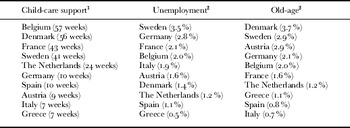
To formulate detailed hypotheses about country differences in welfare generosity, we use national statistics on child-care support for working parents, unemployment benefits and old-age pensions. We focus on these three aspects because of their clear links with a person's financial status. Insofar as country differences exist, we formulate specific hypotheses on how the support received by adult children is expected to vary. Table 1 shows three types of welfare provision in the ten European countries ranked in order of generosity. Child-care support is measured as the number of weeks of remunerated leave available to (working) parents with children aged less than three years in 2003: the data are from Saraceno and Keck (Reference Saraceno and Keck2008). We believe that this measure of the generosity of child-care support is a good indicator of the degree to which governments seek to maintain parents' income when a child is born and to support their continued participation in the labour market. Alternative indicators, such as parental or child allowances, differ markedly by family type and are difficult to standardise (Saraceno and Keck Reference Saraceno and Keck2008). Single-parent families, for example, receive much higher benefits in Sweden than in Austria, whereas this is not the case for two-parent families. Information on expenditure on old-age and unemployment benefits was taken from the Eurostat (2008) database and has been computed as a percentage of gross domestic product (GDP) in 2004.
The ranked generosity of three types of welfare provisions, ten European countries, 2004

Notes: 1. Duration in weeks of the support for children aged less than three years in 2004.
2. Spending on the benefit as a percentage of gross domestic product in 2004.
Sources: Saraceno and Keck (Reference Saraceno and Keck2008) ; Eurostat (2008).
Note in Table 1 that the levels of generosity of the provisions are similar in some countries and very different in others. For instance, The Netherlands, Greece, Italy and Spain have rather similar spending on old-age pensions but much less than in Denmark, Sweden and Austria. The country rank orders for the three types of provisions differ, which underscores the need to distinguish transfers to older and younger age groups. We expect that welfare provisions influence monetary transfers from parents to children, and more specifically that children who are recipients of child-care provisions and unemployment benefits have a lower likelihood of receiving parental support in the most generous welfare states. Likewise, we expect that children whose parents receive a pension have a greater chance of receiving parental support in the most generous welfare states.
In the following tests of the hypotheses, The Netherlands is designated as the reference country. To limit the number of detailed hypotheses, they have been formulated only for the countries at the extremes of the rank orders in Table 1. We expect that adult children in The Netherlands with young children of their own were more likely to receive support from their parents compared to those in Belgium and Denmark, but less likely than those in Italy and Greece. For unemployed adult children, we expect that those in Sweden and Germany were especially unlikely to receive monetary support from their parents. Finally, we expect that adult children of retired parents in Denmark, Sweden and Austria were more likely to receive monetary support than those in The Netherlands.
Methods
Sample
The data are from the first wave (release 2.01) of the Survey of Health, Ageing and Retirement in Europe (SHARE) collected in 2004 (Börsch-Supan and Jürges Reference Börsch-Supan and Jürges2005). This wave compiled a sample of individuals aged 50 or more years in a number of European countries. The sampling design was not the same in all countries; some used samples of individuals and some samples of households. In both cases, however, all household members aged 50 or more years were invited for interview. The data therefore contain information on both parents of the child if they lived in the same household. The average household response rate was 55 per cent. The data for The Netherlands, Belgium, Austria, Germany, France, Sweden, Denmark, Spain, Italy, and Greece were analysed. These countries represent several regions of the continent but not Eastern Europe. Two surveyed countries were not included, Israel and Switzerland, in both cases because of a lack of comparative data on welfare provisions. The number of parents in the analysis sample ranged from 947 in Denmark to 2,006 in Belgium, and the number of children for which there are data is 32,758, and they had 17,050 parents in the sample.
The respondents provided detailed information for up to four of their children. If the primary respondent had more than four children, those aged 18 or more years were selected first. If the respondent had more than four children aged 18 and over, the ones living closest by were selected. In the case of proximity ties, the oldest children were selected, and if there were identical birth years, a random selection was made. Since only four children were selected, the observed number of transfers may be under-estimated in families with more extant children (but this applied to only 4 per cent of the respondents, with a range from 1.3 per cent in Greece to 6.2 per cent in Spain). We selected all children aged 18 or more years.
The measures
The dependent variable was measured from the responses to the question, ‘Not counting any shared housing or shared food, have you [or] [your] [husband/wife/partner] given any financial or material gift or support to any person inside or outside this household amounting to €250 or more (in the local currency)?’ If the parent had provided support to a child, the particular child who received the support was identified, which enabled characteristics of both the child and the parent(s) to be incorporated in the analysis. The needs of the child were measured by labour-force status and life-course stage. Since the data do not have a direct measure of the child's income or ‘ability to make ends meet’, we used labour-force status as an indirect measure of the financial needs of the child. Three dummy variables were created to indicate whether the child was: (a) unemployed, (b) in vocational (re)training, or (c) a homemaker. Part-time or full-time employed children were the reference category. To restrict the number of labour-force categories, we excluded adult children who were already retired and those who were permanently sick or disabled (3% of all children). Analyses not reported showed that including these groups did not affect the results, nor were the dummy variables representing these categories significant. A dummy variable for whether the child lived in the parental household was also created.
The indicator for the parents' resources is whether the household was ‘able to make ends meet’. Although income was collected by SHARE, the number of missing values was high. We decided not to use imputed income because the theoretical model assumes that parents provide monetary support to children only when they have sufficient resources to distribute, so the indicator of whether parents could ‘make ends meet’ is a more appropriate measure than income itself. Two dummy variables measured household resources: one indicates ‘difficulty’ with making ends meet, and the other that ends were met ‘fairly easily’ (the reference category). Parents' employment status was measured by two dummy variables indicating whether: at least one living parent was employed; and that at least one living parent was retired. In the case of a single parent, the reference category is parents who are unemployed, a homemaker or permanently sick or disabled. When both parents were alive, the reference category is that both were unemployed, or a homemaker, or permanently sick or disabled. In cases where both parents were alive and one was employed and the other retired, they were coded into the retired dummy.
The three indicators of future reciprocity were constructed as follows. Distance to the parents was measured by creating a set of dummy variables to indicate whether the child lived within specified distances up to 25 kilometres, or further away. The reference category was living within one kilometre and included living in the same building but not the same household. A dummy variable was created to denote whether one of the child's parents (of either the respondent or his/her partner) was a step-parent. No children in the sample had only step-parents; they all had at least one biological parent. The gender of the child was measured by a dummy variable for female or not.
A number of variables measured the need for alternative expenditures. To represent the generational structure of the family, dummy variables were created for: (a) either parent had a living parent, namely a grandparent of the child, (b) whether the parent(s) had grandchildren other than those belonging to the adult child respondent, and (c) the interaction between the (a) and (b) dummy variables. The health of both parents was measured by the respondents' self-evaluations of their health on a five-point scale. The dummy variable represents situations where one of the parents has indicated that their health was ‘bad’ or ‘very bad’.
A number of control variables for both the parent and the child were used. At the parental level, we included level of education, which was coded using the International Standard Classification of Education (ISCED) (United Nations Educational, Scientific and Cultural Organization 1997). Three levels were distinguished: (a) very little or no education (pre-primary education, primary education or first stage of basic education, and lower secondary or second stage of basic education), (b) intermediate levels of education (secondary education, and post-secondary non-tertiary education), and (c) high level of education (first stage of tertiary education, and second stage of tertiary education). The intermediate level was the reference category. As levels of education of both parents correlated quite strongly (r=0.60), we used the level of the more educated parent. We excluded respondents who were not classified in any of the pre-defined ISCED categories, which amounted to less than 1 per cent of all parents. Excluding these parents did not affect the results. The final control variable at the parental level indicated whether the household sending the transfers had two parents. At the level of the child, we controlled for age, with a variable centred at the mean.
The analyses
The unit of analysis is the parent–child dyad (or, more precisely, assemblage). As indicated before, we assumed that transfer decisions are made by the parental couple (when still together), not by individual parents. By using multilevel logistic models with random effects at the parental level, we accounted for the clustering of children by parents. Since there were insufficient countries to include these as a third level of analysis, The Netherlands was taken as the reference category and dummies for each of the other countries were included. To test the hypothesised influence of welfare-state provisions on individual support, we created terms for the interactions between individuals likely to receive welfare support and the country dummies. When significant, these indicate that children in the given country and in the given situation (has children/unemployed/with pensioned parents) were more or less likely to receive support from their parents compared to their peers in The Netherlands. To support the hypothesis that differences in welfare regimes shape intergenerational transfers at the dyadic level, the interactions would have to be ranked in a similar order to those of welfare generosity as in Table 1. The model thus incorporates random intercepts only at the level of parents. The country hypotheses were tested by using fixed effects, not random effects.
The results
Before detailing the results, it should be noted that the majority of children did not receive financial support from their parents, and that the calibrated model therefore predicts a phenomenon that was comparatively rare. While some of the effects are rather large, it should also be remembered that odds ratios (OR) indicate the relative probability of receiving support given the specified characteristics, not the actual probability. In the following account, both the predicted OR and the predicted actual probability are on occasion reported. As a final clarification, although the model accounts for national differences in the composition of the analysis sample, it does not indicate the nature of the compositional differences. We therefore begin the results section with an overview of the country differences in the dependent variable and in needs, resources and alternative expenditures.
Monetary transfers
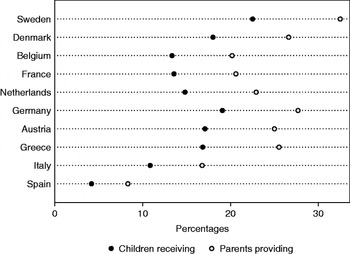
Figure 1 presents for each of the 10 countries the percentage of children who received financial support from their parents, and the percentage of parents who provided monetary support to at least one child. The former percentage is a measure of the proportion of all adult children that received financial support, and the latter a measure of the proportion of all parental couples that provided financial support to any of their children. Children in Spain (4%) were by far the least likely to receive support, and those in Italy (11%) the second least likely – Italy's percentage was closer to that of all the mid-continental European countries (except Germany) than to the figure for Spain. At the other extreme, Sweden clearly stands out as the country with the highest proportion (23%) of children that received support. Among the intermediate cases, in Greece a much higher proportion of children (17%) received support than in the other southern European countries.
Percentages of children receiving monetary support and of parents providing monetary support.

The variations in the percentage of parents that supported their children have a similar pattern. The difference in the percentages that received and gave were greatest in countries where the number of children per family was relatively high, such as Spain and Italy (Figure 1). In these countries in 2004, it appears that parents were more inclined to support only some of their children, whereas in countries such as Sweden with smaller family sizes, a higher proportion of the available children were supported. This difference is itself a case for considering needs and resources in models of the factors that determine which child receives support. These descriptive findings also suggest that clustering countries using welfare regime typologies (as discussed earlier) will miss important facets of the actual variations (or similarities). Consider, for example, the Southern Europe cluster. The differences in the percentages of parents that gave financial support to their children were large (cf. Greece 25%, Italy 18% and Spain 8%). Moreover, the large difference between Greece and Spain, and the small differences between Greece and most of the other countries, justify neither a focus on differences between clusters nor ignoring the differences within clusters. At least with respect to intergenerational transfers, the within-regime differences were as great as the between-regime differences.
Needs
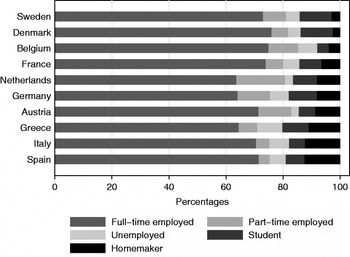
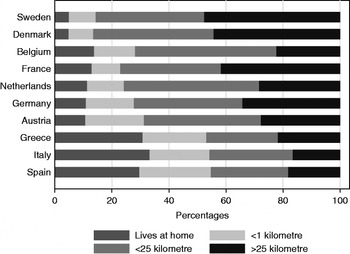
As depicted in Figure 2, the majority of adult children in all countries were employed in 2004. At the extremes were Greece (74%) and Belgium (86%), and there were considerable differences as between full-time and part-time employment. Especially in The Netherlands and to a lesser extent in Austria, many of the adult children were employed part-time. Note that full-time employees and part-time employees were not distinguished in the analyses. Given that to work part-time is often a conscious decision, rather than a response to a shortage of full-time jobs, we assume that all those that were employed had a similar and relatively low level of financial needs. Although there were national differences in the prevalence of the not-employed (or economically inactive) children, the greatest variations were in the constituent categories. For the unemployed, the lowest prevalence (3%) was in Austria, and the greatest (8%) was in Greece. Students varied more, from 2 per cent of the adult children in Belgium to 9 per cent in Sweden and Denmark. The representation of homemakers also had substantial variation, from around 4 per cent in Denmark, Sweden and Belgium, to around 11–12 per cent in Greece, Italy, and Spain. Austria, Germany, The Netherlands and France had intermediate values (around 8%). As Figure 3 shows, almost 30 per cent of adult children lived in their parents' household in Italy, Spain and Greece. At the other extreme were Sweden and Denmark, where only 2 per cent lived in the same household. About 10 per cent of adult children lived with their parents in Belgium, Austria, The Netherlands and Germany.
Employment status of adult children.

Distance of adult children to their parents.

Resources
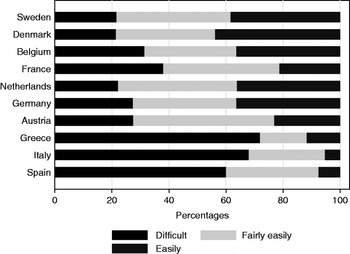
Compared to children's needs, parents' resources showed more variation among the countries. Figure 4 shows substantial differences in the ability of the parents' households to make ends meet. Hardship was most prevalent in Greece, Italy and Spain, as more than 60 per cent of all parents reported ‘difficulty’ with household expenses, and only around 10 per cent ‘easily got by’. By contrast, in The Netherlands, Sweden, and Denmark, only 20 per cent of the parents reported that their households had ‘difficulty getting by’, and around 40 per cent reported that they ‘easily made ends meet’. The parental households in France, Belgium, Germany and Austria were in intermediate positions, with from 23 to 38 per cent having trouble making ends meet.
Ability to make ends meet for household of parents.

Future reciprocity and alternative expenditures
Figure 3 shows substantial national differences in the distances between the parents' and their adult children's homes. In Italy, Spain, and Greece, almost 20 per cent lived within one kilometre, whereas in Sweden and Denmark only 8 per cent were that close and a large majority of children lived a considerable distance from their parents – almost 50 per cent were more than 25 kilometres away. Belgium, France, Austria, The Netherlands and Germany had a similar level of geographical separation, with 10–15 per cent living within one kilometre and the great majority more than one kilometre apart.
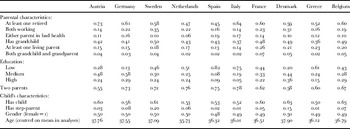
The indicators of alternative expenditures are presented in Table 2. The percentage of parents with other grandchildren varied between 36 per cent in Greece and 37 per cent in Italy to 51 per cent in Denmark. The number of parents with both grandchildren and at least one living parent was low, varying between 2 per cent in Greece, Germany, Spain and Italy, to 7 per cent in France. Having a household member in bad health also varied among the countries, The Netherlands' parent respondents having the lowest (6%), and Italy (17%) and Spain (19%) the highest.
Means of variables measuring alternative expenditures and control variables per country for parents and children in the sample

The explanatory results
The descriptive results have shown substantial differences among the countries, especially in parents' resources and requirements for alternative expenditures, but it has not yet been established if and how these compositional differences account for the observed differences in parent-to-child money transfers. A model that included only the country dummies will be discussed when differences between the countries are examined, but first we present the results of the model of the influence of child's and parents' characteristics on the support received by the child. Later we assess whether the national differences in individual-level transfers can be linked to welfare-state generosity. Since we use multilevel logistic regression models, a single measure of model fit is not available. To indicate the contribution of the included independent variables, we compare the model using only the intercepts for the different countries to the full model. The results indicate that our full model significantly reduced the model's log likelihood (Likelihood ratio χ2 (22 degrees of freedom)=1,694; p<0.001).
Needs
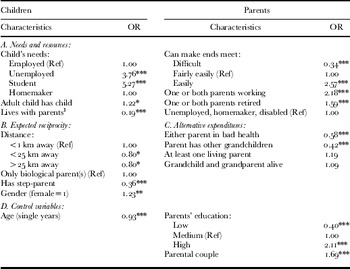
The support received was clearly related to the child's needs (Table 3). With employed children as the reference category, the odds of receiving support were 3.8 times greater if a child was unemployed, and 5.3 greater if the child was a student. Being a homemaker did not increase the odds of receiving financial support. The odds of receiving a financial transfer were five times smaller if a child co-resided with the parents, compared to when he or she lived within one kilometre, all else equal. These results clearly illustrate the strong influence of a child's needs on the likelihood of receiving a transfer. Finally, an adult child with at least one child of their own moderately increased the likelihood that she or he received financial support (OR=1.2).
Odds ratios for financial transfers to children, ten European countries, 2004

Notes: The multilevel logistic regression model included dummy variables for the countries, and their effects are presented in Table 4. Ref: reference category. 1. Living less than one kilometre from the parents. The differences between the other distance categories are also significant and in the same direction. OR: odds ratio.
Significance levels: * p<0.05, ** p<0.01, *** p<0.001.
Resources
The resources of the parent were also important predictors of money transfers. Compared to the parents who reported that their household got by financially fairly easily, having a parent that reported that they got by easily increased the odds of a child receiving monetary support by 2.6, but if the parent said the household had difficulty, the odds were 3.3 times smaller. This clearly shows that, holding all other variables constant, the odds of a child receiving a transfer were highly dependent on how readily the parental household could make ends meet. The employment or economic-activity status of the parents was also influential, even after taking the household's ability to make ends meet into account. Compared to the reference case of one or both parents not working, if both parents were employed the odds of receiving a transfer were 2.2 times higher. If either parent was retired, the odds of receiving a transfer were 1.6 times higher. Although the evidence about the resources available to the parents is indirect, these findings indicate that children were more likely to receive financial transfers when their parents were in economically stable situations such as employment or retirement.
Future reciprocity
For those not living in the parents' home, the odds of receiving a financial transfer were 1.3 times lower if they lived more than one kilometre away from their parents. Adult children with a step-parent were considerably less likely to have received financial support than those without step-parents. Their odds of receiving a transfer were 2.5 times lower compared to those with only one or both biological parents. The results also show that daughters were somewhat more likely to receive support compared to sons (OR=1.2) (Table 3).
Alternative expenditures
It was also found that in cases where at least one of the parents had a serious health concern, the odds of receiving monetary support were 1.7 times lower. If the parent had grandchildren other than those of the child respondent, the odds of receiving a financial transfer were 2.5 times lower. Whether the child's parents had a living parent did not significantly influence the likelihood that a child received monetary support, nor did the parents having both grandchildren and a living parent.
Control variables
With increasing age, children were less likely to receive support: the odds of receiving a transfer reduced 1.1 times for each year of age. The odds of receiving a transfer were also strongly influenced by the parents' level of education. Children with highly-educated parents had 2.1 times higher odds compared to those with medium-educated parents, and those whose parents had a low level of education were much less likely to receive a transfer (OR=0.40). If the child still had two (or more) step- or biological parents, the odds of receiving a transfer were 1.7 times larger compared to a child with only one biological parent (Table 3).
Differences between countries
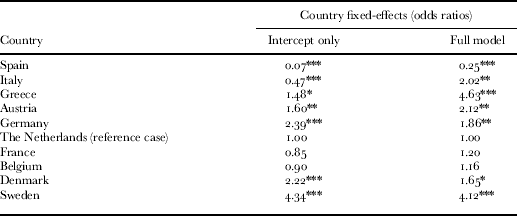
The descriptive results have confirmed that the countries differed considerably in terms of several pertinent socio-demographic and socio-economic characteristics of the sample, or in other words, that composition effects were likely to be important. Table 4 presents the comparison between the intercept-only model and the full model, and shows that the compositional differences from The Netherlands had a considerable effect on the model explanation for the Southern European countries. Adult children in Spain, where levels of monetary transfers were lowest, were much more likely to receive support. In the intercept-only model, the odds (0.07) were 10 times lower, but after taking the compositional differences into account the disadvantage reduced to 4.0 times lower (OR=0.25). The most influential factors were co-residence with the parent and the parents' household having difficulty in making ends meet. Put another way, if we consider the odds of not receiving a transfer, the odds changed from a factor of ten to four when taking the composition of the Spanish and Dutch samples into account. Although compositional differences do not fully explain the difference between Spain and The Netherlands, they substantially reduced the difference in odds of receiving financial support. For adult children in Italy, the effect of the compositional differences was to alter the intercept-only prediction that they were less likely (OR=0.47) to receive monetary support than those in The Netherlands, to a prediction that they were more likely to be recipients (OR=2.02). Among adult children in Greece, the compositional effects markedly raised the likelihood of receiving money transfers (OR=4.6). The differences between adult children in the other countries and The Netherlands produced only modest compositional effects, but interestingly in Denmark and Germany the full model reduced the odds of receiving money transfers (see Table 4).
Comparison of the country fixed-effects for the intercept-only model and the full model
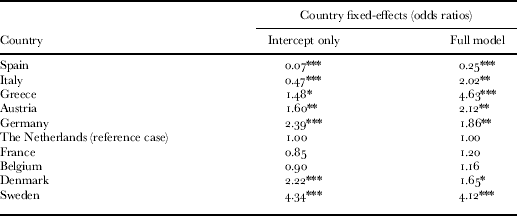
Note: The model is specified in Table 3.
Significance levels: * p<0.05, ** p<0.01, *** p<0.001.
Probability of receiving support
The results presented to this point indicate the probability of an adult child having received monetary support given a certain characteristic, relative to those without the characteristic. For example, unemployed children were more likely to receive monetary support than employed children controlling for other predictors. However, the absolute likelihood of receiving support depended on whether they, for example, had a child, lived in the household of their parents or not, and had parents who could make ends meet easily. Consider a hypothetical child who was unemployed, had at least one child, did not live in the household and had parents who made ends meet easily. This child had an estimated probability of 0.11 of receiving monetary support from his or her parents. A child with exactly the opposite characteristics – employed, no children, and co-resident in the parents' household that had difficulty making ends meet – had an estimated zero probability (0.0) of receiving monetary support. It has also been shown that receiving support was highly dependent on the country of residence. The first hypothesised child had a probability of 0.01 of receiving support in Spain, but 0.26 in Sweden, and in the other countries the probabilities were: The Netherlands (0.08), Belgium (0.09), France (0.09), Italy (0.11), Denmark (0.14), Austria (0.16), Germany (0.18), and Greece (0.25).
Test of the welfare-state influence
The question remains if the differences among the countries that were not explained by the micro-level model can be attributed to differences in welfare-state provisions. To test this hypothesis, we added terms to the model for the interactions between each country dummy and the indicators of whether the child was unemployed or had children of their own, and whether the parents were pensioned. Hardly any significant interaction effects were found, but in Belgium and Austria adult children who had children of their own were significantly more likely to receive financial support than their counterparts in The Netherlands (OR=2.4). The effect for respondents in Austria was expected, but not that in Belgium. Taking the two effects together, and considering the absence of any other significant difference between these particular countries, we reject the proposition that differences in welfare-state generosity in child-care support explain the difference in parental support. Neither do we find significant differences in the likelihood of receiving support from retired parents across countries. Given the different pension systems in Europe, we expected adult children in Sweden, Austria and Denmark to be significantly more likely to receive support from their pensioned parents than those in The Netherlands. Because of the very low number of unemployed adult children in the various countries, we cannot reliably report coefficients for the interaction terms with the countries. While some of the estimated coefficients were significant, the very low numbers of unemployed children led to implausibly high odds ratios. These results (not detailed) were out of line with the national differences in welfare-state generosity reported in Table 1.
Additional analyses were run to determine whether the specification of the model was responsible for the lack of significant results. First of all, we changed the reference category from The Netherlands, a country with middling welfare provisions, to countries at the extremes. Neither the use of Denmark (with one of the most generous welfare-state provision), nor Greece (one of the least generous) as reference categories resulted in any other significant interactions. We investigated whether the lack of significant results was attributable to the inclusion of the dummy variable representing the easiness or difficulty in making ends meet. The reasoning behind the welfare-state influencing intergenerational solidarity is that generous pension systems provide greater means for pensioned parents to transfer funds to their children and vice versa, but excluding the dummy variables for making ends meet did not change the significance of the interactions. The only notable change that we found was with the indicators of the parents' employment status. In the model that did not include the ‘making ends meet’ variables, the coefficients for parents who were employed or retired were considerably higher compared to the model in which these variables were included (not shown). This is of course caused by the fact that employed and retired parents were in general much more able to make ends meet than those who were unemployed, homemakers or disabled. Not including the dummy variables for making ends meet in effect shifts the effects to the employment status indicators.
Discussion
This paper has examined financial transfers from parents to their adult children in ten European countries in 2004 using a twofold approach. Firstly, we tested a theoretical model which incorporated micro-level determinants of support provision (money transfers) by parents and of receipts by children. This model was based on explicit expectations about the role of the child's and the parents' needs and resources, including the parents' need to make alternative expenditures, and the parents' expectations of future reciprocal support. We then used this model to test whether differences in welfare-state generosity associated with systematic national differences in the patterns of transfers from parents to their children. To test the micro-level hypotheses, we used multilevel models to account for the nesting of children by parents. We controlled for country-level differences by using fixed-effects at the country level. The test of welfare-state influence was performed by identifying pensioned parents and adult children with children of their own or who were unemployed, namely those who were likely to receive state support. Differences in generosity between welfare systems were hypothesised to result in differences between countries in the likelihood of financial transfers, especially from pensioned parents and to unemployed children and children with children of their own.
At the individual level, the findings have revealed the importance of considering both the child's and the parents' characteristics. The child's needs were an important predictor of transfer receipt. Children more in need of financial support – as indicated by employment status – were considerably more likely to have received support from their parents, while children living in the parental household were least likely to have received financial support. Adult children who lived more than one kilometre away from the parents were less likely to have received monetary support, but considerably more so than those living inside the household. It was also found that adult children with children of their own were more likely to have received support, although this likelihood was attenuated when other siblings also had children of their own. The results also confirm the expectation that the parents' resources have a strong influence on whether they are able to provide monetary support. Parents that had alternative expenditures had a lower likelihood of making transfers to children. Daughters were more likely to receive transfers than sons, and step-children were less likely to receive support compared to biological children – both these findings are in line with the reasoning that expectations of future reciprocity influence the likelihood of transfers to adult children. We also found that in families where at least one of the parents was in poor health, adult children were less likely to receive monetary support from their parents.
In contrast to earlier comparative empirical work on support provision between parents and children in Europe, we chose not to cluster countries by welfare regimes (Albertini, Kohli and Vogel Reference Albertini, Kohli and Vogel2007). Although this hampers the comparability of our findings with those of previous research, we argue that examining individual countries provides more nuanced insights into macro-level differences and how they are translated at the micro-level. The variations in the aggregate level of financial support from parents to adult children among the ten countries have shown that, on the whole, within-cluster differences were just as large as between-cluster differences. When the considerable compositional differences between countries were taken into account, the differences in the likelihood of support receipt were reduced, and those that remained were not consistent with the three commonly-used welfare regimes. Furthermore, we have not found evidence that the generosity of the welfare state consistently influences the likelihood of transfer receipt by specific groups of children. The likelihoods of receipts from retired parents did not differ across the countries, and the same applied to adult children who received child-care support from the state.
Without clear evidence of the influence of state provisions on financial transfers from parents to children, statements regarding the ‘crowding-out effect’ for material support seem superfluous (if and how ‘crowding out’ pertains to personal care and instrumental support is another question). Our results suggest that state support does not substitute for family support, for no evidence of the hypothesised link has been found. This result is rather surprising given that previous scholarly work has shown that intergenerational support follows patterns of regime typologies, although part of the evidence considers time transfers, which we have not addressed (Albertini, Kohli and Vogel Reference Albertini, Kohli and Vogel2007). Irrespective of the type of transfers considered, previous empirical work on the link between the family and the state, by focusing on aggregate patterns, has lacked an explicit test. Our direct test of the hypothesised influence has found no support for these previous findings, and suggests that the similarities between countries are not bounded by geographical region. This also seems to rule out the cultural explanation for the differences between countries proposed by Reher (Reference Reher1998). His notion of strong and weak family ties is not reflected in the reported patterns of monetary support. After taking into account compositional differences, support was highest in Sweden and Greece, exemplars of countries with respectively weak and strong family ties. The lack of country-level variation in our results may have resulted from the use of dummy variables to capture country differences. The inclusion of more and more sensitive measures of particular aspects of each country's welfare-state arrangements would be a valuable refinement. This kind of analysis requires a much larger number of countries, since with just ten cases multilevel modelling at the country level is not an option. An alternative would be to include measures of welfare-state support at the individual level, but we are not aware that such data exists.
The descriptive results also revealed marked differences among the countries in the levels of household wealth. At the individual level, the analysis showed that parents hardly ever send money when they have difficulty making ends meet. Only when a shortage of money was not a concern did they support their children financially. Combining the descriptive and analytical results makes clear that aggregate differences in welfare-state spending go hand-in-hand with differences in individual incomes by country. Hence, aggregate differences among the countries in monetary transfers to a certain degree reflect levels of relative wealth. In families where wealth is a limiting factor, one expects that filial responsibility is fulfilled in other ways, for example, by investing time.
Time transfers may not be independent of money but rather a substitute in cases where monetary means are lacking. This may be a possible explanation of why the observed patterns were not in line with different welfare-state arrangements. Previous research has described differences between countries in the provision of money and time transfers (Albertini, Kohli and Vogel Reference Albertini, Kohli and Vogel2007). Time transfers are more common in Southern European countries than elsewhere in Europe, suggesting that they substitute for money transfers. We have attempted to take non-monetary transfers into account, at least partially, by including an indicator for whether adult children still live in the parental household (Tomassini et al. Reference Tomassini, Glaser, Wolf, Broese van Groenou and Grundy2004). Future research may be able to provide insight into the dynamics between different forms of transfers by incorporating other non-monetary forms of support into the models.
This close examination of the ten European countries for which there were sufficient data has unavoidably overlooked other European countries, and regrettably none of the countries in ‘New Europe’ were represented. Eastern European countries are not homogeneous either in socio-demographic composition or welfare policies, and they have recently undergone major welfare policy changes (Adukaite Reference Adukaite2009), making them particularly interesting for further study. Extending the scope of research on intergenerational transfers would provide new insights into the micro- and macro-level influences and dynamics.
Acknowledgements
The research reported in this paper was carried out for an EU-funded project, MULTILINKS (Grant SSH-2007-3.1.1-217523, ‘How demographic changes shape intergenerational solidarity, well-being, and social integration: a multi-links framework’), which was co-ordinated by Pearl Dykstra. This paper uses data from SHARE Wave 1. SHARE data collection in 2004–07 was primarily funded by the European Commission through its 5th and 6th framework programmes (projects QLK6-CT-2001-00360; RII-CT-2006-062193; CIT5-CT-2005-028857). Additional funding by the US National Institute on Aging (grants U01 AG09740-13S2; P01 AG005842; P01 AG08291; P30 AG12815; Y1-AG-4553-01; OGHA 04-064; R21 AG025169) as well as by various national sources is gratefully acknowledged (see http://www.share-project.org for a full list of the funding organisations).