


Introduction
Electroconvulsive therapy (ECT) is a safe and well-tolerated medical treatment for several psychiatric and neurological disorders [Reference Elias, Das, Kirkland, Loyal and Thomas1]. It is the most effective intervention in depressive episodes [Reference Kirov, Jauhar, Sienaert, Kellner and McLoughlin2, Reference Mutz, Vipulananthan, Carter, Hurlemann, Fu and Young3] and is also variously used in the treatment of mania [Reference Elias, Thomas and Sackeim4], schizophrenia [Reference Lally, Tully, Robertson, Stubbs, Gaughran and MacCabe5], and catatonia [Reference Leroy, Naudet, Vaiva, Francis, Thomas and Amad6].
However, provision varies markedly worldwide [Reference Leiknes, Jarosh-von Schweder and Høie7]. A 2012 review, based on published data from various locations, estimated annual treated person rates (ATPRs) for several nations [Reference Leiknes, Jarosh-von Schweder and Høie7]. While these included some Nordic and western European countries, only the calculations for Denmark, Germany, Norway, Spain, Sweden, and the United Kingdom were correct and based on national-level data, most of which are now two decades old. Use across Nordic countries was last documented three decades ago [Reference Strömgren8]. Recent reviews have covered the Baltic states [Reference Lõokene, Kisuro, Mačiulis, Banaitis, Ungvari and Gazdag9] and central and eastern Europe [Reference Gazdag, Dragasek, Takács, Lõokene, Sobow and Olekseev10], the latter showing ATPRs varying from 2 per million inhabitants in Ukraine to 292 in Slovakia.
The present study aims to provide an up-to-date review of ECT practice in the remainder of the continent. We present an overview of use across Nordic and western European countries, using recent national-level data to calculate each nation’s ATPR and combining this with more historical data, where available, to identify trends in usage over time.
Method
Inclusion criteria
An expert on each country was identified via informal networks and asked to collaborate if they had access to national data on ECT usage (unless data were from before 1 January 2015 or from selected regions comprising under half the country’s population), or could collect novel data for the present study. For some countries, it was appropriate to involve more than one individual, to complement skills, knowledge, and resources. National psychiatric associations were not directly contacted. Countries with a population under one million were excluded, to avoid effects of random fluctuations in low numbers.
Outcomes
The primary outcome was the number of individuals treated with ECT in any given year. Further information was sourced, where available, on the number of ECT centres, attitudes and access to ECT, national policy guidance, diagnostic indications, and treatment parameters, such as electrode placement and hospital admission status.
Data sources
Sources included peer-reviewed literature, governmental publications not subject to peer review, published and unpublished administrative datasets, and hitherto unpublished surveys, methodologies of which are detailed in Supplementary Material.
Analysis
The primary analysis compared ATPRs (calculated by dividing the number of individuals treated by the national population in millions that year, sourced from https://data.worldbank.org) for the most recent year for which data were available in each country. For surveys reliant on optional responses from treatment providers, extrapolation of data to cover non-respondent providers was considered if the response rate exceeded 50%. Secondary analyses compared mean number of patients per centre and, in countries for which the primary outcome was available at two or more time points, trends in ATPRs over 25 years and compound annual growth rate (CAGR), calculated using this formula [Reference Elango11]:

Ethical approval
As this study was based on retrospective analysis of anonymised data and did not require treatment providers or other organizations to access any individual patient records, ethical approval was not required in any of the participating countries.
Results
There are 15 Nordic or western European countries with populations over one million; numbers of ECT centres in each are shown in Figure 1. Usage data were available for at least 1 year since 2015 for 14 countries, excluding Spain. Finland (survey response rate <50%) and Portugal (data restricted to public hospital inpatients) were excluded from the primary analysis. Sources of recent and historical data are shown in Table 1. Results are detailed below by country and in Table 1, Figures 2–4, and Supplementary Material.
Number of electroconvulsive therapy centres.
Note: Estimated number of centres in each country shown in bold font. Year of data and national population in that year shown in standard font.

Figure 1 Long description
The map highlights 15 European countries in orange with callout boxes providing 3 data points: the number of ECT centres in bold, the data year, and the national population in millions (m).
* In the north:
- Finland: 25 centres, 2023, 5.58m.
- Norway: 29 centres, 2024, 5.57m.
- Sweden: 45 centres, 2024, 10.57m.
- Denmark: 21 centres, 2024, 5.98m.
* In Western and Central Europe:
- United Kingdom: 98 centres, 2024, 69.28m.
- Republic of Ireland: 14 centres, 2024, 5.40m.
- Netherlands: 30 centres, 2023, 17.88m.
- Belgium: 20 centres, 2023, 11.79m.
- Germany: 178 centres, 2016, 82.35m.
- Austria: 12 centres, 2016, 8.74m.
- Switzerland: 10 centres, 2017, 8.45m.
- France: 122 centres, 2019, 65.18m.
* In the South:
- Portugal: 25 centres, 2024, 10.69m.
- Spain: 122 centres, 2012, 46.77m.
- Italy: 8 centres, 2024, 58.99m.
Sources of data and estimated numbers of patients treated annually

Table 1 Long description
The table contains nine columns: Year of data, Reference, Data source, Coverage and details, an empty spacer column, Estimated patients per year, Population in millions, and ATPR (patients per million).
Key data points by country:
* Austria (2016): 271 patients, 8.74m population, 31.0 A T P R.
* Belgium (2023): 1,018 patients, 11.79m population, 86.3 A T P R.
* Denmark (1999 – 2024): Shows a trend of increasing ATPR from 321.4 in 1999 to a peak of 418.6 in 2022, ending at 386.3 in 2024.
* Finland (2023): 2,087 patients, 5.58m population, 374.0 A T P R.
* France (2017 – 2023): ATPR increased from 39.6 to 59.9.
* Germany (2016): 5,700 patients, 82.35m population, 69.2 A T P R.
* Italy (2024): 159 patients, 58.99m population, 2.7 A T P R.
* Netherlands (2023): 1,559 patients, 17.88m population, 87.2 A T P R.
* Norway (2024): 1,192 patients, 5.57m population, 214.0 A T P R.
* Portugal (2024): 204 patients, 10.69m population, 19.1 A T P R.
* Republic of Ireland (2008 – 2024): ATPR decreased from 88.2 to 43.7.
* Spain (2012): 3,090 patients, 46.77m population, 66.1 A T P R.
* Sweden (2010 – 2024): High ATPR ranging from 353.5 to 426.5, ending at 371.4 in 2024.
* Switzerland (2017): 402 patients, 8.45m population, 47.6 A T P R.
* United Kingdom (2024 whole U K): 2,347 patients, 69.28m population, 33.9 A T P R.
Abbreviations include ECT for electroconvulsive therapy and ATPR for annual treated person rate. Data sources vary between surveys, national registers, and insurance data.
Abbreviations: ECT, electroconvulsive therapy; ATPR, annual treated person rate; nc, not calculated; pc, personal communication; NIHDI, National Institute for Health and Disability Insurance; DNPR, Danish National Patient Register; NPR, Norwegian Patient Registry; INE, Instituto Nacional de Estatistíca; IP, inpatient; MHC, Mental Health Commission; Q-ECT, Kvalitetsregister ECT; SEAN, Scottish Electroconvulsive Therapy Audit Network; ECTAS, Electroconvulsive Therapy Accreditation Service; E/W/NI, England, Wales, and Northern Ireland.
a See Supplementary Materials for further information on methodology of previously unpublished surveys.
b Value rounded to the nearest 10 at the request of Statistics Denmark.
c Excluded from all comparative analyses due to low survey response rate.
d Population data for Metropolitan France from https://www.insee.fr/en/statistiques/serie/000067671 [accessed 4 March 2026].
e Excluded from primary comparative analysis due to restriction of scope to public hospital inpatients.
f Excluded from primary comparative analysis due to age of data.
g Regional and aggregate population data from https://www.ons.gov.uk/ [accessed 15 February 2026].
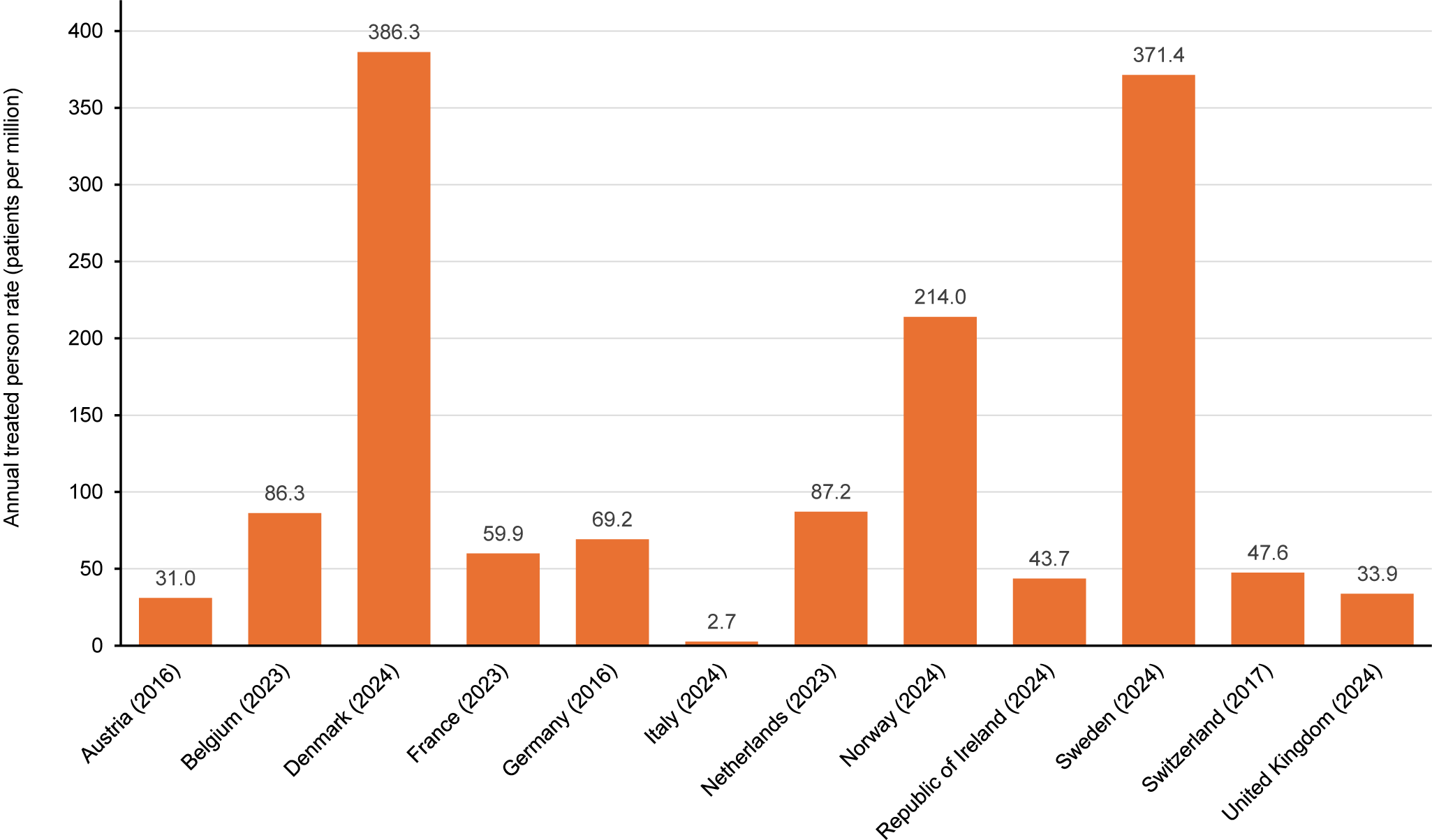
Annual treated person rate.
Note: Based on the most recent year with available data. Exclusions: Finland (low response rate for most recent survey), Portugal (data only from public hospital inpatients), and Spain (most recent data from before 2015).

Figure 2 Long description
The vertical Y axis is labelled annual treated person rate (patients per million) with increments of 50 from 0 to 400. The horizontal X axis lists 12 countries with their data year. The data bars from left to right are as follows.
* Austria (2016) 31.0
* Belgium (2023) 86.3
* Denmark (2024) 386.3
* France (2023) 59.9
* Germany (2016) 69.2
* Italy (2024) 2.7
* Netherlands (2023) 87.2
* Norway (2024) 214.0
* Republic of Ireland (2024) 43.7
* Sweden (2024) 371.4
* Switzerland (2017) 47.6
* United Kingdom (2024) 33.9
Denmark and Sweden represent significant peaks in the dataset, while Italy shows the lowest rate.
Austria
A hitherto unpublished survey (Supplementary Material) identified 12, predominantly public, facilities in 2017, all of which responded, detailing 271 individuals receiving 2,682 treatments. Depressive episodes accounted for 86% of activity. Outpatient treatment was provided at two centres, and maintenance ECT at 10. Around 22% of treatments were given without consent, in accordance with legal provisions. Recent decades have seen expanding provision, with 7 ECT centres in 2000 [Reference Müller, Geretsegger, Baghai, Frey, Kasper and Möller39], 8 in 2004 [Reference Rubner, Koppi and Conca40], and 10 in 2013 [Reference Di Pauli, Grözinger, Conca, Nickl-Jockschat and Di Pauli41], while there were still 12 centres in 2026 (Baldinger-Melich P & Di Pauli J, personal communication, 9 March 2026).
Belgium
For the present study, a survey of the six largest ECT centres revealed 11,705 treatments administered to 792 individuals in 2023 (Supplementary Material). Insurance data show these centres accounted for 77.8% of 15,046 ECT treatments nationally; hence, an estimated 1,018 individuals received ECT in 2023, 34% as outpatients. These data show the number of ECT facilities has reduced, from 32 in 2003 [Reference Sienaert, Dierick, Degraeve and Peuskens12] to 20 in 2023, while the annual number of ECT treatments has more than doubled from 7,068 [Reference Sienaert, Falconieri, Obbels, van den Ameele and Bouckaert13]. A nationwide survey [Reference Sienaert, Falconieri, Obbels, van den Ameele and Bouckaert13] suggested ECT practice largely followed contemporary US [42] and Netherlands [Reference van den Broek, Birkenhäger, de Boer, Burggraaf, van Gemert and Groenland43] guidelines. Striking regional differences exist: despite accounting for 42% of the population, the Wallonia and Brussels regions are collectively responsible for only 13% of ECT activity. In contrast, Flanders, with 58% of the population, accounts for 87%.
Denmark
Individual treatments are recorded in the National Patient Registry [Reference Lynge, Sandegaard and Rebolj44] with 90% completeness, allowing for epidemiological studies into ECT use, safety, and clinical outcomes [Reference Hundrup, Osler and Jørgensen15, Reference Osler, Rozing, Christensen, Andersen and Jørgensen45, Reference Osler, Rozing, Jørgensen and Jørgensen46, Reference Jørgensen, Gronemann, Rozing, Jørgensen and Osler47]. Registry data show ECT was given to 2,300 individuals aged >18 years in 2022, increasing in the last decade (Figure 3). Bilateral (BL) ECT constitutes over 80% of treatments [Reference Bjørnshauge, Hjerrild and Videbech48, Reference Jorgensen, Andersen, Nielsen, Videbech and Jorgensen49], although regions vary regarding preferred frequency of treatment and electrode placement [Reference Hundrup, Osler and Jørgensen15, Reference Bjørnshauge, Hjerrild and Videbech48]. Diagnosis is severe depressive episode in around 75% of cases, while involuntary treatment is allowed in life-threatening clinical situations and constitutes 2% of treatments [Reference Hundrup, Osler and Jørgensen15]. A more comprehensive national quality database, including information on clinical response, side effects, and other technical variables, is underway. ECT follows national guidance [50]. Access is free in public hospitals.
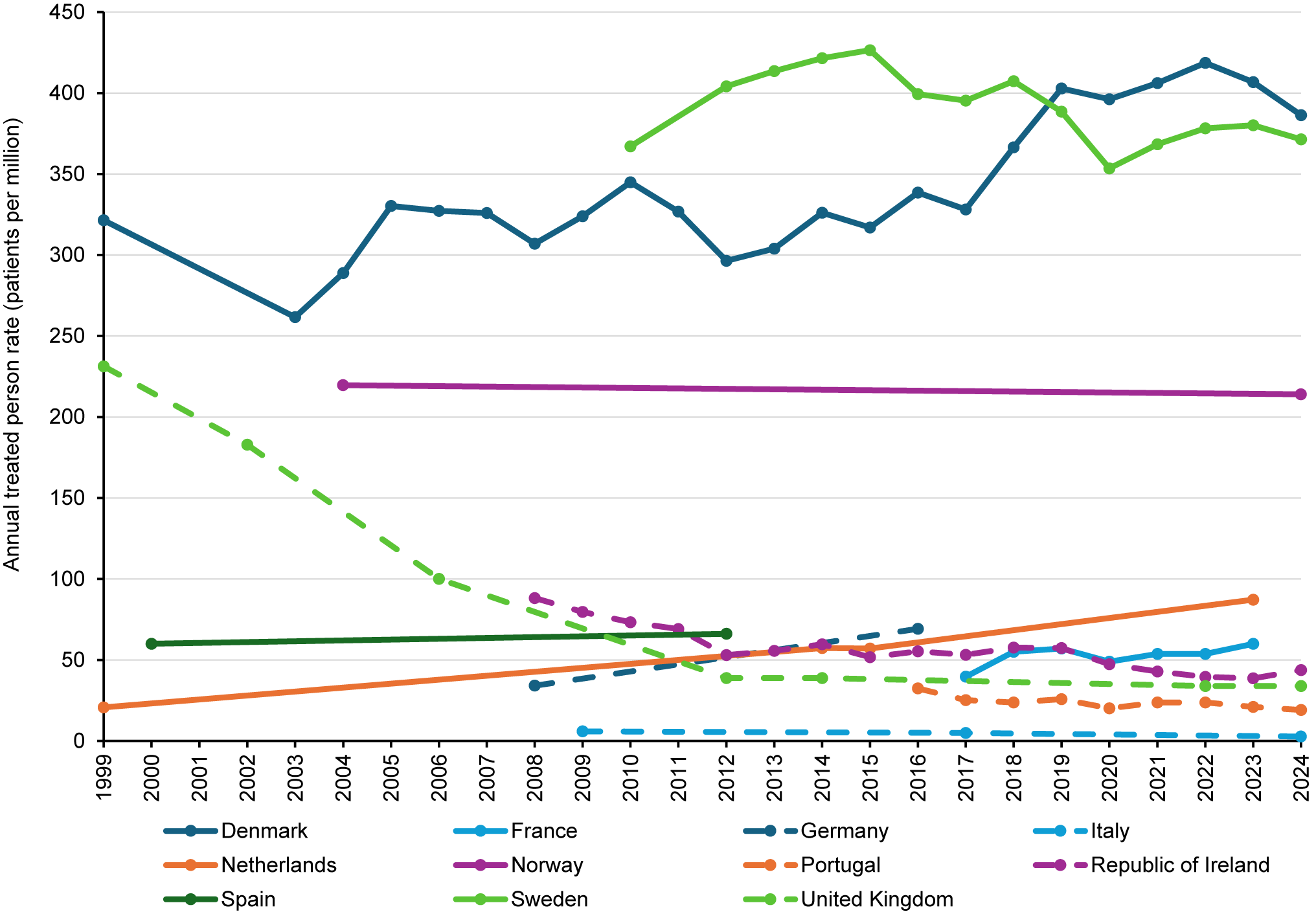
Trends in electroconvulsive therapy use over 25 years.
Note: Exclusions: Austria and Belgium (data only available for one time point); Finland (low response rate for most recent survey).

Figure 3 Long description
The X axis represents years from 1999 – 2024. The Y axis represents the annual treated person rate in patients per million, ranging from 0 to 450. The data is divided into two distinct clusters.
High-rate cluster (200 to 450 patients per million):
* Denmark (dark blue solid line): Fluctuates between 260 and 350 until 2017, then rises sharply to a peak of 420 in 2022 before a slight decline.
* Sweden (light green solid line): Starts at 370 in 2010, peaks at 425 in 2015, and remains high between 350 and 400 through 2024.
* Norway (purple solid line): Shows a nearly flat, stable trend around 220 from 2004 – 2024.
Low-rate cluster (0 to 100 patients per million):
* United Kingdom (light green dashed line): Shows a steep decline from 230 in 1999 to approximately 35 by 2024.
* Netherlands (orange solid line): Shows a steady linear increase from 20 in 1999 to nearly 90 in 2023.
* Republic of Ireland (purple dashed line): Fluctuates between 40 and 90 from 2008 to 2024.
* Germany (dark blue dashed line): Shows a gradual increase from 35 in 2008 to 70 in 2016.
* France (light blue solid line): Remains stable at ~ 55 from 2018 – 2023.
* Spain (dark green solid line): Shows a stable trend around 60 from 2000 – 2012.
* Portugal (orange dashed line): Fluctuates at a low level between 20 and 30 from 2015 – 2024.
* Italy (light blue dashed line): Represents the lowest rate, remaining near zero from 2009 – 2024.
Finland
A 2013 survey had a response rate of 86% [Reference Sumia, Seppälä, Ritschkoff, Tammentie-Sarèn, Leinonen and Järventausta16], giving an ATPR of 231.6 (Table 1). A hitherto unpublished survey covering 2023 saw 8 (32%) of 25 centres respond, covering 39.5% of Finland’s population, reporting on 840 patients who received ECT in 2023 (Supplementary Material). This has been extrapolated to an estimated 2,087 patients nationally and an ATPR of 374.0 (Table 1), tentatively suggesting a steady increase in usage. However, given the low response rate, this has not been included in the comparisons in Figures 2–4. Seventy-seven percent of patients had affective disorders and 13% had schizophrenia, while 46% of patients were outpatients, and 1% were treated without consent. Right unilateral (RUL) placement was most common, followed by BL, typically used when treating schizophrenia or catatonia. Demand is increasing, and maintenance ECT is provided at all centres [Reference Karttunen, Virtanen, Holm, Seppälä, Sumia and Jääskeläinen51]. Access is free nationwide.
Use of ECT in Nordic and western European countries.
Note: (A) ECT annual treated person rate per million population. Data from the most recent year with available data. Exclusions: Finland (low response rate for most recent survey), Portugal (data only from public hospital inpatients), and Spain (most recent data from before 2015). (B) Compound annual growth rate in ECT use. Values calculated using different time periods between 1999 and 2024, due to varying data availability. Belgium value based on numbers of treatments, not numbers of patients. Exclusions: Austria and Switzerland (data only available for one time point); Finland (low response rate for most recent survey). (C) Mean number of patients treated per ECT centre per year. Same exclusions as Panel A. ECT, electroconvulsive therapy.

Figure 4 Long description
A three-panel set of geographical maps.
Panel A, on the left, shows the annual ECT treated person rate per million population using a green color scale. The highest rates, ≥ 300, are in Sweden and Denmark. Norway and Iceland are in the 100 to less than 300 range. The United Kingdom, Ireland, France, and the Netherlands are in the 50 to less than 100 range. Germany and Luxembourg are in the 10 to < 50 range. Italy and Switzerland show the lowest rates at < 10.
Panel B, in the center, shows the compound annual growth rate in ECT use. Red indicates a decrease of less than negative 7 percent, seen in the United Kingdom and Ireland. Orange indicates a decrease of negative 7 percent to less than negative 3 percent, seen in Spain and Italy. Grey indicates a stable rate of negative 3 percent to 3 percent, seen in Norway, Sweden, and France. Light blue indicates growth of 3 percent to < 7 percent, seen in the Netherlands and Belgium. Dark blue indicates growth ≥ 7 percent, seen in Germany.
Panel C, on the right, shows the mean number of patients treated per ECT center per year using a purple color scale. Denmark has the highest density at ≥ 100. Sweden and the Netherlands are in the 75 to < 100 range. Norway, Belgium, and Germany are in the 50 to < 75 range. The United Kingdom, Ireland, France, and Switzerland are in the 25 to less than 50 range. Italy and Iceland have the lowest density at < 25.
France
A national registry was implemented in 2017. Use has increased steadily since, particularly in private hospitals, from 2,562 patients in 2017 to 3,972 in 2023 [Reference Barruel, Belnou, Plaze and Dauriac-Le Masson17]. Compared with psychiatric inpatients who did not receive ECT in 2019, more of the 3,705 patients treated at all 122 centres that year were female, older, socioeconomically advantaged, and experiencing severe or psychotic depressive episodes [Reference Lecarpentier, Gandré, Coldefy and Ellini52, Reference Lecarpentier, Gandré, Coldefy and Ellini53]. There are geographical disparities, only partially explained by distances from ECT centres, with northern and eastern regions tending to treat less frequently [Reference Barruel, Belnou, Plaze and Dauriac-Le Masson17]. Multicentre studies indicate that ECT is used in accordance with national and international recommendations, but initiation is often delayed: mean episode duration before initiation was 9–10 months, with a mean of 3.4 trials of other treatments [Reference Samalin, Yrondi, Charpeaud, Genty, Blanc and Sauvaget54, Reference Yrondi, Blanc, Anguill, Arbus, Boudieu and Patoz55].
Germany
An estimate of 62,450 treatments given to 5,700 individuals was extrapolated from 2016 data submitted by 130 (73.0%) of 178 ECT centres that responded to a survey [Reference Jolivet and Grözinger19], with usage doubling since a previous survey 8 years earlier [Reference Loh, Nickl-Jockschat, Sheldrick and Grözinger18]. Since 2020, the number of treatments has been recorded by the Institute for Hospital Remuneration System (InEK), but there are no more recent data on patient numbers. Nevertheless, 72,193 treatments in 2023 [Reference Dreger, Uphaus, Zilles-Wegner, Sartorius, Guhra and Kreisel20] represent an increase of 16% from 62,450 in 2016. Inpatients accounted for 85% of treatments in 2023, while provision varied markedly by federal state [Reference Dreger, Uphaus, Zilles-Wegner, Sartorius, Guhra and Kreisel20], demand significantly exceeding capacity in many regions [Reference Methfessel, Belz, Bühler and Zilles-Wegner56]. This increased demand may have been driven in part by a 2012 joint policy statement by national psychiatric associations across German-speaking countries endorsing ECT [57], while the German Association for Psychiatry, Psychotherapy, and Psychosomatics has recently published its own expert consensus statement on ECT for patients lacking capacity [Reference Zilles-Wegner, Gather, Hasan, Müller, Pollmächer and Simon58].
Italy
There is no national registry and 2024 usage data derive from a survey of eight known centres, conducted for the present study (Supplementary Material). Although the National Bioethics Committee expressed a favourable opinion on ECT in 1995, provided it is administered according to modern standards [59], there are no national clinical guidelines. Instead, a 1999 circular issued by the Ministry of Health provides general recommendations, authorising ECT only for severe, treatment-resistant disorders, exclusively with informed consent [Reference Bindi60]. Enduring professional and cultural resistance to ECT means it is reserved for such cases, within a few, primarily northern, centres. Consequently, usage is highly restricted and unevenly distributed. Established practitioners run workshops as part of efforts to reintroduce ECT to more hospitals and turn the tide of steadily diminishing use.
Netherlands
Health insurance data show 328 patients had ECT in 1999 [Reference Verwey, Sienaert, Verwey and van Waarde23], rising to 1,559 in 2023 (Vektis, personal communication, 5 November 2024), a fourfold increase over 25 years [Reference Verwey, Sienaert, Verwey and van Waarde23] (Figure 3). Clinical practice follows national guidelines [61], which recommend starting ECT with high-dose RUL placement, except when symptoms are severe. The main indication is depressive episode, but it is suggested ECT was underutilised in 2014, when only 1.2% of people with treatment-resistant depression received it [Reference Scheepens, van Waarde, Lok, Zantvoord, de Pont and Ruhé62]. A nationwide platform (Werkgroep ECT Nederland) organises biannual meetings and aims to promote quality and uniformity in practice. ECT training is mandatory for psychiatry residents.
Norway
Data were sourced from the Norwegian Patient Registry (NPR), complemented by a survey conducted by the National ECT Registry (Supplementary Material), to which 28 of 29 centres responded. These sources showed 1,192 patients had ECT in 2024, when the ECT Registry had just begun patient-level data collection at around half of ECT centres [Reference Krokli, Skaar, Aakhus, Bergesen and Kessler63]. In 2024, 77% of treatments were administered for unipolar and 15% for bipolar depressive episodes. Mean age was 61 years (range: 18–91), with 63% female. RUL placement was used at 79% of first sessions, with a mean of 8.7 acute treatments. In 187 courses with full Montgomery–Åsberg Depression Rating Scale (MADRS) data, mean scores decreased from 33.1 to 10.3; among 327 courses with post-ECT scores, 51% reached remission (MADRS ≤10) [Reference Krokli, Skaar, Aakhus, Bergesen and Kessler63]. ECT is exclusively delivered by publicly funded health services.
Portugal
There are eight private ECT facilities, but most treatments occur in 17 public hospitals. There is no ECT registry; the only available data derive from a hospital registry, which records treatments administered to public hospital inpatients. Data from 2008 to 2015 have been previously reported, with mood disorders accounting for 61% of cases [Reference Mota, Gonçalves-Pinho, Ribeiro, Macedo, Freitas and Mota64]. Prevalence of outpatient and private ECT is unknown, so the degree to which these data underestimate activity is unclear. Consequently, the most recent tally of 204 patients in 2024 (estimated ATPR 19.1) has not been included in the comparison in Figure 2. However, analysis of data from 2016 to 2024 suggests the number of inpatient ECT procedures decreased by 4.4% per year (incidence rate ratio = 0.956, 95% CI: 0.932–0.980, p < 0.001) (Figure 3). Access is free at public hospitals.
Republic of Ireland
A mandatory registry has published annual reports from 2008 to 2024 [29]. Data accuracy is limited by lack of access to registry source material, absence of a national individual health identifier, and the possibility of duplicate data. Annual reports (2008–2023) demonstrate ECT use primarily in affective disorders (mean 79%) and among females (65%), with a mean age of 60 years; 15% of courses involved involuntary treatment, and 78% resulted in Clinical Global Impression–Improvement (CGI–I) outcomes of “much improved” or better. In 2023, 49% of ECT was RUL, 17% was continuation or maintenance, with almost no acute outpatient treatment. Compliance with Rules [65] and a Code of Practice [66] is assessed by annual inspections of centres. All psychiatry trainees must demonstrate competence in ECT administration. The public health system provides free access, but geographical and other inequities persist.
Spain
Most recent national data are from a survey covering 2012 [Reference Vera, Sanz-Fuentenebro, Urretavizcaya, Verdura, Soria and Martínez-Amorós31], so they were excluded from the primary comparison. More recent data from Catalonia [Reference Gil-Badenes, Alemany, Iglesias, de Arriba, Foguet-Boreu and Hernández-Ribas67] are likely unrepresentative of the whole country [Reference Vera, Sanz-Fuentenebro, Urretavizcaya, Verdura, Soria and Martínez-Amorós31].
Sweden
Usage has remained relatively unchanged in 50 years, with ATPRs around 400 [Reference Nordanskog, Hultén, Landén, Lundberg, von Knorring and Nordenskjöld32]. The Quality Register for ECT is non-mandatory but highly valid, with national coverage of 95% [Reference Ahmad, Sandberg, Brus, Ekman, Hammar and Landén68]. By cross-linking data with the mandatory National Patient Register for medical procedures, Sweden can present precise information on ECT use. Data encompass details from each course, including patient characteristics and technical parameters, informing research, monitoring of guidelines, and provision of public information concerning practice and outcomes. RUL placement was used in 75%, and depressive episode was the indication in 76% of courses in 2024, with a 46% remission rate (MADRS ≤10) after a median of six treatments, and 76% “much improved” or better on CGI–I [Reference Kvalitetsregister33]. After treatment, 19% had subjective memory impairment, with improvement in 21%. The legal framework for ECT does not differ from other procedures.
Switzerland
Most recent data derive from a systematic study, identifying 10 centres in 2017, reporting on 402 individuals given 5,192 treatments [Reference Wilhelmy, Brühl, Himmighoffen, Conca and Grözinger34]. ECT has been less prominent in French-speaking cantons [Reference Wilhelmy, Brühl, Himmighoffen, Conca and Grözinger34] but, contrary to previous reports [Reference Dawson69, Reference McLaren70], is not legally prohibited and access is improving (Swierkosz-Lenart L, personal communication, 27 March 2025). Recent years have seen marked expansion in provision, with eight ECT centres in 2010 [Reference Böker71, Reference Pfaff, Seidl, Angst, Ramseier, Seifritz and Quednow72] and 2013 [Reference Ramseier, Böker, Grözinger, Conca, Nickl-Jockschat and Di Pauli73], increasing to 17 centres in 2024 and 19 in 2025 (Brühl AB, personal communication, 24 September 2025). Practitioners participate in peer support across German-speaking countries.
United Kingdom
In Scotland, with 8% of the population, all 16 centres mandatorily submitted data on 264 patients to the Scottish ECT Audit Network in 2024 [38]. Activity data in the remaining three regions, comprising 92% of the population, are collected annually by the ECT Accreditation Service, another quality improvement network; in 2024, all 82 centres submitted data, detailing treatment of 2,083 patients. Depressive episode was the indication in 85%, 18% were outpatients, RUL electrode placement was used for 16%, and 52% lacked mental capacity to consent and had ECT under specific legal provisions. Altogether, 2,347 patients were treated at the UK’s 98 centres in 2024. Previous data depict a steady decline over 25 years (Figure 3) [Reference Buley, Copland, Hodge and Chaplin35, Reference Bickerton, Worrall and Chaplin36]. Access is free.
Discussion
After ECT was first administered in Italy in 1938, its effects were so pronounced that its use had spread across northern and western Europe by 1940 [Reference Shorter and Healy74]. The modern procedure retains this remarkable efficacy [Reference Kirov, Jauhar, Sienaert, Kellner and McLoughlin2, Reference Mutz, Vipulananthan, Carter, Hurlemann, Fu and Young3] and is safe and well-tolerated when administered correctly [Reference Elias, Das, Kirkland, Loyal and Thomas1]. Indeed, modified, brief-pulse ECT is a technologically advanced treatment at the forefront of medical practice in many well-developed healthcare systems.
Despite this, our review, the first collating ECT usage data from Nordic and western European countries, shows marked variation across this high-income region. It brings together findings from various sources to give an up-to-date picture of service provision, complementing a previous review in central and eastern Europe [Reference Gazdag, Dragasek, Takács, Lõokene, Sobow and Olekseev10].
This review shows three broad patterns of use. First, that seen across the Nordic countries, where the ATPR consistently exceeds 200 patients per million, and ECT is widely considered an early option for depressive episodes and the preferred choice when complicated by psychosis. Second, the pattern observed across the remainder of northwest Europe, from Ireland to Austria, with ATPRs between 30 and 100. In these countries, practice varies between localities, with ECT seen as a last resort by many psychiatrists. Finally, Italy, with an outlying ATPR of 2.7 and huge regional variation in access to ECT, which is only ever proposed in the most dire or life-threatening clinical scenarios.
The reasons for this disparity are complex. Patient attitudes [Reference Obbels, Verwijk, Bouckaert and Sienaert75, Reference Kronsell, Nordenskjöld, Mittendorfer-Rutz and Tiger76] and public perception of ECT, shaped by its profile within fictional and real-world media [Reference Sienaert77,Reference de Anta, Alvarez-Mon, Donat-Vargas, Lara-Abelanda, Pereira-Sanchez and Gonzalez Rodriguez78], and, in some cases, supposed links to historical government regimes [Reference Passione79], may uniquely affect its use in individual countries or even within different regions of the same country. Public understanding of the true nature of serious mental illness, and its distinction from situational, emotional distress in psychologically vulnerable individuals, is lacking in most societies and leads to scepticism of biological treatments for the former. Appreciation of this distinction among clinicians may vary significantly across the continent, depending upon exposure to training opportunities [Reference Nagda, Harshe, Karia, Harshe, Harshe and Shah80]. There may be a vicious cycle of diminishing access in some locations, whereby a decreasing rate of use, for whatever initial reason, results in closure of centres and loss of training and expertise, perpetuating the downward trend. Lastly, although outside the scope of this article, there are marked differences in legal frameworks that may enable or hinder access to ECT in various countries.
Notably, French-, Dutch-, and German-speaking areas of Europe have seen steadily increasing use in recent years, following espousal by national psychiatric organisations [Reference Sienaert, Falconieri, Obbels, van den Ameele and Bouckaert13, 57, Reference Zilles-Wegner, Gather, Hasan, Müller, Pollmächer and Simon58, Reference Sienaert, De Fruyt and Dierick81, Reference Sienaert, De Fruyt, Dierick and Ansseau82, 83, Reference Sauvaget, Bulteau, Galvao, Szekely, Fossati and Poulet84], instilling enthusiasm among junior and senior clinicians. Conversely, English-speaking nations have seen a steady decline. Stringent, poorly evidenced UK guidance published in 2003 [85] has been implicated in this decline [Reference Bickerton, Worrall and Chaplin36, Reference Fink86, Reference Shah87], while there has been a long-running UK-based campaign to discredit ECT [Reference Meechan, Laws, Young, McLoughlin and Jauhar88]. Efforts to reverse this trend include mandatory annual ECT clinic attendance for UK psychiatry residents since 2025, and annual training open to all psychiatrists.
Contrary to previous reports [Reference Dawson69, Reference McLaren70, Reference Eranti and McLoughlin89, Reference Felthous and Swartz90], there is no evidence that ECT is prohibited by law in any European country or federal state. Even Slovenia, which has no ECT facilities, permits the treatment in restricted circumstances [91]. It seems likely the word “ban” has been loosely applied by authors to situations where ECT has fallen into disuse or become subject to restrictive guidance [Reference Gazdag, Dragasek, Takács, Lõokene, Sobow and Olekseev10, Reference Simini92, Reference Etter and Bertschy93], then misinterpreted by others as indicative of legal prohibition.
Previous reviews of service provision in the Low Countries have reported the number of individual ECT treatments given per year and calculated population-adjusted usage rates based upon these figures [Reference Sienaert, Dierick, Degraeve and Peuskens12, Reference van Waarde, Verwey, van den Broek and van der Mast24, Reference Verwey, Tuerlings and van Waarde26, Reference Sienaert, Bouckaert, Milo and Peuskens94]. One [Reference Sienaert, Dierick, Degraeve and Peuskens12] inappropriately compared its Belgian rate with an earlier German rate calculated instead using the number of ECT courses [Reference Lauter and Sauer95]. Subsequent researchers have inadvertently misquoted Belgian figures as if they represented the number of patients rather than treatments [Reference Leiknes, Jarosh-von Schweder and Høie7, Reference Gazdag, Dragasek, Takács, Lõokene, Sobow and Olekseev10, Reference Schweder, Lydersen, Wahlund, Bergsholm and Linaker27, Reference Nordanskog, Hultén, Landén, Lundberg, von Knorring and Nordenskjöld32]. The present study sets these comparisons straight.
Rates of RUL placement range from 79% in Norway to just 16% in the United Kingdom, despite high-level evidence confirming RUL as equally effective as BL in depressive episodes, while causing less retrograde amnesia [Reference Kolshus, Jelovac and McLoughlin96]. Depressive episodes were by far the most common indication across the studied region, in contrast with many Asian and eastern European nations, where schizophrenia predominates [Reference Leiknes, Jarosh-von Schweder and Høie7, Reference Gazdag, Dragasek, Takács, Lõokene, Sobow and Olekseev10].
Limitations include marked variation in the mode of data collection between countries. Roughly half involved comprehensive registries, with the remainder dependent on questionnaire survey data. Limited response rates to the latter could influence data reliability, while extrapolation assumes non-responding centres have similar activity to responders. Additionally, quantitative data cannot provide detail on clinical decision-making or contextualize how ECT might be under- or over-prescribed in some nations.
The way in which activity is defined differs even amongst countries with comprehensive collection systems. For some, the number of individual patients who received ECT at any time during a calendar year is tallied, while others count only the courses that started or finished in that year. Lastly, data do not distinguish between acute, continuation, and maintenance courses.
Conclusions
The optimal rate of ECT usage is not known. But widely differing rates across the region suggest this highly effective treatment is underused in some countries with otherwise well-developed healthcare systems, potentially depriving vulnerable patients of vital medical care. Conversely, particularly high usage in some countries underlines the importance of attention to evidence-based indications, ensuring ECT is withheld when other interventions might offer a better risk–benefit balance.
To improve care of seriously ill patients and drive service development, we suggest robust data collection systems are adopted, gathering detailed, accurate, and comprehensive information on ECT practice. Data provision should be straightforward for clinicians, ideally with largely automated transfer of anonymised data from clinic to database. This should improve awareness among clinicians of services and therapeutic outcomes in their localities, reduce stigma, and ultimately lead to higher quality provision.
The international ECT community must come together to support improved patient access in areas with underdeveloped or no services. Along with endorsement of ECT by international psychiatric organisations [Reference Zilles-Wegner, Wasserman, Schulze, Pogarell, Miskimen and Rapaport97], there may be scope for bodies such as the European Forum for ECT (EFFECT) to collaborate with key stakeholders to ensure appropriate treatment is offered to all patients for whom it is clinically indicated.
Supplementary material
The supplementary material for this article can be found at http://doi.org/10.1192/j.eurpsy.2026.12238.
Data availability statement
Data may be available on request, depending on the relevant country’s legal regulations for the collected data.
Acknowledgements
The authors wish to thank Annette Brühl, Andreas Conca, Gábor Gazdag, Marjut Grainger, Anu Holm, Erika Jääskeläinen, Pia Merete Laulund, Christiane Licht, Pia Melich-Baldinger, Pedro Mota, Luigi Saccaro, Niko Seppälä, Petri Sumia, Kevin Swierkosz-Lenart, Lauri Virtanen, all clinicians who responded to surveys and submitted information to databases, and all administrators who enabled collection of data.
Author contribution
RB and GK devised the project, recruited national experts, and aided calculation of outcomes. SW, MG, and JDP conducted the survey in Austria and calculated outcomes. PS and JO collected data from Belgium, conducted the survey in Belgium, and calculated outcomes. AJ collected data from Denmark and calculated outcomes. KJ and SK collected data from Finland and calculated outcomes. AA collected data from France and calculated outcomes. MG collected data from Germany and calculated outcomes. CIC conducted the survey in Italy and calculated outcomes. DR and FQT collected data from the Netherlands and calculated outcomes. UK collected data from Norway, conducted the survey in Norway, and calculated outcomes. MGP, PF, and AJOM collected data from Portugal and calculated outcomes. MF collected data from the Republic of Ireland and calculated outcomes. PN collected data from Sweden and calculated outcomes. SW and MG collected data from Switzerland and calculated outcomes. RB collected data from the United Kingdom and calculated outcomes. RB drafted the manuscript with substantial contributions from SW, PS, AJ, KJ, SK, AA, MG, CIC, DR, FQT, UK, MGP, MF, and PN. All authors were involved in reviewing and revising the draft and are accountable for all aspects of the work.
Financial support
There was no funding for this project.
Competing interests
CIC has acted as consultant for, and has received grant/research support from, Angelini, Ecupharma, Janssen, Lundbeck, and ROVI, and is on the speaker/advisory boards of Angelini, Janssen, Lundbeck, and ROVI. MGP has received payments or honoraria for lectures from Johnson & Johnson. AJOM was investigator or national coordinator of trials sponsored by Compass Pathways and Janssen-Cilag, was recipient of a grant from Schuhfried, and has received payment, honoraria, consultancy fees, or support for attending meetings and participating in advisory boards from MSD Portugal, Neurolite AG, Janssen-Cilag, the European Monitoring Centre for Drugs and Drug Addiction, Bioprojet Pharma, and NaturalX Health Ventures. GK has received ECT-related author royalties. RB, AA, JDP, MF, PF, MG, KJ, AJ, SK, UK, PN, JO, DR, PS, FQT, and SW declare that they have no competing interests.




 Open access


Comments
No Comments have been published for this article.