


1. INTRODUCCIÓN
Inspirados en las investigaciones sobre la desigualdad económica y su relación con el proceso de globalización, se han incrementado los análisis de la desigualdad en la historia para apreciar qué situaciones llevaron a su aumento y, al mismo tiempo, cómo evoluciona la desigualdad regional de forma que sea posible la aplicación de políticas correctoras de desequilibrios regionales.
Los esfuerzos se han dirigido a examinar la evolución de la desigualdad a largo plazo. Conocidos son los estudios de Milanovic (Reference Milanovic2005), Milanovic et al. (Reference Milanovic, Lindert and Williamson2011), analizando los niveles de desigualdad en sociedades preindustriales donde se detecta la correlación con el nivel de ingresos per cápita. Los análisis se han centrado en países de Europa (Van Zanden (Reference Van Zanden1995), Hoffman et al. (Reference Hoffman, Jacks, Levin and Lindert2002), Allen (Reference Allen2003)), en Italia (Alfani, 2010) y Alfani y Ammanatti (Reference Alfani and Ammannati2017)); Francia (Morrisson y Snyder (Reference Morrisson and Snyder2006) y Piketty (Reference Piketty2003)); Gran Bretaña (Lindert (Reference Lindert2000)); Países Bajos (Van Zanden y Soltow (Reference Van Zanden and Soltow1998)); Suecia (Bengtsson et al. (Reference Bengtsson, Missiaia, Olsson and Svensson2018)); y Alemania (Alfani et al. (Reference Alfani, Gierok and Schaff2020)), entre otros. En la mayoría se analizan las variaciones de la desigualdad en el período de crecimiento asociados a los cambios introducidos por la industrialización, de modo que se contempla si la evolución de la desigualdad fue similar a la contemplada por Kuznets (Reference Kuznets1955), quien describió una curva en U invertida. No siempre se cumple este paralelismo detectándose lugares donde mayor crecimiento económico no estuvo siempre asociado a más niveles de desigualdad (Alfani, Reference Alfani2021).
En España la evolución de la desigualdad ha sido presentada por Prados de la Escosura (Reference Prados de la Escosura2008) quien describió la desigualdad del PIB entre 1850 y 2000, entendiendo que siguió una evolución similar a la descrita por Kuznets si bien acontecimientos como la Guerra Civil alteraron la progresión de reducción de la desigualdad. Para analizar la desigualdad, se realizó un estudio previo acerca del PIB regional de España a largo plazo por Álvarez Nogal y Prados de la Escosura (Reference Alvarez-Nogal and Prados de la Escosura2007), concluyendo que hubo un estancamiento de la producción per cápita en los siglos XVII y XVIII. Su estimación partió de los movimientos en el consumo y la producción agrícola utilizando un enfoque de función de demanda; a su vez aproximaron las tendencias de la producción en la industria y los servicios a través de los cambios en la población. Si bien los autores no entran en cálculos de desigualdad, sus estimaciones son un punto de partida para que puedan establecerse las tendencias de la producción total y la producción per cápita a nivel regional y nacional. Concluyeron que existió un estancamiento del PIB real per cápita -en los años que aquí analizamos- con una importante disparidad de los resultados regionales, donde contrasta la evolución de las regiones del interior y las costeras, con desiguales ritmos de crecimiento económico.
Otros trabajos de desigualdad en el siglo XVIII son los de Santiago-Caballero (Reference Santiago-Caballero2011), Nicolini y Ramos Palencia (Reference Nicolini and Ramos Palencia2015, Reference Nicolini and Ramos Palencia2016), Fernández y Santiago-Caballero (Reference Fernández and Santiago-Caballero2018) o Espín-Sánchez et al. (Reference Espín-Sánchez, Gil-Guirado and Giraldo-Paez2019). Santiago-Caballero (Reference Santiago-Caballero2011) defiende una disminución de la desigualdad en Castilla en el último tercio del siglo XVIII a partir de un estudio de caso de la provincia de Guadalajara, en línea similar a la de nuestro estudio. Sobre la base de la investigación en el catastro, los autores Fernández & Santiago-Caballero (Reference Fernández and Santiago-Caballero2018) manifiestan una vinculación entre desigualdad y crecimiento económico en la provincia de Madrid entre 1500 y 1840, concretamente un incremento no lineal de la desigualdad. Dos estudios del siglo XVIII en España son los de Espín-Sánchez (Reference Espín-Sánchez, Gil-Guirado and Giraldo-Paez2019), relativos a la ciudad de Murcia, advirtiendo una reducción de la desigualdad a partir de la estimación de los ingresos entre 1730 y 1780, y el de García Montero (2020) quien acomete el estudio de la desigualdad en Cataluña en el largo plazo –desde la Peste Negra al período preindustrial- y a partir de un estudio de caso: la comarca de Balaguer. Pero todas estas publicaciones no presentan una evolución de la desigualdad provincial en el siglo XVIII. Confrontar la desigualdad en varias provincias a mediados del siglo XVIII (1750) ha sido tarea de Nicolini y Ramos Palencia (Reference Nicolini and Ramos-Palencia2020) examinando la desigualdad de ingresos en la antigua Corona de Castilla analizando, a partir de la información del Catastro de Ensenada, núcleos urbanos y rurales de León, Palencia, Cantabria, Madrid, Guadalajara, Jaén y Granada, detectando mayor desigualdad en las zonas urbanas y en las agrociudades, aunque tuvieran niveles de renta per cápita superiores a los de los centros rurales.
El presente estudio se centra en medir la desigualdad regional en la segunda mitad del siglo XVIII. Son también numerosos los trabajos internacionales que analizan este aspecto estableciendo la distancia en el desarrollo económico entre distintas regionesFootnote d.
La desigualdad regional en España ha sido analizada fundamentalmente a partir del período iniciado en 1850, puesto que la información disponible es mayor desde la puesta en marcha de un sistema de información provincial. En estas investigaciones se concluye que hubo una evolución creciente de la desigualdad regional sean cuales sean las variables analizadas: la concentración industrial como determinante de la evolución de la desigualdad (Pons y Tirado, Reference Pons and Tirado2008; Martínez-Galarraga, Reference Martínez-Galarraga2012; Rosés et al., Reference Rosés, Martínez-Galarraga and Tirado2010; Tirado et al., Reference Tirado, Díez-Minguela and Martínez-Galarraga2016), la localización poblacional (Ayuda et al., Reference Ayuda, Collantes and Pinilla2010; Beltrán et al., Reference Beltrán Tapia and Martinez-Galarraga2018; Beltrán y Martínez-Galarraga Reference Beltrán Tapia and Martínez-Galarraga2020), el nivel educativo y el acceso a la tierra (Beltrán Reference Beltrán Tapia2013, Reference Beltrán Tapia2015). Nuestro trabajo pretende hacer una aportación a la literatura científica sobre desigualdad regional calculada desde una fuente inédita para este aspecto: las recaudaciones fiscales ligadas al consumo, pero en un período anterior a 1850, lo que permitirá establecer un enlace en la evolución de la desigualdad regional descrita.
El principal objetivo de este trabajo ha sido estimar los niveles de consumo per cápita en Castilla calculado a partir de las recaudaciones de alcabalas y cientos entre 1750 y 1785 a nivel provincial. Se calculan los niveles de desigualdad regional y se lleva a cabo una descripción de las razones que pudieron explicar los cambios.
Tradicionalmente, el estudio de la desigualdad se ha centrado en las distribuciones de renta. En cualquier caso, el propio Atkinson (1998) o Blundell y Preston (Reference Blundell and Preston1998) proporcionan argumentos para utilizar el consumo en el análisis de la desigualdad, porque pueden ayudar a cuantificar cómo se distribuye el bienestar individual. Es en esta línea de trabajo en la que situamos nuestra investigación siguiendo los trabajos realizados por autores que han enfatizado que lo importante para medir la desigualdad regional no es la renta, sino el consumo (Blundell y Preston, Reference Blundell and Preston1998, Cutler y Katz, Reference Cutler and Katz1992; Deaton y Paxson, Reference Deaton and Paxson1994; Slesnick, Reference Slesnick2001; Krueger y Fabrizio, Reference Krueger and Fabrizio2006).
Para ello se ha establecido una relación entre los ingresos fiscales y el consumo. Dada la inexistencia de datos precisos relativos al consumo en cada provincia castellana, como indicador cuantitativo y contrastado, se ha tomado como referencia la recaudación realizada por la Real Hacienda, establecida sobre el valor de las ventas o bienes comercializados en cada provincia.
Presentamos una base de datos inédita sobre ingresos por impuestos al consumo extraída de fuentes primarias (Archivo General de Simancas). Con esta información se ha creado un conglomerado de las provincias castellanas, en base a una serie de variables que se identifican como de influencia significativa en el consumo. Se han utilizado, además, los resúmenes que la Junta de la Única Contribución realizó con objeto de evaluar la riqueza castellana.
La metodología aplicada parte de la aplicación de una regresión lineal con MCO para conocer los factores que explican el consumo en cada provincia de Castilla. A partir de sus resultados, se ha aplicado la técnica estadística multivariante del análisis de conglomerados para estratificar y agrupar las provincias en grupos homogéneos según las variables significativas identificadas en la regresión lineal. Por último, se han calculado el coeficiente de Gini y el índice de Theil para los grupos de provincias definidos.
La investigación realiza las siguientes aportaciones a la literatura sobre la desigualdad económica regional. En primer lugar, es innovador el cálculo de la desigualdad a partir del consumo, partiendo de datos inéditos resultantes de los impuestos establecidos sobre bienes básicos. La segunda aportación es de carácter espacial. Los estudios de las economías preindustriales sobre la desigualdad en España parten del análisis del siglo XVIII, pero profundizan en desigualdad individual calculada en provincias concretas porque la recogida de datos de territorios más amplios es compleja. En este sentido, superando esta dificultad mediante la incorporación de datos provinciales, abarcamos todas las provincias de Castilla, de donde se presentan los índices de desigualdad regional. En tercer lugar, las aportaciones de carácter metodológico son significativas. Por una parte, se utiliza un modelo de regresión lineal como herramienta para realizar un análisis multivariante, estableciendo las variables características de los distintos grupos de provincias a partir de su relación y significación con el consumo per cápita de España. Por otra parte, se aplica un análisis clúster para agrupar homogéneamente a las provincias castellanas en función de las variables significativas que afectan al consumo previamente obtenidas en la estimación econométrica. A partir de aquí se evalúan los niveles de desigualdad a partir de los índices clásicos: Gini y Theil.
La aproximación empírica revela que el consumo per cápita puede ser explicado por la productividad del trabajo y el porcentaje de la población rural sobre el total. En cuanto al nivel de desigualdad económica, la evolución constante que presentan el coeficiente de Gini y el índice de Theil para el conjunto de Castilla contrasta con las pequeñas diferencias de nivel y evolución que experimentan los grupos de provincias creados mediante el análisis de conglomerados aplicado.
2. CONTEXTO DE LA INVESTIGACIÓN
El contexto geográfico de la investigación es la Corona de Castilla. Dada la fuente de información fiscal, se han excluido aquellas provincias españolas con un sistema fiscal diferente, por lo que se han analizado 22 provincias castellanas.
El sistema fiscal de Castilla en el siglo XVIII era fundamentalmente de carácter indirecto. La recaudación de los impuestos provinciales sobre el consumo, hasta finales del siglo XVIII, rara vez era realizado por la administración pública. Los sistemas de encabezamiento, repartimiento y arrendamiento distorsionaban la base tributaria (Angulo, Reference Angulo Teja2002). Era razonable introducir cambios de los sistemas de recaudación que permitieran mayor eficiencia en la gestión. Uno de los principales métodos de racionalización fue precisamente la centralización de la gestión. Así, a mediados de siglo comenzaron a dictarse decretos que incorporaban la gestión de la administración de las rentas en manos de los funcionarios del Estado. En 1731 se estableció que los arrendamientos debían ser sustituidos por la administración directa en las provincias de Córdoba, La Mancha, Palencia, Sevilla y Toledo (AGS, DGT, I 24, 648), norma que se extendió al resto de Castilla en 1749 (AHN, Hacienda, libro 8017). Estos decretos ilustrados tuvieron como objetivo conseguir mayor capacidad recaudatoria. Por lo tanto, tenemos más precisión de datos comparables sobre los ingresos derivados de los impuestos sobre el consumo a partir del cambio en los sistemas de cobro, lo que justifica que la investigación se centre en ese periodo.
En el sistema fiscal de Castilla existía un protagonismo de las llamadas rentas provinciales (recaudaciones de impuestos sobre la compraventa y sobre el consumo (Angulo, Reference Angulo Teja2002)). La cantidad más importante de este heterogéneo grupo de rentas la aportaban las alcabalas y los cientos. La alcabala debía recaudarse sobre el precio de la venta o trueque de los principales productos de consumo, más los derivados de la venta de otros bienes: censos, adjudicaciones y daciones, es decir, actos en los que se ejecuta la enajenación de bienes y derechos. Debía pagarse en los lugares donde se concertaban los contratos. El tipo impositivo era del 10%, como se regulaba en el “Cuaderno de Alcabalas” de 1491 y que siguió vigente en el siglo XVIII. Este porcentaje se aplicaba sobre el valor de cada cosa vendida o comerciada, siendo el Alcalde o Juez que conocía la cosa vendida quien determinaba su valor. Los cientos se fueron estableciendo progresivamente en función de las alcabalas (uno por ciento del valor de las alcabalas y así sucesivamente hasta llegar a recaudarse por este concepto el 4%), debido a que se necesitaban ingresos extraordinarios para la Hacienda Pública, por lo que también se establecieron por el consumo de cada provincia (Artola, Reference Artola1982). Los “cientos” eran, en esencia, un aumento del derecho de alcabala, aunque se recauda como contribución diferente (López-Juana Pinilla, Reference López Juana Pinilla1848). Se extendió de este modo el cobro de 4% sin exenciones de privilegio. Con esta idea, las Cortes fueron autorizando el cobro de esos unos por ciento, convirtiéndose en impuestos ordinarios de cobro permanente. Estos dos tributos sobre el consumo son los que integran nuestra base de datos.
Las rentas provinciales estudiadas –alcabalas y cientos- no tuvieron grandes alteraciones en la segunda mitad del siglo XVIII. El intento de implantar una Única Contribución en Castilla, al modo de las nuevas contribuciones establecidas en la Corona de Aragón a comienzos de este siglo (talla, catastro, equivalentes), no llegó a consolidarse y se mantuvieron estas rentas provinciales como garantía de ingresos. Fracasó, por tanto, la supresión de estas rentas por los desiguales repartos que se hicieron entre provincias y los recursos que de ello se derivaron. Una vez descartada la suplantación de las Rentas Provinciales por la Única, se examinó la implantación de una nueva reforma en el año 1783 (Anes, Reference Anes1995), impulsada por Floridablanca y caracterizada por ser una contribución proporcionada: la de frutos civiles, que exigían un tanto por ciento por los bienes que producían por arrendamiento tanto para propietarios como para forasteros. El nuevo tributo, que vendría a ser el equivalente de alcabalas y cientos (Anes, Reference Anes1995), se aprobó por RD de 29 de junio de 1785. Esto explica la falta de información continua a partir de entonces de las recaudaciones que hemos utilizado y que nos han hecho descartar la continuidad de la serie.
3. RECAUDACIONES SOBRE CONSUMO EN CASTILLA EN EL SIGLO XVIII
Para el estudio de la capacidad fiscal como aproximación al consumo de las provincias castellanas, se ha utilizado la recaudación de las alcabalas y cientos contenida en las Relaciones Generales de Valores (AGS, DGT, Inventario 24). Se trata de las relaciones de valores, salarios y gastos de las rentas provinciales proporcionadas por los administradores de los partidos de cada provincia. Desde nuestro punto de vista, la consideración de estas recaudaciones de alcabalas y cientos puede ser un proxy del consumo provincial puesto que eran tributos que se aplicaban directamente sobre el consumo. Fueron los impuestos que más ingresos producían a la Hacienda Real y de aplicación universal, pese a que hubiera algunos privilegios de exención tanto por razón de las personas como de las cosas. Su evolución refleja las variaciones experimentadas en el consumo ya que no existen diferencias significativas en la aplicación de tipos impositivos de forma diferencial en las provincias.
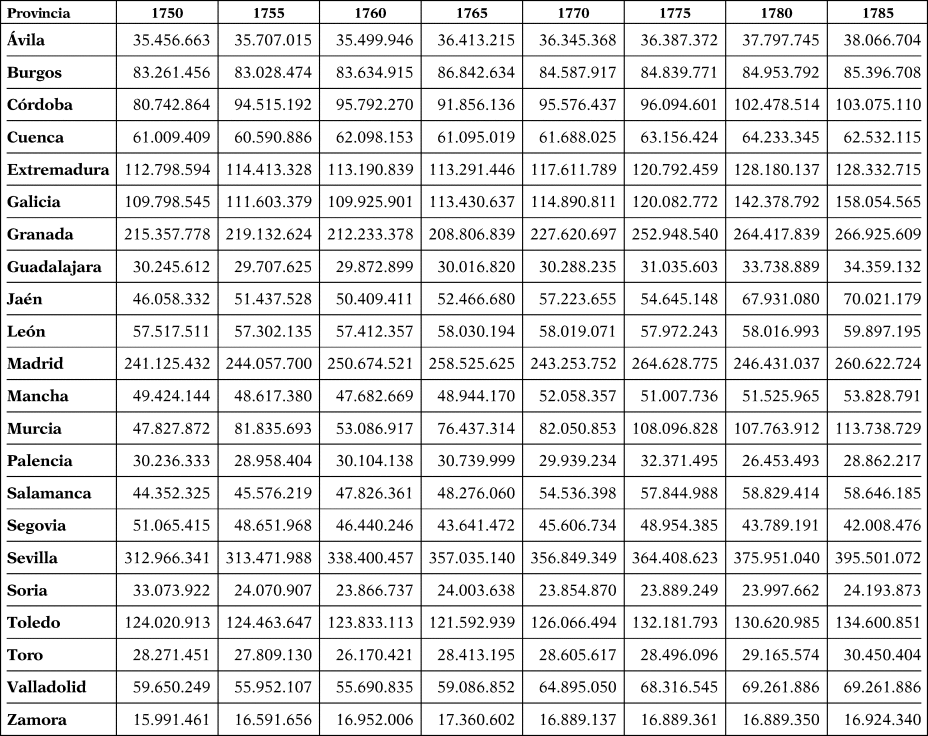
Su fiabilidad reside en que los contadores y escribanos de dichas rentas habían certificado previamente que la relación era correcta. Es, por tanto, una de las fuentes más fiables ya que contienen un doble proceso de verificación. A partir de la misma se ha construido una base de datos con los valores líquidos de las recaudaciones de alcabalas y cientos de cada provincia (Tabla 1).
RECAUDACIÓN DE ALCABALAS Y CIENTOS EN LAS PROVINCIAS CASTELLANAS, 1750–1785

Fuentes: Elaborado a partir de la AGS, Dirección General del Tesoro, Inventario 24 (ver Fuentes)
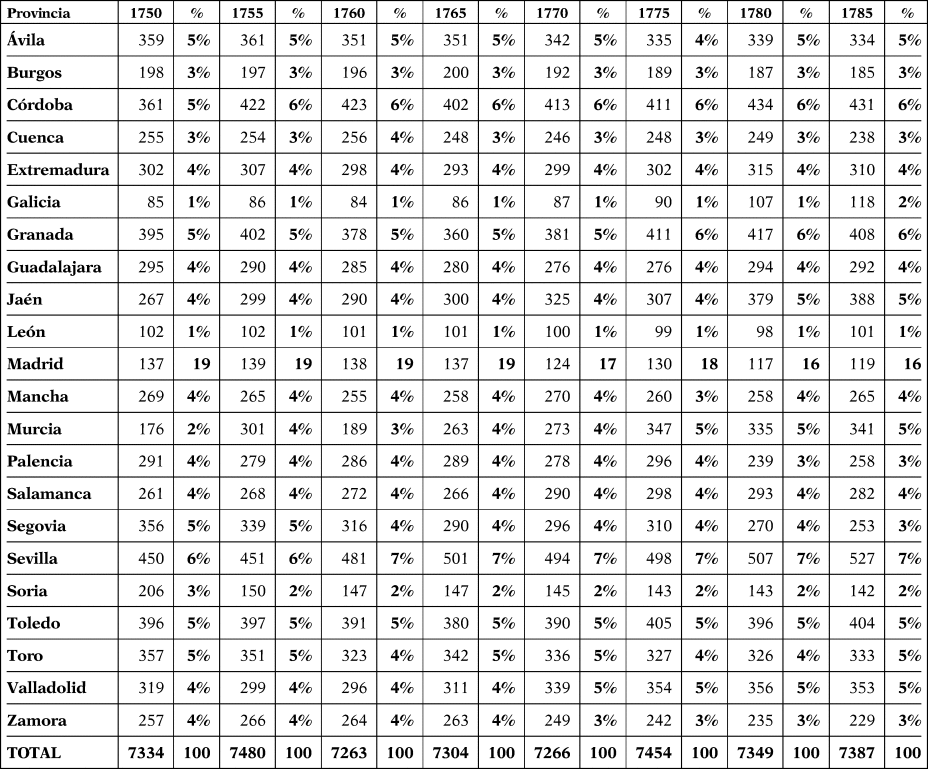
Los valores absolutos de los pagos se han corregido en función de la población de cada provincia según el Catastro de Ensenada, donde se informaba del número de vecinos. La traducción de los vecinos al número de habitantes no está exenta de dificultades. Unas veces se registraron los hogares, otras veces las estimaciones podían contarse redondeando su número. Hemos utilizado la estimación realizada por el INE (1986) basada en el uso de lo comúnmente aceptado. El coeficiente de conversión de vecinos en habitantes varía en cada provincia, aunque se sitúa en torno al 3,9. Se ha calculado considerando las personas que vivían en el hogar familiar y el número de clérigos seculares y regulares. La evolución de los datos demográficos se ha realizado según la información demográfica del censo de Floridablanca (1787). Se considera el censo de la verdadera modernidad estadística por la universalidad y uniformidad en la elaboración de los datos y la simultaneidad en la recogida de información (Pérez Moreda, Reference Pérez Moreda2010). De acuerdo con la población de cada provincia, la tabla 2 muestra la evolución del consumo per cápita para cada 5 años en la segunda mitad del siglo.
EVOLUCIÓN PROVINCIAL DE LAS RECAUDACIONES PER CÁPITA DE ALCABALAS Y CIENTOS, 1750–1785

Fuentes: Las mismas que en la tabla 1 (ver Fuentes), Censos de población (INE)
De nuestra relación se observa que las recaudaciones se incrementaron en términos nominales en Castilla mientras que lo hizo en menor proporción la población, aunque con desigual evolución en las distintas provincias. Crecieron los ingresos por estos conceptos en valores absolutos en la provincia de Madrid –a un ritmo de un 2,51% anual- aunque advertimos un importante crecimiento poblacional (25%), un 0,63% anual. Al margen de la peculiaridad de la capital, le siguen a distancia Jaén y Galicia, que superan el crecimiento anual del 1% en sus recaudaciones de alcabalas y cientos. Los ingresos en términos absolutos fueron del 52% y 44% respectivamente, con solo ligeros incrementos demográficos. La capacidad de consumo debió ser, por tanto, mayor, puesto que no se advierte mayor eficacia recaudatoria en los años descritos. Esto parece confirmar la tesis expuesta por Andrés Ucendo y Comín Comín (Reference Andrés Ucendo and Comín Comín2021) que describen un crecimiento de los ingresos de la Corona en la segunda mitad del siglo XVIII en términos nominales y constantes, impulsada desde la década de 1760 -y al menos hasta 1793- por la expansión de los ingresos ordinarios, si bien es cierto que su análisis incorpora más tipos impositivos (todos los ordinarios). Esta evolución es coherente con los datos presentados en la investigación de Prados de la Escosura et al. (Reference Prados de la Escosura, Alvarez-Nogal and Santiago-Caballero2021) que demuestran un crecimiento del PIB per cápita en el siglo XVIII, en la misma línea que otros países de Europa (Hoffman et al., Reference Hoffman, Jacks, Levin and Lindert2002; Alfani, Reference Alfani2021).
En nuestro análisis, no encontramos uniformidad en todas las provincias. Desde el interior de Castilla, Segovia y Soria disminuyeron su aportación a la Hacienda Real: un 17% y un 26%, (un decrecimiento del 0,5% y 0,9% anual), pero con un incremento de la población: 16% y 6% respectivamente, lo que muestra una menor capacidad de consumo. En definitiva, con los datos que figuran en la tabla 1 y 2, podemos afirmar que las recaudaciones de alcabalas y cientos en términos absolutos para toda Castilla aumentaron un 19,52% mientras que la población lo hizo en un 10%. Si relativizamos esas recaudaciones de consumo con la población existente, el crecimiento de estas rentas fue de un 8,71% pero con desigual evolución de modo que provincias como Murcia aumentaron su aportación a la Hacienda por estos conceptos un 94%, mientras que Soria redujo su consumo en más del 31%.
4. METODOLOGÍA
La metodología aplicada se puede estructurar en las siguientes fases para conseguir los objetivos definidos en esta investigación. En primer lugar, una vez realizado un análisis descriptivo del proceso de recaudación, se ha llevado a cabo una regresión lineal con MCO para conocer qué factores de los aportados por la Real Junta de Única Contribución explican la recaudación por habitante en 1770. La expresión del modelo es:
 $$ \eqalign{& {\rm Recaudaci\hskip 2.2pt {^^ {\vskip2pt \prime} \hskip-5pt o n} \ per\ c {^^ {\hskip2pt \vskip2pt \prime } \hskip-4pt a} pit}{\rm a}_{\rm i} = \alpha + \beta _ 1\,{\rm Productividad\ de\ la\ tierr}{\rm a}_{\rm i} \cr &+ \beta _ 2{\rm Productividad\ del\ ganad}{\rm o}_{\rm i} + \beta _ 3{\rm Productividad\ del\ trabajo\ } + \cr & \beta _ 4{\rm Proporci\hskip 2.1pt {^\prime} \hskip-5pton\ de\ las\ rentas\ de\ los\ terrenos\ sobre\ el\ tota}{\rm l}_{\rm i} \cr &+ \beta _ 5{\rm Poblaci \hskip2pt{^\prime} \hskip-5pto n\ activ}{\rm a}_{\rm i} + \beta _ 6{\rm Poblaci \hskip2pt {^\prime} \hskip-4pt \rm on\ rura}{\rm l}_{\rm i} + \varepsilon _{\rm i}} $$
donde i (i = 1, … 22) se refiere a la provincia, α es la constante del modelo, β revela el coeficiente de cada una de las variables explicativas y ɛ es el término del error. La estimación del modelo persigue identificar las variables independientes que explican la recaudación per cápita en Castilla con el propósito de emplear las variables significativas al 95% para caracterizar los conglomerados de provincias. Ello nos permitirá, por un lado, conocer la fuente de desigualdad en los grupos definidos y, por otro lado, examinar el grado de desigualdad en grupos de provincias con unas características más homogéneas.
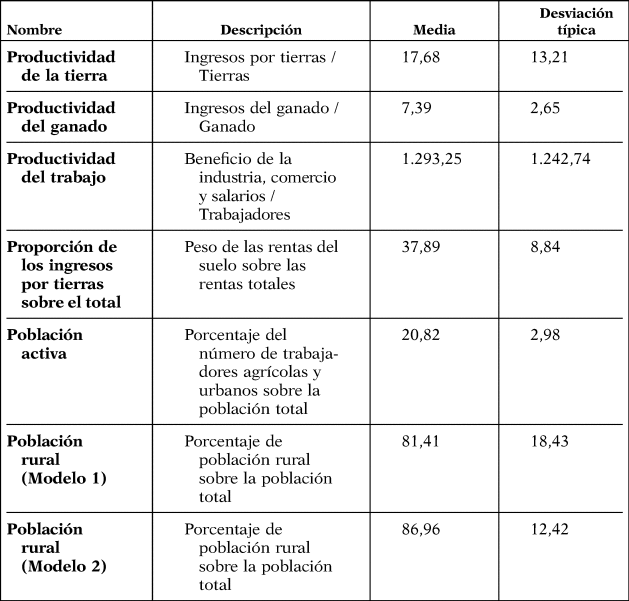
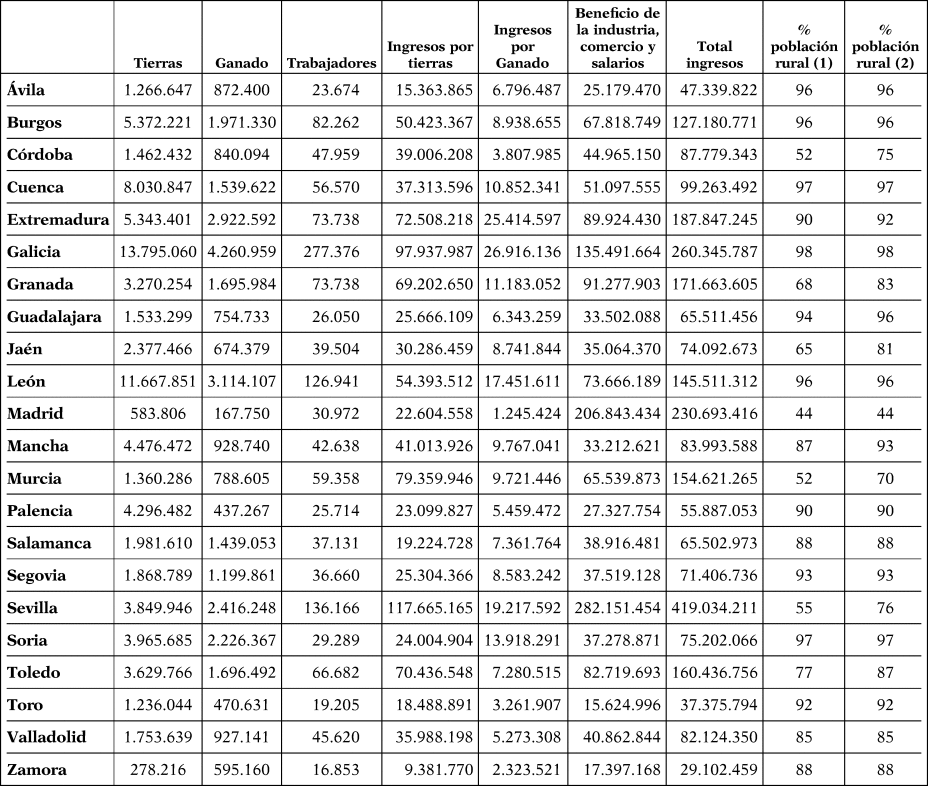
Las variables explicativas (Tabla 3) han sido calculadas a partir de las proporcionadas por el informe sobre el Estado de la renta de las 22 provincias de Castilla (Tabla 4). Dicho estado se corresponde con la documentación de la “Real Junta de Única Contribución”, órgano administrativo creado por Fernando VI en 1749 para establecer la reforma fiscal en Castilla. La Junta se encargaba de analizar la riqueza, evaluar los bienes, las rentas y las cargas en los territorios de Castilla. El resultado de esta investigación era el estado de los productos de las 22 provincias de la Corona (AHN, Hacienda, MPD 11). El informe responde a la información remitida por cada provincia según los mapas generales del Catastro de Ensenada. Se recogen las medidas de tierra seculares y eclesiásticas, el número de cabezas de ganado y el número de artesanos y jornaleros. Se incluyen, además, el producto de la tierra (tierras en producción, puesto que el informe las asocia a los rendimientos obtenidos), de la industria, del ganado, del comercio y de los jornales. Los datos utilizados en el trabajo corresponden a la conclusión de la realización del Catastro del Marqués de la Ensenada (1749–1770).
ESTADÍSTICOS DESCRIPTIVOS DE LAS VARIABLES UTILIZADAS EN LA REGRESIÓN LINEAL

Fuentes: Elaborado a partir de AHN, Hacienda, 11
VARIABLES EXPLICATIVAS DEL CONSUMO PER CÁPITA (EN REALES)

(1) Modelo 1: Población urbana cuando el municipio tiene más de 5.000 habitantes más capitales de provincia
(2) Modelo 2: Población urbana compuesta por localidades con más de 5.000 habitantes, cuya población activa no agraria sea inferior al 50% del total de la población activa o cuyo número de artesanos, comerciantes y fabricantes sea mayor de 2.000 o más de 4.000 trabajadores en los sectores secundario y terciario (Llopis Agelán, E. & González Mariscal, M. (Reference Llopis and González-Mariscal2006)).
Fuentes: Elaborado a partir de AHN, Hacienda, 11
La selección de las variables explicativas, en una sociedad eminentemente agraria, radica en el hecho de que la tierra y su producción son factores básicos para contemplar la riqueza de una región (Rosés et al., Reference Rosés, Martínez-Galarraga and Tirado2010). El número de fanegas se incorpora al modelo, así como su producción en reales. Nos acercamos a la productividad de la tierra y de forma comparativa en todas las provincias. Si bien es cierto que el tamaño de las explotaciones supondría una variable de inmenso valor, no tenemos la información que nos detalle la dimensión, tan solo podemos establecer la proporcionalidad con el número de trabajadores, lo cual supone una aproximación por las necesidades de mano de obra en cada espacio de cultivo. El valor de la ganadería es secundario, como demuestra su aportación al valor total de la renta provincial. Su productividad se ha analizado considerando el número de cabezas de ganado y su contribución a dichas rentas. Otros autores incorporan variables similares con el objetivo de explicar la desigualdad en el siglo XVIII, pero relativas a la desigualdad individual (Espín-Sánchez et al., Reference Espín-Sánchez, Gil-Guirado and Giraldo-Paez2019; Fernández y Santiago Caballero, Reference Fernández and Santiago-Caballero2018; Nicolini y Ramos Palencia, Reference Nicolini and Ramos Palencia2016; Santiago Caballero, Reference Santiago-Caballero2011).
La utilización de la variable población rural responde a que permite hacer comparaciones entre distintas regiones y facilita el análisis, eso sí, incorpora la dificultad de delimitar qué es un núcleo rural y urbano. De ordinario, en estudios de demografía de España en el siglo XVIII se ha incorporado el criterio numérico, considerando urbanas las poblaciones de más de 5.000 o 10.000 habitantes más las capitales de provincias, puesto que estas asumen actividades típicamente definidas como tales pese a su menor tamaño (Pérez Moreda y Reher, Reference Pérez Moreda and Reher2003). Este criterio se asume en el modelo 1. Además, se ha utilizado el modelo 2 uniendo los conceptos de capitalidad, dimensión y estructura ocupacional (Llopis Agelán y González Mariscal, Reference Llopis and González-Mariscal2006). Con ello, se limita la distorsión que supone valorar grandes centros rurales –agrociudades- como población urbana (ver Tabla 4). En cualquier caso, incorporando esta variable así conformada, se puede comprobar que los resultados no difieren en cuanto a variables significativas (se ha utilizado el modelo 2 para definir los conglomerados). Tampoco se han utilizado los matices que existirían si evaluásemos la existencia de una producción para el consumo propio, puesto que al analizar la desigualdad en base a las transacciones, esta queda fuera del análisis. Asumimos que una parte de la producción de las zonas rurales pudiera destinarse al consumo familiar, por lo que los consumos en algunas zonas podrían estar infravalorados, entendiendo que tampoco supondrían una modificación importante de nuestros resultados.
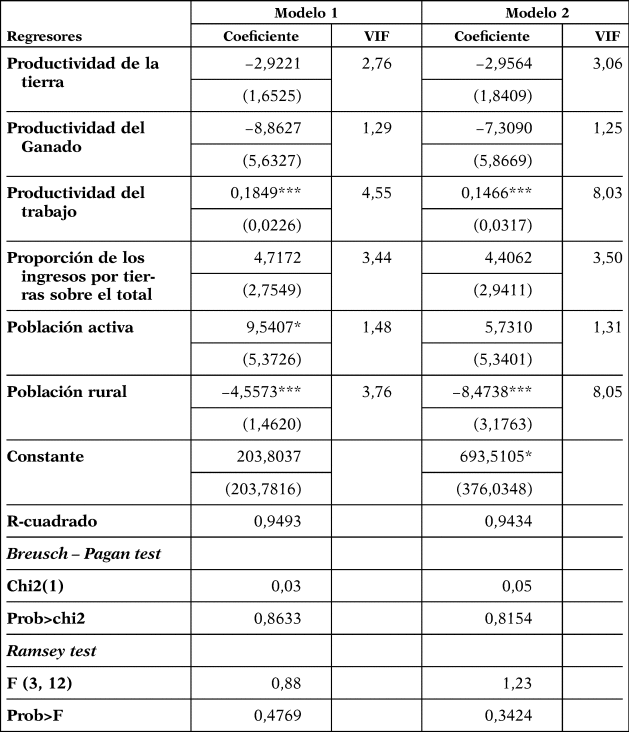
Por la similitud de los resultados de los modelos de regresión definidos, el diagnóstico de los modelos se planteará analizando el modelo 2. En primer lugar, no se produce multicolinealidad considerando que los factores de inflación de la varianza de los factores explicativos (ver tabla 5) y el VIF conjunto (4,20) están por debajo de 10. Los modelos no presentan problemas de heterocedasticidad considerando los valores obtenidos en la prueba de Breusch-Pagan /Cook-Weisberg (χ21 = 0,05; Prob > chi2 = 0,8154). La especificación de los modelos es correcta según los resultados de la prueba RESET de Ramsey (F (3, 12) = 1,23; Prob > F = 0,3424). Además, la inexistencia de poder explicativo de la predicción cuadrada (p-valor = 0,130) evaluada a través de la prueba “linktest” confirma que la especificación del modelo es correcta. Finalmente, la prueba de normalidad de Shapiro-Wilk (p-valor = 0,4999) determina que los residuos se distribuyen normalmente.
REGRESIÓN LINEAL CON OLS

Los errores estándar figuran entre paréntesis: * p < 0,10; ** p < 0,05; ***; p < 0,01
Fuentes: Calculado a partir de AGS, DGT, I.24, Censos de población (INE) y AHN, Hacienda, 11.
De acuerdo con los resultados obtenidos en ambos modelos de regresión, se ha aplicado la técnica estadística multivariante de análisis clúster con el fin de estratificar y agrupar las provincias castellanas en grupos homogéneos. Las variables de control utilizadas para caracterizar los grupos se seleccionan en función de la capacidad explicativa de las variables incluidas en el modelo de regresión estimado en la primera etapa (Tabla 5). Así, la significación estadística del 95% en ambos modelos de la productividad de la mano de obra y la población rural apoyan su uso como variables de control y caracterización de los grupos provinciales.
Se aprecia que a mayor productividad del trabajo más recaudación. Por el contrario, la población rural incidía negativamente en la misma lo que justifica las grandes diferencias que se producían entre entornos urbanos y entornos rurales. Estos resultados están en consonancia con investigaciones que afirman que la concentración de la población en determinados entornos tuvo importantes implicaciones económicas debido a los mayores salarios, impulsados por la mayor productividad de estas zonas, y a la contribución directa de mejores niveles de vida (Ayuda et al., Reference Ayuda, Collantes and Pinilla2010; Ciccone y Hall, Reference Ciccone and Hall1996).
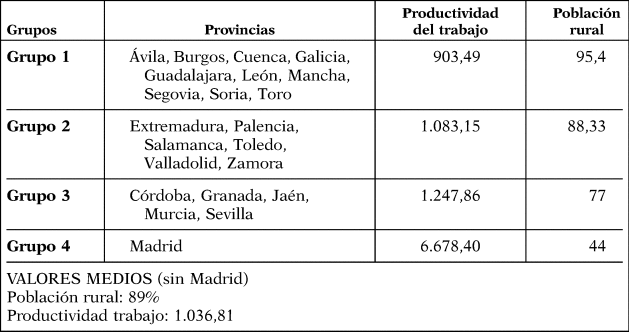
La medida de asociación elegida para medir la disimilitud entre las provincias es la distancia euclidiana. Las dos variables seleccionadas están tipificadas para evitar que su rango y sus diferentes unidades de medida distorsionen esta distancia. Como técnica de clustering se ha elegido el algoritmo de partición “k-medias”, ya que es comúnmente utilizado en el ámbito científico y es fácil de implementar. El pseudoíndice de Calinski-Harabasz - F (109,30) y el examen gráfico del “Elbow plot” determinan que el número óptimo de clúster es de cuatro. La tabla 6 indica la composición y la media de las variables caracterizadoras en cada uno de los grupos obtenidos:
COMPOSICIÓN Y CARACTERIZACIÓN DE LOS CONGLOMERADOS (MODELO 2)

Fuentes: Elaborado a partir de AHN, Hacienda, 11
El grupo 1 se caracteriza por una baja productividad laboral y un muy alto volumen de población rural sobre el total (95%). De todas las provincias que integran este grupo, son Galicia, tomada como provincia, y León las que tienen un nivel más bajo de productividad laboral, basada en la disponibilidad de espacios en relación con su población. La tradición ganadera es persistente, además, en otras provincias como Cuenca, con niveles próximos. La diversidad de este grupo es alta. Hemos de destacar provincias como Ávila, Soria y Guadalajara, e incluso Segovia, cuyo peso de población rural es muy alto (96–97%) que nos hace incluirlas en este conglomerado pese a su mayor productividad laboral. La composición de este grupo nos hace destacar la tradición manufacturera de la mayoría de las capitales, que marcan su evolución pese al peso importante de su zona de influencia agraria. Completan este grupo con menores valores de productividad, pero manteniendo la alta tasa de población agraria, la enorme provincia de Burgos (que incluye a Cantabria y a la Rioja), La Mancha y Toro.
El Grupo 2 se caracteriza por una productividad laboral y un porcentaje de población rural situados en los valores medios de todo el territorio castellano. Son provincias que mantienen la población concentrada en la capital, con tradición artesanal, como alguna de las que integran el grupo anterior, pero con una población rural en la provincia algo menor sin llegar a superar el 90%. Palencia, Salamanca y Toledo marcan características similares. Extremadura, con los más altos porcentaje de productividad del trabajo, se incluye en este grupo atendiendo a la proporción de población ocupada en el sector agrario y ganadero ya citada.
El Grupo 3 se define por una alta productividad laboral y un porcentaje de población rural (77%) por debajo de la media de Castilla. Andalucía y Murcia integran este grupo caracterizado por la alta comercialización relacionada por su relación con los puertos de salida hacia América y con reclamaciones crecientes de los trabajadores agrarios, canalizadas fundamentalmente por los intendentes provinciales ante el Consejo de Castilla. Así las provincias de Córdoba, Sevilla y Murcia son las que tienen el mayor porcentaje de población urbana incluso restándoles aquellos grandes núcleos cuya estructura ocupacional es básicamente rural (73%). De ellas, es Sevilla la que tiene un índice más alto de productividad del trabajo. En los mismos márgenes de estos indicadores se sitúan Granada y Jaén, si bien con mayor protagonismo de la población rural, por su menor vinculación con el comercio exterior.
Por último, las condiciones específicas de la provincia de Madrid, con un alto grado de urbanización y de concentración demográfica, llevan al análisis de clúster a definirla como Grupo 4.
En base a los clústeres obtenidos, se han calculado las medidas de desigualdad tradicionalmente utilizadas en la literatura económica para todas las provincias de Castilla y para los conglomerados definidos en la segunda fase a partir de las 176 observaciones obtenidas. Muchos estudios han utilizado el coeficiente de Gini o el índice de Theil para conocer la desigualdad de la renta y la riqueza de países o regiones (Alfani, Reference Alfani2010; Santiago-Caballero, Reference Santiago-Caballero2011; Reis, Reference Reis2017; Bengtsson et al., Reference Bengtsson, Missiaia, Olsson and Svensson2018, Fernández y Santiago-Caballero, Reference Fernández and Santiago-Caballero2018). Considerando la heterogeneidad que existe entre el consumo per cápita de las provincias de Castilla, hemos usado en ambos índices la ponderación de la población de cada una de las provincias para evitar la distorsión que puede producirse por esa disparidad (Zubarevich y Safronov, Reference Zubarevich and Safronov2011). Aunque es cierto que los índices ponderados no reflejan la desigualdad personal en un territorio, tienen las ventajas de aproximarse mejor a ese concepto que las medidas de desigualdad sin ponderar (Milanovic, Reference Milanovic2005) y reflejar el papel que juega en la evolución de la desigualdad regional los cambios en el tamaño de la población (Mussini, Reference Mussini2017).
El coeficiente de Gini mide cuánto se aleja la distribución del consumo de las provincias españolas de una distribución equitativa, con un rango de variación entre 0 (igualdad) y 1 (máxima desigualdad). Gluschenko (Reference Gluschenko2018) define el coeficiente de Gini ponderado por la población (Gp) como:
 $$G_p = \displaystyle{{\mathop \sum \nolimits_{i = 1}^m \mathop \sum \nolimits_{k = 1}^m n_in_k \mathop \sum \nolimits y_i - y_k} \over {2{\bar{y}}_{( p ) }}}$$
i = 1,2, … m se refiere a las provincias, yi e yk indican la renta per cápita de las provincias i y k,  $\bar{y}\;$ es la media aritmética de la renta per cápita de todas las provincias, ni y nk son la proporcióne las provincias en el total de la población nacional e
 $\bar{y}_{( p ) }\;$ es la media ponderada de las rentas per cápita provinciales.
La segunda medida calculada es el índice de Theil, que mide “la divergencia entre la participación del consumo y la participación de la población y pondera estas divergencias por las proporciones del consumo” (Goerlich y Villar, Reference Goerlich and Villar2009). Este índice, que toma valor 0 cuando la distribución es equitativa, es definido por Gluschenko (Reference Gluschenko2018) como:
 $$Th_p = \mathop \sum \limits_{i = 1}^m n_i\displaystyle{{y_i} \over {{\bar{y}}_{( p ) }}}ln\left({\displaystyle{{y_i} \over {{\bar{y}}_{( p ) }}}} \right)$$
donde m es el número total de individuos, yi es la renta de la provincia i,  $\overline {y\;} $es la media aritmética de la muestra de provincias e
 $\bar{y}_{( p ) }$ es la media ponderada de las rentas per cápita provinciales.
A partir de los grupos de provincias creados, la propiedad de descomposición aditiva del índice de Thei. n permite averiguar si la desigualdad se origina entre los grupos o dentro de cada gru. xesión de la descomposición de este índice es:
 $$T = \mathop \sum \limits_{g = 1}^G \displaystyle{{m_g{\bar{y}}_g} \over {m\bar{y}}}\mathop \sum \limits_{i = 1}^{m_g} \displaystyle{{y_i^g } \over {m_g{\bar{y}}_g}}log\displaystyle{{y_i^g } \over {{\bar{y}}_g}} + \mathop \sum \limits_{g = 1}^G \displaystyle{{m_g{\bar{y}}_g} \over {m\bar{y}}}\log \displaystyle{{{\bar{y}}_g} \over {\bar{y}}}$$
Aplicado a esta investigación, mg es el número de individuos de cada grupo,  $\bar{y}_g$ es el consumo medio per cápita del grupo e
 $y_i^g $ es el consumo per cápita del individuo i del grupo g. Además, si designamos
 $T_I = \mathop \sum \limits_{g = 1}^G {{m_g{\bar{y}}_g} \over {m\bar{y}}}\mathop \sum \limits_{i = 1}^{m_g} {{y_i^g } \over {m_g{\bar{y}}_g}}log{{y_i^g } \over {{\bar{y}}_g}}$ y
 $T_E = \mathop \sum \limits_{g = 1}^G {{m_g{\bar{y}}_g} \over {m\bar{y}}}\log {{{\bar{y}}_g} \over {\bar{y}}}$, el índice de Theil puede definirse como T = TI+ TE, donde TI se refiere a la desigualdad dentro de cada grupo y TE a la desigualdad entre los grupos definidos. Se han utilizado métodos de bootstrap para estimar los intervalos de confianza en los cálculos del coeficiente de Gini y del índice de Theil.
5. RESULTADOS Y DISCUSIÓN
La utilización del coeficiente de Gini y del índice de Theil ponderado por la población ha servido para conocer, por un lado, cómo evolucionó el nivel de desigualdad regional en Castilla en la segunda mitad del siglo XVIII y, por otro, si hubo diferencias en el nivel de desigualdad entre subconjuntos de provincias. Estas técnicas se han aplicado sobre el nivel de vida de los habitantes de las distintas provincias, calculado a partir de registros fiscales que nos indican la capacidad de consumo y, por tanto, el capital disponible. El crecimiento de las rentas destinadas al consumo en algunas de las provincias españolas revela la existencia de proyectos de reforma e inversión relacionados con el pensamiento ilustrado. La necesidad de transformación era evidente, como se puso de manifiesto, por ejemplo, tras los levantamientos que tuvieron lugar en varias ciudades castellanas en 1766. Desde entonces, las actuaciones de los gobernantes ilustrados se dirigieron a modernizar aquellos sectores en los que podían intervenir sin alterar las bases del Antiguo Régimen.
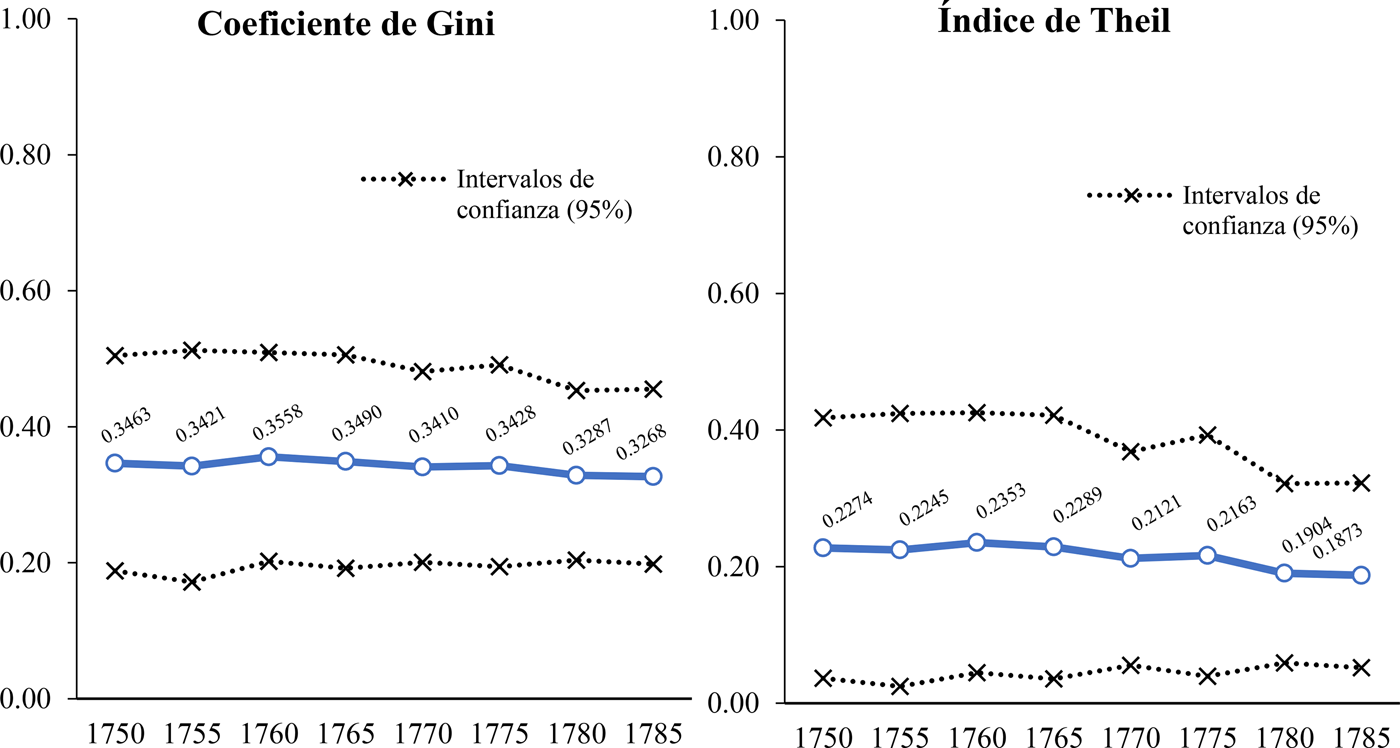
El nivel de desigualdad regional en Castilla se mantuvo relativamente constante entre 1750 y 1785 (Figura 1). El coeficiente de Gini se mantuvo prácticamente constante entre 1750 (0,3463) y 1785 (0,3268) en Castilla, alcanzando el mayor nivel de desigualdad en 1760 con un coeficiente de 0,3558. Así, la evolución del índice de Theil para el conjunto de provincias muestra una evolución similar, aunque con valores significativamente más bajos (rango de variación entre 0,2353 en 1760 y 0,1873 en 1785).
COEFICIENTE DE GINI E ÍNDICE DE THEIL, 1750–1785
Fuentes: Calculado a partir de la AGS, DGT, I.24 (ver Fuentes), Censos de población (INE)

El análisis de los mínimos cambios en ambos índices debe ser considerado con cierta cautela. Aunque es cierto que los intervalos de confianza, para ambos índices, obtenidos por el método Bootstrap, sugieren que dichos cambios no fueron estadísticamente significativos al 95%, la gran amplitud de los intervalos de confianza, que evidencia ausencia de significación estadística respecto a la evolución de la desigualdad, se genera por el pequeño tamaño de la muestra de población.
Los factores que explican la evolución de esa desigualdad regional permiten expresar que las reformas de los ilustrados -ya fuera sobre la construcción de la red de caminos, el establecimiento de regadíos, la implantación de una legislación favorable a arrendatarios o la creación de las Nuevas Poblaciones de Sierra Morena- apenas tuvieron incidencia sobre el despegue de provincias más atrasadas, como tampoco hubo un mayor distanciamiento de las castellanas que ya mostraban un mayor crecimiento en el siglo XVIII. En esta línea se muestra Santiago-Caballero (Reference Santiago-Caballero2013) cuando ofrece una visión de constancia en los rendimientos agrarios en este período en Castilla, de modo que los contrastes entre provincias no variaron. Su estudio incide en que la modernización de la agricultura que provoca cambios en la desigualdad provincial no se produjo hasta mediados del siglo XX. Otros estudios sobre la desigualdad regional en España confirman esta evolución para el siglo XIX en España (Rosés et al., Reference Rosés, Martínez-Galarraga and Tirado2010; Tirado et al., Reference Tirado, Díez-Minguela and Martínez-Galarraga2016; Ayuda et al. Reference Ayuda, Collantes and Pinilla2010; Beltrán Tapia y Martínez-Galarraga, Reference Beltrán Tapia and Martínez-Galarraga2020).
A pesar de la evolución constante de la desigualdad en el periodo de análisis, los cambios más acusados se produjeron en 1760 y 1780. La desigualdad regional se acrecentó levemente entre 1755 y 1760, siendo el coeficiente de Gini un 4% más elevado, relacionándose con los cambios en la producción agraria, de modo que una serie de malas cosechas conllevó alteraciones de desigualdad (Anes, Reference Anes1973). Esta estabilidad en la desigualdad del consumo refleja las dificultades económicas que afectaron a las provincias de Castilla derivadas de las pérdidas de las cosechas. Las quejas llegadas al Consejo de Castilla reclamando medidas que facilitaran el acceso a la tierra y la moderación de sus precios, se acentuaron entre 1755 y 1760. De hecho, la supresión de la tasa de grano de 1765 no fue sino una respuesta de Campomanes, presidente del Consejo, a dichas peticiones. A partir de 1770 la moderación de los precios fue también garantía de un mantenimiento bajo de los índices de desigualdad, mostrado por la medición de ambos índices. A partir de 1780, la inequidad regional se ve reducida mínimamente, evidenciada a través de una reducción del índice de Theil del 12%.
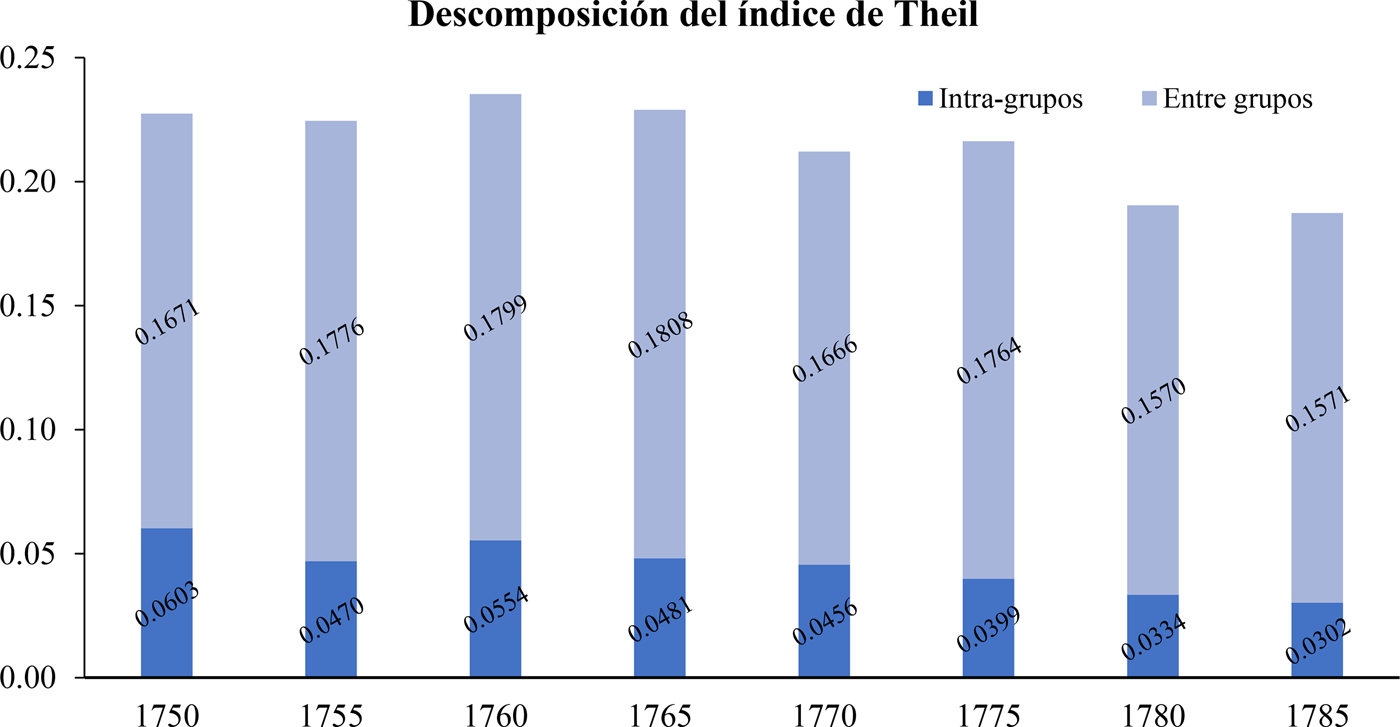
El análisis de desigualdad regional a partir de los conglomerados creados con la técnica estadística de análisis clúster (Tabla 6) muestra que la desigualdad regional en Castilla a lo largo del siglo XVIII se debió en mayor proporción a las diferencias en el nivel de desigualdad entre cada uno de los cuatro grupos de provincias. La descomposición del índice de Theil indica que la inequidad entre los cuatro grupos de provincias supuso entre un 73,5% (1750) y un 83,9% (1785) de la inequidad regional en Castilla (figura 2).
DESCOMPOSICIÓN DEL ÍNDICE DE THEIL, 1750–1785
Fuentes: Calculado a partir de la AGS, DGT, I.24 (ver Fuentes), Censos de población (INE)

Este predominio de la desigualdad entre grupos como fuente de inequidad en relación con el índice de Theil se explica por el efecto de Madrid como grupo sobre el índice general. Las condiciones específicas de esta provincia hacen que el análisis clúster la defina como uno de los grupos. Esto no permite obtener las medidas de desigualdad en dicho grupo (grupo 4).
En el análisis del consumo per cápita, Madrid se diferencia del resto de las provincias y no comparte características significativas de ninguna otra. Ello está estrechamente relacionado con la presencia de un gran sector de servicios en esa región y por el efecto de capitalidad de la nación, proceso que siguió marcándose en los siglos XIX y XX (Rosés et al., Reference Rosés, Martínez-Galarraga and Tirado2010; Pons y Tirado, Reference Pons and Tirado2008; Ayuda et al. Reference Ayuda, Collantes and Pinilla2010). No obstante, la tendencia de los ingresos en Madrid se aminoró en el período analizado, lo que explicamos por la tendencia a la baja de los salarios de los trabajadores no cualificados en la ciudad (Llopis y García-Montero, Reference Llopis and García-Montero2011). No obstante, pese a la evolución puntual descendente de las recaudaciones, hemos de señalar que el consumo per cápita fue significativamente superior a la del resto de las provincias. Madrid concentró gran parte del comercio peninsular. De hecho, el abastecimiento de la capital se convirtió en uno de los principales objetivos de los gobernantes. La dotación de nuevas carreteras, por ejemplo en 1761, respondió a esta necesidad, consolidándose el modelo de infraestructuras radial. Al mismo tiempo, ya existían flujos mercantiles que cruzaban las mesetas desde la periferia para evitar la escasez de la capital. La venta en la corte actuaba como elemento de impulso de la producción (Anes, Reference Anes1975). También se generaron grandes acumulaciones de capital (García Sanz, Reference García Sanz and Fernández1985). Todo ello justifica el dinamismo de Madrid y las cifras diferenciales en cuanto a recaudación que se muestran en esta investigación. Este dinamismo fue, sin embargo, insuficiente para lograr la modernización del interior del país. A pesar de todo, estudios posteriores demuestran que la conexión entre Madrid y los puertos no se produjo por completo y que el mayor esfuerzo centralizador se realizó después de la época de la Ilustración (1790–1820) (Pablo-Martí et al., Reference Pablo-Martí and Alañón-Pardo2021).
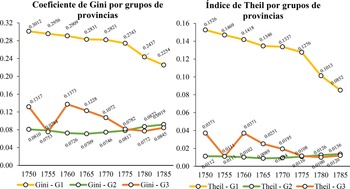
La estimación de los índices de desigualdad regional establecidos para cada uno de los grupos en esta aproximación empírica (Gini y Theil) revela resultados diferenciados entre los grupos 1, 2 y 3, que se presentan en la Figura 3. Aunque la desigualdad en el consumo per cápita en los tres grupos de provincias es pequeña, la evolución y los propios niveles de desigualdad de cada uno de los grupos indican que existen disimilitudes que deben ser examinarse con la misma cautela que la aplicada al análisis de los índices de desigualdad para Castilla en su conjunto.
DESIGUALDAD POR GRUPOS DE PROVINCIAS, 1750–1785
Fuentes: Calculado a partir de los datos obtenidos de la AGS, DGT, I.24 (ver Fuentes), Censos de población (INE) y AHN, Hacienda, 11.

El grupo 1 de provincias redujo ligeramente su inequidad regional entre 1750 y 1775, situando su coeficiente de Gini entre 0,30 y 0,27. Esta tendencia generalizada durante todo el período examinado se acentuó a partir de 1775 en este grupo, con una reducción de la desigualdad regional del 11% (Gini) y 21% (Theil) entre 1775 y 1780 y del 8% (Gini) y 16% (Theil) entre 1780 y 1785, lo que indica una ausencia de transformaciones que redundaran en un incremento de consumo per cápita, que permaneció muy baja en todo el período.
La inequidad regional registrada en este grupo se origina principalmente por la disparidad del consumo per cápita entre provincias como Galicia (92,8 reales de renta per cápita media), León (100,5 reales de renta per cápita media) o Soria y Burgos, con algo más de 150 reales de consumo medio con el resto de las provincias del grupo. Las restantes alcanzan, e incluso superan, los 300 reales. Ello se ve constatado con su participación del consumo per cápita respecto al total: la de León solo fue del 1% en todos los años analizados y la de Galicia de apenas el 2% en 1785. Sus rentas estaban condicionadas por su estructura productiva que hacía que sus ingresos fueran bajos y, por tanto, también lo era su consumo. La recaudación fiscal en estas extensas comarcas era baja, y no llegaba al 30% de la recaudación media de toda la Corona de Castilla. Como se observa al analizar el sistema de comercialización en particular en Galicia, contaban con una red de mercados semanales y mensuales que cubrían gran parte de sus necesidades. Esto implicaba un comercio permanente menos frecuente (López, Reference López2004). Parte de su consumo debía estar cubierto por la propia producción, signo de una sociedad menos modernizada. El predominio de una economía señorial en Galicia, donde el 90% de la población vivía en territorios señoriales (Saavedra, Reference Saavedra2019), permite advertir que gran parte de los excedentes de renta se entregaban a los señores del señorío y esto limitaba su poder de consumo. Esta estructura también afectó a las características de la población rural. Pérez Moreda (Reference Pérez Moreda1988) ha demostrado que Galicia era la región más sensible a las subidas de precios. Los años en los que el precio de los cereales se duplicó, la mortalidad adulta aumentó hasta un 86%, circunstancia que sólo se dio en esta región. Esto reduce, además, la relevancia de la existencia de un fuerte consumo propio que permitiera el mantenimiento de la población.
El período de mayor caída de la desigualdad entre las provincias que integran este grupo disminuyó más aún a partir de 1775, por un crecimiento de las recaudaciones y por tanto del consumo de las que estaban más atrasadas, fundamentalmente Galicia (31,62%), y la reducción de otras del interior, en particular Segovia y Soria. Las dificultades de la producción de la meseta se evidencian en estos años. Fueron años de agitación, alentados por la subida de los precios agrícolas y el aumento de la demanda de tierras que se tradujo en un incremento de la renta. Las roturaciones aumentaron en las mesetas sin que se produjera un aumento de los rendimientos (Anes, Reference Anes1973). En esos años se muestra la mayor caída de consumo de provincias del interior, lo que incide en ese acercamiento a provincias de menor renta. Los testimonios de la época hablan del difícil acceso a Segovia, por ejemplo, por la falta de carreteras en buen estado. Se diseñaron nuevas rutas, pero no hubo financiación para ellas (Larruga, Reference Larruga1793). Estas dificultades de la provincia de Segovia se evidencian, asimismo, en la reducción de las recaudaciones de alcabalas y cientos de sus ferias en más del 30% en los años analizados (López, Reference López2004). No fue solo característico de esta zona. Otras del interior castellano se expresaron en la misma línea. Soria también quedó fuera de las principales vías de comunicación que desde Madrid comunicaban con Burgos y Bilbao. Jovellanos ya había criticado en su Informe sobre la Ley Agraria (1794) que los caminos habían quedado inconclusos, y que la escasez de caminos secundarios dificultaba la comercialización. No obstante, Segovia estaba orientando su sector productivo hacia la industria, tratando de incorporar innovaciones organizativas empresariales a su sistema industrial tradicional. Esto le había permitido iniciar una lenta recuperación de sus talleres artesanales (García Sanz, Reference García Sanz1996). Los efectos de estas innovaciones aún no repercutieron en incrementos en el consumo.
En el Grupo 2 (ver tabla 6), el rango de variación de los dos indicadores de desigualdad es mínimo, situándose entre 0,07–0,09 (Gini) y 0,009–0,014 (Theil), lo que indica que el nivel de desigualdad del consumo per cápita de las provincias que lo componen es muy bajo. Tan solo podemos observar un ligero crecimiento de la desigualdad a partir de 1780, pero con un escaso margen de variación. La existencia de un ascenso ligero de la desigualdad entre estas provincias es debido al incremento de rentas de provincias del interior como Salamanca y Valladolid. En estas provincias los pueblos más pequeños perdían dinamismo. Es cierto que en este grupo se están incluyendo provincias de economías distintas, economías básicamente agrarias a juzgar por el alto protagonismo de la población ocupada en estas tareas. Podemos identificar por un lado las provincias de la meseta norte (Valladolid, Zamora, Salamanca y Palencia) caracterizadas por una productividad de las actividades secundarias menor que la de Extremadura y Toledo, calculadas per cápita, pero con una población activa agraria en torno al 85%. Niveles similares de productividad presentan las provincias de Extremadura y Toledo si bien estamos ante una población activa urbana muy baja. Su estructura productiva agraria presenta diferencias en cuanto a estructura de la propiedad y explotación de la tierra con respecto a las anteriores, pero no en la escasa población urbana y en los niveles productivos de artesanos y comerciantes.
En el grupo 3 (Córdoba, Granada, Jaén, Murcia y Sevilla) el rango de variación de las medidas de desigualdad se cifra entre 0,08–0,14 (Gini) y 0,01–0,04 (Theil) (Figura 3), mostrando que la desigualdad entre las provincias es baja. La diferenciación de este grupo con respecto al resto puede basarse en el patrón de evolución expuesto entre 1750 y 1760. En estos años, el grupo experimentó una etapa de reducción de la desigualdad (1750–55) y crecimiento (1755–60) consecutivos: el coeficiente de Gini y el índice de Theil crecieron un 82% y un 236% respectivamente entre 1755 y 1760, tras unos años de caída. Esta marcada evolución se debe a la gran disparidad de consumo per cápita en Murcia durante la primera década del periodo estudiado. Las recaudaciones experimentaron un importante crecimiento, precisamente en los años 1750 y 1755, cuando se registra un mayor descenso de la desigualdad entre las provincias incluidas en el grupo.
La mayor productividad de la tierra gracias a las mayores tasas de regadío en las vegas de Murcia, Lorca y la Vega de Molina, junto con la incorporación de otros regadíos menores (Alhama, Totana y Cartagena) favorecieron el crecimiento de la población en estos años (37%) (Pérez Picazo y Lemeunier, Reference Pérez Picazo and Lemeunier1984). Asimismo, se detecta un incremento importante del consumo, de manera que se llega a igualar al consumo más elevado del resto de las provincias que integran el grupo, las de Andalucía (ver tabla 2). No obstante, el crecimiento del consumo de Murcia no fue constante. En opinión de Pérez Picazo y Lemeunier (Reference Pérez Picazo and Lemeunier1984), las clases sociales emergentes -comerciantes y agricultores ricos- pudieron impulsar aún más el crecimiento mediante la adquisición de tierras, pero el sistema de producción estaba limitado por la existencia de las tierras señoriales que bloqueaban la inversión. Es cierto que Murcia había sido objeto de políticas ilustradas y que se impulsaron importantes iniciativas en el sector agrario (protección de los bosques, resolución de conflictos hidráulicos…), pero habían sido insuficientes para aumentar ek rendun¡¡imiento de las explotaciones agrarias (Pérez Picazo y Lemeunier, Reference Pérez Picazo and Lemeunier1984). Las recaudaciones por consumo en la provincia volvieron a incrementarse desde 1775 (su peso en el total de Castilla se incrementó hasta el 5%). Murcia también se benefició del crecimiento de su puerto marítimo, el de Cartagena, principalmente como consecuencia de la liberalización del comercio en la República Dominicana en 1765, que le permitió comerciar directamente con América (AHN, Consejos, 1.588).
La Figura 3 muestra que este grupo 3 mantuvo una tendencia negativa en las dos medidas de desigualdad utilizadas desde 1760 a 1780, con una reducción del coeficiente de Gini y del índice de Theil del 44% y del 72% entre esos dos años respectivamente. La proximidad en el consumo de las provincias de Andalucía determina el bajo nivel de desigualdad, una vez explicado el descenso anterior. Hay que tener en cuenta que el grupo está constituido por dos provincias que mantuvieron en estos años una vinculación con el comercio americano. Sevilla, que incluye Cádiz, y Córdoba, con presencia de financieros y comerciantes con elevadas rentas personales, son las que presentan una mayor recaudación por consumo (valor medio de 489 reales). Por otro lado, las tierras, variable utilizada en nuestro análisis, tuvieron un alto rendimiento pese a que no desarrollaran en su totalidad el potencial existente (Llopis y González-Mariscal, Reference Llopis and González-Mariscal2010). En cualquier caso, se manifiesta un alto nivel de consumo en las dos provincias. Es en este período cuando se aproximan las rentas de estas provincias a las dos restantes andaluzas por el incremento de las recaudaciones en las de Jaén (un 45% mayor) y ligeramente en Granada (3%). Su proporción de población urbana, superior a la media, manifiesta la dedicación a actividades relacionadas con el sector textil, sobre todo en la seda, con una importante tradición. No apreciamos elevados índices de desigualdad entre estas provincias, pese a que pueden incluir una importante heterogeneidad en la composición de su estructura productiva con la concentración de población urbana en las principales ciudades (Granada o Málaga). Esto no afecta a la evolución de la desigualdad que, de forma agregada, no presenta niveles de desigualdad puesto que el peso de las rentas de la fuerza de trabajo era elevado, así como los rendimientos unitarios del trabajo.
Las provincias de Jaén y Córdoba fueron señaladas como objeto de inversiones ilustradas derivadas del Proyecto de Nuevas Poblaciones de Olavide (1767) que se realizaron juntamente con el inicio de la construcción de un nuevo camino real que debía conectar la capital sobre todo con Córdoba (RD 10 de junio de 1761: AHN, Hacienda, 8.022). Podría pensarse que estas nuevas inversiones se tradujeron en un incremento de la renta de sus habitantes y, por tanto, en mayores recaudaciones por consumo. De hecho, algunos autores hablan de un “cierto abaratamiento del transporte” (Llopis, Reference Llopis, Comín, Hernández and Llopis2002). No obstante, pese al esfuerzo del gobierno ilustrado, no encontramos una repercusión significativa de este hecho en la renta. Algunos investigadores sostienen que hubo un crecimiento lineal y no un auténtico desarrollo del capitalismo, sin las transformaciones estructurales como las relacionadas con la propiedad de la tierra (Fernández de Pinedo et al., Reference Fernández de Pinedo, Gil Novales and Dérozier1980). En cualquier caso, hubo una política económica bien orientada, pero sin éxito a largo plazo porque fue poco ambiciosa, y se enfrentó a muchos obstáculos como la propia estructura de la sociedad señorial (Llombart, Reference Llombart1994). Esto justifica que los niveles de renta apenas ofrezcan variaciones y que los niveles de desigualdad permanecieran constantes.
6. CONCLUSIONES
El trabajo que presentamos ofrece una visión de la desigualdad en Castilla en la segunda mitad del siglo XVIII medida a partir de la capacidad de consumo, calculada con las recaudaciones de dos rentas que supusieron los mayores ingresos fiscales del estado en este período: alcabalas y cientos.
Se puede destacar que la correlación positiva entre productividad del trabajo (medida a través del beneficio en la industria, comercio y salarios) y la recaudación de impuestos al consumo significa que las grandes diferencias se producían entre entornos urbanos y rurales.
La desigualdad regional presentó unos niveles reducidos y relativamente constantes durante la segunda mitad del siglo, y no se encuentran elementos que alterasen significativamente la diferencia entre regiones. Estos resultados están en línea con los alcanzados por Santiago-Caballero (Reference Santiago-Caballero2013) y Reis et al. (Reference Reis, Pereira and Martins2012). Así resulta tras la aplicación de los coeficientes de Gini e índice de Theil que muestran una desigualdad controlada en un margen pequeño (según el primero de 0,3463 a 0,3268 y el segundo de 0,2353 a 0,1873 entre 1750 y 1785). Hubo factores que pudieron alterar la desigualdad entre provincias, ya que es el siglo de las reformas ilustradas. Sin embargo, las actuaciones de estos no supusieron cambios profundos de transformación que incidiesen significativamente en una evolución distinta de la desigualdad, y no se observan grandes divergencias entre provincias ni tampoco a nivel individual (al ponderar por la población). No se trata de minusvalorar las reformas iniciadas, pero en nuestra opinión su repercusión fue menos significativa de lo esperado.
Un análisis preciso de la desigualdad nos permite, no obstante, señalar etapas de reducción y aumento de la desigualdad, afectadas por los acontecimientos económicos del siglo, en particular las crisis agrarias. El nivel de desigualdad fue mayor en los años de mayor incidencia de estas crisis, de modo que se concentran las variaciones de desigualdad al alza en los años previos a la supresión de la tasa de grano (1765). No hubo cambios significativos en el sector agrario que nos permitan hablar de mejoras en los rendimientos en los años subsiguientes. Antes bien, es conocido que la renta de la tierra se incrementó y que fueron más las diferencias individuales porque se acumuló riqueza en los propietarios de tierras. La medida de desigualdad ponderada que calculamos nos oculta esta diferenciación interpersonal, de modo que no observamos la divergencia entre personas.
El análisis de conglomerados revela que la desigualdad en Castilla se debió en mayor proporción a las diferencias de desigualdad en cada uno de los grupos de provincias. El consumo per cápita define en gran parte la agrupación y de esta forma destaca Madrid, con un intenso proceso de desarrollo del sector servicios, en torno a la capitalidad, diferenciándose del resto de Castilla.
Las provincias de la mayor parte de Castilla (grupo 1) tuvieron una desigualdad decreciente en los últimos años analizados mostrado en la aproximación del consumo de unas y otras. Así el crecimiento de algunas como Galicia, compensó la caída de las restantes como Segovia. En realidad, se podría hablar de una pequeña desigualdad que tiende a disminuir, dentro de la pobreza.
Las provincias que se distancian entre sí, con una desigualdad constante, aunque ligeramente creciente, se situaron en el interior castellano, donde encontramos diferencias de consumo basculadas hacia Valladolid y Salamanca, cuyo consumo empezó a despuntar. Creció, por tanto, el distanciamiento entre ellas y se inició un incremento de la desigualdad.
Las provincias más dinámicas (las de Andalucía y Murcia) no presentan tampoco una brecha de desigualdad entre ellas, tendiendo además a decrecer desde 1760. Muestran un crecimiento homogéneo si bien limitado. La explicación a una reducción de desigualdad en este grupo radica en el crecimiento de Murcia, Jaén y Córdoba, que se igualan a Sevilla y Granada. Por una parte, las Nuevas Poblaciones instaladas desde 1767 en Sierra Morena junto a algunos beneficios derivados de la mejora en la red caminera debieron incidir, aunque fuera ligeramente, en el crecimiento de las primeras de modo que se aprecia la convergencia en esas otras provincias caracterizadas por su vinculación al comercio exterior y su progresivo aumento del grado de urbanización. La confluencia de Murcia, por otra parte, está más vinculada a la repercusión de las tímidas reformas agrarias con la implantación de espacios de regadío.
En definitiva, podemos concluir que la desigualdad en Castilla presenta una línea homogénea y estable en el siglo XVIII en cuanto a la productividad del trabajo. Se advierten dificultades derivadas del sector agrario, con limitaciones a la producción y bajos rendimientos, junto a iniciativas reformistas. Estas actuaciones limitaron una mayor divergencia de la desigualdad puesto que incidieron acercando el consumo de algunas de las provincias a las que se dirigieron las reformas, pero esas actuaciones no fueron generalizadas. De este modo, se presentaron medidas generales (ley de construcción de caminos, leyes de arrendamientos) cuya repercusión no es perceptible para todas las regiones y no influyeron en el consumo per cápita entre los años 1750 y 1785.
La investigación presentada no está exenta de limitaciones. En primer lugar, la estratificación de las provincias mediante conglomerados deja una composición desigual de los cuatro grupos de provincias. En segundo lugar, parte de la desigualdad de la renta podría deberse a la desigualdad intraterritorial, no considerada en este trabajo. En este sentido, con respecto a una posible desagregación municipal, abordar esta investigación sería una tarea de gran dimensión para que alcance a toda Castilla, puesto que se trata de incorporar los valores de 15.000 municipios castellanos. Por último, hay que tener en cuenta la configuración de España en el siglo XVIII donde aún no se había producido una integración del mercado interior. En este siglo se introdujeron cambios iniciados por los ilustrados que no habían logrado la unificación pero que permiten hablar de una de una ligera cohesión del espacio por la uniformidad mayor de las instituciones y otros cambios legales, pese a las naturales diferencias.
La importancia de los resultados de esta investigación la convierte en un punto de partida para el análisis de la desigualdad regional en España, bastante desarrollado para el período posterior a 1850. Conocer los impuestos al consumo que estaban presentes hasta la reforma de Mon-Santillán (1845) es posible, ya que hasta ese momento todavía constituían una parte sustancial de los ingresos de la Hacienda Pública (más del 30%). Así, nuestra línea de investigación futura tendría como objetivo identificar el patrón de convergencia respecto a la desigualdad de las sociedades en los inicios de la industrialización.
AGRADECIMIENTOS
En este trabajo queríamos agradecer sinceramente la labor de los revisores, los cuales ayudaron con sus comentarios a mejorar nuestra propuesta inicial.
Queríamos, asimismo, extender nuestros agradecimientos a la directora de la revista, Blanca Sánchez-Alonso, y a la editora, Nuria Muñoz. Ambas pusieron el cuidado en el tratamiento de nuestro trabajo. También su contribución ha sido fundamental para enriquecerlo. Agradecemos el interés de todos ellos en analizar nuestro trabajo.
Por último, este trabajo ha requerido una intensa labor de investigación en el Archivo General de Simancas. Nos gustaría agradecer la acogida que nos dieron. Todos los que allí trabajan han sido imprescindibles para que nuestra tarea saliera adelante.