INTRODUCTION
The Asterocheridae and Artotrogidae, the most plesiomorphic families of the order Siphonostomatoida, are so closely related that some authors have pointed out the possibility that the Artotrogidae arose within the Asterocheridae (Boxshall & Hasley, Reference Boxshall and Halsey2004) and therefore the latter may be paraphyletic (Boxshall & Hasley, Reference Boxshall and Halsey2004; Johnsson & Neves, Reference Johnsson and Neves2004). There is not only a need for a comprehensive phylogenetic analysis of these families, but it is also necessary to revise the different asterocherid genera, since for more than a century Asterocheridae has been serving as a repository for genera and species which did not fit into other siphonostomatoidan families (Boxshall & Hasley, Reference Boxshall and Halsey2004). This has enlarged the heterogeneity of this family (Nair & Pillai, Reference Nair and Pillai1984; Boxshall & Hasley, Reference Boxshall and Halsey2004; Johnsson & Neves, Reference Johnsson and Neves2004). Although several attempts have been made to study the family as a whole (Sewell, Reference Sewell1949; Stock, Reference Stock1965, Reference Stock1975; Ummerkutty, Reference Ummerkutty1966), a thorough revision of the family is still to be undertaken. Asterocheres is the largest genus within Asterocheridae since it contains nearly 30% of the known species; however, many of these are poorly or incompletely described for reliable comparisons to be made (Stock, Reference Stock1966a; Ho, Reference Ho1984; Humes, Reference Humes1996a; Ivanenko & Smurov, Reference Ivanenko and Smurov1997; Kim, Reference Kim2004, Reference Kim2005). Most of these poorly known species have not been recorded since their original descriptions and future studies may be based on type material deposited in different museums in order to clarify the rather confused state of the systematics of Asterocheres and, therefore, the family.
In this paper, we redescribe some of these poorly known or incompletely described Asterocheres species deposited in the Natural History Museum of London (NHM).
MATERIALS AND METHODS
The condition of the type material deposited in the NHM differs according to the Asterocheres species studied. Thus, for three species—A. hongkongensis Malt, Reference Malt1991; A. indicus Sewell, Reference Sewell1949; and A. ovalis Sewell, 1949—there is only the dissected holotype, a female in case of the two first species, and a male for the latter. Some of these slides are currently in such bad condition and/or contain the entire copepod—as in the case of A. indicus—that some details of the copepod's oral appendages are difficult to observe. On the contrary, there was enough material of both sexes for A. ellisi Hamond, Reference Hamond1968, A. bulbosus Malt, Reference Malt1991 and A. rotundus Malt, Reference Malt1991. When the dissected specimens of these three species were not enough to make detailed descriptions of some appendages, a specimen was dissected in lactic acid, stained with Chlorazol black E (Sigma® C-1144) examined as a temporary mount in lactophenol and finally sealed with Entellan as a permanent mount.
With regards to A. micheli, Gurney did not mention where he deposited its type material, but the Museum considered a specimen in alcohol as Gurney's type material. However, this specimen did not correspond to a siphonostomatoid but to a harpacticoid copepod and, therefore the holotype of A. micheli should be considered lost. All figures were drawn with the aid of a camera lucida on a Leica DMLB differential interference microscope. All appendage segments and setation elements were named and numbered using the system established by Huys & Boxshall (Reference Huys and Boxshall1991). Mean body length of the copepod was measured from anterior margin of rostrum to posterior margin of caudal rami.
SYSTEMATICS
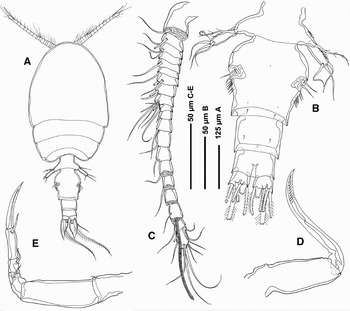
Asterocheres bulbosus, Malt, Reference Malt1991 (paratype female). (A) Habitus, dorsal; (B) urosome, dorsal; (C) antennule; (D) maxilla; (E) maxilliped.

TYPE MATERIAL
Holotype (NHM 1989.200; 1 slide), allotype (NHM 1989.201; 1 slide) plus one female paratype (NHM 1989.202; 11 slides), 8 female paratypes (NHM 1989.203–210; in alcohol), one male paratype (NHM 1989.211; 1 slide) and 7 male paratypes (NHM 1989.212–218; in alcohol) associated with a purplish sponge collected at 10 m depth at Gau Tau (Hong Kong) on 18 April 1986.
DIAGNOSIS
Description of adult female
Body cyclopiform (Figure 1A), slender, with cephalothorax oval and cylindrical urosome. Mean body length 486 µm (470–510 µm) and maximum width 206 µm (190–220 µm), based on 3 specimens. Ratio of length to width of prosome 2.2:1. Ratio of length of prosome to that of urosome 1.7:1. Prosome comprising cephalothorax fully incorporating first pedigerous somite and 3 free pedigerous somites. Epimeral areas of pedigerous somites 2, 3 and 4 with rounded posterolateral angles (Figure 1A).
Urosome 4-segmented comprising pedigerous somite 5, genital double-somite and 2 free abdominal somites. All urosomites ornamented with flattened epicuticular scales (not shown in the Figure 1B). Pedigerous somite 5 wider than long. Genital double-somite slightly longer than wide, bearing genital apertures, paired gonopores located dorsolaterally; lateral margins with rows of setules in distal third, posterior to genital apertures (Figure 1B). Each genital area armed with 2 small setae. Integumental pores and sensilla present on urosomites (Figure 1B).
Caudal rami wider than long, armed with 6 setae; seta I absent, setae II–VII all arranged around posterior margin with setae II and VII slightly offset onto dorsal surface. Caudal setae IV and V bulbous, all setae plumose.
Antennule 20-segmented (Figure 1C); about 190 µm long, segmental homologies and setation as follows: I-1; II-2; III-2; IV-0; V-1; VI-1; VII-2; VIII-2; IX–XII-7; XIII-1; XIV-spine; XV-1; XVI-1; XVII-1; XVIII-1; XIX-1; XX-0; XXI-1+ae; XXII–XXIII-2; XXIV–XXVIII-9. All setae smooth.
Antenna, siphon, mandible and maxilla as in original description (Figure 5D–G; see Malt, Reference Malt1991).
Maxilla 2-segmented (Figure 1D); with unarmed coxa. Claw-like basis recurved at its end; ornamented with row of spinules distally on lateral margin.
Maxilliped 5-segmented (Figure 1E), comprising short syncoxa, long basis and 3-segmented endopod with distal claw-like element. Syncoxa with short seta distally and basis without ornamentation. First endopodal segment bearing 3 short smooth setae and second segment with subdistal seta. Third endopodal segment bearing curved terminal claw plus additional distal smooth seta. Claw surface ornamented with row of spinules.
Swimming legs as in original description (Figure 5H–K; see Malt, Reference Malt1991).
Fifth leg (Figure 1B) with protopod incorporated into somite; outer basal seta displaced to laterodorsal surface. Free segment elongated, more than twice longer than wide, with 3 smooth terminal setae. Outer lateral margin with spinules.
Sixth leg (Figure 1B) represented by paired opercular plates closing off gonopores on genital double-somite; each armed with 2 smooth setae.
Description of adult male
Body cyclopiform (Figure 6A; Malt, Reference Malt1991) with mean body length 385 µm (360–410 µm) and maximum width 150 µm (140–160 µm), based on 2 specimens. Sexual dimorphism in urosomal segmentation, antennules and leg 6 but not in the maxilliped which lacks hook-like process usually present on the basis. Except for plumose setae of the caudal rami, urosome and caudal rami as in original description (Figure 6B; Malt, Reference Malt1991).
Antennule (Figure 6C; Malt, Reference Malt1991) 17-segmented, about 167 µm long, with geniculation between segments 15 (XIX–XX) and 16 (XXI–XXII). Anteroventral margin of the penultimate segment enlarged in a pointed process (not a hook).
Remaining appendages as in Malt's illustrations.
REMARKS
Malt (Reference Malt1991) described Asterocheres bulbosus omitting some taxonomically important appendages, such as the maxilla and the maxilliped which are drawn and described here for the first time. Comparison with Malt's text and illustration revealed some differences such as the body shape is not dorso-ventrally flattened, but rather cyclopiform and slender with oval cephalothorax and cylindrical urosome. The genital area drawn by Malt has one seta instead of 2 present in the holotype. The epicuticular scales on the urosomite and the spinulose ornamentation of the external margin of leg 5 were not observed by Malt. Furthermore, Malt's illustration of the female antennule shows 21 segments, instead of 20. This last difference is indeed very important since A. bulbosus has always been compared with the group of Asterocheres species with a 21-segmented antennule in females defined by Boxshall & Huys (Reference Boxshall and Huys1994) to which this species no longer belongs. Contrarily, A. bulbosus should be compared with the group of Asterocheres having a 20-segmented antennule, which is the group with the highest number of incompletely described species. The 20-segmented antennule group is composed of about 23 species. However, among all these species, only three, A. longisetosus Nair & Pillai, Reference Nair and Pillai1984, A. stocki Nair & Pillai, Reference Nair and Pillai1984 and A. tetrasetosus Johnsson, Reference Johnsson1998, possess a 1-segmented mandibular palp like A. bulbosus. Nevertheless, there are also four species—A. dentatus Giesbrecht, Reference Giesbrecht1897, A. minor Thompson & Scott, Reference Thompson and Scott1903, A. intermedius (Hansen, Reference Hansen1923) and A. ventricosus (Brian, Reference Brian1927)—with no information about this appendage (Giesbrecht, Reference Giesbrecht1897; Thompson & Scott, Reference Thompson and Scott1903; Hansen, Reference Hansen1923; Brian, Reference Brian1927; Nair & Pillai, Reference Nair and Pillai1984; Johnsson, Reference Johnsson1998) and therefore they should be distinguished from A. bulbosus by other characteristics. Asterocheres dentatus and A. ventricosus have the ratio of the genital double-somite wider than long (Brian, Reference Brian1927) while A. bulbosus has a slightly longer than wide genital double-somite. The oral cone in A. bulbosus reaches only as far as the base of the maxilliped, being significantly shorter than that of A. intermedius which extends beyond the insertion of first leg (Hansen, Reference Hansen1923). Asterocheres minor can be separated from A. bulbosus based on the body shape. Thompson & Scott's (1903) illustration of the habitus of A. minor shows a nearly circular body in outline with second abdominal somite longer than wide and only slightly shorter than genital somite. In contrast, A. bulbosus presents a cephalothorax oval and the second abdominal somite wider than long.
Asterocheres stocki can be easily distinguished from A. bulbosus by the extremely long siphon, which extends to the hind border of the fifth leg (Nair & Pillai, Reference Nair and Pillai1984). Asterocheres longisetosus possesses 3 striking features which are unique among Asterocheres species: the long aesthetasc on distal segment of the antennule, 3 terminal setae on mandibular palp, and ornamentation of leg 5 with the free segment armed with 2 long setae and 2 very short spines, together with the unusual long seta of pedigerous somite 5 (see figure 32 in Nair & Pillai, Reference Nair and Pillai1984).
Asterocheres tetrasetosus presents 4 setae on the free segment of the fifth leg therefore differentiating it from all other known species of the genus (Johnsson, Reference Johnsson1998).
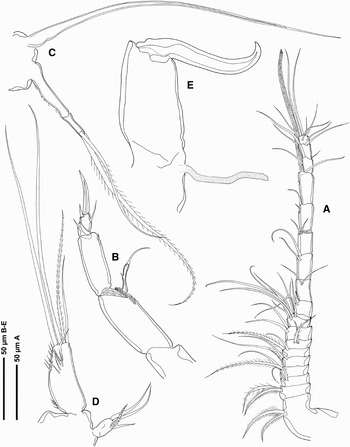
Asterocheres ellisi Hamond, Reference Hamond1968 (holotype female except for A). (A) Antennule (paratype female); (B) antenna; (C) mandible; (D) maxillule; (E) maxilla.

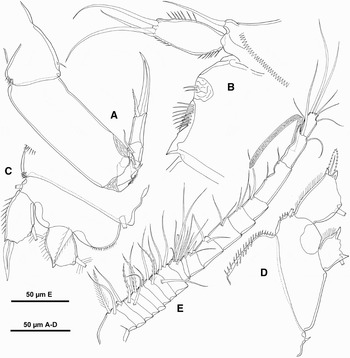
Asterocheres ellisi Hamond, Reference Hamond1968 (holotype female). (A) Maxilliped; (B) detail of genital double somite and leg 5; (C) leg 1; (D) leg 4. Asterocheres ellisi Hamond, Reference Hamond1968 (allotype male); (E) antennule.

TYPE MATERIAL
Holotype female (NHM 1967.10.2.3, 1 slide), allotype male (NHM 1967.10.2.3, 1 slide) and 6 female paratypes (NHM 1967.10.2.3A; in alcohol) at West Runton, Norfolk (Great Britain). Host unknown.
DIAGNOSIS
Description of adult female
Body cyclopiform, with dorso-ventrally flattened prosome and cilindrical urosome (Figure 7; Hamond, Reference Hamond1968). Mean body length 736 µm (700–760 µm) and maximum width 490 µm (450–540 µm), based on 3 specimens. Ratio of length to width of prosome 1.17:1. Prosome comprising cephalothorax and 3 free pedigerous somites. Cephalothorax fully incorporating first pedigerous somite; with posterolateral angles incurved and slightly overhanging. Pedigerous somite 4 much smaller and narrower than preceding ones.
Urosome 4-segmented, comprising pedigerous somite 5, genital double-somite and 2 free abdominal somites. Pedigerous somite 5 wider than long. Genital double-somite (Figure 3B; figure 8 in Hamond, Reference Hamond1968) slightly wider than long; paired genital apertures bipartite, each comprising lateroventral copulatory pore and dorsolateral gonopore; lateral margins with rows of setules on distal third, posterior to genital apertures. Each genital area armed with 2 small setae (Figure 3B).
Caudal rami (figures 7–8 in Hamond, Reference Hamond1968) slightly longer than wide; armed with 6 setae. Seta I absent, setae III–VI arranged around posterior margin and setae II and VII slightly displaced onto dorsal surface.
Antennule (Figure 2A) 21-segmented, about 321 µm long, segmental homologies and setation as follows: I-1; II-2; III-2; IV-2; V-2; VI-2; VII-2; VIII-2; IX–XII-7; XIII-2; XIV-1+spine; XV-2; XVI-2; XVII-2; XVIII-2; XIX-2; XX-2; XXI-2+ae; XXII–XXIII-2; XXIV–XXV-3; XXVI–XXVIII-7. Segment 10 (XIII) reduced, partly overlapped by distal expansion of compound segment 9 (IX–XII).
Antenna biramous (Figure 2B), about 188 µm long. Coxa unarmed, basis unarmed but ornamented with row of spinules on distal third. Exopod 1-segmented, very long, about 6 times longer than wide; with small lateral seta and long terminal seta. Endopod 3-segmented; proximal segment elongated, ornamented with 2 spinules on lateral margin; middle segment produced distally on medial side but articulating with distal segment proximally on lateral side, bearing smooth subterminal seta; distal segment with lateral and terminal smooth setae, both smooth, and distal claw.
Siphon slender (figure 13 in Hamond, Reference Hamond1968), about 301 µm long, reaching between bases of legs 1 and 2.
Mandible (Figure 2C) comprising stylet-like gnathobase and slender 2-segmented palp. Proximal segment ornamented with spinules on lateral margin and longer than distal segment. Distal segment armed with one plumose and one smooth terminal setae. Stylet located in oral cone, formed by labrum and labium.
Maxillule bilobed (Figure 2D); praecoxal endite (inner lobe) 3 times longer than palp (outer lobe). Inner lobe armed with 5 distal setae, one of them minute, ornamented with rows of spinules on lateral margin proximally and distally, and patch of long spinules subdistally. Outer lobe armed with 2 terminal and 2 subterminal setae, one subterminal seta stout and densely plumose.
Maxilla (Figure 2E) 2-segmented but with partial transverse surface suture on syncoxa marking plane of fusion between praecoxa and coxa. Praecoxa bearing flaccid element medially, representing tubular extension of external opening of maxillary gland, and coxa unarmed. Claw-like basis stout and short recurved at its end.
Maxilliped 5-segmented (Figure 3A), comprising short syncoxa, long basis and 3-segmented endopod. Syncoxa with short seta on inner margin and patch of spinules distally on outer margin. Basis unarmed, without ornamentation. First endopodal segment bearing 3 smooth setae and ornamented with rows of spinules on outer margin; second endopodal segment with smooth seta; and third endopodal segment bearing terminal claw close to pinnated seta.
Swimming legs 1–4 biramous (Figure 3C & D; figures 16–19 in Hamond, Reference Hamond1968). Intercoxal sclerite present in legs 1–4. Spine and seta formula:
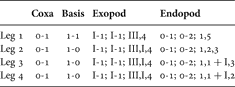
The inner coxal seta short in leg 1, large in legs 2 and 3, and reduced in leg 4; being always pinnate (except for leg 4) whereas outer basal seta always smooth.
Fifth leg (Figure 3B) with protopod incorporated into somite; outer basal seta smooth, displaced to lateral surface. Free segment (exopod) elongated, oval, with truncated distal end and bearing 3 smooth terminal setae. Both outer and inner margins with spinules.
Sixth leg represented by paired opercular plates closing off gonopores on genital double-somite; armed with 2 short smooth setae.
Description of adult male
Body cyclopiform, with dorsoventrally flattened prosome and cilindrical urosome (figure 20 in Hamond, Reference Hamond1968). Smaller than female, and much less broad; body length 580 µm. Sexual dimorphism in urosomal segmentation, antennules, maxillipeds and leg 6. Urosome 5-segmented, comprising pedigerous somite 5, genital somite and 3 free abdominal somites (figure 21 in Hamond, Reference Hamond1968). Genital somite about 1.2 times wider than long.
Antennule (Figure 3E) 18-segmented, about 272 µm long, geniculation located between segments 16 (XIX–XX) and 17 (XXI–XXII). Segmental fusion pattern as follows: I-2; II-2; III-2; IV-2; V-2; VI-2; VII-2; VIII-2; IX–XII-7; XIII-2; XIV-1+spine; XV-2; XVI-2; XVII-2; XVIII-2; XIX–XX-2; XXI–XXII-2+ae; XXIII–XXVIII-6.
REMARKS
Comparison with Hamond's text and illustrations revealed a number of discrepancies: (1) Hamond (Reference Hamond1968) described the female antennule as 20-segmented; re-examination showed that the minute tenth segment (XIII) was overlooked by Hamond and thus, the antennule is 21-segmented; (2) the antennary exopod has 2 elements, alateral setule and a terminal seta instead of a single element, and the 3-segmented antennary endopod has a different articulation from that shown by the original illustration; (3) the mandibular palp is clearly 2-segmented; (4) the inner maxillular lobe has 5 terminal setae instead of 4 as stated by Hamond; (5) the maxilla has an aesthetasc-like extension on the proximal part of the syncoxa which was not illustrated by Hamond; (6) the maxilliped is 5-segmented with the setal formula: (1, 0, 3, 1, 1+claw) and not 4-segmented as claimed by Hamond; (7) the 2 short-setae of the genital areas were omitted; and (8) the basal setae of the first and fourth legs were also overlooked by Hamond.
Asterochres ellisi was originally included in a group of species that shows 20-segmented antennule in females. However, after this redescription it should be relocated to the group of 21-segmented antennule. According to Bandera et al. (Reference Bandera, Conradi and López-Gonzalez2007), this latter group is composed of fifteeen species (excluding A. bulbosus; see above). However, these authors disregarded 2 species which also have this characteristic: (1) Asterocheres uncinatus (Kritchagin, Reference Kritchagin1873) described from Yalta; and (2) Asterocheres bacescui (Marcus, Reference Marcus1965) from the Black Sea.
From these seventeen species, only 7 have been described or illustrated as dorso-ventrally flattened prosome: A. jeanyeatmanae Yeatman, Reference Yeatman1970, A. tenuicornis Brady, 1910 (redescribed by Eiselt, Reference Eiselt1965), A. simulans (Scott, 1898) (redescribed by Sars in Reference Sars1915 and Ivanenko in Reference Ivanenko1997), A. reginae Boxshall & Huys, Reference Boxshall and Huys1994, A. lunatus Johnsson, Reference Johnsson1998, A. lilljeborgi Boeck, 1859 and A. bacescui. Furthermore, we also have to consider A. uncinatus whose body shape was omitted in the description. This last species can be separated easily from A. ellisi by the number of terminal setae on the exopod of leg 5, A. uncinatus has 2 (Kritchagin, Reference Kritchagin1873) and A. ellisi shows 3 setae. Among the 7 species with dorso-ventrally flattened prosome, A. bacescui is the only one with 1-segmented mandibular palp (see Figure 6C; Marcus, Reference Marcus1965), in contrast with the 2-segmented mandibular palp of A. ellisi.
According to Yeatman's description (see figure 35 in Yeatman, Reference Yeatman1970), A. jeanyeatmanae possesses 2 terminal setae in the exopod of leg 5, although, as mentioned above, A. ellisi bears 3 terminal setae on this leg.
The caudal rami, slightly longer than wide in A. ellisi, separates it from A. tenuicornis, that has an extremely long caudal rami (about 6 times longer than wide; see Figure 2A; Eiselt, Reference Eiselt1965); and A. simulans which shows a very short caudal rami (about twice wider than long; see Figure 1B; Ivanenko, Reference Ivanenko1997).
As for the cephalosome shape, A. ellisi presents a cephalosome moderately broad, about 1.3 wider than long and epimeral areas of cephalosome and somites bearing legs 2–4 with posterolateral angles rounded. Contrarily A. reginae shows a broad and short cephalosome, about 1.8 times wider than long (see Figure 1A; Boxshall & Huys, Reference Boxshall and Huys1994) and A. lilljeborgi and A. lunatus have the epimeral areas of cephalothorax with posterolateral angles pointed (Johnsson, Reference Johnsson1998; Ivanenko & Ferrari, Reference Ivanenko and Ferrari2003).
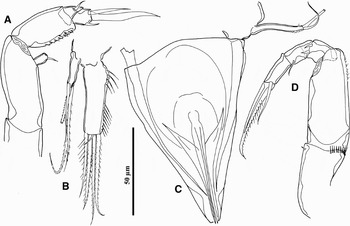
Asterocheres hongkongensis Malt, Reference Malt1991 (holotype female). (A) Antenna; (B) maxillule; (C) siphon and mandible; (D) maxilliped.

TYPE MATERIAL
Holotype female (NHM 1989.199; 1 slide) associated with an orange sponge collected at Chek Chau (Hong Kong), 8 m depth, in April 1986.
DIAGNOSIS
Description of adult female
As this species was described based on a single female, the only available material was the slide made by Malt (Reference Malt1991) and therefore, the habitus of this copepod has been impossible to observe. Total length measured 500 µm (according to Malt, Reference Malt1991). Prosome 1.8 times as the length of urosome.
Urosome 4-segmented, comprising pedigerous somite 5, genital double-somite and 2 free abdominal somites. Pedigerous somite 5 wider than long. Genital double-somite (Figure 4B; Malt, Reference Malt1991) as long as wide; paired genital apertures bipartite, each comprising lateroventral copulatory pore and dorsolateral gonopore; lateral margins with some setules posterior to genital apertures.
Caudal rami (Figure 4B; Malt, Reference Malt1991) slightly longer than wide (measured along outer margin); armed with 6 short setae; seta I absent; setae III–VI arranged around posterior margin and setae II and VII on dorsal surface.
Antennule as in original description (Figure 4C; Malt, Reference Malt1991).
Antenna biramous (Figure 4A), stout and 152 µm long. Coxa and basis unarmed. Exopod 1-segmented, short, about 1.5 times longer than wide; with a short and smooth seta and a hole where might be another seta that has been lost in dissection. Endopod 3-segmented; first segment elongated, unarmed but ornamented with row of spinules on lateral margin. Second segment produced distally on medial side but articulating with distal segment proximally on lateral side; bearing subterminal smooth seta. Third segment with distal claw, and 2 setae, one lateral and short and other subterminal and long, both of them smooth.
Siphon short, about 105 µm long, pyriform, not reaching maxilliped base (Figure 4C).
Mandible (Figure 4C) comprising stylet-like gnathobase and slender 1-segmented palp. Stylet located in oral cone formed by labrum and labium. Palp ornamented with spinules distally; armed with 2 unequal apical setae.
Maxillule bilobed (Figure 4B); praecoxal endite (inner lobe) more than twice longer than palp (outer lobe) and ornamented with row of setules on proximal and distal margins; armed with 5 distal setae, four of them plumose and one short and smooth. Palp armed with subterminal smooth seta and 3 distal plumose setae.
Maxilla 2-segmented (Figure 4F; Malt, Reference Malt1991), with unarmed syncoxa and claw-like basis terminally recurved with minute seta (overlooked by Malt, Reference Malt1991) and rows of spinule distally.
Maxilliped 5-segmented (Figure 4D), comprising short syncoxa, long basis and distal subchela consisting of 3 free endopodal segments armed with distal claw-like element. Syncoxa with one short seta on inner margin and row of setule distally. Basis elongated with spinules laterally. First endopodal segment bearing 2 setae and second armed with one smooth seta. Third endopodal segment bearing apical seta and curved terminal claw with distal margin with row of long spinules. All endopodal setae smooth.
Legs 1 to 5 as in original description (Figure 4B & 4H–K; Malt, Reference Malt1991).
Sixth leg represented by paired opercular plates closing off gonopores on genital double-somite; each armed with 2 setae.
Adult male unknown.
REMARKS
Although Malt (Reference Malt1991) described the body of this asterocherid species as dorso-ventrally flattened, rounded cyclopoid, her illustration (page 171, figure 5A, Malt, Reference Malt1991) is more similar to a rounded shape than to a dorso-ventrally flattened prosome as stated. Unfortunately, this feature has not been verified because the single female available was dissected.
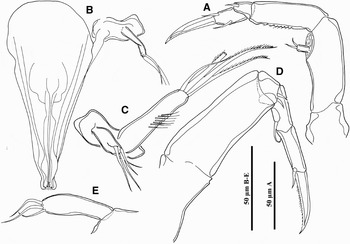
Asterocheres indicus Sewell, Reference Sewell1949 (holotype female). (A) Antenna; (B) siphon and mandible; (C) maxillule; (D) maxilliped; (E) free segment of leg 5.

A detailed re-examination of Astrerocheres hongkongensis holotype has revealed a number of significant differences: (1) the antennary endopod is 3-segmented instead of 2-segmented. Furthermore the formula of its armature is 0, 1, 2+claw with first endopodal segment ornamented with row of spinules on lateral margin; (2) as Kim (Reference Kim2005) pointed out Malt (Reference Malt1991) described this species omitting the mandible. Nevertheless, the palp is 1-segmented with 2 terminal setae, a short seta and another probably longer although its length is impossible to ascertain since it is broken; and (3) Malt also overlooked some elements in the maxillule and maxilliped: the maxillule possesses 5 and 4 setae in inner and outer lobes respectively and the 5-segmented maxilliped has the formula: 1, 0, 2, 1, 1+claw.
Asterocheres hongkongensis belongs to the species group with 19-segmented antennules in females and 1-segmented mandibular palp which includes: Asterocheres scutatus Stock, 1966, Asterocheres proboscideus Stock, 1966, Asterocheres aesthetes Ho, Reference Ho1984, Asterocheres aplysinus Johnsson, Reference Johnsson2002 and Asterocheres brevisurculus Kim, Reference Kim2005.
The length of the oral cone separates A. hongkongensis, characterized by a short siphon not reaching the maxilliped base, from 2 species: Asterocheres proboscideus, which according to Stock (Reference Stock1966a) has a very long oral siphon, extending beyond the caudal rami and A. aplysinus with siphon extending beyond the insertion of leg 1 (Johnsson, Reference Johnsson2002). Furthermore, the exopod of leg 5 of A. aplysinus bears only 2 setae instead of the 3 as in A. hongkongensis.
In A. scutatus the genital double-somite is much wider than long (about as wide as the last metasome segment; see figure 1A, B in Stock, Reference Stock1966b) while in A. hongkongensis it is about as long as wide.
The 2 remaining species can be separated from A. hongkongensis by the length of the caudal setae. According to the illustration made by Ho (figure 17A in Ho, Reference Ho1984), A. aesthetes presents the caudal setae longer than the entire urosome; and in the description of A. brevisurculus made by Kim in Reference Kim2005 (Figure 4A; Kim, Reference Kim2005) the caudal setae are as long as the entire urosome. In contrast, A. hongkongensis possesses the caudal setae scarcely longer than the caudal rami, being a unique characteristic among the Asterocheres species.
TYPE MATERIAL
Holotype female (NHM 1963.628.435; 1 slide) found in washings from alcyonarians at the John Murray Expedition Station 45.
DIAGNOSIS
Description of adult female
Body cyclopiform (figure 10A in Sewell, Reference Sewell1949), slender with oval cephalothorax and cylindrical urosome. Total length 740 µm and maximum width 380 µm. Ratio of length to width of prosome 1.3:1. Ratio of length of prosome to that of urosome 1:1. Epimeral areas of cephalothorax and pedigerous somites 2–4 with posterolateral angles rounded. Pedigerous somite 4 much smaller and narrower than preceding ones.
Urosome 4-segmented, comprising pedigerous somite 5, genital double-somite and 2 free abdominal somites. Pedigerous somite 5 wider than long. Genital double-somite about 1.1 times wider than long; genital apertures bipartite, comprising ventrolaterally located copulatory pore and dorsolaterally located gonopore.
Caudal rami (figure 10A, B in Sewell, Reference Sewell1949) slightly longer than wide and armed with 6 setae; seta I absent, setae II–VII arranged around posterior margin.
Antennule (figure 10C in Sewell, Reference Sewell1949) 20-segmented, about 218 µm long. Segment 18 armed with an aesthetasc.
Antenna biramous (Figure 5A); about 166 µm long. Coxa and basis unarmed. Exopod short, twice longer than wide; 1-segmented, bearing 2 short smooth setae. Endopod 3-segmented; first segment elongated, unarmed but ornamented with row of spinules on lateral margin. Second segment produced distally on medial side but articulating with third segment proximally on lateral side and armed with distal smooth seta. Third segment with distal claw, and 2 smooth subterminal setae.
Siphon short (Figure 5B), about 140 µm long, reaching posterior margin of insertion of maxillipeds.
Mandible (Figure 5B) comprising stylet-like gnathobase and slender 1-segmented palp. Stylet located in oral cone formed by labrum and labium. Palp ornamented with distal rows of spinules and armed with 2 unequal apical setae.
Maxillule bilobed (Figure 5C); praecoxal endite (inner lobe) 2.3 times longer than palp (outer lobe). Endite ornamented with row of setules medially; armed with 4 distal setae, 3 of them plumose, ornamented with short spinules distally, plus short and smooth seta. Palp armed with 2 subterminal and 2 terminal setae; all setae seemingly smooth.
Maxilla as in original description (figure 10E in Sewell, Reference Sewell1949).
Maxilliped 5-segmented (Figure 5D), comprising short syncoxa, long basis and distal subchela consisting of 3 free endopodal segments with distal claw-like element. The small inner distal seta usually present in syncoxa has not been observed although there is a notch where this seta is commonly found. Basis elongated, without ornamentation and unarmed. First endopodal segment bearing 2 naked setae and second segment with smooth seta. Third endopodal segment bearing recurved terminal claw plus additional apical smooth seta. Distal margin of claw with row of minute setules.
Swimming legs as in original description (figure 10G in Sewell, Reference Sewell1949).
Fifth leg (Figure 5E) with protopodal segment incorporated into somite; exopod slender, more than 3 times longer than wide, armed with 3 smooth terminal setae.
Sixth leg represented by paired opercular plates closing off gonopores on genital double-somite; each armed with a seta.
Adult male unknown.
REMARKS
Sewell (Reference Sewell1949) described Asterocheres indicus with omission of the mandible which is drawn and described for the first time here. Furthermore, a re-examination of the holotype revealed some differences with the original description: (1) Sewell described this species as possessing a 19-segmented antennule and illustrated it with segments 9 (IX–XII) and 10 (XIII) only incompletely separated (see figure 10C in Sewell, Reference Sewell1949). Although the specimen has been mounted in ventral side with antennules lying on the rest of the body, it can be observed that segments 9 and 10 are completely separated and, therefore the antennule has one more segment; (2) Sewell drew the antennal endopod with 2 segments, the latter with a suture. However, this structure is clearly 3-segmented. The ornamentation of the first endopodal segment, a row of lateral spinules, is also missing in the original illustration; (3) the original description only mentioned that the 2 maxillulary lobes are markedly unequal not specifying their armature or ornamentation. However, as the specimen is whole mounted, it is impossible to ascertain whether the setae of the outer lobe are plumose; (4) the maxilliped is 5-segmented with setal formula 0, 0, 2, 1, 1+claw instead of 0, 0, 0, 1, 1+claw illustrated by Sewell. Nevertheless it is probable that the seta usually present in the first segment was lost during the mounting since there is a notch in that place; and (5) the free segment of leg 5 bears 3 terminal setae instead of 2 as described by Sewell.
Some of these observations have already been made by Ummerkutty (Reference Ummerkutty1966), who found this species in the Gulf of Manaar from weed washings. He observed that his specimens have the antennule segments 9 (IX–XII) and 10 (XIII) fully separated and also that the free segment of leg 5 bears 3 terminal setae. These two characteristics are present in the holotype. However, the third difference stated by Ummerkutty (Reference Ummerkutty1966), ‘a pair of rather strong setae is present on the ventral side of the genital somite, guarding the genital apertures’, has been impossible to observe due to the rather deteriorated state of the genital area in the holotype.
From now on, A. indicus belongs to the group of species with 20-segmented antennule in females and 1-segmented mandibular palp. As commented above (see remarks on A. bulbosus), there are 4 Asterocheres species which share these 2 characteristics (A. longisetosus, A. stocki, A. tetrasetosus and A. bulbosus) and another 4 species which have to be included since there is no available information about the mandibular palp (A. dentatus, A. minor, A. intermedius and A. ventricosus).
Among the species poorly described, A. minor can be separated from A. indicus by body shape, which is nearly circular in outline in the former and has an oval cephalothorax in the latter. According to Brian (Reference Brian1927), A. ventricosus possesses a genital somite laterally expanded, about 1.8 times wider than long. However, the genital somite of A. indicus is as long as wide. The length of the siphon reaching the posterior margin of the insertion of maxillipeds in A. indicus separates it from A. intermedius whose siphon, reaches beyond the base of leg 1 and from the 2 species described by Nair & Pillai (Reference Nair and Pillai1984)—A. longisetosus and A. stocki—that have an extremely long siphon (see remarks on A. bulbosus). The characteristic 4 setae on the free segment of the fifth leg of A. tetrasetosus distinguish this species from A. indicus.
Information about A. dentatus is really scarce. However, this species has a genital somite with tooth-like process on lateral margin, posteriorly to genital area, which is absent in A. indicus. Asterocheres bulbosus is the most similar species to A. indicus in this group; however we can find some differences between them. According to Malt's illustration (see Figure 5D; Malt, Reference Malt1991), the exopod of the antenna bears 2 terminal long setae instead of the 2 short setae present in A. indicus. The caudal rami are longer in A. indicus and the genital somite is longer in A. bulbosus.
TYPE MATERIAL
The material deposited in the Natural History Museum of London as Ascomyzon micheli (NHM 1928.4.2.13; cotype), collected at Kabret (Cambridge Suez Canal Expedition) in 1924, is a harpacticoid copepod.
REMARKS
This species was collected during the Cambridge Expedition to the Suez Canal and described by Gurney in Reference Gurney1927. The description is poor, the author only drew the dorsal habitus of the male (figure 110G in Gurney, Reference Gurney1927) and a ventral view showing the mouth parts (figure 110H in Gurney, Reference Gurney1927), not mentioning the number of specimens collected nor the host where the copepods were found. Nevertheless the original text description provides enough information to distinguish it from the remaining species of the genus. According to Gurney's description the antennule is 18-segmented in the female and there are only 2 species more which share this characteristic, A. unicus Johnsson, Reference Johnsson2001 and A. spongus Johnsson, Reference Johnsson2002. These 2 species can be separated from A. micheli by the mandibular palp and length of the oral cone. Ascomyzon micheli possesses a 2-segmented mandibular palp and siphon reaching the insertion of leg 1. However, A. unicus shows 1-segmented mandibular palp and siphon between the insertion of maxilliped and leg 1; A. spongus has 1-segmented mandibular palp and the oral cone reaches beyond the insertion of the maxilliped (Johnsson, Reference Johnsson2001, Reference Johnsson2002). Moreover, the 2 species decribed by Johnsson possess 2 setae on the free segment of the leg 5 while A. micheli has 3 terminal setae.
In the original description, Gurney pointed out that the basipodite of leg 1 presents a very large spine. However, there is no illustration of this appendage and it is not possible to know its exact position or length.
Another uncommon feature is the length of the male antennule. Gurney describes it as rather longer than the female antennule.
This species (a single male) has also been recorded by Sewell Reference Sewell1949, who collected it at Nicobar Island (Bay of Bengal, India). However he expressed some reservations about its specific assignment and did not provide any information about the host.
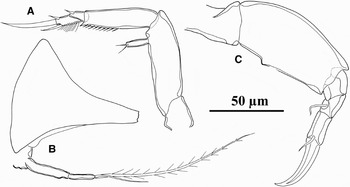
Asterocheres ovalis Sewell, Reference Sewell1949 (holotype male). (A) Antenna; (B) siphon and mandible; (C) maxilliped.

TYPE MATERIAL
Holotype male (NHM 1963.6.28.436; 1 slide) found in washings from an ascidian host at the John Murray Expedition Station 10.
DIAGNOSIS
Description of adult male
Body cyclopiform (figure 11A in Sewell, Reference Sewell1949), with dorso-ventrally flattened prosome and cylindrical urosome. Total body length 500 µm and maximum width 360 µm. Ratio of length to width of prosome 1.1:1. Ratio of length of prosome to that of urosome 2.2:1. Prosome very broad, comprising cephalothorax fully incorporating first pedigerous somite and 3 free pedigerous somites with well-developed epimeral margins. Genital somite about 1.4 times wider than long; bearing genital apertures postero-laterally on ventral surface.
Caudal rami (figure 11A in Sewell, Reference Sewell1949) as long as wide and armed with 6 setae; seta I absent, setae II–VII arranged around posterior margin. Antennule, maxillule and maxilla as in original description (figure 11B, D, F in Sewell, Reference Sewell1949).
Antenna (Figure 6A) biramous, 178 µm long, with small unarmed coxa and long unarmed basis. Exopod more than 3 times longer than wide, 1-segmented, bearing 2 terminal setae. Endopod 3-segmented; first segment elongated, unarmed but ornamented with lateral row of spinules. Second segment produced distally on medial side but articulating with third segment proximally on lateral side and armed with smooth seta. Third segment armed with 2 subterminal smooth setae and distal claw; inner margin ornamented with lateral rows of fine setules.
Mandible (Figure 6B) with 2-segmented slender palp and stylet-like gnathobase. Stylet located in oral cone. Both segments of palp without ornamentation; second segment armed with 2 terminal setae, the shorter one smooth.
Siphon (Figure 6B) short, about 86 µm long, formed by labrum and labium joined laterally, reaching between the insertions of maxilla and maxilliped.
Maxilliped 5-segmented (Figure 6C), robust, comprising short syncoxa, long basis and distal subchela consisting of 3 free endopodal segments armed with distal claw-like element. Syncoxa without usual small inner distal seta. Basis with small tooth-like process in proximal half of medial margin. First endopodal segment unarmed; second armed with smooth seta and third endopodal segment with recurved terminal claw plus additional apical smooth seta. Distal claw stout.
Legs as in original description (figure 11I–H in Sewell, Reference Sewell1949).
Female unknown.
REMARKS
Sewell (Reference Sewell1949) described Asterocheres ovalis based on a single male. Except for three species: A. abyssi (Hansen, Reference Hansen1923), A. ovalis Sewell, Reference Sewell1949 and A. alter Eiselt, Reference Eiselt1965, the descriptions of the Asterocheres species are based on females of which in more than 30% of cases the male is unknown, so it is difficult to make comparisons among them.
After comparing the specimen deposited in the NHM and the original description, a number of differences have been found: (1) the antenna possesses a 3-segmented endopod with setal formula: 0, 1, 2+claw instead of 1, 0, 2+claw illustrated by Sewell; (2) the mandibular palp is 2-segmented; and (3) the armature of the maxilliped is 0, 0, 0, 1, 1+claw and not unarmed as in the original illustration. The setae usually present in segments 1 and 3 have not been observed in this specimen.
The most conspicuous feature of A. ovalis is the number of antennule segments since there is no previous record of an Asterocheres with only 14 segments.
The prosome of A. ovalis is dorsoventrally flattened, which is shared by about 30% of the 71 Asterocheres species known. In 16 of these 20 species, the male is known and the antennules are always 17- or 18-segmented. From the remaining 4 species whose males are still unknown, 3 of them can be separated from A. ovalis with respect to: (1) the mandibular palp, which is 1-segmented in A. scutatus Stock, 1966 in contrast with the 2-segmented palp present in A. ovalis; (2) the siphon length, reaching the insertion of leg 1 in A. serrulatus (Humes, Reference Humes1996b); and (3) the armature of the outer lobe of the maxillule, which consists of only 2 setae in A. crenulatus Johnsson, Reference Johnsson1998 and 4 setae in A. ovalis.
The closest Asterocheres species to A. ovalis, with regard to the characteristics mentioned above, is A. maxillatus Stock, Reference Stock1987. Nevertheless, this latter species has only a female known which was collected in Curaçao (Netherlands Antilles) associated with the scleractinian coral Manicina areolata (Linnaeus, 1758), and the females present a 20-segmented antennule. The male antennule will probably be 17- or 18-segmented as in the remaining species of the group with 20-segmented antennule in the female. According to Stock (Reference Stock1987), the shield-shaped anterior part of the body of this species hides the posterior metasomites in dorsal view while there are no hidden metasomites in A. ovalis.
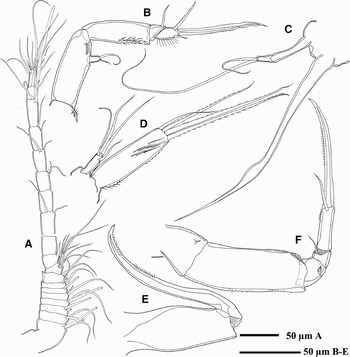
Asterocheres rotundus Malt, Reference Malt1991 (holotype female). (A) Antennule; (B) antenna; (C) mandible; (D) maxillule; (E) maxilla; (F) maxilliped.

TYPE MATERIAL
Holotype female (NHM 1989.219; 1 slide) plus 1 female paratype (NHM 1989.225; in alcohol) associated with a purplish sponge, at Gau Tau (Hong Kong), 5–10 m depth, 18 April 1986. 1 female paratype (NHM 1989.224; 1 slide) and 1 male paratype (NHM 1989.225; 1 slide) associated with Ricinia sp. at Chek Chau (Hong Kong), 15 m depth, 6 April 1986. 1 male allotype (NHM 1989.220; 1 slide) associated with a reddish-purple sponge at Peng Chau (Hong Kong), 2 m depth, 15 April 1986 plus 2 female paratypes (NHM 1989.222–223; 2 slides) and 1 male paratype (NHM 1989.221; 1 slide).
DIAGNOSIS
Description of adult female
Body cyclopiform (Figure 6E; Malt, Reference Malt1991), with cephalothorax oval and cylindrical urosome. Body length 620 µm (590–660 µm) and maximum width 327 µm. Prosome about 2.2 times as long as urosome. Epimeral areas of pedigerous somites 2 and 3 with posterolateral angles rounded. Pedigerous somite 4 narrower than preceding ones.
All urosomites ornamented with epicuticular scales. Pedigerous somite 5 wider than long. Genital double-somite 1.2 times wider than long; paired genital apertures bipartite, each comprising lateroventral copulatory pore and dorsolateral gonopore; lateral margins with rows of setules in distal third, posterior to genital apertures. Each genital area armed with 2 setae.
Caudal rami (Figure 6F; Malt, Reference Malt1991) slightly wider than long; armed with 6 setae; seta I absent; setae II–VII arranged around posterior margin.
Antennule 19-segmented (Figure 7A); about 365 µm long, segmental homologies and setation as follows: I-2; II-2; III-2; IV-2; V-2; VI-2; VII-2; VIII-2; IX–XII-7; XIII-spine; XIV-0; XV-2; XVI-0; XVII-2; XVIII-2; XIX-2; XX–XXI-1+ae; XXII–XXIII-3; XXIV–XXVIII-10. All setae smooth.
Antenna biramous (Figure 7B); 213 µm long. Coxa and basis unarmed. Exopod 1-segmented, with 2 distal setae, one short and the other long. Endopod 3-segmented; first segment elongated, ornamented with patch of spinules on lateral margin. Second segment produced distally on medial side but articulating with distal segment proximally on lateral side; bearing distal seta. Third segment with distal claw plus 2 subterminal setae, one of them plumose and ornamented with long setules on lateral margin.
Siphon pyriform (figure 6I in Malt, Reference Malt1991), about 170 µm long, reaching between insertion of maxilliped and leg 1.
Mandible (Figure 7C) comprising stylet-like gnathobase and slender 2- segmented palp. Stylet located in oral cone, formed by labrum and labium, with expansion medially. Palp with first segment long and slender; second segment ornamented with fine spinules apically and 2 apical smooth setae.
Maxillule bilobed (Figure 7D); praecoxal endite (inner lobe) 3.2 times longer than palp (outer lobe), ornamented with spinules on lateral margin, long setules medially, with 4 distal setae, three of them long and plumose and remaining seta short and smooth. Palp with 2 subterminal and 2 terminal setae, all smooth.
Maxilla 2-segmented (Figure 7E); with unarmed coxa. Claw-like basis curved at its end; ornamented with distal row of spinules on lateral margin.
Maxilliped 5-segmented (Figure 7F), comprising short syncoxa, long basis and distal subchela consisting of 3 free endopodal segments with distal claw-like element. Syncoxa with short seta distally; basis ornamented with rows of spinules on lateral margins. First endopodal segment bearing 2 short smooth setae; second segment with medial seta; third endopodal segment ornamented with spinules apically bearing curved terminal claw plus plumose seta distally.
Legs as in original description (figures 6F & 7A–D in Malt, Reference Malt1991).
Description of adult male
Mean body length 490 µm (480–500 µm). Sexual dimorphism in urosomal segmentation, antennules, maxillipeds and leg 6 (Figure 7F–H; Malt, Reference Malt1991). Prosome (Figure 7E; Malt, Reference Malt1991) with angular head.
REMARKS
This species was described by Malt in Reference Malt1991 and was collected from Hong Kong together with Asterocheres hongkongensis and Asterocheres bulbosus. Malt described these three species as having a dorso-ventrally flattened prosome but none of them seem to have it, they possess the usual cyclopoid shape with cephalothorax oval and cylindrical urosome. The re-examination of the holotype and paratypes of Asterocheres rotundus also provide some characteristics that are missing in the original description. For example: (1) Malt missed one seta in the 19-segmented antennule; (2) the antennary exopod is shorter than originally drawn and her boundary between the second and third endopodal segments does not correspond with the pattern observed; (3) the mandibular palp is clearly 2-segmented and the stylet has a thicker area at medial region; (4) the maxillule inner lobe presents long setules medially and the outer lobe possesses 4 naked setae; and (5) the maxilliped is 5-segmented with setal formula (1, 0, 2, 1, 1+claw). In the original description there are some setae missing and the segmentation between the 2 last segments is unclear.
Asterocheres rotundus belongs to the Asterocheres species group with 19-segmented antennule in the female and a 2-segmented mandibular palp which includes: Asterocheres renaudi Canu, Reference Canu1892, A. halichondriae Stock, 1966, A. serrulatus (Humes, 1996), A. dysideae Humes, 1996, A. enewetakensis Humes, Reference Humes1997, A. crenulatus Johnsson, Reference Johnsson1998, A. spinopaulus Johnsson, Reference Johnsson1998, A. abrolhensis Johnsson, Reference Johnsson1998, A. crinoidicola Humes, Reference Humes2000, A. picinguabensis Johnsson, Reference Johnsson2001, A. pilosus Kim, Reference Kim2004 and A. walteri Kim, Reference Kim2004. Asterocheres renaudi is particularly distinct because of the cuticle ornamentation of the cephalic appendages (Canu, Reference Canu1892) which distinguishes it from the remaining Asterocheres species.
Asterocheres serrulatus Humes, 1996, A. dysideae Humes, 1996, A. crenulatus Johnsson, Reference Johnsson1998, A. spinopaulus Johnsson, Reference Johnsson1998 and A. abrolhensis Johnsson, Reference Johnsson1998 have a dorsoventrally flattened prosome (Humes, 1996; Johnsson, Reference Johnsson1998) separating them from A. rotundus.
The illustration of the urosome in dorsal view for A. rotundus (see Figure 6F; Malt, Reference Malt1991) shows a relatively short free segment of leg 5 which is 2.6 times longer than wide. The illustrations of urosome for A. enewetakensis (see Figure 1B, C; Humes, Reference Humes1997) and A. crinoidicola (see Figure 1A, C; Humes, Reference Humes2000) show a clearly longer free segment of leg 5 whose ratios are, respectively, 6 and 5 times longer than wide. The ornamentation of this structure differs in A. rotundus, with 2 long and 1 very short terminal setae and A. picinguabensis, which has only 2 terminal setae (Johnsson, Reference Johnsson2001).
Kim described 2 species, A. pilosus and A.walteri, from Panama in 2004. Asterocheres pilosus possesses the largest innermost seta of the maxillular palp with very long hairs on the inner margin. However, A. rotundus has 4 setae of usual length and shape for the genus in the maxillular palp. Furthermore, the inner lobe of the maxillule is 3.2 times longer than the outer lobe in A. pilosus, while in contrast, A. walteri has an outer lobe 1.2 times longer than the inner lobe (Kim, Reference Kim2004).
The most similar species of this group is A. halichondriae. In order to make a detailed comparison between these two species, we have re-examined Stock's material deposited in the Zoological Museum of Amsterdam (ZMA Co. 100.951c). This comparison revealed 2 unique differences between A. rotundus and A. halichondriae: (1) the body length is about 150 µm longer in A. rotundus; and (2) A. halichondriae possesses 5 setae in the inner lobe of maxillule, one of them naked and minute (Stock, Reference Stock1966a); while, the inner lobe of maxillule of A. rotundus present only 4 distal setae.
ACKNOWLEDGEMENTS
The authors are very grateful to Miranda Lowe, curator at the Natural History Museum of London and Dirk Platvoet, curator at the Zoological Museum of Amsterdam, for the loan of the type material.