INTRODUCTION
According to the World Health Organization (2012), the goal of palliative care is to improve the quality of life for persons with a terminal illness and their families. When a family member is diagnosed with cancer, ordinary family life is disrupted and often perceived as chaotic and unpredictable. The healthy parent often needs to assume the ill parent's responsibilities while caring for them and their children.
In the terminal phase of cancer, the patient's functional status diminishes while carers' depression and perceived burden rise (Grunfeld et al., Reference Grunfeld, Coyle and Whelan2004), to the extent that the need of the carer for psychological support may be greater than that of the patient. At the same time, the ability of each child to cope depends on how their parents manage the impact of the new situation on family members and family dynamics (Worden, Reference Worden1996; Wright & Leahey, Reference Wright and Leahey2005). According to Benner and Wrubel (Reference Benner and Wrubel1989), both parents usually find ways to manage such crises as advanced or terminal cancer. Nevertheless, children face many changes in their daily family routines. Witnessing the changes in the ill parent's functionality, attitudes, and outlook during the palliative phase of cancer can be particularly stressful for young children (Christ & Christ, Reference Christ and Christ2006). Stress can lead to behavioral and emotional problems (Visser et al., Reference Visser, Huizinga and van der Graaf2004), expressed as fear, sorrow, anxiety, confusion, sadness, anger, and feelings of uncertainty and guilt (Helseth & Ulfsaet, Reference Helseth and Ulfsaet2003; Huizinga et al., Reference Huizinga, van der Graaf and Visser2003; Bugge et al., Reference Bugge, Helseth and Darbyshire2008; Forrest et al., Reference Forrest, Plumb and Ziebland2009). Cross-sectional studies suggest that children of parents with serious physical illnesses, including cancer, experience more difficulties than their peers (Welch et al., Reference Welch, Wadsworth and Compas1996). The healthy parent's parental role is challenged in different ways depending on the age of their children. Our review has been concerned with parents with children aged 6–12 years. During this stage of life, children are particularly vulnerable because they are strongly dependent on their closest carers. At the very moment when children are in need of greatest support, the people on whom they typically rely to shepherd them through life's crises are least available (Forrest et al., Reference Forrest, Plumb and Ziebland2006). At this age, their cognitive processes are more concrete, and they need guidance to express thoughts, feelings, and experiences (Piaget, Reference Piaget1932; Worden, Reference Worden1996).
Chapter 10a of The Norwegian Health Personnel Act (Lovdata, 2012) states that, from January 2010, when a mother or father is seriously ill, health professionals are compelled to support parents in meeting children's needs for adequate information and to answer their questions. This legislation reflects the tenets of the United Nations Convention on the Rights of the Child, which promote children's rights to express their views on matters affecting them. The Norwegian law and the goal of palliative care (World Health Organization, 2012) underline health professionals' special responsibilities for patients in the palliative phase of cancer who are parents of young children.
In a retrospective survey of 376 spouses and children where the mother of family had recently died, relatives reported having had only limited opportunities to talk about their everyday difficulties (Eriksson et al., Reference Eriksson, Arve and Lauri2006). Furthermore, factors considered important by patients and their families can be very different from the factors seen as important by health professionals (Steinhauser et al., Reference Steinhauser, Christakis and Clipp2000). The number of studies addressing the impact of cancer on families has increased during recent years, but the literature on the needs of families and the outcomes of the process of a parent dying from a terminal illness remains limited (Rauch & Muriel, Reference Rauch and Muriel2004; Visser et al., Reference Visser, Huizinga and van der Graaf2004; Semple & McCance, Reference Semple and McCance2010; Krattenmacher et al., Reference Krattenmacher, Kuhne and Ernst2012). There is a gap in explicit information on how the healthy parent is able to fulfill the responsibilities and tasks related to parenting when the other parent has advanced cancer, and little is known about parents' support needs in managing their children's needs. We posed three research questions aimed at improving our understanding and increasing the knowledge of healthy parents' challenges, coping, and need for professional support when their partner, the parent of their children, has advanced cancer or is dying:
1. What challenges confront the healthy parent?
2. How does the healthy parent experience and cope with the parental role?
3. What kind of support does the healthy parent need from health professionals with respect to the parental role?
The aim of the present review is to provide a systematic overview of the knowledge in a specific area, and to evaluate the quality of that literature, in order to explain the research findings and to justify the need for, and importance of, new research (Fink, Reference Fink2005).
METHOD
Design
A systematic review of the literature was undertaken using the procedures outlined by Fink (Reference Fink2005). The procedural steps were: (a) selecting research questions, (b) choosing databases, (c) selecting keywords, (d) applying inclusion and exclusion criteria, (e) appraising the scientific quality of a study, (f) performing the survey, and (g) presenting a synthesis of the findings.
Search Methods
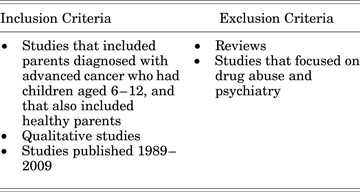
The inclusion and exclusion criteria are presented in Table 1. For all three questions, we searched relevant bibliographic databases for qualitative studies reporting empirical, non-numeric data on the healthy parent. The systematic literature search from 1989 to 2009 was conducted using Medline, Cinahl, and PsycINFO. All database searches were performed by the first author (TA) together with an experienced medical librarian. The keywords used were: child of impaired parents, neoplasm, critical illness, palliative care, terminal care, attitude toward death, death, bereavement, grief, life-change events, adaptation, communication, resilience, coping, hardiness, parents, parental characteristics, parental death, parental role, parenting skills, parent–child communication, parent–child relations, child-rearing attitudes, and parental involvement.
Inclusion and exclusion criteria

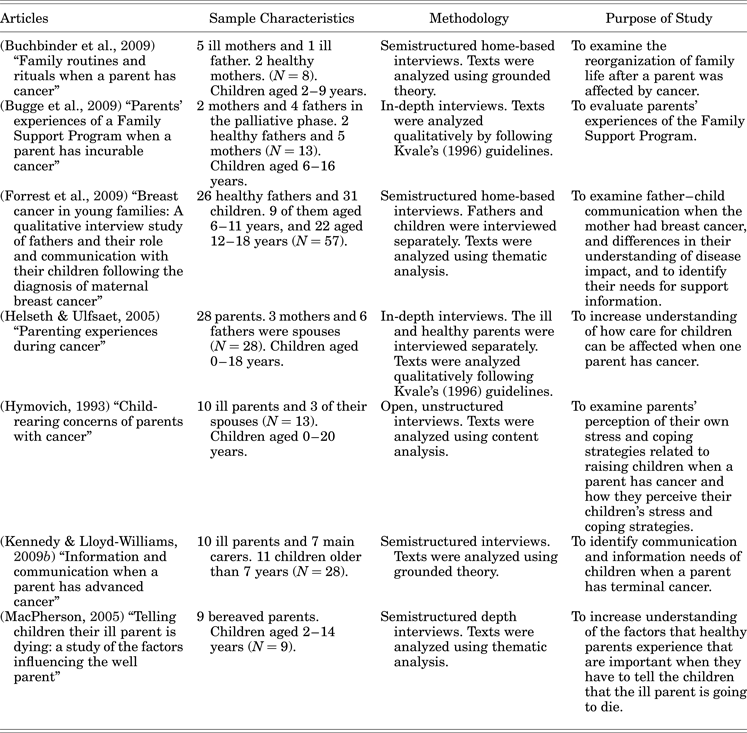
The search returned a total of 182 studies. Seven articles met the inclusion criteria and included comments from healthy parents about how they experienced the situation of a partner being seriously ill or in the palliative phase of cancer, and with children aged 6–12 years. In only one study was the healthy parent interviewed explicitly, and so it is included even though it does not deal with the advanced stages of cancer. Manual searches of the references in the selected articles did not yield any additional studies. The sample is presented in Table 2.
Presentation of the sample (N = 7)

The first author (TA) perused the titles and abstracts of all the studies and identified appropriate studies based on our inclusion and exclusion criteria. The second author (KEB) read through these abstracts. TA was responsible for primary analysis of data in synthesizing findings, but emerging codes, subcategories, categories, and themes from content analysis were discussed with KEB.
We expanded the search until June 2013 to see if there was something new added during the time the article was being prepared, and we found only one study that met the inclusion criteria (Kennedy & Lloyd-Williams, Reference Kennedy and Lloyd-Williams2009a). This study was not included in the study sample but was included in the discussion along with three others of recent date that highlight the theme of family and palliative care (Buchwald et al., Reference Buchwald, Delmar and Schantz-Laursen2011; Kuhne et al., Reference Kuhne, Krattenmacher and Beierlein2012; Semple & McCaughan, Reference Semple and McCaughan2013).
Performing the Survey
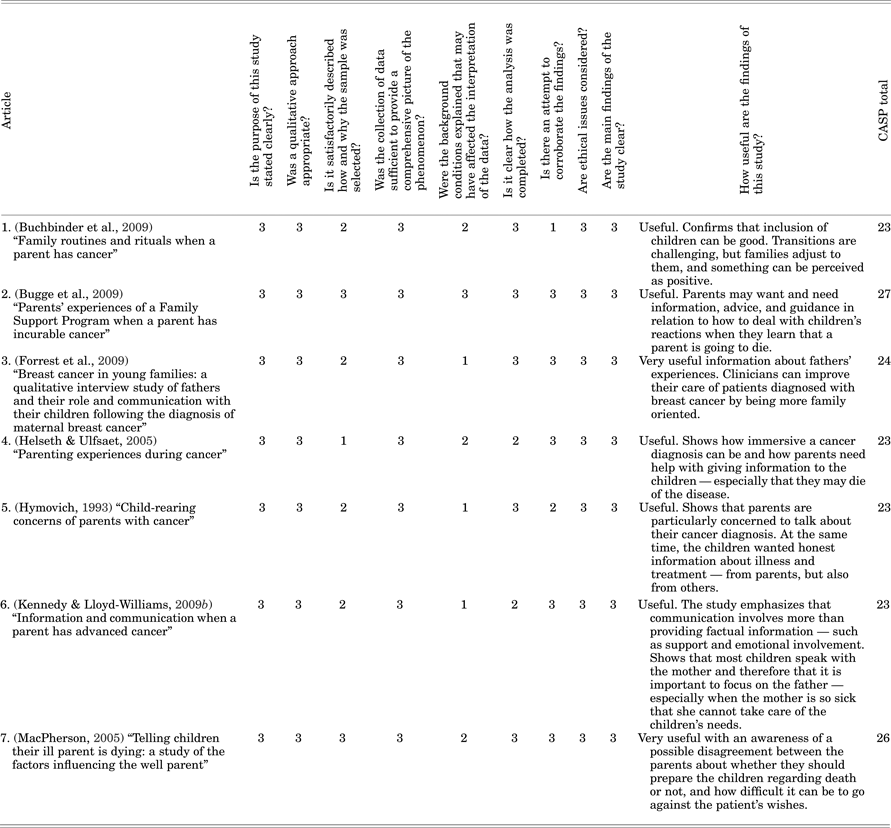
The quality of the relevant studies was evaluated using a predefined checklist, the “Checklist to Assess Qualitative Research,” developed by the Norwegian Knowledge Centre for the Health Services (NOKC) (http://www.kunnskapssenteret.no/Home) (2006). This assessment tool includes 10 questions that deal broadly with some of the principles or assumptions that characterize qualitative research. Duggleby et al. (Reference Duggleby, Holtslander and Kylma2010) developed a 3-point rating system to determine the score for each article on each of the questions. The Critical Appraisal Skills Programme (CASP) tool (2013) is recommended by the Joanna Briggs Institute as a standardized mechanism for evaluation of qualitative studies with metasynthesis. Based on the study by Duggleby et al. (Reference Duggleby, Holtslander and Kylma2010), which used the CASP tool, 9 out of 10 questions from NOKC's assessment tool were given a score from 1 to 3.
A low score (1 point) was ascribed to articles that offered little or no justification or explanation for a particular issue (e.g., the author did not mention where, when, how, and by whom data were collected). A moderate score (2 points) was given to articles that addressed the issue but did not fully elaborate on it (e.g., the author reported the analytical method but did not show how it was used). A high score (3 points) was accorded to articles that justified and explained the issue extensively (e.g., the author explained that semistructured interviews were conducted, transcribed verbatim, and modified throughout the study, and showed examples of interview questions).
The maximum possible score in our review was 27. The response to question number 10 — “How useful are the findings of this study?” — depended on the context in which an article was read and how useful it was for the reader. The questions and results are presented in Table 3. CASP scores for all seven studies ranged from 23 to 27.
Quality assessment of the studies (N = 7) presented with CASP score (1 = weak score, 2 = moderate score, 3 = strong score; maximum score = 27)
Sample
The total sample from the studies included 174 participants, comprising 132 parents, 42 children aged 7–18 years, and 64 partners. The studies were conducted in Norway (2), England (2), the United States (2), and Scotland (1). The majority of healthy parents were aged 30–45 years. Their partners had been diagnosed with cancer from 2 months to 7 years earlier. The diagnoses included advanced cancer of the breasts, testes, ovaries, brain, and pancreas, and malignant melanoma and leukemia.
Synthesis of Findings
Findings from the included papers were synthesized using the principles of qualitative content analysis following Graneheim and Lundman (Reference Graneheim and Lundman2004). Results from included papers, together with their quotes, shed light on the three research questions in this review:
Step 1: A search for answers to the three research questions in this review was carried out systematically, one article at a time. Results that shed light on research questions were noted under each question.
Step 2: The results from each research question were analyzed to establish common content. The study findings were evaluated for similarities and differences to clarify defining and overlapping attributes among the interpreted concepts, and common contents were identified.
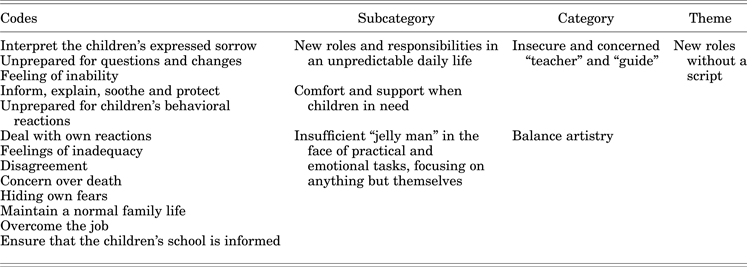
Step 3: The common contents of themes were synthesized by combining the convergence factors from the common contents into categories and subcategories. The tentative categories were discussed and revised by the two authors. A process of reflection and discussion resulted in agreement on how to sort the codes. Finally, the categories were abstracted and formulated into a theme. Examples of codes, categories, and subcategories in a theme are given in Table 4.
Examples of codes, subcategories, categories, and a theme from content analysis of the findings related to research question 1 (“What do the articles tell us about challenges that the healthy parent faces?”)
RESULTS
Synthesis of findings resulted in four themes with associated categories:
1. New roles without a script
2. Attempting to maintain a safe and normal life
3. Feeling alone even within the family
4. Support to help children
The themes and categories are used in the presentation as headings and subheadings.
New Roles Without a Script
Balance Artistry
The healthy parent in these papers expressed being torn between the needs of their ill partner and those of their children. Despite facing practical and emotional challenges of balancing the different needs of family members with vitality and determination, they expressed feeling inadequate.
Insecure and Concerned “Teacher” and “Guide”
They described the challenges in recognizing their children's expressed grief and the difficulties in soothing and protecting children appropriately. Dealing with children's reactions of anger and refusal — a new behavior often misunderstood by parents — was especially difficult. The following quote expresses what most of the healthy parents experienced:
I was hurt and irritated [because of the children's reactions], and I was angry. I did not have knowledge. (Bugge et al., Reference Bugge, Helseth and Darbyshire2009, p. 3485)
Healthy parents emphasized the importance of openness with children while at the same time finding it difficult to even speak with them. The reason for this dilemma relates not only to a lack of knowledge about cancer, its treatment, and the expected side effects, but also to concealment of personal feelings, especially not wanting to express negative thoughts or report negative results.
Attempting to Maintain a Safe and Normal Life
Appropriate and Inappropriate Coping
In these studies, the healthy parent emphasized the importance of maintaining a normal family life, even in the face of new routines. Their coping strategies were based on a common motive and a strong desire for the children to experience a sense of security and normalcy despite the abnormal situation. These papers showed variation in parents' thoughts on how to act in the best interests of the children. Some healthy parents deliberately planned coping strategies, such as hospital visits, with explanations and playing with medical equipment, hiring a maid, or seeking help from health professionals. Other parents deliberately withheld information from their children and told them not to worry and to continue with normal activities, in the belief that this was best for the children. For some, the goal of maintaining routines meant concealing changes in order to preserve security.
Several healthy parents emphasized the importance of social networks in maintaining a normal daily life. Some found it difficult to admit to needing help with practical or emotional support, but they accepted help for the benefit of the children. Some expressed the importance of maintaining their own hobbies to relax and to increase energy but gave low priority to taking a break in order to restore energy for caring for their sick partner and children. Many of the healthy parents emphasized the importance of positive thinking, and they chose to face unavoidable change with a positive perspective, for instance, seeing the illness as allowing them to spend more time with their children.
Some healthy parents hid their feelings, confronted the challenges, and tried to survive. Without complaining, they fought to remain ambulatory for the sake of the ill partner and their children.
Feeling Alone Even Within Family
Lonely with Difficult Thoughts About the Future
For the majority of healthy parents, the most important aspects of their situation were having each other and being together as a family. Both parents and children conspired to remain silent for fear of upsetting someone. Emotions were concealed through the shared belief that everyone should be happy. One healthy parent spoke about their difficulty in expressing needs, thoughts, and feelings to others as follows:
My own needs — I stored them away. When you get into a situation like this, you just have to follow along — you're not the person in focus. (Helseth & Ulfsaet, Reference Helseth and Ulfsaet2005, p. 42)
Sometimes the feeling of inadequacy in relation to a partner's disease led to anger and frustration. Participants felt that support, trust, and confirmation from the patient were desirable and important. The healthy parents stated that they put their own needs aside and chose to control and conceal their feelings while focusing on the needs of the patient and children. An accompanying challenge for parents involved disagreements over when and what to tell the children. In one case, the dying parent informed the children even though the other parent was not ready:
I kept trying to stop him, and I don't know why; to stop him giving them so much information about how long a [dying parent's] got and things. I was putting my hand up and saying, “They don't need to know that,” and he was saying, “They do.” He said, “I love them, and I don't want them to hear anything from anybody else; I want them to hear it from me and just to know exactly what's going on.” (MacPherson, Reference MacPherson2005, p.122)
Informants reflected on the contradictory impulses of wanting to deny the realities of the disease and imminent death while trying to control the overwhelming feeling caused by being unable to see into a future. Rarely would healthy parents admit, even to themselves, to having these thoughts. The most important thing was to be with one another for as long as possible.
Support to Help Children
Desire for Knowledge and Support in a New and Unknown Role
Healthy parents felt challenged to recognize their children's expressed sadness over the situation while not being able to soothe and protect them as much as they wanted. They expressed a desire to converse with health professionals; they wished to receive specific advice and guidance on when and how to inform the children, especially when they had to tell the children that their mother or father was going to die. They rarely experienced being offered such a conversation. They wanted to share the responsibility with someone — either by having health professionals inform the children for them or by being prepared to face and deal with their possible reactions:
I had no one to help me with this and had to find everything out myself — how to tell the children, how to talk to them, how to deal with their reactions. I wanted someone to give advice and to share the responsibility. (Bugge et al., Reference Bugge, Helseth and Darbyshire2009, p. 3484)
Some healthy parents expressed a wish for “expert” knowledge of how others have dealt with a similar situation. However, they did not discuss this with health professionals or seek help for themselves or their children so as to not make too many demands on the clinician's time.
DISCUSSION
Healthy Parents' Challenge of Balancing Needs
The healthy parents in our review described the challenge of dealing with uncertainty in the face of both new and demanding tasks. A central finding is that they are trying to balance the needs of their children, the patient, and themselves during the illness. They adapt to most of their new duties in the family but need to balance everyone's input and needs. Their role as a flexible “jelly man” can be experienced as a stressful balancing act similar to tightrope walking, where one could easily slip and fall to either side. Some of them experienced overwhelming emotions of grief, fear, and anger but managed to cope without abandoning their ill partner or their children. This finding is in line with a study which found that carers in situations like this felt overwhelmed by the various demands (Thastum et al., Reference Thastum, Johansen and Gubba2008). Parents play many roles in meeting children's physical and emotional needs, and these roles are normally met by two parents. Practical challenges are perceived as equally difficult and limiting as emotional problems. Some parents have both the skills and the energy to safeguard their children, while others express helplessness toward new and expanded tasks, and find it difficult to respond to children's emotional needs (Thastum et al., Reference Thastum, Johansen and Gubba2008; Semple & McCaughan, Reference Semple and McCaughan2013).
This review confirms that, when a parent is in the palliative phase of cancer, their healthy partners face the common challenge of assuming a double role as mother and father while also caring for a terminally ill spouse. The healthy parent and the children need to handle their daily lives with the temporary loss of both a partner and parent depending on the disease symptoms, the side effects, and the threat of permanent loss (Bugge et al., Reference Bugge, Helseth and Darbyshire2008). Losses are described as both actual and potential, and at young ages children are especially vulnerable because they are dependent on their closest caregivers to explain the situation and to comfort them when a parent is dying (Piaget, Reference Piaget1932; Worden, Reference Worden1996). The closest caregiver, when a mother or father is seriously ill, is most often the healthy parent.
Although the healthy parent's and partner's motivation is “caring and concern” (Benner & Wrubel, Reference Benner and Wrubel1989), for some, being increasingly alone in caring for children may be highly challenging. On the one hand, they often have little experience with serious illness, grief, and death as it is experienced in the palliative phase of cancer, and, on the other hand, they may not have knowledge and experience of children's reactions and needs in relation to an ill parent. Therefore, they often act from the belief that what they choose to do is the best for their children, and some choose not to inform children about the situation. Earlier studies have shown that parents may experience difficulties in talking to their children about cancer because they are afraid of scaring them and depriving them of hope (Buxbaum & Brant, Reference Buxbaum and Brant2001; Barnes et al., Reference Barnes, Kroll and Lee2002). Barnes et al. (Reference Barnes, Kroll and Burke2000) found that the most common reason for not discussing the illness is that parents want to avoid children's questions, particularly those about death. However, avoiding talking to them does not protect the children from their thoughts about death (Buchwald et al., Reference Buchwald, Delmar and Schantz-Laursen2011).
Own Needs Were Put Aside
To maintain balance, the healthy parent may need to find space for his or her own feelings, frustrations, and concerns, which may require a great deal of effort in their often special and unpredictable everyday situation (Hilton et al., Reference Hilton, Crawford and Tarko2000; Saldinger et al., Reference Saldinger, Cain and Porterfield2004). It is known that the primary carer of cancer patients in the late palliative phase can experience extreme distress (Grov et al., Reference Grov, Fossa and Sorebo2006), and most of the healthy parents in the included papers chose to hide their feelings from the rest of the family. They provided primarily for the others and set themselves aside, and often spent a great deal of energy in hiding changes from the children and pretending that all was fine. The danger in this way of handling the situation lies in fatigue, which in turn can make the parent unable to care for themselves or their children. According to Glaser and Strauss (Reference Glaser and Strauss1968), the trajectory toward death is more difficult for carers and survivors than for patients, and this is in line with reports from the healthy parents who admitted a desire for an end to the disease process, but could not see a future without their partner. In order to cope with everyday life and to maintain balance, they found that support and trust were necessary, especially from their dying partner.
An important issue arising in this review is the challenge in relation to disagreement over how to handle information, a finding that indicates and confirms the fact that different family members have different needs (Wright & Leahey, Reference Wright and Leahey2005). This was confirmed in a recent study by Edwards et al. (Reference Edwards, Olson and Koop2012), who showed that following the patient's lead was often stressful for carers, particularly when they did not agree with the patient's choices. Nevertheless, family members tend to put the patient's needs before their own (Pitceathly & Maguire, Reference Pitceathly and Maguire2003; Grunfeld et al., Reference Grunfeld, Coyle and Whelan2004). Huizinga and colleagues (Reference Huizinga, van der Graaf and Visser2003) found a correlation between problematic communication between parents and increased posttraumatic stress symptoms in children. On the day when parents receive information about the incurable disease, it may be good for them, if there is time, to first deal with the information by themselves and to agree on how to inform the children. Hopefully, they may feel more comfortable in taking care of the children and better able to handle their reactions positively together. When faced with pressure from all sides, healthy parents often feel alone in making decisions and taking actions, and this may endow a sense of loneliness — even as a member of a family.
Desire for Information
The healthy parent's desire and need for knowledge and support to face their new roles is demonstrated over and over again in the literature. Their experience of and ways of coping with parenthood varied but shared a focus on their children's needs and on making an effort to offer support in the best way possible. Most of the healthy parents wanted to protect their children from being drawn into painful and difficult issues and were unsure about how to talk to them. They did not ask for help themselves, even while holding an impression of unsupportive professionals and feeling a lack of advice on how to talk to their children. Semple and McCaughan (Reference Semple and McCaughan2013) confirmed the feeling of need for the kind of professional help that cannot be received within their hospital care setting.
Children's basic need for love, warmth, attention, and stimulation from their parents can hardly be regulated by law (Lovdata, 2012); enlightenment and other preventive measures and support are more significant in this regard. Research has shown that informed children and involvement in treatment procedures normalize the experience of cancer by giving them the opportunity to ask questions and learn about the disease (Visser et al., Reference Visser, Huizinga and van der Graaf2004; Lewis et al., Reference Lewis, Casey and Brandt2006), and their level of fear may be reduced (Rosenheim & Reicher, Reference Rosenheim and Reicher1985).
Kennedy and Lloyd-Williams (Reference Kennedy and Lloyd-Williams2009a) suggest that the coping strategy adopted by a parent influences the coping strategy adopted by the child. Where parents informed and talked openly with the children about the illness and possible death, the children felt free to cope with this knowledge in their own way and were thus more likely to access appropriate support. Where parents chose a more closed communications approach and focused on maintaining normality and thinking positively, children did not have the same freedom. An open communication style within the family appeared to engender trust between them and their parents, while a closed style could bring on feelings of exclusion, insignificance, and fear (Semple & McCaughan, Reference Semple and McCaughan2013).
Parents' lack of experience, and hence their uncertainty, and the fact that they experience difficulty in asking for help, can also prevent health personnel or others from helping. According to the above-mentioned United Nations convention and Norwegian law, health professionals are obliged to support parents in meeting children's needs for adequate information and in answering their questions. Parents supposedly know their children best, but can nurses or other health personnel trust that parents know what is best in a situation where the whole family is often afraid, vulnerable, and exhausted? What if parents report that everything is under control and that the children are informed? How can health personnel be sure that the children are, or will be, seen, heard, and safeguarded during the illness and after death? What will happen with the young children if the parents do not have sufficient energy?
Children fear the ill parent's death and worry about the healthy parent's well-being (Christ et al., Reference Christ, Siegel and Freund1993). Although not all children develop difficulties when parents become ill or die, children of seriously ill parents are exposed to many risk factors. Due to psychosocial stress, healthy parents may have difficulty adequately meeting their children's needs, which may in turn exacerbate their children's situations (Saldinger et al., Reference Saldinger, Cain and Porterfield2004). For some, these problems will be emotional or behavioral, but difficulties may also be related to school, to participation in leisure activities, and to development of social skills and a positive self-image. To ensure that children's needs are met, it may be necessary to provide support in terms of information, help in understanding and predicting the outcome of the disease, improved physical capacity, and coping- and problem-focused assistance (Bugge et al., Reference Bugge, Helseth and Darbyshire2008; Bugge et al., Reference Bugge, Helseth and Darbyshire2009; Kuhne et al., Reference Kuhne, Krattenmacher and Beierlein2012; Semple & McCaughan, Reference Semple and McCaughan2013). Physical, mental, and emotional deterioration may compromise the ability of dying parents to reach out to their children, and the healthy parent is already burdened by the physical and emotional toll of caring their ill partner (Saldinger et al., Reference Saldinger, Cain and Porterfield2004). This was perhaps one of the biggest challenges: when the children need predictability, support, and information relevant to their parents' care, confidence, and coping, the healthy parent often finds that caring for them is most difficult, even overwhelmingly so (Thastum et al., Reference Thastum, Johansen and Gubba2008).
Limitations of the Study
Little can be inferred from the findings of the seven studies because of the different methodological approaches and because findings were synthesized from findings of other studies rather than from concrete data. As a result, the assumptions made by the authors of the included articles are continued in this metasynthesis. As the presentation in Table 2 shows, four of the seven articles did not focus specifically on the end stage of cancer. This confirms that the literature is pretty sparse with regard to the needs and outcomes for healthy parents and their needs for support in managing their children's needs when their spouse is seriously ill or in the palliative phase of cancer. It is also the reason for their inclusion. The healthy parents in the reviewed literature describe what it is like to be left with most of the responsibility for children and family when the other parent is seriously ill with cancer. There may be an opportunity or hope for a cure, but uncertainty and unpredictability most often beset these families. The children's ages in much of the literature is 6–12 years, but the age range of the children in the included articles is wider (0–18).
The articles were considered t o be of high quality (see Table 3), and all findings were included in the metasynthesis when they were found to contribute to a deeper understanding of the healthy parent's experience of, and coping with, parenting young children when the spouse is seriously ill or in the palliative phase of cancer.
Relevance to Clinical Practice
In life-threatening diseases such as cancer, death is always imminent, and decisions taken around death can have major consequences for the family that may affect them in their later life. One dilemma is how to meet all the family members' needs in a difficult situation. This involves approaching the patient and family with an understanding of their often special and demanding situation, as well as the involvement of nurses (Benner & Wrubel, Reference Benner and Wrubel1989). Strategies and goals in palliative care refer to the importance of safeguarding the entire family (World Health Organization, 2012). As the face of palliative and end-of-life care are changing (Grant et al., Reference Grant, Elk and Ferrell2009), nurses play a central role for families before, during, and after death, and they are in an excellent position to offer support and guidance. According to Benner and Wrubel (Reference Benner and Wrubel1989), the essential condition for coping is care. They described how nurses can help the patient and family obtain care, to acquire meaning, and also to maintain or reestablish a sense of belonging. Buchwald and colleagues (Reference Buchwald, Delmar and Schantz-Laursen2011) recently found that none of the children they studied had discussed their thoughts about death with health professionals and the possible reasons for this. They pointed to the need for health professionals' qualifications to be enhanced. It is imperative that society facilitate and secure parents' knowledge of children's needs and provide an opportunity to take care of children in a satisfactory manner. It is important to ask the family what they want and need, instead of assuming that the family's needs are being met (Steinhauser et al., Reference Steinhauser, Christakis and Clipp2000).
The United Nations Convention on the Rights of the Child, the goal of palliative care as stated by the World Health Organization (2012), and The Norwegian Health Personnel Act, Chapter 10a (Lovdata, 2012) all emphasize the importance of collaboration between health professionals and parents. To assist the children, a dialogue with their parents is essential. Patients with young children may want help from professionals to inform their children about serious illness and imminent death (Barnes et al., Reference Barnes, Kroll and Burke2000; Helseth & Ulfsaet, Reference Helseth and Ulfsaet2005; Bugge et al., Reference Bugge, Helseth and Darbyshire2009). Nurses can support families by informing them about how to talk about illness and death with children, supporting them in doing so, and telling them about other families' experiences and coping regarding both emotional and practical problems during the palliative phase of cancer, as demonstrated in this review. Nurses can share the experiences of others — what they found helpful. Offering such support may help a family to feel in control and to stay connected to each other during the palliative phase of a parent's cancer (Bugge et al., Reference Bugge, Helseth and Darbyshire2008; Mehta et al., Reference Mehta, Cohen and Chan2009). Our review also demonstrates the need for practical support in such families, and that nurses or other health professionals must be proactive and try to offer practical help. These two areas of support are important in helping the healthy partner deal with the challenges of everyday life when their spouse is seriously ill or in the palliative phase of cancer. Another important area is health professionals' involvement in the care of the healthy parent as well as the patient. They must be given opportunities to present their questions and needs — in order to meet patients' and children's emotional needs. As presented in a recent review (Kuhne et al., Reference Kuhne, Krattenmacher and Beierlein2012), successful interventions for families of palliative patients with young children already begin during palliative care and last throughout bereavement.
CONCLUSION
This compilation provides new knowledge and insight into how some healthy parents try to manage the challenges in parenting young children, including dealing with their everyday lives and taking on new roles, when their partner has advanced cancer or is dying. In an everyday life characterized by uncertainty and unpredictability due to the presence of a life-threatening cancer, they endeavor to balance the needs of all family members. To attain the goals of palliative care, health professionals are encouraged to offer the patient, the healthy parent, and the children practical and emotional support.
According to Kristjanson (Reference Kristjanson2005), research to inform nursing practice should focus on increasing our understanding of the unique needs of diverse palliative populations, and investigators need to utilize innovative research approaches in this process.
Our findings shed light on and support the conclusion of other authors who stress the necessity of systematic knowledge to discover the effective “doses” of support in family caregiver palliative care (Hudson & Payne, Reference Hudson and Payne2011) while taking due account of the healthy parent.
ACKNOWLEDGMENTS
The Regional Centre for Excellence in Palliative Care, South Eastern Norway, Oslo University Hospital, sponsored the time needed to undertake this review for the first author. There were no conflicts of interest related to the study.