Children with acute myeloid leukemia (AML) are at substantial risk of morbidity and mortality from infections, with rates of microbiologically documented infection as high as 60% and cumulative incidence of infection-related mortality ranging from 6% to 11%. Reference Lehrnbecher, Varwig, Kaiser, Reinhardt, Klingebiel and Creutzig1–Reference Molgaard-Hansen, Mottonen and Glosli4 Bloodstream infections (BSIs) are among the most common infections experienced by this patient population. Multiple risk factors have been associated with BSIs, including presence of a central venous access device (CVAD), prolonged duration of neutropenia, administration of cytarabine, and gastrointestinal disturbance. Reference Lehrnbecher, Varwig, Kaiser, Reinhardt, Klingebiel and Creutzig1,Reference Lech-Maranda, Seweryn and Giebel5–Reference Sung, Gamis and Alonzo7 CVADs are used in pediatric oncology patients to facilitate frequent laboratory sampling and delivery of chemotherapy, blood transfusions, and nutrition. Three types of CVADs are commonly used in the care of pediatric cancer patients: tunneled externalized catheters (TECs), peripherally inserted central catheters (PICCs), and totally implantable catheters (TICs).
The infectious risk conferred by CVAD type is still a matter of debate. Data from noncancer populations Reference Maki, Kluger and Crnich8 and general pediatric oncology patients Reference Rinke, Bundy and Chen9–Reference Cecinati, Brescia, Tagliaferri, Giordano and Esposito11 suggest that infectious risk is greater with TECs and PICCs than TICs. However, these findings are inconsistent, and many studies are conducted at a single center, use administrative data, and include heterogenous patient populations. Data from heterogenous cohorts likely do not pertain to homogeneous patient populations, such as children with AML, who exhibit unique risk factors for BSI. Studies specific to AML patients are needed to better estimate the comparative risk of BSI between CVAD type in this patient population to enable disease-specific clinical guideline development. Current variation in CVAD use among pediatric AML patients offers an opportunity to assess the comparative outcomes of BSI by CVAD type. In this observational study, we compared the incidence rates of BSI by CVAD type in a homogenous population of pediatric patients receiving treatment for AML at multiple pediatric institutions in the United States.
Methods
Source population
We performed a secondary analysis of data captured for a bidirectional observational cohort that included children diagnosed with de novo AML (excluding acute promyelocytic leukemia) who received frontline chemotherapy between January 2011 and July 2019 at 18 pediatric institutions across the United States. Reference Getz, Szymczak and Li12 The objective of the primary study was to understand the impact of outpatient versus inpatient post-chemotherapy neutropenia management. The cohort included patients aged <19 years at AML diagnosis. The Institutional Review Board of the Children’s Hospital of Philadelphia and those of all participating institutions approved this study with a waiver of informed consent, allowing the complete capture of the target population.
Data collection
All data collection was performed as part of the primary research effort. Trained research associates traveled to each site to complete standardized manual medical record abstraction of specific information on demographics, diagnosis, treatment, antimicrobial prophylaxis, inpatient and outpatient encounters, and results of blood cultures performed at the treating institution as well as those submitted to the site from outside institutions. All data were entered directly into electronic case report forms. Participating institutions were surveyed for standard supportive care practices including approach to systemic anti-infective prophylaxis, central-line care, and antiseptic bathing protocols.
Standard AML therapy
For the duration of the study period, standard frontline chemotherapy for newly diagnosed pediatric AML was delivered over 3–5 intensive cycles of chemotherapy. Each cycle includes 5–10 days of chemotherapy administration (varies by protocol and cycle), followed by a 2–4-week period of neutropenia. The next cycle of chemotherapy is delivered upon resolution of neutropenia.
Study population
From the source population, we included in our analyses children and adolescents who received standard frontline chemotherapy at 1 of 17 participating institutions that contributed complete blood culture data (not available at 1 site). We excluded patients with trisomy 21 due to differences in treatment regimen, baseline BSI risk, and supportive care practices. Reduced intensity chemotherapy regimens were excluded because patients did not experience neutropenia. The fifth course of chemotherapy was also excluded because the standard treatment protocols for pediatric AML during most of the study period included only 3 or 4 courses of chemotherapy. Finally, chemotherapy courses in which the CVAD was not in place at the start of chemotherapy were excluded because the low numbers prohibited meaningful comparisons to this group. All other frontline chemotherapy courses were included in the analyses.
Exposure
The primary exposure was CVAD type documented at the start of each chemotherapy cycle, categorized as TEC, PICC, or TIC.
Outcomes
Course-specific follow-up began the first day the absolute neutrophil count (ANC) fell below 500 cells/µL and continued until ANC recovery occurred (>500 cells/µL), initiation of subsequent chemotherapy course, start of conditioning for stem cell transplantation, relapse, death, or transfer to another institution. The primary outcome was the first occurrence of microbiologically determined BSI during each course of post-chemotherapy neutropenia. Second or later BSIs in a single chemotherapy course were not considered as part of the outcome definition due to challenges distinguishing new from persistent infections and because a first BSI alters a patient’s risk for subsequent BSIs.
BSI in each course was defined as a single positive pathogenic bacterial blood culture unless the bacteria was considered a common commensal organism by the National Healthcare Safety Network (NHSN). 13 Bacteria considered commensal organisms (except viridans group streptococci) required 2 positive blood cultures within 3 days to meet the definition of BSI. Viridans group Streptococcus was considered a pathogenic bacteria based on its well-described pathologic role in oncology patients. Reference Sung, Lange, Gerbing, Alonzo and Feusner3,Reference Gamis, Howells, DeSwarte-Wallace, Feusner, Buckley and Woods14,Reference Sung, Buxton, Gamis, Woods and Alonzo15 Nonbacterial pathogens were not considered as having achieved the outcome. Clinical data beyond culture results (eg, vital signs, physical examination, imaging findings) were not considered in the definition of BSI. Each incident BSI was classified as mucosal barrier injury (MBI) or not based on NHSN designation. 13 MBI and non-MBI BSI were examined separately as secondary outcomes. Incidence rates for BSI were reported per 1,000 neutropenic days.
Finally, as an exploratory outcome, we also described course specific rates on therapy all-cause mortality.
Covariates
Patient-level demographic, clinical, and hospital-level characteristics to be evaluated as potential confounders were determined based on the content-area knowledge of the investigators. Demographic information included sex, age at diagnosis (≤1 year, 2–10 years, or ≥11 years), race (White, Black or other), ethnicity (Hispanic or not Hispanic), and insurance at course start. Clinical characteristics included disease risk stratification (low or intermediate, high, not stratified, or unknown), clinical trial enrollment (yes or no), receipt of antibacterial prophylaxis, and chemotherapy received each course. Survey results describing hospital-level standard practices with respect to infection control and central line management, including utilization of systemic antimicrobial prophylaxis, chlorhexidine gluconate bathing, antibiotic and ethanol catheter lock therapy, and inpatient or outpatient management of AML (all as dichotomous variables) were also assessed as potential confounders.
Statistical analyses
Covariate distributions were compared by CVAD type using the χ2 test or the Fisher exact test in the case of low numbers. Variability in CVAD use and BSI occurrence by site was examined graphically. Multivariate Poisson regression with log of neutropenia duration as offset was used to compute crude and adjusted incident rate ratios (aIRRs) comparing occurrence of BSI by line type. The unit of analytic measurement was chemotherapy course; patients could contribute multiple course to the analyses. General estimating equation methods were used to account for nonindependence of multiple courses for the same patient. Adjustment was made for covariates found to both differ by CVAD type (10% or greater difference by line type, regardless of statistical significance) and to be associated with BSI (ie, IRR > 1.2 or IRR < 0.83 regardless of statistical significance).
Results
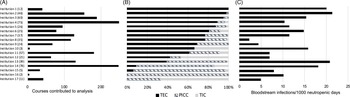
The source population included 575 patients (1,967 chemotherapy courses). After excluding patients with trisomy 21 (n = 13 patients, n = 53 courses), reduced intensity chemotherapy courses (n = 20 courses), course 5 (n = 48 courses), and courses with no CVAD at the start of chemotherapy (n = 18 courses), 560 patients contributed 1,828 chemotherapy courses to these analyses. The distribution of these courses across institutions is shown in Figure 1A. The median duration of neutropenia per course was 19 days (interquartile range [IQR], 14–25). TECs were the most common CVAD, accounting for 65.1% of courses; PICCs accounted for 27.5% and TICs accounted for 7.3%. These distributions were stable over the course of therapy (Supplementary Table 1 online).
Substantial center-level variability in prevalence of central venous access device (CVAD) types and rate of bloodstream infections. In this figure, each row represents an institution and the number of patients at each institution captured in these analyses. (A) Total number of courses each institution contributed to the analyses. (B) Distribution of line types (denoted by shading) across all courses of chemotherapy included in the analyses. (C) Rate of bloodstream infections normalized to 1,000 neutropenic days at each institution.

Baseline characteristics
Distribution of covariates by line type are shown in Table 1. There was considerable variation in the distribution of CVAD type by treating institution (Fig. 1B), but course length and duration of neutropenia did not vary by CVAD type (Supplementary Table 2 online). Age, race, ethnicity, and insurance status all varied by CVAD type, as did receipt of antibacterial prophylaxis, due primarily to the variability in patient population and supportive care practices that occur at a center level.
Demographic, Clinical and Hospital-Level Characteristics by Central Venous Access Device Type

Note. TEC, tunneled externalized catheter; PICC, peripherally inserted central catheter; TIC, totally implantable catheter; EMR, electronic medical record; ADE, cytarabine/daunorubicin/etoposide; AE, cytarabine/etoposide; MA, mitoxantrone/cytarabine; HD AraC high-dose cytarabine.
Bloodstream infections
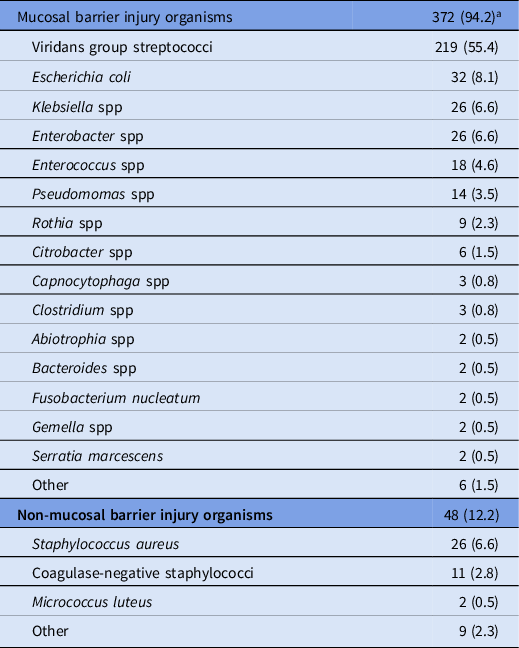
Overall, incident BSIs occurred in 444 (22.5%) chemotherapy courses. Of those, 395 (89.0%) occurred during neutropenia, resulting in an overall rate of neutropenic BSI of 12.0 infections per 1,000 neutropenic days. Overall, incident neutropenic BSIs occurred in 21.2% of courses with TECs, 23.3% of courses with PICCs and 18.7% of courses with TICs. MBI BSIs were more common than non-MBI BSIs (incidence rate, 10.0 per 1,000 neutropenic days for MBI BSI versus 1.4 per 1,000 neutropenic days for non–MBI BSI). The distribution of identified organisms is shown in Table 2. The most commonly isolated organisms were viridans group streptococci, which accounted for 219 (55.4%) of the 395 BSIs. Overall, 3% of BSI were polymicrobial infections. Only 29 courses (1.6%) contained a second BSI event.
Organisms Identified in Incident Bloodstream Infections

a Results presented as no. (% of total bloodstream infections with organism).
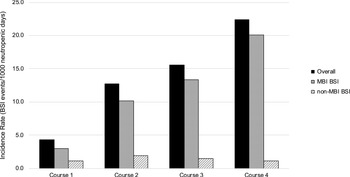
BSIs were common in all cycles of chemotherapy, with rates increasing over the course of frontline treatment, driven primarily by an increase in the rate of MBI BSI (Fig. 2). BSI rate varied considerably by institution and did not qualitatively correlate with the distribution of CVAD type within each institution (Fig. 1C).
Rate of bloodstream infection (BSI), and specifically mucosal barrier injury (MBI) BSI, increases over the course of therapy. Bar chart illustrating the rate of BSI by course during AML chemotherapy. The shading of the bars denotes organism classification as MBI or non-MBI.

Univariable analysis identified several covariates that were associated with BSI, including course, age, receipt of antibiotic prophylaxis, and hospital-level prophylactic practices that would require adjustment in the multivariable models. Treatment with a St. Jude Children’s Research Hospital (SJCRH) protocol was also associated with BSI. No other clinical or disease characteristics were meaningfully associated with BSI in unadjusted analyses (Supplementary Table 3 online).
Association between CVAD and BSI
Table 3a shows the unadjusted associations between CVAD type and BSI as well as the final multivariable associations adjusting for course, age, trial enrollment, antibacterial prophylaxis, and hospital-level antibacterial prophylaxis. The rates of BSI by central-line type were 11.0 BSIs per 1,000 neutropenic days for TECs, 13.7 for PICCs, and 10.7 for TICs. After adjustment, the IRR for BSI comparing PICC to TEC was 1.00 (95% confidence interval [CI], 0.75–1.32) and the IRR for BSI comparing TIC to TEC was 0.83 (95% CI, 0.49–1.41) (Table 3a). Similar point estimates of association were identified when limiting to just MBI BSI (Table 3b) and non-MBI BSI (Table 3c) in separate models.
Crude and Adjusted Comparisons of Bloodstream Infections (BSIs) by CVAD Type

Note. BSI bloodstream infection; CVAD, central venous access device; IRR, incident rate ratio; TEC, tunneled externalized catheter; PICC, peripherally inserted central catheter; TIC, totally implantable catheter; PCP, primary care physician.
a Adjusted for age at diagnosis, trial enrollment, any antibacterial prophylaxis, hospital-level prophylaxis (3A); age at diagnosis, trial enrollment, any Pneumocystis jirovecii pneumonia coverage, any antibacterial prophylaxis, hospital-level prophylaxis (3B); age at diagnosis, trial enrollment, any Pneumocystis jirovecii pneumonia coverage, any antibacterial prophylaxis, hospital-level prophylaxis as standard, hospital-level antibacterial bathing and hospital-level outpatient management of neutropenia (3C).
We performed a sensitivity analysis excluding patients who were treated on a SJCRH protocol (n = 180 courses) because this treatment approach was highly correlated with central-line type and supportive care practices that influence BSI risk at the center level. This sensitivity analysis identified very similar point estimates of association as the primary analyses when comparing PICC to TEC (IRR, 1.06; 95% CI, 0.79–1.44) and comparing TIC to TEC (IRR, 0.81; 95% CI, 0.46–1.42).
On therapy mortality
Overall, on therapy mortality was rare, occurring in 22 (1.2%) of courses. The rate was similar across line types, with mortality occurring in 9 TEC patients (0.8%), 11 PICC patients (2.2%), and 2 TIC patients (1.5%).
Discussion
Children with AML are at high risk of BSI due to prolonged duration of neutropenia and the presence of a CVAD. In this large, multicenter cohort of pediatric AML patients, we found no difference in the rate of BSI during neutropenia by CVAD type. This finding held true when limiting the outcome to either MBI only or non-MBI only pathogens.
Our results are consistent with those previously reported for single-center studies of AML patients. In one retrospective study at a single pediatric hospital, there was no difference in the risk of BSI based on CVAD type. Reference Rogers, Eisenman and Dolan6 Similarly, a single-center adult cohort also found no difference in BSI between adults with TECs or those with PICCs. Reference Lim, Al-Kali and Ashrani16 However, this finding contrasts with studies of general oncology populations that have demonstrated different rates of infection by CVAD type, increasing incrementally from TIC to TEC to PICC. Reference Hord, Lawlor and Werner10,Reference Orgel, Ji, Pastor and Schore17–Reference Fu, Hodgman, Burkhalter, Renkes, Slone and Alder21 This finding also has been replicated in nononcology populations. Reference Maki, Kluger and Crnich8
Although it is possible that in certain patient populations CVAD type does truly alter the risk of infection, it must also be recognized that CVAD type may act as a proxy for other factors that alter infection risk such as patient age, disease, or chemotherapy regimen. Therefore, caution should be exercised in extrapolating the results from one patient population to another because BSI risk factors among these groups are different. For example, results from heterogenous adult nononcology cohorts Reference Maki, Kluger and Crnich8 should not be assumed to be applicable to children with AML. Prior studies have acknowledged this limitation of data transportability and used subanalyses to parse line type from oncologic disease. Yacobovich et al Reference Yacobovich, Ben-Ami and Abdalla22 found a higher rate of infection with TEC compared with TIC, but in analyses restricted to AML and hematopoietic cell transplant patients, no difference was identified. Similarly, Fratino et al Reference Fratino, Molinari and Parodi23 reported that the association between CVAD type and infectious complications was driven by an association in solid-tumor patients, with a weaker association for patients with hematologic malignancies. These data underscore the importance of considering patient-specific risk factors when applying data regarding BSI risk.
Several hypotheses might explain why association of line type and infection may be different in AML compared to nononcology or even non-AML oncology patients. The baseline infection rate in AML is much higher due to the type and intensity of chemotherapy, severity and duration of neutropenia and mucositis, as well as the need for frequent central-line access for administration of blood products and total parenteral nutrition. Reference Lech-Maranda, Seweryn and Giebel5,Reference Penel, Neu, Clisant, Hoppe, Devos and Yazdanpanah24,Reference Sung, Zaoutis and Ullrich25 Additionally, BSIs in AML are frequently caused by translocation from the alimentary tract in the setting of chemotherapy-induced mucosal barrier injury, mucositis, and prolonged neutropenia. This cause is evident in the high proportion of BSIs that were categorized as MBI BSIs. Any difference in BSI risk conferred by line type may be less impactful amid these other risk factors dictating higher BSI rates. These data can inform efforts to reduce BSI in children with AML and perhaps other patient populations in whom MBI-BSIs are common, such as adults with AML or patients undergoing hematopoietic stem cell transplantation. Systemic prophylaxis or oral care may be more effective at reducing BSI than focusing on CVAD selection or other CVAD-based interventions (eg, lock therapy), and future efforts may be able to leverage datasets such as this one to investigate these questions in disease-specific cohorts. As these data highlight, monitoring BSI rates in specific patient populations may provide meaningful supplemental metrics for comparison of BSI risks over time or across institutions, as well as for the evaluation of interventions.
Given the center-level variability in both CVAD selection and patient characteristics and supportive care practices that impact BSI risk, it can be challenging to generalize the results of single center studies. The multi-institutional nature of our study overcomes this limitation of other analyses by considering supportive care practices and clustering at the hospital level in our statistical models. Furthermore, by leveraging the interinstitutional variation in standard line choice, as emphasized in Figure 1, our multicenter analyses were less subject to selection biases of single-center analyses, where the possibility that patients who receives a nonstandard line type are systematically different than other patients. The standardized approach to chart abstraction ensured comparable quality and consistency in data collection across all participating institutions, minimizing the risk of misclassification across study variables.
Nevertheless, this retrospective study had several limitations. CVAD selection was highly correlated to institution. The inclusion of hospital-level prophylaxis practices in our multivariable models mitigates this concern, but we could not fully exclude a residual center effect. In addition, we only examined BSI during the neutropenic period. Although the neutropenic period drives BSI risk in AML, as evidenced by 89% of BSI occurring during neutropenia, CVAD-associated risk profiles during the non-neutropenic period might be more consistent with associations identified in nononcology or non-AML oncology populations. Studies examining risk factors for BSI during non-neutropenic periods will provide important complementary data to this study. Reference Esbenshade, Zhao and Baird26 We also focused specifically on bacterial BSI risk and fungal pathogens, such as Candida BSIs, were not evaluated. However, given the relatively lower cumulative incidence of fungal BSI with current prophylactic strategies in AML, the inclusion of fungal pathogens would be unlikely to substantial impact our findings. Reference Fisher, Westling and Boge27,Reference Dix, Cellot and Price28 Similarly, we did not examine primary versus secondary BSIs. However, given the predominance of primary BSIs in this patient population, we hypothesize that those primary events are driving the identified rates. Reference Alexander, Fisher and Gaur29,Reference Feusner30 Finally, we did not consider CVAD characteristics beyond generic line type (eg, biomaterials, total days in situ) nor did we consider other CVAD-related adverse events such as insertional, mechanical, bleeding, or thrombotic complications, which may vary by CVAD type and may influence selection in practice. Reference Adler, Yaniv and Steinberg31–Reference Refaei, Fernandes, Brandwein, Goodyear, Pokhrel and Wu34
The decision of which type of CVAD to use may be based on several clinical and hospital-level characteristics such as planned chemotherapy and supportive care delivery and ease of placement. However, our findings suggest that bacterial BSI risk should not drive clinical decision making around CVAD selection for pediatric patients with AML. Instead, alternative factors, such as availability of facilities and technical skills for line insertion, burden of line maintenance, and risk of thrombosis, should drive selection of CVAD. Additional research is needed to design optimal BSI-prevention strategies for pediatric patients with AML.
Supplementary material
To view supplementary material for this article, please visit https://doi.org/10.1017/ice.2022.82
Acknowledgments
Financial support
This research was supported by the Patient Centered Outcomes Research Institute (grant no. CER-1409-22827). Dr. William Otto’s effort on his project was supported in part by a NICHD Training Award (grant no. T32 HD043021). Dr. Kelly Getz’s effort on this project was supported in part by a NHLBI Career Development Award (grant no. 1K01HL143153). The content of this publication does not necessarily reflect the views of policies of the Department of Health and Human Services, nor does mention of trade names, commercial products, or organizations imply endorsement by the US government.
Conflicts of interest
BTF receives research funding from Pfizer and Merck. He also serves as on a data safety monitoring board for Astellas. All other authors report no conflicts of interest relevant to this article.