Introduction
Post-traumatic stress disorder (PTSD) is characterised by specific symptoms, including intrusive thoughts, hyperarousal and avoidance, numbing, poor concentration and difficulty in explicitly recalling aspects of traumatic event. Several brain imaging studies have reported various structural and functional abnormalities of brain in subjects with PTSD (Reference Lanius, Frewen, Girotti, Neufeld, Stevens and Densmore1–Reference Landre, Destrieux and Baudry5). Most consistent findings are activation failure in medial prefrontal cortex, hippocampus and enhanced activation in amygdala in PTSD (Reference Bremner, Narayan, Staib, Southwick, McGlashan and Charney6–Reference Brunetti, Sepede and Mingoia11). Additionally, studies in PTSD have shown that posterior cingulate gyrus (PCG) functionally related to aforementioned regions (Reference van den Heuvel, Mandl, Luigjes and Hulshoff Pol12) is implicated in a neural circuit of stress (Reference Bremner13).
It is thought that PCG, which consists of Brodmann areas 23, 29, 30 and 31, plays a critical role in memory, visuospatial orientation, monitoring eye movements and formation and retention of conditioned fear response (Reference Meunier, Jaffard and Destrade14,Reference Vogt, Finch and Olson15). Notably, PCG has reciprocal connections with prefrontal cortex, anterior cingulate gyrus (ACG) and limbic system (Reference Maddock and Buonocore16), from which PCG transmits information to posterior neocortical association areas (Reference Meunier, Jaffard and Destrade14,Reference Vogt, Finch and Olson15). Lesions in PCG in animals resulted in an impairment of spatial learning and memory function, therefore rats failed to perform the place navigation task (Reference Sutherland, Whishaw and Kolb17,Reference Whishaw, Maaswinkel, Gonzalez and Kolb18). Similarly, Katayama et al. (Reference Katayama, Takahashi, Ogawara and Hattori19) have reported that PCG infarction in a woman leads to a failure in memorising a new route which likely results from a loss of directional memory over wide areas. Additionally, from an animal model of PTSD it appears that there is a significant degree of cortex specificity in memory impairment following underwater trauma (Reference Richter-Levin20).
Researches using diffusion tensor imaging (DTI) to explore dysfunction of white matter networks about PCG in PTSD were rare. DTI is a developed magnetic resonance imaging (MRI) technique that can provide information about white matter microstructural integrity in vivo(Reference Basser, Mattiello and LeBihan21,Reference Moseley, Cohen and Kucharczyk22). Fractional anisotropy (FA) value derived from DTI is measured by magnitude and direction of water diffusion (Reference Beaulieu23). Previous DTI studies concerning PTSD have found abnormalities of white matter integrity in ACG and PCG. Abe et al. (Reference Abe, Yamasue and Kasai24) reported increased FA values in left ACG, which correlated positively with symptom severity in victims with PTSD. However, Kim et al. (Reference Kim, Lyoo and Kim25) found that FA values in left ACG were lower in PTSD subjects than in healthy controls and they correlated negatively with severity. Kim et al. (Reference Kim, Jeong and Sim26) also showed decreased FA values in multiple subregions of left cingulum bundle, especially in its anterior portion. There was only one published DTI study revealing lower FA values in right PCG in subjects with PTSD rather than in those without PTSD (Reference Wang, Zhang and Tan27). Differences in types of trauma, illness duration, asymmetrical parameters in imaging processing and analysis, comorbid psychiatric disorders, including major depressive disorder, alcohol dependence and generalised anxiety disorder, could account for discrepant findings.
On 8 June 2005, a severe coal mine accident occurred in Zijiang Coal Mine in Hunan Province, China. Twenty-two miners lost their lives and the other 112 miners were rescued after more than 10 h of the ordeal in the darkness (Reference Hou, Liu and Wang7). The epidemiological data were obtained, and the survivors diagnosed with and without PTSD were scanned by neuroimaging techniques at 2, 10 and 24 months post-trauma, respectively. These techniques consisted of functional MRI (fMRI), three dimensions and DTI. Our group (Reference Hou, Liu and Wang7) has recently examined the neural correlates of PTSD using trauma-related imagery adapted to fMRI. In that study, subjects with acute PTSD at 2 months post-trauma exhibited increased activation in left PCG and decreased activation in bilateral middle frontal gyri when presented with trauma-relevant pictures versus neutral pictures. The PTSD group also showed decreased activation in right frontal gyrus while performing memory performance. The recent findings suggested neurophysiological alterations and memory performance deficit in acute PTSD.
This study presents the results of a longitudinal study of white matter integrity in PTSD and data were obtained at 10 and 24 months post-trauma. We hypothesised that PTSD subjects would exhibit increased white matter integrity in PCG, consistent with increased activation in PCG in PTSD reported in prior functional neuroimaging studies (Reference Lanius, Frewen, Girotti, Neufeld, Stevens and Densmore1,Reference Bremner, Narayan, Staib, Southwick, McGlashan and Charney6,Reference Sachinvala, Kling, Suffin, Lake and Cohen28–Reference Whalley, Rugg, Smith, Dolan and Brewin31). We have not found any prior research assessing longitudinal changes in PTSD using DTI. Survivors in this life-threatening coal mining accident experienced simultaneously and had high homogeneity in demographic background, which offered a distinct advantage in reducing the impact of confounding factors.
Materials and methods
Subjects
PTSD and matched control subjects were chosen from survivors of the coal mine accident and assessed according to the Structured Clinical Interview for Diagnostic and Statistical Manual of Mental Disorders, Fourth Edition (DSM-IV). Eighteen individuals who met the DSM-IV criteria of current PTSD were recruited into the study at 10 months post-trauma. At 24 months post-trauma, three original PTSD subjects dropped out of the study and the other seven people did not meet the PTSD diagnostic criteria. Thus the remaining 8 original PTSD subjects, along with 5 new people who met the criteria of current PTSD and 14 controls exposed to the same accident were recruited at 24 months post-trauma. Exclusion criteria for both groups included any history of head injury, any significant medical or neurological conditions, comorbid psychiatric disorders, substance abuse or dependence and mental retardation. During the study's 14-month follow-up period, subjects were excluded from the study if they experienced another traumatic event. All subjects were males and dextral, free of medication and without excessive head movement. Informed consent was written after the procedures had been fully explained. This study was approved by the Ethics Committee of the Second Xiangya Hospital of Central South University, China.
Instruments
Severity of illness was assessed by the PTSD Checklist Civilian Version (PCL-C), which is a 17 question, self-report measure used to evaluate PTSD symptoms from the DSM-IV criteria (Reference Peterlin, Tietjen, Meng, Lidicker and Bigal32). Three subscores from PCL-C were calculated corresponding to three PTSD symptom clusters: intrusion, avoidance and hyperarousal. Anxiety symptoms were assessed by the State-Trait Anxiety Inventory (STAI) (Reference Barnes, Harp and Jung33). Depressive symptoms were assessed by the Beck Depression Inventory (BDI) (Reference Beck34). This self-report inventory consists of 20 items to assess state anxiety and another 20 items to assess trait anxiety. The logical memory subtest and the visual reproduction subtest of Wechsler Memory Scale-Revised in China were used to evaluate the short-term memory of survivors (Reference Hou, Liu and Wang7).
Data acquisition and processing
DTI was performed using a standard head coil on a 1.5T-Tesla General Electric scanner (Twin-speed, Milwaukee, WI, USA). Cushions were placed around the subjects' head to minimise head movement. Each volume consisted of 30 contiguous axial slices. Single-shot echo planar imaging with alignment of the anterior commissure–posterior commissure plane was undertaken, using the following parameters: repetition time = 12 000 ms, echo time = 107 ms, acquisition matrix = 128 × 128, field of view = 24 × 24, excitation number = 5, slice thickness = 4 mm and no gap. The diffusion sensitising gradients were applied along 13 non-collinear directions (b = 1000 s/mm2), together with an acquisition without diffusion weighting (b = 0 s/mm2) (Reference Ma, Li and Shu35).
Three pairs of eigenvalues (λ1, λ2, λ3) and eigen vectors were derived by diagonalisation of the diffusion tensor matrix. Subsequently, the FA value was calculated on a voxel-by-voxel basis according to the equation in Basser's study (Reference Basser, Mattiello and LeBihan36).
The method of imaging processing was similar to that described previously (Reference Ma, Li and Shu35,Reference Hao, Yan, Liu, Xu, Xue and Song37). Parametric images of FA and b = 0 were calculated with the DTI-Studio version 2.40 (H. Jiang, S. Mori; Department of Radiology, Johns Hopkins University, Baltimore, MD, USA) and transformed from Digital Imaging and Communications in Medicine (DICOM) format to analyse format for further processing using statistical parametric mapping (SPM2; Wellcome Department of Imaging Neuroscience, London, UK), implementing on Matlab 6.5 (MathWorks, Sherbon, MA, USA). For each subject, the b0 image was normalised to the standard Montreal Neurological Institute (MNI) space using SPM2, and then the transformation matrix was applied to the FA map in order to normalise the map to the standard MNI space. All the images were resampled with a voxel size of 2 × 2 × 2 mm3. The normalised FA maps were smoothed with an 8-mm full-width at half-maximum isotropic Gaussian kernel to decrease spatial noise, and a mean image (FA template) was created.
ROI analysis
As extensive alterations were observed in PCG in PTSD subjects, this region was brought into our central attention. Region of interest (ROI) analysis was performed to identify the FA value of the region. The colour-coded FA maps of DTI were used to outline different white matter fibre systems (Reference Assaf and Pasternak38). In Colour Map-0, the axial line was located in the genus–splenium of the corpus callosum in the middle sagittal plane. The coronal line was taken from the medial surface of splenium of corpus callosum to the lateral surface in the middle sagittal plane and every movement of coronal line represents 2 mm from the medial surface. Different coronal plane follows every movement of coronal line in the middle sagittal plane. Two ROIs were located in bilateral PCG from each coronal plane. The FA value was obtained from Colour Map-0. Then, the mean FA values of bilateral PCG in different coronal planes (eight coronal planes for each individual) were calculated.
All measurements were performed by one rater (L. Z.) without the knowledge of subjects' identity. The intrarater reliability was established by rating five subjects randomly sampled from the whole subject group; the interrater reliability was also established by independent ratings of five subjects by two skilled raters who were familiar with brain anatomy (L. Z. and Yin Yan). Before the intraclass correlation coefficients (ICCs) were calculated, raters practised on another set of brains. The ICCs were 0.8969 for the left PCG and 0.9722 for the right PCG.
Statistical analysis
Intergroup [PTSD subjects at 10 months post-trauma (n = 8) vs. PTSD subjects at 24 months post-trauma; PTSD subjects at 24 months post-trauma (n = 13) vs. controls (n = 14)] differences in mean FA values were examined with paired t-test and two sample t-test, respectively. They were performed in a voxel-by-voxel manner. A statistical threshold of p < 0.005 (height threshold, uncorrected) (Reference Reading, Yassa and Bakker39) as well as an extent threshold of cluster size >50 voxels (400 mm3) were considered to be statistically significant.
Paired t-test and independent t-test were also used in demographic and clinical assessment. Pearson correlation analysis was utilised to evaluate the correlations between mean FA values of each ROI and clinical variables, which involved subscores of PCL-C and STAI, logical memory and visual reproduction scores. A level of p < 0.05 (two tailed) was considered statistically significant. SPSS 13.0 (SPSS Inc, Chicago, IL, USA) for Windows was used for the computations.
Results
General information
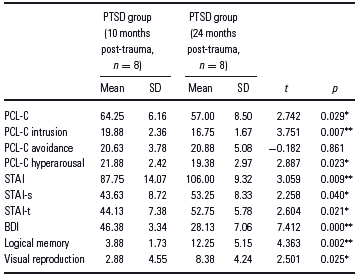
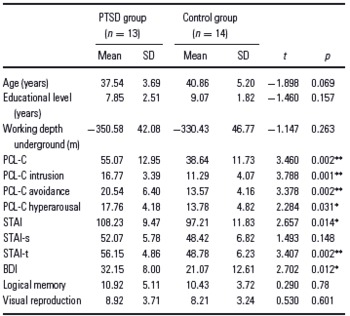
Results relating to the PTSD groups (10 months post-trauma vs. 24 months post-trauma) in the longitudinal study were shown in Table 1. Significant differences were evident between two groups in PCL-C, STAI, BDI, logical memory and visual reproduction scores, and PCL-C intrusion, hyperarousal, STAI-state (STAI-s) and STAI-t subscores. There were no significant differences in PCL-C avoidance subscores between two groups. Results relating to the PTSD and control groups (24 months post-trauma) in the cross-sectional case–control study were presented in Table 2. As shown in the table, there were no significant differences in age, educational level, working depth underground, STAI-s subscores, logical memory and visual reproduction scores between the two groups. Significant differences were evident in PCL-C, STAI, BDI scores, PCL-C intrusion, avoidance, hyperarousal and STAI-t subscores.
General information of the PTSD groups in the longitudinal study
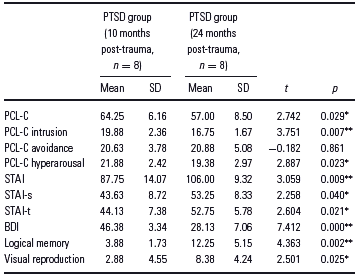
* BDI, Beck Depression Inventory; PCL-C, PTSD Checklist Civilian Version; PTSD, post-traumatic stress disorder; STAI, State-Trait Anxiety Inventory; STAI-s, STAI-state; STAI-t, STAI-trait.
* *p < 0.05, **p < 0.01.
General information of the PTSD and control groups in the cross-sectional study

* BDI, Beck Depression Inventory; PCL-C, PTSD Checklist Civilian Version; PTSD, post-traumatic stress disorder; STAI, State-Trait Anxiety Inventory; STAI-s, STAI-state; STAI-t, STAI-trait.
* p < 0.05, **p < 0.01.
Group comparison
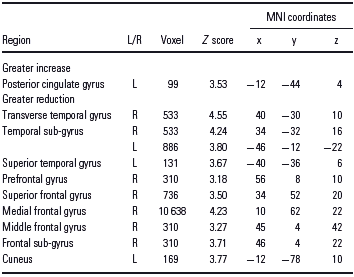
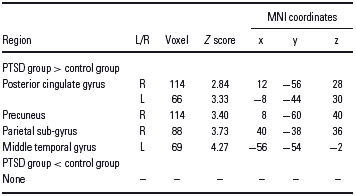
In the longitudinal study, compared with the 10 months post-trauma, PTSD subjects at 24 months post-trauma showed significant increased FA values in the left PCG (Fig. 1) and decreased FA values in the right transverse temporal gyrus, bilateral temporal sub-gyri, left superior temporal gyrus, right prefrontal gyrus, right superior frontal gyrus, right medial frontal gyrus, right middle frontal gyrus, right frontal sub-gyrus and left cuneus (Table 3). In the cross-sectional study, compared with the control group, areas with higher FA values in the PTSD group were identified with bilateral PCG (Fig. 2), right precuneus, right parietal sub-gyrus, left middle temporal gyrus (Table 4). Regions with lower FA values in the PTSD group were not found.
Increased FA in left PCG (the orange show) in PTSD at 24 months compared to 10 months post-trauma in the longitudinal study. The colour bar represents the T score. FA, fractional anisotropy; PCG, posterior cingulate gyrus; PTSD, post-traumatic stress disorder.

Significant difference about FA value in PTSD subjects in the longitudinal study
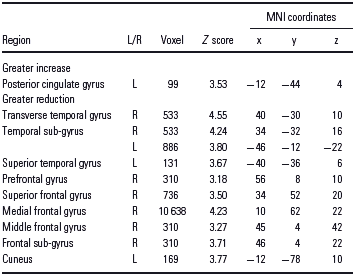
FA, fractional anisotropy; L, left side; MNI, Montreal Neurological Institute; R, right side.
Region displayed are for p < 0.005, cluster size >50 voxels.
Higher FA in right PCG (a) and left PCG (b) (the orange show) in the PTSD group compared to the control group in cross-sectional study. FA, fractional anisotropy; PCG, posterior cingulate gyrus; PTSD, post-traumatic stress disorder.
Significant difference about FA value between the PTSD and control groups in the cross-sectional study
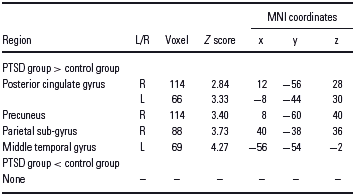
FA, fractional anisotropy; L, left side; MNI, Montreal Neurological Institute; PTSD, post-traumatic stress disorder; R, right side.
Region displayed are for p < 0.005, cluster size >50 voxels.
Correlation
In the cross-sectional study, FA values of the left PCG in PTSD (n = 13) correlated positively with the logical memory scores (r = 0.61, t = 2.55, p = 0.027) and negatively with PCL-C intrusion (r = −0.586, t = −2.398, p = 0.035) as well as STAI-t subscores (r = −0.605, t = −2.518, p = 0.029). FA values of the right PCG correlated negatively with STAI-s (r = −0.580, t = −2.362, p = 0.038) and STAI-t subscores (r = −0.630, t = −2.691, p = 0.021) (Fig. 3). FA values of bilateral PCG showed no significant correlations with any other clinical variables in PTSD. No correlations were observed in controls.
Correlations between FA values of left PCG in PTSD and (a) logical memory score (r = 0.61, t = 2.55, p = 0.027), (b) PCL-C intrusion subscores (r = −0.586, t = −2.398, p = 0.035, data from two of the victims were overlapping), (c) STAI-t subscores (r = −0.605, t = −2.518, p = 0.029; correlations between FA values of right PCG in PTSD), (d) STAI-s subscores (r = −0.580, t = −2.362, p = 0.038) and (e) STAI-t subscores (r = −0.630, t = −2.691, p = 0.021). FA, fractional anisotropy; PCG, posterior cingulate gyrus; PCL-C, PTSD Checklist Civilian Version; PTSD, post-traumatic stress disorder; STAI, State-Trait Anxiety Inventory; STAI-s, STAI-state; STAI-t, STAI-trait.
In the longitudinal study, FA values of the left PCG in the PTSD group (n = 8) at 10 months post-trauma correlated positively with the STAI-s subscores only (r = 0.773, R 2 = 0.5978, t = 2.986, p = 0.024). Meanwhile, FA values of the left PCG in the PTSD group (n = 8) at 24 months post-trauma correlated negatively with PCL-C intrusion subscores only (r = −0.749, R 2 = 0.56, t = −2.765, p = 0.033).
Discussion
Using DTI approach, we found increased FA values in the left PCG over a 14-month follow-up period in PTSD subjects. To our knowledge, this is the first longitudinal study describing morphological changes of white matter over time through the whole brain of PTSD. Although there is little previous information concerning white matter connection of PCG in PTSD, some follow-up studies showed glucose hypometabolism (Reference Villain, Fouquet and Baron40,Reference Fouquet, Desgranges and Landeau41) and greater grey matter loss in PCG (Reference Chetelat, Landeau and Eustache42) in patients with amnestic mild cognitive impairment relative to controls. These results suggest that PCG has dynamic structural and metabolic alterations in the course of diseases.
We also observed white matter abnormalities in bilateral PCG in the cross-sectional case–control study. Similar to our findings, one prior study (Reference Han, Renshaw and Dager43) reported that subjects with panic disorder (PD) exhibited increased white matter FA values in the right PCG. Our result is also congruent with the findings of functional neuroimaging studies, reporting increased regional cerebral blood flow (rCBF) in bilateral PCG in subjects with PTSD relative to controls (Reference Bremner, Narayan, Staib, Southwick, McGlashan and Charney6,Reference Sachinvala, Kling, Suffin, Lake and Cohen28,Reference Bremner, Staib, Kaloupek, Southwick, Soufer and Charney29). In addition, a structural neuroimaging study exhibited grey matter density increasing significantly in the right PCG in rape victims with PTSD compared with healthy controls (Reference Sui, Wu and King44). We therefore propose that dysfunction in PCG may contribute to the mechanism of neuropathology in PTSD.
Another major finding was that increased FA values in the left PCG in PTSD correlated negatively with intrusive symptom, which often manifested as a rapid succession of intrusive memory (Reference Tuerk, Grubaugh, Hamner and Foa45). This pattern of correlation is consistent with functional evidence that increased activation in PCG is involved in intrusive or traumatic memory processing in subjects with PTSD (Reference Frewen, Lanius and Dozois30,Reference Whalley, Rugg, Smith, Dolan and Brewin31,Reference Bremner, Vythilingam and Vermetten46–Reference Masaki, Nishikawa and Ikejiri51). These studies rely on trauma-related scripts, sounds and pictures that can elicit intrusive or traumatic memory in PTSD (Reference Lanius52,Reference Hull53). Furthermore, elevated FA values of PCG in PTSD subjects with improvement of intrusive symptom in the longitudinal study suggested that it may be a protective strategy for PCG to prevent the deterioration of intrusive recollection in PTSD.
More interestingly, our follow-up study showed that anxiety symptoms including state anxiety and trait anxiety increased in severity of PTSD. These findings supported the high rates of comorbid anxiety disorders or symptoms in full PTSD (Reference Garieballa, Schauer and Neuner54,Reference Mayou, Bryant and Ehlers55) or sub-threshold PTSD (Reference Marshall, Olfson, Hellman, Blanco, Guardino and Struening56). Our results also showed that increased white matter integrity in the left PCG in PTSD correlated negatively with trait anxiety. The same phenomenon happened between right PCG and trait anxiety as well as state anxiety. Unfortunately, our results were inconsistent with the study that increased FA values in right PCG in PD patients correlated positively with severity of anxiety symptoms (Reference Han, Renshaw and Dager43). Another study also showed that right PCG correlated positively with trait anxiety (Reference Etkin, Klemenhagen and Dudman57) in healthy subjects during fear processing. In addition, Bench et al. (Reference Bench, Friston, Brown, Frackowiak and Dolan58) used a positron emission tomography (PET) approach to have found state anxiety associated with increased rCBF in PCG in depressive patients. Furthermore, from PET scans significant reductions in serotonin 1A receptor which played a crucial role in the pathophysiology of affected disorders were observed in PCG in individuals with anxiety disorders (Reference Neumeister, Bain and Nugent59–Reference Spindelegger, Lanzenberger and Wadsak61). Many factors involving different types of mental illnesses and methods of imaging data processing as well as analysis could result in these inconsistent consequences. Taken together, however, these findings support hypothesis that PCG is implicated in affective regulation (Reference Etkin, Pittenger, Polan and Kandel62–Reference Tillfors, Furmark and Marteinsdottir65), which would contribute to the pathogenesis of anxiety spectrum disorders including PTSD and so on. We speculated that it might become an important target of early intervention for PTSD.
The limitations of this study are the small sample size and the risk of a type I error (uncorrected). Moreover, there was no control group at 10-month post-trauma. In addition, the findings of this study showed that quite many other brain regions (especially in frontal lobe and temporal lobe) might undergo specific change in PTSD, which would be discussed elsewhere due to limitation of space.
In spite of these limitations, using the voxel-based method with a relatively strict restriction of p < 0.005 and cluster size >50 voxels, we presented evidence for possible alterations of FA value in PTSD subjects, which suggests that white matter pathology may occur late in the course of illness.
In conclusion, these findings suggest that alterations of white matter integrity in PCG link to mnemonic and affective processing in individuals with PTSD over a long-term follow-up period. The results reveal that PTSD is associated with structural plastic changes to brain white matter in the evolution of illness. Further studies can use DTI to explore whether such changes are progressive over the course of PTSD and the relationship between the abnormalities and symptom severity, memory tests. We also would like to explore changes of white matter integrity in people with lifetime PTSD but not currently in the evolution of this illness.
Acknowledgements
We thank our subjects for their readiness to engage in this study and the Department of Radiology for providing scan time and technical assistant. We would also like to thank the study staff at the Mental Health Institute for their diligent work and essential contributions to the recruitment of participants and collection of data. We thank the fund support from the National Natural Science Foundation of China (30830046 to L. L.), the National Science and Technology Program of China (2007BAI17B02 to L. L.), the National 973 Program of China (2009CB918303 to L. L. and 2007CB512308 to Z. Z.), Program of Chinese Ministry of Education (20090162110011 to L. L.) and National Hi-Tech Research and Development Program of China (863 program: 2008AA02Z413 to Z. Z.).