1. Introduction
Theories of institutional economics analyse the relationship between organizations and institutions in three different ways. According to a first approach, which is the most frequent, organizations are seen as a subgroup of institutions. We may call this the inclusion view. In a second perspective, organizations and institutions constitute two clearly different, but interactive, categories. This can be named the distinction view, put forward by Douglass North (Reference North1990). Finally, John R. Commons's Institutional Economics argues that organizations and institutions represent two facets of one and the same phenomenon: ‘It is these going concerns, with the working rules that keep them agoing, (. . .) that we name Institutions’ (Commons, Reference Commons1934a: 69). We shall call this standpoint the assimilation view.
The work of Commons has been widely commented, especially in the recent period where a renewed interest in his work has become manifest. The contribution attempted here is to illustrate what we interpret as an organizational theory of institutions, which Commons developed in his three important books: Legal Foundations of Capitalism (first published in 1924), Institutional Economics (first published in 1934) and The Economics of Collective Action (first published posthumously in 1950). The paper underlines the role of the hierarchy of rules, compares Commons's typology of transactions with Karl Polanyi's scheme of integration modes and considers the implications of his somewhat restricted definition of institutions, also discussing ambiguities about the place of markets in the economy and the relationship of state to society.
A first section gives an outline of the theory. The second section stresses a few important contributions of Commons to institutional economics. The third section discusses some limitations of his theory, from a historical and theoretical point of view.
The proposed assessment is that, beyond well-known problems of exposition, Commons's creative work gives a very valuable (but often undervalued) contribution to political economy and to social science in general. In some important respects, it complements or goes further than other currents of institutional economics; however, it also has some weak points, which are sometimes the reverse side of his very contributions. Both evaluations are of course open to debate, as a consequence of the complexity and relative opacity of his work, and also of the fact stressed by Yngve Ramstad (Reference Ramstad1986: 1095) that ‘to truly understand the meaning in part-whole terms of any component of Commons's thought, one must first grasp his entire framework’.
Commons's original stance in institutional economics
Four original aspects in Commons's ‘institutional economics’ are the role ascribed to the American experience, the association of law and economics, the attitude he takes in relation to previous economic theories, and his reformist perspective. All are linked to his relatively inductive approach to theorizing.
While Karl Marx had taken England in the mid-19th century as the model for his theory of capitalism, Commons refers to the United States of the end of the 19th century and the beginning of the 20th century as the basis and the source of conceptualization for his theory of ‘modern capitalism’ that emerged after the 1850s.Footnote 1 In some measure he fulfils an objective of the historical school, namely the association of history and theory (but also the national grounding of economic theory). His unconventional approach is furthermore based on interaction between his experience as a man of action, as a consultant, an expert, a legislator, and his research as an academic (Bazzoli, Reference Bazzoli1999). In his autobiography, Myself (Commons, Reference Commons1934b), he gives numerous examples of such interaction and its effects on the piecemeal elaboration of his theory, which really matured in the 1920s and 1930s.Footnote 2
The interpretation given by common law courts and by the Supreme Court of the United States to emergent rules of American capitalism in the age of ‘stabilization’ is an essential source of Commons's historically contextualized institutional concepts, such as ‘going concern’, ‘intangible property’, ‘due process of law’, ‘reasonable value’ and ‘goodwill’. The fundamental relationship between law and economics, expressed in the title Legal Foundations of Capitalism, is crucial for its author (Commons, Reference Commons, Rutherford and Samuels1996a); it is linked to the ‘common law method of making law’ that typifies in his eyes the general fashioning of working rules as a basic component of institutions.
The idiosyncratic reading of the history of economic thought by Commons, influenced by his intention to critically incorporate previous theories as moments in institutional economics rather than to discard them altogether, is linked to a historical approach of economic theories as expression of changing social conditions.Footnote 3 These theories are also taken as support in his arduous conceptual endeavour of erecting a new school of institutional economics.Footnote 4 It is in this context that his positive references to authors such as David Hume, Thomas Robert Malthus, Henry Dunning MacLeod and Thorstein Veblen have to be understood.
While Veblen proclaimed in principle that science proper was incompatible with normative positions, Commons adopts an explicit reformist attitude and tries more generally to include ethical dimensions in understanding economic processes. As opposed to socialists or communists, his objective was to contribute to make capitalism ‘reasonable’, echoing the doctrine of reasonableness he observed in American law. ‘I was trying to save Capitalism by making it good’ (Commons, Reference Commons1934b: 143); ‘They wanted a goat for the sins of capitalism. I would regulate but not destroy the system’ (ibid.: 118).
2. Institutions as organizations: the assimilation view
While not all institutions are in principle organized in Commons's theory, as may be seen with custom, which is regarded as ‘unorganized’ collective action, the dominant trend of his work is to state that in the modern form of capitalism, organized going concerns constitute the whole social domain, and that customs develop essentially within going concerns, before being possibly transformed into (formalized) working rules.Footnote 5 Thus in Institutional Economics we observe that institutions are principally associated with organizations. Admittedly, an essential aspect of Commons's methodology ‘resides in giving a variety of competing formulas for a same structure’ (Théret, Reference Théret2001: 110), and there is a ‘flexibility and relativity of the meaning of words’ in his conceptualization (Grinberg, Reference Grinberg2001: 181), which is manifest in the use of terms such as ‘institution’ and ‘organization’. Our reading is that the dominant approach in his work is, as a matter of fact, an organizational theory of institutions.
1. Going concerns
Commons defines the institution as ‘collective action in restraint, liberation, and expansion of individual action’ (Commons, Reference Commons1934a: 73). The relationship between collective and individual action is the foundation of going concerns and their rules: ‘It is these going concerns, with the working rules that keep them agoing, all the way from the family, the corporation, the trade union, the trade association, up to the state itself, that we name Institutions’ (Commons, Reference Commons1934a: 69). The assimilation view we mentioned above can be thus summarized: institution = going concern + its working rules.
Following his borrowing of legal notions expressing changes in economic relations, Commons derives the concept of ‘going concern’ from recent English and American jurisprudence, while noting its similarity with the German gutgehendes Geschäft. The going concern has succeeded the earlier notion of corporation. It may be understood as a living organization: ‘The concern “goes” as long as the participants earn a living or a profit through collective action; it may die by bankruptcy, be dissolved, or be absorbed by another corporation. Individuals come and go, but the concern goes on, if not in one form, then in another. Hence our “institutions” are, in reality, “going concerns”. A going concern is an organization’ (Commons, Reference Commons1950: 34).
But going concerns are not limited to economic organizations, referred to in this excerpt. Commons regards society and economy as constituted by innumerable organizations, which he classifies in three categories: economic, political and cultural organizations. Individuals are members of several going concerns, from the small family to the state itself (the latter being interpreted as the largest going concern). Characteristics of all going concerns or organizations are legitimate authority, duration (beyond the entry and departure of their members), transactions, working rules and sanctions. ‘The going concern is animated by a common purpose, governed by common rules of its own making, and the collective behavior in attaining that purpose we distinguish as “going business”.’ (Commons, Reference Commons1924: 145)Footnote 6 Beyond the diverse purposes of economic, political or cultural going concerns, an important difference is the kind of sanction they may use to enforce the rules they are based on: respectively economical, physical or moral sanctions (Commons, Reference Commons1924: 333).
The concept of sovereignty, or ‘collective action in control of violence’ (Commons, Reference Commons1950: 74), has gone through a long historical evolution, extensively analysed in Legal Foundations. Gradually concentrated by the state, then becoming an exclusive attribute of the latter, it was eventually and partially delegated to other, non-state going concerns. In this respect diverse organizations ‘are, indeed, governments, since they are collective action in control of individual action through the use of sanctions’ (Commons, Reference Commons1950: 75). We come back below on such analogy between the state and other going concerns, and the hierarchical relationship implied.
The main components of going concerns are future-oriented transactions. ‘A going concern is a joint expectation of beneficial bargaining, managerial, and rationing transactions, kept together by working rules and by control of the changeable strategic or limiting factors which are expected to control the others.’ (Commons, Reference Commons1934a: 58)
2. Working rules, the common law method and artificial selection
Going concerns have legitimate ‘authoritative actors’ exerting sovereignty over their members; their role is singularly to establish the rules that govern their activity, and to enforce them by recourse to specific sanctions. ‘The rules, regulations or bylaws I name the “rules of action” or “working rules of collective action”.’ (Commons, Reference Commons1950: 26)Footnote 7
The most universal form of collective action is ‘custom’ (Commons, Reference Commons1934a: 72), but it is ‘unorganized’. In going concerns, it becomes organized. Commons christens the specific method of establishing formal working rules in organizations ‘the Common-Law method of Making Law by the decision of disputes’. The traditional Anglo-American juridical system ‘of making new law by deciding conflicts of interest, thus giving greater precision and organized compulsion to the unorganized working rules of custom or ethics’ (Commons, Reference Commons1934a: 72, 73) is ‘only a special case’ of this method, which is universal in all collective action. ‘The decisions, by becoming precedents, become the working rules, for the time being,Footnote 8 of the particular organized concern.’ (ibid.)
After writing Institutional Economics, Commons introduced a distinction between the organization itself as ‘institution’ and its rules of action as institutes, the Roman law concept, differentiating the activity or production proper (going concern) and its product (working rules) (Commons, Reference Commons, Rutherford and Samuels1996c: 499, 500; 1950: 129), and criticizing the earlier confusion on this point.
If working rules are first established in order to mediate conflicts, through the common law method, they do not put an end to them, as according to Commons conflicts are a structural dimension of social reality, based on scarcity. ‘The working rule is not a foreordained harmony of interest, as assumed in the hypotheses of divine or natural rights, or mechanical equilibrium of the classical or hedonic schools, but it actually creates, out of conflict of interests, a workable mutuality and orderly expectation of property and liberty.’ (Commons, Reference Commons1934a: 92) Conflicts of interests are always to be seen within going concerns; this consideration was wrongly set aside by economists for the present, and by Marx for the future: ‘there is no such thing as an automatic harmony of economic interests, either under capitalism or future socialism’ (Commons, Reference Commons2009: 135, 136).
Working rules are generally embedded in a wider institutional context, evoking ‘the hierarchy of parts in the whole activities’. ‘Even where only two individuals agree on a rule of action as to price, quantity, and quality, there are also the customs, the habits, the laws of the land, and the Constitution, all of which are tacitly setting the rule within which the two individuals deal with each other.’ (Commons, Reference Commons1950: 127, 128)Footnote 9
Commons opposes the concept of natural selection transposed by Veblen from Charles Darwin and applied to economic phenomena and especially to institutions, and in contrast borrows the concept of artificial selection. The reason he gives is that natural selection disregards the role of the human will (Commons, Reference Commons1924: 376).Footnote 10 The interaction between changes in individual behaviours and changes in working rules comes through a specific artificial selection: it is ‘the common-law method of making new law by taking over the changing customs of the dominant portion of the people at the time, and formulating them, by a rationalizing process of justification, into working rules for future collective action in control of individual action’ (Commons, Reference Commons1934a: 682). The role of power, and of legitimation, is here stressed by CommonsFootnote 11 in discussing the artificial selection of rules.
3. A hierarchy of collective action
Commons places the emphasis on the various ordered levels of working rules, or hierarchy of collective action. An important distinction, developed in Legal Foundations but absent in later writings, is between authoritative and authorized transactions,Footnote 12 which underscores the special role of the state in ‘authorizing’ other going concerns. While the common law method refers to an artificial selection of customary rules that are initially produced from below and later sanctioned from above, the superiority of authoritative compared with authorized transactions stresses a hierarchy of power levels, through a process of delegation.
The supreme organized collective action is the monopoly of physical force by taking violence out of private hands. This is sovereignty. There are subordinate forms of organized collective action, sanctioned by the physical force of sovereignty but authorized, in the case of business corporations, to use the economic sanctions of scarcity, or, in the case of churches or clubs, to use the merely moral sanctions of public opinion. These subordinate forms are delegated forms, since they are created, permitted, regulated, dissolved or prohibited by the supreme institution, sovereignty. I date the modern recognition by the state of these delegated forms of economic collective action from the time of the general corporation laws beginning in the decade of the 1850s, and I consider this period to be the beginning of modern capitalism (Commons, Reference Commons, Rutherford and Samuels1996c: 494).
The hierarchy of collective action contemplated has actually two fundamental levels, the state and all other going concerns. Commons often stresses the similarities between the state and other going concerns, sometimes characterizing it as a going concern among others,Footnote 13 but as a matter of fact there is an essential difference between them, namely the ascendancy of state rules on other organizations’ rules, following a pattern of subordination and delegation.Footnote 14 The physical sanctions used by the state are also superior to the economic or moral sanctions of the economic or cultural organizations, which they somehow ‘authorize’.
Possible mismatches or biased dimensions of organizational rules justify their submission to a higher level of collective action: ‘It is the “working rules” of each organization, governing subordinates, that tie the individuals together and enlarge their personalities by loyalty to a “going concern”. But it is the abuses that are embodied in these same working rules that require a hierarchy of superior working rules ultimately organized through the sovereign legislative, executive, judicial, and administrative departments of government’ (Commons, Reference Commons1950: 138, 139). However, this does not mean that there is an absolute rationality of the state's rules as opposed to other concerns’ rules, as the state itself is an evolving condensation of social compromises, ‘an accumulated series of compromises between social classes, each seeking to secure for itself control over the coercive elements which exist implicitly in society with the institution of private property’, to quote an early formulation of Commons (Reference Commons1899–1900: 100).
Two types of collective behaviour are actually implied in the rules of a going concern, both guided and secured by the state: ‘one is the promised behavior of the government set forth in the working rules for public officials, the other the intended behavior of a going concern set forth in the working rules for its employees, agents and functionaries’ (Commons, Reference Commons1924: 145).
Another dimension of the general hierarchy of collective action might be called a process of internalization of the state's rules in the inside rules of other organizations.
Over all, the general statute law, the common law, the decisions of courts, in short, the working rules of the general government, are read into the articles of incorporation and into the transactions of principal and agent, employer and employee, stockholders, bondholders, patrons, clients, customers, so that the will of the state, or rather its working rules, perpetuate the rights, duties, liberties and exposures, within which the working rules of a subordinate concern are made up and its collective behavior goes along (Commons, Reference Commons1924: 147).
3. Commons's contribution to institutional economics
Among highly original dimensions of Commons's theory, two may be underlined here: the place given to transactions and methodological holindividualism.
1. A world of transactions
The ‘transaction’ is a renowned concept since it has been borrowed by the transaction costs economics of Oliver Williamson. While explicitly taken from Commons, it has been cut from its original theoretical framework, illustrating the chasm between ‘old’ and ‘new’ institutional economics.
According to Commons, ‘our subject-matter is the transactions of human beings in producing, acquiring, and rationing wealth by cooperation, conflict, and the rules of the game’ (Commons, Reference Commons1934a: 121); ‘our theories of economics come to center on transactions and working rules, on the problems of organization, and on the way collective action becomes organized into going concerns’ (Commons, Reference Commons1950: 21). Following Veblen on this point, he refutes the ‘atom’ view of the individual, reduced to a ‘globule of desire’ in hedonic and neo-classical theories. Commons's approach is fundamentally relational.Footnote 15 ‘These individual actions are really trans-actions – that is, actions between individuals – as well as individual behavior. It is this shift from commodities, individuals, and exchanges to transactions and working rules of collective action that marks the transition from the classical and hedonic schools to the institutional schools of economic thinking. The shift is a change in the ultimate unit of economic investigation, from commodities and individuals to transactions between individuals.’ (Commons, Reference Commons1934a: 73) Working rules of going concerns determine a ‘bundle of correlative and reciprocal economic relationships’ (Commons, Reference Commons, Rutherford and Samuels1996b: 445). Each and every right for an individual is accompanied by a duty for (an)other individual(s), each liberty is associated to an exposure, etc. This is an ‘exposure–liberty relation’: thus ‘an employer is exposed to the liberty of the employee to work or quit, and the employee is exposed to the liberty of the employer to hire or fire’ (Commons, Reference Commons1934a: 70).
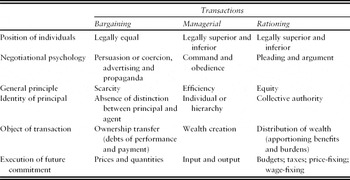
The original typology of bargaining, managerial and rationing transactions is an important achievement of Commons, who considers it is universal and exhaustive. It distinguishes what was confused in the single concept of ‘exchange’. The various dimensions of the three essential transactions are summarized in Table 1.
Three types of transactions

Sources: Commons (1934: 59–68, 91, 106); Commons (Reference Commons1950: 57). See Chavance (Reference Chavance2008a).
The concept of transaction is the ultimate unit of activity, containing the three principles of conflict, dependence and order; it correlates law, economics and ethics. In the bargaining transactions, the object transferred is future rights of ownership, not simple things. The distinction between commodities as things and property rights on these commodities is central for Commons, closely binding the legal and economic dimensions of the transaction. Accordingly institutional economics is also deemed ‘proprietary economics’. In bargaining transactions the relation is established between legally equal individuals, but they may be unequal in terms of bargaining power. Managerial and rationing transactions involve legal relations between superior and inferior. The distinctive concept of rationing refers both to quantity rationing and to price rationing.
The focus on transactions, and the typology given by Commons, may be assessed as a major contribution to institutional economics in general. They imply a radical criticism of the centrality of markets in mainstream theories. First, while neoclassical theories are market-centred, they alter the general approach by proposing a theory of an ‘organizational economy’ – to borrow the expression of Herbert Simon (Reference Simon1991), somewhat reversing what has since become a central feature of new institutional economics.Footnote 16 Second, they introduce a pluralist approach to coordination, as opposed to dualistic models (market/state, or market/organization), while encompassing and transcending them. The subsequent contribution in this essential direction will be Polanyi's (Reference Polanyi, Polanyi, Arensberg and Pearson1957) typology of ‘forms of integration’, exchange, reciprocity and redistribution.Footnote 17 Finally, they are associated to an original methodological stance.
2. Transcending holism and individualism
Heterodox institutional economists often attempt to refute the opposition between methodological individualism and holism, insisting on the contentious reduction implied by both (Biddle, Reference Biddle1990; Lawson, Reference Lawson1996; Hodgson, Reference Hodgson2007; Chavance, Reference Chavance2008a). The combined notion of ‘holindividualism’ has thus been submitted, bringing together the macro or meso level of the institutions produced by individual actions and the micro level of individual actions conditioned by the existing institutions, distinguishing the different time frames of the genesis and change applying to the two levels (Boyer and Saillard, Reference Boyer and Saillard2002). We believe that Commons's theory offers an original methodological holindividualistic approach,Footnote 18 somewhat overcoming the dichotomy between the two traditional stances.
Commons differs from holist institutional theories by the critical weight he gives to individual action, and the importance he assigns to a ‘volitional’, ‘negotiational’ and ‘transactional’ psychology. The individual is an essential actor of economic processes. However, he is not the utilitarian and pre-social ‘globule of desire’ derided by Veblen, but the ‘institutionalized mind’ that has learned, through his process of socialization, customs and working rules bequeathed by previous historical collective actions. ‘It is not individualism. It is institutionalized personality.’ (Commons, Reference Commons1934a: 873, 874) Commons's approach is simultaneously distinguished from individualist institutional theories by the prominence attributed to ‘collective action’ and by his hierarchical view of working rules of going concerns.
Different traditions of naturalistic individualism concentrate on the relations of individuals to nature or to other ‘natural’ individuals; however, in order to view individuals as citizens with rights, a negotiational psychology is warranted, and Commons states that Dewey's social psychology of custom ‘may become negotiational’ (Commons, Reference Commons1934a: 91). Transactions realized by individuals are future-oriented, and simultaneously framed by rules of action: ‘In all cases negotiations are directed towards future time – the universal principle of futurity. Working rules are always explicitly or tacitly taken into account, since they are the expectations of what the participants can, must or may do, as controlled, liberated, or expanded by collective action’ (Commons, Reference Commons1934a: 91).
Commons's view could be called ‘bounded volition’, where individual action, while often more motivated by stupidity and ignorance than by reason (see his frequent reference to Malthus on this point),Footnote 19 and also framed by existing rules, – always has a space for autonomy. ‘Thus the working rules of a concern necessarily allow to every member a certain amount of discretion or choice of alternatives, consisting in the authority (right) and the immunity (liberty) allowed by the rule in question and limited by the alternatives actually open to him.’ (1924: 148) Bounded volition is also at work in the actions of the individual aimed at what he sees as the present limiting factors, as distinguished from complementary factors (Commons, Reference Commons1934a: 639).Footnote 20
In the process of artificial selection of working rules, individual actions are taken into account at two levels: the first, citizens of going concerns (evolving customs), and the second, authoritative actors (officials) of the concerns. A kind of sequence is at work:
Evolving individual actions -> evolving customs -> common-law method -> changed working rules of going concerns, by authoritative actors -> collective action -> control of individual action -> evolving individual actions -> . . .
We have an ongoing causal historical spiral, echoing a Veblenian cumulative causation process, where both moments of individual actions generating collective rules, and of collective rules conditioning individual actions, are taken into account, with different levels and temporalities of change.
The original stance of Commons in methodological matters is seen for example in the fact that he criticizes economic (neoclassical) theories in which ‘corporations are falsely treated as individuals’ (Commons, Reference Commons, Rutherford and Samuels1996c: 498). This seems close to a traditional argument by champions of methodological individualism; however, his rationale is quite different:
[such approach] ends in the inequality of treating as equals a concerted thousand or hundred thousand stockholders and bankers, acting together as a single person, in dealing with wage earners or farmers or other buyers or sellers, who act separately in their naked individualism of Smith, Bentham, Ricardo, the Austrian economists, the Declaration of Independence (Commons, Reference Commons, Rutherford and Samuels1996c: 498).
Furthermore, in contradistinction to methodological individualists, he gives a central place to collective action, and even refers to the collective will of an organization. But such collective will has no independent foundation that would be external to individual practices and transactions. ‘Thus the going concern may be looked upon as a person with a composite will, but this so-called “will” is none other than the working rules of the concern operating through the actions and transactions of those who observe the rules.’ (Commons, Reference Commons1924: 147)
Individual action is purposeful, and expresses human will. Willingness discriminates between strategic action and non-strategic action, between limiting and complementary factors. Individual action is foremost, but it is the action of an institutionalized mind, acting in the framework of pre-existing working rules of going concerns, namely of collective action.
According to Commons, there is a temporal gap between emerging variations in custom and reshaping of working rules with their concurrent sanctions. ‘Thus the process of making law by deciding disputes fits laggingly both the changing economic conditions and the changing ethical opinions of justice and injustice.’ (Commons, Reference Commons1934a: 788) He actually shares with Veblen the idea of a delay between changed informal behaviour of individuals and transformation of formal institutions. However, Veblen emphasizes the causal role of changes in technology, mediated by changes in habits, and considers longer historical lags, while Commons rather stresses the role of conflicts and their tentative resolutions, mediated by deliberate changes in working rules, and discerns a shorter delay in the institutional lag.Footnote 21
4. Some limitations of Commons's theory
Commons's genuine contributions are, in different aspects, counterbalanced by theoretical limits, which illustrate the unfinished character of his attempt to make a ‘contribution of institutional economics to the whole of a rounded-out theory of Political Economy’ (1934a: 6).
1. Transactions and coordination
As mentioned above, Commons's theory is among the first to introduce a pluralist scheme of the problem of coordination, through his threefold typology of transactions. The criticism of the market-centred paradigm – clearly expressed for instance by Léon Walras (Reference Walras1874) who contended that ‘the whole world may be looked upon as a vast general market made up of diverse special markets’ – is widened in comparison with criticisms that counterpose a dualist scheme to such paradigms, like Marx versus Smith opposing ex post spontaneous coordination by the market to ex ante deliberate planned coordination by the capitalist in the manufacture, like Friedrich Hayek versus socialists contrasting the spontaneous order of the market and the organized order of the firm or organization, or like Williamson versus the traditional neo-classical view, distinguishing governance through market or through hierarchy.
As a matter of fact, the two types of bargaining and managerial transactions remain close to the dual scheme of market/firm coordination. An original theme is that within bargaining transactions, coercion and duress may be present beyond negotiation, as the bargaining power of the legally equal participants may be unequal.Footnote 22 More generally, Commons states that political economy has wrongly removed power from its domain.
The concept of rationing transactions is thus the essential means of building a pluralist model of coordination. If we compare Commons's pattern with Polanyi's typology of forms of integration (reciprocity, redistribution and exchange), we see that the latter does not integrate managerial transactions. He does not elaborate an organizational theory, as Commons does. There is a broad similarity between rationing transactions and redistribution, although Polanyi stresses here a process of centralization and dissemination that is absent in Commons. The author of Institutional Economics also has no direct equivalent of reciprocity. But both thinkers have different aims; Polanyi develops a general anthropological and historical theory, while Commons plans to build a theory of modern capitalism.
However a limit of Commons's theory of going concerns is that it understates the important point, stressed by Marx, and reiterated in a different fashion by Ronald Coase and Oliver Williamson, namely that bargaining transactions are removed inside the firm. Commons states that the three types of transactions are present within going concerns, or has some ambiguous statements about it. On the contrary, Marx and Williamson overlook the presence of commonsian rationing transactions within the firm; they essentially take the managerial transaction into account.
Admittedly, the distinction between transactions internal and external to going concerns is in principle acknowledged, if qualified,Footnote 23 by Commons, but it is not easily reconciled with the notion that transactions are mainly conducted within going concerns and that they are essentially ‘components’ or ‘parts’ of going concerns (1934a: 655, 58, 59, 97). While this does not raise problems for managerial transactions, it becomes the case for rationing and even more for bargaining transactions. Questioning the traditional centrality of the market is plainly a strong point of Commons's trilogy of transactions, but it sometimes seems that the very location of the market becomes unclear in the metaphorical picture he draws of the economy. This difficulty is linked to the relation between the state and non-state going concerns discussed below.
Although all modern economic systems combine for him the three types of transactions, Commons observes a relation between the domination of a given ‘social philosophy’, with the prominence it gives to specific transactions, and various systems.
If managerial and rationing transactions are the starting point of the philosophy, then the end is the command and obedience of Communism, Fascism, or Nazism. If bargaining transactions are the units of investigation, then the trend is towards the ideals of equality of opportunity, of fair competition, of equality of bargaining power, of due process of law, of the philosophy of Liberalism and regulated Capitalism. But there may be all degrees of combinations, for the three kinds of transactions are interdependent and variable in a world of collective action and perpetual change which is the uncertain future world of institutional economics (Commons, Reference Commons1934a: 93).
Note that the philosophy of Liberalism and regulated Capitalism is here presented as a single philosophy, based on the centrality of bargaining transactions. In a different perspective, it might be split, in a Polanyian spirit, by stressing that Liberalism wants to universalize bargaining transactions, while the philosophy of regulated Capitalism has in view a more balanced association of bargaining, managerial and rationing transactions.
2. The state as a model for understanding going concerns
Commons borrows the concept of going concern to the evolving legal parlance about economic organizations. He extends it to diverse political and cultural concerns, including the state, which he describes as ‘the sovereign concern’ or ‘the political concern’ (Commons, Reference Commons1934a: 752, 70). He views the state as a going concern, carrying on the German historical school approach (shared with the Austrian school) of classifying the state among organizations in general. But subsequently he often takes the state as a template for other going concerns; this is especially the case about their designation as ‘governments’, the mention of the management as the ‘politicians’ of the concern, the characterization of their members as its ‘citizens’ and the generality assigned to the ‘common law method’ of formulating working rules. Internal rules of organizations are compared with law in general: every concern ‘must have its working rules, which are its laws. (. . .) They are the common law, the statute law, and the equity jurisprudence of the concern’ (Commons, Reference Commons1924: 332, 333).
Commonalities between the state and other going concerns are indeed a question creatively explored by Commons, and a theme that gives significant strength to his conceptual scheme. It allows him to combine politics with economics and law, in an enlarged concept of political economy.Footnote 24 It is also linked to his approach where individuals or groups are gradually empowered through conflicts and new working rules, where they may gain an access to power through a progressive historical process. However, some limits of this original statist approach appear. Viktor Vanberg (Reference Vanberg1997) remarks that both concepts of going concern and collective action carry in Commons's work a dual meaning: a restricted sense (generally used by Commons) and an extended sense. A similar ambiguity is observed about the state: his work somewhat fluctuates between a narrow definition of the state as a going concern, and a wide definition of the state as polity, encompassing the whole society.
Traditional distinctions between state and polity, or between state and society, or state and nation, seem to disappear in his theory. The dual character of the state as an organization with its own internal working rules, and as a (modern) polity where individuals become citizens and are included in a general legal system, is not taken into account.Footnote 25 Consequently, while the image of various going concerns as ‘governments’ with their ‘officials’, their ‘citizens’, their common law method, creatively underlines the ‘politics of the concern’ (Commons, Reference Commons1934a: 749), it also veils the essential difference between democracy and citizenship in the polity, and political processes that take place within organizations.
Even though Commons writes that ‘we distinguish the “state” and “government” from “society” and “the people”’ (1924: 150), as a matter of fact the state is construed as both separate and coextensive with society. It is separated in the process of monopolization of violence, of exclusivity of physical sanctions, and basically different as a going concern, but it is coextensive with society in the sense that its ‘citizens’ are seen as members of an encompassing political concern, which is equivalent to society as a whole.Footnote 26 Similarly, non-state going concerns seem both distinct of the state as an organization, and embedded in the state as a comprehensive polity.
A comparison with Hayek's view of the state may seem relevant. There seems to be important similarities between Hayek's and Commons's views of the state. Both define the state as an organization, namely an organized order for the first and a going concern for the second; both stress the role of internal rules of such organization; both also emphasize the general importance of common law. But their perspectives are radically different. Hayek has not commented on Commons's work, but he would have obviously seen him as a constructivist of sorts. He has a dichotomous view of orders and rules, where the spontaneous order with its evolved rules of just conduct are counterposed to the organized order with its deliberate and teleological rules. As an organization, the state has its own finalized rules, but its general task is to protect and enforce the rules of just conduct of the spontaneous order of the market or of society (Hayek, Reference Hayek1973). Commons, on the other hand, puts forward a unitary picture of going concerns, stressing commonalities between the political concern of the state, and economic and cultural concerns. A similar ‘method of the common law’ is seen at work in all going concerns.
As some commentators have noted, Commons's approach radically questions Hayek's dichotomy of orders and rules, and his strict opposition between spontaneous and deliberate processes. However, his unitary view may be pushed too far, as it downplays the differentia specifica between political processes in society (or within the state as the general political concern) and in non-state going concerns. It confuses internal and external relations of the state as a going concern. As the state becomes the political society proper, it may seem that society is exhaustively made up of going concerns. This organizational view of society also tends both to downplay the importance of inter-organizational relations and overstate internal relations of going concerns. This may be linked to the difficulty of thoroughly integrating markets in the theory (or expel them altogether), which was mentioned above.
3. Delimiting ‘institutions’
Carl Menger has made the well-known distinction between two modes of formation of institutions: the deliberate way, which he calls pragmatic, and the spontaneous way, which he terms organic. A frequent criticism of Commons is about his concentration on pragmatic institutions and neglect of organic institutions – a reproach that may be formulated both from an Austrian (Langlois, Reference Langlois1989) and from a Veblenian point of view (Hodgson, Reference Hodgson2003). This is an understandable objection, but a symmetrical criticism could be addressed both to the Menger and Hayek Austrian tradition, and to Veblen's writings, that overly focus on organic institutions. However, two points have to be stressed here. The first is that Commons gives a great weight to ‘custom’, which represents the origin of formalized and sanctioned working rules of going concerns: such ‘unorganized collective action’ typically belongs to the category of organic institutions.Footnote 27 The second is that the very distinction between organic and pragmatic ways of formation of institutions is actually challenged in Commons's approach. As acknowledged by many commentators, while insisting on ‘willingness’ in action, he does consider unexpected consequences of human action. Institutions (i.e. going concerns and their rules) are taken in an evolutionary process where emerging conflicts result in the artificial selection of specific (organic) customs, which are transformed into (pragmatic) working rules, ‘for the time being’, i.e. institutions subsume both organic and pragmatic elements.Footnote 28
This controversy is related to the question of the extension given to the concept of institution, and to the difference between the inclusion, the distinction and the assimilation views. By following the assimilation view, Commons indeed focuses on an organizational interpretation of institutions, where deliberate or ‘volitional’ dimensions are stressed. It is precisely this somewhat restrictive definition of institution that gives a great strength to his conceptual scheme, differently from theories based on an encompassing definition, i.e. that follow the inclusion view. Paradoxically, we can say that the (contrary) restrictive definition adopted by North (Reference North1990, Reference North1994), following the distinction view, where institutions are clearly differentiated from organizations, also allows North to extend the theory to an essential question, namely the interaction between ‘institutions’ (as rules of the game) and organizations. Both perspectives may be regarded as limited or restrictive, and they actually are in some respect. But here we confront a difficulty of numerous theories of institutional economics, where on the contrary a very wide and all-embracing concept of institution, following the inclusion view, may make it fuzzy and resistant to rigorous theorization. This is especially the case when language, money, law, the state and organizations are all incorporated in an extended concept of institution.Footnote 29
Commons himself occasionally shifts from his prominent restrictive definition of institutions to the more conventional encompassing interpretation. He thus at times names as institutions ‘fire, tools, machinery’, money, and language (Commons, Reference Commons1934a: 639, 791, 746), which may assuredly refer to custom, or sometimes working rules, but cannot be easily subsumed under his category of going concern.
We face here a dilemma for institutional economics in general, between a comprehensive definition of institutions that opens on a tentative general theory, but may embrace too wide an assortment of ‘instituted’ phenomena to preserve accuracy, and a more bounded definition that may restrict the scope of the theory, as a price for a potential gain in precision. The inclusion view chooses the first branch of the dilemma; both distinction and assimilation views choose the second branch.
Commons was to some extent aware of this tension between a restrictive and an enlarged concept of institution, which he attempted to evade with his concept of collective action in control of individual action.
The difficulty in defining a field for the so-called Institutional Economics is the uncertainty of meaning of the word institution. Sometimes an institution seems to be analogous to a building, a sort of framework of laws and regulations, within which individuals act like inmates. Sometimes it seems to mean the behavior of the inmates themselves. Sometimes anything additional to or critical of the classical or hedonic economics is deemed to be institutional. Sometimes anything that is dynamic instead of static, or a process instead of commodities, or activity instead of feelings, or management instead of equilibrium, or control instead of laissez-faire, seems to be institutional economics (Commons, Reference Commons1934a: 69).
5. Conclusion
Eventually, limits in Commons's approach may be stressed by contrast to other traditions of institutional economics, like the Veblenian approach or the new institutional economics. In the first case, one-sided insistence on legal institutions, limited reference to the Darwinian paradigm, and discarding instinct–habit psychology may be stressed (Hodgson, Reference Hodgson2003). In the second case, the lack of consideration of limits of the state enforcement of rules, and of private ordering may be emphasized (Van de Ven, Reference Van de Ven1993). This may be correct, but it should be stressed that, even though Commons was aiming at building a rounded-out theory of institutional economics, and did not complete such project, there is no such wholesale and consistent theory from the point of which his limits could be correctly assessed. In some respects, the Veblen tradition or new institutional economics also have shortfalls (that may be symmetrical to the ones observed in Commons), if ascertained from the hypothetical perspective of comprehensive institutional economics.
Consequently, it might be more apposite to stress the partial but at least complementary contribution of Commons to the building of such a general perspective that would include deliberate and spontaneous genesis of institutions, formal and informal rules (Chavance, Reference Chavance2008b), processes of artificial and of natural selection of institutions, and an organizational and a wider meta-organizational outlook.