


1. Introduction
How legislatures allocate power and conduct their business are central determinants of policy outcomes. This has long motivated a study of parties in legislatures, how they organize themselves, and how they formulate and vote on policy proposals.
Theories of legislative organization have, in the context of the US Congress, focused on the committee system, with the central question being which members are assigned to which committee. Is it that members with intense preferences in a particular policy domain are appointed to those committees, as in the Distributive Theory (Denzau and Mackay, Reference Denzau and Mackay1983; Shepsle and Weingast, Reference Shepsle and Weingast1987; Weingast and Marshall, Reference Weingast and Marshall1988)? Or are the members most knowledgeable, or those willing to invest in expertise, appointed to the appropriate committees as in the Informational Theory (Gilligan and Krehbiel, Reference Gilligan and Krehbiel1987; Krehbiel, Reference Krehbiel1990, Reference Krehbiel1992)? Or are the parties powerful in controlling the appointments to further their collective agenda, as in the Cartel Agenda Theory of Cox and McCubbins (Reference Cox and McCubbins2005)?
Theories and empirics in this tradition have emphasized who is appointed to committees, rather than how they are appointed. Thereby, the literature has overlooked the structured protocols that parties follow in making committee assignments. I study this missing step.
In this paper, I examine the assignment processes by which committee members are selected. The novelty of my approach derives from the observation that members are appointed to committees via matching mechanisms.Footnote 1 I use this fact to leverage the tools of matching theory, to show that these procedural choices are in fact consequential for legislative organization and the role of parties therein. I test the theoretical predictions from my analysis using datasets of Senate Democrat committee requests and assignments (Frisch and Kelly, Reference Frisch and Kelly2006; Stewart and Woon, Reference Stewart and Woon2005) and a novel archival dataset on Senate Republican committee requests for the 91st and 103rd Congresses (Robert and Elizabeth Dole Archive and Special Collections [University of Kansas]).
My first result is to demonstrate that the parties use different mechanisms to assign their members to committees. To the best of my knowledge, this has not been noted in the literature heretofore. Moreover, the matching mechanisms the parties use are structurally different, with different implications for the role of parties in Congress. Immediately, therefore, this implies that the theories of legislative organization, and the role of parties in Congress, cannot be applied on equal terms to both major parties.
The Senate Republicans use a matching mechanism that is known as the Top Trading Cycles, or Serial Dictatorship, mechanism. This is a seniority-based mechanism. It leaves no scope for party influence and exhibits, therefore, no trace of a party-dominant view of Congressional organization. It also does not imply self-selection onto committees on the basis of preference intensity or informational expertise.
The Senate Democrats use an altogether different mechanism. Committee assignments are made via an approximation of what is known as the Boston mechanism.Footnote 2 The party can wield influence, but only in case there is excess demand for a committee and party leaders (on the Democrat Committee on Committees [COC]) are asked to vote to break ties. This is consistent with a weaker form of party power, in which members’ own preferences shape committee assignments, but the party can place a thumb on the scale, so to speak. And this tie-breaking can factor in intensity of preference and informational expertise, along with other criteria such as seniority.
These different, party-specific mechanisms also imply that very different approaches are required to empirically disentangle the preferences of the members, the assignments they receive, and the inferences drawn from them. The Top Trading Cycle mechanism of the Republican Party is strategyproof. This means that members can do no better than submit their preferences faithfully when requesting assignments. I use Republican committee request data complemented by evidence from archival correspondence to show that Republican Senators understand this and truthfully submit their preferences for committee assignments.
However, in contrast to the Republican mechanism, the Democrats’ Boston matching mechanism is non-strategyproof. That means members can gain by reporting their preferences strategically. This complicates the inferences that researchers can make from this data. Leveraging the tools of matching theory, I show how to analyze and interpret the committee preference request data. I find evidence of strategic preference reporting by Democrat Senators consistent with what the mechanism incentivizes them to do. Moreover, by comparing requests and assignments across parties and across seniorities, I find evidence consistent with the Democrat party potentially imposing party discipline on prestige (Budget and Rules) and policy committees (Environment, Commerce, and Governmental Affairs), but not on constituency committees. The discretion arising from the tie-breaking vote by the Democrat CoC—in stark contrast with the purely seniority-based Republican mechanism—admits room for party influence. Importantly, to the extent this can be anticipated, I show that Democrats strategically respond to this through strategic reporting of preferences.
A defining feature of legislative bodies is their cast of ever-changing actors; involving some incumbent politicians who retain office, while others retire or lose elections and are replaced by a new crop of freshmen. While most of the matching theory studies the static, one-shot assignment problem, in studying committee assignments, I also emphasize the dynamics of this richer environment. Seniority norms (conferring preferential rights and benefits to more senior members of the Senate) and property rights norms (giving an incumbent who already holds committee assignments preferential consideration in retaining their current committee assignment), yielding incumbents privileged status, priority, and power in several aspects of legislative organization, are often highlighted in the literature. However, within the context of committee assignment mechanisms, these seniority and property rights norms can be implemented in several distinct ways. I show how potential inefficiencies regarding movements of politicians across committees are affected by these different implementations of the seniority and property rights norms.
The approach I describe in this paper puts committee assignments, legislative organization, and party power in a new light. The tools of matching theory allow us to see the underlying structure and test how it matters. Throughout the paper, I show how these tools are useful in explaining why the distinct procedural choices taken on by the Republican and Democratic parties incentivize very different strategic behavior by their members, imply distinct sorting possibilities as to who gets what committee, and admit different degrees of party power influencing committee membership and consequently, policy outcomes.
2. Related literature
I survey the theoretical and empirical literature on the politics of committee assignments, addressing two fundamental questions. i) How are committee positions assigned? and ii) What motivates politicians?
The theoretical literature suggests several possibilities for how committees are assigned.
The Distributional Theory (Denzau and Mackay, Reference Denzau and Mackay1983; Shepsle and Weingast, Reference Shepsle and Weingast1987; Weingast and Marshall, Reference Weingast and Marshall1988) posits that by dividing work across orthogonal jurisdictions and giving monopoly gate-keeping and ex-post veto power to committees, a structure-induced equilibrium is able to solve the enforcement problem of legislative bargaining and vote trading. Thus, politicians self-select into relevant committees, and the seniority system establishes the politician’s “property right,” giving monopoly control over that jurisdiction in exchange for control over other jurisdictions.
On the other hand, the Informational Theory (Gilligan and Krehbiel, Reference Gilligan and Krehbiel1987; Krehbiel, Reference Krehbiel1990, Reference Krehbiel1992) advocates that politicians in committees engage in costly information acquisition to assess and shape policy within their jurisdiction. Thus, committees consist of those members who have a lower cost of specialization to develop expertise in that particular domain.
Finally, the Cartel-Agenda Theory (Cox and McCubbins, Reference Cox and McCubbins2005) proposes that the committee system is used by political parties as a mechanism to enforce party discipline. The assignment process is used by the parties to reward party loyalty and punish deviators, and party leaders and senior members are given important posts on the major committees to enforce the party platform via gatekeeping power.
Although they initially focused on only the House committee system, these theories have since collectively formed the foundation of American politics’ understanding of committee politics more broadly. In Section 4, I reevaluate their underlying assumptions, modeling choices, and resulting predictions in light of the Senate committee assignment procedures I analyze in Section 3. More generally, I caution that careful attention must be given to the design of the matching mechanism before assessing the applicability of these organizational theories.
The politics of how committee positions are assigned has been empirically a black box. Much of the within-party negotiations, bargaining, and politics are done behind closed doors, and details of the process have not been well studied. Empirics has largely focused on the House Democrat assignment process since the foundational work by Shepsle (Reference Shepsle1978)Footnote 3 collected committee request data from House Democrats in the 86th to 94th Congresses (1958–1978). More recently, Frisch and Kelly (Reference Frisch and Kelly2007) supplemented that dataset by including committee request data from both House Democrats and Republicans from 80th to 103rd Congresses (1947–1995). Bullock Reference Bullock1985 collected Senate Democrat requests from the 83rd to 91st Congresses (1953–1971) and concluded that seniority is the primary variable strongly associated with assignment success. Frisch and Kelly (Reference Frisch and Kelly2006) supplemented the dataset to 103rd Congress (1953–1994) for Senate Democrats and found that the importance of seniority is overstated and that the party leadership has had influence over the assignment process. However, empirical work has largely overlooked matching theory by assuming the assignment procedure is strategyproof, whereby reported preferences are equivalent to true preferences.Footnote 4 I show in Section 3 that the matching mechanisms used in the Senate are not always strategyproof, and hence, assuming that the stated preferences over committees are, in fact, true preferences would be misguided.
As per the question of what motivates politicians and how academicians should think of politicians’ utility functions, the set of theories is rich. Mayhew (Reference Mayhew1974) postulates that politicians are solely motivated by getting reelected. Working on committees allows politicians to make speeches to advertise their brand, craft policy changes, stake out popular positions, and take credit for successfully implementing/blocking particular policies to gain popularity. Fenno (Reference Fenno1978) suggests that politicians are motivated not just by reelection, but also by gaining power within Congress and making good public policy. All policymaking is advanced through the committee system, and power is often associated with being a chair on powerful committees such as Appropriations, Rules, or Budget. Finally, as Ferejohn (Reference Ferejohn1974) argues, personal monetary gain and a desire to obtain pork-barrel projects can be achieved through legislative negotiations, vote trading, and gate-keeping power in committees.
Attempts to empirically distinguish what motivates politicians have often exploited committee assignments, however, without a careful analysis of the underlying matching mechanisms at work.
Weingast and Marshall (Reference Weingast and Marshall1988) show that politicians tend to get their first or second choice committee requests and compare voting patterns of committee members with those who aren’t on the committee to conclude that committee members are preference outliers. However, this approach naively assumes that the assignment mechanism is strategyproof. Namely, that everyone’s stated top choices are actually their true top choices relies on the mechanism’s induced strategic properties. Hence, what appears to be “self-selection” could in fact be the gaming of a non-strategyproof mechanism.
Simply regressing committee assignments on constituency and politician-specific characteristics would, of course, ignore the assignment mechanism altogether; hence, committee request data must be used to make progress. Frisch and Kelly (Reference Frisch and Kelly2004, Reference Frisch and Kelly2006) regress committee rank-order preferences on constituency and politician characteristics, but this also crucially relies on strategyproofness of the assignment mechanism.
Bullock and Sprague (Reference Bullock and Sprague1969); Bullock (Reference Bullock1973); Shepsle (Reference Shepsle1978); Munger (Reference Munger1988); Groseclose and Stewart (Reference Groseclose and Stewart1998, Reference Groseclose and Stewart1999), and Endersby and McCurdy Reference Endersby and McCurdy1996 attempt to consider ratios of committee transfers to and from committees to evaluate the relative importance or power of committees; however, this approach ignores the underlying assignment mechanism and takes for granted that the mechanism perfectly resolves the existing tenants problem of incumbents in an individually rational manner (see Section 3.5); otherwise, for example, a swap in fact can make a politician worse off.
Shepsle (Reference Shepsle1975, Reference Shepsle1978) acknowledges that the assignment mechanism could be non-strategyproof, and tries to structurally estimate the value for each committee. However, this structural approach does not include details of the assignment mechanism (as in Section 3) and hence does not guarantee reliable estimates. Moreover, I show that although his model somewhat captures the spirit of the Senate Democrat mechanism, it cannot be applied to the Senate Republican mechanism.
Finally, there is a growing empirical literature that uses committee assignments to understand who has the power within a committee to attract pork (Berry and Fowler, Reference Berry and Fowler2016), which positions/members interest groups target on committees (Hall and Wayman, Reference Hall and Wayman1990; Barber et al., Reference Barber, Canes-Wrone and Thrower2017; Fouirnaies and Hall, Reference Fouirnaies and Hall2018; Bertrand et al., Reference Bertrand, Bombardini, Fisman and Trebbi2020), and how politicians’ voting behavior and legislative focus are affected by committee membership (Hall and Wayman, Reference Hall and Wayman1990; Stratmann, Reference Stratmann2000; Powell and Grimmer, Reference Powell and Grimmer2016). These analyses do not consider the underlying committee assignment mechanisms (see Section 3). Thus, in trying to isolate the impact of committee membership, these studies run the risk of picking up effects from covariates that affect committee assignments via the matching mechanisms, e.g., CoC tie-breaking in the Democrat mechanism and seniority-based assignment mechanisms used by Republicans.
3. Assignment mechanisms
In the US Senate, every two years, after each election, the Republican and Democratic parties independently match their members to legislative committees (Table A1 lists the committees by their administrative categorization into A, B, and C committees).Footnote 5 Each committee is composed of many politicians, and most politicians are assigned to multiple committees. Hence, this is a many-to-many matching problem.
The assignment procedures of both parties incorporate politicians’ rank-order preferences over which committees they would like to be assigned, but not committees’ preferences over politicians, making this a one-sided matching problem.Footnote 6 After every election, there are both incumbents who have previous committee assignments and first-term politicians who have no previous assignments. Whether incumbents can retain their previous assignments, how they are incentivized to participate in the mechanism, and whether their participation exposes them to a risk of getting a less preferred committee represent an existing tenants problem from matching theory.
There are several constraints—Senate official rules and some self-imposed by the Parties—that structure the committee assignment problem (Table D1 in Online Appendix D). Collectively, these rules establish a well-defined matching problem with feasibility constraints as to how many committees a member can be matched to, what the term limits are on each committee, and what the set of feasible requests is. Through these rules, the many-to-one matching mechanisms I describe in my paper to give a cleaner exposition are used repeatedly in a sequential manner to ultimately deliver many-to-many matching allocations.Footnote 7
This section analyzes the underlying assignment mechanisms used to assign Senators to committees from this matching theory perspective.Footnote 8
Archival exhibits I: Assignment procedures

Table 1 Long description
Content consists of three archival exhibits about how Republican senators communicated committee assignment preferences. Exhibit 1 quotes a September 12, 1969 letter from the Republican Committee on Committees chairman to Senator Bob Dole requesting any rank order lists and asking him to inform Mark Trice by 10:00 A. M. on Monday, September 15 if his present assignments are not satisfactory, otherwise they will be assumed satisfactory. Exhibit 2 quotes a November 6, 1990 letter from Senator elect Hank Brown to Howard O. Greene Jr. requesting standing committee assignments in order of preference: Appropriations first, then Energy and Natural Resources, and if not assigned to either, Judiciary first, then Armed Services. Exhibit 3 quotes a December 17, 1992 letter from Senator John C. Danforth to Howard O. Greene Jr. stating willingness to give up his seat on the Intelligence Committee in exchange for a seat on Environment and Public Works, while stating no desire to be transferred from Finance and from Commerce, Science, and Transportation. Each exhibit ends with an archival collection citation and folder location.
After each election, party leaders negotiate over the total number of seats and the party-wise split of seats within each committee. The split in most committees closely mirrors the overall party split in the legislative body.Footnote 9 A COC is selected internally within each party. It often comprises of party leaders, senior ranking members, and some other members to maintain geographic balance across the many US states. The COC requests members to submit their rank-order preference over committees (see Table 1, Exhibit #1). Freshmen are greatly encouraged to take part in this process so that they can get matched according to their preferences (see Table 1, Exhibit #2). Incumbents have one of three choices: 1) remain with their current committee assignments, 2) request a transfer to another, presumably more preferable, committee if possible, or 3) retain previous assignments and request an additional assignment (see Table 1, Exhibit #3). Each COC then uses its own assignment mechanism process to assign its members to available committee positions. Following COC assignments, each party has an internal vote to approve the assignments, followed by a vote by the entire floor. There is a strong pro forma norm to agree unanimously without debate or disagreement on both of these votes. The basic steps of the process are outlined in Table A2.
I highlight the different matching mechanisms used by Republicans (Section 3.1) and Democrats (Section 3.2) to assign their members to committees.Footnote 10 I analyze the key differences across these two mechanisms: the incentive to strategically report committee preferences (Section 3.3) and the discretionary power held by the COC (Section 3.4). Lastly, I underscore how the implementation of the seniority norm and property rights norm affects whether incumbents, who have existing committee assignments, risk being made worse off by participating in the assignment mechanism (Section 3.5).
3.1. Senate republican assignment mechanism
Senate Republicans “rely on a seniority formula” to make committee assignments (Schneider, Reference Schneider2006). Republicans define seniority ordering based on previous service and length of service as 1) Senator, 2) Congressman, 3) state governor, and all ties in seniority are broken randomly. The Republican assignment procedure can be approximated by a Serial Dictatorship (SD) mechanism, where in this order of seniority,Footnote 11 politicians are called upon and assigned to their most preferred committee amongst those still available.
3.2. Senate democrat assignment mechanism
Senate Democrats make nominations on a “seat-by-seat basis” where ties are resolved by vote of the Democrat COC (Schneider, Reference Schneider2006). The Democrat assignment procedure can be approximated by a Boston mechanism with tie-breaking based on the Democrat COC vote. Namely, this mechanism first tries to assign each Democrat to their top preference. If a committee has a sufficient number of vacancies compared to the demand, all those seeking assignment are assigned to that committee. If, however, a committee has an insufficient number of vacancies compared to the demand, ties are broken by a vote of the Democrat COC.Footnote 12 For those who remain unassigned, the process is then repeated by considering allocation to their second-best preference, followed by their third-best preference, and so on.
3.3. Strategyproofness
The Democratic and Republican mechanisms fundamentally differ in whether or not it is in the best interest of a politician to truthfully report their true preferences over committees to their respective COCs.
The Republican seniority-based Serial Dictatorship mechanism is strategyproof, i.e., a politician can do no better than reporting their preferences truthfully to the COC, as any misreporting of preferences would only expose the politician to the risk of getting a less preferred assignment (Svensson, Reference Svensson1999). There is evidence that Republicans understand this when they qualify their reported preferences with “I recognize that it is not available ... but I ... note it anyway” and “Obviously, I recognize that other members are also interested in this committee ...” when ranking popular committees such as Finance and Appropriations at the top of their preference list (see Table 2, Exhibit #4). These statements suggest that these politicians report their preferences truthfully—as expected when faced with a strategyproof mechanism—by ranking committees they truly value highly on their preference lists without paying any heed to how popular these committees might be or how improbable it might seem to them that they will actually be assigned to these committees.
In sharp contrast, the Democrats’ Boston mechanism is non-strategyproof (Abdulkadiroğlu and Sönmez, Reference Abdulkadiroğlu and Sönmez2003) and compromises the truthful revelation of Senate Democrats’ preferences over committees. Namely, the mechanism incentivizes strategic (mis-)reporting of preferences, allowing a politician to get a more preferred committee compared to if they were truthful in reporting their preference.Footnote 13 In the Democrat Boston mechanism, truthfully ranking a popular position at the top is risky because if you fail to get this competitive seat, then your latter choices may have already been taken by others. Thus, strategically replacing highly competitive, popular committees at the top of one’s preference with less popular, yet slightly less preferred committees is the way to game the system.Footnote 14 Thus, knowing which committees are popular and one’s odds of being selected by the COC vote is essential for effective strategizing.
Prediction 1
Senate Republicans request their committee preferences truthfully, while Senate Democrats’ requests are an outcome of strategic behavior.
Consistent with this cross-party difference, Schneider (Reference Schneider2006) finds that Republicans’ “personal efforts to compete for committee seats appear to be minimal as compared with Democrats.” Strategic preference reporting has been documented in other settings where the Boston mechanism has been implemented (e.g., Chen and Sönmez, Reference Chen and Sönmez2006; Pathak and Sönmez, Reference Pathak and Sönmez2008, Reference Pathak and Sönmez2013) and is consistent with the encouragement of information-gathering by Senators prior to submitting their rank-order preferences. As Schneider (Reference Schneider2006) puts it, for Democrats, “it appears to be important for senators-elect, in formulating their preferences, to consult with party leaders, and the chairs (or ranking members) of preferred committees. This consultation acts both to notify senior senators of a freshman’s substantive interests and to inform the freshman senator of the likelihood that they will be assigned to preferred committees.” Hence, this communication helps Democrats strategically report their preferences (e.g., finding out which committees are popular, what are the likelihood of successfully getting assigned different committees) and also directly influence the likelihood of being assigned to a committee through personal lobbying.
A redeeming quality of the Boston mechanism, referred to as favoring higher ranks property (Kojima and Unver, Reference Kojima and Unver2014), is that each committee admits all the candidates who rank it higher before admitting anyone who ranks it lower on their preference rank-order lists.Footnote 15 This intuitive welfare criterion also enables politicians to express the strength of their preference (i.e., cardinal utility) by ranking something higher in their preference rank-order. However, this very property of favoring higher ranks leads to the strategic manipulability of the mechanism.
3.4. CoC’ power
The distinct assignment procedures used by the two parties imply stark differences as to the power and influence their respective COCs can exert over their own members.
Archival exhibits II: Strategyproofness and power of party leaders

The Senate Republican Assignment Mechanism is headed by the Republican COC, which is “relatively small in part because it relies on a seniority formula in assigning both returning and newly elected Republican Senators” (Schneider, Reference Schneider2006). As Schneider (Reference Schneider2006) comments, “the formula makes the assignment process somewhat automatic; the absence of significant debate and voting thus requires comparatively few members.” That party leaders strictly adhere to the protocol that “all committee assignments are based on seniority” and fundamentally lack the discretion to personally influence assignments is most evident from Republican leader Bob Dole’s reply to Senator Coverdell’s request to advance his committee preferences (see Table 2, Exhibit #5). In line with this muted COC power, the Republican COC has not witnessed much politics over who should serve on the COC; in sharp contrast to the Democrat COC.
The Senate Democrat Assignment Mechanism is headed by the Democrat COC, called the Steering and Outreach Committee, which breaks ties using a secret majority rule balloting in case there is excess demand for a particular committee. The Democrat COC is a large group (e.g., 16 members in 2016) that often includes the Democratic leader, the Democratic whip, the chief Democratic whip, the deputy Democratic whip, and many committee ranking members. In their capacity to cast the tie-breaking votes, the Democrat COC considers many factors including, “senators’ preferences, state demographics, length of time since the state was last represented on the committee, perceived willingness to support the party, policy views, and personal and occupational backgrounds” (Schneider, Reference Schneider2006). Because the Democrat COC has so much discretion over assignments, there has historically been a lot of political debate and changes in the composition of the COC, which has been documented by Shepsle (Reference Shepsle1978) and more recently by Frisch and Kelly (Reference Frisch and Kelly2006). Naturally, senators want a Democrat COC with allies who would advocate for their assignment. Democrats not only spend significant time and effort strategizing over what preferences to report, but even after submitting preferences, actively lobby to convince the tie-breakers sitting on the Democrat COC to support their case. As Schneider (Reference Schneider2006) puts it, “personal intervention by a requesting senator or another senator, is sometimes helpful.”
The Democrat COC’s tie-breaking power within the Democrat Boston mechanism creates opportunities for enforcing party discipline. If the Democrat COC can commit to certain tie-breaking rules, it can incentivize politicians to request committees differently and influence the final committee assignments. For example, suppose there are three politicians  $\{1,2,3\}$, three committees
 $\{A,B,C\}$ each with one vacancy, and each politician must be assigned to one committee. Suppose the preferences of all three politicians are identical:
 $A\succ B\succ C$. If the Democrat COC values only the chamber seniority for tie-breaking purposes—by which say any tie would be broken
 $1\succ 2\succ 3$—then politicians 1 and 2 would have to rank their top choices as A and B, respectively, (to optimize and prevent any profitable deviations) and regardless of how 3 ranks his preferences and the unique equilibrium allocation will be
 $1-A$,
 $2-B$, and
 $3-C$. However, suppose the Democrat COC commits to breaking a tie in committee B in the order
 $1\succ 3\succ 2$, then knowing this, 3 would rank committee B at the top, 1 still ranks A at the top, and regardless of how 2 ranks his preference, the equilibrium allocation would be
 $1-A$,
 $2-C$, and
 $3-B$. In this way, commitment to a certain tie-breaking rule allows the Democrat COC to selectively reward politician 3 while punishing politician 2.
The example also highlights that party discipline à la Cartel-Agenda Theory can be imposed only when there is excess demand. In this perfectly correlated preference environment, by committing to different tie-breaking rules, the Democrat COC can bring about any of the six matching allocations of politicians  $\{1,2,3\}$ to committees
 $\{A,B,C\}$. Absent such a correlation across preferences (e.g., had every politician’s top choice been distinct), the Democrat COC would lack discretion to tie-break as there would be no excess demand. Thus, the more politicians’ preferences over committees are correlated, the more scope there is for the Democrat COC to discipline via their tie-breaking powers.
However, the use of the discretionary tie-breaking power by the Democrat COC need not be limited to party disciplining. If ties are broken taking the cardinal utilities of the politicians into account, this can increase aggregate social welfare (Abdulkadiroğlu et al., Reference Abdulkadiroğlu, Che and Yasuda2011) by accommodating the intensity of preference or factors such as expertise or experience that make a politician better suited for the position. In this sense, giving priority solely to seniority, as in the Republican mechanism, might not match the ‘most worthy’ politician to the committee, e.g., based on what the committee, constituency, party, and/or politician would benefit from.
Prediction 2
Committees where the distribution of
(a) Democrats’ seniority at the time of request is significantly different,
(b) Democrats’ seniority at the time of assignment is significantly different, or
(c) Democrats’ seniority at the time of assignment has a higher variance
compared to that of Republicans, use non-seniority tie-breaking criteria, and/or involve party disciplining by Democrat COC.
Anticipating that the Democrat COC chooses not to exclusively use seniority as the basis for tie-breaking could cause Democrats to change their request behavior, and such non-seniority-based tie-breaking by the Democrat COC would cause the distribution of seniority at the time of request/assignment to be different compared to that of the Republicans. Taking the solely seniority-based Republican mechanism as a benchmark, any difference in the distribution of seniority at the time of assignment/request for Democrats would then suggest that i) the Democrat COC uses tie-breaking criteria that are not solely seniority-based, ii) Democrats strategically respond to Democrat COC tie-breaking rules, and/or iii) the Democrat COC engages in party disciplining members à la Cartel-Agenda Theory via the tie-breaking vote.
3.5. Incumbents and existing tenants problem
Every two years when the committee assignment process takes place, there are newly elected freshman Senators along with incumbents, or existing tenants, who are reelected or who were not up for election that year and have existing committee assignments from their most recent term. Existing tenants may want to i) stay with the committee assignments they currently have, ii) switch committees, or iii) take on additional committee assignments.
How the parties design their matching mechanisms is consequential for incentivizing existing tenants to take part in the assignment process and thereby for reaching efficient committee assignments. A mechanism is individually rational if it prevents an incumbent from getting a less preferred committee by participating in the mechanism. An individually rational mechanism can help incentivize incumbents to participate in the mechanism, thereby enabling Pareto improvements by vacating their position for someone else.
3.5.1. Seniority and property rights norms
The seniority norm confers numerous rights and benefits to senior members of the Senate: greater power within the caucuses, increased power within the committee (e.g., chair and ranking member), etc. Within the Republican committee assignment process, seniority carries two benefits: more seniority often implies a higher priority for choosing committees, and seniority (via the incumbency privilege) also results in the property rights norm. The property rights norm allows an incumbent who already holds committee assignments preferential consideration in retaining their current committee assignment. The various degrees of implementing the seniority and property rights norms result in different variants of the seniority-based Republican mechanism, which are consequential for individual rationality and Pareto efficiency.
To illustrate the differences across the variants of the seniority-based Republican mechanism consider the following running example we develop through this section.
Example 1. Consider four incumbents  $\{Inc_1, Inc_2, Inc_3, Inc_4\}$ and one freshman
 $\{Fr_1\}$ with seniority ordering
 $Inc_1 \gt Inc_2 \gt Inc_3 \gt Inc_4 \gt Fr_1$ and five seats
 $\{A,B,C,D,E\}$. The initial endowment is Inc1—A, Inc2—B, Inc3—C, Inc4—D, Fr1 is unassigned, and seat E is vacant. The politicians’ rank-order preferences over seats are given by

In the absence of any property rights norm, existing committee assignments of incumbents would be revoked, and all committee assignments for all Republicans would be allocated anew after every election. Namely, this would correspond to a Serial Dictatorship mechanism based on seniority, where all committee positions are pooled together and, in order of seniority, all Senators are assigned to their most preferred committee that is available when it is their turn to choose. Although the SD mechanism is strategyproof and Pareto efficient, it is not individually rational, as a more senior incumbent can take the committee currently assigned to a junior incumbent, leaving the junior incumbent worse off. Hence, the SD mechanism exposes incumbents to the risk of being made worse off. In Example 1, the SD mechanism would result in the matching (Inc 1—D, Inc 2—C, Inc 3—B, Inc 4—E, Fr 1—A), which is not individually rational for Inc 3, who prefers his initial assignment of seat C to seat B.
A weak version of the property rights norm would be implemented by a Serial Dictatorship with squatting rights mechanism (Abdulkadiroğlu and Sönmez, Reference Abdulkadiroğlu and Sönmez1999). First, all incumbents would choose whether they would like to retain their previous committee assignment or vacate their current assignment and join the mechanism. Then a Serial Dictatorship in order of seniority would be run amongst all incumbents who chose to participate and all freshmen. Although the SD with squatting rights mechanism is strategyproof, it is not individually rational because by vacating their position and entering the mechanism, it is possible that both their more preferred committees and the committee they vacated are taken up by more senior politicians, thereby leaving them with a committee they rank lower compared to their previous assignment. Discouraging incumbents from participating in the mechanism in this manner can lead to Pareto losses. In Example 1, if all politicians chose to participate in the SD with squatting rights mechanism, it would result in the matching (Inc 1—D, Inc 2—C, Inc 3—B, Inc 4—E, Fr 1—A). This is not individually rational for Inc 3, who prefers to keep his initial assignment of seat C to getting seat B. Thus, if Inc 3 chose instead not to participate and retain his seat C, then this would cause Inc 2 to be assigned to seat E by participating, which in turn means Inc 4 would keep their original seat D regardless of whether he participates, thus Inc 1 would keep seat A, and Fr 1 would get seat B. This would result in the matching (Inc 1—A, Inc 2—E, Inc 3—C, Inc 4—D, Fr 1—B). This matching is not Pareto efficient, as giving seat C to Inc 2, seat D to Inc 3, and seat E to Inc 4 would be Pareto improving.
An intermediate version of the property rights norm would be implemented by the Serial Dictatorship with waiting list mechanism (Abdulkadiroğlu and Sönmez, Reference Abdulkadiroğlu and Sönmez1999). In this mechanism, in order of seniority when it is their turn, a politician can choose to maintain their previous assignment or choose their most preferred committee that is available. Namely, in this mechanism, an incumbent’s seat is vacated and becomes available to others only after the incumbent’s turn in the order of seniority, should the incumbent choose to leave their current committee. Although strategyproof and individually rational (as existing tenants are able to keep their current assignment and hence cannot be made worse off), this mechanism is Pareto inefficient. For example, a mutually beneficial swap between two incumbents of different seniorities would never be permitted under this mechanism. In Example 1, the strategyproof SD with waiting list results in (Inc 1—A, Inc 2—E, Inc 3—C, Inc 4—D, Fr 1—B). This matching is individually rational but not Pareto efficient, as giving seat D to Inc 3, seat C to Inc 2, and seat E to Inc 4 results in a Pareto improvement.
Finally, a strong version of the property rights norm is implemented by the “You Request My House-I Get Your Turn” (YRMH-IGYT) mechanism (Abdulkadiroğlu and Sönmez, Reference Abdulkadiroğlu and Sönmez1999). Namely, in order of seniority, ask politicians to choose their most preferred committee. If that committee has a vacancy, then assign the politician to that committee. If that committee is occupied by an existing tenant, see if that existing tenant is able to change to a more preferred committee by giving him your seniority turn. If this chain of more preferred moves terminates with a politician wanting either a vacant position or the initial politician’s vacated seat, execute this chain of improved assignments. This mechanism is equivalent to the Top Trading Cycles (TTC) mechanism (Abdulkadiroğlu and Sönmez, Reference Abdulkadiroğlu and Sönmez1999). In the TTC mechanism, politicians point to their top choice amongst the committees that are left and committees first point to their existing members (break ties by seniority) and then point to the senior-most, amongst remaining politicians if no incumbents are left. If this pointing results in a cycle (including a committee pointing to a politician who points back), execute the cycle, make the assignments, and remove the assigned positions and politicians from the mechanism. At each iteration, there will be at least one cycle and this algorithm will terminate (seeAbdulkadiroğlu and Sönmez, Reference Abdulkadiroğlu and Sönmez1999, for more details). Abdulkadiroğlu and Sönmez (Reference Abdulkadiroğlu and Sönmez1999) characterize the equivalence of the TTC and YRMH-IGYT mechanisms, henceforth called the TTC/YRMH-IGYT mechanism. The TTC/YRMH-IGYT mechanism is strategyproof and individually rational, as an incumbent can keep their own seat if they so prefer, hence it is guaranteed to never be made worse off. Moreover, the TTC/YRM-IGYT mechanism is also Pareto efficient as it executes all Pareto-improving swaps/cycles that allow a senior politician to request a junior incumbent’s committee, if the junior incumbent can take the turn of the senior politician and get a better committee for himself.Footnote 16 In Example 1, the strategyproof and individually rational TTC/YRM-IGYT mechanism results in (Inc 1—D, Inc 2—B, Inc 3—C, Inc 4—E, Fr 1—A), which is Pareto efficient.
Summary of the static properties of the various mechanisms (Abdulkadiroğlu and Sönmez, Reference Abdulkadiroğlu and Sönmez1999, Reference Abdulkadiroğlu and Sönmez2003; Kojima and Unver, Reference Kojima and Unver2014)

In practice, Republicans seem to be using the TTC/YRMH-IGYT mechanism, which is individually rational. Firstly, there is evidence that the mechanism is implemented sequentially in the order of seniority as per the YRMH-IGYT mechanism (see Table 2, Exhibit #6).Footnote 17 Secondly, senator preferences explicitly indicate a willingness to change committee only if they cannot be made worse off: Senator John C. Danforth clarifies to Republican Secretary for the Minority Howard O. Greene Jr. when conveying his preferences, on December 17, 1992, “My willingness to move off the Intelligence Committee is contingent on my ability to obtain a seat on the Committee on Environment and Public Works” (Robert J. Dole Republican Leadership Collection, 1985–1996, Series: Personal/Political 1980–1996, Box 471, Folder 20, Dole Archives).
This discussion, summarized in Table 3, emphasizes that the precise definition and implementation of seniority and property rights norms matter for the committee assignment procedures. They determine whether incumbents are incentivized to or discouraged from participating in the mechanism, and thus, whether committee assignments are efficient or whether they leave Pareto-enhancing exchanges on the table.
3.5.2. Existing tenant’s guarantee: seniority and more truthful behavior
Restricting attention to the Democrat Boston mechanism and assuming that the property rights and seniority norms address the existing tenants problem,Footnote 18 I show that 1) non-freshmen existing tenants are more truthful (i.e., reported preference rank order is more correlated with one’s true preference rank order) in their reported preference rank-orders than freshmen and 2) non-freshman with a more preferred existing committee assignment will be more truthful in their reported preference rank-ordering.
Since an existing tenant is endowed with their current committee assignment, and because the property rights and seniority norms guarantee that the existing tenant cannot be assigned a committee that he deems to be worse than his current endowment, he is better hedged against downside risk compared to a freshman who has no such minimum payoff guarantee. Moreover, the better this minimum payoff guarantee (i.e., the more the incumbent values his current committee assignment), the more truthful the existing tenant will be in reporting preferences, as he can afford to take on more risk. To capture this intuition more formally, I posit a model of how strategizing against a Boston mechanism depends on the minimum payoff guarantee established by the existing committee assignment.
Here I explain a simple two-committee rank-order preference version of the model to illustrate the underlying strategic ideas. The politician is submitting a preference list of two committees in order to ultimately be assigned to one committee. In Online Appendix A, these results are generalized to submitting n-committee preference rank-orders.
Suppose the politician wants to choose the optimal two-committee rank-order preference  $(x_1,x_2) \in X$, where
 $X\in \mathbb{R}$ is the set of committees. Let
 $u(x): X \rightarrow \mathbb{R}$ be the utility the politician gets from being assigned committee x. For all
 $x \gt x'$,
 $u(x) \gt u(x')$. Let
 $p_i(x_i)$ denote the probability of being allotted committee xi ranked in the ith place. The incentive to strategize arises in the Boston mechanism when the more you like the committee, the harder it is to get into (e.g., the highly sought-after Appropriations committee).Footnote 19 Hence I focus on this case, assuming that for all
 $x_i \gt x_i'$,
 $p_i(x_i) \lt p_i(x_i')$. An existing tenant has an existing committee assignment
 $\underline{x}$ which guarantees him a minimum payoff
 $u(\underline{x}) \gt 0$. Note that the true ordinal preference is higher for larger x since u is increasing. However, given that the Boston mechanism is not strategyproof, the politician must rank the committee that gives him the highest payoff conditional on being allotted that committee. Hence the politician’s problem is
 \begin{eqnarray*}
\nonumber
\max_{(x_1,x_2)} p_1(x_1)u(x_1) + (1-p_1(x_1)) p_2(x_2) u(x_2)+(1-p_1(x_1))(1-p_2(x_2))u(\underline{x})
\end{eqnarray*}
To simplify notation, let us denote W for  $u(\underline{x})$, ux for u(x),
 $p_{x_i}$ for
 $p_i(x_i)$, and
 $p_{y_i}$ for
 $p_i(y_i)$. Writing
 $p_{x_i}$ involves a slight abuse of notation in that xi’s subscript i denotes the function pi.
 \begin{eqnarray*}
\nonumber
\max_{(x_1,x_2)} p_{x_1}u_{x_1} + (1-p_{x_1}) p_{x_2}u_{x_2} +(1-p_{x_1})(1-p_{x_2})W
\end{eqnarray*}
This model simplifies the environment to consider a single politician’s game against a stochastic environment. It does not characterize the equilibrium of the non-strategyproof Boston mechanism because such a model is computationally hard and would require an inordinate number of assumptions on the information, higher-order beliefs, etc., of all politicians. Instead, I assume the information and behavior of all other politicians translate into beliefs of the likelihood of success (i.e., pi function giving the likelihood of being allotted ith reported preference xi). This reduced form approximates a politician’s representation of this game: forming beliefs about their likelihood of success in ranking committees in different rank orders and optimizing.
Without loss of generality, assume ranking preferences  $(x_1, x_2)$ are optimal for W = 0 and
 $(y_1,y_2)$ is optimal for some W > 0. Firstly, it is proven that
 $y_1\ge x_1$ and
 $y_2 \ge x_2$ (see Online Appendix A.1 for proof). Namely, an existing tenant with a guarantee of a committee at least as good as his current assignment
 $\underline{x}$, is more truthful as he ranks weakly higher xi, which is more in line with his true ordinal preference that is increasing in x. Secondly, comparing W > 0 with W = 0 was without loss of generality, and the result holds for any affine transformation of utility; hence, for any
 $u(\underline{y}) \gt u(\underline{x})$ where
 $\underline{y} \gt \underline{x}$, it is optimal for
 $y_i \ge x_i$ for all i. Thus, this gives the additional result that an existing tenant is more truthful the better his guaranteed current assignment.
More generally, for n-preference rank-order, the model shows:
Proposition 1.
Assuming that for all  $x_i \gt x_i'$,
 $p_i(x_i) \lt p_i(x_i')$, for any minimum payoff guarantees
 $u(\underline{y}) \gt u(\underline{x})$ where
 $\underline{y} \gt \underline{x}$, suppose
 $(x_1,...,x_n)$ is optimal for
 $u(\underline{x})$ and
 $(y_1,...,y_n)$ is optimal for
 $u(\underline{y})$, then
 $y_i \ge x_i$ for all i.
See Online Appendix A.2 for proof.
Proposition 1, although based on a simple, partial equilibrium model, highlights the key strategic interplay between the Democrat Boston mechanism and the incumbent’s guarantee of not being made worse off by participating. Namely, the Boston mechanism incentivizes agents to strategically misreport to hedge: not ranking highly valued, yet popular committees at the top of their list, but instead ranking slightly less valued, but much less popular committees where they have a higher chance of getting appointed. Importantly, this interacts with the incumbent’s existing tenants guarantee, ensuring that an incumbent cannot be made worse off relative to their existing committee assignment. This gives empirical traction to compare incumbents’ preference ranking behavior with that of freshmen within the Democrat mechanism. Prediction 3 translates the theoretical insights into empirical predictions.
Prediction 3
(a) Freshmen Senate Democrats are more strategic by requesting fewer popular and highly sought-after committees relative to non-freshmen. (b) A non-freshman Democrat requests committee preferences more truthfully, the more they prefer their existing assignment.
3.5.3. Incumbency and within committee seniority
As incumbents gain seniority within a committee, their influence over the policy-making process increases and they get assigned the chair/ranking-member position, which has been shown to attract more pork and lobbying money (Berry and Fowler, Reference Berry and Fowler2016). This phenomenon produces a queuing benefit based on the length of time served on a given committee and makes committee assignments increasingly sticky.
Since the Republican TTC/YRMH-IGYT mechanism relies on a strong version of the property rights norm to address the existing tenants problem and because higher seniority implies a higher priority in committee selection, high chamber seniority on a committee suggests that members choose to stay despite the mechanism increasing their priority for selection onto other committees. The queuing benefit is a confounding factor in this identification strategy. The decision to remain on the existing committee implies that the 1:1 exchange of being in this committee at the current relative seniority rank is better than being at the end of the queue on another new committee. Nevertheless, if seniority is higher on a committee even after removing members with the highest relative seniority within the committee, this suggests by revealed preference, that this committee is more valuable.
Prediction 4
Committees with higher average seniority for Republican members—even after excluding politicians with high within-committee seniority (e.g., the chair and ranking members)—are more preferred.
A similar prediction would not hold for Senate Democrats. Bullock Reference Bullock1985 and Frisch and Kelly (Reference Frisch and Kelly2006) suggest that seniority is one of the primary dimensions based on which the COC resolves ties and assigns committees. However, that seniority is the only tie-breaking criterion seems unlikely.
There is a significant amount of stickiness in committee assignments (see Figure C1 in Online Appendix C for a cross-party comparison). This phenomenon is generally explained as politicians developing specializations and/or because there are queuing benefits from being more senior within a committee. My discussion in this section highlights that poor mechanism design, which puts existing tenants at risk of swapping to a less preferred committee, could also explain this empirical regularity.
4. Revisiting theories of committee assignments
In light of the matching mechanisms used in the Senate, I assess the assumptions, logic, and empirical predictions of the 1) Distributional Theory of Shepsle, Weingast, and Marshall, 2) Informational Theory of Gilligan and Krehbiel, and 3) Cartel-Agenda Theory of Cox and McCubbins.
Gilligan and Krehbiel (Reference Gilligan and Krehbiel1987) posit that when information acquisition and specialization is costly, it is efficient for committees to be stacked with members who have lower costs of specialization. As Krehbiel (Reference Krehbiel1992, p. 76) states, “Informational committee power ... refers to behavior that results in gains to committee and non-committee members alike.” While Gilligan and Krehbiel (Reference Gilligan and Krehbiel1987) can be viewed as an informational efficiency story as to possible criteria for committee assignments, Krehbiel (Reference Krehbiel1992) derives empirical predictions of committees having heterogeneous non-outliers, except in exceptional cases with low cost of specialization (pp. 95–96). In light of the matching mechanisms described above, this empirical claim would rely on a) Democrat COC using such selection criteria based on lower costs of information acquisition and specialization, and b) Republicans’ informational benefit and expertise increasing with seniority in whichever committee they seek. While Democrat COC might incorporate informational advantages in its tie-breaking criterion, it may not be the only consideration. Moreover, it is dubious that Republican politicians care only about the informational benefit they bring to a committee, and while expertise and knowledge does increase with seniority, it is not clear whether such relative expertise is always present in all the committees a politician might desire. Hence, for the Senate, the Informational Theory might explain potential criteria used by the Democrat COC to break ties, but has difficulty explaining the Republican mechanism.
Cox and McCubbins (Reference Cox and McCubbins2005) suggest in their Cartel-Agenda Theory that committee assignments might be exploited by political parties to establish party discipline. As Cox and McCubbins (Reference Cox and McCubbins2005, p. 24) state, “The cartel ensures a near-monopoly on agenda-setting offices to the extent that it can control the relevant votes on the floor (on election of the speaker and appointment of committees). To aid in controlling these floor votes, the cartel establishes an intra-cartel procedure to decide on the nominee for speaker and on a slate of committee appointments.” In light of the assignment mechanisms, Senate Republican party leaders appear to have virtually no discretion over committee assignments to establish party discipline via this channel, while Senate Democrats have such discretion through COC tie-breaking votes.
The Distributive Theory suggests that politicians self-select onto committees which they value the most, and the committee system accommodates the mutually beneficial equilibrium where politician i gives up power over the jurisdiction of j’s committee, in exchange of j giving up power over the jurisdiction of i’s committee.Footnote 20 Weingast and Marshall (Reference Weingast and Marshall1988, p. 160) state, “First, committees are composed of high demanders, that is, individuals with greater than average interest in the committee’s policy jurisdiction. Second, the committee assignment mechanism operates as a bidding mechanism that assigns individuals to those committees they value most highly.” It is not clear from the Republican TTC/YRMH-IGYT mechanism in order of seniority, how the highest demanders will necessarily get on that committee, unless highest demanders for any committee are in order of seniority. Moreover, their “bidding mechanism” notion somewhat matches the Senate Democrat Boston mechanism. However, for this mechanism to result in the highest demanders self-selecting onto the committees they value most highly, either the COC must only break ties with regards to which politicians value the committee the most or the equilibrium imposed by the non-strategyproof mechanism—a rather complex issue—causes such self-selection.
In justifying their empirical analysis, Weingast and Marshall (Reference Weingast and Marshall1988, p. 149) state, “While he —Shepsle (Reference Shepsle1975, Reference Shepsle1978)— did not discuss the preference revelation aspects of the assignment process, it is clear that the process must rely on some means of inducing truthful requests.” This goes against the notion of a non-strategyproof mechanism that incentivizes strategic, non-truthful reporting of preferences. On the other hand, Weingast and Marshall (Reference Weingast and Marshall1988, p. 145)’s notion of the bidding mechanism correctly anticipates strategic responses to non-strategyproof Boston mechanism used by Senate Democrats, “... because some committees are valued by all (e.g., the spending or taxing committees). However, here too the bidding mechanism determines assignment. The more competition for seats, the less likely the bid will be successful. Suppose each potential bidder for a highly valued committee (e.g., one concerning taxes) also values some specific policy committee with much less competition (e.g., housing, agriculture, or public works). The increased competition for seats on the tax committees implies that only those with the greatest differential value between the tax committee and their next-best alternative will pay the opportunity cost of bidding (i.e., giving up a higher probability of getting their policy committee).” However, their equilibrium calculations oversimplify the strategizing of such a non-strategyproof mechanism. Moreover, (p. 150) “...considerable evidence that freshman requests take into account competition for seats. Competition of this sort appears necessary—though not sufficient—to ensure that bids reflect underlying preferences” misinterprets the notion of strategyproofness.
Hence, the Distributional theory correctly anticipates that the Senate Democrat assignment mechanism is non-strategyproof and hence allows for strategically ranking preferences, however, it treats equilibrium calculations too naively, considers potentially strategic preferences as truthful in empirical tests, and fails to account for the very different mechanism used by Senate Republican, which is strategyproof.
5. Suggestive empirical evidence and structural estimations
5.1. Available data and limitations
I use three datasets to empirically test my predictions—summarized in Table 4—for the Senate. First, the Frisch and Kelly (Reference Frisch and Kelly2006) dataset contains Senate Democrat Committee Requests from the 80th to 103rd Congresses (1947–1995). Second, the Stewart and Woon (Reference Stewart and Woon2005) dataset contains Senate Committee Assignments from the 103rd to 114th Congresses (1993–2017). Finally, I collected a novel dataset of Senate Republican Committee Requests for 91st and 103rd Congresses from the Robert and Elizabeth Dole Archive and Special Collections (University of Kansas). Lacking extensive and systematic Senate Republican committee request data—which is truthful due to the non-strategyproof mechanism—is a key empirical limitation.
In spite of the data limitations, I provide some suggestive evidence in Section 5.2 using the available data for Predictions 2(b), 2(c), 3(a), and 4. I lack a sufficiently large dataset of Republican and Democrat committee preferences to test Predictions 1 and 2(a), and Prediction 3(b), respectively.
Summary of predictions

5.2. Empirical tests of predictions
As is standard in the literature, I categorize the committees into four types: Constituency, Policy, Prestige, and Admin (Table A3).
5.2.1. Strategic preference reporting: Prediction 3(a)
Consistent with Prediction 3(a), Figure 1 shows that freshmen Senate Democrats request 8% fewer popular, highly sought-after Prestige committees compared to non-freshmen (p-value of difference of 0.15). This behavior is consistent with the mechanism’s induced incentives to strategically hedge and request safer, less popular options amongst Policy and Constituency committees, particularly when lacking the incumbents’ guarantee of at least maintaining one’s existing committee assignments. Moreover, the average chamber seniority at the time of request also exhibits behavior consistent with freshmen Senate Democrats being strategic in substituting their preferences away from Prestige committees (3.88 years), toward Policy (2.89 years) and Constituency (2.58 years) committees (Table A4).
On the other hand, consistent with the strategyproofness of the Republican mechanism, I find no significant substitution away from Prestige committees across Republican freshmen versus non-freshmen (p-value of difference of 0.80) using novel data for Republican assignment requests from the 91st and 103rd Congresses (Figure A1).
This figure shows the fraction of committees in each of the four categories (Constituency, Policy, Prestige, and Admin) that freshmen Senate Democrats (left column) and non-freshmen Senate Democrats (right column) from 81st to 103rd Congresses ranked as their 1st choice. Data: Frisch and Kelly (Reference Frisch and Kelly2006).

5.2.2. Tie-breaking criteria and party discipline: Prediction 2
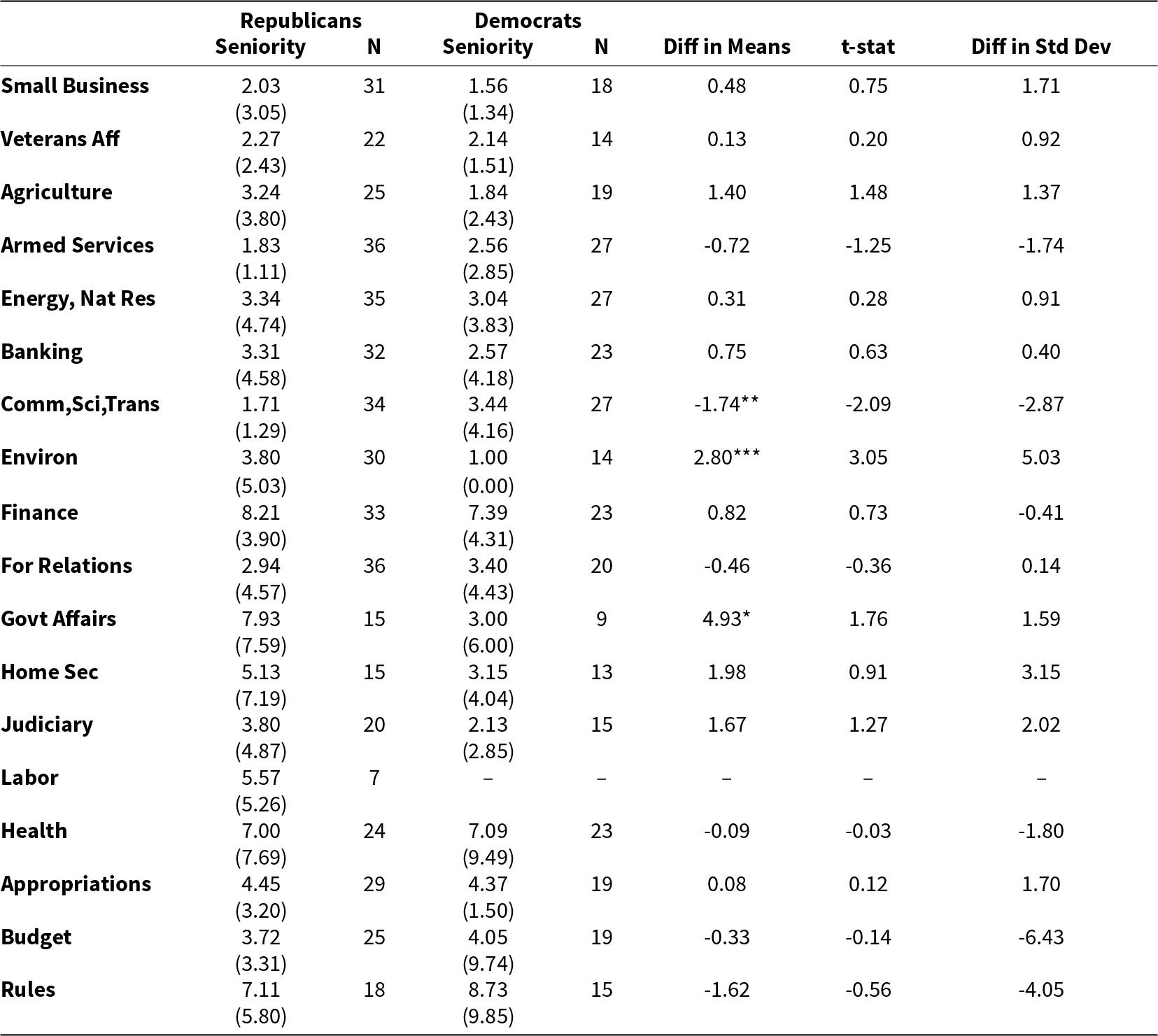
In making cross-party comparisons of the distribution of seniority at the time of request and assignment, I assume that the distribution of the true preferences of Republicans and Democrats is the same. Absent the data limitations faced here, this assumption could have been relaxed by empirically matching politicians, controlling for covariates, or using structural estimation to estimate the true preferences of Democrats. Comparing cross-party differences in the distribution of chamber seniority at time of appointment (Predictions 2(b) and 2(c)) in Table A5, I find statistically significant evidence of possible party disciplining or non-seniority tie-breaking criteria used by the Democrat COC for Prestige committees (Budget and Rules based on Prediction 2(c)) and some Policy committees (Environment, Commerce, and Governmental Affairs based on Predictions 2(b) and (c)), but not for Prestige and Constituency committees. This sheds light on the selective use of party discipline or non-seniority considerations for tie-breaking by the Democrat COC.
5.2.3. Value of committees: Prediction 4
Even after trying to account for the queuing benefit—Table A6 ranks average committee seniorities while excluding 1, 2, or 3 members with the highest within-committee seniority—I find Rules, Finance, Governmental Affairs, and Appropriations represent the most sought-after committees, using the revealed preference argument combined with the seniority-based Republican mechanism in Prediction 4.
5.3. Empirical analysis with structural assumptions
Combining the knowledge of the Republican TTC/YRMH-IGYT mechanism with reduced-form structural assumptions enables empirically distinguishing the common and idiosyncratic components of politicians’ utility across committees.Footnote 21 Let the utility of politician i for committee c be given by  $u_{ic}=\delta_c + \epsilon_i$, with ϵi distributed with mean 0 and variance
 $\sigma^2_\epsilon$. Hence, under this reduced form model of utility,Footnote 22 there is a common value δc which all politicians agree upon, based on legislation, pork, oversight, gate-keeping power, and campaign donations reaped from being assigned to committee c. Moreover, each politician i has an idiosyncratic value ϵi, which could be due to their own personal characteristics, the characteristics of their constituency, or the electoral competition they face.
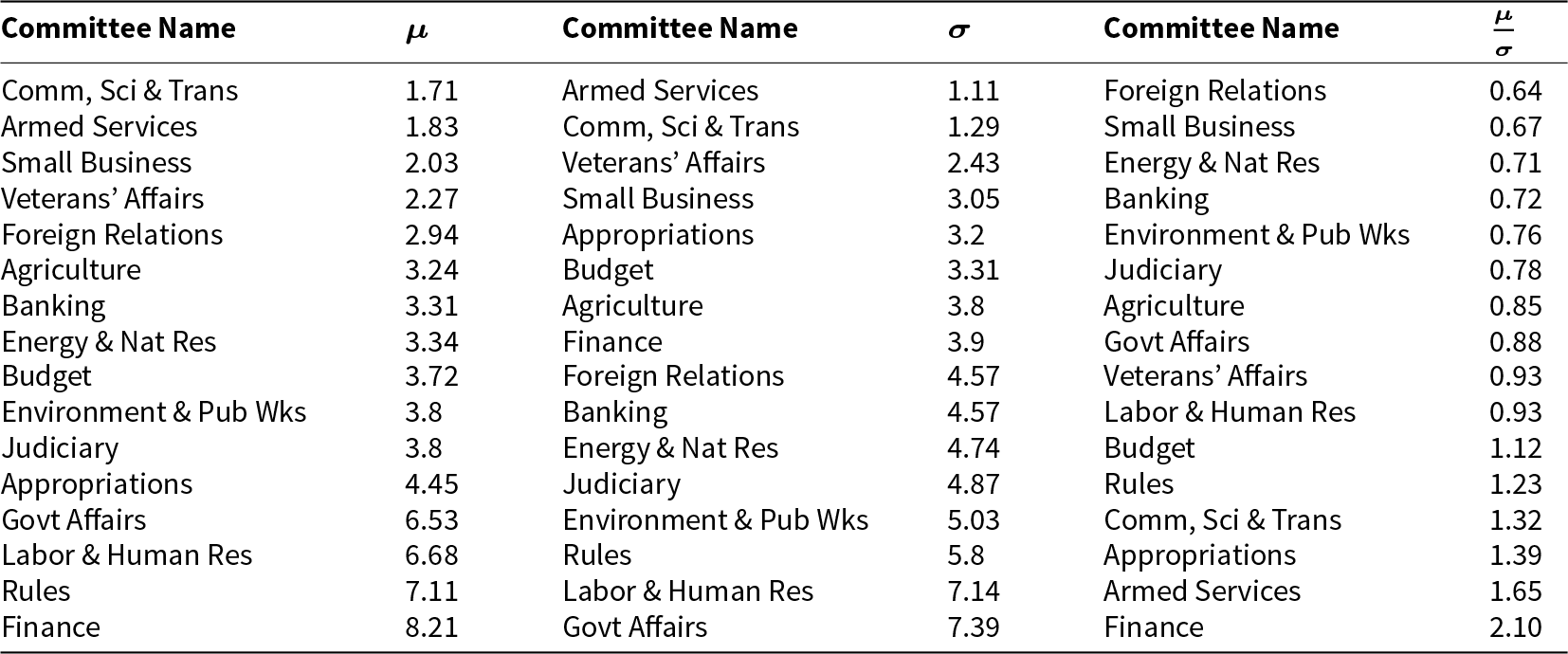
Assuming this simple functional form implies that the mean µ and variance σ of chamber seniority at appointment (or minimum chamber seniority at appointment  $\mu_{min}, \sigma_{min}$) to the committee identifies δc and
 $\sigma^2_\epsilon$, in units of chamber seniority in years, for Senate Republicans.
As seen from Tables A7 and A8, I find that i) powerful Policy and Prestige committees like Finance and Appropriations have large common values and relatively small idiosyncratic differences, ii) Constituency committees such as Small Business and Armed Services depend on particulars of the politician’s constituency characteristics and hence have lower common value, and iii) Policy committees such as Environment and Labor have relatively large idiosyncratic values, depending on the politician’s own views and that of their constituency, which dominate the common value component.
6. Conclusions
Applying matching theory tools to study assignment problems in legislative organizations like the US Senate is key to developing both a better theoretical and empirical understanding of legislative organization, party power, politicians’ motivations and preferences, and the broader impact on policy-making, interest group behavior, and lobbying.
In this paper, I explore theoretically and empirically the structure of these matching mechanisms and what they imply for the nature of party governance. Understanding the details of the data-generating process leads to a re-evaluation of the foundational theories of legislative organization. How parties choose to organize their committee assignment procedures is consequential. For example, the seniority-based Senate Republican mechanism does not leave much scope for discretionary party disciplining, as suggested by the Cartel Agenda Theory. And it seems dubious to assume that high-demanders and experts are necessarily ordered by seniority in order to be self-selected onto every such committee, as suggested by the Distributive and Information Theories. On the other hand, though only relevant when there is excess demand for a committee, the Senate Democrats’ tie-breaking procedure of voting by the COC admits the possibility of party disciplining or selection based on expertise or relative value to the politician.
I show that the possibility and consequences of non-strategyproof behavior induced by the underlying matching mechanism has largely been ignored by the existing literature. My analysis underscores how the two parties’ mechanisms differ on strategyproofness. Moreover, I highlight how precisely defining concepts like seniority norms and property right norms and understanding exactly how they are implemented in the mechanism design affects the induced strategic intricacies and properties of these mechanisms. Whether a mechanism induces strategic behavior is also consequential for how empiricists should understand and parse/subset (e.g., by party or by seniority) committee request and committee assignment data for econometric analysis. It is dubious to assume that any set of reported preferences is necessarily truthful; thus careful attention should be given to the underlying data-generating process: the matching mechanism.
Supplementary material
The supplementary material for this article can be found at https://doi.org/10.1017/psrm.2025.10043. To obtain replication material for this article, https://doi.org/10.7910/DVN/KG68DK.
Acknowledgements
I am grateful to the three referees, editor, and board member for their comments, which improved the paper. A special thanks to Al Roth, Steven Callander, Keith Krehbiel, Paulo Somaini, Fuhito Kojima, Muriel Niederle, Ignacio Rios, Carlos Varjao, Ken Shotts, David Baron, and participants at Stanford GSB Political Economy Theory Lunch and Hong Kong Baptist University for their guidance and comments. I am grateful to Scott Frisch and Sean Kelly for making available their datasets with House and Senate Democrat committee requests, Charles Stewart III and Jonathan Woon for making their datasets with Senate Committee Assignments available, and Sarah Gard for helping access and providing data from the Robert and Elizabeth Dole Archive and Special Collections (University of Kansas). I would like to thank Stanford Graduate School of Business and ECONTribute: Markets and Public Policy at University of Cologne, and acknowledge support from Lee Kuan Yew School of Public Policy and the Deutsche Forschungsgemeinschaft (DFG, German Research Foundation) under Germany’s Excellence Strategy—EXC 2126/1—390838866.
Appendix
List of senate committees

Table A1 Long description
Columns are labeled A Committees, B Committees, and C Committees, each listing committee names by row. A Committees lists 12 items: Agriculture; Appropriations; Armed Services; Banking, Housing, & Urban Affairs; Commerce, Sci, & Transportation; Energy & Natural Resources; Environment & Public Works; Finance; Foreign Relations; Education & Labor; Homeland Security & Govt Aff; Judiciary; and Select Intelligence. B Committees lists 6 items: Budget; Rules & Administration; Small Business & Entrp.; Veterans Affairs; Special Aging; and Joint Econ Committee, followed by blank cells for the remaining rows. C Committees lists 5 items: Select Ethics; Indian Affairs; Joint Taxation; Joint Library; and Joint Printing, followed by blank cells for the remaining rows.
Timeline of Committee Assignments Procedure

Table A2 Long description
Seven sequential steps outline a committee assignment procedure. Step 1 is election, with incumbents re elected and freshmen elected. Step 2 is party leaders negotiating the number of seats for the party. Step 3 is the COC asking for preference orders. Step 4 is freshmen being encouraged to talk with seniors, gain support, and find out what is feasible. Step 5 states the assignment is a many to many matching with existing tenants. Step 6 is a vote by the party internally, with a norm to agree unanimously. Step 7 is a vote by the floor, with a norm to agree unanimously.
Categories of Senate Committees

Table A3 Long description
Four columns group committee names under Constituency, Policy, Prestige, and Admin. Constituency lists Small Business, Veterans Affairs, Agriculture, Armed Services, and Energy & Nat Res. Policy lists Banking, Housing, & Urban Aff; Commerce, Sci, and Transp; Environment & Pub Wks; Finance; Foreign Relations; Government Affairs; Judiciary; and Labor & Human Resources. Prestige lists Appropriations, Budget, and Rules, with the remaining Prestige cells blank. Admin lists District of Columbia and Post Office, with the remaining Admin cells blank.
Average Chamber Seniority at Request for Senate Democrats (81st to 103rd Congress) Data: Frisch and Kelly (2006)

Table A4 Long description
Average chamber seniority when requesting assignments is listed by committee type and committee name, with a numeric value in the column, Avg Chamb Sen when Request. Constituency committees range from 1.5 for Veterans Affairs to 3.78 for Armed Services, with Small Business at 3.21, Agriculture, Nutrition, & Forestry at 2.06, and Energy & Natural Resources at 2.35; Constituency Avg is 2.58. Policy committees range from 2.05 for Banking, Housing, & Urban Affairs to 5.29 for Foreign Relations, with Commerce, Science, & Transport at 2.68, Environment & Public Works at 2.08, Finance at 3.25, Government Affairs at 2.35, Judiciary at 3.14, and Labor & Human Resources at 2.26; Policy Avg is 2.89. Prestige committees list Appropriations at 4.3, Budget at 4.31, and Rules & Admin at 3.04; Prestige Avg is 3.88. Admin committees list District of Columbia at 2.33 and Post Office at 3.5; Admin Avg is 2.91.
Average Chamber Seniority (in years) when appointment is made to committee by party, difference by party, and difference in standard deviations for 104th to 114th Congress (Data: Stewart and Woon (2005))

Table A5 Long description
Committee rows report average chamber seniority in years at appointment for Republicans and Democrats, with counts labeled N, plus Diff in Means, t-stat, and Diff in Std Dev; a second line in each row gives seniority standard deviations in parentheses. Small Business lists Republicans 2.03 with N 31 and standard deviation 3.05, Democrats 1.56 with N 18 and standard deviation 1.34, Diff in Means 0.48, t-stat 0.75, and Diff in Std Dev 1.71. Armed Services lists Republicans 1.83 with N 36 and standard deviation 1.11, Democrats 2.56 with N 27 and standard deviation 2.85, Diff in Means minus 0.72, t-stat minus 1.25, and Diff in Std Dev minus 1.74. Comm,Sci,Trans lists Republicans 1.71 with N 34 and standard deviation 1.29, Democrats 3.44 with N 27 and standard deviation 4.16, Diff in Means minus 1.74 with two asterisks, t-stat minus 2.09, and Diff in Std Dev minus 2.87. Govt Affairs lists Republicans 7.93 with N 15 and standard deviation 7.59, Democrats 3.00 with N 9 and standard deviation 6.00, Diff in Means 4.93 with one asterisk, t-stat 1.76, and Diff in Std Dev 1.59. Labor lists Republicans 5.57 with N 7 and standard deviation 5.26, while the Democrat columns and the difference columns show en dashes. Other rows include Finance at 8.21 for Republicans and 7.39 for Democrats, Health at 7.00 for Republicans and 7.09 for Democrats, and Rules at 7.11 for Republicans and 8.73 for Democrats, each with their listed N values, standard deviations, and difference columns.
Average Chamber Seniority (in years) of Senate Republicans on each Committee given all members, excluding most senior, excluding 2 most senior, and excluding three most senior by rank on committee. (Data: Stewart and Woon (2005))

Table A6 Long description
Four columns report average seniority in years for Senate Republicans by committee: all members, excluding the most senior, excluding the two most senior, and excluding the three most senior. In all members, values range from 6.32 years for Small Business up to 16.56 years for Rules, with Finance at 14.94, Appropriations at 14.72, and Govt Affairs at 14.43. Excluding the most senior, values range from 5.61 for For Relations up to 16.73 for Rules, with Govt Affairs at 15.09 and Finance at 14.04. Excluding the two most senior, values range from 4.51 for Small Business up to 14.96 for Rules, with Govt Affairs at 12.77, Finance at 12.66, and Appropriations at 12.53. Excluding the three most senior, values range from 4.10 for Small Business up to 12.92 for Rules, with Finance at 11.84, Govt Affairs at 11.77, and Appropriations at 11.66. Across committees, the listed averages generally decrease as more senior members are excluded.
Republican  $\mu, \sigma,$ and
 $\frac{\mu}{\sigma}$ of yearly chamber seniority at time of appointment for 104th to 114th Congress (Data: Stewart and Woon (2005))

Table A7 Long description
Yearly chamber seniority at time of appointment is summarized for Republican members by committee, reported as a mean, a standard deviation, and a mean to standard deviation ratio. Mean seniority values range from 1.71 years for Comm, Sci and Trans up to 8.21 years for Finance, with Rules at 7.11, Labor and Human Res at 6.68, and Govt Affairs at 6.53. Standard deviation values range from 1.11 for Armed Services up to 7.39 for Govt Affairs, with Labor and Human Res at 7.14 and Rules at 5.8. Mean to standard deviation ratios range from 0.64 for Foreign Relations up to 2.10 for Finance, with Armed Services at 1.65, Appropriations at 1.39, and Comm, Sci and Trans at 1.32. Additional ratio values include Budget at 1.12, Rules at 1.23, Veterans Affairs at 0.93, Labor and Human Res at 0.93, and Agriculture at 0.85.
Republican  $\mu_{min}, \sigma_{min},$ and
 $\frac{\mu_{min}}{\sigma_{min}}$ of yearly minimum seniority at appointment for 104th to 114th Congress (Data: Stewart and Woon (2005))

Table A8 Long description
Yearly minimum seniority at appointment is summarized for Republican members using three columns: mean minimum seniority, standard deviation of minimum seniority, and the ratio of the mean to the standard deviation. Mean minimum seniority values by committee are: Foreign Relations 1; Small Business 1; Banking 1.2; Comm, Sci and Trans 1.22; Armed Services 1.4; Energy and Nat Res 1.4; Agriculture 1.5; Veterans Affairs 1.75; Environment and Pub Wks 1.89; Govt Affairs 2.11; Budget 2.43; Judiciary 2.75; Rules 4.25; Labor and Human Res 5; Appropriations 5.4; Finance 6. Standard deviation values by committee are: Foreign Relations 0; Small Business 0; Banking 0.63; Comm, Sci and Trans 0.67; Armed Services 0.84; Agriculture 0.93; Energy and Nat Res 1.26; Govt Affairs 1.45; Veterans Affairs 1.49; Finance 1.7; Budget 1.9; Appropriations 2.63; Environment and Pub Wks 2.67; Judiciary 3.28; Rules 3.99; Labor and Human Res 6.73. Ratio values by committee are: Environment and Pub Wks 0.713; Labor and Human Res 0.74; Judiciary 0.84; Rules 1.06; Energy and Nat Res 1.11; Veterans Affairs 1.18; Budget 1.28; Govt Affairs 1.45; Agriculture 1.62; Armed Services 1.66; Comm, Sci and Trans 1.83; Banking 1.9; Appropriations 2.05; Finance 3.53; Foreign Relations infinity; Small Business infinity. Foreign Relations and Small Business have standard deviation 0, corresponding to the infinity ratios shown for those committees.
Republican Freshmen vs. Non-Freshmen Committee Requests. This figure shows the fraction of committees in each of the four categories (Constituency, Policy, Prestige, and Admin) which freshmen Senate Republicans (left) and non-freshmen Senate Republicans (right) for 91st and 103rd Congresses ranked as their 1st choice. I only compare 1st choice due to limited data (76% Republican non-freshmen rank only 1 choice in data sample). (Data: Dole Archives)





 Open access

