In a sense, the world is positive manifold. At some level, everything in the world is interrelated, and thus seemingly disconnected events may end up covarying or even be causally linked, a point brought into popular culture by the well-known “butterfly effect” within chaos theory (Gleick, Reference Gleick1987; Magnusson & Stattin, Reference Magnusson, Stattin, Damon and Damon1998). Scientists' attraction to contemporary developmental system theories of human development (Lerner, Reference Lerner2002, Reference Lerner, Lerner and Damon2006) is based at least in part on the use of such models in providing ideas about how to extract from the flux of the constant changes in the ecology of human life predictions about the successive structure of relations within and across levels of organization.
For instance, the notion of orthogenesis, introduced by Werner (Reference Werner1948, Reference Werner and Harris1957) specifies that, whenever development occurs, it moves from a structural state of globality and lack of differentiation to a state of differentiation, integration, and hierarchic organization. In turn, Brandtstädter (Reference Brandtstädter, Damon and Lerner1998, Reference Brandtstädter, Lerner and Damon2006) notes that individuals and their multilevel and changing context exist in mutually influential, bidirectional relations, termed developmental regulations and represented as individual ↔ context relations. When developmental regulations are mutually beneficial they provide better, more adaptive, fit between the structure and function of both person and context. Baltes (Reference Baltes1997; Baltes, Lindenberger, & Staudinger, Reference Baltes, Lindenberger, Staudinger, Lerner, Damon and Lerner2006) notes that individual ↔ context relations are marked by changes across life in structural and functional gains and losses and, similarly, Ford and Lerner (Reference Ford and Lerner1992) describe the developmental system as involving a synthesis of elaborative and dissipative changes.
Within these and other examples of models of the structure and function of the developmental system (Damon & Lerner, Reference Damon and Lerner2008; Lerner, Reference Lerner2002, Reference Lerner, Lerner and Damon2006), variables across levels of organization ranging from the biological or physiological (involving genes, hormones, or the nervous system), through the psychological and behavioral, to the social, cultural, physical ecological, and ultimately the historical, may be linked within or across time. For about the first half of the 20th century, the study of human development (mostly of infants and children) was marked by attempts to describe connections among variables that were typically within a level but occasionally crossed levels (Bronfenbrenner, Reference Bronfenbrenner and Stevenson1963; Cairns & Cairns, Reference Cairns, Cairns, Lerner and Damon2006; Mussen, Reference Mussen1970). However, increasingly since the 1960s, and burgeoning especially within the last 35 years, developmental scientists have sought to explain the links among variables within and across levels of organization and have sought to understand these associations through use of one or another of the family of models within developmental systems theories (Lerner, Reference Lerner2002, Reference Lerner, Lerner and Damon2006).
A classic example of this interest is the work of Kagan and Moss (Reference Kagan and Moss1962) in regard to the analysis of data from birth to maturity (young adulthood) derived from the Fels Longitudinal Study data set. Kagan and Moss differentiated between homotypic continuity, where descriptively similar behaviors (e.g., high activity levels in infancy and adulthood) covary across the life span, and heterotypic continuity, where descriptively distinct behaviors are linked across life (e.g., high fear of bodily harm among infant males linking to high dependency on spouses among adult males) because of continuity in underlying motives. In turn, Bronfenbrenner (Reference Bronfenbrenner1979) explained how events in the exosystem of an infant or child (i.e., portions of the social ecology in which the infant does not take part, e.g., the parents work place or the state agency making rules for the availability of home visiting programs for families of adolescent mothers with infants) can nevertheless impact the child's behavior and his or her developmental trajectory (i.e., the arc, or pathways, of development that is constituted by theoretically meaningful or systematic cross-time covariation among an individual's structures or functions).Footnote 1
On the one hand, the examples of the work of Kagan and Moss (Reference Kagan and Moss1962) and Bronfenbrenner (Reference Bronfenbrenner1979) illustrate a ubiquitous phenomenon in development across the life span, arguably especially when the trajectories are seen through the lens of developmental systems theories. That is, the examples illustrate developmental cascades, links across the life span among heterotypic (qualitatively distinct) variables associated with one or more levels of organization. The inevitability of some association among variables within the ecology of human development would suggest that cascades are commonplace, and thus, potentially marking only small, adventitious, or even trivial associations. However, what makes cascades a powerful concept within developmental science is that they may be used in theories of individual ↔ context relations to structure expectations about disparate links among qualitatively distinct variables within the developmental system.
When used to structure patterns of covariation among qualitatively discontinuous variables, ideas about specific developmental cascades enable developmental scientists to avoid capitalizing on the chance or noncausal associations that will arise within the developmental system, because, as we have noted, the world is ultimately positive manifold. However, few examples of this theory-predicated, a priori use of the developmental cascades concept exist in the literature. One example is provided by Masten et al. (Reference Masten, Roisman, Long, Burt, Obradovic and Riley2005), who posited a developmental cascade model to test links among academic competence and externalizing and internalizing symptoms across a 20-year period. Another example of such a theory-based use of the cascade concept is provided by Dodge, Greenberg, and Malone (Reference Dodge, Greenberg and Malone2008), who tested a model of serious adolescent violence across a span of years from kindergarten through Grade 11. The model included links among the community and family context of the young child, later school behaviors, the peer group, and ultimately adolescent violence.
The Masten et al. (Reference Masten, Roisman, Long, Burt, Obradovic and Riley2005) and the Dodge et al. (Reference Dodge, Greenberg and Malone2008) studies both indicate that the developmental system is full of “forks in the road.” That is, when particular sets of variables are present at particular times of life, specific roads (trajectories) are more likely to be taken. Some roads will lead across decades to positive outcomes, and others will eventuate in problematic developments. However, the power of the examples provided by these two studies lies in the opportunities they afford for both theory and application. For instance, subsequent studies about the cascades Masten and colleagues and Dodge and colleagues discovered might consider what variable or variables need to be added or subtracted from the sets of individual ↔ context relations present at a particular time in life in order to prevent or to promote particular outcomes later in life. Such knowledge could then be used to devise or test intervention models and/or to engage policy discussions.
Because cascades can be expected to link over time to either positive and/or problematic behaviors, we believe that the core question to ask in regard to using the developmental cascades notion to structure one's analysis of a developmental (longitudinal) data set is the following: what variables from what levels of organization and at what points (periods) in an individual's life will lead to which short- and long-term outcomes for the individual and for his/her context? For instance, following the ideas of both Baltes (Reference Baltes1997; Baltes et al., Reference Baltes, Lindenberger, Staudinger, Lerner, Damon and Lerner2006) and Brandtstädter (Reference Brandtstädter, Damon and Lerner1998, Reference Brandtstädter, Lerner and Damon2006) regarding the nature of individual ↔ context relations within the developmental system, we may ask what does the person need to gain or lose at particular times of life in order for adaptive developmental regulations to exist between him or her and his context, as instantiated by positive, healthy development of the individual and benefits for the social context (e.g., the greater presence of social capital; Putnam, Reference Putnam1995, Reference Putnam2000)?
Given the paucity of examples of the theoretical use of the developmental cascades concept in the analysis of longitudinal data sets, and perhaps especially of examples drawn from developmental systems models about adaptive developmental regulations in adolescence (compared to examples about relations associated with psychopathology), we illustrated such use by drawing on data from the 4-H Study of Positive Youth Development (PYD; Lerner et al., Reference Lerner, Lerner, Almerigi, Theokas, Gestsdóttir and Naudeau2005). We tested a cascade model of the development in adolescence of mutually beneficial relations between youths and their social world. To frame the test of this model, we briefly describe the PYD perspective and its derivation from developmental systems theory. The cascade model of individual ↔ context relations that we tested involves links in early adolescence between ecological resources and intentional self-regulatory capacities in the lives of youths (Gestsdóttir & Lerner, Reference Gestsdóttir and Lerner2007, Reference Gestsdóttir and Lerner2008; Gestsdóttir, Lewin-Bizan, von Eye, Lerner, & Lerner, Reference Gestsdóttir, Lewin-Bizan, von Eye, Lerner and Lerner2009) and the development in middle and late adolescence of characteristics of thriving and of youth contributions to the social capital of their communities.
The PYD Perspective: An Overview
Within the study of the adolescent portion of the life span, interest in applying developmental science to describe, explain, and optimize behavior and development has involved elaboration of the PYD perspective (Damon, Reference Damon2004; Lerner, Reference Lerner2005; Lerner, Phelps, Forman, & Bowers, Reference Lerner, Phelps, Forman, Bowers, Lerner and Steinberg2009). Derived from developmental systems ideas (Lerner, Reference Lerner2007, Reference Lerner, Snyder and Lopez2009), the core idea within the PYD perspective is that all adolescents have strengths, for instance, by virtue of the plasticity (i.e., the potential for systematic change in structure or function across ontogeny) that exists within the developmental system: every adolescent has the potential to change the course of his or her development. The PYD perspective holds as well that there are strengths that exist in the ecology of youths (resources in families, schools, neighborhoods, etc.) that can support actualization of adolescent change in more positive directions; these contextual resources are termed “ecological developmental assets” (Benson, Scales, Hanmilton, & Semsa, Reference Benson, Scales, Hamilton, Semsa, Lerner and Damon2006). The key hypothesis within the PYD perspective is that, if the strengths of youths are aligned across adolescence with ecological developmental assets, then every young person's development can be enhanced (Lerner, Reference Lerner2005, Reference Lerner, Snyder and Lopez2009; Lerner, Phelps, et al., Reference Lerner, von Eye, Lerner and Lewin-Bizan2009).
The PYD perspective stands as a conceptual alternative to the long-held deficit models of this developmental period (Lerner, Reference Lerner, Snyder and Lopez2009; Lerner & Steinberg, Reference Lerner, Steinberg, Lerner and Steinberg2009). As such, it provides a rationale for how a strength-based conception of youth may provide a revised agenda for research about adolescent development as well as a different focus for policies and programs aimed at enhancing the life chances of diverse young people. Instead of searching for the conditions that may decrease problem behaviors or prevent problems from occurring, the PYD perspective broadens the scope of research to include assessment of the individual ↔ context relations that promote thriving (increases in positive characteristics) across adolescence. From this perspective, thriving in adolescence is not seen as the absence of problems (i.e., thriving is not conceived as the absence of bullying, drinking, unsafe sex, school failure, substance abuse, etc.). Thriving is instead seen as the growth of attributes that mark a flourishing, healthy young person (e.g., the characteristics termed the “Five Cs” of PYD: competence, confidence, character, connection, and caring; Eccles & Gootman, Reference Eccles and Gootman2002; Lerner et al., Reference Lerner, Lerner, Almerigi, Theokas, Gestsdóttir and Naudeau2005; Roth & Brooks-Gunn, Reference Roth and Brooks-Gunn2003) as well as youth contributions to self, family, community, and civil society (Lerner, Alberts, & Bobek, Reference Lerner, Alberts, Bobek and Stiftung2007; Lerner et al., Reference Lerner, Lerner, Almerigi, Theokas, Gestsdóttir and Naudeau2005).
In turn, the PYD perspective suggests that policies should be directed not only to problem reduction or prevention, but as well to fostering conditions that promote such attributes of thriving. At the same time the perspective suggests that parents or youth-serving practitioners should identify the actions needed to provide for youth individual ↔ context relations that place them on a thriving trajectory across adolescence, for example, actions such as positive and sustained adult–youth relations, life-skills building opportunities, and opportunities for youth participation in and leadership of valued family, school, and community activities (i.e., actions that are termed by Lerner (Reference Lerner2004), the “Big 3” attributes of effective youth-serving programs).
Accordingly, the PYD perspective suggests that an array of variables from across multiple individual and contextual levels of organization is integrated across the adolescent years to place a young person on a thriving trajectory (Lerner, Reference Lerner, Snyder and Lopez2009; Lerner, von Eye, et al., Reference Lerner, von Eye, Lerner and Lewin-Bizan2009). As such, in this paper we sought to illustrate the positive-growth and supportive individual ↔ context relations that constitute the adaptive developmental regulations believed, within the PYD perspective, to instantiate a thriving trajectory.
We then specifically sought to describe what attributes of American adolescents, and what contextual conditions, at what points in time, may constitute such a course of thriving. The rationale for assessing these links among youth attributes, contextual characteristics, and thriving across portions of adolescence is based on findings associated with the PYD perspective (see Lerner et al., Reference Lerner, Lerner, Almerigi, Theokas, Gestsdóttir and Naudeau2005) and associated research (e.g., Lewin-Bizan et al., Reference Lewin-Bizan, Doyle Lynch, Fay, Schmid, Lerner and Lerner2010; Phelps et al., Reference Phelps, Balsano, Fay, Peltz, Zimmerman, Lerner, Carrey, Ungar and Martin2007; Zimmerman, Phelps, & Lerner, Reference Zimmerman, Phelps and Lerner2008). That is, findings from research directed at ascertaining the relations in the developmental system that are linked to PYD indicate that key ecological resources promoting PYD are found in families and, more specifically, in youth–parent relations marked by parental warmth and monitoring (e.g., Theokas & Lerner, Reference Theokas and Lerner2006). A large body of research has indicated that parental warmth is an important predictor for adolescent behavior and psychosocial adjustment (e.g., Baumrind, Reference Baumrind1991; Forehand & Nousiainen, Reference Forehand and Nousiainen1993). Higher parental warmth has been associated with higher academic competence (Gray & Steinberg, Reference Gray and Steinberg1999) and lower levels of externalizing and internalizing problems (Fauber, Forehand, Thomas, & Wierson, Reference Fauber, Forehand, Thomas and Wierson1990; Garber, Robinson, & Valentiner, Reference Garber, Robinson and Valentiner1997). In addition to parental warmth, parental monitoring is also a key construct in adolescent socialization (Dishion & McMahon, Reference Dishion and McMahan1998). Parental monitoring predicts delinquency (Dishion, Patterson, Stoolmiller, & Skinner, Reference Dishion, Patterson, Stoolmiller and Skinner1991), substance use and alcohol misuse (Barnes, Hoffman, Welte, Farrell, & Dintscheff, Reference Barnes, Hoffman, Welte, Farrell and Dintcheff2006), and other externalizing behaviors (Brody, Reference Brody, Crouter and Booth2003).
Attributes of youth that have been found to be linked to these parental characteristics and to PYD involve components of intentional self-regulation (e.g., Baumrind, Reference Baumrind1991; Gestsdóttir & Lerner, Reference Gestsdóttir and Lerner2007; Gestsdóttir et al., Reference Gestsdóttir, Lewin-Bizan, von Eye, Lerner and Lerner2009; Lerner, Freund, De Stefanis, & Habermas, Reference Lerner, Freund, De Stefanis and Habermas2001; Zimmerman et al., Reference Zimmerman, Phelps and Lerner2008). For instance, indices of intentional self-regulation have been linked to scores for the Five Cs of PYD and to measures of youth contribution and to problem behaviors (Gestsdóttir et al., Reference Gestsdóttir, Lewin-Bizan, von Eye, Lerner and Lerner2009).
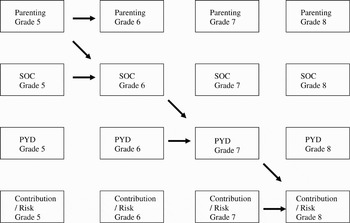
Based on this literature, we tested the model shown in Figure 1. The model tested a sequence of relations that begins with the social context that parents provide for an adolescent (defined by two parental behaviors: parental warmth and parental monitoring). Specifically, the model tested whether parenting at any given time (measured by school grade) predicts intentional self-regulation at a later time (specifically the following grade), whether intentional self-regulation at any given time (measured by school grade) predicts PYD at a later time (specifically the following grade), and whether PYD at any given time (measured by school grade) predicts the ultimate outcome (contribution, delinquency, substance use, and/or depressive symptoms) at a later time (specifically the following grade). We controlled for the outcome also at the prior wave (see Figure 1).
The model testing a sequence of relations that begins with the social context provided by parents (parental warmth and parental monitoring) through selection, optimization, and compensation (SOC) and positive youth development (PYD) to youth outcomes (contribution and risk behaviors).

Method
Procedure
The 4-H Study of PYD is a longitudinal investigation of adolescents from Grade 5 to Grade 12. Details of the methodology of the 4-H study have been presented elsewhere (e.g., Lerner et al., Reference Lerner, Lerner, Almerigi, Theokas, Gestsdóttir and Naudeau2005). We present here those features of methodology pertinent to the focus of the present study. Overall, across all six waves of the study, 6,120 youths (59% female) in 41 states were surveyed, along with 3,084 of their parents. Across waves, 2,527 of these students were tested two or more times. Attrition in the 4-H study sample is not randomly distributed across schools or youth program sites. For example, in Waves 2 and 3, some principals withdrew consent for their school to participate, and thus these students dropped out without having had the opportunity to remain in the study. However, attrition from Wave 1 to Wave 2 for students who were allowed to be asked to remain in the study was only 10%. Of the 1,954 participants tested in Wave 2, 21.5% individually withdrew their participation from Wave 3, and 337 (17.5%) dropped out because of school/site attrition. In subsequent waves (4, 5, and 6), many of the same schools did not allow us to conduct on-site data collection. The youths in these schools were contacted through mail or phone and were asked to complete the survey and mail it back or to go online to complete it. Because all youths who ever participated in the study have been consistently contacted, many youths who were not surveyed in earlier waves came back into the study in later waves. During Waves 4, 5, and 6 all youths who were part of the first three waves were contacted and the sample was increased by expanding the recruitment of youths in 4-H clubs around the country. For new youth participants, their parents were also asked to give consent and to complete the parent survey.
Participants
For the present study, we focus on Grades 5 through 8 (Waves 1–4). Because this is a longitudinal study, the present report is based on 1,994 individuals who participated in at least two of these four waves of data collection. Of these 1,994 adolescents included in the analyses, between 111 and 384 had complete data on each of our variables for all four measurement occasions, and between 1,219 and 1,759 had complete data on each of our variables for two measurement occasions. Because imputation of missing data is preferred compared to other methods for handling missingness such as listwise deletion and mean replacement (Collins, Schaffer, & Kam, Reference Collins, Schaffer and Kam2001; Jelicic, Phelps, & Lerner, Reference Jelicic, Phelps and Lerner2009), missing values for these 1,994 adolescents were replaced using multiple imputation based on chained regression equations. Multiple imputation was implemented by employing the user-written “ice” (imputation by chained equations) program, which was run on Stata version 10 SE (Royston, Reference Royston2004, Reference Royston2005a, Reference Royston2005b).
The idea of multiple imputation is to create multiple imputed data sets for a data set with missing values. The analysis of a statistical model is then done on each of the multiple data sets. The multiple analyses are then combined to yield a single set of results applying “Rubin's rules” for combining the results of an analysis of multiply imputed data sets (Rubin, Reference Rubin1987). In the current study, 10 data sets combining observed and imputed values were created as suggested by Graham, Olchowski, and Gilreath (Reference Graham, Olchowski and Gilreath2007). Missing values for each variable were imputed by regressing the variable with missing data on a set of predictor variables (all the variables used in the inferential analyses of this study and, in addition, measures that were not used in the inferential analyses).
Measures
Parental warmth
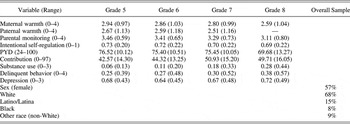
Maternal warmth and paternal warmth were assessed separately at Grades 5 to 8 and 5 to 7, respectively, using the eight-item parental warmth subscale of the Child's Report of Parenting Behaviors Inventory (Schludermann & Schludermann, Reference Schludermann and Schludermann1970). Examples of warmth items include “My mother speaks to me in a warm and friendly way” and “My mother cheers me up when I am upset.” The same questions were asked about experiences with fathers. The response format ranges from 0 = almost never to 4 = almost always. At each grade, items were averaged to create a composite score measure (separately for mothers and fathers), with higher scores indicating higher maternal and paternal warmth. In the 4-H study, scale reliability was high at Grades 5 to 8 for mothers (α = 0.94, 0.96, 0.96, and 0.96, respectively) and at Grades 5 to 7 for fathers (α = 0.96, 0.97, and 0.97, respectively). Means and standard deviations are presented in Table 1.
Ranges, means (standard deviations), and percentages for variables in the sample

Note: PYD, positive youth development.
Parental monitoring
Parental monitoring was assessed at Grades 5 to 8, using the eight-item, adolescent self-report, Parental Monitoring Scale (Small & Kerns, Reference Small and Kerns1993). Example items include “My parent(s) know where I am after school,” “My parent(s) know how I spend my money,” and “My parent(s) know who my friends are.” The response format ranges from 0 = never to 4 = always. At each grade items were averaged to create a composite measure, with higher scores indicating higher parental monitoring. In the 4-H study, scale reliability was high (α = 0.88, 0.91, 0.90, and 0.91 for Grades 5 to 8, respectively). Means and standard deviations are presented in Table 1.
Intentional self-regulation
Intentional self-regulation was assessed at Grades 5 to 8 using the Selection, Optimization, and Compensation (SOC) Questionnaire (Freund & Baltes, Reference Freund and Baltes2002). The original SOC measure, which was created in German for use with adult populations, includes 48 items. Freund and Baltes (Reference Freund and Baltes2002) also created a shorter version of this measure, which includes 6 items per subscale (selection, optimization, and compensation). Each of the items has a forced-choice format; each item consists of two statements, one describing behavior reflecting selection, optimization, or compensation and the other describing a non-SOC related behavior. Participants are asked to decide which of the statements is more similar to how they would behave. An example item from the elective selection subscale is “I concentrate all my energy on few things [SOC action]” or “I divide my energy among many things [non-SOC action].” An example item from the optimization subscale is “I keep trying as many different possibilities as are necessary to succeed at my goal [SOC action]” and “When I do not succeed right away at what I want to do, I don't try other possibilities for very long [non-SOC action].” An example item from the compensation subscale is “For important things, I pay attention to whether I need to devote more time or effort [SOC action]” or “Even if something is important to me, it can happen that I don't invest the necessary time or effort [non-SOC action].” Using structural equation modeling procedures, prior work (Gestsdóttir & Lerner, Reference Gestsdóttir and Lerner2007; Zimmerman et al., Reference Zimmerman, Phelps and Lerner2008) indicated that the SOC measure can be used as a global rather than a differentiated 9-item index of intentional self-regulation among youths in Grades 5 through 7. Therefore, in the present study, the 9-item short version has been used. At each grade items were averaged to create a composite measure, with higher scores indicating higher SOC. In the 4-H study, scale reliability was moderate (α = 0.55, 0.63, 0.62, and 0.62 for Grades 5 to 8, respectively). Means and standard deviations are presented in Table 1.
PYD
As described by Lerner et al. (Reference Lerner, Lerner, Almerigi, Theokas, Gestsdóttir and Naudeau2005), several measures derived from the overall measurement model of the 4-H Study of PYD were used to index PYD, operationalized through the assessment of the Five Cs (Eccles & Gootman, Reference Eccles and Gootman2002; Roth & Brooks-Gunn, Reference Roth and Brooks-Gunn2003). Each of the Five Cs of PYD (competence, confidence, character, connection, and caring) comprises a number of well-validated scales designed to assess the essential elements of the definition of the construct. Full details about the substance and psychometric characteristics of these measures are found in prior publications (e.g., Lerner et al., Reference Lerner, Lerner, Almerigi, Theokas, Gestsdóttir and Naudeau2005). A PYD score for each participant was computed as the mean of Five Cs and could range from 0 to 100, with higher scores representing higher levels of the Five Cs and PYD. In the 4-H study, scale reliability was high (α = 0.92, 0.96, 0.95, and 0.95 for Grades 5 to 8, respectively). Means and standard deviations are presented in Table 1.
Contribution
At Grades 5 to 8, contribution was assessed using a composite measure of ideology and action components. Example items for ideology include, for example, “I often think about doing things so that people in the future can have things better,” or “It is important to me to contribute to my community and society.” Example items for action include, for example, “During an average week, how many hours do you spend helping friends or neighbors?,” and “During the last 12 months, how many times have you been a leader in a group or organization?” The items have been rescaled to a range of 0–100, with higher scores indicating higher levels of contribution. In the 4-H study, scale reliability was low to moderate (α = 0.45, 0.69, 0.77, and 0.80 for Grades 5 to 8, respectively). Means and standard deviations are presented in Table 1.
Depressive symptoms
At Grades 5 to 8, depressive symptomatology was assessed using the Center for Epidemiological Studies depression 20-item self-report measure (Radloff, Reference Radloff1977). Example items include “During the past week I was bothered by things that usually don't bother me” and “During the past week I felt sad.” The response format ranges from 0 = rarely or none of the time to 3 = most or all of the time. At each grade, items were averaged for a total score, with higher scores being indicative of higher depressive symptomatology. In the 4-H study, scale reliability was good (α = 0.81, 0.84, 0.87, and 0.87 for Grades 5 to 8, respectively). Means and standard deviations are presented in Table 1.
Substance use and delinquency
These behaviors were assessed at Grades 5 to 8 using a set of questions derived from items included in the Search Institute's Profiles of Student Life—Attitudes and Behavior Scale (Leffert, Benson, Scales, Sharma, & Drake, Reference Leffert, Benson, Scales, Sharma, Drake and Blyth1998) and the Monitoring the Future (2000) questionnaire. Five items assessed the frequency of substance use (e.g., smoked cigarettes, drank alcohol, used marijuana or hashish) in the past year. The response format ranges from 0 = never to 3 = regularly. At each grade, items were averaged for a total score, with higher scores being indicative of higher frequency of substance use. In the 4-H study, scale reliability was moderate (α = 0.65, 0.66, 0.86, and 0.87 for Grades 5 to 8, respectively). Similarly, four items assessed the frequency of delinquent behaviors. An example item is “During the last 12 months, how many times have you hit or beat up someone?” The response format for these items ranges from 0 = never to 4 = five or more times. At each grade, items were averaged for a total score, with higher scores indicating higher frequency of delinquent behavior. In the 4-H study, scale reliability was moderate (α = 0.66, 0.65, 0.73, and 0.71 for Grades 5 to 8, respectively). Means and standard deviations for substance use and delinquency are presented in Table 1.
Demographic characteristics
In order to account for characteristics that prior studies found to be linked to adolescents' outcomes, we controlled for participants' age, sex, and race.
Results
The goal of this research was to illustrate a developmental systems theory predicated model of cascades in the relations between individuals and contexts that promote positive development among adolescents (Lerner, Reference Lerner2004, Reference Lerner2005, Reference Lerner, Snyder and Lopez2009). This model suggests that adaptive developmental regulations in adolescence (involving links between ecological resources and individual strengths) lead to PYD, which in turn leads to both youth community contributions and lowered risk/problem behaviors.
The specific operationalization of this model that was tested in the present study (Figure 1) involved a series of regressions analyses. Analysis was conducted using Zellner's seemingly unrelated regression (SUR); this regression fits a system of seemingly unrelated regression models (Zellner, Reference Zellner1962, Reference Zellner1963; Zellner & Huang, Reference Zellner and Huang1962). The technique is used to estimate a system of equations that have a different set of predictors (hence, the equations seem unrelated), but correlations across the errors in different equations are exploited to gain efficiency. Zellner (Reference Zellner1962) formulated the SUR model as correlated regression equations, and the regression equations are “seemingly unrelated” because taken separately the error terms would follow standard linear ordinary least squares linear model form. However, because the dependent variables are correlated and some of the same variables may be dependent and predictor variables, there may be a correlation among the errors across the equations, and therefore the standard ordinary least squares solutions that ignore any correlation among the errors across equations are not well suited for our model. As such, SUR models may lead to more efficient estimates than running the models separately, as well as allowing joint tests (StataCorp, 2007). We conducted SUR analyses to test our model, given that we have several equations (Eqs. 1–4); in each equation a subset of explanatory variables is the same, and SUR analysis allows each of the dependent variables to have a different design matrix with some of the predictor variables being the same. SUR models allow for a variable to be both the dependent and predictor variables across equations, and this technique is well suited for our analysis of the hypothesized cascade because it allowed us to obtain the joint estimates from several regression models, each with its own error term. These estimates would be the case, as our regressions were related because the errors associated with the dependent variables may be correlated (Woolbridge, Reference Woolbridge2002). To overcome possible problems of endogeneity and maintain a developmental cascade, lagged models were estimated. That is, this analysis tested associations between earlier predictors and later outcomes at any given grade, and focused on a set of regression models to test the hypothesized links between parenting, adolescents' intentional self-regulation, PYD, and the developmental outcome. (We refer here only to contribution as a developmental outcome, although models were also run for substance use, delinquent behaviors, and depressive symptoms as developmental outcomes; see Figure 1 and Table 2, Table 3, Table 4, and Table 5). The SUR model also addresses the autocorrelation problem that might arise when using lagged variables. Specifically, we estimated the following model, with the four predictions run as a joint test:




where t is a time index representing Grades 5 through 8; α0, α1, α2, β0, β1, β2, β3, γ0, γ1, γ2, γ3, δ0, δ1, δ2, and δ3 are parameters to be estimated; ɛ1, ɛ2, ɛ3, and ɛ4 are error terms; and Z is a control variable.
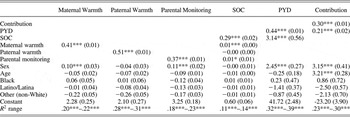
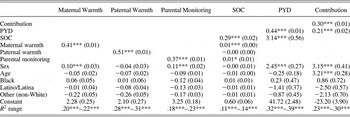
Unstandardized parameter estimates (standard errors) for unrelated regression models describing the relationships among parenting, intentional self-regulation (SOC), positive youth development (PYD), and contribution
Note: All predictor variables (except demographics) are time lagged.
*p < .05. ***p < .001.
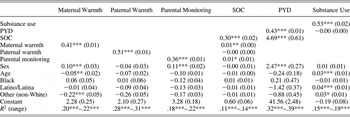
Unstandardized parameter estimates (standard errors) for unrelated regression models describing the relationships among parenting, intentional self-regulation (SOC), positive youth development (PYD), and substance use

Note: All predictor variables (except demographics) are time lagged.
*p < .05. **p < .01. ***p < .001.
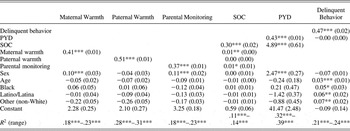
Unstandardized parameter estimates (standard errors) for unrelated regression models describing the relationships among parenting, intentional self-regulation (SOC), positive youth development (PYD), and delinquent behavior
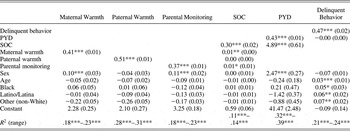
Note: All predictor variables (except demographics) are time lagged.
*p < .05. **p < .01. ***p < .001.
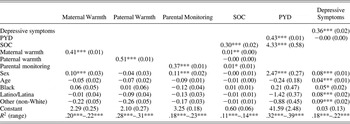
Unstandardized parameter estimates (standard errors) for unrelated regression models describing the relationships among parenting, intentional self-regulation (SOC), positive youth development (PYD), and depressive symptoms

Note: All predictor variables (except demographics) are time lagged.
*p < .05. **p < .01. ***p < .001.
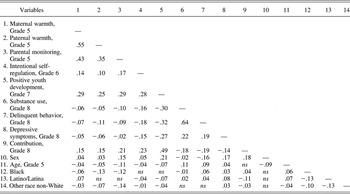
Specifically, this analysis tested whether parenting at any given grade (controlling for SOC at the same grade) predicted SOC at the following grade; whether SOC at any given grade (controlling for PYD at the same grade) predicted PYD at the following grade; and whether PYD at any given grade (controlling for contribution at the same grade) predicted contribution at the following grade. Correlations among these variables at these grades are presented in Table 6.
Correlations among cascade variables assessed in the study

Note: All correlations are significant at p < .05 unless otherwise specified. A table of the correlations among all variables for all grades can be obtained from the authors.
The results from these models are presented in Tables 2–5 (the coefficient sizes and significance level that is reported is the exact p value that we obtained, using an α level of 0.05 or less for all statistical tests). Here we summarize only the main results. Table 2 summarizes results from the regression model predicting the ultimate outcome, contribution. Results suggest that earlier parenting behaviors (maternal warmth and parental monitoring) were positively associated with later SOC (Β = 0.05 and 0.05, respectively, for any grade), but paternal warmth was not associated with SOC (Column 4). In turn, earlier SOC was positively associated with later PYD (Β range = 0.07 in Grade 5 to 0.06 in Grade 8; Column 5). In turn, earlier PYD was positively associated with later contribution (Β range = 0.15 in Grade 5 to 0.18 in Grade 8; Column 6).
Table 3 summarizes results from the regression model predicting the ultimate outcome substance use. The results suggest that earlier parenting behaviors (maternal warmth and parental monitoring) were positively associated with later SOC (Β = 0.05 and 0.05, respectively, for any grade), but paternal warmth was not associated with SOC (Column 4). In turn, earlier SOC was positively associated with later PYD (Β range = 0.10 in Grade 5 to 0.08 in Grade 8; Column 5). However, earlier PYD was not associated with later substance use (Column 6).
Table 4 summarizes results from the regression model predicting the ultimate outcome delinquent behavior. Results suggest that earlier parenting behaviors (maternal warmth and parental monitoring) were positively associated with later SOC (Β = 0.05 and 0.05, respectively, for any grade), but paternal warmth was not associated with SOC (Column 4). In turn, earlier SOC was positively associated with later PYD (Β range = 0.10 in Grade 5 to 0.09 in Grade 8; Column 5). However, earlier PYD was not associated with later delinquent behavior (Column 6).
Finally, Table 5 summarizes results from the regression model predicting the ultimate outcome, depressive symptoms. Results suggest that earlier parenting behaviors (maternal warmth and parental monitoring) were positively associated with later SOC (Β = 0.05 and 0.05, respectively, for any grade), but paternal warmth was not associated with SOC (Column 4). In turn, earlier SOC was positively associated with later PYD (Β range = 0.09 in Grade 5 to 0.08 in Grade 8; Column 5). However, earlier PYD was not associated with later depressive symptoms (Column 6).
Discussion
Developmental cascades are links across the life span among heterotypic (qualitatively distinct) variables associated with one or more levels of organization within the ecology of human development. From a developmental systems theoretical perspective (Lerner, Reference Lerner2002, Reference Lerner, Lerner and Damon2006), which stipulates that human life involves relational integrations (Overton, Reference Overton, Damon and Lerner2006), or fusions (Greenberg & Tobach, Reference Greenberg and Tobach1984; Sameroff, Reference Sameroff1975; Thelen & Smith, Reference Thelen, Smith, Lerner, Damon and Lerner2006), among variables within and across the levels of organization that comprise the ecology of human development, it is, by definition, that some association among variables exists. We have argued, however, that this covariation means that, although developmental cascades may be commonplace, they are not trivial when they are used within theoretical models that explain the course of individual ↔ context relations. Past theory-predicated research, notably Masten et al. (Reference Masten, Roisman, Long, Burt, Obradovic and Riley2005) and Dodge et al. (Reference Dodge, Greenberg and Malone2008), illustrate just such a powerful use of the concept of developmental cascades.
The potential contribution of the present research is to extend these past exemplars of the use of the cascades concept to the study of thriving within the adolescent period. Accordingly, by using data from the longitudinal 4-H Study of PYD, we illustrate a developmental systems theory predicated model of cascades in the relations between individuals and contexts that promote positive development among adolescents (Lerner, Reference Lerner2004, Reference Lerner2005, Reference Lerner, Snyder and Lopez2009). The findings we presented confirmed that, as expected (see Figure 1), positive parenting was a major contextual asset predicting subsequent intentional self-regulation, and intentional self-regulation predicted subsequent scores for PYD; in turn, PYD positively predicted later youth contribution scores.
The overall model was confirmed, but there are two interesting qualifications to our findings; one is related to our scores on parenting and the other pertaining to the links between PYD and problematic outcomes. In regard to our findings involving parenting, the results indicated that parenting scores for mothers were better predictors than corresponding scores for fathers, at least in regard to the index we used of parental warmth. This finding is surprising because prior research indicates that paternal behavior is often equal to, and sometimes more important than, maternal behavior in predicting children's behaviors (Coley, Reference Coley1998; Rohner & Veneziano, Reference Rohner and Veneziano2001; Veneziano, Reference Veneziano2003; Thomas, Farrell, & Barnes, Reference Thomas, Farrell and Barnes1996). It may be that the measure that was used was not as valid for fathers or that the covariation between mothers and fathers is too great for father scores to contribute significant additional variance.
Although some facets of parenting (e.g., monitoring in the present data set) may be equally important for both parents to manifest in order for thriving to be promoted, it may be that warmth is a more important domain for effective mothering than for effective fathering. However, the 4-H study data set does not have indexes of the sorts of intensely measured mother–adolescent and father–adolescent exchanges that would need to be assessed in order to test the plausibility of this possibility. Thus, future research would need to be conducted to explore with more nuance the role of positive parenting in launching the developmental cascade linked to thriving across adolescence.
In regard to the links between PYD and problem behaviors, we found that PYD was not linked to later scores for youth problematic behaviors (delinquency, substance use, and depression). This finding is consistent with other recent research derived from the 4-H study (Lewin-Bizan et al., Reference Lewin-Bizan, Doyle Lynch, Fay, Schmid, Lerner and Lerner2010; Phelps et al., Reference Phelps, Balsano, Fay, Peltz, Zimmerman, Lerner, Carrey, Ungar and Martin2007) that indicates that high trajectories of PYD are not necessarily linked to low trajectories of risk or problem behaviors. Future research should ascertain the point in time when particular levels of PYD are (or are not) predictive of risk or problem behaviors.
Moreover, other limitations of the present research should be considered when discussing the results. As is the case with many long-term longitudinal studies, nonrepresentative samples became increasingly biased because of selective attrition (Schaie, Reference Schaie1965), a methodological challenge certainly present within the 4-H study data set. Therefore, future research should assess whether the developmental cascade identified in the present research can be generalized to more diverse and representative samples of youths and, as well, across the diversity of families and communities within which adolescents develop.
Nevertheless, the presence of the cascade found in the present research and the possibility that there may be variation across families in the instantiation of these cascades has implications for application as well as for further research. If we have answers to the multilevel questions about what facets of the ecology and individual combine in the development of a healthy developmental trajectory, one that benefits both the individual and his or her social and physical ecology, then we have the information we need to decide where to invest financial resources and human energies in order to maximize the probability that adolescent thriving will occur.
For example, the cascade identified in this study indicated that both higher parental monitoring and maternal warmth led to higher levels of intentional self-regulation. These measures of positive parenting might allow adolescents more opportunities to practice intentional self-regulation skills while parents provide appropriate guidance and a safety net as adolescents begin to engage in outside the family goal-directed behaviors and build autonomy. A warm and watchful parent may be more likely to help (both directly and indirectly) an adolescent in selecting and prioritizing goals, identifying means and obtaining resources to attain a goal, and compensating when a goal is blocked or an initial strategy is not successful. As the present work found, successful use of these skills was related to higher levels of PYD.
In addition, even if adolescents experience poor parenting contexts, intervention programs and youth-serving practitioners could focus on lessening the risks associated with an adverse social environment by helping youths develop intentional self-regulation skills. Extracurricular activities marked by the Big 3 attributes of effective youth-serving programs may provide youths with the four dimensions of ecological assets (human, physical, collective activity, and accessibility; Theokas & Lerner, Reference Theokas and Lerner2006) as well as the skills needed to utilize the resources to lead to positive adaptations in adolescents.
The social utility of research that identifies theoretically predicated developmental cascades is that such scholarship provides a roadmap for macrolevel policy makers and more microlevel, youth-serving practitioners (including school teachers and community mentors), as well as parents and young people themselves, to find an ecological niche within which they can act to contribute to the health and thriving of youths. The multilevel connections discovered through research elucidating developmental cascades serves as a potent tool for the application of developmental science to bring policies and programs together to optimize the positive development of all youths.