Introduction
Unpaid carers, which may be family, friends, or neighbors, provide a significant contribution to supporting people with care and support needs (Calvó-Perxas et al., Reference Calvó-Perxas, Vilalta-Franch, Litwin, Turró-Garriga, Mira and Garre-Olmo2018; Kaschowitz and Brandt, Reference Kaschowitz and Brandt2017). Unpaid or “informal care” has significant opportunity costs (Buckner and Yeandle, Reference Buckner and Yeandle2015; Oliva-Moreno et al., Reference Oliva-Moreno, Peña-Longobardo, García-Mochón, Del Río Lozano, Mosquera Metcalfe and García-Calvente2019). Establishing the best way to deploy limited resources and maximize societal welfare is of fundamental importance to the economics of social care (Drummond et al., Reference Drummond, Sculpher, Torrance, O’Brien and Stoddart2005; Williams et al., Reference Williams, McIver, Moore and Bryan2008).
Systematic reviews of studies of effectiveness are a cornerstone of evidence-based policy making (Gurevitch et al., Reference Gurevitch, Koricheva, Nakagawa and Stewart2018). The role of systematic reviews of economic evaluations is however uncertain (Centre for Reviews and Dissemination, 2009). In particular, concerns have been raised with respect to their generalizability or external validity (Anderson, Reference Anderson2010). Compared with effectiveness evidence, there are a much wider range of factors that limit the generalizability of cost-effectiveness studies, for example differences in the volume and cost of resource use between target decision maker/jurisdiction (Sculpher et al., Reference Sculpher2004). Reviews of economic evaluations, as previously suggested, generally give priority to the requirements for generalizability or applicability, rather than to considerations of methodological quality or compliance to established methodological standards (Anderson, Reference Anderson2010). Additionally, in most cases the need for a comprehensive systematic review of previous economic evaluations of an intervention or policy choice might be unwarranted due to geographic transferability concerns (Goeree et al., Reference Goeree2011). Whilst we acknowledge these limitations, we believe that a systematic review of economic evaluations is appropriate to examine what advances have been made in a specific health and social care context. Prior work has documented that there is a growing literature on the economic evaluations of interventions for supporting carers showing that due to variation in the types of interventions and contexts examined, little can be concluded to inform policy making (Clarkson et al., Reference Clarkson, Davies, Jasper, Loynes and Challis2017; Gomes et al., Reference Gomes, Calanzani, Curiale, McCrone and Higginson2013; Heslin et al., Reference Heslin, Forster, Healey and Patel2016; Jones et al., Reference Jones, Edwards and Hounsome2012; Nguyen et al., Reference Nguyen, Comans and Green2018; Nickel et al., Reference Nickel, Barth and Kolominsky-Rabas2018). Given this background, the main goals of this systematic review are:
-
1. To summarise the cost-effectiveness of all types of interventions for supporting adult carers, with a specific focus on the UK health and social care context drawing on the National Institute for Health and Care (NICE) guideline on Supporting Adult Carers (NICE, 2020)
-
2. To critically appraise the quality of the economic evaluations of such interventions and their applicability to the UK context
-
3. To identify any gaps in the evidence and suggest a future agenda for research.
Methods
A systematic review was undertaken to identify evidence evaluating the cost-effectiveness of interventions aimed to support adult carers in the UK. The protocol of the review was agreed by the Guideline Committee (GC); was conducted as part of the development of the NICE guideline on Supporting Adult Carers (NICE, 2020); and was based on the NICE manual for guidelines’ methods (NICE, 2018). In addition, this systematic review was carried out following Preferred Reporting Items for Systematic reviews and Meta-Analyses (PRISMA) guidelines (Moher et al., Reference Moher, Liberati, Tetzlaff and Altman2009).
A broad search was conducted to identify economic evidence related to the topic in several electronic databases with an economic search filter applied. Where possible, the searches were restricted to retrieve articles published in English. The search strategies can be found in the appendices of the Supporting Adult Carers guideline (NICE, 2020). The searches were run in November 2017, and re-run in January 2019. In December 2019, the “similar articles” tool in PubMed was used on the articles that were initially included in the review.
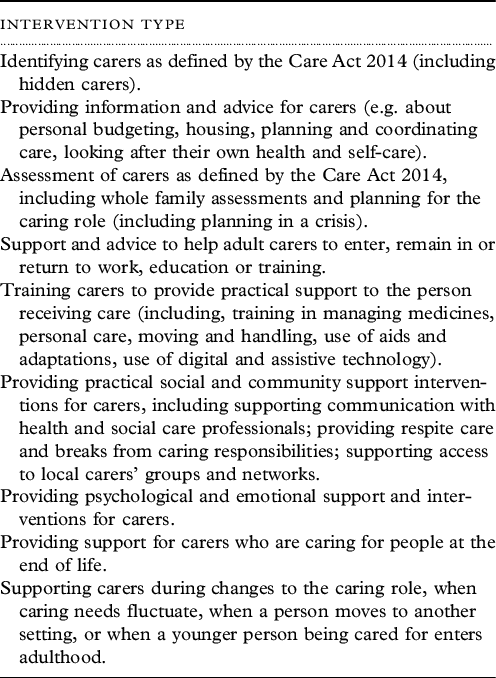
Economic evaluations of interventions for supporting adult carers published in or after 2003 were considered. Eligible types of economic evaluations included cost-effectiveness analyses (CEAs), cost–benefit analyses, cost–utility analyses (CUAs), cost–consequences analyses, cost–minimization analyses, and comparative cost-analyses. Participants included in the selected studies were adult carers (aged 18 years or above) who provided unpaid care for either ≥1 adult or ≥1 young person (aged 16–17 years) with ongoing needs. An intervention for supporting carers was defined as any activity, program, or strategy whose primary aim was to provide adult carers with any kind of assistance or benefit (Table 1). Comparators included usual care/treatment as usual, standard practice, different types of supporting carers, or no support. Outcome measures included measures of cost-effectiveness (e.g. costs and quality-adjusted life years [QALYs]). Studies conducted in the US were excluded because of the nature of the health and welfare systems might undermine the applicability of findings to the UK context. Finally, studies published in languages other than English were not eligible for inclusion.
Intervention categories for supporting adult carers included in the review

All identified titles and abstracts were screened and, where relevant, full-text articles were obtained and assessed independently by two of the authors against the study inclusion criteria. Disagreements at this stage (full-text screening) were resolved through discussion. Data collection was performed by one reviewer (FP) and checked by a second reviewer (PJ) using a standardized form, with any discrepancies resolved through discussion. Extracted data included study details (e.g. author(s), year of publication, and country), participant’s characteristics, intervention and comparator details, main analytical approaches (e.g. decision-analytic modeling), and the primary outcome(s) specified for the economic analysis. In addition, key assumptions made in the base case or tested in sensitivity analyses (e.g. perspective, time horizon, etc.), sources and categories of included estimated costs, estimates of cost-effectiveness, and approaches to quantifying uncertainty were extracted.
The applicability and methodological quality of included economic evaluations were assessed using the economic evaluations checklist specified in “Developing NICE guidelines: the manual” (NICE, 2012).The online supplementary material reports details on items and notes of the checklist. The applicability assessment included nine questions related to the relevance of the study to the review question and the UK health and social care context (e.g. study population, interventions and services, health and social care context, costs perspective, non-direct health effects measurement, discounting rate, health effects valuation, and changes in health-related quality of life (HRQoL) [utilities] valuation). Each study was classified as either “Directly applicable”, “Partially applicable”, or “Not applicable”. Studies deemed as “not applicable” were excluded from further consideration. Study limitations (i.e. the level of methodological quality) assessment included 11 items, with each study scored as having “minor limitations”, “potentially serious limitations”, or “very serious limitations”. The items in the study limitations checklist included questions on the model structure, time horizon length, health outcomes identification, baseline health outcomes and relative treatment effects valuation, costs identification, resource use valuation, costs of resources valuation, incremental analysis valuation and reporting, sensitivity analysis, and conflict of interest.
Results
Results of the search
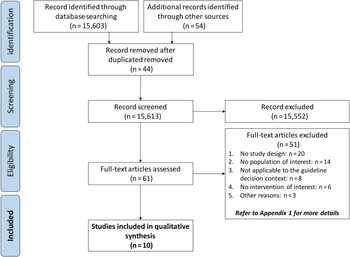
In total, 15,657 articles were identified through searches; 15603 remained after excluding duplicates. Primary screening of abstracts and titles reduced this to 61 papers for full-text review. Ten papers were deemed as relevant and included in the review (Figure 1). Most of the studies excluded at the last stage of the screening process were ineligible as they focused primarily on care recipients rather than on carers, or were judged as not applicable to the guideline decision context (Additional file 1).
Flow chart showing number of articles selected for review.

Overview of selected studies
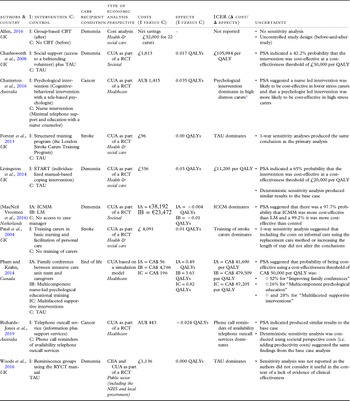
An overview of the basic characteristics of the included evidence is provided in Table 2, which provides a summary of the basic characteristics and main findings of these studies. Most studies included in the review were CUAs, with the exception of a cost analysis (Allen, Reference Allen2016). Almost all economic evaluations included were undertaken alongside clinical trials (Table 2), with only one analysis based on a decision-analytic modeling approach (Pham and Krahn, Reference Pham and Krahn2014). Therefore, most of the studies did not adopt a long-term time frame to reflect the long-term costs and benefits of health and social care interventions; the time horizon in six studies was ≤1 year (Chatterton et al., Reference Chatterton2016; Forster et al., Reference Forster2013; Patel et al., Reference Patel, Knapp, Evans, Perez and Kalra2004; Pham and Krahn, Reference Pham and Krahn2014; Richards-Jones et al., Reference Richards-Jones, Mihalopoulos, Heckel, Gunn, Tan and Livingston2019; Woods et al., Reference Woods2016), whereas only three studies used a time horizon longer than 1 year (Charlesworth et al., Reference Charlesworth, Shepstone, Wilson, Thalanany, Mugford and Poland2008; Livingston et al., Reference Livingston2014; MacNeil Vroomen et al., Reference MacNeil Vroomen2016), and one study used a time horizon ranging from 10 to 15 months (Allen, Reference Allen2016). Most of the reviewed studies adopted a societal perspective with respect to costs (Table 2). The health benefits of the intervention were measured using QALYs in all included CUAs; however, many authors pointed out limitations of using QALYs for measuring health benefits of interventions to support carers (e.g. Charlesworth et al., Reference Charlesworth, Shepstone, Wilson, Thalanany, Mugford and Poland2008; MacNeil Vroomen et al., Reference MacNeil Vroomen2016; Patel et al., Reference Patel, Knapp, Evans, Perez and Kalra2004).
Main findings of economic evaluations of interventions for supporting adult carers

Δ: incremental; CBT: Cognitive behavioral therapy; CSNAT: Caregiver Support Needs Assessment Tool; ICER: Incremental cost-effectiveness ratio; RCT: Randomized controlled trial; QALY: quality-adjusted life year; PSA: probabilistic sensitivity analysis; ICMM: Intensive Care Management Model; LM: Linkage Model; START: STrAtegies for RelaTives; TAU: Treatment as usual
1 Incremental net monetary benefit AU$ 3,047
The included studies were conducted in four countries (i.e. Australia, Canada, the Netherlands, and the UK), with half published between 2016 and 2019 (Allen, Reference Allen2016; Chatterton et al., Reference Chatterton2016; MacNeil Vroomen et al., Reference MacNeil Vroomen2016; Richards-Jones et al., Reference Richards-Jones, Mihalopoulos, Heckel, Gunn, Tan and Livingston2019; Woods et al., Reference Woods2016). Most studies focused on carers of people with dementia, cancer, or stroke (Table 2). They typically focused on assessing the cost-effectiveness of psychological and emotional support programs, interventions for supporting carers during changes to the caring role, interventions for providing carers with practical support, and strategies used to support carers at the end of life of the cared-for person. One study evaluated the cost-effectiveness of a multi-component intervention (i.e. manual-based coping skills training for dementia carers), including both a component of psychological support for carers and a component of training carers to provide practical support (Livingston et al., Reference Livingston2014).
Quality assessment results
All studies included in the review were deemed as “partially applicable” to the context of the NICE guideline for supporting adult carers in the UK. This was mainly due to one or more of three reasons: they included a population of carers of people with specific conditions (Table 2); they were performed in health and social care settings different from the UK, but these differences were unlikely to substantively change the cost-effectiveness estimates (Chatterton et al., Reference Chatterton2016; MacNeil Vroomen et al., Reference MacNeil Vroomen2016; Pham and Krahn, Reference Pham and Krahn2014; Richards-Jones et al., Reference Richards-Jones, Mihalopoulos, Heckel, Gunn, Tan and Livingston2019); or they used methods different to those used in the UK NICE Reference Case (i.e. scope and boundaries of the decision problem, choice of comparator, perspective, time horizon and discounting, sources of data, preferred type of economic evaluation; NICE, 2013) (Allen, Reference Allen2016; MacNeil Vroomen et al., Reference MacNeil Vroomen2016; Richards-Jones et al., Reference Richards-Jones, Mihalopoulos, Heckel, Gunn, Tan and Livingston2019).
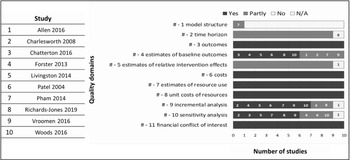
Based on reporting quality assessment from the NICE appraisal checklist for economic evaluations, five studies were classified as having minor limitations (Forster et al., Reference Forster2013; Livingston et al., Reference Livingston2014; MacNeil Vroomen et al., Reference MacNeil Vroomen2016; Pham and Krahn, Reference Pham and Krahn2014; Woods et al., Reference Woods2016), four as having potentially serious limitations (Charlesworth et al., Reference Charlesworth, Shepstone, Wilson, Thalanany, Mugford and Poland2008; Reference Chatterton2016; Patel et al., Reference Patel, Knapp, Evans, Perez and Kalra2004; Richards-Jones et al., Reference Richards-Jones, Mihalopoulos, Heckel, Gunn, Tan and Livingston2019), and the remaining with very serious limitations (Allen, Reference Allen2016). Figure 2 displays the proportion of each quality criterion in the NICE appraisal checklist that was reported sufficiently (i.e. yes), partially (i.e. partly), not at all (i.e. no), or was not relevant in that particular instance (i.e. N/A). Of the quality criteria evaluated, one was not applicable in 10 reviewed studies (i.e. item 1: model structure), as these economic evaluations were based on data from clinical studies and did not extrapolate intervention outcomes or costs beyond the study’s follow-up period. Figure 2 shows that the biggest variation in quality pertained to the incremental analysis, to the sources used for eliciting the estimates of baseline outcomes and to the execution of sensitivity analyses to explore the most likely uncertainties in the evaluations. According to the NICE checklist, the quality criteria most frequently fulfilled were the inclusion of all relevant outcomes and costs, stating the perspective of the analysis, the valuation of resource usage in costing the interventions’ effects; and the disclosure of source of funding of studies. The quality criteria less frequently fulfilled with respect to the NICE checklist were specifying the time horizon, and the methods used for estimating the relative intervention effects.
Methodological quality for included studies.

Psychological and emotional support interventions
Five economic evaluations were identified with respect to the cost-effectiveness of psychological and emotional support interventions to adult carers for maintaining and/or improving their health and well-being (Allen, Reference Allen2016; Chatterton et al., Reference Chatterton2016; Livingston et al., Reference Livingston2014; MacNeil Vroomen et al., Reference MacNeil Vroomen2016; Woods et al., Reference Woods2016). Table 2 provides a brief summary of these studies.
A cost analysis (Allen, Reference Allen2016) of Cognitive Behavioral Therapy (CBT) for carers of people living with dementia was carried out in the UK as part of a before-and-after study. The CBT intervention comprised four elements, namely information giving, understanding the feelings of those with dementia, managing stress, and coping with difficult behaviors and feelings. The study compared contacts with Accident and Emergency departments (A&Es), inpatients, outpatients, and mental health pre- and post-intervention. The authors reported a reduction in mental health contacts from 119 before CBT for Carer groups to 18 contacts after, with an estimated saving of £35,451. They noted that community contacts increased from six to seven after the intervention for an estimated increase in cost of £351. Total savings were reported at £47,000 for a project cost of £15,000.
An Australian CUA (Chatterton et al., Reference Chatterton2016) compared an individualized cognitive behavioral intervention led by a psychologist with nurse-led self-management for carers of people with cancer with low and high distress at baseline. The analysis was undertaken from the perspective of the Australian health sector. Costs included the interventions and the healthcare resources of cancer patients and their carers. As costs and outcomes were only collected at 1 year, no discounting was applied. The psychologist-led intervention was more costly in both the high distress and low distress groups but the differences in total costs were not statistically significant at the 5% level. Nor were there significant differences in the QALYs for carers across high and low distress groups, although the point estimates were higher for the psychologist-led intervention. The authors concluded that the psychologist-led intervention is likely to be cost-effective for high distress carers but that for low distress carers the nurse-led intervention is more likely to be cost-effective.
A UK study (Livingston et al., Reference Livingston2014) reported on an economic evaluation undertaken alongside a randomised controlled trial (RCT). The participants in the trial were family carers of people living with dementia. The study compared a psycho-educational intervention (START) with treatment as usual. START comprised of eight sessions delivered by trained and supervised psychology graduates. Treatment as usual was based on NICE guidelines and comprised “assessment, diagnosis and information, drug treatment, cognitive stimulation therapy, practical support, treatment of neuropsychiatric and cognitive symptoms, and carer support”. Costing was undertaken using a health and social care perspective. At 8-month follow-up, the incremental cost-effectiveness ratio (ICER) was £6,000 per QALY and a probabilistic sensitivity analysis (PSA) suggested that there was a >99% probability of START being cost-effective when using a cost-effectiveness threshold of £30,000 per QALY. For the longer-term analysis at 24 months, the intervention group had higher costs but again the difference was not statistically significant (£336; 95% CI £223 to £895). The ICER was £11,200 per QALY with PSA indicating a 75% chance that START was cost-effective at a cost-effectiveness threshold of £30,000 per QALY.
A CUA in a Netherlands setting (MacNeil Vroomen et al., Reference MacNeil Vroomen2016) compared two forms of case management with no case management for unpaid caregivers and people living in the community with dementia. Case management with ICMM (Intensive Care Management Model) involved the appointment of case managers in a single organization specialized in dementia care. These case managers provide guidance and support for a long period of time and use their own organization to provide medical and psychosocial services. There is a collaborative arrangement between the case manager, the organization multidisciplinary team, and the unpaid care giver. Case management according to LM (Linkage Model) involves the collaboration of multiple providers of care. Following diagnosis, the case manager provides disease-related advice in addition to educational, emotional, and practical support. The case manager also gives recommendations on the availability of supportive health and social services. The analysis was undertaken from a societal perspective. In order to address baseline differences and possible selection bias arising from the non-randomized study design, propensity scores were calculated and used as sampling weights. The study found that ICMM had the lowest total mean costs but that the differences were not statistically significant at the 5% level. As suggested by the PSA, there was a high probability that ICMM was the most cost-effective intervention.
A UK economic evaluation (Woods et al., Reference Woods2016) compared the cost-effectiveness and, as a secondary analysis, the cost utility, of reminiscence therapy compared with treatment as usual for people living with mild/moderate dementia in the community and their carers. The intervention was based on the “Remembering Yesterday, Caring Today” (RYCT) manual and comprised weekly group sessions for 12 weeks followed by 7 maintenance sessions at monthly intervals for the patient/carer dyad. Costing was based on a public sector perspective. The study found no statistically significant differences between the intervention and control in the primary outcome measures. The mean cost of the intervention was £9,433 which worked out at £964 per dyad. The ICER was £2,586 per one-point change on the Quality of Life in Alzheimer’s disease (QoL-AD) scale. A cost per QALY was not calculated as there was a negligible difference in QALYs between the intervention and the control and markedly higher costs for RYCT and the authors reasoned an ICER was not required to demonstrate that the intervention was not cost-effective.
Interventions for supporting adult carers during changes to their caring role
Three economic evaluations were identified relating to the cost-effectiveness of interventions for supporting carers during changes to the caring role (Forster et al., Reference Forster2013; Patel et al., Reference Patel, Knapp, Evans, Perez and Kalra2004). Table 2 provides a brief summary of these studies.
A UK economic evaluation (Forster et al., Reference Forster2013) reported the results of a CUA that compared a structured training program, the London Stroke Carer Training Course (LSCTC), for carers of people with stroke to usual care. The LSCTC consisted of 14 training components (six mandatory) that were considered to provide important knowledge and skills that would be needed by carers of stroke survivors following transfer to home. The analysis adopted both societal and health and social care perspectives. Health and social care costs included the costs of nursing/residential care; hospital inpatient, outpatient, day hospital, and accident and emergency services; and primary care/community-based health/social care services. For the societal analysis, all these costs were included along with the costs of unpaid care (e.g. placing a value on carers’ time). Both resource use and effectiveness evidence were derived from a cluster single RCT including 930 carers, with a follow-up of 1 year (Forster et al., Reference Forster2013). No difference between carers receiving training versus no training were observed in levels of self-reported burden, anxiety, depression, social restriction, or QALYs, at follow-up. In addition, costs were found to be similar in carers who did and carers who did not receive training. Both univariate and probabilistic sensitivity analyses were performed and confirmed the findings of the base-case analysis, that LSCTC was not cost-effective compared to usual care.
Another UK study (Patel et al., Reference Patel, Knapp, Evans, Perez and Kalra2004) compared the cost-utility of a training program for carers of people who had had a stroke compared to no caregiver training. The training program comprised instruction in basic skills of moving and handling, facilitation of activities of daily living, and simple nursing tasks. Carers received training over three to five sessions, each lasting from 30 to 45 minutes, and a follow-up session at home. The analysis costing was undertaken from a societal perspective. Both resource use and effectiveness evidence were derived from a prospective single-blinded RCT (Kalra et al., Reference Kalra2004), with a follow-up of 1 year. No difference in QALYs was found between carers receiving training and those receiving no training. The authors queried whether the EQ-5D measure was sufficiently sensitive to changes in carer HRQoL since statistically significant differences were found between the groups using a visual analogue scale (Kalra, 2004). Total health and social care costs were found to be lower for people whose carers received training than for those whose carers did not. One-way sensitivity analysis showed that the use of higher costs or longer length of stay increased the total costs in both groups, but did not affect the comparison of the total costs.
Social support interventions
Two economic evaluations were identified with respect to the cost-effectiveness of interventions for providing carers with practical support (Charlesworth et al., Reference Charlesworth, Shepstone, Wilson, Thalanany, Mugford and Poland2008; Richards-Jones et al., Reference Richards-Jones, Mihalopoulos, Heckel, Gunn, Tan and Livingston2019). Table 2 provides a brief summary of these studies.
A UK study (Charlesworth et al., Reference Charlesworth, Shepstone, Wilson, Thalanany, Mugford and Poland2008) involved an economic evaluation undertaken alongside an RCT. Participants in the trial were adult family carers of people living with dementia. The study aimed to assess whether a social support intervention (i.e. access to an employed befriending facilitator) was effective relative to usual care. The intervention was provided in addition to usual care, which comprised typical social and voluntary services for carers, such as short-term and longer-term respite support services, information, support groups, and luncheon clubs. Costing was undertaken using a societal perspective, which included costs incurred by the statutory sector (NHS and other government funded sources), the voluntary sector and the household level. Both resource use and effectiveness evidence were derived from a prospective single-blinded RCT, with a follow-up of 12, 15, and 24 months (Charlesworth et al., Reference Charlesworth, Shepstone, Wilson, Thalanany, Mugford and Poland2008). No significant difference in QALYs and costs were found between carers receiving the support intervention and those receiving usual care only, at 15-month follow-up in the primary analysis. The mean ICER of befriending was £105,954 with a 42.2% probability that the intervention would be cost-effective at a cost-effectiveness threshold of £30,000 per QALY. When the analysis was based on the utility of the care dyad (care recipient and carer) the ICER for befriending fell to £26,848 with a 51.4% probability of being cost-effective. One-way sensitivity analysis showed that as the time-horizon extended, the cost-effectiveness declined, with costs increasing at a faster rate than the corresponding health gain. From a statutory perspective, the access to befriending intervention has a lower probability of being cost-effective than if a societal perspective is used. The authors concluded that “access to a befriender facilitator” is neither an effective nor a cost-effective intervention in the support of carers of people living with dementia.
An Australian CUA (Richards-Jones et al., Reference Richards-Jones, Mihalopoulos, Heckel, Gunn, Tan and Livingston2019) compared a proactive telephone outcall intervention with telephone call reminders about the availability of the telephone outcall service for carers of people with cancer. The intervention included six topics (i.e. psychological distress, health literacy, health, family support, financial problems, and practical issues), consisted of three telephone calls to carers, and was delivered by a trained oncology nurse, who followed a standardized protocol during each outcall. It was tailored by the nurse to address potential unmet carer needs and to direct carers to available healthcare resources. The control consisted of three outcalls aimed to remind carers of the availability of the proactive telephone outcall intervention. If carers called the service, they received the usual support administered by the service, not the outcall program being proactively delivered to those in the intervention group. The analysis was undertaken from the perspective of the Australian health sector. As costs and outcomes were only collected at 6 months, no discounting was applied. The intervention was more costly and less effective relative to the control, so it was dominated; these results were robust to sensitivity analyses. As noted by the authors, a limitation of this economic evaluation is the short time frame of the analysis, which is unlikely to be long enough to capture all potential longer-term effects, especially if carers who received the proactive outcall service were increasing their healthcare usage in the short-term as a result of increased health awareness.
End of life support interventions
One study was identified with respect to the cost-effectiveness of interventions to support carers at the end of life of the cared-for person (Pham and Krahn, Reference Pham and Krahn2014). This Canadian study assessed three interventions to support adult carers of people with a terminal illness. Table 2 provides a brief summary of this study. End of life care and related healthcare resource use were simulated using a Markov model for a population cohort of Ontarian decedents in their last year of life and their principle unpaid carers. The analysis adopted the perspective of the health payer (the Ontario Ministry of Health and Long Term Care). The analysis showed that when compared to usual care: 1) Family conferences were found to be effective in reducing depressive symptoms among carers of people dying in ICU in a 3-month period of bereavement; the intervention appeared cost-effective with PSA indicating there was a 52% probability of improving family conferences being cost-effective using a cost-effectiveness threshold of 50,000 CA$ per QALY. However, sensitivity analysis indicated that the results might change with additional data or different assumptions. 2) Multi-component psycho-educational training was not cost-effective, being dominated by usual care. 3) Multifaceted supportive interventions may be cost-effective with this strategy leading to a very small, but not statistically significant, improvement in carers’ HRQoL and an increase in the mean healthcare costs. Sensitivity analysis suggested that the conclusions were subject to considerable uncertainty and could change with additional data or different assumptions. As suggested by the PSA, there was only a 28% probability of this intervention being cost-effective at a cost-effectiveness threshold of 50,000 CA$ per QALY.
Discussion
Previous economic reviews have been either focused on specific interventions for supporting carers (Clarkson et al., Reference Clarkson, Davies, Jasper, Loynes and Challis2017; Mason et al., Reference Mason2007), on specific carers’ populations (Clarkson et al., Reference Clarkson, Davies, Jasper, Loynes and Challis2017; Gomes et al., Reference Gomes, Calanzani, Curiale, McCrone and Higginson2013; Heslin et al., Reference Heslin, Forster, Healey and Patel2016; Jones et al., Reference Jones, Edwards and Hounsome2012; Nguyen et al., Reference Nguyen, Comans and Green2018; Nickel et al., Reference Nickel, Barth and Kolominsky-Rabas2018), or on specific approaches of economic analyses (Guets et al., Reference Guets, Al-Janabi and Perrier2020) with no studies investigating the applicability of the reviewed cost-effectiveness results. In this review, we attempted to identify and investigate the evidence for the cost-effectiveness of all types of interventions for supporting adult carers, with a specific focus on the UK health and social care context. The methodological appraisal of the included evidence, relative to its level of applicability, has been regarded as a priority. To achieve these goals, with the present review we endeavored to flag any gaps in the evidence and suggest a future agenda for research.
Cost-effectiveness of interventions for supporting adult carers
We identified 10 economic evaluations including strategies for supporting carers which were deemed to be relevant to the UK health and social care context. From our examination of the overall literature, we could detect a paucity of studies evaluating the cost-effectiveness of health and social care interventions targeted at carers, despite the large body of evidence on the effectiveness and acceptability of such interventions (NICE, 2020). According to existing evidence (Guets et al., Reference Guets, Al-Janabi and Perrier2020; Mason et al., Reference Mason2007), the main types of these strategies were psychological and emotional support interventions, training and education support interventions, and community support interventions. The narrative synthesis of results indicated a wide variation in cost-effectiveness findings. We found that the interventions more likely to be cost-effective usually were tailored to the specific carers’ circumstances and delivered face-to-face, were aimed at supporting carers psychosocially and emotionally, and were multi-component in nature, including elements of psycho-education, training, psychological and practical support (Chatterton et al., Reference Chatterton2016; Livingston et al., Reference Livingston2014; MacNeil Vroomen et al., Reference MacNeil Vroomen2016; Patel et al., Reference Patel, Knapp, Evans, Perez and Kalra2004). In addition, there was heterogeneity across studies in terms of carers’ characteristics and circumstances. The prominent focus of many reviewed economic evaluations was on carers of people with stroke, with less of a focus on carers of people with other conditions, such as, physical or learning disabilities, a long-term illness, a terminal condition, or difficulties with drug or alcohol use. Interestingly, the GC factored this element and agreed to recommend only those interventions believed to be cost-effective for the entire spectrum of carers’ circumstances, given the evidence available and their expertise. (NICE, 2020).
Methodological quality
Most of the included studies were based on controlled trials which did not extrapolate treatment data beyond the study follow-up period, in contrast with model-based economic evaluations. Trial-based economic evaluations tend to be limited by their shortened time horizons, and failure to incorporate all relevant evidence in estimating the relative intervention effects (Sculpher et al., Reference Sculpher, Claxton, Drummond and McCabe2006). The time horizon, which is the period of analysis of the economic evaluation, should be long enough to include all relevant costs and outcomes relating to the intervention, particularly in the health and social care context (Drummond et al., Reference Drummond2009). According to previous research (van den Berg et al., Reference van den Berg, Brouwer and Koopmanschap2004), we noted that most of the included studies were likely to omit some relevant costs and outcomes experienced by the evaluated social care interventions in the long-term period, and this could affect the empirical findings of these studies. Furthermore, all studies but one (Pham and Krahn, Reference Pham and Krahn2014) based on their estimates of intervention-relative effects on the best available methods, like systematic reviews or a large sample of carers, whilst most estimates of treatment effect were based on a single clinical study with moderate population sizes. These methodological concerns are consistent with recent similar reviews, which have reported a paucity of model based cost-effectiveness analyses evaluating interventions for supporting unpaid carers (Guets et al., Reference Guets, Al-Janabi and Perrier2020; Jones et al., Reference Jones, Edwards and Hounsome2012; Nguyen et al., Reference Nguyen, Comans and Green2018).
Economic evaluation offers a systematic and transparent framework to support decision making. In the UK, this has typically involved a focus on providing information about which health intervention will maximize health outcomes, subject to a budget constraint. The QALY is the preferred measure of health outcome used to inform decisions over the use of care interventions for adults in the UK NHS (NICE, 2018). QALYs are important outcomes from a cost-effectiveness perspective because they allow comparisons across different diseases, care settings, and interventions; therefore, they facilitate comparisons and choices, providing decision rules for policy. However, this outcome measure which considers the overall impact of alternative interventions on both the quantity and quality of life of people appears to work less well in complex interventions, like those strategies for supporting adult carers (Weatherly et al., Reference Weatherly2017). Most health economists and health technology assessment agencies prefer instruments such as the EQ-5D to be used for QALY calculation purposes in adults. However, the use of the EQ-5D to measure quality of life may not be sensitive enough to pick up relevant changes in carers’ QALY (MacNeil Vroomen et al., Reference MacNeil Vroomen2016; Patel et al., Reference Patel, Knapp, Evans, Perez and Kalra2004); with cost-effectiveness decisions, based on QALY estimated by means of EQ-5D, likely to be biased towards interventions that improve physical health (Jones et al., Reference Jones, Edwards and Hounsome2012). Economic evaluations of social care interventions should consider that the objectives of adult social care may be broader and may have wider implications than health improvement. Different outcome measures capture different benefits and are often used to measure benefit for different interventions or populations (NICE, 2017). For example, the EQ-5D-5L aims to measure HRQoL and is mostly used in healthcare economic evaluation; while the Adult Social Care Outcome Toolkit (ASCOT) and a suite of preference-based instruments measuring capability (ICECAP) capture social care-related quality of life and well-being in a broader sense and should be mostly used in social care economic evaluations (Weatherly et al., Reference Weatherly2017). Notably, both of these tools include measures specifically designed to capture carer quality of life.
Limitations and strengths of the review
The results in this study are likely to provide a comprehensive understanding of the cost-effectiveness of interventions to support adult carers in the UK, as this review was conducted as part of the development of the NICE guideline on Supporting Adult Carers (NICE, 2020), involving consultation with scientific experts, adult carers, practitioners, and stakeholders in the UK health and social care context.
Nonetheless, this systematic review is not without limitations. First, it was limited to studies published in English, and therefore the findings may be affected by “language bias” (Morrison et al., Reference Morrison2012). However, this only represents a minor drawback for this review, as it was intended to assess evidence relevant to the UK health and social care context. Second, the literature on the cost-effectiveness of interventions supporting adult carers was limited and heterogeneous; therefore, search and selection bias may have occurred (Drucker et al., Reference Drucker, Fleming and Chan2016). Nevertheless, this research was agreed, guided, and constantly peer-reviewed by a Guideline Committee, with the aim to identify and analyze all available evidence on the economics of supporting adult carers. Third, reviewers were not blinded to the authors or journal of publication which may have influenced results, particularly when completing the reporting quality checklist (Morissette et al., Reference Morissette, Tricco, Horsley, Chen and Moher2011). Finally, to provide contemporary evidence, only studies published in or after 2003 were included in this review, and thus our results may be biased in terms of “time-lag bias” (Greco et al., Reference Greco, Zangrillo, Biondi-Zoccai and Landoni2013). This time limit was selected as for the introduction in the UK of the “Carers (Equal Opportunities) Act 2004”; this legislative act aimed to ensure that carers were identified and informed of their rights, that their needs for education, training, employment, and leisure are taken into consideration and that public bodies recognize and support carers (Pickard et al., Reference Pickard, King and Knapp2016).
Implications of the review for research and practice
Economic evaluations of interventions for supporting carers is an area of increasing research and policy importance, as suggested from the temporal trend of the included evidence. Given the research gaps identified, we recommend that future economics research should be targeted on interventions for identifying carers; strategies for assessing their changing needs and circumstances (including whole family assessments and planning for the caring role); and programs for providing carers with support and advice to help them to enter, remain in or return to paid work or in education. Specifically, we recommend that a societal perspective is adopted to include all direct, indirect, and non-medical costs incurred with running the interventions, and associated with the carer healthcare resource use, carer out-of-pocket costs, and carer time/travel costs for accessing health and social care. Furthermore, it is vital to carefully consider that all costs and health effects should be included in the analysis, based on all the available evidence, over an appropriate time horizon. These requirements suggest that, in most circumstances, limiting the time horizon to that of the trial period alone will likely miss out on important health related benefits and costs which would be attributed to the effect of a particular intervention. Therefore, it is important that treatment related effects and costs are reflected, ideally, across an entire illness horizon. This will allow decision makers to make more informed decisions about the costs and benefits of particular interventions (Sculpher et al., Reference Sculpher, Claxton, Drummond and McCabe2006).
The GC agreed to make recommendations for carer’ multi-component programs, including self-care, communication, skills, understanding the condition of the person cared for, knowledge of relevant services, skill building, and psychosocial elements. It was also acknowledged that such interventions were more likely to be cost-effective when tailored to the specific carers’ circumstances and delivered face-to-face.
Source of funding
This systematic review is funded by National Institute for Health and Care Excellence (NICE).
Conflict of interest
This article presents a systematic review undertaken by the National Guideline Alliance(NGA) at the Royal College of Obstetricians and Gynaecologists (RCOG) as part of the 2020 NICE guideline on ‘Supporting Adult Carers’ (NICE, 2020). This work received funding from NICE but they did not play any direct role in conducting the research, writing the report; or deciding to submit the article for publication. The views expressed in this publication are those of the authors and not necessarily those of the NGA, RCOG or NICE.
Description of authors’ roles
FP, PJ, JMF and BP contributed to the conception and design of the review question and protocol; FP was responsible for carrying out the re-runs of the search strategy; FP and PJ performed the study selection, data extraction and analysis, and quality assessment; all authors interpreted the results. All authors approved the final version of the review for publication and agree to be accountable for its accuracy and integrity.
Acknowledgements
The authors would like to thank the NICE, the NGA and the committee for the ‘Supporting Adult Carers’ NICE Guideline (NICE, 2020).
Supplementary material
To view supplementary material for this article, please visit https://doi.org/10.1017/S1041610220004111.