Introduction
para1The Cerrado biome is a typical savanna formation that previously occupied 2 million km2 of Brazil before the replacement of huge areas by crops and man-made sown pasture in the recent agricultural revolution (Ratter et al., Reference Ratter, Ribeiro and Bridgewater1997). Within this biome, seasonally dry tropical forest (hereafter SDTF), often called ‘dry forest’ (mata seca), and a characteristic savanna forest (called mesotrophic cerradão) occur under the same climatic conditions (Furley & Ratter, Reference Furley and Ratter1988). The SDTFs are restricted to more fertile eutrophic soils, while mesotrophic cerradão occurs on slightly less fertile mesotrophic soils (Ratter, Reference Ratter and Ferri1971; Ratter et al., Reference Ratter, Richards, Argent and Gifford1973, Reference Ratter, Askew, Montgomery, Gifford and Ferri1977, Reference Ratter, Bridgewater, Ribeiro, Pennington, Lewis and Ratter2006, Reference Ratter, Bridgewater, Ribeiro, Fonseca-Filho, Rodrigues da Silva and Milliken2011; Furley & Ratter, Reference Furley and Ratter1988). It is worth pointing out, however, that although areas of more fertile soils are frequent in many parts of the Cerrado biome, by far the greatest part has very dystrophic soils carrying sparser forms of Cerrado or cerradão lacking the characteristic marker species of more fertile soils (Furley & Ratter, Reference Furley and Ratter1988; Ratter et al., Reference Ratter, Askew, Montgomery, Gifford and Ferri1977, Reference Ratter, Bridgewater, Ribeiro, Fonseca-Filho, Rodrigues da Silva and Milliken2011).
According to Silva & Bates (Reference Silva and Bates2002) the Cerrado forest formations (cerradões) now occupy less than 1% of the total area of the biome. This is due partly to destruction by cultivators in the past who recognised their soils were more fertile. However, this is no longer the case since modern mechanised Cerrado agriculture prefers vast areas of flat topography, such as chapadas, where – although the soils are very dystrophic – the terrain allows maximum use of heavy machinery and nutrient differences can be counteracted by use of fertilisers.
Previously, however, the situation was rather different and mesotrophic cerradão in many areas was an important and sometimes a dominant part of Cerrado vegetation (Ratter et al., Reference Ratter, Bridgewater, Ribeiro, Pennington, Lewis and Ratter2006, Reference Ratter, Bridgewater, Ribeiro, Fonseca-Filho, Rodrigues da Silva and Milliken2011). It was still abundant in the times of the construction of the Belo Horizonte–Brasília highway and those in eastern Mato Grosso in the 1960s (Rizzini, Reference Rizzini1979; Ratter et al., Reference Ratter, Bridgewater, Ribeiro, Pennington, Lewis and Ratter2006), and more recently in the area of the Rio Maranhão in the state of Goiás (Ratter, Reference Ratter, Furley, Proctor and Ratter1992; Silva & Scariot, Reference Silva and Scariot2003, Reference Silva and Scariot2004).
The present paper is devoted to the study of the vegetation and soils occurring in an SDTF/mesotrophic cerradão transition in western Brazil.
Material and Methods
Area of study
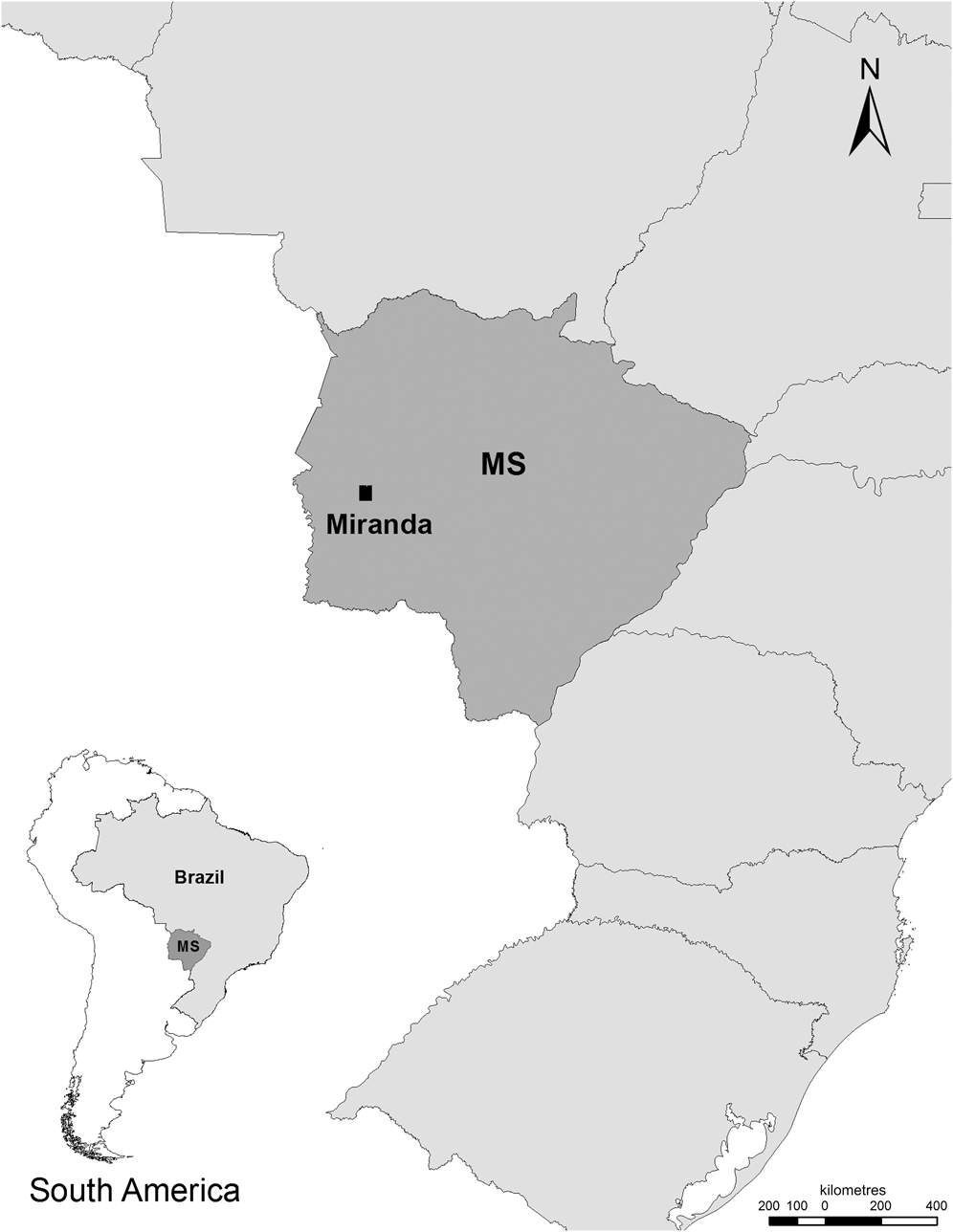
para1The study was carried out in the area of the Municipality of Miranda in the state of Mato Grosso do Sul, southwestern Brazil (20°16′S, 56°14′W) (Fig. 1). The regional climate is tropical, humid and strongly seasonal, classified as Aw following Köppen (Reference Köppen1948). The mean annual temperature is 25°C and the rainy season is concentrated from November to March, with average annual precipitation of 1200–1700 mm.
Map showing the location of the Municipality of Miranda in the state of Mato Grosso do Sul (MS), central-western Brazil.

The Pre-Cambrian Cuiabá landscape group characterises the principal depression of Miranda with altitudes of 100−200 m. Mica schist is the predominant rock and Dark Red Latosols are the principal soils (Brasil, 1982a).
Cerrado (sensu lato) in its various forms from cerradão to campo limpo is the predominant vegetation of the Rio Miranda basin, but close to the Rios Aquidauana and Miranda there are Eutrophic somewhat Humic Gleys that carry SDTFs (Brasil, 1982a, 1982b; Mato Grosso do Sul, 1988, 1989).
The study site consists of adjacent areas of SDTF, with taller trees 15−25 m and very sparse ground vegetation, and mesotrophic cerradão with trees of 10−12 m and a dense lower vegetation of herbs, shrubs and young trees. The SDTF area is on a slope, with the cerradão occupying a flat area above, and there is a rather gradual transition between the two. The whole study area is protected and belongs to the Bandeirantes Settlement.
Vegetation structure and soil data
para1Ten contiguous plots of 20 × 25 m (0.5 ha) were established in the SDTF, and another 10 plots of the same size in mesotrophic cerradão. All trees with diameter at breast height (dbh) ≥ 5 cm were recorded using the nomenclature of APG III (2009). Ten soil samples of 0−20 cm depth were taken in each plot and mixed to make a single composite plot sample and these were analysed by the Laboratory of Soil Analysis of the Universidade Federal de Lavras (UFLA), following the protocol of Embrapa (1997).
Data analysis
para1The basal area (BA), relative and total abundance (RA and TA), relative and total frequency (RF and TF), relative and total dominance (RDo and TDo), and importance value (IV) were calculated for all species following Mueller-Dombois & Ellenberg (Reference Mueller-Dombois and Ellenberg1974). The Shannon-Wiener index (H′) and Pielou index (J′) (Brower & Zar, Reference Brower and Zar1984) were used to determine floristic diversity. All the values were calculated using the Mata Nativa 2 program (Cientec, 2007).
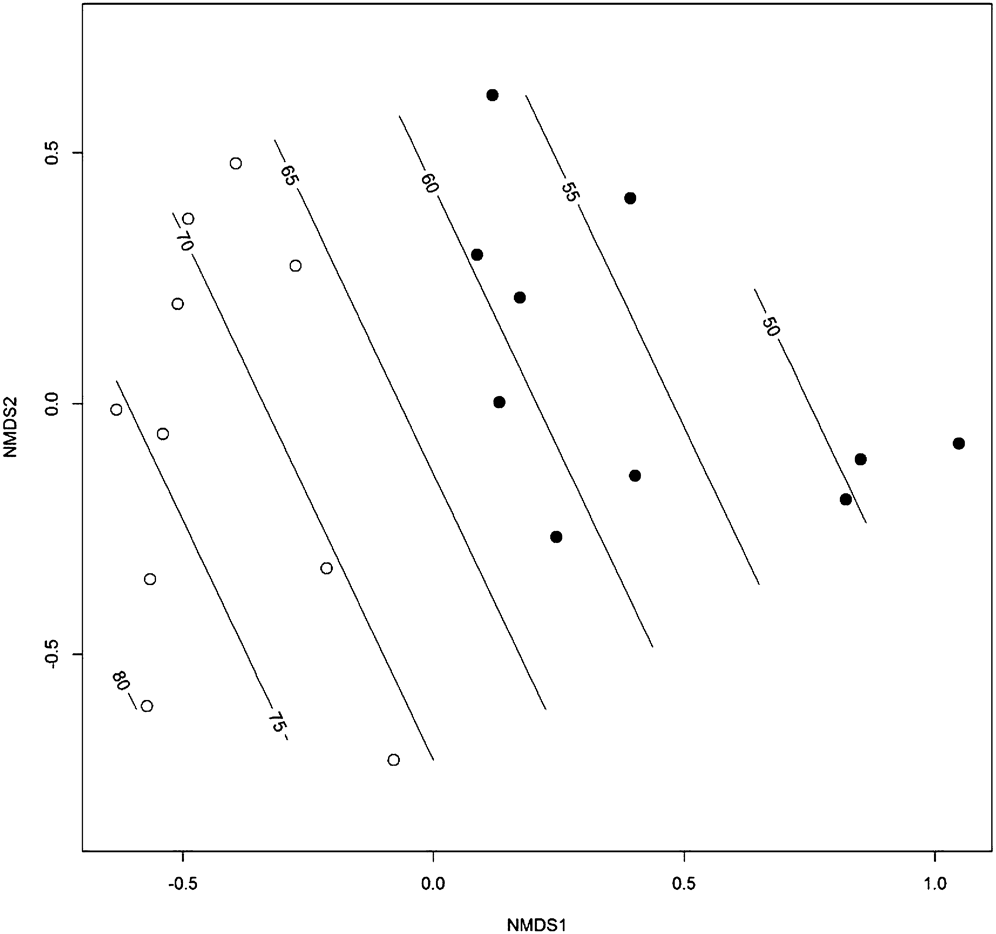
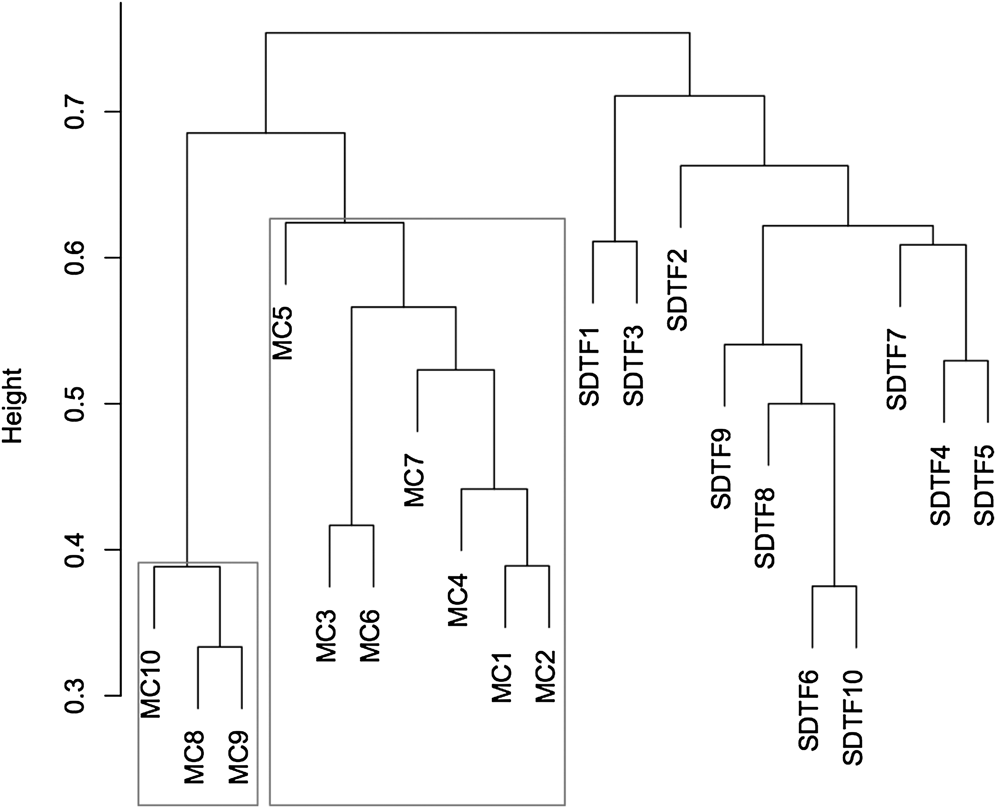
Classification and ordination analyses were carried out using the packages of the R software (R Development Core Team, 2012). The function ‘pvclust’ (Suzuki & Shimodaira, Reference Suzuki and Shimodaira2011) was used to perform a cluster analysis with Bray-Curtis distances of floristic dissimilarity between the 20 plots and the unweighted paired groups as a linkage method to produce the dendrograms (McCune & Grace, Reference McCune and Grace2002) with multiscale bootstrap resampling as support values (Fig. 3). A non-metric multidimensional scaling (NMDS) using a generalised additive modelling ‘surf’ function was also made to investigate the variance in species composition (Fig. 2). This technique is available as metaMDS in the package ‘vegan’ (Oksanen et al., Reference Oksanen, Kindt, Legendre and O’Hara2012). Finally, to check the agreement between the variance and the explanatory variables, the soil parameters were examined to select a subset of predicting environmental variables. To do this the forward selection function available in the ‘packfor package’ (Blanchet et al., Reference Blanchet, Legendre and Borcard2008) was used.
Non-metric multidimensional scaling (NMDS) of the 20 forest plots. The base saturation (V%) is fitted to this surface using a generalised additive model, as implemented in the surf function of the R package labdsv. Stress = 0.20. Open circles – seasonally dry tropical forests (STDF); black bullets – mesotrophic cerradão.
Cluster analysis of the 20 forest plots. MC – mesotrophic cerradão; SDTF – seasonally dry tropical forest; the rectangles indicate bootstrap support > 0.95. Distance measure = Bray-Curtis; linkage method = average; co-phenetic correlation = 0.81.
Results and Discussion
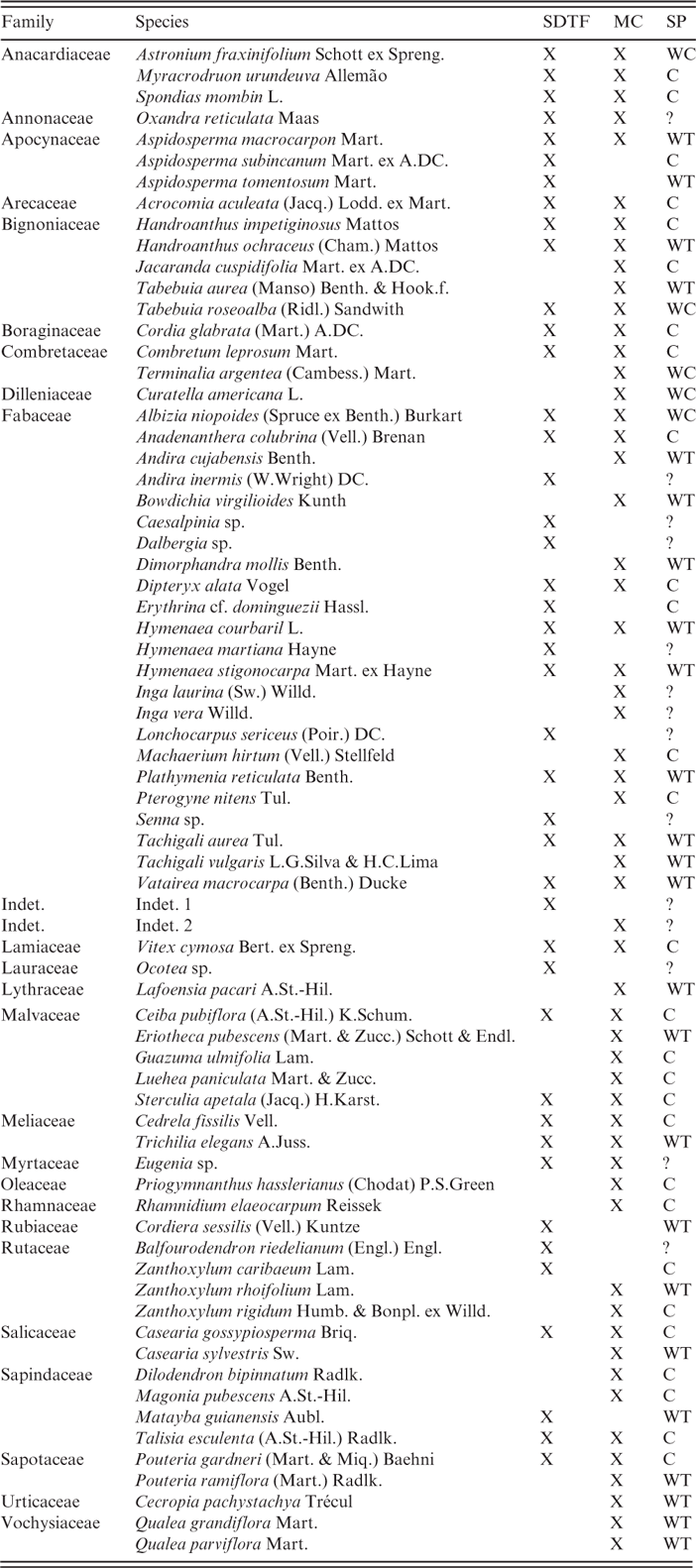
para1A total of 888 individual trees belonging to 24 families and 71 species was sampled. The mesotrophic cerradão was more diverse with 56 species, while the SDTF had 43. The Fabaceae were the richest family in both communities, with 14 species in the SDTF (34.14% of its total) and 17 in the mesotrophic cerradão (29.31%). Malvaceae were the second richest family in the mesotrophic cerradão, with six species representing 39.21%, while Anacardiaceae, Apocynaceae, Bignoniaceae and Malvaceae had three species each in the SDTF, representing 27.9% of the total (Table 1). Many authors have reported the richness of the Fabaceae in the Cerrado biome, while in the SDTF this family is the richest recorded anywhere (Gentry, Reference Gentry, Bullock, Mooney and Medina1995; Pennington et al., Reference Pennington, Prado and Pendry2000) with the exception of the Caribbean where Myrtaceae dominate (Lugo et al., Reference Lugo, Medina, Trejos-Torres, Helmer, Pennington, Lewis and Ratter2006).
Species recorded in seasonally dry tropical forest and mesotrophic cerradão
SDTF – seasonally dry tropical forest; MC – mesotrophic cerradão; SP – soil preference: WC – weakly calcicolous; WT – wide tolerance; C – calcicolous; ? – not known (estimates based on observations of Ratter et al., Reference Ratter, Bridgewater, Ribeiro, Fonseca-Filho, Rodrigues da Silva and Milliken2011).
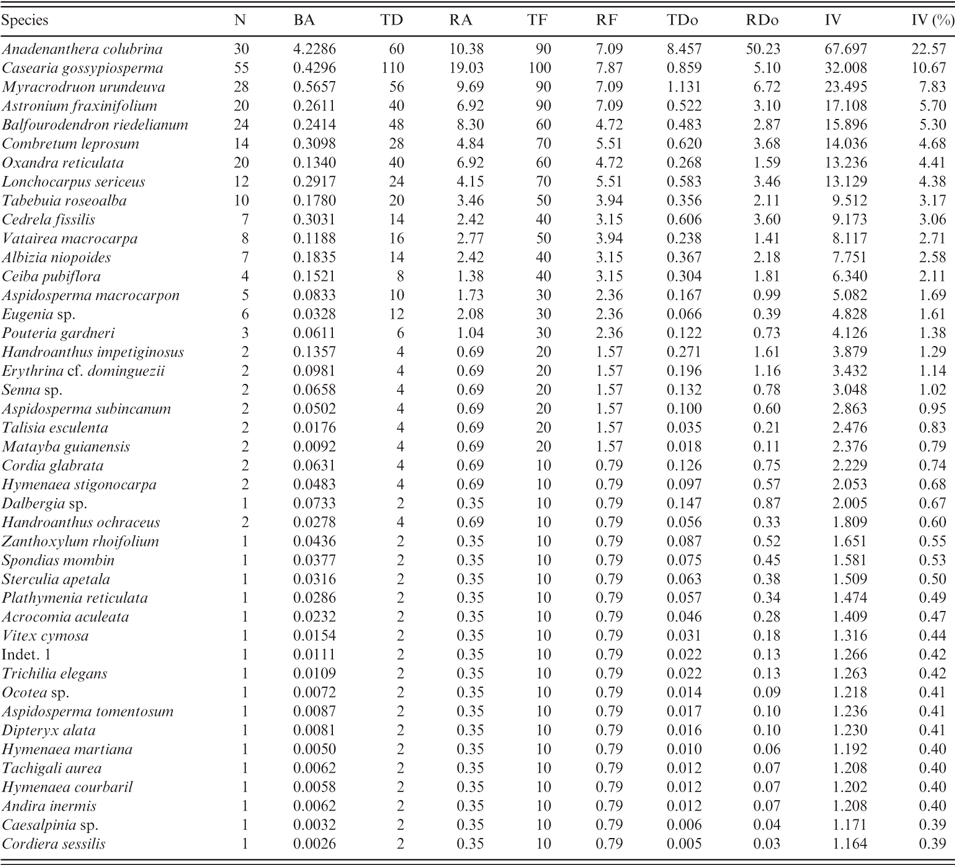
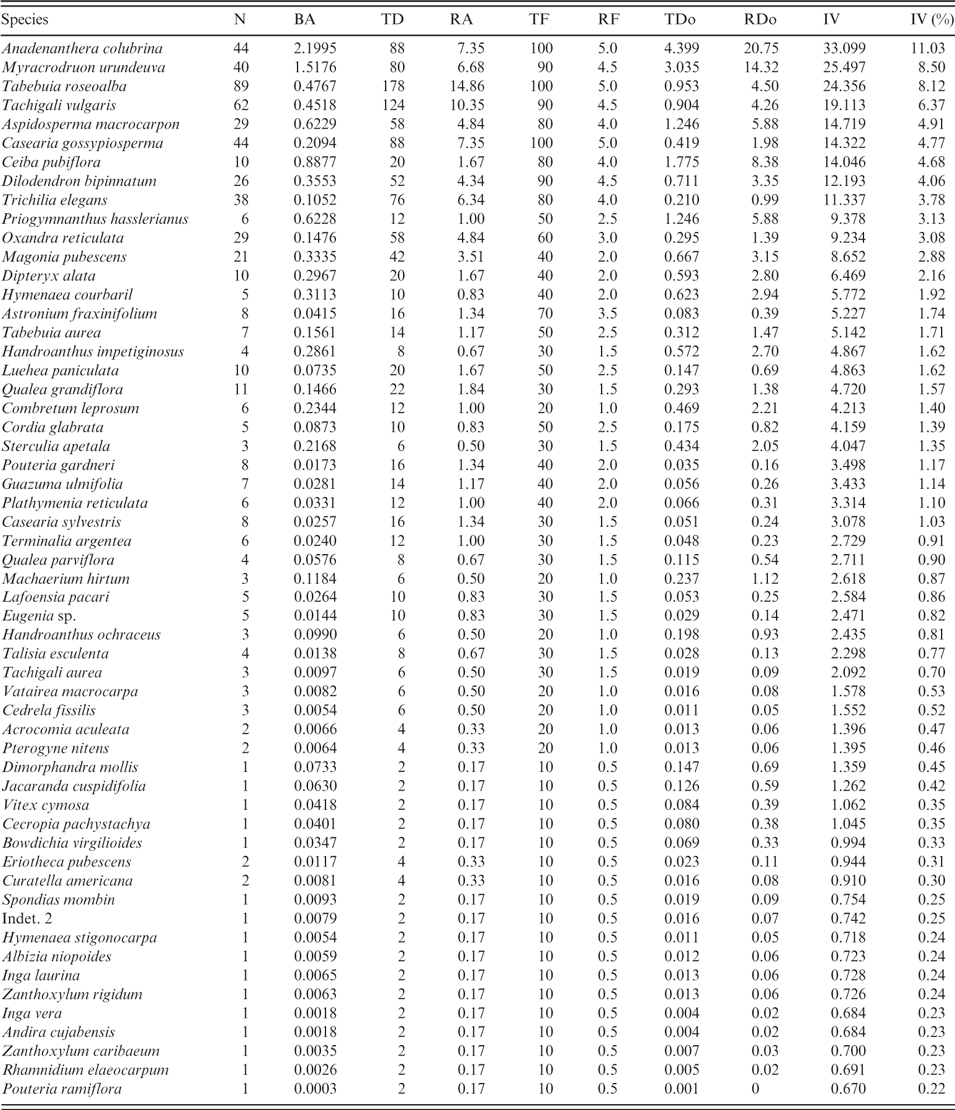
The total tree density in the SDTF was 578 individuals/ha and the top five species were Casearia gossypiosperma, Anadenanthera colubrina, Myracrodruon urundeuva, Balfourodendron riedelianum and Astronium fraxinifolium (taxon authors in Table 1), representing 54.32% (Table 2). Other authors also described most of these species as ‘common’ or ‘characteristic of’ SDTF (Ratter et al., Reference Ratter, Askew, Montgomery and Gifford1978; Dubs, Reference Dubs, Furley, Proctor and Ratter1992; Salis et al., Reference Salis, Shepherd and Joly1995; Neri et al., Reference Neri, Schaefer, Silva, Souza, Ferreira-Junior and Meira-Neto2012). The total density in the mesotrophic cerradão was 1198 individuals/ha and the commonest five species were Tabebuia roseoalba, with 14.86%, Tachigali vulgaris (10.35%), Casearia gossypiosperma (7.35%), Anadenanthera colubrina (7.35%) and Myracrodruon urundeuva (6.68%) (Table 3). Tabebuia roseoalba, Anadenanthera colubrina, Casearia gossypiosperma and Myracrodruon urundeuva are clearly related to fertile soils (Ratter et al., Reference Ratter, Askew, Montgomery, Gifford and Ferri1977; Pott & Pott, Reference Pott and Pott1994; Lehn et al., Reference Lehn, Salis, Mattos and Damasceno-Junior2008), whereas Tachigali vulgaris is more common in dystrophic cerradão or more open forms of Cerrado and is often a short-lived colonising species (Ratter, Reference Ratter, Furley, Proctor and Ratter1992; Carvalho, Reference Carvalho1994; Ratter et al., Reference Ratter, Bridgewater, Ribeiro, Fonseca-Filho, Rodrigues da Silva and Milliken2011). Tabebuia roseoalba, the most abundant species in our mesotrophic cerradão, is also an important element in SDTF throughout the Cerrado biome (Oliveira Filho et al., Reference Oliveira Filho, Curi, Vilela and Carvalho1998; Silva & Scariot, Reference Silva and Scariot2003, Reference Silva and Scariot2004; Salis et al., Reference Salis, Silva, Mattos, Silva, Pott and Pott2004).
Phytosociological parameters of the seasonally dry tropical forest area; species in order of importance value
N – individuals/0.5 ha; BA – basal area; TD – total density (individuals/ha); RA – relative abundance; TF – total frequency; RF – relative frequency; TDo – total dominance; RDo – relative dominance; IV – importance value.
Phytosociological parameters of the mesotrophic cerradão areas; species in order of importance value
N – individuals/0.5 ha; BA – basal area; TD – total density (individuals/ha); RA – relative abundance; TF – total frequency; RF – relative frequency; TDo – total dominance; RDo – relative dominance; IV – importance value.
The diversity indices in the SDTF were H′ 2.95 and J′ 0.78. Silva & Scariot (Reference Silva and Scariot2004) found similar values in another SDTF of the Cerrado biome (H′ 2.99 and J′ 0.77). Moreover, Rodal & Nascimento (Reference Rodal and Nascimento2006), studying an SDTF in the Caatinga biome, also found a similar result (H′ 2.72). Ratter (Reference Ratter, Furley, Proctor and Ratter1992) stated that SDTFs generally have low alpha diversity caused by the domination of certain characteristic species, such as Astronium fraxinifolium, Anadenanthera colubrina and Myracrodruon urundeuva (Ratter et al., Reference Ratter, Askew, Montgomery and Gifford1978; and Table 2). Our Pielou value corroborates this since it indicates just such an uneven distribution of species in our SDTF. This pattern may be explained by the disjunct distribution of SDTFs (Prado & Gibbs, Reference Prado and Gibbs1993; Pennington et al., Reference Pennington, Prado and Pendry2000), causing lower migration rates and therefore high abundance in local species (Hubbell, Reference Hubbell2001).
The Shannon-Wiener index of our mesotrophic cerradão was H′ 3.32, rather lower than the H′ 3.47−3.85 recorded by Costa & Araújo (Reference Costa and Araújo2001), Pereira Silva et al. (Reference Salis, Silva, Mattos, Silva, Pott and Pott2004), Marimon Junior & Haridasan (Reference Marimon Junior and Haridasan2005) and Kunz et al. (Reference Kunz, Ivanauskas and Martins2009). According to Oliveira Filho & Ratter (Reference Oliveira Filho, Ratter, Oliveira and Marquis2002), the richness of tree species in a dystrophic cerradão can be up to 150 species. This number is much less in mesotrophic cerradão, where dominance of a group of characteristic species causes lower alpha diversity. However, it is probably always higher than that of SDTF since, in addition to the characteristic marker species of more fertile soils, it contains a large number of typical Cerrado species more tolerant of dystrophic soils (see wide tolerance (WT) species in Table 1).
In terms of forest structure, Anadenanthera colubrina had the highest IV in both formations (22.5% in SDTF and 11.03% in mesotrophic cerradão), and also the highest BA values (4.22 m2/ha in SDTF and 2.19 in mesotrophic cerradão). The top five species in IV (Table 2) agree with other authors’ observations in diverse locations (Ratter et al., Reference Ratter, Askew, Montgomery and Gifford1978; Furley & Ratter, Reference Furley and Ratter1988; Oliveira Filho et al., Reference Oliveira Filho, Curi, Vilela and Carvalho1998). The strong dominance of some species and low alpha diversity pattern are not unusual in tropical forests, although much more common in seasonal forests (Richards, Reference Richards1952; Oliveira Filho & Ratter, Reference Oliveira Filho, Ratter, Rodrigues and Leitão Filho2000).
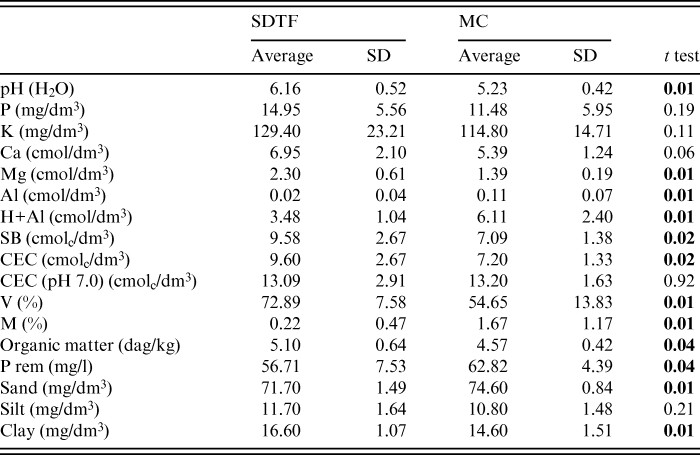
According to the Embrapa (2006) classification system, the SDTF soil is eutrophic, i.e. with base saturation (V%) higher than 70%, whereas the mesotrophic cerradão soil is, as one would expect, mesotrophic (V% ranging from 50 to 70%) (Table 4). The soils of both areas were slightly acid and, apart from P, K, Ca, cationic exchange capacity and silt, all other soil parameters were significantly different.
Average, standard deviation and t test of the edaphic parameters in the forest plots
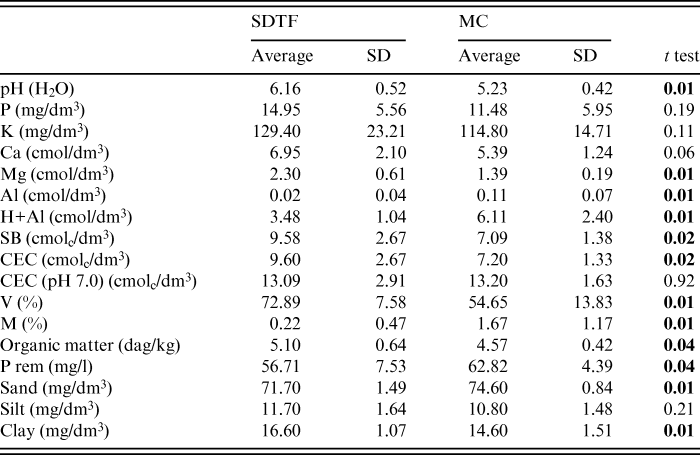
SDTF – seasonally dry tropical forest; MC – mesotrophic cerradão; SB – sum of bases; CEC – cation exchange capacity; V – base saturation; M – aluminium saturation; P rem – phosphorus remnant.
The highest value in the forward selection procedure was base saturation (adjusted R 2 = 0.17; P < 0.05). After the variance explained by V%, the residuals explained by other variables were insignificant. Our results agree with the observations of Ratter et al. (Reference Ratter, Richards, Argent and Gifford1973) and Furley & Ratter (Reference Furley and Ratter1988) who found such differences in soil fertility between SDTFs and mesotrophic cerradões. Ratter (Reference Ratter, Furley, Proctor and Ratter1992) noted Myracrodruon urundeuva, Anadenanthera colubrina, Astronium fraxinifolium, Aspidosperma subincanum and Cedrela fissilis as strong SDTF indicators, while Dipteryx alata, Magonia pubescens and Terminalia argentea were classified as mesotrophic cerradão indicators. However, these authors pointed out that usually there is a rather gradual transition between the two communities.
The non-metric multidimensional scaling (NMDS) emphasised the formation of a gradient in relation to soil fertility (V%) (Fig. 2) and the cluster analysis confirmed the soil fertility segregation (Fig. 3). Both analyses showed an agreement between soil fertility and variance in species composition gradients. The bootstrap value (AU) was high in mesotrophic cerradão (Fig. 3) and, although there are a considerable number of species shared between these communities, this result supports the recognition of SDTF and mesotrophic cerradão as different, although closely related, communities. In fact, our hypothesis is that most of the SDTF species have a narrow niche breadth, explaining our cluster segregation, and corroborating the patterns of high beta diversity in neotropical SDTF (Gillespie et al., Reference Gillespie, Grijalva and Farris2000; Trejo & Dirzo, Reference Trejo and Dirzo2002; Linares-Palomino, Reference Linares-Palomino, Pennington, Lewis and Ratter2006; Lott & Atkinson, Reference Lott, Atkinson, Pennington, Lewis and Ratter2006; Queiroz, Reference Queiroz, Pennington, Lewis and Ratter2006; Castillo-Campos et al., Reference Castillo-Campos, Halffter and Moreno2008). The postulated narrow niche breadth of characteristic SDTF species is demonstrated by the constancy of calcicolous flora in so many disjunct areas and its absence from poor soils.
Mesotrophic cerradão typically occurs as a transition band on intermediate soils between dystrophic Cerrado (or cerradão) and SDTF (Ratter et al., Reference Ratter, Askew, Montgomery, Gifford and Ferri1977; Furley & Ratter, Reference Furley and Ratter1988; Pott & Pott, Reference Pott, Pott and Costa2003). However, in some areas such as the valley of the Rio Paranã in the state of Goiás it covers large areas (Ratter, Reference Ratter, Furley, Proctor and Ratter1992; Silva & Scariot, Reference Silva and Scariot2003). Typical transitions between SDTF and Cerrado with intermediate areas of mesotrophic cerradão have been recorded over a large area of central Brazil in the states of Bahia, Goiás, Maranhão, Mato Grosso, Mato Grosso do Sul, Minas Gerais, Piauí, Rondônia, Tocantins and the Federal District (Ratter et al., Reference Ratter, Bridgewater, Ribeiro, Fonseca-Filho, Rodrigues da Silva and Milliken2011 and unpublished survey records).
Species recorded as important in both communities such as Anadenanthera colubrina, Myracrodruon urundeuva and Tabebuia roseoalba are the same as shown by other authors (e.g. Ratter, Reference Ratter, Askew, Montgomery, Gifford and Ferri1977; Felfili, Reference Felfili and Costa2003) to characterise disjunct SDTF fragments in various parts of Brazil. According to Prado & Gibbs (Reference Prado and Gibbs1993), Myracrodruon urundeuva and Anadenanthera colubrina have a wide distribution in neotropical areas and can be found in both very humid and dry locations. The presence of these species that occur both in the Caatinga vegetation of northeast Brazil and in the Missiones and western Piedmont areas of Argentina supports the suggestion of Prado & Gibbs (Reference Prado and Gibbs1993) that they belonged to a continuum of dry forest vegetation during the Pleistocene.
Conclusions
para1Our study area represents a fairly typical transition of mesotrophic cerradão and SDTF. As shown in other studies, the SDTF occurred on the more fertile soils (eutrophic according to the Embrapa 2006 classification), while those of the cerradão with somewhat lower levels of nutrients were mesotrophic. Anadenanthera colubrina had the highest importance value in both vegetation types, while other characteristic species of eutrophic and mesotrophic soils such as Myracrodruon urundeuva and Tabebuia roseoalba were also important. The cerradão showed higher species richness since it also includes many species typical of more dystrophic and open forms of Cerrado.