Introduction
Over the past decades, simultaneous demographic, social and economic transitions have incited growing research on how patterns of resource transfers between adult children and their ageing parents have changed (Agree, Biddlecom and Valente Reference Agree, Biddlecom and Valente1999; Frankenberg, Lillard and Willis Reference Frankenberg, Lillard and Willis2004). One such transition addressed within gerontology research is the increasing spatial dispersion of kin through internal and international migration, yet the issue of transnational care – care-giving across political and geographical spaces – has remained under-addressed in much literature on ageing and intergenerational care (Baldassar Reference Baldassar2007; Zechner Reference Zechner2008). More limited still is research on the intersection among care-giving, migration and elderly wellbeing.
Despite the acknowledgement that the family provides an essential source of old-age support, research on the relationship between the migration of adult children and elderly wellbeing outcomes is scarce (Frankenberg, Lillard and Willis Reference Frankenberg, Lillard and Willis2004). Much literature on migration and elderly wellbeing has explored how long-distance elder-care is practised (Baldassar Reference Baldassar2007; Baldassar and Baldock Reference Baldassar, Baldock and Agozino2000; Zechner Reference Zechner2008) rather than on how such transnational family arrangements influence the wellbeing of elderly individuals separated from their migrant kin. There are several notable exceptions: King and Vullnetari (Reference King and Vullnetari2006), writing in Albania, and Grant, Falkingham and Evandrou (Reference Grant, Falkingham and Evandrou2009), writing in Moldova, for instance, have explored the emotional wellbeing of elderly individuals following the migration of adult children through qualitative narratives. Other studies conducted in countries as far-flung as Mexico (Antman Reference Antman2010) and Cambodia (Zimmer and Knodel Reference Zimmer and Knodel2013) have used quantitative methods to model the potential impacts of child migration on the physical health and care of their elderly parents. These contributions have added essential evidence to the study of elderly wellbeing in transnational family contexts, but they reveal a marked absence of research on the links between adult child migration and elderly wellbeing as a holistic concept.
This article builds on this past research by assessing the impact of adult child migration on the multi-dimensional wellbeing of elderly parents who remain in Moldova. Moldova provides an excellent case study through which migration and elderly wellbeing can be studied given the sheer scale of the emigration from the country coupled with limited availability of public- and market-based elder-care. Since the late 1990s, Moldova has experienced persistent, large-scale emigration. By 2010, it was estimated that 21.5 per cent of the population resided abroad (Ratha, Mohapatra and Silwal Reference Ratha, Mohapatra and Silwal2011). Men constituted both greater stocks of emigrants abroad and the largest share of flows (estimated at 63.7% of all outgoing migrants in 2010), but women have increasingly entered international migration and outnumber men among migrants destined for European Union countries such as Italy (International Organisation for Migration 2012). The growing pace of female emigration has raised concerns over elder-care, as the family – chiefly female kin – often provides both regular and instrumental care to elderly individuals given the absence of appropriate institutional structures to support the ageing population (Grant, Falkingham and Evandrou Reference Grant, Falkingham and Evandrou2009).
Using data derived from a nationally representative household survey conducted across all regions of Moldova (except Transnistria) in 2011–12, this paper empirically evaluates how the migration of an adult child impacts different dimensions of elderly wellbeing using a multi-dimensional wellbeing index. In evaluating the relationship between adult child migration and different indicators and dimensions of elderly wellbeing, the analysis reveals that the physical absence of an adult child rarely corresponds to significantly worse elderly wellbeing outcomes – and that the physical distance between an ageing individual and potential sources of care does not affect all aspects of wellbeing equally.
Conceptualisation of elderly wellbeing
Central to this research is understanding what ‘wellbeing’ actually entails. A significant volume of gerontology research has addressed the concept of quality of life (QOL; for a discussion of the use of the term, see Dijkers Reference Dijkers2007). In recognising that QOL is strongly linked to inner perceptions about expectations and achievements, and thus difficult to capture in quantitative assessments using standardised measurement tools, the term wellbeing is preferred here.
The concept of wellbeing – or its counter term, deprivation – provides many conceptual advantages in understanding wellness in later life, particularly when connected to conceptual frameworks such as the capabilities approach. Formulated as an alternative to uni-dimensional, utilisation-maximising approaches to deprivation or poverty, the capabilities approach regards deprivation as a multifaceted dilemma resulting from an individual's limited ‘capabilities’ to achieve a desired end. Rather than emphasising end ‘functionings’, such as being materially well-off, for instance, the capabilities approach views the capabilities an individual has to achieve that end – such as access to employment – as essential for cultivating wellbeing (Robeyns Reference Robeyns2005; Sen Reference Sen, Nussbaum and Sen1993). Wellbeing is inherently multi-dimensional in this approach, as an individual's sense of worth and fulfilment spans many domains of life. Deprivation in any number of dimensions can thus result in the failure of an individual to achieve wellbeing (Alkire Reference Alkire2002; Alkire and Foster Reference Alkire and Foster2011; Robeyns Reference Robeyns2005; Sen Reference Sen, Nussbaum and Sen1993).
A concept of multi-dimensional wellbeing based on the capabilities approach recognises that wellbeing is inherently tied to an individual's stage in the lifecycle and corresponding changes to the set of capabilities available to them. These conceptual advantages are offset by a practical limitation, however: the capabilities approach does not define components of wellbeing. The literature on elderly QOL, particularly in health-care and geriatric treatment settings, can provide better guidance. Within the QOL literature, wellbeing in older age has been described as spanning several dimensions, including: physical health; mobility; social connectedness and the ability to maintain meaningful relationships; emotional wellbeing, including life satisfaction and self-esteem; and material security, including housing and economic stability (see e.g. Brown and Brown Reference Brown and Brown2004; Cummins Reference Cummins1996, Reference Cummins, Lim, Yuen and Löw1999; Dijkers Reference Dijkers2007; Farquhar Reference Farquhar1995; Fillenbaum Reference Fillenbaum1984; George and Bearon Reference George and Bearon1980). The literature has highlighted that these dimensions are overlapping, with interdependencies among dimensions of wellbeing growing closer as an individual ages. For instance, essential functions like maintaining independence – the ability to perform self-care tasks such as eating and using the toilet (Fillenbaum Reference Fillenbaum1984) – have direct impacts on the ability to maintain wellness in other domains. Deteriorating physical health, which can be associated with a decline in the capacity to engage in social life and in relationships, can correspond to decreased emotional wellbeing (Ward, Barnes and Gahagan Reference Ward, Barnes and Gahagan2012).
The interconnectedness among functionings has given rise to the concept of functional wellness, within which researchers and care-givers have identified five basic dimensions of elderly wellbeing: activities of daily living and associated necessary standards of mobility, mental health, physical health, and social and economic functioning (Fillenbaum Reference Fillenbaum1984). These domains have been used in several instruments for measuring elderly wellbeing and poverty, including the Gallup-Healthways Wellbeing Index (Coughlin Reference Coughlin2010) and the elderly wellbeing index developed by the Stanford Center on Longevity (Kaneda, Lee, and Pollard Reference Kaneda, Lee and Pollard2011).
Based on the concept of multi-dimensional wellbeing derived from the capabilities approach and the domains of wellbeing identified in QOL literature, the definition of elderly wellbeing used here is the following:
Wellbeing is a multi-dimensional state of personal being comprised of both self-assessed (subjective) and externally assessed (objective) positive outcomes across four realms of opportunity: physical health, emotional health, housing and social wellbeing.
This definition recognises that there are a multitude of factors within an individual's life that contribute to the achievement of wellbeing. These elements are seldom context independent and static, changing not only with age but as the result of other complex processes. Migration is one such process that alters the context in which individuals function, but its effects are not universal and homogenous.
Migration and elderly wellbeing
The achievement of multi-dimensional wellbeing and the availability of resources and care, particularly that provided by the family, are deeply connected. Even in countries with market or public provision of care for ageing individuals, adult children can provide important sources of support to their ageing parents, including social or emotional support, financial assistance and practical, hands-on assistance (Kalmijn and Saraceno Reference Kalmijn and Saraceno2008). Physical proximity is not a precondition for intergenerational support exchanges, but transnational care may imply different types of support and different means of its provision. As noted by Baldassar, Baldock and Wilding (Reference Baldassar, Baldock and Wilding2007), transnational care-giving can and does occur, but it is subject to different constraints than care provided locally or translocally (i.e. within the same country but at a distance). Challenges include not only physical distance but also legal regimes that affect possibilities for physical visits, the availability of telecommunication services that facilitate exchange, and differences in health-care infrastructures between countries of origin and residence, among other factors (Baldassar, Baldock and Wilding Reference Baldassar, Baldock and Wilding2007). Given these unique features, individuals providing care transnationally may provide less direct support, such as physical assistance, and instead provide emotional support or may organise and prioritise the care needs to be met by someone in closer physical proximity to the recipient (Zechner Reference Zechner2008).
The international migration of an adult child, and the change in care such migration may imply, could affect the wellbeing outcomes of elderly parents remaining in the home country in both positive and negative ways. Kanaiaupuni (Reference Kanaiaupuni2000), for instance, found that the international migration of adult children from Mexico corresponded to disruptions in traditional living arrangements, increasing the number of older individuals residing independently. The transition from residing in a multigenerational household to living alone could involve trade-offs in the resources the parents of migrants have at their disposal. For instance, the receipt of remittances could increase the financial resources available to a parent, enabling greater expenditure on medicines and other health inputs, yet the physical absence of a child could imply decreased support for routine physical activities (Kanaiaupuni Reference Kanaiaupuni2000). Another study in Mexico by Antman (Reference Antman2010) found that the migration of adult children corresponded to distinctly negative physical health outcomes for their ageing parents. Among the sample of elderly individuals included in the study, those with migrant children reported higher levels of physical and emotional health deterioration and were more likely to have suffered from heart attack or stroke since the migration of a child. Antman cautioned that the link between reduced physical health and the migration of a child should be more robustly tested and confirmed, but the preliminary evidence suggests a relationship between the absence of a child through migration and reduced physical wellbeing.
Other research has addressed the potential consequences of a child's migration for the social and emotional wellbeing of their parents. In interviews conducted among older parents with migrant children in Albania, King and Vullnetari found that while migrant children still provided many forms of support to their ageing parents – including financial assistance, emotional support through telephone calls and physical assistance during return visits – older parents experienced losses in ‘the anticipated privileges and roles of old age, above all those of grand-parenting and those that require physical proximity’ (2006: 808). The inability to participate in family life in older age contributed to feelings of social isolation and loss of self-respect among those parents with children and grandchildren living abroad. Similar sentiments were documented in a study conducted among older individuals in Moldova with children living abroad (Grant, Falkingham and Evandrou Reference Grant, Falkingham and Evandrou2009), with some interview respondents speaking of feelings of loss and grief regarding the absence of their children, particularly those residing abroad illegally who would be unable to return to Moldova to attend to their parents on their deathbeds.
In contrast, other studies have found benign or even positive relationships between the migration of an adult child and the wellbeing of their ageing parents. In Cambodia, for instance, Zimmer and Knodel (Reference Zimmer and Knodel2013) found that the movement of an adult child away from the parental home, either to another district in Cambodia or abroad, allowed migrant children to provide better financial support for their parents. The absence of a child did not contribute to the withdrawal of other forms of support, however, as most families had multiple children, and the siblings of a migrant would remain nearby their parents to provide for more immediate physical needs. This signals that the potential consequences of migration for the wellbeing of elderly kin are shaped by the larger care-giving and family context in which migration occurs. A similar finding was suggested in Moldova. Stöhr (Reference Stöhr2013), using the same data-set as the present study, suggested that siblings strategically allocate their time and ‘specialise’ in either migrating or staying behind to ensure that their parent(s) are not faced with a deficit of care. This may explain why so few negative impacts of migration on elderly wellbeing were found in further analyses. A quantitative assessment of the physical and emotional health of elderly individuals found that the migration of a child did not significantly affect the mental and cognitive health of elderly parents. Migration did correspond, however, to higher body weight, consumption of a more diverse diet, a greater share of time spent sleeping and on leisure activities, and a decrease in time spent on subsistence farming (Böhme, Persian and Stöhr Reference Böhme, Persian and Stöhr2013). Other positive findings have been reported in Thailand, where Abas et al. (Reference Abas, Punpuing, Jirapramukpitak, Guest, Tangchonlatip, Leese and Prince2009) found in an analysis of survey data that older individuals with children living abroad had lower reported rates of depression. The authors caution that such results may reflect a selection effect, in that migrants are more likely to come from households that have better pre-existing socio-economic conditions, factors that independently support better mental health in old age.
These studies have added vital insight into how the migration of a child and the wellbeing of older parents may be connected; they also reveal how diverse the impacts of a child's migration may be for different aspects of wellbeing. The results also highlight areas in which the relationship between adult child migration and the wellbeing of their elderly parents remaining in the home country are less well understood. Most of the studies that explored the specific relationship between adult child migration and the wellbeing of their elderly kin focused on only one aspect of wellbeing, such as physical or emotional health, generally in isolation from other aspects of an individual's life that could contribute to an overall sense of wellbeing. Other studies explored the potential impacts of migration on elderly wellbeing through qualitative accounts, which necessarily involved smaller and in some cases selective samples of individuals that disallowed discussion of impact or prevalence. Based on the findings and limitations of prior research, the following analysis therefore explores two interconnected research questions: are there differences in the wellbeing outcomes of elderly individuals with and without adult migrant children, and, if so, what components of wellbeing are most impacted by a child's migration? These research questions are explored by use of a multi-dimensional wellbeing index, which allows the differential impacts of adult child migration on specific aspects of wellbeing to be explored.
Data and methodology
Data
The following analyses of the impacts of adult child migration on the multi-dimensional wellbeing of elderly parents remaining in Moldova uses data derived from a nationally representative household survey conducted between September 2011 and February 2012. Data were collected from 3,255 households, of which 1,743 contained at least one elderly person aged 60 or older. Rather than using the conventional age cut-off of 65 to define an individual as ‘elderly’, the age of 60 was deemed more appropriate in the Moldovan context given earlier ages of retirement (62 for men and 57 for women) and lower life expectancies (64 for men and 73 for women). The survey sample was drawn from the Moldovan Labour Force Survey conducted in the second quarter of 2011 and covered all regions of Moldova except Transnistria. Only households with one or more elderly household member (aged 60+) or child (aged 0–18) were considered eligible for completion of the survey, as the project for which this survey was conducted focused on the impacts of migration on household dependants.
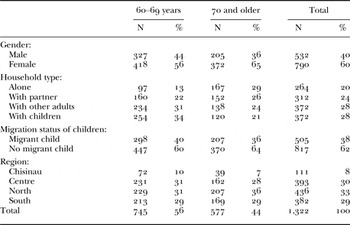
The survey collected information on the demographic features of household members, household living conditions, members' migration histories, and the experiences and conditions of elderly household members. To retain elderly individuals as the unit of analysis, information was collected directly from individuals over the age of 60 about work history, time allocation, physical health and nutrition, mental health, mobility, and relationships with household and non-household members. The survey sample included 2,278 elderly individuals, of whom 1,884 had children. Of this population of elderly individuals with children, the final analytical sample was restricted to those with full information on essential covariates, resulting in a final sample population of 1,322. The in- and out-of-sample population of elderly individuals with children did not differ significantly from one another on the basis of key variables such as age, gender, household composition or child migration status, suggesting that the observations omitted from the final analytical sample were missing at random. Key demographic information of this population is provided in Table 1.
Key demographic characteristics of the elderly population

Source: Authors' calculations.
The sample of elderly individuals was distributed similarly across four types of households, with the smallest proportion (20%) living alone and the largest proportion (28%) living in a household with at least one child below 18 years or in a house with other adults. The sample contained a greater proportion of women than men, which increased with age in line with lower male life expectancy. The elderly population was divided into two groups based on the location of adult children, with 38 per cent of the elderly sample having at least one migrant child at the time of the survey. In line with United Nations conventions, a current migrant was defined as any individual who lived abroad for three or more months consecutively at the time of data collection (United Nations 1998). This definition was considered particularly appropriate in the Moldovan context, as many migrants can be considered circular or seasonal migrants who work abroad at specific times of the year, generally in seasonal industries such as tourism or agriculture. Seasonal and circular migrants are often excluded in other measures of migration that require an absence of 12 or more months, which would exclude a significant proportion of the Moldovan migrant population.
Indicators
To assess the impacts of adult child migration on the multi-dimensional wellbeing of elderly individuals, a wellbeing index comprised of four dimensions and seven indicators was constructed. The index method advantageously allows for comparison of wellbeing outcomes of elderly individuals with and without children living abroad, which can be disaggregated by aspect (dimension) of wellbeing or aggregated to total index level to provide a single measure of wellbeing.
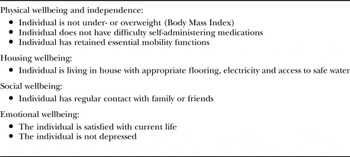
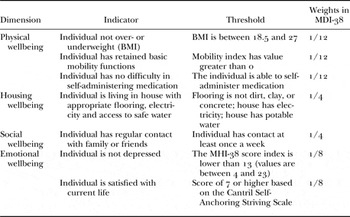
The dimensions of wellbeing included in this index include physical, emotional, social and housing wellbeing; the indicators included in each dimension can be seen in Table 2. Indicators within each dimension were chosen according to several criteria: parsimony, with a minimal number of indicators chosen to facilitate simplicity in comparison and interpretation; commonality and conceptual clarity, with indicators chosen that had been used in prior studies of wellbeing or QOL; and data quality, with indicators with high levels of missing data excluded from analysis. Different indicators were tested and compared according to these criteria, with the final indicator mix reflecting indicators that were the most methodologically and conceptually appropriate.
Wellbeing indicators per dimension

Physical wellbeing is comprised of indicators measuring an individual's weight-for-height (Body Mass Index, BMI); an individual's ability to take medication without aid, which is used as a proxy for functional independence and is correlated with other activities that measure elderly independence (Kaneda, Lee and Pollard Reference Kaneda, Lee and Pollard2011); and an individual's ability to perform activities of daily living (basic mobility functions) such as bathing, dressing, walking and going to the bathroom without assistance. The mobility indicator is a composite measure created through factor analysis, which was conducted to determine the underlying factors that explain rates of mobility. This factor analysis included several dummy variables that measured the elderly individual's ability to perform essential daily functions, all of which are correlated with each other.
Housing wellbeing is measured by indicators of housing quality, with living conditions considered appropriate when the house has proper flooring (not dirt, clay or concrete) and when the household has access to electricity and safe (potable) water. Housing was considered an essential domain of wellbeing given the strong ties between elderly-rated QOL and living environment, which is likely to shape how an individual navigates daily tasks and needs (Borowiak and Kostka Reference Borowiak and Kostka2004).
Social wellbeing is measured by regular contact with friends in the community. Extensive literature proposes that a good relationship with people in the community helps improve overall elderly wellbeing (Fillenbaum Reference Fillenbaum1984; Kaneda, Lee and Pollard Reference Kaneda, Lee and Pollard2011; Ward, Barnes and Gahagan Reference Ward, Barnes and Gahagan2012). As some elderly individuals reside with family, which would skew the proportion of individuals with contact with family, social contact with friends in the community was a preferred indicator of social contact over contact with family.
Emotional wellbeing was measured by two subjective indicators: self-reported depression and current life satisfaction. Questions on depression and life satisfaction were derived from the mental health inventory (MHI-38), an instrument designed to measure mental health within the elderly population. In line with MHI-38 scoring thresholds, an individual with a score of 13 or more on the depression indicator was considered unwell. Life satisfaction was measured using a ten-point Likert scale, with zero indicating complete dissatisfaction with one's current life and ten indicating complete satisfaction. Based on the Cantril Self-Anchoring Striving Scale, a score of seven or higher indicates that an individual is ‘thriving’ or satisfied with his/her own life.
Notably absent from the index are indicators of material wellbeing such as income or expenditures, which are traditional indicators of wellbeing (or its inverse, poverty). Material wellbeing was excluded as a dimension of wellbeing because it is likely to influence all aspects of wellbeing and should therefore be included as an explanatory variable in all multivariate analyses. As the elderly individual is the unit of analysis, material wellbeing was controlled for in the analysis by average per capita old-age pension, which is a financial resource to which an older individual is almost guaranteed to have access to (in contrast to per capita household income, which represents a household-level average that may not actually be accessible to all household members due to disparities in intra-household resource allocation).
Methodology
Wellbeing across different groups of elderly individuals was assessed and compared using this multi-dimensional wellbeing index. First, wellbeing with respect to each indicator was analysed. An elderly individual was considered not deprived if she or he met the established wellbeing threshold within a given indicator (for an overview of thresholds per indicator, see Table 3). Indicator wellbeing rates (IWB) were calculated by counting the number of elderly persons who met the wellbeing threshold, expressed as a share of all the elderly (Roelen and Gassmann Reference Roelen and Gassmann2012; Roelen, Gassmann and de Neubourg Reference Roelen, Gassmann and de Neubourg2011):
 $$IWB_x \, = \,\displaystyle{1 \over n}\sum\limits_{i = 1}^n {I_{ix}} $$
where n is the number of elderly for which the indicator is observable and I ix is a binary variable taking the value 1 if the elderly person i has reached the threshold for wellness and 0 if the elderly person has not. The denominator, n, differs across indicators by the number of actual observations. Indicators observed at household level, such as for housing quality, are assigned to all individuals living in the respective household, assuming equal access and intra-household distribution.
Multi-dimensional index: dimensions, indicators, thresholds and weights

Notes: MHI-38: mental health inventory. BMI: Body Mass Index.
A second step involved building a multi-dimensional wellbeing index inspired by the methodology developed by Alkire and Foster (Reference Alkire and Foster2011) for the measurement of multi-dimensional poverty. An elderly person can be considered multi-dimensionally well if the weighted combination of indicators is equal to or exceeds 70 per cent of the total. Each wellbeing dimension is assigned equal weight, as is each indicator within a dimension (see Table 3). This facilitates the interpretation of results (Atkinson Reference Atkinson2003) but also asserts that each dimension is of equal importance. Dimension weights signal the relative value of each dimension in contributing to overall wellbeing; as such, care must be taken in assigning weights to ensure that they represent reasoned consensus. Such consensus can be derived from participatory processes, such as consultations with experts or surveys among the populace. Differing dimension weights can be assigned in calibration with local norms and standards or in line with international standards (Alkire and Santos Reference Alkire and Santos2010). In this analysis, equal dimension weights were chosen given the absence of data that signals such consensus, particularly for the elderly population and in the Moldovan context. The decision to set the cut-off at 70 per cent of the aggregated indicators follows the cut-off used for multi-dimensional child wellbeing indices (Roelen and Gassmann Reference Roelen and Gassmann2012).
An elderly person is considered well if the sum of the weighted indicators is equal to or higher than the cut-off value. Elderly individuals with positive outcomes are assigned a value of one; all others are assigned a value of zero. The incidence (or headcount rate) of multi-dimensional wellbeing is the percentage of elderly individuals considered well as a proportion of all elderly individuals.
The calculation of wellbeing rates by indicator, dimension and total index level facilitates the comparison of wellbeing outcomes between the elderly population with and without migrant children. To test if the relationship between migration and elderly wellbeing is actually statistically significant, however, and to identify other characteristics that determine wellbeing, such as personal or household characteristics, multivariate probit analyses were subsequently used. As the aim is to assess the causal impact of migration on elderly wellbeing, potential endogeneity of migration due to self-selection must also be addressed. Endogeneity occurs when the variable indicating migration is correlated with other, unobserved variables that are also determinants of the dependent variable (elderly wellbeing). As an example, unobserved family characteristics, such as past episodes of depression, may influence present elderly wellbeing but can also influence the migration propensity among the elderly person's adult children, with the health of an elderly parent acting as a determinant of whether or not his or her adult child is able to migrate.
To solve this identification problem, an instrumental variable approach is used. In order for an instrument to be valid, two conditions must hold: the instrument must have a clear effect on the endogenous variable (in this case, migration), and it must be exogenous or uncorrelated with any other determinant of the dependent variable (elderly wellbeing). In this instance, such an exclusion restriction would imply that the instrument is not correlated with the error term and only affects elderly wellbeing through migration.
An instrument created by Böhme, Persian and Stöhr (Reference Böhme, Persian and Stöhr2013) using the same data-set is used here. The instrument is based on migrant network–economic growth interactions in destination countries. Networks are defined as emigrant stocks in destination countries in 2004, and Gross Domestic Product (GDP) per capita growth rates in destination countries are calculated between 2004 and 2010. This instrument assumes that networks are shared at the village level and decrease the cost of migration while facilitating access to employment abroad (Böhme, Persian and Stöhr Reference Böhme, Persian and Stöhr2013). Given economic growth in destination countries, individuals belonging to a network may be more incentivised to work abroad, but such GDP growth in destination countries is expected to be uncorrelated with elderly wellbeing in Moldova except through migration.
The two-stage least squares (2SLS) method of instrumental variable estimation is used. As other variables are expected to affect both the migration of an adult child and elderly wellbeing, the estimation controls for relevant covariates. The instrumental variable estimation is denoted as:
 $$Y_i \, = \,\alpha \, + \,\beta M_h \, + \,\gamma X_i \, + \,\delta H_h \, + \,\theta V_v \, + \,\varepsilon _i, $$
where Y i is the outcome variable, the different dimensions of elderly wellbeing and the multi-dimensional wellbeing index. M h is the instrumented variable indicating whether the elderly person has a child abroad, and X i indicates characteristics of the elderly person such as age, sex or ethnicity. H h denotes household-level variables, including the highest level of education in the household, the number of children, their mean age and the per capita household-level old-age pensions; V v indicates urban/rural status as well as the shares of migrants to Russia, Romania, Ukraine and Italy in 2004, as controls of the network–growth interaction instrument.
The indicators and dimensions of elderly wellbeing are expressed as binary values, either 0 (deprived) or 1 (well). This expression lends itself naturally to binary choice models such as probit or logit and is less well-suited to models like 2SLS that work with continuous dependent variables. Binary choice models with endogenous regressors have important drawbacks, however, as control functions (such as the ivprobit estimation command in the Stata software package), are said to be consistent only when the endogenous regressor is continuous (Dong and Lewbel Reference Dong and Lewbel2012). In recognising that the use of dependent outcome variables in an estimation method designed for continuous variables may yield inconsistent results, an additional test (two-stage residual inclusion estimation) was run to check the sensitivity of the results to the estimation method. Within this method, the residuals from the first-stage regression, which predicts the likelihood of having a migration experience, are estimated and included as an additional regressor in the second-stage equation, which predicts elderly wellbeing. As residuals are correlated with the unobservable characteristics that influence both the endogenous regressor (migration) and the dependent variable in the second-stage regression (elderly wellbeing), their inclusion ensures that the migration coefficient in the second-stage equation only reflects the causal effect of migration on elderly wellbeing (Marchetta Reference Marchetta2012). This method is known for producing consistent estimates in non-linear models (Terza, Bazu and Rathouz Reference Terza, Bazu and Rathouz2008).
Results
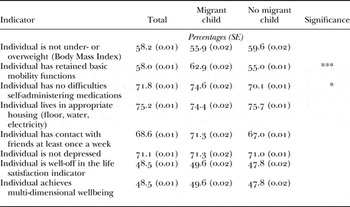
Elderly wellbeing rates by indicator can be seen in Table 4. In the domain of physical health, approximately 58 per cent of all elderly individuals were of normal weight (not underweight, overweight or obese according to BMI). The relatively high share of elderly persons with a BMI outside the ‘normal’ score band (defined as a BMI between 18.5 and 27) may signal that BMI score bandings should be better refined for the elderly Moldovan population, as the thresholds for ‘normal’ weight apply to the whole adult population and may not adequately measure body fat percentages in the elderly population. The measure could be better calibrated to the population under study, but it nevertheless provides an appropriate metric for comparison of population means. The migration status of children was not significantly correlated to the attainment of wellbeing in this indicator.
Indicator wellbeing rates of elderly individuals, by migration status of adult child(ren)

Note: SE: standard error.
Source: Authors' calculations.
Significance levels: * p < 0.1, *** p < 0.01.
Over half of the elderly population were able to perform basic functions without difficulty; a greater share of individuals with migrant children (62.9%) than those without (55%) were considered well in this indicator, a statistically significant difference. Over 70 per cent of the population was considered well in terms of functional independence, measured by the ability to self-administer medication, with more individuals with a child residing abroad considered well in this indicator. Housing wellbeing was the most frequently attained of all indicators, with more than 75 per cent of the elderly population enjoying appropriate housing conditions (i.e. housing with appropriate flooring, access to electricity and a safe source of drinking water). Housing wellbeing rates did not differ significantly by the migration status of children. Almost 69 per cent of the elderly were not deprived in social wellbeing. Elderly individuals without a migrant child had lower social wellbeing rates than elderly individuals with a child abroad, but these differences were not significant. Around 30 per cent of the total population reported being depressed, and less than 50 per cent of all respondents reported being satisfied with their lives. Differences in wellbeing rates of individuals with and without migrant children were not significant for either of these indicators. On total index level, nearly 49 per cent of the elderly population can be considered multi-dimensionally well, meaning that the weighted sum of the indicators is equal to or larger than 0.7. Overall wellbeing rates did not significantly differ by the migration status of adult children.
The comparison of wellbeing rates between individuals with and without children living abroad is useful descriptively, but wellbeing can be driven by characteristics other than migration. Multivariate probit models were thus estimated that predicted the relationship between adult child migration and elderly wellbeing while controlling for characteristics of the elderly individual, including sex and age, and characteristics of the household, such as the number children living in the household and the highest level of education of household members. Table 5 shows the abbreviated results of these models; only the coefficients associated with adult child migration are shown for brevity, and the full models are available upon request. The probit estimation suggests a limited relationship between migration and elderly wellbeing: the migration of an adult child corresponded to significantly different probabilities of an individual attaining wellbeing only for the mobility indicator, where individuals with a migrant child had a six-percentage-point higher probability of being considered well compared to members of their cohort with no children living abroad. Given the potential endogeneity discussed earlier, the results of the probit estimation imply correlation rather than causation; to demonstrate the real impact of adult child migration on the wellbeing of the elderly who remain in the home country, instrumental variable regression was then applied.
Probit results, relationship between adult child migration and elderly wellbeing

Notes: Robust standard errors (clustered at the village level) are given in parentheses. Other control variables have been omitted for brevity (full models available upon request). BMI: Body Mass Index. MWI: Multidimensional Well-being Index.
Source: Authors' calculations.
Significance level: * p < 0.05.
The estimation was performed in two steps: first, the migration of an adult child was estimated based on the instrument (network–growth interaction variable) and the other exogenous variables included in the probit estimation. Second, the fitted values of the first regression were used in the main equation to predict elderly wellbeing.
The coefficients of the first-stage regression predicting migration had the expected signs: elderly individuals with ethnic origins other than Moldovan/Romanian (e.g. Russian, Ukrainian, Gagauzian) had a higher probability of having a child abroad compared to ethnic Moldovans. An individual's number of children had a positive effect on the likelihood of migration, with diminishing increases associated with each additional child. The highest level of education in the household was positively correlated with migration, suggesting that migrants belong to households with above-average levels of formal education. Per capita old-age pensions (aggregated at a household level) were also positively correlated with migration of an adult child. Finally, living in an urban area was positively correlated with the likelihood of migration. The instrument used to predict migration was significant at a 1 per cent level and positively correlated with migration. Additional goodness-of-fit tests – the Kleibergen–Paap F statistic (Kleibergen and Paap Reference Kleibergen and Paap2006) and the conditional likelihood ratio test – further confirmed the relevance of the instrument. The results from the first-stage estimation are omitted here, given space constraints, but are available upon request.
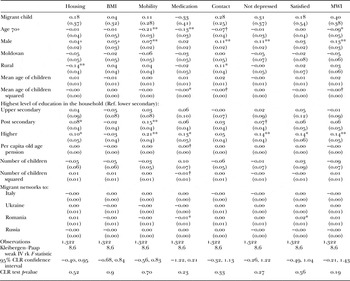
The instrumental variable regression results, shown in Table 6, reveal that no indicators of elderly wellbeing are significantly affected by the migration of an adult child. The difference between the instrumented and un-instrumented results suggests that elderly individuals with migrant children may appear more mobile because of a selection process by which adults with more mobile parents are more likely to enter migration precisely because their parents have retained some measure of independence. Other covariates have a stronger relationship to elderly wellbeing. An individual's age and sex were significant in many estimations: individuals within the oldest age cohort (aged 70 and older), for instance, had lower probabilities of being well in several indicators than did individuals in the 60–70-year-old age cohort. Men had higher probabilities than women of being well in several dimensions, but this correlation could be explained by the higher percentage of men within the youngest age cohort. Education increased the probability of an individual being well in many indicators, whereas living in a rural area corresponded to a marked decrease in the probability of an individual having appropriate housing, by 14 percentage points.
Second-stage regression: determinants of wellbeing

Notes: The conditional likelihood ratio (CLR) tests whether the coefficient for migration is equal to zero (β = 0) at a 5 per cent level. In all the regressions, the null hypothesis is not rejected: the impact of migration is not significantly different from zero. MWI: Multidimensional Well-being Index. Ref.: reference category.
Source: Authors' calculations.
Significance levels: † p < 0.1, * p < 0.05, ** p < 0.01.
A two-stage residual inclusion estimation was also conducted as a sensitivity test. The results, available upon request, confirm the findings from the 2SLS model, with migration not found to significantly impact any dimension of elderly wellbeing.
Discussion
The finding of these analyses – that the migration of an adult child does not levy statistically significant impacts on any of the measured dimensions of elderly wellbeing – provides a clear but somewhat unexpected answer to the research questions around which this study was framed. Two questions were posed: are there differences in the wellbeing outcomes of elderly individuals with and without adult migrant children, and, if so, what components of wellbeing are most impacted by a child's migration? While several dimensions of wellbeing appeared to be shaped by a child's migration (such as mobility), any differences in the outcomes of individuals with and without migrant children disappeared once endogeneity was controlled for. Such findings are contrary to those of much past literature, which suggested that the migration of a child should correspond to differences, either positive or negative, in the wellbeing outcomes of their ageing parents. The absence of significant results in this study have several possible interpretations – and several implications for how the phenomenon of the elderly ‘left behind’ should be understood.
One important explanation for the limited impact of a child's migration on elderly wellbeing outcomes relates to the analytical method. Elderly individuals with adult children living abroad appeared to be healthier in terms of basic mobility functions, but this relationship disappeared once potential endogenity was controlled for. This suggests that migrant self-selection contributed to the higher probability of elderly individuals with migrant children attaining wellness in this domain. The analytical approach adopted here and the findings it generated provide valuable nuance to the field of study, particularly in a country like Moldova where strongly negative discourses around migration emphasise the risks that migration generates for those ‘left behind’ (Panţîru, Black and Sabates-Wheeler Reference Panţîru, Black and Sabates-Wheeler2007). It also suggests that feelings associated with physical separation from a migrant child, such as loss and grief (as found by Grant, Falkingham and Evandrou Reference Grant, Falkingham and Evandrou2009), do not necessarily correspond to worse wellbeing outcomes, particularly when assessed within the larger set of features that shape holistic wellness.
The limited influence of migration on elderly wellbeing outcomes likely also reflects the particularities of local elder-care norms. Despite the significant scale of migration from Moldova, particularly among the ‘middle generation’ of individuals of prime working age, elderly individuals are unlikely to be left without any form of informal social assistance. As noted by Grant, Falkingham and Evandrou (Reference Grant, Falkingham and Evandrou2009), formal elder-care services or institutions are limited, and care for ageing kin is generally organised at the family level. Given this norm, the migration decision is likely to be made with consideration not only of individual benefits but also of family-level obligations; individuals with ageing parents may plan their potential migration projects in conjunction with their siblings. This suggestion is supported by other research in Moldova conducted by Stöhr (Reference Stöhr2013), who proposed that a migrant will strategically plan his or her migration with siblings to ensure that their parent(s) will not face a deficit of care. Indeed, only very few elderly individuals with multiple children were ‘left behind’ by migration; only 8 per cent of elderly persons with two children and 3.6 per cent of those with between three and five children had experienced the migration of all their children (Stöhr Reference Stöhr2013). This suggests that when the option to negotiate between or among potential migrants arises, families will do so in such a way to ensure that ageing parents will always have at least one child in the country. This finding is echoed by studies in other countries as well, including Zimmer and Knodel (Reference Zimmer and Knodel2013) in Cambodia. Given the important role kinship networks play in providing the elderly with old-age support, it is important for further research to investigate exactly how mobility decisions are made within families and for policy makers to address how informal social assistance regimes are affected by such mobility.
While this research did not find that the migration of a child levied significant impacts on different indicators of wellbeing, several other factors did – chief among them the sex and educational level of the elderly individual. Men had higher probabilities than women of being considered well in all indicators but the ability to self-administer medication and self-reported life satisfaction. Individuals who had attained some form of tertiary education had much higher probabilities of being well in all indicators except for BMI and social contact than did their counterparts who had attained lower-secondary education. These characteristics importantly suggest that individuals with different demographic profiles navigate the ageing process differently and may face different sources of risk and resilience. Rather than focusing on the migration of kin as a risk factor that can inhibit active ageing, as is currently done in Moldova, policy could perhaps better investigate how demographic characteristics shape the ageing process. What risks do women face in older age that men do not, and why do the higher educated navigate the ageing process in apparently better ways than those with lower levels of education?
The findings of this study add valuable nuance to the discussion of how migration can affect multi-dimensional elderly wellbeing in Moldova, but the study did face limitations that should be addressed in future research. First, certain indicators of wellbeing could be refined to better accommodate specific characteristics of the elderly Moldovan population. For example, BMI was used as an indicator of physical wellbeing, yet the range of ‘normal’ scores represent values that have not been specified for the elderly population or for the Moldovan population. The lack of calibration to the particular population under study would not be expected to lead to systematic differences between individuals with and without adult migrant children, but it does suggest that wellbeing rates across the population are potentially skewed. Second, the variables used to proxy wellbeing could be better refined to accommodate the transient nature of ‘wellbeing’. The data used in this analysis are cross-sectional and therefore represent the wellbeing of respondents at a particular moment in time. Certain indicators of wellbeing, such as self-reported depression or life satisfaction, are likely to vary across even short time-spans in response to events or conditions. Longitudinal data that collect observations from the same individuals over time could help establish ‘baseline’ values of subjective wellbeing that could help determine whether individuals manifest temporary dips or peaks in response to life events or circumstances (Clark et al. Reference Clark, Diener, Georgellis and Lucas2008). A third and final limitation relates to the choice to only compare elderly individuals with at least one child abroad to those with no children abroad. The wellbeing outcomes of elderly individuals would be expected to differ based on the particular family situation in which an ageing person is embedded; two elderly persons with children living abroad may have markedly different outcomes if one of them has another children living in the same household and the other does not have any other children aside from the migrant living abroad. The location and availability of children matters for the type of care that an elderly person may receive; local, translocal and transnational care-givers are likely to have different capacities and constraints (Baldassar, Baldock and Wilding Reference Baldassar, Baldock and Wilding2007), emphasising the importance of better modelling the particular family constellation in which an elderly individual lives.
Despite these limitations, this study makes several contributions to the literature. First, the disaggregation of wellbeing into different domains illustrates the value in conceptualising wellbeing as an inherently multi-dimensional concept. Wellbeing rates varied considerably by domain and by indicator, signalling the danger in measuring wellbeing using traditional, uni-dimensional approaches based exclusively on material security. Second, the use of an instrumental variable approach to measuring the impacts of migration on the wellbeing outcomes of elderly individuals provided an apt illustration of how endogenity can bias results. The relationship between migration and wellbeing was significant only prior to application of an instrument, suggesting that the apparent influence of migration on specific wellbeing outcomes (such as mobility) was likely capturing unobservable characteristics of migrants and their families that could distort the estimation results. Third, and finally, the weak relationship between the migration of an adult child and the wellbeing outcomes of their elderly parents suggests that other factors of an individual's life – gender and education level chief among them – may play a stronger role in shaping wellbeing outcomes. Further exploration of the difference in wellbeing outcomes across different sub-population groups (e.g. men/women, rural/urban residents, poorly/well educated) is likely to reveal that migration is a much less strong predictor or contributor to wellbeing than other factors in an individual's life.
Acknowledgements
Funding for this research was provided by the European Commission through grant contract DCI-MIGR/2010/229-604. The project from which data were collected adheres to the International Code on Market and Social Research elaborated by the International Chamber of Commerce and the European Society for Opinion and Market Research (ESOMAR). The survey company responsible for data collection is an ESOMAR member and is subject to the ethical standards elaborated in the International Code. In addition, the protocols followed in the project were checked by the Moldovan Ministry of Labour, Social Protection and Family, as well as an independent psychologist who evaluated and approved the survey instrument.