Introduction
The ‘Mediterranean’ style of European Palaeolithic parietal art was defined during the first half of the twentieth century as a late expression that evolved autonomously in southern Italy and Sicily from the Franco-Cantabrian style (Graziosi Reference Graziosi1933, Reference Graziosi1956, Reference Graziosi and Ripoll Perelló1968; Vigliardi Reference Vigliardi, Mundi and Gravina1984). For decades, the Romanelli Cave has been considered an important reference site for this so-called ‘Mediterranean artistic province’, even though the cave's parietal and portable art has never been subject to a full and systematic investigation. Over the last 20 years, new discoveries and reappraisals of previous research have transformed our understanding of Palaeolithic rock art around the Mediterranean, recognising common stylistic features, which widen its known geographical distribution significantly, and blur and nuance our knowledge of these cultural spaces following the Late Glacial Maximum (Bicho et al. Reference Bicho2007; Huyge et al. Reference Huyge2011; Tusa et al. Reference Tusa2013; Naudinot et al. Reference Naudinot2017; Ruiz-Redondo et al. Reference Ruiz-Redondo2019; Domingo & Roman Reference Domingo and Roman2020; Sigari Reference Sigari2020). In this context, the need for a systematic study of the Romanelli Cave became increasingly important and, in 2016, a new multidisciplinary research project was initiated to investigate the cave.
In 2017, fieldwork focused on the different techniques used to create the rock art in two specific areas of the cave, GRP002 and GRP005, each of which has rich concentrations of previously unknown and undocumented art. This article presents the results of this work, concentrating on four panels: Panel A in area GRP002 and Panels E, F and H in area GRP005. We also refine the chronology of the cave's occupation levels (Calcagnile et al. Reference Calcagnile2019) with seven new radiocarbon dates between 11 500 and 13 400 BP. The newly discovered rock art raises questions about the chronology, technology and the context within which the Romanelli Cave art developed, showing graphical associations with other Eurasian Palaeolithic sites.
The Romanelli Cave site in context
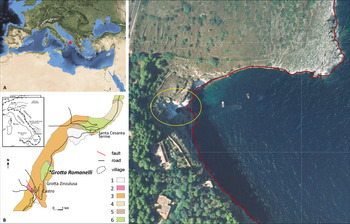
The Romanelli Cave (40°00′58″N, 18°26′01″E) is located in the territory of the Castro (Lecce) municipality, at the south-eastern extremity of Apulia in Italy. It lies within the regional nature park of Otranto-Santa Maria di Leuca Coast and Tricase Woods, and faces the Adriatic Sea (Figures 1 & 2). The cave is a key site for studies of the Mediterranean Pleistocene, due to its extensive archaeological and palaeontological evidence (see complete bibliography in Sardella et al. Reference Sardella2019).
Romanelli Cave. Location in the Mediterranean (A) (Google Earth, modified by D. Sigari) and in the bay (B–C), showing the geology of the coastline: 1) Salento Calcarenite (Pleistocene, Sicilian); 2) Leuca Breccia (Miocene, Messinian); 3) Castro Limestone (Oligocene, Chattian); 4) Torre Specchialaguardia Limestone (Eocene, Priabonian); 5) Torre Tiggiano Limestone (Eocene, Lutetian); 6) Altamura Limestone (Upper Cretaceous, Maastrichtian) (drawing B (adapted from Forti et al. Reference Forti2020: 20); image C (Puglia.con n.d.) modified by D. Sigari).

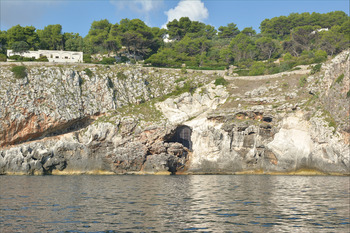
Entrance of the Romanelli Cave (photograph by D. Sigari).

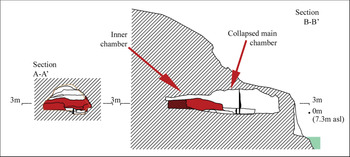
The cave is located approximately 7.30m asl, and opens into Ciolo limestone, which belongs to the Apulian Carbonate Platform, an Upper Cretaceous bioclastic calcarenite-calcirudite. The large, east-facing entrance is approximately 11.5m wide × 9.0m high. Inside, the cave is divided into two parts: a collapsed main chamber that is littered with large boulders fallen from the ceiling, and an inner chamber. The two sections are distinct, formed by a change in the angle of the slope of the cave ceiling, which has created a step-like vertical surface labelled the ‘pediment’.
The archaeology of the Romanelli Cave
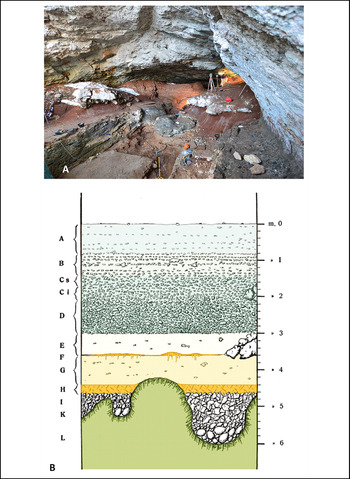
The Romanelli Cave was identified by Ulderico Botti in 1874, but due to the difficulty of access caused by cave deposits accumulated around the entrance, excavations, by Stasi, were not initiated until 1900 (Sigari & Sardella Reference Sigari, Sardella, De Pascale and Tarantini2018). The cave deposits were divided into two main contexts: ‘terre rosse’ (Layer G), which contained lithic material attributed to the Mousterian period (Piperno Reference Piperno1974) and ‘terre brune’ (Layers A–E), which featured rich deposits of lithics and animal bone, a small quantity of human bones and several portable art objects. Furthermore, stone fragments featuring possible parietal art had fallen from the walls and ceiling of the cave in antiquity (Stasi & Regalia Reference Stasi and Regalia1904; Blanc Reference Blanc1939; Fabbri Reference Fabbri1987; Bietti Reference Bietti, Fabbri, Ingravallo and Mangia2003; Sardella et al. Reference Sardella2018) (Figure 2).
A) Panoramic view of the Romanelli Cave (photograph by L. Forti); B) stratigraphy of the archaeological deposits (Sardella et al. Reference Sardella2019).

Within the terre brune layers, the palaeontological record is characterised by temperate species, mainly from steppe and grassland environments, along with North Atlantic and subarctic marine species, such as great auk (Pinguinus impennis) (see Sardella et al. Reference Sardella2018; Mecozzi et al. Reference Mecozzi2021). The lithic material totalled approximately 10 000 artefacts (with some 5800 pieces in Layer C), including small end scrapers, burins, finely retouched points on a blade, a bladelet or flake and many backed and truncated lithics (Sardella et al. Reference Sardella2019).
Portable art
From within the terre brune layers, 111 examples of portable art, or ‘plaquettes’, were recovered (including supposed engraved fragments from the ceiling and the walls), of which 110 are engraved and one is painted (Graziosi Reference Graziosi1933; Acanfora Reference Acanfora1967). Most of these pieces came from Layer C2 or from disturbed layers. The engravings may have been executed using a range of tools, as the scratched grooves vary in depth and width (Acanfora Reference Acanfora1967). The figures depicted are primarily zoomorphs, as well as abstract motifs. The decorative motifs of the portable art objects are characterised by a homogeneous style (Graziosi Reference Graziosi1932, Reference Graziosi1956, Reference Graziosi1973; Vigliardi Reference Vigliardi, Mundi and Gravina1984, Reference Vigliardi, Beltrán Martínez and Vigliardi1996; Frediani & Martini Reference Frediani, Martini, Fabbri, Ingravallo and Mangia2003). Many of the figures and motifs identified on the plaquettes are also present on the walls and ceiling of both chambers of the cave, suggesting a coherence in both the style and chronology of the two art forms (Stasi Reference Stasi1905; Blanc Reference Blanc1928; Graziosi Reference Graziosi1932, Reference Graziosi1933; Battaglia Reference Battaglia1935; Stella Reference Stella1937; Acanfora Reference Acanfora1967).
Chronology
Samples were selected for radiocarbon dating to confirm the chronology of the stratigraphic sequence identified during the earlier excavations. Those from the terre brune layers (in which the majority of the portable art objects were found, especially Layers B–D), returned a chronological range of 9135–8639 cal BP for Layer B and 13 976–13 545 cal BP for Layer D (for further details, see Calcagnile et al. Reference Calcagnile2019). This widens the previously published date range for the Upper Palaeolithic occupation of the cave, with Layers D and E encompassing the Late Pleistocene–Holocene boundary and Layer B extending into the younger Northgrippian (Middle Holocene) (see Table S1 in the online supplementary material (OSM)).
The Romanelli Cave art
The presence of art in the Romanelli Cave was first reported in 1905, when two engraved panels were discovered on the northern wall of the main chamber (Stasi Reference Stasi1905). No systematic study, however, was undertaken to record the numbers of figures and motifs and their typologies. The literature refers only to the art ensemble in the main chamber and the presence of a semi-naturalistic bovid figure, oval and fusiform (tapering) figures and linear marks (Stasi Reference Stasi1905; Blanc Reference Blanc1928; Graziosi Reference Graziosi1932, Reference Graziosi1933, Reference Graziosi1973). Subsequently, further engravings were discovered extending across other surfaces of the cave. Recent publications note a female silhouette and a bovid figure in the inner chamber—although without reporting their precise locations (Mussi & De Marco Reference Mussi and De Marco2008)—and a further bovid figure of unspecified location (Ciccarese Reference Ciccarese2000).
With its concentration of both parietal and portable art, the cave quickly became a key point of reference for researchers of Palaeolithic art, along with the Iberian caves of La Pileta and Parpallò, Ebbou Cave in France, and the Levanzo and Addaura caves in Sicily. Together, these caves present the main characteristics that define the ‘Mediterranean artistic province’ (Graziosi Reference Graziosi1932, Reference Graziosi1933, Reference Graziosi1956). According to Graziosi (Reference Graziosi1956, Reference Graziosi and Ripoll Perelló1968, Reference Graziosi1973), the Palaeolithic art of the Romanelli Cave reflects graphic tendencies that strongly characterise the Mediterranean style: simple realistic and naturalistic or semi-naturalistic figures and abstract motifs.
Material and methods
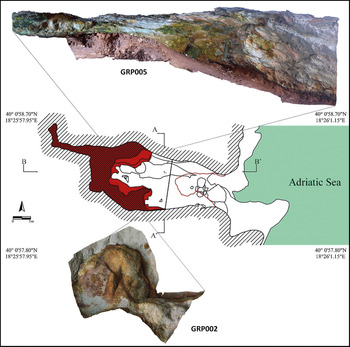
The fieldwork initiated in 2016 included an intensive visual examination of the whole cave interior using oblique light to identify engravings and any damage to the rock surfaces. The cave was divided into seven areas based on the spatial distribution of the known art and the morphology of the rock surfaces (Figures 4 & 5). Panels were defined within each area based on the rock surface features and the concentrations of engravings.
Sections of the Romanelli Cave indicating the established 0m base level (set at 7.3m asl) and the inner and collapsed main chambers (drawings by G. Lembo and B. Muttillo).

Planimetry of the Romanelli Cave and location of areas GRP002 and GRP005 (drawings by G. Lembo and B. Muttillo).

The parietal art in the main and inner chambers is distributed differently. In the main chamber, the art is located at an elevated height, forming a frieze. In contrast, in the inner chamber, the art is restricted to two small, natural recesses on the northern and southern walls.
The 2016–2017 fieldwork focused on the two previously unpublished areas of the inner chamber, labelled GRP002 and GRP005. These include dense concentrations of engravings with significant superimposition, potentially featuring different engraving techniques.
Due to the poor state of preservation of the engravings (Sardella et al. Reference Sardella2019), direct contact with the rock surface was avoided by recording the art using photography, which was subsequently enhanced with image editing software (Adobe Photoshop, GIMP). The results were checked and corrected during repeated visits to the site.
The inner chamber art panels
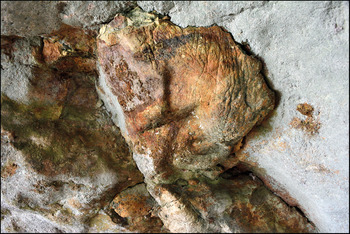
Within the inner chamber, the area labelled GRP002 (Figure 5) is a convex surface within a small recess of the southern wall. It features a single panel of engraved art—Panel A (Figure 6). This panel measures 0.58m in length × 0.61m in height, and is positioned 4.2m above the established 0m base level that coincides with the lowest point of the floor of the cave, set at 7.3m asl. Today, the panel can be accessed from the top of the archaeological deposits, at the point where the ceiling of the cave slopes sharply downwards. The panel features an abstract reticulate (grid-like) motif, executed using a rounded point that produced a groove with a U-shaped profile approximately 1.5mm deep × 2mm wide. The engraving is generally well preserved, but algae and lichens have affected the surrounding surface.
Panel GRP002-A showing the reticulate motif on the edge of the recess (photograph by D. Sigari).

Area GRP005, another recess, is located on the northern side of the inner chamber, opposite GRP002. Today, it sits just above the upper surface of the terre brune layers, and 4.13m above the established base level. The rock surface in this area is poorly preserved, having been damaged by both anthropic and other agents, such as lichens, algae, and rock erosion and fracturing (see Sardella et al. Reference Sardella2019: tab. 4). We divide GRP005 into ten panels, labelled A to J, of which Panels E, F and H are presented here. These three panels feature especially rich concentrations of previously unknown and undocumented art. They include a variety of subjects and techniques, along with figurative palimpsests, and are close to the archaeological sediment that is under investigation. In total, Panels E, F and H feature 30 individual figures and motifs, including zoomorphs, geometric figures and finger flutings.
Panel E
Panel E is 1m wide × 0.60m high, and includes four groups, or graphic units, of figures and motifs (Figure 7). E1 is a fusiform figure measuring 0.21m high × 25mm wide.
Tracing of panel GRP005-E (tracing by D. Sigari).

E2 is formed by a dense concentration of lines. E3 is a meandering figure developed around a vertical axis, commonly called a ‘barbèle’. It measures 0.32m in height × 50mm in width. Both E2 and E3 are overlapped by E4 and E6, which, together with E5, E7 and E8, are lines within Panel E that cannot be related to any specific figure. E2 and E3 were executed using a large, flattened point, whereas the grooves of E1 and E4–E8 have a narrow, V-shaped profile, indicating the use of a finer, sharper tool.
Panel F
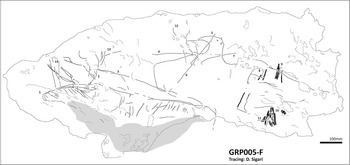
Panel F (Figure 8) is 1.54m wide × 0.6m high and encompasses 14 graphic units: three zoomorphs and eleven linear marks. F1 is a bovid, measuring 0.64m wide × 0.27m high. The head and the back of the animal are infilled with parallel lines and the horns point forwards. The shape of the cave wall creates a 3D effect, forming the body of the animal. This graphic unit is physically related to adjacent units F2, F3, F13 and F14, but the poor preservation prevents a clear understanding of any association or superimposition. F4 is a group of lines.
Tracing of panel GRP005-F (tracing by D. Sigari).

F5 is an ornithomorphic figure, 90mm wide × 0.1m high. It includes only the head, with a large beak and an eye, with three short parallel lines immediately beneath. The figure is overlapped by an oblique line (F6) and overlaps another oblique line (F7). F8 is the back and the rear part of another zoomorph, measuring 0.24m wide × 0.14m high. This overlaps F9, which comprises a group of lines engraved with a thick, flat point. F10 and F11 are groups of lines engraved in the lower part of the panel, below F8. F11 was made using a thick, flat point—probably on a softer surface—and was later overlapped by the thinner groove of F10. F12 is a single curved line at the top of the panel.
Panel H
Panel H measures 0.65m wide × 0.29m in height. It is slightly concave and the lower part curves, forming a slight shelf. The surface, identified as a concretion of moonmilk (a white carbonate precipitate found in limestone caves), is characterised by several small fractures. Eight finger flutings were recorded (Figure 9). H1, H3, H4 and H6 are short horizontal flutings. H1, H3 and H7 appear to follow the lower edge of the panel. H2 and H8 are vertical and sinuous.
Tracing of panel GRP005-H (tracing by D. Sigari).

Assessment
The survey of the walls and ceiling of the inner chamber has identified zoomorphs (3), geometric motifs (4), groups of linear marks (16) and finger flutings on moonmilk (8). The figures were all produced by engraving. Variable groove profiles indicate the use of different tools selected to suit the different rock-surface types: finger flutings on moonmilk, wide grooves scratched using large, flattened, pointed tools on soft limestone surfaces, and thinner examples scratched with a sharp, pointed tool on harder rock (Groupe de Réflexion sur l'Art Pariétal Paléolithique 1993; Aujoulat et al. Reference Aujoulat and Clottes2010). Diachronic changes in the hardness of the rock due to natural limestone alteration (see Ford & Williams Reference Ford and Williams2007), would have led to the use of different tools for later work, as demonstrated by the overlaps among the graphic units, such as where E4 overlaps E2 and E3, or where F8 crosses F9.
No stylistic homogeneity can be discerned between the three zoomorphic figures. F5 and F8 (incomplete) are depicted only in outline, while F1 features infilling. Moreover, in their small size and narrow grooves, they also differ from the previously known engravings of the main chamber (Stasi Reference Stasi1905; Graziosi Reference Graziosi1973), which include a large number of engravings with thick, deep grooves with a V-shaped profile that were produced by abrading the rock. Among these figures is an outlined zoomorph—the so-called ‘Romanelli bovid’—as well as reticulate motifs and other geometric figures, including vulvar and fusiform motifs (Stasi Reference Stasi1905; Graziosi Reference Graziosi1973; Sigari Reference Sigari2018).
Discussion
The panels presented here are all located at the same height relative to the established baseline in the main chamber, between 4.4 and 4.13m; in the inner chamber the panels are 0.5m above the surface of the archaeological deposits. Analysis of archival photographs documenting early research activities in the cave reveals that these engraved surfaces were, at that time, concealed by cave sediments that have subsequently been removed. Furthermore, our investigations below panel GRP005-F are currently exploring stratigraphic units corresponding to the mid to upper part of Layer C, which provided a chronological reference of c. 11 500 cal BP (Table S1).
A precise chronological framework for the Romanelli Cave art is difficult to define due to the lack of direct dating evidence. The cave surface is covered by a biofilm, and past excavation activities cleared the chamber walls without recording the relationship between the engravings and the archaeological layers. Stylistic analysis of the art is therefore the only evidence available. The new radiocarbon dates confirm only the date of sediment deposition and, hence, use of the cave between 14 000 and 11 000 cal BP. This stretching of the chronology allows for the possibility of a longer period of artistic activity, with multiple visits to the site, during which different figures were added to the cave walls, forming figurative palimpsests. We cannot, however, exclude the possibility that the cave was accessible during the chronological hiatus between the deposition of Layer E (11 440±50 BP) and Layer F (40 000±3250 BP); this requires further investigation.
Themes, style, techniques, chronology and environment
Bovids are one of the most common subjects depicted in Late Upper Palaeolithic art (Sigari Reference Sigari2020). In graphic unit F1, the profile of the animal's body, together with the S-shaped curved horns pointing forwards, demonstrates a degree of realism that is similar to other bovid figures found in the Italian Peninsula (e.g. Levanzo, Paglicci and Cavallo Caves, and Settecannelle and Romito rockshelters). Similar figures are also found in Iberia (Foz Côa, Siega Verde and Tito Bustillo), France (Ebbou Cave), Egypt (Qurta) and Azerbaijan (Gobustan). The filling technique used in F1 recalls figures at parietal art sites in France (Cosquer, Los Casares, Tuc d'Audoubert, Gouy and Bara Bahau caves) and Portugal (Foz Côa), and in the portable art from the Italian cave sites of Romanelli and Cavallo, the Parpallò Cave and Molì del Salt rockshelter in Spain and the Mas d'Azil and Borie del Rey Cave sites in France (Figure S1).
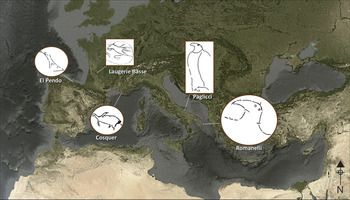
Birds are less frequently depicted in Palaeolithic art, making the F5 figure particularly significant. The detail of the three short lines close to the eye is reminiscent of the lighter-coloured stripe of feathers grown by the great auk during winter. Other auk figures can be found in the parietal art of El Pendo Cave in Spain and Cosquer Cave in France (Clottes et al. Reference Clottes, Courtin and Vanrell2005; Jiménez-Guijarro et al. Reference Jiménez-Guijarro, Sánchez-Marco and García-Díez2011), on a pebble from the Paglicci Cave in Italy, dated to c. 15 000 BP (Palma Di Cesnola Reference Palma Di Cesnola2003) and in another example from Laugerie Basse, France (Tosello Reference Tosello2003) (Figures 10 & S2).
Distribution of auk figures. Parietal art examples shown are in circles, portable art in squares (figure by D. Sigari).

The newly discovered zoomorphs in the Romanelli Cave show probable stylistic connections that extend beyond the chronological and geographical limits of the ‘Mediterranean artistic province’. The barbèles motifs also have a wide distribution and are found in the French caves of Niaux, Lascaux and Marsoulas, and at Tuc d'Audoubert, where some figures show a strong similarity with those of the Romanelli meandering motif, GRP005-E3, both in terms of the shapes depicted and the engraving techniques used (Fritz et al. Reference Fritz, Bégouën, Fritz, Tosello, Clottes, Pastoors and Faist2009). The placement of the reticulate motif in GRP002-A1 on the concave surface of a small recess can be compared to a similar example in the cave of Font-de-Gaume in France, which is also engraved on the edge of a natural depression (Robert Reference Robert, Medina-Alcaide, Romero Alonso, Ruiz-Márquez and Sanchidrián Torti2014).
The distinct types of groove profiles at the Romanelli Cave suggest the use of at least four different engraving tools and techniques: direct finger flutings in the moonmilk (i.e. GRP005-H1-H8); a wide tool to the create flat, broad grooves of GRP005-E2, E3, F9 and F10; a wide, round tool to create the reticulate motif of GRP002-A1; and a sharp, pointed tool to make the V-shaped groove profiles of the remaining figures, motifs and marks. The engravings with wider grooves are all overlapped by the narrower, V-shaped grooves, indicating at least two episodes of activity.
The development of moonmilk requires a complex equilibrium of geological and biological factors and a restricted range of climate-related environmental factors. Its presence in a concreted form suggests changing environmental conditions inside the cave (Borsato et al. Reference Borsato, Frisia, Jones and Van Der Borg2000; Nowell & Van Gelder Reference Nowell and Van Gelder2020). There is currently no active deposition of moonmilk in the cave.
Conclusions
Recent investigations at the Romanelli Cave have identified 31 new graphic units, showing several phases of art-making activity through the superimposition of figures and motifs and in the use of at least four different engraving techniques. The latter indicates the skill of the artists in selecting tools appropriate for rock surfaces of different hardness.
The zoomorphic figures belong to a shared visual concept whose geographical distribution is now known to be more variable and fluid than Graziosi's ‘Mediterranean artistic province’, and which fit within a broader stylistic-cultural tradition that reflects high mobility (Sigari Reference Sigari2020). Indeed, the stylistic and thematic comparisons, together with the new radiocarbon-dating sequence, seem to confirm a possible connection with the iconographic tradition that developed out of the Italian Peninsula after the Late Glacial Maximum, both in Iberia and France, and the Late Upper Palaeolithic of North Africa and the Caucasus.
Additional information may result from further excavation and analysis of the terre brune layers, especially Layers D–E and those immediately below the art panels presented here. This may help to determine the terminus post quem for the cave use and art production.
The discovery of the new engravings not only expands the figurative record of the Romanelli Cave and of Italian Palaeolithic art more generally, but also marks an important step towards setting this site within the wider, more complex landscape of Palaeolithic art. The new figures provide evidence of a shared visual heritage across a wide part of Eurasia during the Late Upper Palaeolithic, opening new questions about social dynamics and the spread of common iconographic motifs around the Mediterranean Basin. The associated radiocarbon dates extend the chronology of the creation of art in the Romanelli Cave, allowing for the presence of a graphic palimpsest recording different artistic episodes and for the possibility of older chronologies. Moreover, our recent survey of the Romanelli Cave has opened new avenues of investigation for understanding the relationship between parietal and portable art. Finally, our research highlights the complexity of the Late Upper Palaeolithic cultural framework, defining the Romanelli Cave as a key site between Western and Eastern Europe.
Acknowledgements
The authors acknowledge Soprintendenza Archeologia, Belle Arti e Paesaggio delle province di Brindisi, Lecce e Taranto for permission to undertake fieldwork and research at the Romanelli Cave. We are grateful to Castro municipality, Capitanerie di Porto di Castro e di Otranto, Parco Naturale Regionale Costa Otranto S.M. di Leuca-Bosco di Tricase, Ninì Ciccarese and Toto De Santis, Michele Rizzo and Red Coral team, and Don Piero Frisullo and Genesareth for their logistical support. We also wish to thank all members of the Romanelli team. We particularly thank Sebastien Nomade, LSCE (UMR 8212), Université Paris Sud, for the new radiocarbon dates. Finally, we thank George Nash, Eleonora Montanari and Akash Sirinvas who assisted with the English editing.
Funding statement
The project was supported by research funding from Sapienza, University of Rome (Finanziamento Ricerche di Ateneo (2015) and Progetto Grandi Scavi (2016–2019).
Supplementary material
To view supplementary material for this article, please visit https://doi.org/10.15184/aqy.2021.128