Introduction
Neuropsychiatric symptoms affect more than a third of dementia patients (Spalletta et al., Reference Spalletta2010), and are associated with institutionalization (Asada et al., Reference Asada, Kinoshita and Kakuma2000) and caregiver stress or care burden (Black and Almeida, Reference Black and Almeida2004) in patients with Alzheimer's disease (AD). They are also common in mild cognitive impairment (MCI) (Apostolova and Cummings, Reference Apostolova and Cummings2008).
Studies report that apathy and depression are the most prevalent neuropsychiatric symptoms in AD, even in the preclinical stage (Apostolova and Cummings, Reference Apostolova and Cummings2008; Monastero et al., Reference Monastero, Mangialasche, Camarda, Ercolani and Camarda2010). Many studies have compared AD with MCI, MCI with controls, amnestic-MCI with non-amnestic type (Apostolova and Cummings, Reference Apostolova and Cummings2008; Geda et al., Reference Geda2008; Monastero et al., Reference Monastero, Mangialasche, Camarda, Ercolani and Camarda2009), but few have compared all groups together; for a review see Apostolova and Cummings (Reference Apostolova and Cummings2008) and Monastero et al. (Reference Monastero, Mangialasche, Camarda, Ercolani and Camarda2009). Moreover, information is limited on newly diagnosed AD and MCI patients not undergoing treatment with psychotropic drugs or acetyl-cholinesterase inhibitors, which can alter the pattern and severity of psychiatric disturbances (Aalten et al., Reference Aalten2008).
Neuropsychiatric phenomenology in AD may be assessed with scales such as the Neuropsychiatric Inventory (NPI) (Cummings et al., Reference Cummings1997), evaluating continuous values of frequency and severity of symptoms. It may also be assessed using a categorical-diagnosis approach, that is, clinical diagnostic criteria to identify psychiatric disorders. Although previous studies have estimated the prevalence of neuropsychiatric symptoms in amnestic-MCI using NPI or other scales (Apostolova and Cummings, Reference Apostolova and Cummings2008; Geda et al., Reference Geda2008; Monastero et al., Reference Monastero, Mangialasche, Camarda, Ercolani and Camarda2010), few have assessed the prevalence of depression and apathy disorders in MCI with specific diagnostic instruments in the most common subtypes of MCI. Thus, there is a need for studies comparing AD, amnestic-MCI, multidomain-MCI and healthy controls, evaluating both the continuous severity of neuropsychiatric symptoms and specific diagnostic criteria for depression and apathy categorical disorders early in the course of the illnesses. In particular, the early identification of neuropsychiatric phenomena of both symptoms and disorders in MCI could improve further the prediction of the complex clinical course of the dementia illness, possibly helping improve treatment approaches, and ultimately the prognosis.
The aim of the current study is to investigate neuropsychiatric phenomena in patients with AD, amnestic-MCI and multidomain-MCI, and healthy controls, in a clinical sample of untreated, first-diagnosis patients evaluated in specialized memory clinics in Italy. Specifically, we aim to (1) compare the frequency of two psychiatric diagnoses, depression and apathy disorders, between amnestic-MCI, multidomain-MCI, and AD; (2) compare frequency and severity of neuropsychiatric symptoms in healthy controls, MCI, and AD; and (3) examine whether sociodemographic variables and level of cognitive and functional impairment influence these associations.
Methods
Study population and exclusion criteria
We studied 352 participants from the MCI/AD Italian prevention project, which aimed to observe neuropsychiatric symptoms and disorders in patients with MCI and AD, at three memory clinics in Rome, Italy. We included 119 subjects with AD, 68 with multidomain-MCI, and 58 with amnestic-MCI consecutively seen at the clinics, and 107 cognitively healthy controls. All subjects underwent examination between March 2004 and November 2008, including a thorough clinical neurological and psychiatric examination, and extensive cognitive assessment. Caregivers were also interviewed. All patients were included at first diagnosis of the disease, and before treatment with psychotropic drugs or acetyl-cholinesterase inhibitor drugs; any patients already prescribed such medications by other physicians were excluded from the study. A thorough clinical examination was used to exclude patients with secondary cognitive deficits due to somatic disorders such as unbalanced diabetes, heart disease, or other major medical illnesses causing secondary cognitive impairment. Patients with potential vascular impairment were excluded if they had a Hachinski Ischemic scale score>4 or MRI evidence of white matter lesions identified through consensus by a neuropsychologist expert in neuroimaging and a neuroradiologist. The exclusion criterion for AD patients was the lack of a “reliable” caregiver, defined as someone able to ensure the patient's compliance to assessment procedures and to contact the patient at least twice weekly, with one contact being a personal visit.
The nature and purpose of the study were presented to patients, caregivers and controls, and written informed consent was obtained. The study was approved by the Ethical Committee of Santa Lucia Foundation.
Sociodemographic and functional assessment
Information on age, education and sex was collected directly from the patient and verified by caregivers. Basic Activities of Daily Living (ADL) were assessed using the Katz scale (Katz, Reference Katz1983). Instrumental ADL (IADL) was assessed with Lawton and Brody's scale (Lawton and Brody, Reference Lawton and Brody1969). Age, ADL and IADL were used as continuous variables.
Cognitive and diagnostic examination
Global cognitive function was assessed with the Mini-mental State Examination (MMSE; Folstein et al., Reference Folstein, Folstein and McHugh1975), adjusted according to Italian normative data (Magni et al., Reference Magni, Binetti, Bianchetti, Rozzini and Trabucchi1996). Cognitive domains were assessed with the Mental Deterioration Battery (MDB; Carlesimo et al., Reference Carlesimo, Caltagirone and Gainotti1996). The MDB tests assess verbal memory (Rey's 15-word Immediate Recall and Delayed Recall); short term visual memory (Immediate Visual Memory); logical reasoning (Raven's Progressive Matrices 47); language (Phonological Verbal Fluency, and Sentence Construction); simple constructional praxis (Copying Drawings, and Copying Drawings with Landmarks). We administered additional tests to assess: long-term visual memory (Delayed Recall of Rey-Osterrieth picture); complex constructional praxis (Copy of Rey-Osterrieth picture); and attentive shifting and control (Stroop test Interference time). Cognitive impairment on the tests was defined using normative data for the Italian population (Carlesimo et al., Reference Carlesimo, Caltagirone and Gainotti1996), with specific age and educational norms.
AD diagnosis was made by a clinical neurologist. Criteria for mild AD were: (1) diagnostic evidence of probable AD consistent with the NINCDS-ADRDA criteria (McKhann et al., Reference McKhann, Drachman, Folstein, Katzman, Price and Stadlan1984). In the current analysis we included only patients with an MMSE score ≥18 and Clinical Dementia Rating (CDR) = 1 to ensure that only mild AD patients were included.
Diagnoses of amnestic-MCI and multidomain-MCI were made according to established criteria (Petersen et al., Reference Petersen, Stevens, Ganguli, Tangalos, Cummings and DeKosky2001) by trained clinical neurologists and psychologists. Criteria for both subtypes of MCI were: (i) subjective complaint of memory deficits, (ii) normal activities of daily living, (iii) normal global cognitive function (MMSE score ≥24), (iv) abnormal memory function for age, and (v) absence of dementia. For amnestic-MCI, objective cognitive impairment included impairment in a memory test, but normal functioning on visuospatial, language, and executive function tests. For multidomain-MCI, impairment was required in at least one cognitive domain in addition to memory (Petersen et al., Reference Petersen, Stevens, Ganguli, Tangalos, Cummings and DeKosky2001).
The 107 volunteers included in the control group were recruited from the general population of the same region as the patients. All controls were living independently in their own homes, and performed at a normal level of cognitive functioning in all neuropsychological tests according to age and education norms for the Italian population (Carlesimo et al., Reference Carlesimo, Caltagirone and Gainotti1996).
Diagnosis of psychiatric disorders
MCI and AD patients underwent a structured interview that included specific diagnostic criteria for psychiatric disorders in people with dementia, including criteria for depression in AD (Olin et al., Reference Olin2002), apathy in AD (Starkstein et al., Reference Starkstein, Petracca, Chemerinski and Kremer2001), and psychosis in AD (Jeste and Finkel, Reference Jeste and Finkel2000).
Neuropsychiatric symptom evaluation
Neuropsychiatric symptoms were assessed with the NPI (Cummings., 1997), which assesses 12 symptoms: delusions, hallucinations, depression/dysphoria, anxiety, disinhibition, elation/euphoria, agitation/aggression, irritability/lability, apathy, aberrant motor behavior, appetite disturbances, and night-time disturbances. A composite score of frequency (1–4) and severity (1–3) was calculated for each symptom (maximum 12). In the current analysis, individual symptoms were also categorized into three clinically relevant categories: no symptoms (score = 0); mild symptoms (score = 1–3) and; clinically significant symptoms (score >4).
Statistical analysis
Baseline characteristics of the groups were first assessed, with χ2 and students t test being used to compare demographic characteristics between controls, amnestic-MCI, multidomain-MCI, and AD patients. Second, logistic regression analysis with 95% confidence intervals were used to compare the likelihood of patients with MCI or AD having a psychiatric disorder of depression or apathy. Third, the NPI was used to assess the frequency and severity of neuropsychiatric symptoms. The proportion of people among MCI and AD groups who exhibited no, mild or clinically significant symptoms on the NPI was calculated. Fourth, logistic regression analysis was used to assess whether patients with MCI or AD had a greater likelihood of exhibiting neuropsychiatric symptoms than controls. Crude odds ratios were calculated, as well as multivariate models adjusted for age, sex, education, and MMSE performance. Finally, as the control population included a small number of people with diagnosed anxiety and depressive disorders, all analyses were rerun using a control group free from anxiety and depression disorders.
Results
Baseline characteristics
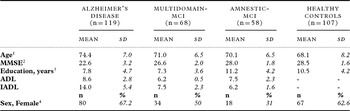
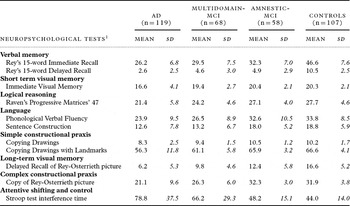
Table 1 shows the baseline characteristics of the study population, stratified by group (controls, MCI, and AD). Most sociodemographic factors differed significantly between each group at the p < 0.05 level. However, a number of factors did not differ. Age was similar between multidomain-MCI and amnestic-MCI, and between controls and amnestic MCI. Sex did not differ between AD and controls or multidomain-MCI and controls. Education was similar between AD and multidomain-MCI and between amnestic-MCI and controls. Amnestic-MCI had a similar mean MMSE as controls and multidomain-MCI patients. Functioning was also assessed in MCI and AD patients. As expected, the mean baseline score on the IADL and ADL was higher in AD patients than MCI. The mean performance for each neuropsychological test, for patients with AD, amnestic-MCI, and multidomain-MCI and controls are shown in Table 2.
Baseline characteristics of the study population stratified by group: Alzheimer's disease (AD), mild cognitive impairment (MCI), and controls

1Differences in age. Controls vs a-MCI: t = −1.574, p = 0.117, df = 163; controls vs md-MCI: t = −2.366, p = 0.019, df = 173; controls vs AD: t = −6.187, p < 0.000, df = 224; a-MCI vs md-MCI: t = −0.702, p = 0.484, df = 124; a-MCI vs AD: t = −3.919, p < 0.000, df = 175; md-MCI vs AD: t = −3.357, p = 0.001, df = 185.
2Differences in MMSE. Controls vs a-MCI: t = 2.053, p = 0.042, df = 163; controls vs md-MCI: t = 7.393, p < 0.000, df = 173; controls vs AD: t = 17.218, p < 0.000, df = 224; a-MCI vs md-MCI: t = 4.2, p < 0.000, df = 124; a-MCI vs AD: t = 11.744, p < 0.000, df = 175; md-MCI vs AD: t = 9.158, p < 0.000, df = 185.
3Differences in education. Controls vs a-MCI: t = −1.065, p = 0.288, df = 163; controls vs md-MCI: t = 5.117, p < 0.000, df = 173; controls vs AD: t = 4.440, p < 0.000, df = 224; a-MCI vs md-MCI: t = 5.574, p < 0.000, df = 124; a-MCI vs AD: t = 4.642, p < 0.000, df = 175; md-MCI vs AD: t = −0.808, p < 0.420, df = 185.
4Differences sex. Controls vs a-MCI: χ2 = 15.020, p < 0.000, df = 1; controls vs md-MCI: χ2 = 2.712, p = 0.100, df = 1; controls vs AD: χ2 = 0.527, p = 0.468, df = 1; a-MCI vs md-MCI: χ2 = 4.6, p = 0.024, df = 1; a-MCI vs AD: χ2 = 20.670, p < 0.000, df = 1; md-MCI vs AD: χ2 = 5.396, p = 0.020, df = 1.
MMSE = Mini-mental State Examination; ADL = activities of daily living; IADL = instrumental activities of daily living.
Neuropsychological test performance (adjusted scores) in AD and MCI patients and controls

1Scores are adjusted for age and education according to Italian normative data.
Occurrence of psychiatric disorders in MCI and AD
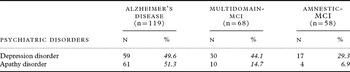
Table 3 shows the frequency of psychiatric disorders in MCI and AD. About half the AD patients had a diagnosis of depression or apathy disorders. AD patients were three times more likely to have a depression disorder compared to amnestic-MCI (adjusted OR = 3.0 CI = 1.1–7.6). There was no difference in the frequency of depression disorders between AD patients and multidomain-MCI (OR = 1.4, CI = 0.7–3.1). The frequency of depression disorder in multidomain-MCI and AD was higher than in amnestic-MCI. However, logistic regression analyses found no significant difference in the odds of having a depression disorder in multidomain-MCI patients compared to amnestic-MCI (OR = 1.9, CI = 0.9–4.0), even after adjustment for age, sex, education, and MMSE (adjusted OR = 1.9, CI = 0.8–4.6).
Diagnosis of apathy and depression disorders at baseline stratified by group: Alzheimer's disease and Mild Cognitive Impairment (MCI)

Although a diagnosis of apathy disorder was common in AD patients, the frequency was lower both in multidomain-MCI and amnestic-MCI. AD patients had a much higher risk of having a diagnosis of apathy disorder compared to amnestic-MCI (adjusted OR:16.9, CI = 4.6–61.8). AD patients had a seven-fold risk of having a diagnosis of apathy disorder compared to multidomain-MCI (adjusted OR = 7.5, CI = 3.0–19.2). More than twice the patients with multidomain-MCI had an apathy disorder compared to amnestic-MCI. The frequency of apathy disorder in multidomain-MCI and amnestic-MCI was not significantly different (adjusted OR: 2.1, CI = 0.5–8.3).
Nine AD patients (7.6%) had a diagnosis of psychotic disorder, whereas only one amnestic-MCI patient (1.7%) and one multidomain-MCI patient (1.5%) had a psychotic disorder. Owing to the low prevalence of psychotic disorders in MCI patients, we were unable to run further analyses to examine the differences between AD and MCI patients.
Occurrence of neuropsychiatric symptoms in controls, MCI and AD
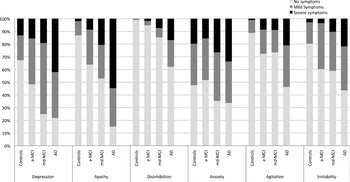
Figure 1 shows the six most frequent NPI neuropsychiatric symptoms, by group, according to the severity levels of symptoms. Symptoms of apathy and depression showed a progressive occurrence with increasing severity of cognitive syndromes. These symptoms were highly prevalent in AD patients (78.2% had depressive symptoms, and 84.9% had apathy symptoms). Multidomain-MCI patients (75.0%) had almost the same frequency of depressive symptoms as AD patients (78.2%), but they were more likely to be mild than clinically significant symptoms; 55.9% of multidomain-MCI patients compared to 36.1% of AD patients had mild depressive symptoms, whereas 19.1% of multidomain-MCI patients and 42.0% of AD patients had clinically significant depressive symptoms.
Occurrence of common neuropsychiatric symptoms in controls, amnestic-MCI, multidomain-MCI, and AD.

Agitation symptoms were more prevalent in AD than the two MCI groups; 39 (37.5%) had mild symptoms, and 25 (24.0%) had clinically significant agitation symptoms. Both the frequency and severity of agitation symptoms were similar in both MCI groups. The pattern of irritability symptoms was similar to the pattern observed for agitation symptoms. Symptoms of disinhibition were present in only one control (0.9%) and three (5.2%) amnestic-MCI patients. However, 14.7% multidomain-MCI and more than a third of AD patients (37.8%) had disinhibition symptoms.
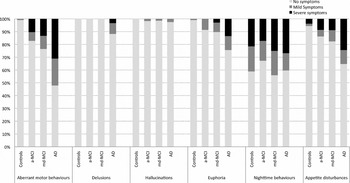
Figure 2 shows the occurrence of the remaining six NPI neuropsychiatric symptoms, according to the severity of symptoms. Symptoms of night-time disturbances were common in the study sample, occurring in more than a third of people. Symptoms of appetite disturbances had an increasing occurrence with increasing severity of the cognitive syndrome. Symptoms of psychosis had a low occurrence in the study sample; symptoms of delusion were only present in AD patients, and hallucinations were rare in all groups.
Occurrence of less common neuropsychiatric symptoms in controls, amnestic-MCI, multidomain-MCI, and AD.

Although symptoms of aberrant motor disturbances were common in AD patients (n = 62, 52.1%), only 1 (0.9%) control, 10 (17.2%) amnestic-MCI, and 16 (23.5%) multidomain-MCI had mild symptoms.
Likelihood of MCI and AD patients exhibiting neuropsychiatric symptoms compared to controls
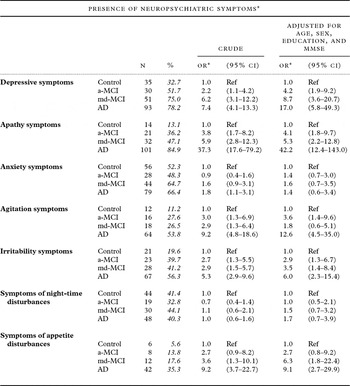
Logistic regression analyses were conducted to compare the odds of MCI and AD patients having neuropsychiatric symptoms compared to controls. Owing to the low prevalence of symptoms of disinhibition, aberrant motor behaviors, delusions, hallucinations and euphoria, we were unable to accurately estimate the OR for these five symptoms, and thus we focused the analysis on the symptoms with the highest occurrence. Table 4 shows the odds ratios for the seven most common neuropsychiatric symptoms.
Presence of neuropsychiatric symptoms: odd ratios of having symptoms in people with MCI or AD compared to control subjects

a-MCI = amnestic-MCI; md-MCI = multidomain-MCI.
Odds ratios calculated with logistic regression models. Separate models calculated for a-MCI vs controls, md-MCI vs controls, and AD vs controls.
*Presence of neuropsychiatric symptoms considered as NPI score = 0 vs score > 1.
There were no differences in anxiety symptoms or symptoms of night-time disturbances in any of the cognitive syndromes. All patients with cognitive syndromes had increased odds of having apathy symptoms than control subjects. However, this risk was most prominent in AD patients, which was 40 times higher than controls. There was an increased risk for patients with either MCI or AD to have depressive symptoms compared to controls. The odds of exhibiting apathy or depressive symptoms increased progressively with increasing severity of the cognitive syndrome (e.g. lower in amnestic-MCI, highest in AD).
AD patients had six-times more irritability symptoms than control subjects. Patients with either type of MCI had three times odds of having irritability symptoms than controls. Although multidomain-MCI were three times more likely to have agitation symptoms than control subjects in the crude analyses, this association was no longer significant after multiple adjustment. The odds of having agitation symptoms compared to controls was significantly higher in AD and amnestic-MCI, both in the crude and adjusted analysis.
Compared to controls, amnestic-MCI did not have more symptoms of appetite disturbances. However, there was a nine-fold risk of symptoms of appetite disturbances in AD patients, and a six-fold risk for multidomain-MCI.
With the exception of agitation symptoms in amnestic-MCI patients, and anxiety symptoms in AD patients, the results of all logistic regression analyses were generally similar in both the crude and adjusted analyses. Furthermore, adjustments for MMSE in addition to demographic factors (age, sex, education) did not differ when adjustment was made for demographics alone.
Analysis of controls without psychiatric disturbances
Eighteen people in the control population had a diagnosis of a psychiatric disorder: one with major depressive disorder, five with minor depressive disorder, seven with generalized anxiety disorder, and six with comorbid anxiety and minor depressive disorder. We conducted a supplemental analysis removing these 18 patients. All logistic regression models reported in Table 4 were rerun using a control population of 88 patients free from a diagnosis of anxiety or depression. The results changed only for anxiety symptoms (measured with NPI). In these 88 controls, 55.7% (n = 49) had no NPI anxiety symptoms compared to 47.7% (n = 51) in the original control group, 29.5% (n = 26) had mild symptoms compared to 32.7% (n = 35) in the original controls, and 14.8% (n = 13) had clinically significant symptoms compared to 19.6% (n = 21). Compared to controls, multidomain-MCI had a two-fold increase in anxiety symptoms (OR = 2.2 (1.0–5.1) after multiple adjustment. For amnestic-MCI and AD compared to controls, the result changed only slightly (amnestic-MCI OR = 1.7 (0.8–3.6); AD OR = 2.0 (0.8–5.0). There were no relevant differences in the OR of any other neuropsychiatric symptoms.
Discussion
Our study on a clinical sample of patients with MCI, AD and control subjects identified a high occurrence of neuropsychiatric symptoms in people with cognitive disorders. We also found a large proportion of patients with AD and multidomain-MCI with a diagnosis of Depression disorder, whereas Apathy disorder was less common in patients with MCI of amnestic or multidomain-type. Further, we found an increasing occurrence of many neuropsychiatric symptoms with increasing severity of cognitive syndromes.
Our study identified a high frequency of both depression and apathy (both symptoms and disorders) in AD patients, similar to previous findings (Starkstein et al., Reference Starkstein, Jorge, Mizrahi and Robinson2006). Our findings that these disturbances are more common in AD than MCI are in line with previous studies (Apostolova and Cummings, Reference Apostolova and Cummings2008; Monastero et al., Reference Monastero, Mangialasche, Camarda, Ercolani and Camarda2009). There was a progressive prevalence of apathy symptoms with increasing severity of cognitive syndromes from amnestic-MCI to multidomain-MCI, to AD. This may reflect reports that symptoms (Robert et al., Reference Robert2008; Palmer et al., Reference Palmer2010) and clinical diagnosis (Vicini Chilovi et al., Reference Vicini Chilovi, Conti, Zanetti, Mazzù, Rozzini and Padovani2009; Palmer et al., Reference Palmer2010) of apathy in MCI patients predict progression to AD. Concerning depression, it is possible that symptoms and disorders are associated with pathological changes in those regions of the brain associated with its pathogenesis. Indeed, there is evidence of increased neuropathological changes within the hippocampus in AD patients suffering from a diagnosis of major depression (Rapp et al., Reference Rapp2006). Further, studies have reported significant left hippocampus morphological changes in depressed patients compared to controls (Zhao et al., Reference Zhao, Taylor, Styner, Steffens, Krishnan and MacFall2008). An alternative interpretation is that depression is a subjective reaction to cognitive impairment in affected individuals. People with memory problems have a high risk of psychological distress and depressive symptoms as a result of the situation (Simard et al., Reference Simard, Hudon and Van Reekum2009). In our study, a depression disorder was more common than apathy disorder in patients at the MCI stage, yet the prevalence of both psychiatric disorders was equal in the AD patients. Furthermore, the prevalence of depression disorder increased from amnestic-MCI to multidomain-MCI, but did not increase further in patients with clinically overt dementia. This suggests that depression, but not apathy, may be partly due to subjective reactions to cognitive deficits or other events, which are more common in the preclinical phases of dementia when the patient is more aware of the changes (Orfei et al., Reference Orfei2010). Conversely, apathy is more likely to be a cognitively related deficit as it increased strongly with increasing severity of the cognitive syndrome, from amnestic-MCI, to multidomain-MCI, to AD. This is supported by previous research reporting that apathy in MCI increases with increasing severity of memory deficits (Robert et al., Reference Robert2008) or global cognitive impairment (Spalletta et al., Reference Spalletta2004). Evidence suggests a link between apathy, executive functioning and frontal dysfunctions (Thomas et al., Reference Thomas, Hazif-Thomas, Saccardy and Vandermarq2004) as well as cortical gray matter atrophy in the frontal regions (Apostolova et al., Reference Apostolova2007), and there is increased neurofibriliary tangle burden in apathetic AD patients (Marshall et al., Reference Marshall, Fairbanks, Tekin, Vinters and Cummings2006).
In addition to symptoms of apathy and depression, the most prevalent neuropsychiatric symptoms in patients with AD and MCI were anxiety, agitation, irritability, night-time disturbances, and appetite disturbances. Our study indicates that symptoms of night-time disturbances were not associated with cognitive impairment, and occur at a similar frequency to cognitively normal controls, contrary to previous reports (Geda et al., Reference Geda2008). Indeed, night-time disturbances are common in older persons, even those without cognitive deficits (Morin et al., Reference Morin, LeBlanc, Daley, Gregoire and Mérette2006), and are associated with numerous somatic conditions. Although our control group included some people with a diagnosis of anxiety, which may be associated with night-time disturbances, we still found no increased risk of night-time disturbances in MCI or AD patients after excluding these people from the control group.
In our study, the frequency of agitation and irritability symptoms was the same in amnestic-MCI and multidomain-MCI, but increased in AD, occurring in more than half the patients. Our results support other studies showing a higher prevalence of these symptoms in MCI and AD (Apostolova and Cummings, Reference Apostolova and Cummings2008; Geda et al., Reference Geda2008). Symptoms of agitation and irritability in MCI may be a subjective reaction to loss of cognitive capacities. Awareness and insight into memory difficulties and their impact are associated with increased anxiety in AD patients (Aalten et al., Reference Aalten, van Valen, de Vugt, Lousberg, Jolles and Verhey2006).
Anxiety symptoms were extremely common in the whole sample, even controls. Thus, we re-ran analyses after removing people with an anxiety disorder from the controls, and found that multidomain-MCI patients had a two-fold risk of having anxiety symptoms compared to normal controls. Although anxiety symptoms may be a subjective reaction to increasing difficulties in cognition (Aalten et al., Reference Aalten, van Valen, de Vugt, Lousberg, Jolles and Verhey2006), evidence suggests that anxiety symptoms in MCI may be part of an ongoing neurodegenerative process, as these patients have a higher risk of progressing to AD (Palmer et al., Reference Palmer, Berger, Monastero, Winblad, Bäckman and Fratiglioni2007).
In line with findings from another study (Spalletta et al., Reference Spalletta2004), hallucinations, delusion and euphoria were the least common symptoms in our AD patients. This is consistent with studies concluding that psychotic symptoms in MCI and AD are rare compared to non-psychotic symptoms, and are more common in the early stage of AD than in MCI (Geda et al., Reference Geda2008). Almost 8% of our AD patients had a diagnosis of a psychotic disorder, but the occurrence was very low in both MCI subtypes. The low prevalence of hallucinations and delusions in our study may be due to the severity of dementia in our patients. We included only patients with mild AD, and psychosis is normally associated with neurodegeneration in the later stages (Jeste et al., Reference Jeste, Wragg, Salmon, Harris and Thal1992). Psychotic symptoms in AD might identify a distinct subtype of AD characterized by a more rapid rate of cognitive decline than AD subjects without psychotic symptoms; indeed, severity of cognitive dysfunction is a strong predictor of psychotic symptoms in AD (Weamer et al., Reference Weamer2009). Furthermore, we utilized a specific diagnostic instrument for a diagnosis of psychosis in AD (Jeste and Finkel, Reference Jeste and Finkel2000), which is likely to have greater specificity for identifying psychosis.
Psychotic symptoms in AD may be associated with pathological changes in the brain regions affected by the disease. Evidence suggests that excess impairment of neocortical and synaptic integrity may underlie psychosis in AD (Sweet et al., Reference Sweet2002). This evidence, in conjunction with our report of extremely low prevalence of psychosis symptoms and disorders in MCI, suggests that psychosis is associated with the later stages of neurodegeneration, and is not characteristic of the early, predementia syndromes.
Our results highlight the importance of assessing depression and apathy disorders with specific diagnostic criteria to increase the distinction between the two disorders, which are often confused, yet evidence suggests distinct neurobiological roles in the disease and support for considering them as two distinct syndromes (Tagariello et al., Reference Tagariello, Girardi and Amore2009). Our findings also emphasize the need for clinicians to consider psychiatric disorders – usually an expression of high severity phenomena – as well as milder neuropsychiatric symptoms, which may be the premorbid phase of a psychiatric disorder. Further, as patients with AD often have heterogeneous signs and symptoms in the years preceding dementia diagnosis (Palmer et al., Reference Palmer, Bäckman, Winblad and Fratiglioni2008), evaluation of different markers at different ranges of severity, such as psychiatric disorders and milder neuropsychiatric symptoms, might help to increase the number of AD patients who can be identified in a preclinical stage. Patients and caregivers may benefit from better information on prognosis of cognitive and non-cognitive symptoms in these disorders, which may help in long-term planning of care and resources. Research on the role of different levels, including severity and quantity, of neuropsychiatric phenomena in MCI and AD can also identify structures related to ongoing degeneration which may help in further understanding disease processes.
Some limitations of the study deserve mention. First, it is cross-sectional, and thus does not provide any insight into the direction of the associations or potential causal effects. Second, we included some controls with psychiatric disorders such as anxiety and depression. However, we conducted all analyses again, excluding these people, and all findings remained the same, except for a slight change in difference in anxiety symptoms between controls and multidomain-MCI patients. Indeed, we did not want to include a group of unrealistically very “healthy” controls, free from all psychiatric disturbances, as this might lead to false positive results. Our control population was therefore more representative of the normal general population. Furthermore, we still found significant differences in neuropsychiatric symptoms between controls, MCI and AD patients, despite including controls with psychiatric disorders, which strengthens our findings. Finally, as our data come from a clinical sample, the results may not be generalizable to the general population. There are several strengths to our study. First, we evaluated a large number of patients and a healthy control group using the same instruments and same specialized personnel. Second, we directly assessed diagnoses of depression, apathy, and psychosis disorders in MCI and AD. Third, we evaluated neuropsychiatric symptoms (with the NPI) as well as diagnoses of psychiatric disorders (with specific diagnostic criteria), ensuring a comprehensive picture of full diagnoses as well as milder symptoms. Fourth, we made multiple adjustments for potential confounders, including sociodemographic factors and global cognitive performance. Further, as the study was cross-sectional, we were able to examine the occurrence of neuropsychiatric symptoms at the point of first diagnosis of MCI or AD, without the confounding effect of drug interventions such as psychotropic medication or acetyl-cholinesterase inhibitors. Finally, we evaluated controls, AD patients, and patients with both amnestic-MCI and multidomain-MCI, to provide a comprehensive comparison of neuropsychiatric symptoms in a wide spectrum of cognitive syndromes.
In conclusion, apathy and depression are the most frequent neuropsychiatric phenomena in MCI and AD at the symptomatic and diagnostic disorder level, which appear to have distinct characteristics and roles. Clinicians should consider their relevance in patients with cognitive disturbances, and incorporate a thorough neurological and psychiatric examination in their evaluation of patients with MCI and AD.
Conflict of interest
None.
Description of authors’ roles
F. Di Iulio was responsible for formulating the research question and designing the study, as well as carrying out data collection, interpreting the data analyses and writing the article. K. Palmer was responsible for formulating the research question and designing the study, analyzing the data, and writing the article. C. Blundo contributed to formulating the research question, designing the study, and critical revision of the paper. A. Casini worked on formulating the research question, designing the study, and critical revision of the paper. W. Gianni contributed to formulating the research question, designing the study, and critical revision of the paper. C. Caltagirone contributed to formulating the research question and designing the study, as well as carrying out data collection, interpreting the data analyses and critical revision of the paper. G. Spalletta contributed to formulating the research question and designing the study, as well as carrying out data collection, interpreting the data analyses and writing the paper.
Acknowledgments
This work was supported by grants from the Italian Ministry of Health (RC 03-05-06-07-08-09/A and RF 05-06-07-08.). Katie Palmer received funding from the European Research Council under the European Community's Seventh Framework Program, (FP7-PEOPLE-2007-2-1-IEF)/ERC Grant agreement no. 200913. We would like to thank all patients and their families for participating in the study.