Introduction
In the spring of 2010 in his acerbic song ‘If I Were to Go’ (Naega Kandamyôn), the South Korean rapper J'Kyun mockingly criticised the major Korean entertainment agencies including YG Entertainment (YG), SM Entertainment (SM) and JYP Entertainment (JYP). The lyrics were mainly in Korean with a few lines in English, indicated in italics as follows:
This type of attack on the mainstream music industry and Korean pop (K-pop) by Korean rappers is part of the established genre rules of Korean hip-hop, particularly for the underground, as an act of self-authentication, although often perceived as a self-promotional tactic. At the same time it highlights complex, changing relations between Korean hip-hop, the culture industry and the music community both domestically and transnationally. In contrast, the male hip-hop group Epik High, together with the five-piece transnational female act f(x) performed at the 2010 MIDEM in France to showcase ‘K-pop Night’ at the world's largest international music industry trade fair. This event involved both private/commercial (SM) and public/state sectors (the Korea Creative Content Agency and Korean Ministry of Culture, Sports and Tourism) to market Korean popular music internationally.
Hip-hop and rap are global but emerged as a quintessentially African American cultural form and diasporic expression, especially in the contexts of subcultural, underground resistance against the dominant hegemony (Gilroy Reference Gilroy1993; Lipsitz Reference Lipsitz1994; Rose Reference Rose1994; Potter Reference Potter1995). Decker (Reference Decker, Ross and Rose1994) suggests that nationalism and Afrocentricism are two distinctive and related sensibilities identified in African American hip-hop. At the same time, hip-hop is a postmodern music for which the creative process is to ‘cut and mix’ different musical styles and cultural references, allowing for a continuous process of hybridisation and syncretism. In this context, hip-hop and rap have become a ‘vehicle for global youth affiliation and a tool for reworking local identity all over the world’; and, as a universally recognised popular genre, also draw our attention to local specificities (Mitchell Reference Mitchell and Mitchell2001, pp. 1–2).
Hip-hop's global appeal and commercial success propelled it to become part of the ‘international repertoire’. Along with R&B and pop, hip-hop and rap are produced and marketed by major transnational recording industries, reflecting the demands and consequences of global capitalism (Mitchell Reference Mitchell and Mitchell2001, p. 2). The production and consumption of the ‘international repertoire’ on a global scale contrasts with other more localised popular musics such as ‘regional repertoires’ or ‘domestic repertoires’ (Negus Reference Negus1999, pp. 156–7). While ‘regional repertoires’ are released in a broad area/region, for example, Mandarin pop in East Asia, ‘domestic repertoires’ are released solely in one national territory such as the Korean trot (also called ppongtchak).
The recent flow and exchange of popular cultures across Asia made these boundaries between ‘regional’ and ‘domestic’ rather permeable and fluid, contributing to their translocal and inter-regional characteristics in production and consumption (see Liew Reference Liew2006 for transnational Mandarin hip-hop; Siriyuvasak and Shin Reference Siriyuvasak and Shin2007 for Korean popular music in the Southeast Asian market). The emerging concept of ‘inter-Asia popular music’ (Shin Reference Shin2009a) also signifies these increasing trends of cultural and musical flows within and across regions – the phenomenon of the Korean Wave being the representative example (Chua and Iwabuchi Reference Chua and Iwabuchi2008). At the same time, however, the notions of local identity, nation and nationalism have not disappeared altogether; instead they appear to have been reconfigured and intensified by a variety of policies of domestic institutions and cultural politics (Chow Reference Chow2009; Dairianathan Reference Dairianathan2009; Ho Reference Ho2009; Jian and Liu Reference Jian and Liu2009; Mori Reference Mori2009). What lies between global and local, according to Biddle and Knights (Reference Biddle and Knights2007, p. 2), are nation-states and social units acting like nations which operate as a ‘mediator’ between global and local.
In this context, Korean hip-hop and rap can be best understood as a mobile, not fixed, nexus between global and local in terms of production and between regional and domestic with respect to consumption. Obviously its national dimension in music and its associated political mediation will also play important roles in this framework. Bennett (Reference Bennett2001) suggests that Lull's concept of ‘cultural reterritorialisation’ offers us a useful model for understanding the cultural mobility of rap. Reterritorialisation, according to Lull (Reference Lull1995, p. 159), embraces two coactive phenomena. Firstly, the foundations of cultural territory (i.e. ways of life, artefacts, symbols and contexts) are ‘all open to new interpretations and understandings’. Secondly, reterritorialisation also implies that culture ‘is constantly reconstituted through social interaction, sometimes by creative uses of personal communication, technology and the mass media’. The process of cultural reterritorialisation, Bennett (Reference Bennett2001, p. 95) further elaborates, ‘recasts cultural forms as malleable resources that can be inscribed with new meanings relating to the particular local contexts within which such products are appropriated’. This process of appropriation of African American hip-hop and rap into a Korean popular musical form has come about through multiple selective strategies of adoption and adaptation with respect to the associated cultural, musical and linguistic components of the genre. This paper will attempt to explore some aspects of these complex processes and interactions.
Korean hip-hop and rap: the local specificities
The ‘local specificities’ of hip-hop culture in Korea emerged two decades ago in the early 1990s when this new music began to gain popularity among Korean youth as an identity marker of the culture of a new generation (sinsedae munhwa). Due to the rapid growth over the past three decades South Korea became the tenth largest economy by the early 1990s.Footnote 3 Politically, Korea was also experiencing some major changes: three decades of authoritarian military rule finally ended as the civilian government headed by Kim Yông-sam was inaugurated in 1993. The relaxation of state censorship on popular music, which began in the late 1980s, allowed songwriters and singers to explore their artistic freedom and creativity (Mun Reference Mun2004). All of these economic, political and social changes provided the contexts in which hip-hop in Korea could take its roots as part of local youth culture from the 1990s onward. For example, Korean youth culture of the 1970s and 1980s was largely associated with university students in their early twenties. The 1970s youth culture, according to Kim Ch'ang-nam (C. Kim Reference Kim2010, p. 224), was ‘liberal and idealistic’ in its outlook while the young people in the 1980s were leaning toward ‘mass-oriented and political radicalism’. In contrast, the youth of the 1990s, known as the sinsedae generation, are largely made up of teenagers. Born in the era of economic stability, these teenagers embraced consumerism and Western popular culture including Anglo-American pop, while rebelling against established social and cultural rules. The emerging importance of hip-hop among Korean teenagers is exemplified by the term ‘Seo Taeji syndrome’ named after the iconic rocker-cum-hip-hop artist Seo Taeji [Sô T'ae-ji] (C. Kim Reference Kim2010).
Seo Taeji, a former member of the heavy metal band Sinawi, who adapted rap to Korean pop in his 1992 song ‘I Know’ (Nan Arayo) has been credited as the first Korean rapper. However, more recently it has been suggested that Hong Sô-bôm's song ‘Wondering Bard Kim with a straw hat’ (Kim Satkat), performed in 1989, was the first prototypical Korean rap.Footnote 4 A year later in 1990 Hyôn Chin-yông performed ‘Sad Mannequin’ which brought singing, dancing and rapping together for the first time.Footnote 5 This song, which showed the influences of the New Jack Swing of the late 1980s, is now more widely accepted as a milestone in Korean hip-hop (Y. Kim et al. Reference Kim2008, pp. 32–6).
Seo Taeji's ‘I Know’ (Nan Arayo) is a love song, and consists of rap verses and sung chorus with instrumental solo interludes played on an electric guitar. Seo Taeji and Boys danced while rapping and singing. This format and style that combined Korean pop ballad, dance and rap became a template for Korean hip-hop and continued to be employed by the ensuing pop idols and mainstream hip-hop artists in Korea, for example, H.O.T.'s ‘We Are the Future’ (1997) and DJ DOC's ‘Run To You’ (2000). A new term, ‘rap dance’, was also created to refer to this hybrid form of early ‘Korean hip-hop’ which was more dance and singing centred. From his second album (1993) and onwards, Seo Taeji's rap began to pay attention to various social issues: for example, his 1994 song ‘Classroom Ideology’ (Kyosil Idea) critiqued the education system in Korea. The fact that Seo Taeji left high school without a diploma made this song ‘real’ and its message powerful, and it therefore appealed to young Korean audiences as the authentic, defiant expression of youth culture.
This issue of the severe and demanding education system has also been taken up as a topic in other East Asian hip-hop. For example, the Japanese rapper King Giddra's song ‘Bullet of Truth’ (Shinjitsu no Dangan) (1995) questions the education system that ‘crushes the dreams of children’.Footnote 7
From the mid-1990s onwards, the mainstream Korean music industry began to create pop-oriented rappers and dance groups. The five-piece boy band H.O.T. (an acronym for High-five of Teenagers), created in 1996 by SM Entertainment,Footnote 8 was one of the first types of teen idol K-pop, who were selected and trained to sing and dance in a variety of popular styles, including ballad, rock, teen pop and hip-hop. Although H.O.T. was disbanded in 2001, their success and popularity presented a great potential and scope for K-pop idol development. For example, YG Entertainment successfully launched the hip-hop duo Jinusean's first album into the mainstream chart in 1997:Footnote 9 their song ‘Please Tell Me’ (Maraejuô) featured the dance music diva Uhm Jung Hwa [Ôm Chông-hwa] who sang the ballad while breakdancers complemented the performance.
Targeting the young audience, JYP Entertainment released the rap dance album The Power of the Twins (Ssangdungi Power), performed by the then 12-year-old twins Ryang-hyôn and Ryang-ha in 2000. Written and produced by JYP's CEO Park Jin Young [Pak Chin-yông], who is a singer, dancer and composer himself, this album is about being a child in contemporary South Korea and how children have to cope with the pressure of ‘doing well’ with their studies and other curricular activities. The Korean children's song ‘Stop Right There’ (Kûdaero Mômch'uôra) was sampled in the title song ‘What Is Dance Anyway?’ (Ch'umi Muôgillae), to create an intertexuality between the nursery rhyme, childhood, hip-hop and Korean youth culture. The twins' rap and acrobatic dance routines, as well as their cascading hair dyed platinum blonde, were popular among the audiences of the targeted age groups (teens and preteens) as well as adult audiences.Footnote 10 From the young audience's point of view, this music was ‘telling it like it is’ for them, and therefore it produced what Moore called ‘second person authenticity’ or authenticity of experience (Moore Reference Moore2002, p. 218). In addition, although created by the industry, the perfect age match of the performers provided the twins' album an additional aura of being real, namely ‘first person authenticity’ or authenticity of expression which, according to Moore, arises ‘when the originator (composer, performer) succeeds in conveying the impression that his/her utterance is one of integrity, that it represents an attempt to communicate in an unmediated form with an audience’ (Moore Reference Moore2002, p. 214).
Clearly, by the end of the 1990s, Korean popular music seemed to have moved from ‘being dominantly aural to visual’ as the Korean music critic Hwang Mun-p'yông predicted a few years earlier (Morelli Reference Morelli and Mitchell2001, p. 253). So dance music topped the charts (e.g. the dancing duo CLON), although the importance of ballads (i.e. songs about love) in Korean popular music never waned, as Howard (Reference Howard, Craig and King2002) noted. In fact, the ballads were integrated into new genres, such as mainstream Korean hip-hop performed by pop idols created by the moguls of the Korean entertainment industry.
Local characteristics and national characters: questions of identities
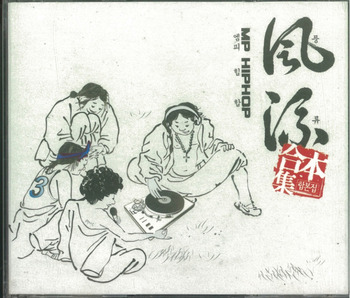
While borrowing from the international/American hip-hop idiom, such as sampling techniques, clothing and dance style, Korean hip-hop has also developed some distinct local characteristics by introducing elements of Korean music (both popular and traditional) and by mixing Korean and English lyrics in ways that are meaningful to its domestic audience (see J'Kyun's ‘If I Were To Go’, above). The local/national character in Korean hip-hop was first introduced by Seo Taeji in his ‘Hayôga’ (1993), by adding a short solo playing of the traditional Korean conical oboe (t'aep'yôngso). MC Sniper, an underground rapper and the founder of the hip-hop crew Buddha Baby, is known for his early use of traditional musical and religious elements including the 12-stringed zither (kayagûm) and the transverse bamboo flute (taegûm) and the Buddhist wooden percussion (mokt'ak) in his productions. His album covers and sleeve notes also featured traditional images and symbols such as the folk paintings and patterns used on his 2003 album The First Journey (Ch'ohaeng). The cover of the compilation album produced by the Seoul-based hip-hop label Master Plan Production develops this artistic device further by adapting a late 19th-century Korean folk painting by Kim Hong-do which depicts a group of young men playing chess sitting on the ground. While maintaining the original composition and style, the image on the CD cover depicts a crew DJ-ing and MC-ing in their hip-hop clothing and headphones (see Figure 1). OneSun, one of the Master Plan Production's artists, is known for his ‘cross-over’ experiments between hip-hop and Korean traditional music. In his debut single album (2001), Hwang Byungki's 1977 suite for traditional Korean instruments Child Minder (Aibogae) was sampled in ‘Prologue’ (Sôsa) while Yi Cha-ram, a young singer of the traditional musical drama p'ansori, featured in his ‘Fisherman's Ode’ (Ôbusa). OneSun's sampling also includes other types of ‘world music’, for example, qawwali (Sufi devotional music of South Asia) in his album For Whom (2003), to develop pan-Asian characteristics in his work.Footnote 11
Cover of the Master Plan Production compilation album P'yungnyu (2002). Image of the artwork used with the kind permission of Master Plan Production Co. Ltd.

Hip-hop fashion is also adapted and mixed for local tastes to create what is termed a ‘clean version’ for middle-class clients. Instead of oversized baggy trousers and T-shirts, semi-fitting garments have been chosen by many hip-hop fans and musicians alike, so that they will blend in more easily while still making their own fashion statement regarding hip-hop aesthetics. In addition, the brand images and price scales of well-known US labels (e.g. FUBU and MF) have been adapted and recreated by the local Korean importers to take local business practices into consideration. For the advertisement or endorsement of these imports, Korean underground rappers were approached to make them appeal to the fan base they have established through hip-hop societies and clubs (Y. Kim et al. Reference Kim2008, pp. 244–73).
Local and transnational Korean hip-hop: ‘what to say’ and ‘how to say it’
From the late 1990s onwards, rappers with transnational connections, such as Korean Americans (chaemi kyop'o), joined the Korean hip-hop scene, especially in the Apkujông-dong area in the south of Seoul. For example, Drunken Tiger is a hip-hop duo comprised of an American Korean, DJ Shine, from New York City and a Korean-born Los Angeles resident, Tiger JK. They released their first album The Year of the Tiger in Korea in 1999 under Doremi Records, one of the largest labels in Korea at that time. More than half the songs on this album employed English only and the rest are in Korean mixed with English. The Year of the Tiger album is transnational and diasporic with respect to the language choice and poetic contents. English rap songs (e.g. ‘Kid from Korea’ and ‘Party People’) portray Korean Americans' migrant/diasporic experiences and some aspects of the racial tensions between Korean and African American communities.Footnote 12 The Korean language rap songs on this album critique social prejudice and challenge the authenticity of the home-grown hip-hop, for example, ‘Do You Understand What Is Real Hip-hop?’ (Nôhiga Hip-hop ûl Anûnya?). Their second album, The Great Rebirth (2000), includes more Korean rap songs. Notably, an image of the national flag of South Korea is incorporated into the interior design of the CD, perhaps signifying their ‘repatriation to the home country’ and the beginning of their own process of ‘cultural reterritorialisation’. In 2000 Drunken Tiger also formed a hip-hop crew called The Movement in an effort to bring ‘real hip-hop’ into the mainstream music of Korea.Footnote 13
These transnational/overseas Korean artists were characterised by the emphasis on their rap (often in English) and sampling (of non-Korean pop sources), in contrast to the ballad singing and dance-oriented domestic Korean hip-hop of the late 1990s. The reception of the local audiences was rather mixed. Clearly the choice and use of the English language and the stylistic differences set transnational hip-hop apart from its K-pop infused local counterpart.Footnote 14
The authenticity and aesthetics of hip-hop in this particular local context probably require several different interpretations. The transnational Korean hip-hop with the emphasis on rapping and sampling was perceived to be authentic because it adhered to or emulated the American hip-hop genre rules and styles (illustrated by Drunken Tiger's derogatory comments in ‘Do You Understand What Is Real Hip-hop?’). The home-grown hip-hop, on the other hand, is perceived to be more ‘real’ for many local audiences because they appreciate the poetic-musical associations between the lyrics and music (K-pop oriented ballad and samples) that are specifically meaningful and comprehensible to them. Stylistically speaking, the visual aspects associated with dance routines and clothing are equally, if not more, important, especially in the case of mainstream ‘rap dance’ groups. The complex rhymes and flows, on the other hand, are the essential technical and aesthetic criteria for the ‘serious’ underground hip-hop artists.Footnote 15 The intricate rhythmic articulation of the Korean language is highly regarded. For example, Kim Jin Pyo [Kim Chin-p'yo] is respected by many Korean rappers for his skilful use of the Korean language.Footnote 16 Outsider, one of the underground rappers, is famous for his extremely fast but clear diction and Verbal Jint is recognised for his intricate ‘literary’ rapping style. The underground hip-hop duo Garion (MC Meta and Nach'al) are regarded as the most authentic Korean hip-hop artists because they only use Korean in their rapping.Footnote 17
The artistic and technical merits of underground hip-hop and their associated authenticity are duly recognised by the mainstream music industry as the key market strategies for this musical genre. Therefore, the underground label ‘YG Underground’ was launched in 2005 by YG Entertainment to create ‘alternative’ music within the mainstream framework. The five-piece boy band Big Bang was created in 2006 through a reality talent show by YG Entertainment. Since their debut, the individual talent and creativity of the band members – for example, G-Dragon as a confident producer and rapper – has been continuously promoted. In fact, the boundary between the underground and ‘overground’ or the mainstream and indie is not always clear.Footnote 18 It is sometimes down to the self-identification of the artists rather than the stylistic features or the characteristics of their music consumption. Given the limited music market size within Korea and the dominance of entertainment agencies, many rappers have collaborated with singers from other musical genres. Teaching hip-hop in popular music academies has become one of their main sources of income.
The interplay between Korean and English has also become a technical and aesthetic device in Korean hip-hop, this being a kind of dialectics of linguistic dualism. For example, Lee Hyun Do [Yi Hyôn-do], a former member of DEUX, interweaves the two languages in a circular mode in ‘Toni Money?’ from his third solo album Wanjôn Hiphop [Complete Hip-hop], released in 2000. The song title has two words: the first Korean word ‘ton’ refers to ‘money’ and the second English word ‘money’ also means ‘what is [it]?’ in Korean. Manabe's analysis of complex and intricate use of language(s) in Japanese hip-hop (Reference Manabe2006) and Condry's study of rhyming (2006) suggest that the global and local interface in hip-hop results in highly individual and creative poetic strategies developed by each rapper. These language aesthetics relate to what Krims (Reference Krims2000, pp. 1–2) stresses as the poetics of rap that ultimately help us to understand how culture works and identities are formulated. Lee (Reference Lee2004) suggests that the linguistic hybridisation and code switch in Korean popular music are the result of appropriations between global and local dialogues and should be understood as a ‘socio-linguistic breathing space’ and the self-expression of multiple identities. The language choice and code switch in Hong Kong hip-hop shown in Lin's study (Reference Lin, Kim and Lee2007) similarly illustrate how the politics of everyday language and identity are closely linked to one another (Berger Reference Berger, Berger and Carroll2003).
In connection with the language issues, it is worth noting that the underground hip-hop artists claim subcultural capital by assuming their social alterity or marginality. Strong language is often used to underline their intended or imagined political stance. For example, Cho PD was known for his strong language and his songs were censored or banned accordingly. The act of ritualised verbal attack on other rappers, known as ‘diss’, which became well known from US East Coast and West Coast hip-hop rivalry, has also been observed by rappers in Korea as part of the genre rule. However, there are unwritten rules that fierce challenge or criticism of senior rappers would be frowned upon as improper and impolite. One hip-hop blogger also claimed that Korean hip-hop does not take place on the street, suggesting that the battlefield of these rappers often became the music industry and online blogs. This argument highlights the importance of the online community and fan base on the Internet, as will be shown below.
Since its inception in the early 1990s, South Korean hip-hop has always been associated with the middle-class, educated, moderate and religious (e.g. Christian) elements of society. The rappers' religious orientation is often made public by including their ‘Thanks to God’ in performance or on their CD sleeves. In many ways, as with Korean punk (Wise Reference Wise2008, p. 97), Korean hip-hop embraces aesthetic and ethical themes rather than political controversy.Footnote 19 Historically, the 1970s and 1980s campus song movement fulfilled social and political functions in Korea, for example, when protesting against the authoritarian military regimes (Hwang Reference Hwang and Howard2006). In contrast, many of the 21st-century Korean hip-hop lyrics are about everyday life or personal stories (underground/non-mainstream) or love (mainstream). For example, Drunken Tiger's acclaimed piece ‘8:45 Heaven’ (2007) is based on his grief over the loss of a family member, and ‘Keep the Change’ (2009) by the Dynamic Duo (Choiza and Gaeko) is about a conversation with a taxi driver.
Local and virtual scenes
Following the introduction of the Internet, the popular music scene in South Korea and its associated culture industry have come to rely heavily on this new communication technology. Underground hip-hop in Korea is also closely linked to the web-based fan clubs and blogs which are run by the amateur rappers, DJs and beatboxers, using Korean web servers such as Chôllian,Footnote 20 HiTel,Footnote 21 Daum,Footnote 22 Nate and Naver, all of which provide free web-based emails, messaging services and forums.Footnote 23 Several webzines and portals also provide important online sites which have facilitated the creation of hip-hop scenes in Korea: Hiphop Playa (since 2000, approximately 280,000 members in September 2011) and Rhythmer (since 2001, approximately 150,000 members in 2008, current figures unknown). These portals offer a wealth of hip-hop related information including up-to-date news about concerts and parties nationwide, profiles of international and Korean hip-hop artists, CD reviews written by the webzine staff members and ordinary members, interviews with Korean artists, rap lyrics (with translations), photos, audio and video files, and links to the websites of domestic and international hip-hop record labels. They also sell a variety of merchandise such as CDs (some of which are signed by the artists), DVDs, printed magazines, posters, hip-hop gear and a streaming service of MP3 files in a wide range of genres. Several hip-hop radio programmes are also available online for a small streaming charge. One of the editorials on the webzine Rhymer suggested that it was technology that gave shape to Korean hip-hop culture and its concept of place, not street or ghetto culture as was the case in the USA. Undoubtedly Seoul has been the centre of hip-hop activities since the 1990s but in more recent years other major cities, such as Pusan and Taegu, began to develop their own local hip-hop ‘scene’ with home-grown artists. The Pusan-born rapper J-Tong in particular is promoting a ‘regional’ Korean hip-hop that represents and reflects the unique character of place including the local dialect and accent. Various regional styles of Korean hip-hop may emerge in the future.
By way of applying Benedict Anderson's notion of ‘imagined community’, Steven Jones suggested that the Internet's communities are imagined in two ways:
First they thrived on the ‘meanwhile’ … We think, and sometimes feel, we belong to the Internet communities, but we are not sure quite how or in what ways, or whether belonging matters. Second, they are imagined as parallel, rather than serial, groupings of people, which is to say that they are not composed of people who are headed in the same direction, for a time. (Jones Reference Jones1997, p. 17)
What Jones implies here is that there are some fundamental differences between online communities and real communities and it therefore follows that the precise relation between online and offline identities may take different forms in different arenas and genres on the Internet. There also is a tendency for the disembodiment of identities on the Internet especially when people choose not to disclose their personal details such as age, gender and photos. The online identity should be understood as an extension of identities that continuously evolve and emerge or are ‘becoming’, to borrow Stuart Hall's term (Hall Reference Hall and Rutherford1990, p. 225).
The importance of the virtual hip-hop communities, especially for underground hip-hop, does not necessarily preclude the development of a ‘real’ physical hip-hop scene. Live performance events in clubs are to be found in the trendy Kangnam area and bohemian Hongdae districts of Seoul, both representing the distinctive, if not oppositional, ethos of contemporary Korean popular culture. The Hongdae area, in the northwestern part of Seoul, is associated with South Korea's own brand of indie and alternative culture, with a number of galleries, small theatres, art studios, publishing companies and clubs. So it is not surprising that most of the hip-hop webzines and portals, and several independent record labels including Master Plan and Sniper Production have their offices in the heart of the Hongdae area. Many of the underground hip-hop fans are under 19 and for this age-group hip-hop events are held during the weekends and school vacation periods; they start in the early evening with only soft drinks being allowed.
For these youths, their online community is created through hip-hop websites while the real community is formed through concerts, which in turn feed into the online community. A variety of activities, such as listening to hip-hop, composing one's own piece, performing at school or at karaoke bars, and writing about hip-hop online, are what Small (Reference Small1998) termed ‘musicking’. And these activities of musicking take place both online and in real space.
What appears to be significant is the way in which these youths define themselves in relation to the Korean underground hip-hop and against the mainstream K-pop genres as well as what they consider to be ‘overground’ hip-hop. This view on musical taste and preference gives them a sense of distinction and an alternative hierarchy which Thornton (Reference Thornton1995) termed ‘subcultural capital’. She also suggests that, within the economy of subcultural capital, media consumption is crucial to the definition and distribution of cultural knowledge. In the case of Korean hip-hop, the consumption of Internet technology certainly plays a crucial role. This point is most clearly illustrated by a recent posting on the Discussion Board of Hiphop Playa by a 14-year-old youth:
Hi, I would like to introduce myself. I am in my second year in Junior High School in Ch'ôngju, Ch'ungch'ông Province. My favourite hip-hop artist is MC Sniper and many other underground rappers. I don't listen to those over [ground hip-hop] and pop stuff. I have been following the Hiphop Playa discussion group for the last couple of years, but I did not dare to join in. Now I feel confident and knowledgeable enough to do so. I will do my best to learn more about hip-hop so that I can participate in your discussion. Thanks in advance for your kind advice. Footnote 24
In his interview with Hiphop Playa, DJ Soulscape suggested that the current hip-hop scene in Korea has moved from the live and dynamic ‘street’ to the virtual realm of the Internet. He believes the online hip-hop scenes lack an essential connection with the ‘real world’ where everything takes place.Footnote 25 One of the Hiphop Playa members thinks differently and argues that:
I am not trying to be cynical about your [DJ Soulscape's] idea that the Korean hip-hop scene should exist on the street, not on the Internet. But if that is the case, this genre, which is already quite small, would exist only in Seoul but nowhere else.Footnote 26
From this youth's point of view, the Internet hip-hop scene offers an inclusiveness to all who see themselves as members of the hip-hop community in Korea. The consumption of Internet technology creates a space for it. In this way, the online hip-hop community mutually supports and shapes the real community of Korean youth culture.
Cultural industries and the state
In addition to the term Korean Wave (Hallyu), which refers to the surge in popularity of Korean popular culture since the late 1990s, the relatively new concept of HanStyle was created by the Ministry of Culture and Tourism in 2006. Six elements of Korean traditional culture, including the Korean language, food, clothing, paper, house and music were chosen to be developed as a Korean cultural brand called HanStyle, which would then be commercialised, globalised and used every day. The state's cultural policy and associated financial support have always been crucial to the promotion and development of all performing arts in Korea. Since the 1990s cultural identity policy has also become a tool for globalising national culture and the arts, thus providing a rationale for fostering cultural industries (Yim Reference Yim2002, p. 47). The concept of HanStyle fits into these developments perfectly in conjunction with the Korean Wave. Since the 2001 establishment of the Korean Cultural Contents Agency (renamed the Korea Creative Contents Agency, KOCCA, in 2009) by the Ministry of Culture, Sports and Tourism, all aspects of Korean culture, including music, are increasingly managed from the ‘contents industry’ point of view. Some examples of the projects include the fusion of Korean hip-hop with other performing arts of Korea.
From the industry's point of view, the sale of Korean hip-hop artists is very small, especially in comparison with mainstream K-pop produced by the major music industries such as SM, YG and JYP.Footnote 27 However, rap, together with dance and ballad, is always included in all mainstream K-pop productions although the rapping may not feature as the main component. Together with b-boying, which has gained prominence through international dance competitions, the Korean music industry in collaboration with the state has been promoting hip-hop as part of K-pop globally. The creative output of the underground hip-hop artists is an invaluable source for the industry while for the fans and audiences this genre is an important component of their youth culture as a symbolic signifier of the individual and their social identity.
In April 2011 the major Korean entertainment agencies, KeyEast, AMENT, Star J Entertainment, SM Entertainment, YG Entertainment and JYP Entertainment announced that they would be joining forces to create a single agency named ‘United Asia Management’. This movement towards integrated overseas investment will further strengthen the control and influence of the Korean mainstream music industry, which aims to achieve the ambition of the Korean state marketing Korean popular music globally (see Shin Reference Shin2009b). Undoubtedly this development will impact on independent and alternative record labels and organisations in terms of their business practice and strategies. However, the subcultural capital of Korean hip-hop, especially ‘the underground’, and their aesthetic of resistance will remain central to defining the local specificities and the process of cultural reterritorialisation will continue.
In conclusion, this review of the development of Korean hip-hop shows that there are complex and divergent routes to localisation. In this context we need to understand the contour of ‘local specificities’ as necessarily including a number of factors such as pop/underground; domestic Korean and transnational influences; youth culture; language, aural and visual elements; racial perceptions; contexts and interactions of virtual communities; live performance space; national and regional characteristics; the music industry; national pride; government support, etc. We can also see that these processes of cultural reterritorialisation are charged with social and cultural politics that direct the evolution of Korean hip-hop to exemplify other dynamic aspects of its society, media and culture.