Introduction
Angiostrongylus cantonensis (Chen, 1935) is a nematode parasite causing eosinophilic meningitis in humans, which are its accidental hosts (Alicata, Reference Alicata1965). It has a complex life cycle and its intermediate and definitive hosts are snails and rats, respectively. Human infection occurs mainly through gastropod intermediate hosts (Kanpittaya et al., Reference Kanpittaya, Jitpimolmard, Tiamkao and Mairiang2000) by consumption of contaminated raw or undercooked snails, and has led to both sudden outbreaks as well as isolated cases of angiostrongyliasis (Schmutzhard et al., Reference Schmutzhard, Boongird and Vejjajiva1988; Chotmongkol & Sawanyawisuth, Reference Chotmongkol and Sawanyawisuth2002; Lima et al., Reference Lima, Mesquita, Santos, Aquino, Rosa L., Duarte, Teixeira, Costa and Ferreira2009). Angiostrongylus cantonensis is present around the world (Wang et al., Reference Wang, Lai, Zhu, Chen and Lun2008), and different geographical locations exhibit genetic differentiation among populations. For instance, the 66-kDa protein gene can only be found in four locations – Thailand, China, Japan and Hawaii (Eamsobhana et al., Reference Eamsobhana, Lim, Zhang, Gan and Yong2010b). Sequencing studies show that the mitochondrial gene cytochrome coxidase subunit I (coxI) is only present in three geographical areas – China, Hawaii and Thailand (Eamsobhana et al., Reference Eamsobhana, Lim, Solano, Zhang, Gan and Yong2010a). Furthermore, eight distinct coxI isolates were found in 18 different geographical localities from Japan, mainland China, Taiwan and Thailand (Tokiwa et al., Reference Tokiwa, Harunari, Tanikawa, Komatsu, Koizumi, Tung, Suzuki, Kadosaka, Takada, Kumagai, Akao and Ohta2012). These results indicate promise for distinguishing between different geographical isolates of A. cantonensis. In Thailand, A. cantonensis has been categorized into two populations by the random amplified polymorphic DNA-polymerase chain reaction (RAPD-PCR) method (Thaenkham et al., Reference Thaenkham, Pakdee, Nuamtanong, Maipanich, Pubampen, Sa-Nguankiat and Komalamisra2012). However, it has been difficult to infer genetic variations and haplotype relationships of nematodes based on this method. Several studies indicate that the cytochrome b (cytb) gene sequence can reveal populations within the species level (Salzburger et al., Reference Salzburger, Martens, Nazarenko, Sun, Dallinger and Sturmbauer2002; Pasi et al., Reference Pasi, Lakra, Bhatt, Goswami and Malakar2013). Using the cytb gene, Heligmosomoides polygyrus populations have been separated into five major clades depending on location – Italian, northern European (Denmark and Ireland), Iberian, western European and Balkan populations (Nieberding et al., Reference Nieberding, Libois, Douady, Morand and Michaux2005). The cytb gene appears to evolve more quickly than control region (CR; D-loop) genes, which in turn evolve more quickly than other genes in Hynobius tokyoensis, and are therefore useful for phylogenetic analyses and for formulating conservation measures (Matsui et al., Reference Matsui, Tominaga, Hayashi, Misawa and Tanabe2007). In addition, there is no information on the phylogeography of A. cantonensis in Thailand.
In this study, A. cantonensis was collected from different locations in Thailand. Nematode species were identified by molecular sequencing technique and a partial cytb gene sequence was determined. This study aimed to appraise the variability of different geographical isolates to assess the genetic differences and infer the phylogeography in different localities in order to find the shared history and better understand the evolutionary landscape of A. cantonensis in Thailand.
Materials and methods
Collection and examination of nematodes
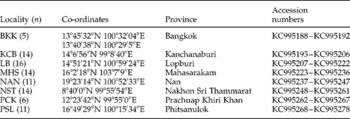
Third-stage larvae of A. cantonensis were collected from the snail Achatina fulica gathered by hand from eight locations around Thailand (see table 1): Nan (NAN), Phitsanulok (PSL), Mahasarakam (MHS), Lopburi (LB), Bangkok (BKK), Kanchanaburi (KCB), Prachuap Khiri Khan (PCK) and Nakhon Sri Thammarat (NST). After removing the hard shell of each snail, the snail's foot was chopped, blended and then incubated with 1% HCl–pepsin solution, at 37°C for 1 h. Next, the third-stage larvae were isolated using Baermann's technique, and morphologically identified as belonging to the genus Angiostrongylus (Eamsobhana, 2006).
Accession numbers of Angiostrongylus cantonensis from eight geographical regions in Thailand: Bangkok (BKK), Kanchanaburi (KCB), Lopburi (LB), Mahasarakam (MHS), Nan (NAN), Nakhon Sri Thammarat (NST), Prachuap Khiri Khan (PCK) and Phitsanulok (PSL); n, number of specimens examined.

In order to confirm Angiostrongylus species at the adult stage, Wistar rats were infected with the third-stage larvae. Sixteen rats were used and infected rats were put down after 3 months. Adult worms were isolated from the rats' pulmonary arteries and their species were confirmed (Bhaibulaya, Reference Bhaibulaya1979). The extracted nematodes were placed in 70% ethanol and stored at − 20°C until used. DNA extractions were performed following the protocol of the Genomic DNA Mini Kit (Tissue) (Geneaid Biotech Ltd., New Taipei City, Taiwan). The genomic DNA was stored at 4°C for PCR technique.
The mitochondrial cytb gene was selected as target for the investigation of intraspecific variations. Specific primers (cytb-F 5′-TGAATAGACAGAATTTTAAGAG-3′/cytb-R 5′-ATCAACTTAACATTACAGAAAC-3′) were designated to amplify partial cytb sequence of A. cantonensis (GenBank NC_013065). Amplification consisted of an initial denaturation at 95°C for 4 min, followed by 29 cycles at 95°C for 30 s, 58°C for 45 s and 72°C for 1 min. According to the TopTaq Master Mix Kit (QIAGEN, Hilden, Germany), each 30 μl reaction mixture consisted of ≤ 1 μg of sample DNA per reaction. PCR reactions were visualized by electrophoresis on a 1.0% agarose gel and UV illumination with ethidium bromide staining. The PCR product purification was followed with a Gel/PCR purification Kit (FAVORGEN Biotech Corp, Taipei, Taiwan) and then the eluted PCR products were quantified using a NanoDrop ND-1000 spectrophotometer (NanoDrop Technologies, Inc., Wilmington, North Carolina, USA) prior to DNA sequencing. All DNA samples were sequenced using BigDye Terminator chemistry with the same primers as in the PCR reaction. The DNA sequencing reactions were electrophoresed on ABI's 3730XL DNA analysers (Applied Biosystems, Carlsbad, California, USA). A basic local alignment search tool (BLAST) search (National Center of Biotechnology Information public databases; http://blast.ncbi.nlm.nih.gov/Blast.cgi) was carried out to explain any similarities between obtained sequences and previously published sequences. Angiostrongylus cantonensis (GenBank NC_013065) was included in the analyses.
Molecular analysis
Partial cytb gene sequences were aligned using the ClustalX program (Thompson et al., Reference Thompson, Gibson, Plewniak, Jeanmougin and Higgins1997). The resulting alignment was used to calculate nucleotide compositions. Using Akaike Information Criterion (AIC), best-fit models of DNA evolution were estimated. The maximum likelihood (ML) analysis was performed using MEGA5 software and the ML tree was evaluated using 1000 bootstrap replications. Angiostrongylus vasorum (NC_018602) was the outgroup and the best substitution model for the cytb was HKY+I. Nucleotide diversity (Nei, Reference Nei1996) was measured by using the DnaSP program version 5.10.01 (Rozas et al., Reference Rozas, Sanchez-DelBarrio, Messeguer and Rozas2003). Genetic distance was computed using MEGA5 software (Tamura et al., Reference Tamura, Peterson, Peterson, Stecher, Nei and Kumar2011) and maximum composite likelihood was used as the substitution model. Non-parametric analysis of molecular variance (AMOVA) and F-statistics (F st) were conducted using Arlequin (Excoffier et al., Reference Excoffier, Laval and Schneider2005) in order to determine genetic differences and to describe genetic structures among populations. The average gene flow among populations (N m) was estimated from F st values, as N m= (1 − F st)/4F st, where N m is number of migrants per generation between two populations (Slatkin & Barton, Reference Slatkin and Barton1989). Haplotype networks of partial cytb sequences were constructed using the statistical parsimony (Templeton et al., Reference Templeton, Crandall and Sing1992) in TCS 1.21 (Clement et al., Reference Clement, Posada and Crandall2000). The network estimation was run at 95% connection limit.
Results
Genetic variation
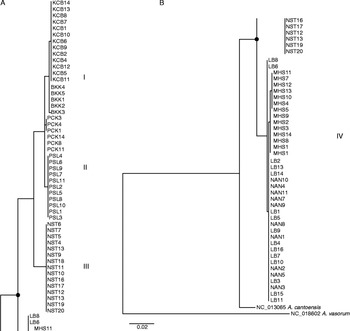
Sequencing determined 853 base pairs (bp) of A. cantonensis cytb sequences from 91 individual worms. The remaining 35 (4.1%) sites were polymorphic, generating 11 different cytb haplotypes. The nucleotide diversity (π) in A. cantonensis was studied by comparing the 853 bp of partial cytb sequences. Genetic variability is defined as the number of nucleotide differences per site between two randomly chosen sequences from a population. The π value was found to be 0.0164, revealing low nucleotide diversity and genetic structure. This low diversity is probably due to bottlenecks during evolution. ML trees were constructed using conserved sites (853 bp). The topology split our A. cantonensis sequences into two distinct clades: one is represented by clusters I, II and III; the other by cluster IV (fig. 1).
Maximum likelihood tree of A. cantonensis based on the mitochondrial cytb gene (853 bp) to show (A) clade 1, comprising clusters I–III; (B) clade 2, with cluster IV, and the black circle representing the internode between clades 1 and 2.

Genetic distance and differentiation
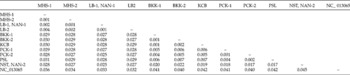
At the cytb locus, 11 haplotypes generated from the alignment sequences, and four clusters generated from the ML tree, were found. The intraspecific distances among A. cantonensis ranged from 0.001 to 0.031 (table 2). Divergence between populations was calculated from the inter-cluster sequence divergence matrix. Genetic distances ranged from 0.004 between cluster I and cluster II region to 0.031, with an average genetic distance of 0.018. Populations from cluster II and cluster IV were found to be the most divergent.
The maximum composite likelihood distance between 11 cytb haplotypes of A. cantonensis in the different or same localities; see table 1 for abbreviations of localities.

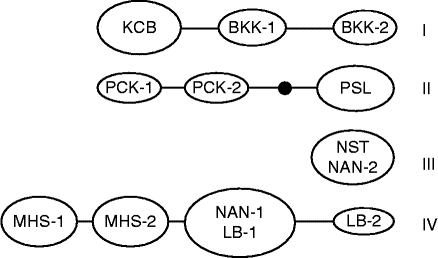
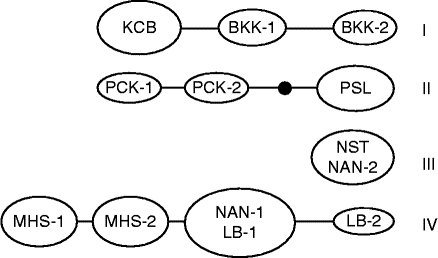
With analysis of molecular variance (AMOVA), variation within populations (69.66%) was found to be greater than the variation between populations (30.34%). The genetic differentiation, estimated by AMOVA, was very large between the two main clades (F st= 0.303, P value < 0.05). Migrant number per population and per generation was 0.015 (Wright, 1978). The two main clades are characterized by such genetic differentiation coefficients, with very significant divergence and little gene flow across geographical distances. Haplotype networks of partial cytb sequences show four separated clusters (fig. 2), which was consistent with the ML tree in cluster I (KCB and BKK), cluster II (PCK and PSL), cluster III (NST and NAN-2) and cluster IV (MHS, LB and NAN-1). Partial sequences of the cytb gene determined in this study were deposited in the DNA Data Bank of Japan/European Molecular Biology Laboratory/GenBank databases with the following accession numbers, KC995188–KC995278 (table 1).
Median-joining network based on A. cantonensis cytb haplotypes (853 bp, 11 haplotypes); haplotypes found in the present study (clear circles), hypothetical haplotypes (black circle), clusters (I–IV).
Discussion
Phylogenetic differences within A. cantonensis populations across different regions in Thailand were found. This suggests that the species has multiple independent origins, and the original native population of A. cantonensis remains uncertain. Variation (11 haplotypes) of A. cantonensis sequences found in Thailand was higher than that found in other countries (8 haplotypes) such as Japan, mainland China, Taiwan and Thailand (Tokiwa et al., Reference Tokiwa, Harunari, Tanikawa, Komatsu, Koizumi, Tung, Suzuki, Kadosaka, Takada, Kumagai, Akao and Ohta2012). This finding indicates that high genetic variation can be found in a narrow geographical area.
In this study, sequencing analysis provides information about the genotype variation and haplotype relationships of A. cantonensis cytb sequences in Thailand. Phylogenetic analyses of cytb sequences revealed two distinct clades, representing eight distinct haplotypes (figs 1 and 2), and confirmed the split population reported in a previous study (Thaenkham et al., Reference Thaenkham, Pakdee, Nuamtanong, Maipanich, Pubampen, Sa-Nguankiat and Komalamisra2012). Four cytb clusters of A. cantonensis were identified from two different clades. Mitochondrial cytb gene sequences were used to assess variability in A. cantonensisin different geographical regions. mtDNA sequence variation observed among individuals of the same species was lower than 10% (Blouin, Reference Blouin2002). Intraspecific distance among A. cantonensis in this study appeared to be within a typical intraspecific range. Haplotype numbers ranged from one to two (fig. 2). These results showed that the same haplotypes were detected in remote areas (Tokiwa et al., Reference Tokiwa, Harunari, Tanikawa, Komatsu, Koizumi, Tung, Suzuki, Kadosaka, Takada, Kumagai, Akao and Ohta2012), and were not correlated with geographical distance. For instance, NAN and NST haplotypes found in the north and south, respectively, were in the same cluster (III). Similar results are typically observed among many invasive species. They frequently undergo founder effects that abolish most, if not all, of their genetic variability (Solignac et al., Reference Solignac, Cornuet, Vautrin, Le Conte, Anderson, Evans, Cros-Arteil and Navajas2005; Rawlings et al., Reference Rawlings, Hayes, Cowie and Collins2007; Goka et al., Reference Goka, Yokoyama, Une, Kuroki, Suzuki, Nakahara, Kobayashi, Inaba, Mizutani and Hyatt2009).
This study also showed that A. cantonensis was found in every part of Thailand where A. fulica exists, and A. fulica might be a key host species in researching the dispersal of A. cantonensis (Vitta et al., Reference Vitta, Polseela, Nateeworanart and Tattiyapong2011; Tokiwa et al., Reference Tokiwa, Harunari, Tanikawa, Komatsu, Koizumi, Tung, Suzuki, Kadosaka, Takada, Kumagai, Akao and Ohta2012). However, the haplotype had no correlation with geography, as seen by the finding of NAN and NST haplotypes in the same cluster (III). An explanation may be found in the review of angiostrongyliasis (Lv et al., Reference Lv, Zhang, Steinmann and Zhou2008), a disease that was found to emerge as a result of long-distance transportation of food. Geographical dispersal of A. cantonensis from its presumptive home is similar to the transportation of infected rats and snails mediated by human activity (Kliks & Palumbo, Reference Kliks and Palumbo1992). Small snails and eggs may be accidentally transported with agricultural, horticultural and other commercial products (Thiengo et al., Reference Thiengo, Fernandez, Torres, Coelho and Lanfredi2008). The snail's ability to store sperm could enable a founding population to form from just one hermaphrodite individual (Pawson & Chase, Reference Pawson and Chase1984).
In addition, it has been suggested that dispersal of A. cantonensis in Thailand could be due to organisms other than A. fulica. Many species of rats are naturally infected with A. cantonensis, and geographical dispersal of A. cantonensis reflects the transportation patterns of infected rats mediated by human activity, for instance through agricultural transportation within the country. A study in Tanzania found that rodents from rural areas can be introduced accidentally into cities (Acedo et al., Reference Acedo, Dropkin and Luedders1984). Moreover, several studies of phylogeographic patterns support the hypothesis of human-mediated colonization of a rat species from its source population to new localities. A study found that humans were the main influence on Andricus kollari populations, an oak gallwasp in France colonized from sources in Italy and Hungary (Stone et al., Reference Stone, Challis, Atkinson, Csoka, Hayward, Melika, Mutun, Preuss, Rokas, Sadeghi and Schonrogge2007). Another study showed that the maintenance and spread of Yersinia pestis in Madagascar is a dynamic and highly active process that relies on the natural cycle between the black rat (its primary host), its flea vectors and human activity. Much long-distance spread of Y. pestis in Madagascar is likely due to human activities that allow the plague-infested rats and fleas to be transported from one location to another (Vogler et al., Reference Vogler, Chan, Wagner, Roumagnac, Lee, Nera, Eppinger, Ravel, Rahalison, Rasoamanana, Beckstrom-Sternberg, Achtman, Chanteau and Keim2011). It is reasonable to hypothesize that introducing murine angiostrongyliasis might advance dispersal of A. cantonensis, as rats are easily distributed to other regions via human transportation (Tollenaere et al., Reference Tollenaere, Brouat, Duplantier, Rahalison, Rahelinirina, Pascal, Moné, Mouahid, Leirs and Cosson2009; Russell et al., Reference Russell, Gleeson and Le Corre2011; Tokiwa et al., Reference Tokiwa, Harunari, Tanikawa, Komatsu, Koizumi, Tung, Suzuki, Kadosaka, Takada, Kumagai, Akao and Ohta2012).
Geographical isolation subjects populations to different selective pressures, since conditions in different areas will vary. Development of a specific vaccine, drug or treatment strategy could reduce patient mortality. However, since identical haplotypes are not correlated with geography, geographical difference may not be an effect of population evolution of A. cantonensis in Thailand. It is hard to develop a specific drug, vaccine and treatment for A. cantonensis isolates unrelated to geographical distribution.
However, the high variation of partial cytb sequences found in this study demonstrates several populations within A. cantonensis. It indicates that there is low gene flow between these populations. One reason can be the method of nematode migration via intermediate and definitive hosts' migration patterns, and being transported by human activities.
By using the RAPD-PCR technique (Thaenkham et al., Reference Thaenkham, Pakdee, Nuamtanong, Maipanich, Pubampen, Sa-Nguankiat and Komalamisra2012), genetic differentiation among A. cantonensis and two populations in Thailand was found. However, the RAPD-PCR method can represent low levels of polymorphism and, as such, is not enough to distinctly split A. cantonensis populations. Mitochondrial genes have been used as markers of choice to assess variation within and between parasite populations because they generally evolve faster than nuclear genes and are maternally inherited, and therefore, are not subject to recombination (Brown et al., Reference Brown, George and Wilson1979). Mitochondrial markers also show higher levels of population differentiation. In previous studies (Eamsobhana et al., Reference Eamsobhana, Lim, Solano, Zhang, Gan and Yong2010a; Tokiwa et al., Reference Tokiwa, Harunari, Tanikawa, Komatsu, Koizumi, Tung, Suzuki, Kadosaka, Takada, Kumagai, Akao and Ohta2012), a partial coxI gene has been unable to separate A. cantonensis within species. Partial cytb sequences give high mutation rates and appropriate variation to detect A. cantonensis populations, and in the present study reveal four populations of A. cantonensis. However, these results need confirmation from another marker because sequence variation varies among populations and current population relationships could be displayed better by a more sensitive marker. In further studies, a more sensitive marker, such as microsatellite, should be used to explain A. cantonensis geographical distribution, and more geographical areas should be incorporated. Information on the phylogenetic features of A. cantonensis must be collected in order to better understand the transmission dynamics of these nematodes in Thailand, and to establish solid baseline data for future epidemiological studies.
Acknowledgements
We gratefully acknowledge Mr Paul R. Adams and Mr Glad Rotaru for their English language editing, as well as an anonymous reviewer for the valuable comments on an earlier version of the manuscript.
Financial support
This work was supported by the Department of Helminthology, Faculty of Tropical Medicine, Mahidol University (Thailand Government Budget 2009 and 2010), and the Development and Promotion of Science and Technology Talents Project (DPST). All of these sources are gratefully acknowledged.
Conflict of interest
None.
Ethical standards
All procedures contributing to this work complied with the ethical standards of relevant national and institutional guidelines on the care and use of laboratory animals. Ethical clearance was provided by the Faculty of Tropical Medicine – Animal Care and Use Committee Mahidol University, Bangkok (No. FTM-ACUC 002/2013).