INTRODUCTION
Toleration or endorsement by the state of diverse ethno-religious and cultural practices is seen as an effective mechanism for stability and accord in multi-cultural settings; such policies protect ethnic and religious group identities while forging groups' allegiance to the state (Lapidoth Reference Lapidoth1997; Rothchild and Hartzell Reference Rothchild, Hartzell, Safran and Máiz2000; Keyder Reference Keyder, Barkey and von Hagen1997, 30). Research on the origins of the institutional mechanisms for managing cultural diversity has focused on secular institutions, such as territorial autonomy (Riker Reference Riker1964; Shaykhutdinov Reference Shaykhutdinov2010; van Cott Reference van Cott2001). Systematic empirical study targeting specifically the formation of religious institutions within secular states has been less frequent.
Yet the question “what explains cross-national variation in the state accommodation of Islamic cultural and religious practices in secular states?” is seen as one of the most “intriguing” (Tatari Reference Tatari2009, 271). Much of the theoretical and comparative work addressing this question has been conducted in the West European and United States context. Among the recent are studies by Klausen (Reference Klausen2005), Fetzer and Soper (Reference Fetzer and Soper2005), and Tatari (Reference Tatari2009) on Muslims in Western Europe; Cesari (Reference Cesari2004) on Muslims in Europe and the United States; and Kuru (Reference Kuru2007; Reference Kuru2009) on Muslims in France (2008) and the assertive and passive secularism in Turkey and the United States. In contrast to Western Europe and North America, cross-national comparative analysis of the post-communist Eurasia has been more limited.
The importance of the question of Muslim religious accommodation goes beyond a purely academic inquiry. The proposed construction of the “Ground Zero Mosque” in Lower Manhattan next to the September 11, 2001 Memorial divided the American society with some 68% of the Americans — opposing the move.Footnote 1 Similarly, a 2009 Swiss referendum banned the construction of mosque minarets in the country.Footnote 2 Echoing this sentiment in the post-communist world, many Muscovites are against building new mosques in the Russian capital.Footnote 3 The Turkish-Georgian bilateral agreement on the restoration of the houses of worship drew harsh criticism from the Georgian Orthodox Church and the prominent members of the society suspecting spiritual “expansion” of Turkey.Footnote 4 Similarly, the Russian-speaking observers of religious affairs in Russia's republic of Tatarstan express apprehension that the number of mosques exceeds that of churches in the republic.Footnote 5 On the other hand, the outrage against the “Tatar 9/11” marking the controversial demolition of a historic Tatar mosque in Moscow on September 11, 2011, divided both the Tatar and Russian communities.Footnote 6 Moreover, concerns have been voiced that the number of mosques is lower than that of churches in a predominantly Muslim Albania.Footnote 7 Clearly, the question of building Muslim places of worship became a major political and social debate throughout the post-communist world and beyond.
Apart from academic and political considerations, the question of mosque construction has direct implications on the ability of pious Muslims to practice their faith. This ability determines not only their quality of living, but also the level of states' adherence to the principle of religious freedom, and state capacity to effectively respond to the policy needs of their communities.
Even though there are sparse reports comparing limited number of post-communist Muslim cases, no systematic comparative analysis of this issue has been found on the post-communist Eurasia. Consequently, in this article, I present and analyze the data on the mosques collected in the context of the Muslim republics of the ex-communist bloc. I find that the level of democracy is among the strongest predictors of whether religious accommodation through mosques takes place. I further employ the case of Russia's Tatars to trace the trend of mosque building.
MOSQUES AND THE ACCOMMODATION OF ISLAMIC RELIGIOUS PRACTICES IN THE POST-COMMUNIST MUSLIM REPUBLICS
Some 20 years after the demise of state communism a vast variation on the relationship between the secular state and Islam is observed in the ex-communist bloc, both cross-nationally (Cummings Reference Cummings2004) and sub-nationally (Matsuzato Reference Matsuzato2007). While the relationship between religion and state includes a number of political, economic, and social issues, variation on “[t]he state accommodation of religious practices constitutes one of the most encompassing and important policy issues affecting the lives of Muslims on a daily basis” (Tatari Reference Tatari2009, 274). Certain religious policies identified in the West European context, such as the provision of burial spaces for Muslims and permission of Islamic ritual slaughter, are not likely to exhibit much divergence in the post-communist Eurasia.Footnote 8 Yet others, including provision of prayer spaces, toleration of Islamic dress code, public funding for Islamic schools, training of clerics, and teaching Islam in school curricula, are. In Uzbekistan, Tajikistan, and, more recently, Azerbaijan, Islamic dress code was banned at schools, whereas in Kazakhstan and Tatarstan the policies regulating dress are more lenient. Debates have also been heated on the Muslim prayer houses, the mosques.
In the West European context, Kuru (Reference Kuru2008) was among the first to use “Muslims-to-mosque ratio” as a comparative measure to assess four West European cases with large Muslim populations and flesh out the exceptional case of France.Footnote 9 Using a similar approach, I apply this measure to the post-communist Muslim republics. By formerly communist Muslim republics I refer to the territorial entities (1) self-identified as republics, (2) located in the geographical area of the former Warsaw Pact countries and ex-Yugoslavia, and (3) where at least 10 percent of the titular nationality is classified as Muslim. Eight independent internationally recognized sovereign states, two partially recognized entities, and 12 sub-national autonomous territories satisfy this definition.
The data on mosques were collected from a variety of sources, including the statements of clerics (primarily leaders of the Muslim Spiritual Boards (DUMs)), government officials, academics, and media reports.Footnote 10 The data in Figure 1 summarizes the pattern of Muslims-to-mosques ratio in the post-communist Muslim republics. The distribution of the republics on “the number of Muslims per a mosque” indicates a clear variation in the state policies toward Islamic religious practices. As the figure indicates, Dagestan, Crimea, and Tatarstan are ranked as top republics that accommodate religious practices through mosque construction; the number of mosques there per a constant group of Muslims is the highest. On the contrary, Azerbaijan, North Ossetia, Abkhazia, Turkmenistan, and Uzbekistan are on the bottom, with the rest of the republics placed in between. From a cross-regional perspective, post-communist Muslim republics compare in a rather mediocre way to the West European cases. While the United Kingdom and Germany would occupy the second and fourth places in this ranking, the Netherlands and even France would be above the median, leaving most post-communist cases below. In fact, France would rank 10th on the Muslims-to-mosques ratio within a population of 22 post-communist Muslim republics (with 13, or 59.1% of the total, below France). This is ironic as France, identified as pursuing “exceptionally restrictive policies toward its Muslim population” (Kuru Reference Kuru2008, 2) and having the worst mosques-to-Muslims ratio (1 per 2,670) among the European nations with major Muslim populations, is quite Muslim-friendly from the post-communist perspective. Yet, what accounts for the divergence within the post-communist Muslim world?
(Color online) The number of Muslims per a mosque in the post-communist Muslim republics.

EXPLAINING STATE POLICIES ACCOMMODATING MUSLIM RELIGIOUS PRACTICES
Alternative Explanations
A number of well-established competing theories purport to explain the trends in government policies toward religion. These perspectives include the civilizational, or essentialist, approach; ideology; modernization theory; and the rational choice explanation, which includes resource mobilization and political opportunity structure theories (Fetzer and Soper Reference Fetzer and Soper2005; Kuru Reference Kuru2007; Reference Kuru2009; Tatari Reference Tatari2009; Fox Reference Fox2006). In a civilizationalist view, cultural essences are a primary factor responsible for political outcomes. This view implies that cultural categories, while different from each other, are largely invariant in their core essences. Thus, this approach is capable of explaining the differences between religious categories, however it is ill-equipped to do so within them. Since the republics considered in this article all exhibit a considerable degree of Islamic cultural heritage but implement highly variant policies toward Islamic religious practices, we have to look for the explanation elsewhere. The application of ideology in comparative studies has generally been idiosyncratic to the cases selected making its employment in the post-communist world difficult; it has also been theorized as endogenous to a multitude of other factors (Tatari Reference Tatari2009). Perhaps the greatest difficulty of incorporating ideology in a quantitative analysis of accommodation of Islamic religious practices relates to the coding decisions concerning the type of ideology, its relevance, and identity, number and strength of ideology's proponents in the republic. Some scholars go as far as to dismiss quantitative study of ideology altogether equating “quantitative models with “ideology” as an independent variable” with “nonsense or rhetoric” (Wilson Reference Wilson2008, 2).
Structural and historical processes, such as modernization, may be responsible for the variation in accommodative policies of the state. An important version of modernization theory implies that economically developed states will pursue more secular policies due to secularizing trends within the society (Bruce Reference Bruce2002), church-state separation, and the advent of secular, rational, state bureaucracies (Norris and Inglehart Reference Norris and Inglehart2004). As Geertz (Reference Geertz2005, 10) put it, “the rationalization of modern life was pushing religion out of the public square, shrinking it to the dimensions of the private, the inward, the personal, and the hidden.” Empirical tests, however, have not been supportive of this hypothesis, as demonstrated both by the focused comparative (Kuru Reference Kuru2009; Reference Kuru2007) and large N empirical studies (Kuru Reference Kuru2009; Reference Kuru2007; Fox Reference Fox2008; Reference Fox2006; Barro and McCleary Reference Barro and McCleary2005). In fact, according to Lindquist and Handelman (Reference Lindquist and Handelman2011, 6), by the 1990s and 2000s a number of academics who previously advocated “the secularization paradigm admitted that it was wrong.” Despite such a pessimistic outlook and due to highly uneven levels of development throughout the post-communist world, I test the effects of modernization on state policies toward religion and present the results below.
The rational choice approach focuses, according to Olson (Reference Olson1984), on “individual preferences, their rational calculation, and their structural constraints” (Kuru Reference Kuru2007, 577). While applications of the rational choice paradigm to explaining state policies toward religion (Gill Reference Gill1996) have been criticized in the literature (Kuru Reference Kuru2007; Reference Kuru2009), this approach does inform such important structural insights as the resource mobilization theory and political opportunity structures theory noted as important in the studies on Islam and state.
Resource mobilization theory postulates that the resources at the avail of Muslims are a crucial factor in carving out concessions from the state. Such resources include “effective organizational structures, wealth channeled to these organizations to further the political agendas of the group, and a successful leadership with knowledge of the political system of the host country” (Tatari Reference Tatari2009, 278). Consequently, a state's policy in regards to Muslim religious rights can be accounted for “by analyzing domestic political consideration and the relative power of parties and movements that support Muslim religious rights against those that oppose them” (Fetzer and Soper Reference Fetzer and Soper2005, 7).
In a similar vein, political opportunity structures are important determinants of Muslim mobilization in the quest for religious rights. However, in contrast to resource mobilization, this approach focuses on “the influence of political institutions” of the state (Tatari Reference Tatari2009, 278), or “key regime characteristics — such as whether it is a unitary or federal polity; the type of electoral system; the separation of powers between the executive, legislative, and judicial branches of government; and the position of key political elites” (Fetzer and Soper Reference Fetzer and Soper2005, 10–11). As these regime traits are especially relevant for studying accommodation of Muslim religious practices in Western Europe, it is noteworthy that opportunity structures and resources available to religious movements may differ from those accorded to secular groups (Aminzade and Perry Reference Aminzade, Perry, Aminzade, Goldstone, McAdam, Perry, Sewell, Tarrow and Tilly2001).
Level of Democracy and State Accommodation of Muslim Religious Practices
Another important distinction pertaining to opportunity structures concerns the relevance of regime type to post-communist Eurasia, compared to Western Europe. Regime type is largely irrelevant in explaining the variation in the policies of Muslim religious accommodation in Western Europe as all West European nations are currently democratic with the regime type indexes practically invariable in that regional context. Consequently, it is no surprise that scholars focused on the institutional differences within democracies as the primary explanatory factors of religious accommodation. However, such institutional factors as electoral system and the legal balance of the presidential/parliamentary powers may be much less relevant in undemocratic settings. Therefore, in my view, regime type is key to understanding political and social outcomes in the post-communist context especially in light of the vast variation in the regime type in the region.
In general, regime type defines the potential that exists for members of the public to influence government decision-making. Opportunities for the public to play a role in the policymaking process tend to be greatest in those (post-communist) states that enjoy the highest levels of democracy. Democratic states are also credited with forging a culture of toleration that allows for diverse cultures to live together within the context of a single state.
Further, democratic institutions are thought to discourage contestation over the structure of political and social institutions and decrease the potential for violence (Dassel and Reinhardt Reference Dassel and Reinhardt1999, 67). In long-standing democracies, elite preferences for repression are reduced, since historically they have been able to address successfully group grievances and challenges (Gurr and Moore Reference Gurr and Moore1997, 8). Historical patterns and institutional constraints make it costly for state leaders to use force against their citizens opting instead for conciliatory means to redress grievances. In newer post-communist democracies states may still dislike the popular grassroots movements that reassert their cultural distinctiveness, “but, under the democratic conditions [as] in postcommunist Poland, the state administration has no legal means to suppress this project” (Kamusella Reference Kamusella2011, 769, emphasis added).
In this context, it is important to consider how the government's adherence to the democratic norms and principles, can influence group strategies and success in obtaining concessions from the state. As Tilly points out, “From their eighteenth-century origins onward, social movements have proceeded not as solo performances, but as interactive campaigns” (Tilly Reference Tilly2004, 12, italics as in original). Consequently, social, and, in particular, ethnic and religious “movements' variation and change” can never be explained “without paying close attention to political actors other than the central claimants, for example the police with whom demonstrators struggled …” (Tilly Reference Tilly2004, 12). Group members may favor peaceful protest as their first-choice action (Gurr Reference Gurr2000). However, in light of government-induced intransigence, brutality, and repression they may choose to employ violent tactics as recent case studies (Sambanis Reference Sambanis2004) and statistical (Sambanis and Zinn Reference Sambanis and Zinn2006) analyses indicate. Consequently, in “difficult” non-democratic regimes groups maximize their odds of obtaining religious institutions by taking up more aggressive action in their quest for greater rights.
In the post-communist world, democracy is also associated with the rise of national movements for self-determination, which would employ religion as a part of their nationalizing projects (Möxämmätşin [Mukhametshin] 2009, 76). Moreover, the divided-power (federal-unitary) dimension of democracy implies that in federal and decentralized structures power is devolved to sub-national units (Lijphart Reference Lijphart1999), including ones with distinct Muslim identities, which is likely to increase the amount of religious services provided.
Democracy directly invigorates both the factors comprising the opportunity structures at the level of state and the degree and nature of resources available to Muslim social actors increasing the quality and quantity of Muslim religious services provided or allowed by the state.
STATISTICAL ANALYSIS
Data
To measure the level of modernization I follow common practice and use Human Development Index.Footnote 11 Among the resources inherent in the Muslim communities are the degree of homogeneity (or fractionalization), the status of the republic (ranging from a long history of independence — 1, to the formerly autonomous structures of the third tier — 5),Footnote 12 and the Muslims' population ratio to the general population. In the western context, scholars point out that Muslims are a very heterogeneous group (Cesari Reference Cesari2004, 4; Fetzer and Soper Reference Fetzer and Soper2005, 50; Klausen Reference Klausen2005, 30) and imply that diversity among the Muslim communities weakens “their odds of effectively bargaining with the state” (Tatari Reference Tatari2009, 283). In a similar vein, in western settings, federalism was noted as an important variable (Fetzer and Soper Reference Fetzer and Soper2005, 53), while in the academic literature on post-communism, the status of the republic was found to be an important contributor to ethnic mobilization (Roeder Reference Roeder1999). As the status of the republic determined the strength and number of ethnic institutions, “[t]he inhabitants of union republics, which had the most extensive networks of ethnic institutions, were on average less vulnerable to assimilation than the inhabitants of autonomous republics, provinces, or districts, which were permitted to have progressively fewer ethnic institutions” (Gorenburg Reference Gorenburg, Arel and Ruble2006, 274).
State leaders should also be more predisposed to consider groups with a particular population size that appears to legitimate claims to accommodate religious practices. Groups with large populations may justifiably claim that the shared interests of a large number of individuals should be accommodated through government policy; it is also the case that ethnic and religious rights movements for larger populations might engender efforts at accommodation by leaders concerned about the potential for widespread unrest (van Cott Reference van Cott2001, 52).
Other key social factors pertaining to various Muslim groups include the levels of assimilation and their experience with Islam, including both the initial encounter and the ultimate completion of Muslimization. I used the data on linguistic Russification from Kaiser (Reference Kaiser1994) as adopted by Gorenburg (Reference Gorenburg, Arel and Ruble2006, 284–285).
Among other plausible explanations for accommodation of Muslim religious practices and specifically the construction of mosques, in the ex-communist world are population density and whether a Muslim group has been deported from their homelands during the Stalinist purges. The demographic data on the internationally recognized republics are obtained from the CIA World Factbook, and from the national statistical bureaus and secondary sources on the subnational units. The data on the deported peoples are from Campana (Reference Campana2007). Polity IV data are used to capture democracy.
Data Analysis and Statistical Results
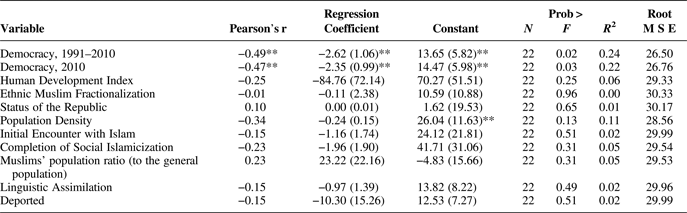
I used a series of correlations and bivariate regressions to gauge the influence of various factors on state accommodation of religious practices in the ex-communist republics using Muslims-to-mosques rate as a measure for my dependent variable.Footnote 13 I present the summary of my statistical analysis in Table 1. In both the correlation analysis and bivariate regression models, the variable representing democracy has a statistically significant influence on the number of Muslims to mosques in the expected, negative direction. The correlation coefficients approach −0.5 for the average democracy score in the period of 1991–2010 (r = −0.49, p < 0.05) and only for the year 2010 (r = −0.47, p < 0.05).
Summary of correlations and bivariate regression between Muslims (1,000s) / mosques ratio and the explanatory variables
Values in parentheses are robust standard errors. All significance tests are two-tailed.
**p < 0.05, *p < 0.1
What is the magnitude of the influence that democracy exerts on accommodation of religious practices? Column 3 in Table 1 addresses this question, by indicating how variations across the values of each democracy variable affect the number of mosques available to Muslims. As the regression model indicates, increasing the value of democracy, which ranges between −10 and 10, one unit diminishes the ratio of Muslims per mosque by 2,625. This means that for a given constant number of Muslims, the number of mosques will rise as their republic becomes more democratic. The most notable aspect of these results, as reflected in both the correlation and regression models, is that democracy proves to be the single most important factor for Muslim groups seeking an accommodation of their religious practices in the post-communist context.
However, the results do not necessarily mean that other factors are totally unimportant. The forces of modernization may still be relevant. Yet, the opposing effect of human development index (HDI), which also captures the level of resources of Muslim groups, in addition to that of modernization, may cancel out the secularizing trends of modernization in the results. Further, democracy as an explanatory variable may be too powerful and encompassing, thus overshadowing other factors, which are vitally reinforced by democracy. As the scholarship on western industrialized countries show, these factors are important. However, these variables operate under the necessary condition of democracy, which “activates” and renders them meaningful. In other words, factors, such as electoral system or the institutional arrangement of the executive power, are more effective in explaining variation in the state's accommodation of religious practices in a democratic milieu. Consequently, the level of democracy explains the larger shifts in the levels of accommodation of Muslim religious rights.
To illustrate these variables “at work” I will use an extended example of Muslim Tatars in the Russian Empire and the contemporary Tatarstan. As Figure 1 indicates, Tatarstan currently ranks in the top three in the provision of Muslim religious services but in the past has seen variation in both the levels of democracy and state responsiveness to Muslim religious needs. Moreover, Russian and Soviet Islamic clergy have traditionally been dominated by Tatars making this case more pertinent to the study of post-communist religious institutions. In doing so, I largely rely on Russian-language sources in addition to publications in English and Tatar.Footnote 14
ISLAM, DEMOCRACY, THE TATARS AND TATARSTAN
One of the most influential Tatar states, the Kazan Khanate, throughout much of its history competed with the Russian territories united under the Muscovy. As the balance of power eventually shifted to the Muscovites, despite the efforts by the last ruler of the Khanate, Queen Söyembikä, Kazan fell to the forces of Ivan the Terrible in 1552. Subsequent repressive policies of the czarist regime led to the destruction of mosques, seizure of property, building of churches, and monasteries (Davis, Hammond, and Nizamova Reference Davis, Hammond and Nizamova2000). Imperial Russia's policy of co-opting the Tatar aristocracy via religious conversion was unsuccessful as only a small portion of Tatars adopted Orthodox Christianity (Tanrısever Reference Tanrısever2001). Consequently, the locals who refused conversion were forced to relocate 30 kilometers away from Kazan and the riverbanks (Faller Reference Faller2002). As the Russian peasantry was transferred to the area (and exempt from serfdom, which was in place in the rest of the Muscovy), Tatars found themselves expelled from their rural areas to arid lands (Faller Reference Faller2002).
Although Kazan became a center for missionary activity, Slavic colonization, and Moscow's assimilation efforts accompanied by sporadic Tatar revolts against Russification, an understanding between the two groups developed with respect to mutual benefit and cohabitation. Tatars were increasingly becoming mediators between the Christian imperial core and the Turkic peoples conquered more recently contributing to their coexistence. Their central geographical location within Russia and social role allowed Tatars to enjoy a relative prosperity that led to the establishment of a large Tatar middle class. Tatars exhibited high literacy rates, developed national consciousness and grew concerned about de-Tatarization and the challenges to the Tatar way of life; by the end of the 19th century, they agreed that a Tatar homeland should exist in the middle Volga region (Toft Reference Toft2003).
As the system was democratizing, by the end of the czarist rule Muslim Tatars were able to acquire political representation in the Russian Duma and assert their aspirations for self-government. A leading scholar of Islam in Russia claims that in contrast to the previous period, by the beginning of the 20th century the political side of their relationship with Russia became especially important to Tatars; the Russian revolution brought “hopes and aspirations for democratic liberties; the notion of the ‘motherland’ gained a new civic substance, which implies the unity [equality] of political rights and duties…” (Möxämmätşin [Mukhametshin] 2002, 137, translated by author). The Tatar intelligentsia clearly understood that the success of Tatars' national aspirations were inexorably tied to “the democratization of the entire political system of Russia” offering a model of Russia's political restructuring based on pluralistic principles long familiar in the West (Möxämmätşin (Mukhametshin) Reference Möxämmätşin (Mukhametshin), Khasanov, Iskhakov, Khakimov, Khisamov, Khairullov, Valeev and Khairutdinov2002, 139, translated by author). In the context of Russia, such a model, first suggested by I. Gasprinski, placed Tatars and Russians in a position of formal equality. As the Muslim Fraction in the Second State Duma published in its program, “as the most appropriate form of state structure for Russia under the current conditions the fraction recognizes the constitutional parliamentary monarchy, in which the highest state authority belongs to the monarch constrained in her rights by the Constitution, and the people embodied by their representatives who act on the base of the same constitution” (Möxämmätşin (Mukhametshin) Reference Möxämmätşin (Mukhametshin), Khasanov, Iskhakov, Khakimov, Khisamov, Khairullov, Valeev and Khairutdinov2002, 138, translated by author). An empirical examination of the democracy scores and religious institutions in the pre-communist Russia of 1833–1919 represented in Figure 2 indicates a level of correlation that approaches perfection, r = 0.96 (p < .00001, df = 10).Footnote 15
(Color online) Democracy and the Number of Mosques/Praying Houses in Russia, 1833–1919.
The Idel-Ural state (1917–1918) uniting Tatars, Bashkirs, and the Finno-Ugric peoples of the area was formed during the World War I, but proved to be short-lived as Bolsheviks took over. Political repression of the 1920s–1930s suppressed the Tatar national movement (Iskhakov, Sagitova, and Izmailov Reference Iskhakov, Sagitova and Izmailov2005, 11). The entire Tatar intelligentsia was purged in 1930s due to the accusation of bourgeois nationalism (Faller Reference Faller2002, 82).
By the end of the Soviet period Tatarstan had become one of the most industrially developed areas of the country (Gorenburg Reference Gorenburg2003, 20). It produced 50% of all Soviet trucks in one of the largest factories in the USSR. By 1970s the republic was the largest producer of oil in the Soviet Union (Gorenburg Reference Gorenburg2003) with an industrial potential superseding that of the three Baltic republics. In spite of the industrial developments, the borders of Tatarstan formed by Soviet ethnic engineers were explicitly designed to divide Tatars and weaken the Tatar identity laying ground for the expression of the ethnically driven demands by the end of the Soviet rule (Toft Reference Toft2003, 48).
The policies of perestroika initiated by Gorbachev in 1985 gave ethnic groups within the communist bloc an opportunity to express their grievances. The return of Islam in the social and political sphere of Tatarstan was inexorably linked to the newly emerging social and political organizations, which consider Islam as a significant aspect of their national identities and an important resource in their struggle for greater recognition of their separate identities by the central government (Möxämmätşin (Mukhametshin) Reference Möxämmätşin (Mukhametshin) and İsxaqov2009, 76). The president of the Russian Islamic University in Kazan classifies the entire period of Islamic revival in the Volga-Urals region under three chronological periods: legalization; institutionalization, and “structuralization;” and internal mobilization (Möxämmätşin (Mukhametshin) Reference Möxämmätşin (Mukhametshin) and İsxaqov2009). The first period of the Islamic revival in 1988–1991 is characterized by the initial emergence of the religious institutions in the region in large part due to the action of movements for national self-determination.
The second period of institutionalization in 1991 — the late 1990s saw the establishment of key religious institutions. While in 1988 there were 18 Muslim communities in Tatarstan, in 1998 they numbered over 700. During this period the first Muslim educational institutions came to existence. By the end of the 1990s, they numbered 30 in the entire Volga district, half of which were situated in Tatarstan. Among the most significant are such mädräsäs as Möxämmädiä and İslam dinen qabul itüneñ 1000 yıllığı in Kazan (Möxämmätşin (Mukhametshin) Reference Möxämmätşin (Mukhametshin) and İsxaqov2009, 76–77). In this period, the institute of the Islamic clergy was revived as was the political engagement of Muslims from central Russia. This includes the formation of Muslim social organizations and political parties. The Tatar Public Center (TİÜ, TOTs) clearly identified Islam as an important part of the national revival. In 1990 the first all-Russian Muslim party, Islamic Party of Renaissance, was formed. In 1996 the mufti of Tatarstan, Ğabdulla Ğaliullin established the movement Muslims of Tatarstan. However, the political aspect of Islam in the Volga-Urals proved to be volatile in large part due to the weak social base (Möxämmätşin (Mukhametshin) Reference Möxämmätşin (Mukhametshin) and İsxaqov2009).
The third period, internal mobilization, started in the late 1990s, is currently ongoing. It marks the end of crucial structural and organizational transformations. A competition between the Central Muslim Spiritual Board (TsDUM) of Tälğät Tacetdin (Tadjutdin) and the Council of Russia's Muftis (SMR) of Rawil Ğaynetdin (Gainutdin) was noted across the entire Volga region (Möxämmätşin (Mukhametshin) Reference Möxämmätşin (Mukhametshin) and İsxaqov2009) and specifically in Tatarstan, which had its own Muslim Spiritual Board (DUM RT) courted by the republic's government. Since the late 1990s the authorities started to monitor the sources of the international Muslim charities, which funded the various DUMs, publishing and educational activity. Foreign sources were blamed for breeding Muslim separatism and radicalism. In May 2000, a fight against Muslim charitable funds was officially announced in Russia. Among such funds were Al-Igasa, Taiba, and Ibrahim al-Ibrahim. Yet, among the current problems the lack of internal economic and educational resources that can sustain an autonomous functioning is emphasized (Möxämmätşin (Mukhametshin) Reference Möxämmätşin (Mukhametshin) and İsxaqov2009).
Among the three, the period of 1991 — the late 1990s (institutionalization) is seen as an apogee for the establishment of religious communities both in Tatarstan and the entire Volga-Urals area. The number of Muslim communities in Tatarstan changed from 18 in 1988 (Möxämmätşin (Mukhametshin) Reference Möxämmätşin (Mukhametshin) and İsxaqov2009, 76; Sagitova Reference Sagitova and Iskhakov2009, 129) to 700 by mid-1990s (Sagitova Reference Sagitova and Iskhakov2009, 129). While in the future their growth continued, its rate “markedly decreased” (Möxämmätşin (Mukhametshin) Reference Möxämmätşin (Mukhametshin) and İsxaqov2009, 77) (Fig. 3). Relying on the figures from the Tatarstan Cabinet's Council on the Religious Affairs, Sagitova shows that by 2001 the number of Muslim communities increased to 1000, but in 2003 this figure remained almost unchanged (Sagitova Reference Sagitova and Iskhakov2009, 129). More recent figures confirm this trend. As of January 1, 2007, 1041 Muslim religious organizations were officially registered in TatarstanFootnote 16; on January 1, 2008, 1055Footnote 17; on January 1, 2009, 1072Footnote 18; and on January 1, 2010, 1087Footnote 19 Muslim organizations were registered. While as of January 1, 2007, over 1100 mosques were notedFootnote 20, on January 1, 2008, 1055 mosques (with 50 in the process of registration)Footnote 21 were reported. The (now renamed) Administration for Religious Affairs did not report exact mosques figures for 2009 and 2010, however its website notes that due to the economic crisis in 2009, DUM RT reported that the number of new temples built is significantly lower. “In the previous years the process of opening new mosques and churches, restoration of the worn-out building was conducted systematically, however in 2009 this process slowed down.”Footnote 22 The most recent figures from the DUM RT show that 1100 registered establishments are a part of the DUM,Footnote 23 indicating a net increase of zero since 2007.
(Color online) Democracy and the Number of Muslim Communities in Tatarstan, 1988–2010.
Yet, what can explain the steep increases in Muslim religious organizations in the 1990s and the miniscule changes of the 2000s? One possibility deals with economic capabilities. The Administration for Religious Affairs, for example, cites economic crisis for a slower rate of temple construction. However, while the crisis started in 2008, the number of Muslim religious communities has been stagnant since the early 2000s. Further, of all Muslim cases, Tatarstan has the highest HDI, which places it in between Britain and Singapore. The levels of economic development of Dagestan and Crimea are much lower and yet both republics have more mosques per a constant number of Muslims than Tatarstan does. In other words, the economic explanation for this difference is weak.
It may also be the case that Muslim institutions reached a point of saturation as Tatarstan has satisfied the needs of its Muslim population in religious services. In fact, the increase in religiosity among the Tatars after communism kept up with the trend of Muslim community growth — high in the 1990s and slows in 2000s.Footnote 24 However, mosque attendance has been growing in a diametrically opposite way.Footnote 25 Over the entire decade of the 1990s mosque attendance increased by only 3.4% (from 7.9% in 1990 to 11.7% in 2001), whereas just over a period of a year in 2001–2002, it did by 22.4% (to 33.7% in 2002), casting doubt that the supply of religious services in Tatarstan is a simple function of its demand.
It is all but clear that religious institutions in Tatarstan have to rely on the state for a large part of their financial support. Consequently, we need to account for the nature of the state, both the republic of Tatarstan and the Russian Federation, and especially their interactions, to obtain a clearer picture of growth in religious institutions. Islam was a potent asset of the secular government of Tatarstan in its efforts of nation-building and asserting greater sovereignty. As noted, the government of Tatarstan embraced “Islam as a secular discourse” (Bilz-Leonhardt Reference Bilz-Leonhardt2007, 231). Yet, even though “[t]he ideology of the Shamiyev regime, which is ultimately rooted in the worldview of the Tatar people, determines its religious policy” (Filatov Reference Filatov1998, 269), there are clear limits as to how and when such determination may take place. In 1998, when Russia was a more democratic country, the federal authorities have generally tolerated the efforts of Tatarstani nation-building and the Islamic renaissance in the republic. With a change in the regime type, Tatarstan's relatively lax religious policy had to change.
Tatar intellectual elites also emphasize the importance of democracy in the national/religious development of the Tatar nation. According to the editor of perhaps the last remaining independent newspaper in Tatarstan, Räşit Äxmätov (Rashid Akhmetov),
…Inorodtsy, the non-Russian element in Russia are more inclined toward democracy, since otherwise they are pushed on the second plan. In a democracy, what is important is not one's nationality, but creative gifts and talents, professionalism. In an authoritarian regime, non-Russians lose a lot more than the actual Russian element does (Äxmätov (Akhmetov) Reference Äxmätov (Akhmetov)2011).
Speaking specifically about the experience of Tatarstan Äxmätov points out at a roundtable discussion in a “Muslim” (i.e., serving halal) restaurant Azu organized by young Tatar businesspeople that
…Our similar [to Bashkirs] mechanisms [of interactions between political elites, on the one hand, and the masses and intellectual elites, on the other] could not materialize. Democracy, unfortunately, was crushed on an all-Russian scale. In Tatarstan the maximal [level of] democracy was [attained] in the first half of the 1990s. Then, a real multi-partisanship existed in the parliament of the republic. There was an opposition, the centrists, and a national wing. Our most important achievements were at that time. Right when democracy ceased to exist, our [state] authorities began retreating, and simply many gains were practically lost. The liquidation of the national-regional component [in the system of education] is only a consequence of the liquidation of democracy
…I think that if our business collects money and establishes such elite schools, then this business will start encountering problems, just like the Tatar-Turkish Lyceés did (Galeev Reference Galeev2009).
In a response to Äxmätov's last remark, another prominent Tatar intellectual, Damir İsxaqov (Iskhakov) claims that
There is nothing to fear here. It is necessary to work. Tatars develop fast, when there is democracy. One should not be afraid of pressure. It is necessary to build various systems, employ various channels. The opportunities for development are always present. Even in the current conditions we could build a lot more effective educational system if our higher-ups pursued smarter policies. They presently deal primarily with petrochemical affairs. This is insufficient … We look at our politicians as if they are deities that could do anything by themselves. Much depends on our own vibrancy, on real vivacity (Galeev Reference Galeev2009).
Empirical examination of the data vindicates the view that the number of religious institutions is related to democracy (Fig. 3). The correlation between the democracy score and the number of Islamic communities is extremely high, r = 0.94 (p = .0005, df = 6).Footnote 26
CONCLUSION
The relationship between Islam and democracy in the post-communist world (and beyond) is not an easy one. An accomplished scholar of post-communism Daniel Treisman finds a negative relationship between democracy and the share of Muslims in the ex-communist countries' population (Treisman Reference Treisman2009). In an attempt to explain the relationship, Treisman, however, rejects an approach developed by Fish (Reference Fish2002) that the Muslim tradition presents an obstacle to democracy noting that the gender gaps found by Fish are not present in the post-communist states. Conceding that clan networks might be important, he is not sure about the exact mechanism and calls for further research on the relationship between Islam and democracy. He, however notes that “[i]t is also possible that in this region authoritarianism has been fueled not so much by elements of Islam as by the fear of it, and by the attempts by incumbent regimes to protect against Islamic fundamentalism in anti-democratic ways” as in Uzbekistan and the pre-2010 Kyrgyzstan (Treisman Reference Treisman2009, 28).
The findings of this study reverse the negative causal link between Islam and democracy claiming that democratic polities are more likely to provide accommodation to Muslim religious practices through building mosques. Accommodation of religious practices may, in turn, strengthen social and political stability within a country contributing to greater democracy and leading to a virtuous circle. Consequently, the leaders of Uzbekistan, Turkmenistan, and Azerbaijan, if sincerely concerned about Islamic threat, should try and genuinely loosen the shackles of their authoritarian systems. In fact, “[r]epression of unofficial Islam has not led to its suppression” but resulted in a greater diversity of unofficial Islam in Uzbekistan. There, “[f]aced with this reality, the authorities face a series of tough questions. [One of which is w]ould it be better to adopt a more liberal religious policy?” (Rotar Reference Rotar2005). If adopted, such policy might make religious groups more open and allow the authorities to determine the groups' true level of support, power, and qualities; authorities may even infiltrate those groups more easily (Rotar Reference Rotar2005). Suppression of these groups, at least in Uzbekistan, led to their disguised action and “conspiratorial” thinking rendering state policies risky, ineffective, counterproductive, and ultimately dangerous to the wellbeing of the very state itself (Rotar Reference Rotar2005).
The issues raised in this paper go beyond the interest of the leaders in the former communist countries and are also of concern to non-regional elites. While some foreign policy makers may base their decisions on the supposition of a negative link between Islam and democracy, others may decide to leave the Muslim-majority countries to the whims of their rulers out of honest respect for the native masses' authoritarian preferences and conscious rejection of democratic freedoms. Yet, this research shows that this is not necessarily the case and that democracy and Islamic institutions are positively related, and may even potentially feed each other in a virtuous circle of peace. Moreover, the presupposition that Muslim masses are not predisposed to the Western-style democracy is likely to be doubtful in many ex-communist contexts.
Yet, this paper has a message to the ex-communist Muslims as well. As indicated in the case of one of the most intransigent regimes of the former communist bloc, the masses are largely ignorant of the meaning of democracy, even though they may not necessarily be inherently loathful of it. According to one of the most thoughtful reporters on Central Asia, “A large majority of Uzbeks consider contemporary Uzbekistan to be the embodiment of Western democratic standards (a characterization of Karimov's authoritarian regime that few, if any Westerners would accept). Uzbeks can often be overheard saying that the Western model of development has brought poverty, corruption, and prostitution to the country” (Rotar Reference Rotar2005). This research, however, shows that a number of West European democracies with large Muslim populations show far greater respect to Muslim religious practices than a secular government of a median ex-communist Muslim republic does. Consequently, the message that this research brings to the region's Muslims is that the West, despite the current debates on the place of Islam in its public life, differs greatly from the governments of the likes of Karimov and Aliyev. Those outside the region, who value democracy and religious freedom and adhere to the universality of these norms, should, on their part, encourage grass-roots educational and cultural programs in the region and lobby governments and organizations to push for greater democratic rights in the former communist Muslim republics.