Introduction
Traumatic brain injury (TBI) is defined by the World Health Organization criteria as an acute brain injury resulting from mechanical energy to the head from external physical forces (Carroll, Cassidy, Holm, Kraus, & Coronado, Reference Carroll, Cassidy, Holm, Kraus and Coronado2004). There is wide variation in how people recover following mild-TBI (Culotta, Sementilli, Gerold, & Watts, Reference Culotta, Sementilli, Gerold and Watts1996). Some people experience persistent cognitive, psychological and physical difficulties, whilst others appear to recover well, with few remaining symptoms (Cassidy et al., Reference Cassidy, Carroll, Peloso, Borg, von Holst, Holm and Coronado2004; Iverson, Reference Iverson2005; Lannsjo, Geijerstam, Johansson, Bring, & Borg, Reference Lannsjo, Geijerstam, Johansson, Bring and Borg2009; Theadom et al., Reference Theadom, Parag, Dowell, McPherson, Starkey, Barker-Collo and Group2016; Zumstein et al., Reference Zumstein, Moser, Mottini, Ott, Sadowski-Cron, Radanov and Exadaktylos2011). Common symptoms, such as headache, fatigue, forgetfulness and poor concentration (Theadom et al., Reference Theadom, Parag, Dowell, McPherson, Starkey, Barker-Collo and Group2016) are referred to as post-concussion symptoms. It has been found that between 27.3% and 47.9% of people experience four or more symptoms 1 year after a mild-TBI (Røe, Sveen, Alvsåker, & Bautz-Holter, Reference Røe, Sveen, Alvsåker and Bautz-Holter2009; Scheenen et al., Reference Scheenen, Spikman, de Koning, van der Horn, Roks, Hageman and van der Naalt2017; Theadom et al., Reference Theadom, Parag, Dowell, McPherson, Starkey, Barker-Collo and Group2016).
To reduce the on-going burden of persistent symptoms, guidelines for the acute treatment of mild-TBI (Marshall et al., Reference Marshall, Bayley, McCullagh, Velikonja, Berrigan and Ouchterlony2015) highlight the importance of giving patients information on symptom management and gradual return to activity. Follow up and further treatment is advised for those experiencing persistent symptoms. Consequently, it is important to be able to distinguish between those individuals who are more likely to need clinical treatment to facilitate their recovery and those who can be discharged with advice following a mild-TBI (Andrade et al., Reference Andrade, Paiva, Soares, De Amorim, Tavares and Teixeira2011; Vos et al., Reference Vos, Battistin, Birbamer, Gerstenbrand, Potapov, Prevec and von Wild2002).
Current prognostic models used to predict outcome for moderate and severe TBI do not perform well for mild-TBI (Lingsma et al., Reference Lingsma, Yue, Maas, Steyerberg, Manley, Cooper and Yuh2015). Studies of people experiencing a mild-TBI, who sought medical treatment from hospital post injury, have highlighted that acute symptoms of headache, dizziness and nausea as well as age, pre-existing psychiatric conditions, alcohol intoxication at time of injury and extracranial injuries are the strongest predictors of global functioning after mild-TBI (Jacobs et al., Reference Jacobs, Beems, Stulemeijer, van Vugt, van der Vliet, Borm and Vos2010; Lingsma et al., Reference Lingsma, Yue, Maas, Steyerberg, Manley, Cooper and Yuh2015). Additionally, headache, dizziness and nausea on presentation to the emergency department have been associated with post-concussion symptoms (De Kruijk et al., Reference De Kruijk, Leffers, Menheere, Meerhoff, Rutten and Twijnstra2002). However, many people experiencing a mild-TBI do not attend hospital (Feigin et al., Reference Feigin, Theadom, Barker-Collo, Starkey, McPherson and Kahan2013), and it is not clear if these findings are generalisable across the mild-TBI spectrum (Menon, Schwab, Wright, Maas, & Health, Reference Menon, Schwab, Wright and Maas2010). It is therefore important that the utility of mild-TBI classification systems is explored within a community-based sample.
An ideal severity classification system needs to be easy to implement within a busy clinical environment, capture the full breadth of possible presentations, have high intra- and inter-rater reliability and high predictive validity across outcomes of importance, such as post-concussion symptoms (Hawryluk & Manley, Reference Hawryluk, Manley, Grafman and Salazar2015). A number of sub-classification systems for mild-TBI (including sports concussion) have been proposed. However, there is a lack of consensus and evidence regarding, which system should be used and whether the systems have clinical utility within a general community setting (Anderson, Heitger, & MacLeod, Reference Anderson, Heitger and MacLeod2006; Guskiewicz, Reference Guskiewicz2001). With the move towards the use of precision medicine and an individualised treatment approach, the ability to distinguish between people who have experienced a mild-TBI, who go on to experience persistent symptoms and those who do not is urgently needed. Additionally, understanding likely prognosis and timeframes for recovery have been found to be important to help people understand their injury and facilitate recovery (Buck, Laster, Sagrati, & Kirzner, Reference Buck, Laster, Sagrati and Kirzner2012).
Part 1 of this paper aims to identify the different mild sub-classification systems currently available, while Part 2 aims to apply these mild classification systems to a mild-TBI adult cohort to identify their ability to distinguish between the experiences of post-concussive symptoms 1-year post injury.
PART 1. Identification of sub-classification systems for mild-TBI
Methods
To identify available sub-classification systems for mild-TBI, a systematic review of the literature was conducted. Electronic searches of MEDLINE (1946-present), CINAHL (1937-present), Scopus (1970-present) and Psycinfo (1806-present) were conducted up to March 2016. Searches of reference lists were conducted and individual study data were extracted from a previous review (Anderson et al., Reference Anderson, Heitger and MacLeod2006). Search terms included ‘TBI’ OR ‘brain injury’ OR ‘head injury’ OR ‘concussion’ AND ‘grad$’ OR ‘severity system’ OR ‘severity classification’, OR ‘scale’ AND ‘mild’. A total of 4879 abstracts were identified, titles and abstracts were reviewed for relevance and 74 full papers were accessed. Systems were included in this review if they graded mild-TBI into two or more categories, were an independent system (if an updated version of a system was available only the revised system was included in the review) and did not require specialist physical assessment or MRI or CT scans (which would not be feasible to implement in a community setting) (Belanger, Vanderploeg, Curtiss, & Warden, Reference Belanger, Vanderploeg, Curtiss and Warden2007).
Results
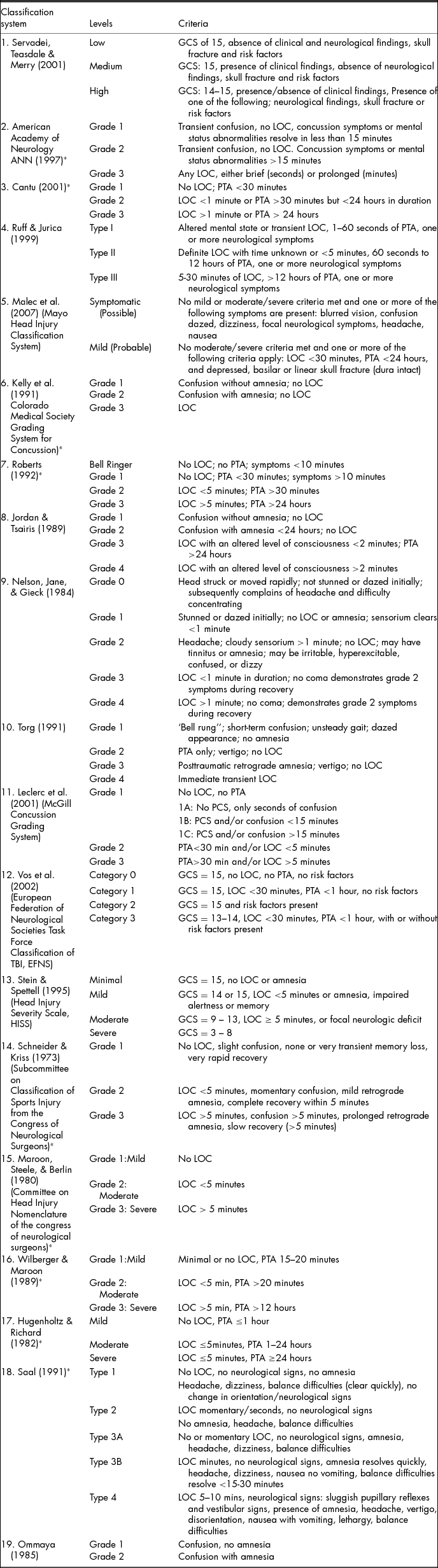
A total of 40 systems were identified, 19 met the inclusion criteria for analysis (see Table 1). Of the 22 excluded systems, three were duplicates, one system was a previous version of an included system, five did not sub-classify mild injuries, five required complex tests for classification (e.g., CT and MRI scans or neuropsychological/neurological examinations), five provided insufficient details of the system to enable classification of participants, and two were dependent on the exact timing of amnesia (currently only the presence of amnesia is recorded due to many people not seeking treatment for some time after injury). Descriptions of the 19 included systems and their classification criteria are outlined in Table 1. Any criteria referring to moderate or severe injuries (e.g., coma >6 hours) have been omitted here due to the focus on mild-TBI.
Description of the Mild TBI Sub-Classification Systems

*Denotes the system was originally developed for use within the sports context.
On review of the systems outlined in Table 1, it was evident that the systems used different wording for their sub-classification criteria (minimal/mild/moderate or low/medium/high risks or different numerical grade/types). For the purposes of comparison in the analysis, the names were removed and the systems were graded ranging from 1 to 5 from least severe to more severe.
PART 2. Application of mild sub-classification systems to an adult mild-TBI cohort
Methods
Mild-TBI Cohort
A cohort of N=869 adult participants (aged ≥16 years at the time of injury) who had experienced a mild-TBI was extracted from a population-based epidemiological study of incidence of outcomes of TBI (Feigin et al., Reference Feigin, Theadom, Barker-Collo, Starkey, McPherson and Kahan2013; Theadom et al., Reference Theadom, Barker-Collo, Feigin, Starkey, Jones and Jones2012). Within this study, people who had experienced a TBI (both hospitalised and non-hospitalised) across the severity spectrum were identified in the Hamilton (129,249 residents) and Waikato Districts (43,956 residents) in the central North Island of New Zealand over a 12-month period (1st March 2010 to 28th February 2011). All cases were reviewed by neurologists and neuropsychologists to determine eligibility based on the World Health Organization criteria. TBI severity was broadly defined using the Glasgow Coma Scale (GCS, Teasdale & Jennett, Reference Teasdale and Jennett1974) 13–15 and/or Post-Traumatic Amnesia (PTA, Marosszeky, Ryan, Shores, Batchelor, & Marosszeky, Reference Marosszeky, Ryan, Shores, Batchelor and Marosszeky1997) <24 hours; moderate TBI – as GCS 9–12 and/or PTA 1–6 days; and severe TBI – as GCS 8 or less and/or PTA 7 or more days (Carroll et al., Reference Carroll, Cassidy, Holm, Kraus and Coronado2004). If GCS and PTA severities differed, the more severe category was assigned. If no information on PTA was available, severity was based on the GCS score only. All adult TBI participants classified as mild (including concussion) were extracted for this analysis.
A participant flow diagram outlining the reasons for non-inclusion in this analysis is presented in Figure 1. There were no differences between those who were included in the analysis and those who were not, based on age t=0.06, p=0.95, gender X 2 = 1.85, p=0.17, urban/rural living status X 2 =1.65, p=0.71 and mechanism of injury X 2 = 1.65, p=0.80. Of the sample, 33% of participants were identified from community-based services or self-referrals and did not attend hospital post injury. Ethical approval was obtained from the Northern Y Health and Disability Ethics Committee of New Zealand (NTY/09/09/095) and the Auckland University of Technology Ethics Committee (09/265). All participants taking part in the study provided written informed consent.
Participant flow diagram.

Assessment Procedure
On identification of each participant, details of their injury were obtained from hospital/GP or other clinical records (e.g., physiotherapy). Alternatively, if the participant did not seek medical treatment, information about the injury and acute symptoms experienced was collected from self-report. Each eligible participant was invited to complete follow-up assessments over the year following their injury.
The Rivermead Post Concussion Symptoms Questionnaire (RPQ, King, Crawford, Wenden, Moss, & Wade, Reference King, Crawford, Wenden, Moss and Wade1995) was used to assess the severity and frequency of symptoms commonly experienced after a brain injury. Participants were asked to rate the severity with which they have experienced each symptom over the past 24 hours compared with how severe it was before the injury on a scale of 0 = ‘not experienced’, 1 = ‘no more of a problem’, 2 = ‘mild problem’, 3 = ‘moderate problem’, 4 = ‘severe problem’. A total score was calculated by a sum of all symptom scores. Scores can range from 0 (no change in symptoms since TBI) to 64 (severe post-concussion symptoms). The RPQ has demonstrated good concurrent and predictive validity in people with TBI and sound test–retest reliability (King, Crawford, Wenden, Caldwell, & Wade, Reference King, Crawford, Wenden, Caldwell and Wade1999; King et al., Reference King, Crawford, Wenden, Moss and Wade1995). Data on the RPQ collected 1-year post injury was extracted for this analysis.
Sub-classification of Mild-TBI Participants
Eligible participants were sub-classified based on the criteria outlined by each of the identified TBI classification systems using data extracted from the medical record or self-reported by the participant. If there was no mention of a particular criterion in the data, the sign or symptom was deemed not to have been present and the lowest category was assigned. If a specific criterion was not able to be applied, categorisation was based on all other available information.
Statistical Analysis
A series of univariate ANOVAs were run (one for each classification system) to determine if the different grades of injury led to variation in post-concussive symptoms at 1-year post injury. Each sub-classification system's grades were used as the grouping variable, and the RPQ total score as the dependent variable. Bonferroni correction was applied to account for multiple comparisons. The Bonferroni-corrected p value was 0.05/19 tests = 0.0026. Adjusted R-Squared values are reported to show how much variation in the RPQ outcome measure was accounted for by each sub-classification system.
Following the identification of the most predictive sub-classification system (as determined by the adjusted R-squared value and p value resulting from the univariate ANOVA), a multivariate hierarchical regression model was employed to determine the contribution of the system to post-concussion symptoms at 1 year. The classification system was entered into the first step of a hierarchical regression analysis to explore the amount of variance explained by the system. In the second step, known prognostic factors of mild-TBI, including age, sex, ethnicity, substance use, extracranial injury, living situation, comorbidities, previous psychiatric disorder and prior TBI, were entered into the model to explore the relative contribution of the model to socio-demographic and contextual factors to outcome.
Results
First, the proportions of mild-TBI participants classified into the different sub-classification system grades are outlined, the results of a series of ANOVAs are then presented to determine whether there were any differences in post-concussion mean scores between the different system grades at 1-year post injury. The results of correlation analysis and multivariate hierarchical regression model are then presented.
Classification of Mild-TBI Participants into System Grades
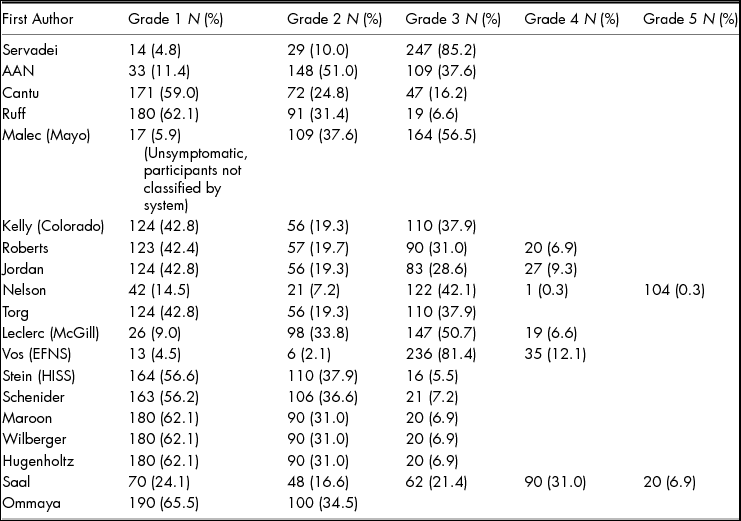
The proportions of mild-TBI participants classified into the different sub-classification grades are shown in Table 2. Classification varied considerably between different systems. Some sub-classification systems judged the majority of participants’ injury severity to fall more in the lower/less severe grade (e.g., Ommaya, Maroon, Wilberger, Hugenholtz and Ruff systems), while others tended to classify our sample in the higher/more severe grades (e.g., Servadei system). Classification using the Maroon, Wilberger and Hugenholtz systems yielded the same results, as they were based only on loss of consciousness and/or PTA and were therefore combined. The system by Scheider yielded similar results, but as the system included other criterion such as confusion and memory loss, this system was retained separately in the analysis. Seventeen (5.9%) participants did not experience any symptoms following their injury (as identified by self-report or medical records) and were therefore unable to be classified by the Malec system. Consequently, an additional category of ‘unsymptomatic’ was added to capture these participants for this system. The data for post-concussion symptoms were skewed towards the lower end of the scale. Whilst ANOVA results have not been found to be sensitive to moderate deviations from normality, in order to check for the influence of the non-normal distribution of the data, Kruskal–Willis tests were conducted. These analyses revealed comparable findings, with no systems able to significantly distinguish between groups, with the exception of the Saal (Reference Saal1991) system, χ 2 = 9.47, p = 0.05.
Classification of Sample based on Mild-TBI Sub-classification Systems (N = 290)

Identifying Differences in Post-Concussion Symptoms by System Grade
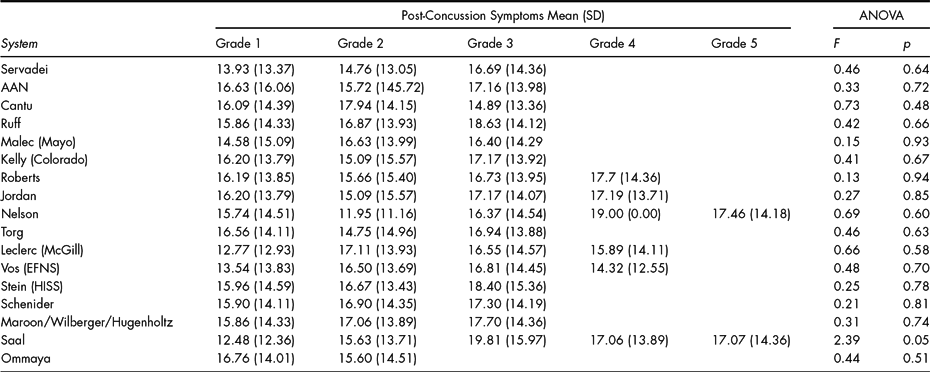
As outlined in Table 3, only the Saal (Reference Saal1991) system was able to statistically determine a difference in group means for post-concussion symptoms at 1-year post injury. On exploration for points of difference between the Saal (Reference Saal1991) system and the other systems, it was evident that there was a greater focus on the symptoms experienced after the injury and this system included more sub-classification levels. Systems relying on GCS and PTA for the mild-TBI sample revealed low clinical utility in differentiating outcome at 1 year. Following adjustment for multiple comparisons, no system was able to retain the ability to significantly distinguish between post-concussion symptoms at 1 year.
Sub-classification According to the Different Systems and Utility in Differentiating Experience of Post-concussion Symptoms at 12 Months

Determining the Individual Contribution of System Variables on Post-Concussion Symptoms
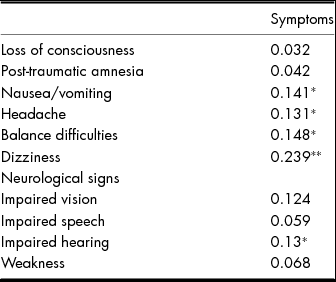
On examining correlations between the criterion highlighted by the Saal (Reference Saal1991) system and post-concussion symptoms (Table 4), it was evident that acute symptoms of headaches, dizziness, balance difficulties and nausea/vomiting and impaired hearing were significantly associated with outcomes at 1 year.
Correlations Between Factors Highlighted by the Saal (Reference Saal1991) Classification System and Post-concussion Symptoms at 1 Year

*p < 0.05, **p < 0.01
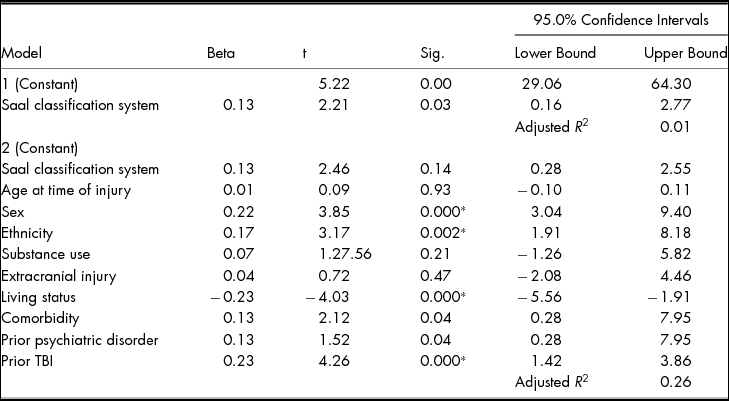
Hierarchical regression analyses showed that the Saal (Reference Saal1991) sub-classification system alone predicted 1% of the variance in post-concussion symptoms at 1 year. As can be seen in Table 5, adjusting for all known covariates or predictors that could confound the results the model explained 26% of the variance in post-concussion symptoms at 1-year post injury. The factors contributing most to explaining the variance in post-concussion symptoms were gender, ethnicity, living alone at time of the injury and a prior TBI.
Hierarchical Regression Analyses for Post-concussion Symptoms at 1 Year

Discussion
This study aimed to identify whether an existing sub-classification system could help to predict outcome following a mild-TBI. There were 19 mild sub-classification systems identified in the search of the literature. Only one system (Saal, Reference Saal1991) that incorporated loss of consciousness and presence of symptoms, including nausea/vomiting, headache, dizziness and balance difficulties, was able to significantly differentiate post-concussion symptoms 1-year post injury. However, after adjusting for multiple comparisons and following the addition of socio-demographic variables into the regression model, the system no longer remained a significant predictor of outcome. Existing sub-classification systems for mild-TBI revealed poor utility in differentiating outcome 1-year post injury.
The links between acute symptoms of headache, dizziness and nausea on presentation and poorer outcomes identified in this study supports previous findings from hospital-based studies of mild-TBI (De Kruijk et al., Reference De Kruijk, Leffers, Menheere, Meerhoff, Rutten and Twijnstra2002). The significant association between balance difficulties and post-concussion symptoms found in this study extends that of previous research and suggests that balance difficulties should also be screened for on medical presentation to assist in outcome prediction. As these symptoms are also included in the RPQ outcome measure, it was expected that significant correlations would be observed. However, it was interesting that the Saal (Reference Saal1991) system's prognostic value, when including these symptoms alongside loss of consciousness as part of its criteria, was low. This suggests that other factors may be more important in explaining variance in longer term outcomes.
It was often difficult to apply some sub-classification symptoms to our data, as it was not clear how some criteria were defined. For example, it was not clear exactly what was meant by the terms ‘mental status abnormalities’, ‘focal neurological symptoms’ and ‘sensorium’. Some criteria, such as hyperexcitability, vacant stare, inability to focus attention, emotionality out of proportion and lack of awareness of surroundings, were also unable to be utilised as they were not routinely collected within the medical record or reported by participants. Additionally, routinely collected data rarely distinguished the presence and duration of retrograde and anterograde amnesia as outlined by several of the included systems making application of the systems challenging. There were also instances, where it was unclear as to whether participants needed to experience all symptoms outlined to be graded at that level, (e.g., within the Saal, Reference Saal1991 system, dizziness is specified in Type 1 and Type 3, but not Type 2). This may have influenced the lack of statistical significance of the findings. Definitions of the terms used (and examples of what each term does or does not include) within the sub-classification systems would assist in their application.
When considering classification of injuries, there may have been an impact on time of health care seeking and reporting of symptoms (Rapp & Curley, Reference Rapp and Curley2012). In some participants, people may have been seen quickly post injury by ambulance personnel, in other cases, people may have seen their GP the following day or several days later, if at all. Consequently, the timing of symptom reporting may need to be taken into account when exploring the utility of sub-classification systems. The RPQ asks people to rate the frequency and severity of symptoms, comparing themselves now with before the accident. This helps in trying to distinguish between symptoms related more directly to the TBI than those commonly experienced in everyday life. However, there is evidence suggesting that patients report that their pre-injury functioning is better than the average person, suggesting a potential recall bias (Iverson, Reference Iverson2010). With many symptoms being subjective in their nature, there is a need to explore the predictors of increased self-reported symptoms noting the limitations of this approach. What this study has also highlighted is that future research also needs to take into account the timing of symptom reporting to explore if this affects utility of mild sub-classification systems.
As the aim of the study was to predict how well the systems were able to predict the overall symptom experience, and to identify whether some symptoms were more indicative of outcome than others, all RPQ items were analysed as one scale or as individual items. Whilst in line with the original scale proposed by King et al. (Reference King, Crawford, Wenden, Moss and Wade1995), it is acknowledged that subsequent research has found little evidence to support a unidimensional structure. Due to inconsistent findings regarding the underlying factor structure of the RPQ measure, there was no clear evidence to support the use of an alternative scoring method for this analysis. Further research across difference TBI severities to confirm the underlying factor structure of the RPQ is needed to inform how the measure should be applied most accurately.
Our results challenge previous findings regarding the utility of the GCS and PTA systems for mild-TBI populations. GCS and PTA were not found to differentiate or correlate with post-concussion symptoms in this sample. Additionally, as many participants sought medical attention in the community in this mild-TBI sample, 42.4% did not have a GCS or PTA recorded. Inclusion of participants who did not seek medical attention and therefore did not have a GCS or PTA recorded was strength of our sample, as sub-classification systems need to be able to be applied to these people who are also at risk of poor outcomes. There can be challenges in determining GCS/LOC and PTA in retrospect, as they can be highly variable over time and the patient needs to be examined by a health care professional to apply them accurately. As GCS and PTA were not routinely collected in the community and were not linked to longer term symptoms in participants where this information was available, whilst they may be useful indicators of outcome from moderate to severe TBI, GCS and PTA may not be useful factors in predicting outcome for mild-TBI.
It was interesting that as the severity grading for each system increased, this did not necessarily equate to increased severity and frequency of post-concussion symptoms experienced at 1 year. For example, in the Saal (Reference Saal1991) classification system the first three grades showed a gradual increase in mean scores as would be expected, but grades 4 and 5 had lower mean symptom scores than grade 3. This may reflect the reliance on accuracy of the timing of loss of consciousness in order to be assigned the higher severity grades (as those without experiencing LOC but where this was not accurately recorded were assigned a lower severity grade). Consequently, the first three grades of the Saal (Reference Saal1991) classification system performed as would be expected from an ordinal scale, but there may be a need to refine grades 4 and 5 specifically, to enhance the performance of this system in predicting outcome.
Whilst many mild sub-classification systems emerged from the need to screen for concussion in sport, it is of note that many sports clinicians have moved away from using brief classification systems in favour of more complex assessments, such as Sports Concussion Assessment Tool or King-Devick tests (Galetta et al., Reference Galetta, Barrett, Allen, Madda, Delicata, Tennant and Balcer2011). Both tools include a cognitive assessment, and the SCAT also incorporates an assessment of symptoms, loss of consciousness, GCS and a balance, neck and co-ordination examination. Whilst such tools are important for assisting health professionals in assessing concussion sustained during a supervised sports activity, such a comprehensive assessment would be difficult to administer within a busy Accident and Emergency clinic and are not designed for use by members of the general public (or require access to the Internet). The Sports Concussion Recognition Tool (McCrory et al., Reference McCrory, Meeuwisse, Aubry, Cantu, Dvorak, Echemendia and Turner2013) is useful to assist in identification of concussion in the general population, however, the tool does not provide any mechanism of identifying those who may be more at risk of persistent symptoms in primary or acute care. With the emergence of new technologies, diagnostic approaches, such as diffusion tensor imaging and functional magnetic resonance imaging hold promise for the prediction of post-concussion symptom, following mild-TBI (Studerus-Germann, Thiran, Daducci, & Gautschi, Reference Studerus-Germann, Thiran, Daducci and Gautschi2016). However, these technologies remain unavailable to many, and therefore it is important to identify factors that can be easily assessed and recorded in both primary (general practice) and secondary (hospital) care as well as by sports coaches and other personnel to help identify those at increased risk of long-term problems, where medical supervision is not available.
Further, the need for mild sub-classification systems is important both for health care planning and for providing information on prognosis to patients. One the most common challenges those affected as well as families and friends experience following mild-TBI is understanding, recognising and acknowledging the persistence of their often ‘invisible’ symptoms (Morris et al., Reference Morris, Prior, Shoumitro, Lewis, Mayle, Burrow and Bryant2005; Saban, Hogan, Hogan, & Pape, Reference Saban, Hogan, Hogan and Pape2015). Given the extensive heterogeneity in mild-TBI, it has been highlighted that the term mild-TBI may actually be unhelpful (McMahon et al., Reference McMahon, Hricik, Yue, Puccio, Inoue, Lingsma and Vassar2014; Tellier et al., Reference Tellier, Della Malva, Cwinn, Grahovac, Morrish and Brennan-Barnes1991). A mild-TBI sub-classification system that can accurately predict outcome may assist in providing clarity and enable practitioners to tailor their information to each person to prevent causing unnecessary concern in those at low risk of persistent symptoms, whilst informing those of the possibilities to those at higher risk. A tool that clearly identifies sub-categories may also assist in generating and defining a new term(s) for referring to mild-TBI.
Symptoms of dizziness, nausea/vomiting, headaches and balance difficulties (factors included in the Saal classification system) only explained 1% of the variance of post-concussion symptoms 1-year post injury. Consequently, the findings of this study highlight that these factors need to be considered alongside socio-demographic and injury characteristics to most effectively predict outcome following mild-TBI. A modified sub-classification/prognostic system encompassing both acute symptoms and contextual factors is needed to better predict outcomes following mild-TBI.
Acknowledgments
We would like to acknowledge the people, who were involved in the recruitment and collection of data for the parent research study, including the Research Assistants and staff of the New Zealand Accident Compensation Corporation, Waikato Corrections Department, New Zealand Health Information Service, Waikato District Health Board and Waikato University, ABI Management, Waikato Concussion Service and the THINK patient support organisations. A special thanks to the study participants and their families and friends.
Financial Support
The parent study from which the TBI sample and assessment data were extracted was funded by the Health Research Council of New Zealand (Grant reference numbers: HRC 09/063A and 11/192).
Conflict of Interest
Kathryn McPherson was appointed as the Chief Executive of the Health Research Council in 2015, but was neither in post nor involved in the funding decisions for this study. The authors declare no conflicts of interest.
Ethical Standards
The authors assert that all procedures contributing to this work comply with the ethical standards of the relevant national and institutional committees on human experimentation and with the Helsinki Declaration of 1975, as revised in 2008.
Bionic Study Group Members
Valery Feigin, Alice Theadom, Suzanne Barker-Collo, Kathryn McPherson, Robert Kydd, P. Alan Barber, Varsha Parag, Paul Brown, Nicola Starkey, Anthony Dowell, Michael Kahan, Shanthi Ameratunga, Grant Christey, Kelly Jones, Amy Jones, Natalie Hardaker and Braden Te Ao.