Decision making (DM) is a frequent process in life, commonly undertaken under stressful conditions, which could be a stressor itself. DM and stress processes also share the activation of certain neural pathways (Cabib & Puglisi-Allegra, Reference Cabib and Puglisi-Allegra2012). For the interaction between DM and acutely induced laboratory stress, Starcke and Brand (Reference Starcke and Brand2012) indicate that acute stress may alter processes related to DM in a linear manner, although a U-inverted relationship is also possible. This alteration in DM processes may result from a stress induced increase in catecholamines and cortisol, which affect neural pathways involved in DM, such as the prefrontal cortex (PFC) (Cabib & Puglisi-Allegra, Reference Cabib and Puglisi-Allegra2012). Many studies have focused on the slow acute stress effects on DM through the hypothalamic-pituitary-adrenal (HPA) axis. However, rapid acute stress response by means of the activation of the sympathetic nervous system (SNS) that causes an increase in catecholamines has received less attention (Pabst, Schoofs, Pawlikowski, Brand, & Wolf, Reference Pabst, Schoofs, Pawlikowski, Brand and Wolf2013). Few studies have focused on rapid acute stress response – in which measures such as heart rate or glucose levels are influenced by SNS activity and catecholamine secretion. The lack of studies in this area makes it difficult to understand how rapid acute stress response may influence DM (Pabst, Brand, & Wolf, Reference Pabst, Brand and Wolf2013b). Data suggests that a moderate increase in catecholamines, in the absence of elevated cortisol concentrations, may enhance performance in DM tasks; while elevated levels of cortisol may impair DM in men (Pabst, Brand, & Wolf, Reference Pabst, Brand and Wolf2013a). However, results are far from consistent.
Studies on this issue differ in aspects that may partially explain discrepancies in results. Firstly, various stressor stimuli were employed such as the Trier Social Stress Test (Gathmann et al., Reference Gathmann, Schulte, Maderwald, Pawlikowski, Starcke, Schäfer and Brand2014; Pabst et al., Reference Pabst, Brand and Wolf2013a; Pabst et al., Reference Pabst, Brand and Wolf2013b; Pabst, Schoofs et al., Reference Pabst, Schoofs, Pawlikowski, Brand and Wolf2013; Preston, Buchanan, Stansfield, & Bechara, Reference Preston, Buchanan, Stansfield and Bechara2007; Starcke, Wolf, Markowitsch, & Brand, Reference Starcke, Wolf, Markowitsch and Brand2008; van den Bos, Hartefeld, & Stoop, Reference van den Bos, Hartefeld and Stoop2009) or the Cold Pressor Test (Porcelli & Delgado, Reference Porcelli and Delgado2009), despite the fact that different stressors may evoke different patterns of neural activity and effects on DM (Buckert, Schwieren, Kudielka, & Fiebach, Reference Buckert, Schwieren, Kudielka and Fiebach2014). Secondly, there are also differences in the interval between stress induction and DM tasks. It has been suggested that the different times of performing a task in relation to the onset of the stressor could have different effects on cognitive performance. Thus, Pabst et al. (Reference Pabst, Brand and Wolf2013a) found less risk-taking 5 and 18 minutes after stress induction than 28 minutes after induction. When an executive task is performed immediately after the stress induction, the acute stress effects on cognitive performance can be ameliorated since hormonal response do not reach the plateau (Pabst et al., Reference Pabst, Brand and Wolf2013b). Thirdly, individual factors such as personality may also modulate acute stress effects on DM (Porcelli & Delgado, Reference Porcelli and Delgado2009).
Another important factor underlying studies in DM and acute stress interaction is the task employed to evaluate DM. Among the most frequently used tasks are the Iowa Gambling Task (Preston et al., Reference Preston, Buchanan, Stansfield and Bechara2007; van den Bos et al., Reference van den Bos, Hartefeld and Stoop2009), the Game of Dice Task (Gathmann et al., Reference Gathmann, Schulte, Maderwald, Pawlikowski, Starcke, Schäfer and Brand2014; Pabst et al., Reference Pabst, Brand and Wolf2013a, Reference Pabst, Brand and Wolf2013b, Pabst, Schoofs et al., Reference Pabst, Schoofs, Pawlikowski, Brand and Wolf2013; Starcke et al., Reference Starcke, Wolf, Markowitsch and Brand2008), and the Balloon Analogue Risk Task (Lighthall et al., Reference Lighthall, Sakaki, Vasunilashorn, Nga, Somayajula, Chen and Mather2012).
These tasks differ subtly, although they all involve decision making under some degree of uncertainty and the contingencies associated with a previous decision are not explicitly provided to the participants. In fact, decision-making has been classified into at least two categories: decision-making under ambiguity and decision-making under risk (Brand, Labudda, & Markowitsch, Reference Brand, Labudda and Markowitsch2006). Ambiguous conditions provide equivocal rules for reward and punishment and are frequently examined with the Iowa Gambling Task. This task requires the development of implicit preference for advantageous choice under ambiguous reinforcement contingencies, which involve structures such as the orbitofrontal/ventromedial prefrontal cortex and amygdala (Gupta, Koscika, Bechara, & Tranel, Reference Gupta, Koscika, Bechara and Tranel2011). In neuropsychological research, risky conditions that offer expected outcomes for competing alternatives have been frequently studied using the Game of Dice Task. This task provide gains and losses based on explicit rules and apparent winning probabilities, which are associated with the activation of several brain regions, such as the dorsolateral prefrontal cortex, posterior parietal lobe, anterior cingulate cortex, and right lingual gyrus (Labudda et al., Reference Labudda, Woermann, Mertens, Pohlmann-Eden, Markowitsch and Brand2008). The Balloon Analog Risk Task (BART), in which subjects inflate a virtual balloon that can either expand or explode, provides an ecologically valid model to assess human risk taking propensity and behavior – and is associated with activation in mesolimbic-frontal regions, including the midbrain, ventral and dorsal striatum, anterior insula, dorsal lateral prefrontal cortex, and anterior cingulate/medial frontal cortex (Rao, Korczykowski, Pluta, Hoang, & Detre, Reference Rao, Korczykowski, Pluta, Hoang and Detre2008). However, studies with the evaluation of these DM tasks in the same sample are infrequent.
As for as individuals being intrinsically averse to risk and ambiguity, studies focused on DM in contexts with some degree of uncertainty consistently report significant effects of acute stress (Morgado, Sousa, & Cerqueira, Reference Morgado, Sousa and Cerqueira2015). In fact, studies focused on DM using the Iowa Gambling Task have reported an increase in disadvantageous decisions – suggesting impairments in contingency learning that are associated with cortisol changes (Preston et al., Reference Preston, Buchanan, Stansfield and Bechara2007; van den Bos et al., Reference van den Bos, Hartefeld and Stoop2009). When the Game of Dice task was employed to evaluate DM, an increase in disadvantageous choices (Starcke et al., Reference Starcke, Wolf, Markowitsch and Brand2008) and an increase in risky decisions without DM impairment (Gathmann et al., Reference Gathmann, Schulte, Maderwald, Pawlikowski, Starcke, Schäfer and Brand2014) or even DM improvements was found (Pabst et al., Reference Pabst, Brand and Wolf2013a), although longer reaction times in loss domain were observed (Pabst et al., Reference Pabst, Brand and Wolf2013b). In this setting, competition in cognitive resources could interact with stress effects, since a second executive task (2-back task) could abolish the stress conditioned preference for risky decisions (Pabst, Schoofs et al., Reference Pabst, Schoofs, Pawlikowski, Brand and Wolf2013). Finally, data from studies using the Balloon Analogue Risk Task suggest that acute stress enhances risk taking behavior, reward collection, and increases decision speed (Lighthall et al., Reference Lighthall, Sakaki, Vasunilashorn, Nga, Somayajula, Chen and Mather2012), and this is probably mediated by personality traits (Wise, Phung, Labuschagne, & Stout, Reference Wise, Phung, Labuschagne and Stout2015). Taking these studies together, the differential effects of acute stress on performance in these tasks has not (to our knowledge) been studied in the same sample.
The purpose of the present study is to examine the effect of acute stress on DM in ambiguous and risky conditions in a laboratory stress context in young healthy men. According to previous studies, an increase in risky decisions together with a disrupted performance in ambiguous and risky DM conditions after acute stress activation is expected. Additionally, personality factors, the magnitude of stress response, and cognitive performance after acute stress and a possible impulsive response profile have been considered. Finally, we hypothesized that autonomic and hormonal activation could mediate the performance in decision making in ambiguous and risky conditions.
Material and Method
Participants
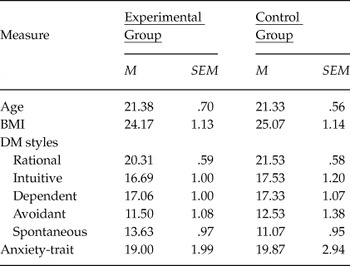
Thirty-one young healthy men (mean age ± SEM = 21.35 ± .44; range: 18–26 years) were recruited using local advertisements. A standardized telephone interview was used to select the sample according to the following requirements: non-familiarity with neuropsychological tests; no history of disease; no drug abuse; and no stressful life events in the last three months. As a precondition for the experiment, we indicated to the participants that they should not eat or be physically active two hours before the experiment. All participants signed informed consent forms and received monetary compensation for participation (€20). The study was conducted according to the ethical standards of human experimentation in the Declaration of Helsinki. Participants were randomized into two groups: experimental group (EG) and control group (CG). EG (n = 16) was exposed to an acute stress situation, and CG (n = 15) was exposed to a similar cognitive demand situation, but under minimal conditions of stress. Descriptions for both groups are in Table 1.
Participant characteristics

Experimental design and procedure
A between subjects design was used. The study was conducted between 3 pm and 8 pm while participants were seated at a constant temperature (22 °C).
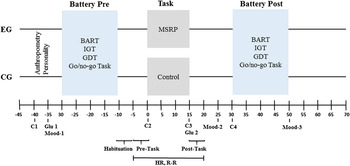
After the participants were gathered, they were asked if they had followed the preconditions of the study (not to eat or undertake physical activity two hours before the experiment), and the study was conducted only if these conditions were followed. A neuropsychological battery (BAT) was then administered to assess baseline in DM performance, and mood states (Mood-1) was evaluated. Participants were then led to another room where acute stress or control situations were administered and electrodes were placed for measuring electrophysiological variables. After habituation, continuous electrophysiological recording of the baseline (BL) during five minutes, the task (15 minutes), and post-task (5 minutes after task) were performed. The task was an adaptation of the Matt Stress Reactivity Protocol (MSRP; Traustadóttir, Bosch, & Matt, Reference Traustadóttir, Bosch and Matt2003). After the electrodes were removed, mood states (Mood-2) were evaluated, and 30 minutes after acute stress onset, the BAT and mood (Mood-3) were assessed again.
We collected four saliva samples to measure cortisol and two glucose blood samples. For cortisol, saliva samples were collected 40 min before, and then immediately before the task (C1 and C2, respectively); and immediately after (C3), and 15 minutes after the task (C4). For glucose, the blood samples were taken 35 min before the task (Glu 1) and immediately after the task (Glu 2). Finally, anthropometric and demographic data was registered and psychological trait questionnaires were completed. Figure 1 shows a summarized version of the experimental protocol.
Time-line of the experimental protocol for the acute stress and control groups.

Acute stress induction: Stress situation and control situation
To homogenize the cognitive demands, all participants performed the same tasks – an adaptation of MSRP (Traustadóttir et al., Reference Traustadóttir, Bosch and Matt2003) – but administration conditions were manipulated. For the EG, time for the tasks was limited and participants were told that performance would be evaluated, while no time limit was given to the CG and participants were told that performance would not be evaluated. In addition, only in the EG, a tuning fork sound was reproduced and participants were recorded with a video camera. MSRP consisted of a stress test battery that combines cognitive tasks (Stroop, arithmetic and anagram tasks), a Cold Pressor Test, and a psychosocial stressor (evaluative threat during a speech) in a set order:
Stroop color word task (Golden, Reference Golden1978)
One of three words (red, blue, or green) was displayed on the computer screen, with the color and meaning of each word producing interference. The EG had a limit of 45 seconds for this task.
Mental arithmetic test
This task consisted of solving mathematic operations. In the EG, the operations descended from the top of a computer screen to the bottom, thus limiting solution time.
Anagram task
Twelve anagrams were presented with ten seconds given for solving each for the EG.
Cold pressor test (CPT; Hines & Brown, Reference Hines and Brown1932)
EG participants placed their dominant hand in a bucket of ice water (0 °C) for as long as they could (up to three minutes). In the CG, the procedure was similar but the bucket contained warm water (34 °C).
Interpersonal stressor
In the EG, participants were asked to prepare a speech about a stressful event in their lives. Participants were told that after ten minutes of preparation, their speech would be evaluated by judges. However, after a few minutes of preparation, the speech was canceled. In the CG, there was no anticipation of speech assessment.
Neuropsychological assessment (BAT)
DM was evaluated using three tasks in the following order: the Balloon Analogue Risk Task, the Iowa Gambling Task, and the Game of Dice Task. Inhibition behavior was then evaluated by means of a Go/no-go Task, as a possible modulator of DM processes.
Balloon analogue risk task (BART; Lejuez et al., Reference Lejuez, Read, Kahler, Richards, Ramsey, Stuart and Brown2002)
A computer-based measure of risk-taking propensity. During 90 trials, participants are invited to inflate a computerized balloon by pushing a ‘pump’. Money is accumulated with each pump – although it is lost if the balloon explodes. Performance was evaluated by the average number of pumps made on blue balloons excluding balloons that exploded. It has been suggested that higher scores are indicators of greater risk-taking (Lejuez et al., Reference Lejuez, Read, Kahler, Richards, Ramsey, Stuart and Brown2002).
Iowa gambling task (IGT; Bechara, Damasio, Damasio, & Anderson, Reference Bechara, Damasio, Damasio and Anderson1994)
In a computerized version of the IGT (Palacios, Paíno, & Alameda, Reference Palacios, Paíno and Alameda2010), participants were told to make choices among four decks of cards to maximize their gains during 50 trials. Disadvantageous decks (A and B) provide high immediate gain but larger future losses; while advantageous decks (C and D) provide lower immediate gain but smaller future losses. The final score (GI) was obtained by subtracting disadvantageous from advantageous choices.
Game of dice task (GDT; Brand et al., Reference Brand, Fujiwara, Borsutzky, Kalbe, Kessler and Markowitsch2005)
A computerized game with stable and explicit rules. Participants must choose during 18 trials a single number or a combination of two, three, or four numbers. After each trial, feedback is given about the outcome of the previous decision. Every number or combination is associated with an explicit and stable gain or loss and a win-lose probability. The single number and two number combinations are understood to be disadvantageous (winning probability below 34%) and combinations of three or four numbers are advantageous (winning probability below 50% or higher). The final index indicates a safer performance.
Go/no-go task (Bezdjian, Baker, Lozano, & Raine, Reference Bezdjian, Baker, Lozano and Raine2009)
A response inhibition task in which the participant must execute or inhibit a response. The task has 160 trials and in each trial a letter (P or R) in a 2 x 2 matrix is presented for 500 milliseconds with an inter-stimulus interval of 1500 milliseconds. Participants were asked to press a button in response to the target letter P and withhold their response to the non-target letter R. The ratio of targets to non-targets was 80:20. Performance was assessed by calculating three values: errors of omission, errors of commission, and reaction time (RT). Errors of omission were considered as an indicator of inattention, while errors of commission and RT were considered as indicators of impulsivity.
Electrophysiological measures of acute stress response
An MP30 system and AcqKnowledge 3.9.1. software (BIOPAC Systems, Bionic Ibérica, Spain) were used to record heart rate (HR). A cable set SS2L electrode was connected to a single input channel acquisition MP30 system to record electrocardiographic activity (ECG). Three standard disposable EL500 series electrodes were used. Two electrodes were placed on the medial surface of each leg above the ankle. A third electrode was placed on the non-dominant forearm above the wrist. A digital low-pass filter (cutoff frequency: 30 Hz) was applied to remove signal artifacts. Channel ECG data was transformed to obtain the heart rate in beats per minute. Kubios HRV Analysis Software 2.2 (Biosignal Analysis and Medical Imaging Group [BSAMIG], University of Kuopio, Finland) was used to filter the signal. In each moment of electrophysiological recording (baseline, task, and post-task) the five central minutes were analyzed (Task Force of the European Society of Cardiology and the North American Society of Pacing and Electrophysiology, 1996). The following parameters were calculated: (a) time domain: heart rate (HR), RR intervals, root mean square differences of successive RR (RMSSD), number of consecutive RR intervals differing more than 50 ms (NN50), the proportion of NN50 divided by total number of NNs (pNN50); and (b) frequency domain: absolute power of low frequency band (LF) (.04 – .15 Hz), absolute power of high frequency bands (HF) (.15 – .4 Hz), relative power of low frequency bands (LF nu), relative power of high frequency bands (HF nu), and ratio between LF and HF band powers (LF/HF).
Hormonal response to acute stress
Cortisol
Saliva samples were collected using salivettes (Sarstedt, Nümbrecht, Germany) for cortisol. Participants were instructed to keep the cotton swab in their mouths for 2 min. The samples were centrifuged at 3000 rpm for 15 min, resulting in a clear supernatant with low viscosity that was stored at –80 °C until the analyses were performed in the Laboratory of Social Cognitive Neuroscience, Faculty of Psychology (University of Valencia). Salivary cortisol concentrations were determined in duplicate with the salivary cortisol enzyme-immunoassay kit from Salimetrics (Newmarket, UK). Assay sensitivity was < .007 ug/dL. For each subject, all the samples were analyzed in the same trial. The criterion for measurement replication was fixed as an inter-duplicate variation coefficient of 8%. The intra- and inter-assay variation coefficients were 1.47 % and 7.9 %, respectively. Cortisol levels were expressed in nmol/L.
Glucose
Glucose levels in blood (mmHg) were analyzed at two time points. For this, the tip of the index finger of the participants was punctured with Onetouch Verio IQ glucometer (Lifescan, Milpitas, USA). The variability observed for finger stick testing is 2.86% or less.
Self-reported measurements
Mood states
The Spanish translation of the POMS inventory (McNair, Lorr, & Droppleman, Reference McNair, Lorr and Droppleman1971) was used to assess mood-state. This instrument has 58 items rated on a five-point scale. The scoring manual describes a factor analysis reproducing six factors (tension, depression, anger, fatigue, confusion and vigor). This inventory has a Cronbach’s alpha for the factors that vary between .80 and .90. The STAI questionnaire (Spielberger, Gorsuch, & Lushene, Reference Spielberger, Gorsuch and Lushene1970) was used to assess anxiety-state. There are two subscales within this measure. The state anxiety scale (STAI-S) evaluates the current state of anxiety, while the trait anxiety scale (STAI-T) evaluates relatively stable aspects of anxiety. Each subscale has 20 items rated on a four-point scale. Cronbach’s alphas for the two scales vary between .90 and .94.
DM styles
General Decision Making Style Inventory (GDMS; Scott & Bruce, Reference Scott and Bruce1995) was used. This inventory measures five different DM styles: rational, intuitive, dependent, avoidant, and spontaneous. The instrument has 25 questions (five items for each dimension) rated on a five-point Likert-type scale. Cronbach’s alphas for the different dimensions vary between .62 and .87.
Data analysis
Kolmogorov-Smirnov was used to test the normality of the data. The result showed that the distribution of cortisol raw data was normal and a logarithmic transformation was performed for this variable. In addition, of the 124 data of cortisol, 5 data were missing, which supposes a percentage of 4% of missing data. These 5 data were estimated using the full information maximum likelihood (FIML) estimation method which retains cases that are missing survey waves – thus avoiding the biased parameter estimates that can occur with pairwise or listwise deletion, according to Schafer and Graham (Reference Schafer and Graham2002).
A T-test for independent samples was then performed to examine the possible differences between groups for variables and initial measurements.
To investigate the effectiveness of the stressor on cardiovascular, psychological, and hormonal variables, we performed repeated ANOVA measures with the groups (EG and CG) as the between-subjects factor. The within subjects factor (‘moment’) was different depending on the considered variable. For cardiovascular variables (HR, R-R, NN50, pNN50, LF, HF, LF nu, HF nu, and LF/HF), the ‘moment’ factor has three levels (BL, task and post-task). For glucose, the ‘moment’ factor has two levels (Glu 1 and Glu 2, pre- and post-stress/control situations, respectively). For cortisol, the ‘moment’ factor has four levels (C1, C2, C3 and C4). For psychological measurements (mood and anxiety), the ‘moment’ factor has three levels (pre-task, post-task, post-battery).
As initial differences between groups were found in RMSSD, repeated measure ANCOVAs (2 x 2) were performed for this variable where EG and CG were considered as between subjects factors; the within subjects factor (‘moment’) has two levels and initial levels were included as covariates.
For cardiovascular variables, reactivities and recoveries were calculated. Reactivity is the difference between task levels minus pre-task levels and recovery is the difference between post-task levels minus task levels. The area under the curve with respect to increase (AUCi) was used to study the global response of cardiovascular, hormonal, and psychological variables, using the trapezoid formula (Pruessner, Kirschbaum, Meinlschmidt, & Hellhammer, Reference Pruessner, Kirschbaum, Meinlschmidt and Hellhammer2003). T-tests for independent samples were performed to examine possible differences between groups in these variables.
For variables of cognitive performance, repeated measure ANOVAs (2 x 2) were performed, with group (EG and CG) as between-subjects factors and the moment (pre-task and post-task) as within-subject factors for each parameter (number of choices of A, B, C and D desk, GDT index, errors of omission, errors of commission, RT, and number of pumps made for blue balloons – excluding balloons that exploded). To calculate changes after the experimental situation (stress/control), pre-levels were subtracted from post-values.
We used Greenhouse–Geisser when the requirement of sphericity in the ANOVA for repeated measures was violated. When a factor was significant in repeated measure ANOVAs, Bonferroni adjustments for the p values and repeated measure ANOVAs on each group were performed as post hoc analysis.
Finally, the association between DM performance, anxiety trait, DM styles, and components of stress response was assessed using Spearman correlations and hierarchical regressions.
Statistical analysis was carried out using SPSS 22.0 and two-tailed tests with p set to .05 were considered as significant.
To facilitate data interpretation, the values of cortisol in the figures and tables represent raw values and not logarithmic-transformed values.
Results
Characteristics of the participants and differences between groups in initial conditions
No significant differences between groups were found in age, BMI, and DM styles or cognitive performance, cortisol, glucose, or mood before the acute stress/control situation. In HR, the only significant differences between groups were found in RMSSD, with higher levels in the EG than in the CG, t(29) = 2.31, p = .03. Thus, initial levels of this variable will be considered as covariate in later analysis.
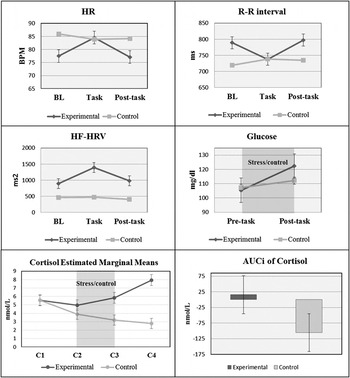
Efficiency of stress manipulation (Figure 2)
Stress manipulation was efficient since significant effects of the ‘group’ were found on cardiovascular, hormonal, and psychological responses.
Differences between groups in cardiovascular and hormonal responses. (A) HR in BL, task, posttask. (B) R-R interval in BL, task, post-task. (C) HF-HRV in BL, task, post-task. (D) Glucose levels pretask and post-task (E) Estimated marginal means of cortisol levels in before and after the tasks. (F) AUCi of cortisol.

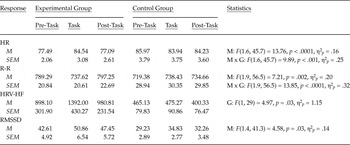
On cardiovascular measurements (Table 2), significant effects of ‘moment’ and Moment x Group interaction were found on HR levels, with significant increases after task with respect to BL in the EG, F(1, 15) = 9.86, p = .007, η2 p = .40, not found in the CG. Accordingly, HR reactivity was significantly greater in the EG than in the CG, t(29) = 3.46, p = .002, while no significant differences were found in recoveries. In HR variability, significant effects of the ‘moment’ and Moment x Group interaction were found for the RR interval. Although no significant differences between groups were found in each period, the EG but not the CG showed significant decreases in RR interval during the task with respect to BL, F(1, 15) = 17.07, p < .001, η2 p = .53. Additionally, a significant effect of ‘group’ was found on high frequency components HR (HRV-HF), with higher levels in EG in all periods (for both, p < .021). No other significant effects of ‘group’ or the interaction were found, although a significant effect of ‘moment’ exists on RMSSD, with increases after task with respect to BL for the total sample, p = .027.
Cardiovascular stress responses before, during and after experimental situation in experimental and control groups

Note: M: ‘moment’, G: ‘group’, M x G: moment x group interaction.
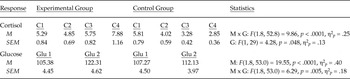
On hormonal measurements (Table 3), significant effects of the Moment x Group interaction and the main factor ‘group’ were found for cortisol levels, with higher levels of cortisol immediately after the task and 15 min after the task in the EG group (p = .02 and p < .001, respectively). AUCi of cortisol was also significantly greater in the EG than in the CG, t(29) = 2.48, p = .019. A significant effect of ‘moment’ and Moment x Group interaction was found for glucose levels, with increases after task with respect to BL in the total sample (p < .001). Increases in glucose after task were significantly higher in EG with respect to CG, t(29) = 3.71, p < .001.
Hormonal stress responses for both groups

Note: M: ‘moment’, G: ‘group’, M x G: moment x group interaction. To facilitate the interpretation of the data, the values of cortisol represent raw values and not logarithmic-transformed values.
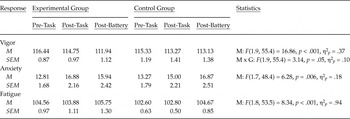
With regards to mood states (Table 4), there were significant effects of ‘moment’ and Moment x Group interaction on the vigor scale, although no significant differences between groups were found – and both groups displayed significant decreases (p < .025 for both). Finally, a significant effect of ‘moment’ was also found for state-anxiety and fatigue, with anxiety increasing after stress/control (p = .046), and fatigue after BAT (p = .002) for the total sample. No other significant effects were found on mood scores.
Psychological stress responses before and after experimental situation, and after battery for both groups

Note: M: ‘moment’, G: ‘group’, M x G: moment x group interaction.
Stress effects on cognitive performance in neuropsychological battery (Figure 3, Table 5)
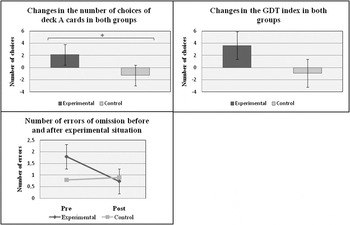
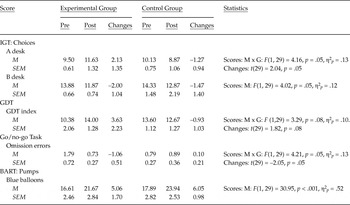
Stress manipulation had effects on cognitive performance in neuropsychological battery. For the IGT, a significant effect of Moment x Group interaction was found for the number of disadvantageous choices in deck A. When the previous performance was considered, increases in the absolute number of choices of the EG after acute stress significantly contrasted with decreases for the CG after the control situation. In addition, significant decreases in the number of choices of B deck cards (disadvantageous) have been found in the total sample, t(29) = 2.04, p = .05.
Cognitive performance in neuropsychological tasks in both groups.

Scores in cognitive tasks in experimental and control groups before and after experimental situation

Note: M: ‘moment’, G: ‘group’, M x G: moment x group interaction.
For performance in GDT, a tendency to a significant effect Moment x Group interaction was found on the GDT index. Examining changes after the experimental situation, increases in the choices of the EG contrasted with CG decreases, although not significantly.
Examining the Go/no-go Task, a significant effect Moment x Group was found for errors of omission, with the EG showing a significant decrease in errors of omission not found in the CG, F(1, 15) = 4.34, p = .05, η2 p = .22. In fact, when the previous performance was considered, EG decreases in errors of omission after stress contrasted significantly with CG increases after the control situation.
With regards to the risk-taking task (balloon), a unique significant effect of ‘moment’ exists, with higher scores after the experimental situation with respect to the previous scores in the total sample, t(30) = –5.62, p < .001.
Association between stress response, cognitive performance, DM styles and anxiety trait
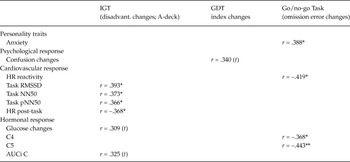
To examine the relationships between variables, correlations were made between parameters of DM performance that present differences between groups and personality variables (trait anxiety and DM styles) and the psychological, cardiovascular, and endocrine measurements of stress response. These correlations are shown in Table 6.
Association between stress response and cognitive performance

Note: *p < .05, **p < .01, (t) tendency of p < .09.
Hierarchical regressions were performed to explain, at least in part, the variability of the cognitive changes that present group differences. The changes in disadvantageous changes observed (A deck) are significantly explained by AUC of cortisol (26.1% of variance, F(1, 30) = 11.59, p = .002, standardized beta coefficient of .534). No other variable significantly contributes to the disadvantageous changes. The changes in omission error of the Go/no-go Task are 39.1% explained by the variance of AUC of HR, the state anxiety changes, and the fatigue changes; with all the variables significantly contributing to the model, F(3, 30) = 7.42, p < .001, standardized beta coefficients of –.462, .313 and .316, respectively, significance of the F changes p = .05 for all.
Discussion
The results suggest that acute stress effects are dependent on the conditions of the DM processes. In fact, acute stress favors disadvantageous DM in ambiguous conditions but not in risky conditions, and is probably favored by competition between cognitive resources in DM requirements. Acute stress also reduces errors of omission in an inhibition response task, which might suggest an improvement in attentional processes. Furthermore, these disadvantageous choices are associated with stress induced HPA activation while inhibition response is related to sympathetic and psychological response to stress.
It should be noted that the experimental procedure has been effective in producing a different psychological, hormonal, and cardiovascular response between groups. In fact, significant differences have been found in HR, RR interval, HRV-HF, cortisol, and glucose responses. However, no significant effects of mood have been found. This dissociation between the different components of the acute stress response has been found previously (Strahler & Ziegert, Reference Strahler and Ziegert2015), probably due to different timings in the responsivity of variables and/or sensitivity of psychological tools employed.
By examining DM by means of the IGT, considered in previous research as ambiguous conditions, our results show that acute stress favors choosing disadvantageous alternatives in men, according to the results of previous studies on exposure to a psychosocial laboratory stressor (Pabst, Schoofs et al., Reference Pabst, Schoofs, Pawlikowski, Brand and Wolf2013; Preston et al., Reference Preston, Buchanan, Stansfield and Bechara2007; van den Bos et al., Reference van den Bos, Hartefeld and Stoop2009). In this sense, the learning effects of contingencies have been interrupted by acute stress in the IGT. In the light of these results, it is likely that this impairment was mediated by glucocorticoid response since AUC of cortisol significantly explained the observed IGT changes. This relationship between cortisol response and the choices of disadvantageous alternatives has been previously found in men (van den Bos et al., Reference van den Bos, Hartefeld and Stoop2009) and is in agreement with the proposed hypothesis. Additionally, IGT performance has been associated with sympathetic responses to stress, such as HR levels, and nearly significantly with the glucose response, suggesting that slow hormonal responses, as well as faster cardiovascular responses, are involved in the disadvantageous choices.
With regard to acute stress effects on DM evaluated by GDT, our results show a lack of significant differences between groups, although a statistical tendency has been observed with the experimental group presenting more advantageous decisions than the controls. These results do not confirm the hypothesis presented in the present study and are not in agreement with van den Bos, Taris, Scheppink, de Haan, and Verster (Reference van den Bos, Taris, Scheppink, de Haan and Verster2014), that showed positive relationships between cortisol and risky DM in the Cambridge Gambling Task (CGT) and a lack of relationships between alpha –amylase and risky decisions in men. Nevertheless, these discrepancies may be related to differences between the GDT and the CGT or in the stressor applied (short-lasting MSRP or long-lasting job-related assessment). Considering the period between the stressor and the task, our results are not in agreement with those when this task was administered in similar periods after the onset of acute stress (Starcke et al., Reference Starcke, Wolf, Markowitsch and Brand2008). However, these results are in agreement with those found in previous studies when DM tasks were performed 20 minutes after the stress onset (Gathmann et al., Reference Gathmann, Schulte, Maderwald, Pawlikowski, Starcke, Schäfer and Brand2014). An interesting study of Pabst et al. (Reference Pabst, Brand and Wolf2013a), considering the period between stress and DM task, reports a significant improvement of DM when the task is carried out at 5 minutes after the stress onset, a nearly significant improvement at 18 minutes after stress, and a lack of effect at 28 minutes. As the DM task was performed 30 minutes after the stress onset in the present study (because cortisol responses have a latency of about 20–30 minutes after the beginning of a stressor) similar results have been found (to a certain degree) at similar periods after the stressor.
Although not significant, it is worth noting than stress favored an improvement in the performance in the GDT task, considered in previous studies as a risky condition task. However, performance in another risky task such as BART did not show significant differences between groups. This data could reflect a complex interaction among stress and cognitive resources involved in the different DM tasks of the present study. As has been described, the order of the tasks was BART, IGT, GDT and the Go/no-go Task. It is possible that the tasks performed before the GDT could act as stressors and the cognitive improvement could be due to an evoked state of alertness – an increased activity of SNS being beneficial for PFC-dependent processes such as DM. The lack of sympathetic variables during the DM task in the present study makes this statement speculative, although no attentional improvements have been found in the Go/no-go Task.
On the contrary, the EG in the present study showed fewer errors of omission after stress induction than the CG, which has been suggested as a predictor of attentional processes improvement. Acute stress could induce a state of hypervigilance, favoring the detection of threats and stimuli. In fact, the level of attention in the inhibitory response task shows an association with trait anxiety, as well as anxiety, cortisol, and cardiovascular responses. This pattern of relationships would be in line with hypervigilance associated with acute stress in optimizing adaptive behavior. Finally, the results cannot be explained in terms of impulsivity, since no significant differences between groups have been found in commission errors in the Go/no-go Task (suggested as a predictor of impulsivity) or the BART task.
Some aspects of these results should be considered, that is, a lack of stress induced effects on BART and GDT tasks with a disrupted learning in the IGT. In terms of the dual process theory (Epstein, Pacini, Denes-Raj, & Heier, Reference Epstein, Pacini, Denes-Raj and Heier1996), the DM processes can be mediated by a System 1 (intuitive-experiential) which acts quickly, in parallel, effortlessly, and is emotional; and a System 2 (rational-analytical) which acts slowly, serially, with effort, and is emotionally neutral (Pabst, Schoofs et al., Reference Pabst, Schoofs, Pawlikowski, Brand and Wolf2013). Accordingly, System 1 would be able to perform without interference from a previous executive task in ambiguous decisions such as IGT; while System 2 could be disrupted by a previous executive task under risk condition, such as the GDT, due to competition for cognitive resources (Pabst, Schoofs et al., Reference Pabst, Schoofs, Pawlikowski, Brand and Wolf2013). With this rationale, previous studies have reported a disruption of stress induced effects on GDT tasks by means of an interference with a 2-back task (Gathmann et al., Reference Gathmann, Schulte, Maderwald, Pawlikowski, Starcke, Schäfer and Brand2014; Pabst et al., Reference Pabst, Brand and Wolf2013a). To our knowledge, studies combining IGT and GDT after acute stress do not exist and this would make comparisons with the present study difficult. Our data suggests that expected, disruptive effects of stress on IGT performance, understood as disadvantageous choices, were not interfered with by the previously performed BART. With respect to the expected disruptions in the GDT performance as a consequence of the stressor, these have been interfered with by the previous IGT task. However, the categorization of the different DM tasks such as ambiguous and risky separate conditions could overlap the fact that all three tasks involve decision making under uncertainty. In fact, the task parameters in all three tasks are ambiguous and the contingencies associated with a given decision are not explicitly provided to the participants. The relationships between confusion changes and GDT performance could be in this line. Thus, to a certain degree, the decisions are not under risk. Further research that employs isolated and counterbalanced tasks in a larger sample is needed regarding the interaction between acute stress and DM processes – and this could help us understand how DM in various real life conditions could modulate the impact of stress.
This study has limitations. A larger sample size could contribute to reaching statistical significance in the tendency found in some DM performances; and the fact that it only includes men limits the generalization of the results. Furthermore, the fact that the tasks were performed twice by the participants might have provoked practice and fatigue effects despite the fact that a control group with a similar number of battery administrations was included to estimate these undesirable effects. Finally, the results could be useful in terms of health, since acute stress could favor impaired DM processes, and these decisions could be related to unhealthy lifestyles.
This research study was supported by the Valencian Government (Generalitat Valenciana, grant no. PROMETEOII/2015/020) and the University of Valencia (UV-INV-AE15–349947). Irene Cano was supported by the FPU Program of Spanish Ministry of Education, Culture and Sport (FPU14/00471). The authors are very grateful to John Rawlins for the revision of English style and grammar.